An
Introduction
to Bayesian
Statistics
Paul Herendeen
April 2013
0
2000
4000
6000
8000
1960 1970 1980 1990 2000 2010
WOS "Bayesian"
Citations by Year
The rise of Bayesian
statistics
So…What are Bayesian
Statistics?
So…What are Bayesian
Statistics?
1) A fundamentally different approach to
probability
So…What are Bayesian
Statistics?
1) A fundamentally different approach to
probability
2) An associated set of mathematical tools
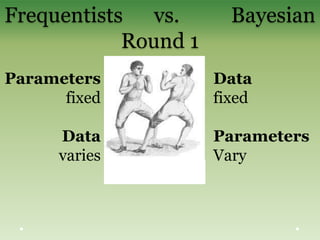
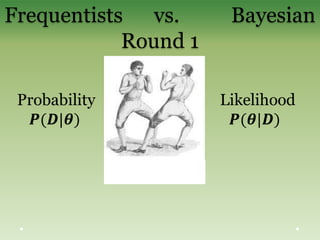
Frequentists vs. Bayesian
Round 1
Parameters
fixed
Data
varies
Data
fixed
Parameters
Vary
Frequentists vs. Bayesian
Round 1
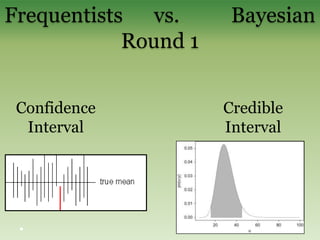
Frequentists vs. Bayesian
Round 1
Confidence
Interval
Credible
Interval
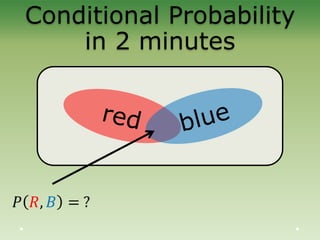
Conditional Probability
in 2 minutes
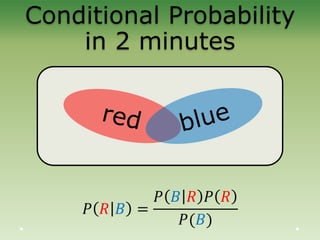
Conditional Probability
in 2 minutes
All possible outcomes
Conditional Probability
in 2 minutes
Conditional Probability
in 2 minutes
Conditional Probability
in 2 minutes
Conditional Probability
in 2 minutes
Conditional Probability
in 2 minutes
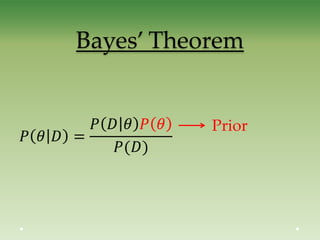
Bayes’ Theorem
Bayes’ Theorem
Prior
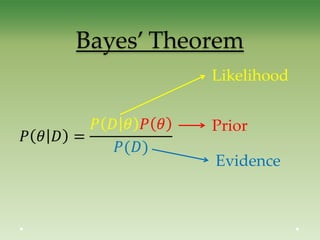
Bayes’ Theorem
Likelihood
Prior
Bayes’ Theorem
Likelihood
Prior
Evidence
Bayes’ Theorem
Likelihood
Prior
Posterior
Evidence
Frequentist vs. Bayesian
Round 2
“The Strength of the Prior”
Sparse
Data
Abundant
Data
Uniform
Prior
Where do Priors Come
From?
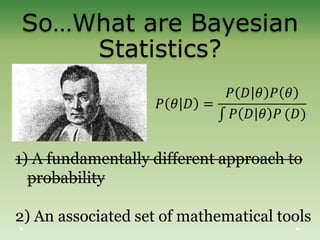
So…What are Bayesian
Statistics?
1) A fundamentally different approach to
probability
2) An associated set of mathematical tools
How do you actually
do this?
So how do you actually
do this?
1. Analytical methods
So how do you actually
do this?
1. Analytical methods
2. Grid approximation
So how do you actually
do this?
1. Analytical methods
2. Grid approximation
3. Markov Chain Monte Carlo
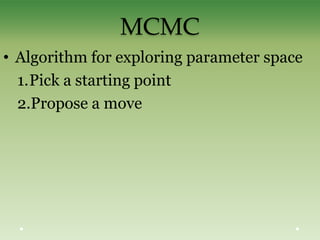
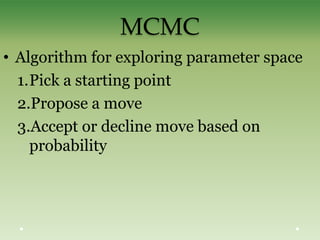
MCMC
• Algorithm for exploring parameter space
MCMC
• Algorithm for exploring parameter space
1.Pick a starting point
MCMC
• Algorithm for exploring parameter space
1.Pick a starting point
2.Propose a move
MCMC
• Algorithm for exploring parameter space
1.Pick a starting point
2.Propose a move
3.Accept or decline move based on
probability
MCMC
• Algorithm for exploring parameter space
1.Pick a starting point
2.Propose a move
3.Accept or decline move based on
probability
• Time spent at each point approximates
parameter distribution
MCMC
• Algorithm for exploring parameter space
1.Pick a starting point
2.Propose a move
3.Accept or decline move based on
probability
• Time spent at each point approximates
parameter distribution
• E.g. Metropolis-Hastings, Gibbs sampling
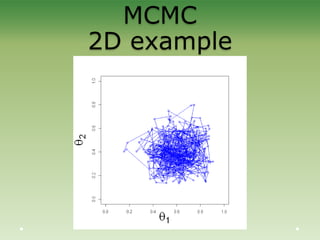
MCMC
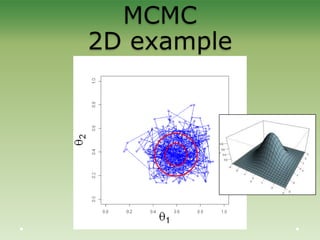
2D example
MCMC
2D example
So what does all this
get us?
Bayesian methods
really shine in complex
(hierarchical) models…
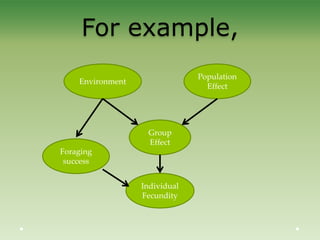
For example,
Individual
Fecundity
Group
Effect
Population
Effect
Foraging
success
Environment
or…
Individual
Fecundity
Group
Effect
Population
Effect
Environment
Many benefits to this
approach
• Simultaneously estimate parameters
• …as well as parameter relationships
• “Borrow” strength across studies
• Model comparison
So, is it a Bayesian
Revolution?
Bayesian stats can do
most things
frequentist,
Bayesian stats can do
most things
frequentist, but…
• Many simple models don‟t gain much
• Better do something „boring‟ well than
something exciting poorly
Bayesian stats can do
most things
frequentist, but…
• Many simple models don‟t gain much
• Better do something „boring‟ well than
something exciting poorly
• Don‟t be this guy
DO use Bayesian
methods if
• You have a complex model with many
interacting parameters
• You have „messy‟ data
• You don‟t want to make assumptions
about distributions
In Conclusion
• Bayesian methods are powerful tools
for ecological research
• Like most things statistical, they are
no substitute for thinking
• They are here to stay, and you should
at least be familiar with them
Great, I want to learn
more!
JAGS
(Just Another Gibbs Sampler)

An introduction to bayesian statistics