A A PROJECT ON
INDUSTRIAL AUTOMATION SYSTEM
AN INDUSTRIAL AUTOMATION CONTROL BY USING
TOUCHSCREEN& PC.
Under the Guidance of : prof:-Snigdha sarangi
Submitted by :
Satya narayan rout
B.Tech in EEE
The Techno School, Bhubaneswar
Project Title
ABSTARCT
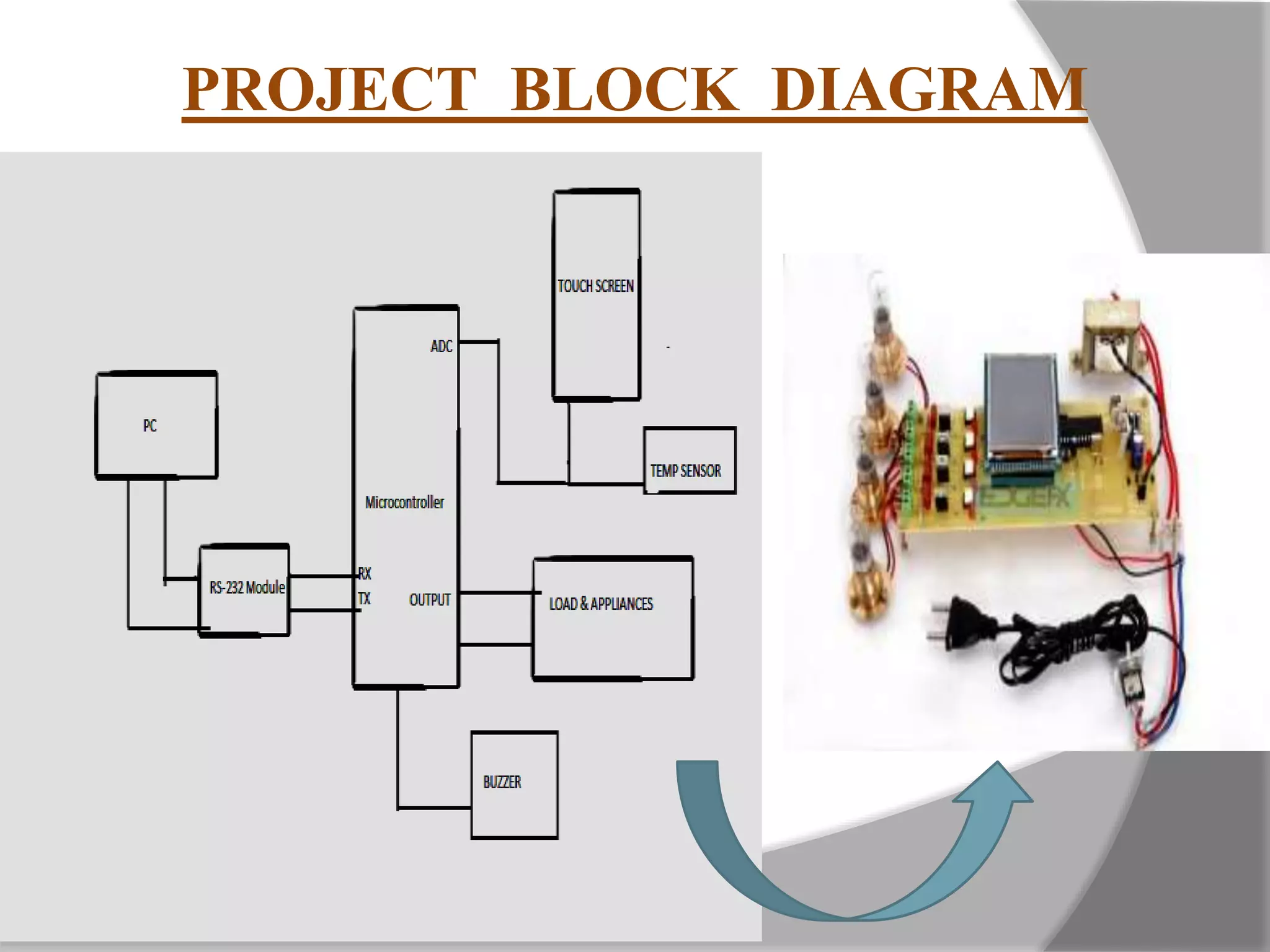
The main objective of the project is to control the loads,
appliances & everything which is necessary for the Industries.
The controllation is done through pc & touch screen. Here
the pc is interfaced with the microcontroller through RS-232
protocol for controlling the appliances & the speed of the load
(i.e. motor).And the touch screen is used for controlling the
gate .
The main objective of the project is to control the loads,
appliances & everything which is necessary for the Industries.
The controllation is done through RFID & touch screen.
PROJECT BLOCK DIAGRAM
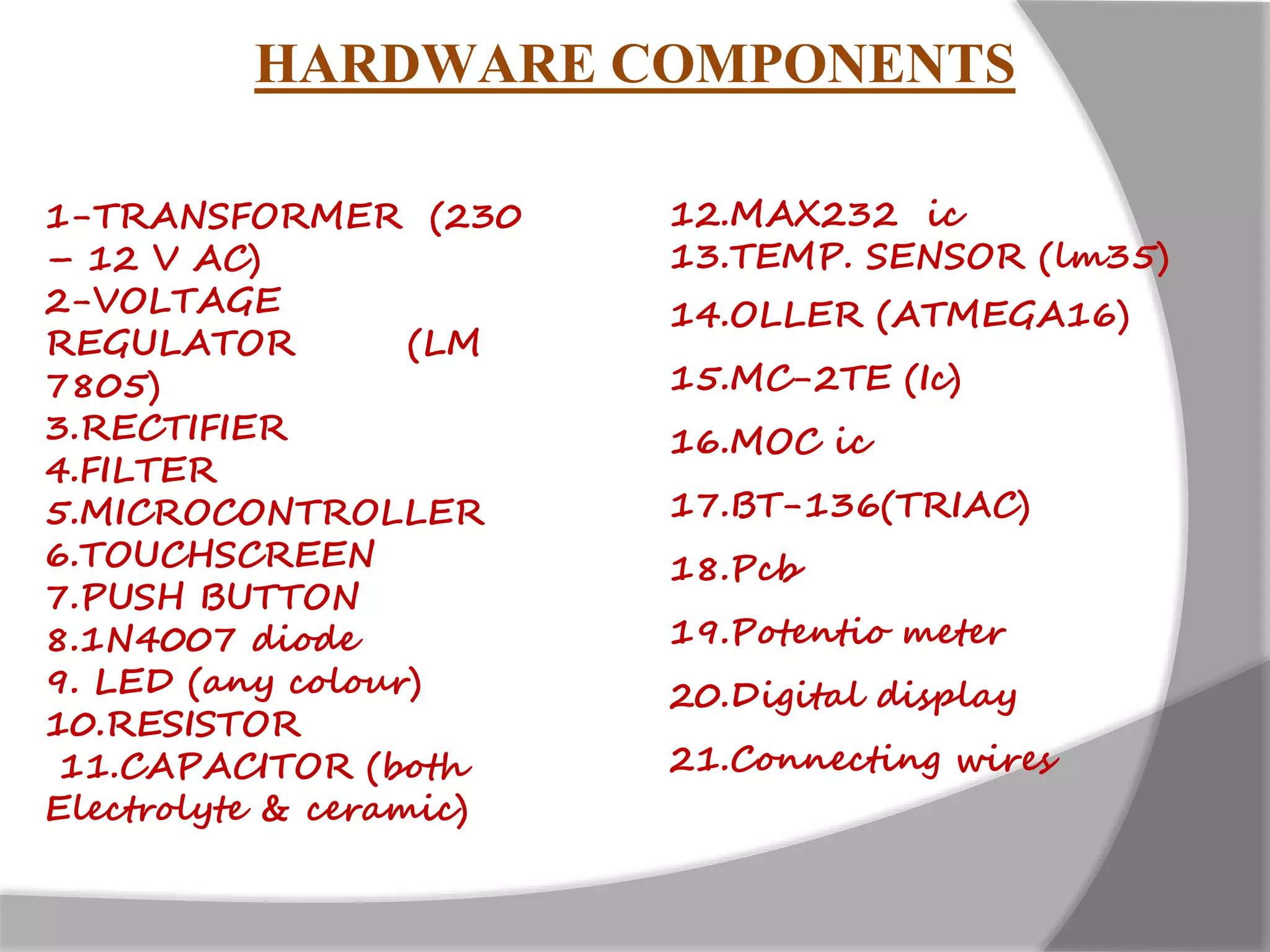
1-TRANSFORMER (230
– 12 V AC)
2-VOLTAGE
REGULATOR (LM
7805)
3.RECTIFIER
4.FILTER
5.MICROCONTROLLER
6.TOUCHSCREEN
7.PUSH BUTTON
8.1N4007 diode
9. LED (any colour)
10.RESISTOR
11.CAPACITOR (both
Electrolyte & ceramic)
HARDWARE COMPONENTS
12.MAX232 ic
13.TEMP. SENSOR (lm35)
14.OLLER (ATMEGA16)
15.MC-2TE (Ic)
16.MOC ic
17.BT-136(TRIAC)
18.Pcb
19.Potentio meter
20.Digital display
21.Connecting wires
POWER SUPPLY
Center tapped Transformer
12-0-12 volt
5V
DC
12V step down
transformer
Filter(470µf)
5volt RegulatorFull wave Bridge rectifier
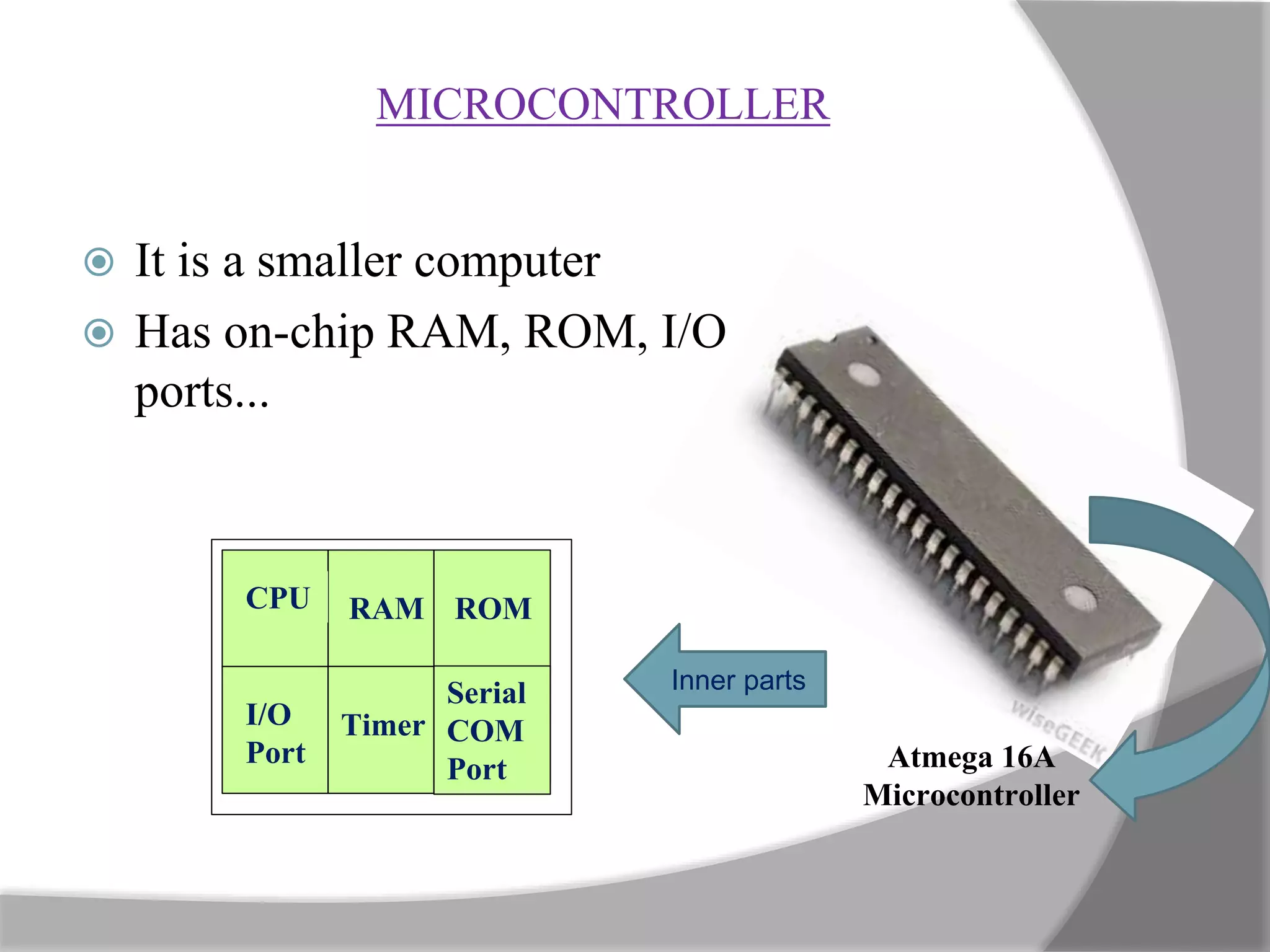
MICROCONTROLLER
 It is a smaller computer
 Has on-chip RAM, ROM, I/O
ports...
RAM ROM
I/O
Port
Timer
Serial
COM
Port Atmega 16A
Microcontroller
CPU
A single chipInner parts
INTERNAL STRUCTURE OF A MICRO
CONTROLLER-ATMEGA 16
CPU
On-chip
RAM
On-chip
ROM for
program
code
4 I/O Ports
Timer 0
Serial
Port
OSC
Interrup
t
Control
External interrupts
Timer 1
Timer/Counter
Bus
Control
TxD RxDP0 P1 P2 P3
Address/Data
Counter
Inputs
Features of ATMEGA 16
 Compatible with MCS®-51 Products
 8K Bytes of In-System Programmable (ISP) Flash Memory
 Endurance: 10,000 Write/Erase Cycles
 4.0V to 5.5V Operating Range
 Fully Static Operation: 0 Hz to 33 MHz
 256 x 8- High-performance, Low-power AVR® 8-bit Microcontroller
 • Advanced RISC Architecture
 – 131 Powerful Instructions – Most Single-clock Cycle Execution
 – 32 x 8 General Purpose Working Registers
 – Fully Static Operation
 – Up to 16 MIPS Throughput at 16 MHz
 – On-chip 2-cycle Multiplier
 • High Endurance Non-volatile Memory segments
 – 16K Bytes of In-System Self-programmable Flash program
 memory
 – 512 Bytes EEPROM
 – 1K Byte Internal SRAM
 – Write/Erase Cycles: 10,000 Flash/100,000 EEPROM bit Internal RAM
Pin Description of ATMEGA16
Working of Project
-The working principle of the project is to contoll the industrial load
i.e,induction motor or any ac load .
- Here the controlling the ac source means contolling the voltage,for
controlling the volt needs appropriate programming in microcontroller.
-First the output of the rectifier means pulsating DC is given to
another opto isolator name MC2TE,the difference between the two
opto isolator is MOC3011 has a photothyristor which is used to controll
AC load but MC2TE has a phototransistor which is used to calculate the
pulse .
-The main use of MC2TE to give zero crossing point of pulsating DC.The
output of MC2TE is given to the interrupt pin of microcontroller.
-Dc voltage is given to the voltage regulator IC to convert 12vdc to 5v
dc which is use for giving the supply to the microcontroller.
Soft ware Requirements
 Keil an ARM Company makes C compilers, macro assemblers, real-
time kernels, debuggers, simulators, integrated environments,
evaluation boards, and emulators for ARM7/ARM9/Cortex-M3,
XC16x/C16x/ST10, 251, and 8051 MCU families.
 Compilers are programs used to convert a High Level Language to
object code. Desktop compilers produce an output object code for the
underlying microprocessor, but not for other microprocessors.
 i.e the programs written in one of the HLL like ‘C’ will compile
the code to run on the system for a particular processor like x86
(underlying microprocessor in the computer).
 For example compilers for Dos platform is different from the
Compilers for Unix platform So if one wants to define a compiler
then compiler is a program that translates source code into object
code.
Applications
 power generation,
 oil refining,
 chemicals,
 steel mills,
 plastics,
 cement plants,
 fertilizer plants,
 pulp and
 paper mills,
 automobile and truck assembly,
 aircraft production,
 glass manufacturing,
 natural gas separation plants, food and beverage processing,
 canning and bottling and manufacture of various kinds of parts
Advantages
 Increased throughput or productivity.
 Improved quality or increased
predictability of quality.
 Improved robustness (consistency), of
processes or product.
 Increased consistency of output.
 Reduced direct human labor costs and
expenses.
Future scope
 Industrial automation can and will generate explosive
growth with technology related to new inflection points:
nanotechnology and nanoscale assembly systems;
MEMS and nanotech sensors (tiny, low-power, low-cost
sensors)
 which can measure everything and anything; and the
pervasive Internet, machine to machine (M2M)
networking.
 Real-time systems will give way to complex adaptive
systems and multi-processing. The future belongs to
nanotech, wireless everything, and complex adaptive
systems.
Conclusion
 In This project we are conclude that ,the all
controlling device are controlled through
touchpad & computer very easy & quick.
 The speed control is very fine & if the room
temp rise or above the 44 degree centt the
heat sensor can sense & buzzer is beep
soundddddd……………..
An industrial automation  satyaaaa

An industrial automation satyaaaa

  • 1.
    A A PROJECTON INDUSTRIAL AUTOMATION SYSTEM
  • 2.
    AN INDUSTRIAL AUTOMATIONCONTROL BY USING TOUCHSCREEN& PC. Under the Guidance of : prof:-Snigdha sarangi Submitted by : Satya narayan rout B.Tech in EEE The Techno School, Bhubaneswar Project Title
  • 3.
    ABSTARCT The main objectiveof the project is to control the loads, appliances & everything which is necessary for the Industries. The controllation is done through pc & touch screen. Here the pc is interfaced with the microcontroller through RS-232 protocol for controlling the appliances & the speed of the load (i.e. motor).And the touch screen is used for controlling the gate . The main objective of the project is to control the loads, appliances & everything which is necessary for the Industries. The controllation is done through RFID & touch screen.
  • 4.
  • 5.
    1-TRANSFORMER (230 – 12V AC) 2-VOLTAGE REGULATOR (LM 7805) 3.RECTIFIER 4.FILTER 5.MICROCONTROLLER 6.TOUCHSCREEN 7.PUSH BUTTON 8.1N4007 diode 9. LED (any colour) 10.RESISTOR 11.CAPACITOR (both Electrolyte & ceramic) HARDWARE COMPONENTS 12.MAX232 ic 13.TEMP. SENSOR (lm35) 14.OLLER (ATMEGA16) 15.MC-2TE (Ic) 16.MOC ic 17.BT-136(TRIAC) 18.Pcb 19.Potentio meter 20.Digital display 21.Connecting wires
  • 6.
    POWER SUPPLY Center tappedTransformer 12-0-12 volt 5V DC 12V step down transformer Filter(470µf) 5volt RegulatorFull wave Bridge rectifier
  • 7.
    MICROCONTROLLER  It isa smaller computer  Has on-chip RAM, ROM, I/O ports... RAM ROM I/O Port Timer Serial COM Port Atmega 16A Microcontroller CPU A single chipInner parts
  • 8.
    INTERNAL STRUCTURE OFA MICRO CONTROLLER-ATMEGA 16 CPU On-chip RAM On-chip ROM for program code 4 I/O Ports Timer 0 Serial Port OSC Interrup t Control External interrupts Timer 1 Timer/Counter Bus Control TxD RxDP0 P1 P2 P3 Address/Data Counter Inputs
  • 9.
    Features of ATMEGA16  Compatible with MCS®-51 Products  8K Bytes of In-System Programmable (ISP) Flash Memory  Endurance: 10,000 Write/Erase Cycles  4.0V to 5.5V Operating Range  Fully Static Operation: 0 Hz to 33 MHz  256 x 8- High-performance, Low-power AVR® 8-bit Microcontroller  • Advanced RISC Architecture  – 131 Powerful Instructions – Most Single-clock Cycle Execution  – 32 x 8 General Purpose Working Registers  – Fully Static Operation  – Up to 16 MIPS Throughput at 16 MHz  – On-chip 2-cycle Multiplier  • High Endurance Non-volatile Memory segments  – 16K Bytes of In-System Self-programmable Flash program  memory  – 512 Bytes EEPROM  – 1K Byte Internal SRAM  – Write/Erase Cycles: 10,000 Flash/100,000 EEPROM bit Internal RAM
  • 10.
  • 11.
    Working of Project -Theworking principle of the project is to contoll the industrial load i.e,induction motor or any ac load . - Here the controlling the ac source means contolling the voltage,for controlling the volt needs appropriate programming in microcontroller. -First the output of the rectifier means pulsating DC is given to another opto isolator name MC2TE,the difference between the two opto isolator is MOC3011 has a photothyristor which is used to controll AC load but MC2TE has a phototransistor which is used to calculate the pulse . -The main use of MC2TE to give zero crossing point of pulsating DC.The output of MC2TE is given to the interrupt pin of microcontroller. -Dc voltage is given to the voltage regulator IC to convert 12vdc to 5v dc which is use for giving the supply to the microcontroller.
  • 12.
    Soft ware Requirements Keil an ARM Company makes C compilers, macro assemblers, real- time kernels, debuggers, simulators, integrated environments, evaluation boards, and emulators for ARM7/ARM9/Cortex-M3, XC16x/C16x/ST10, 251, and 8051 MCU families.  Compilers are programs used to convert a High Level Language to object code. Desktop compilers produce an output object code for the underlying microprocessor, but not for other microprocessors.
  • 13.
     i.e theprograms written in one of the HLL like ‘C’ will compile the code to run on the system for a particular processor like x86 (underlying microprocessor in the computer).  For example compilers for Dos platform is different from the Compilers for Unix platform So if one wants to define a compiler then compiler is a program that translates source code into object code.
  • 14.
    Applications  power generation, oil refining,  chemicals,  steel mills,  plastics,  cement plants,  fertilizer plants,  pulp and  paper mills,  automobile and truck assembly,  aircraft production,  glass manufacturing,  natural gas separation plants, food and beverage processing,  canning and bottling and manufacture of various kinds of parts
  • 15.
    Advantages  Increased throughputor productivity.  Improved quality or increased predictability of quality.  Improved robustness (consistency), of processes or product.  Increased consistency of output.  Reduced direct human labor costs and expenses.
  • 16.
    Future scope  Industrialautomation can and will generate explosive growth with technology related to new inflection points: nanotechnology and nanoscale assembly systems; MEMS and nanotech sensors (tiny, low-power, low-cost sensors)  which can measure everything and anything; and the pervasive Internet, machine to machine (M2M) networking.  Real-time systems will give way to complex adaptive systems and multi-processing. The future belongs to nanotech, wireless everything, and complex adaptive systems.
  • 17.
    Conclusion  In Thisproject we are conclude that ,the all controlling device are controlled through touchpad & computer very easy & quick.  The speed control is very fine & if the room temp rise or above the 44 degree centt the heat sensor can sense & buzzer is beep soundddddd……………..