


Presented to-  Presented By- N.H.Mullick  Anil Kumar Faculty-ISMC  Roll No.-PG07-01 PGPIMC
The Kaira District Co-operative Milk Producers Union Limited, popularly known as Amul Dairy is a US $ 1068 million turnover institution. It is an institution built up with a network of over 10000 Village Co-operative Societies and 500,000 plus members Managed by an Apex cooperative organisation, Gujarat Co-operative Milk Marketing Federation Ltd. (GCMMF), which today is jointly owned by some 3.11 million milk producers in Gujarat, India
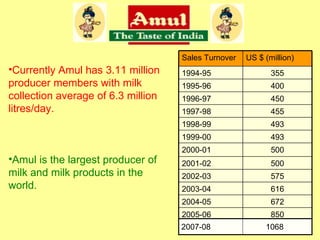
Currently Amul has 3.11 million producer members with milk collection average of 6.3 million litres/day.   Amul is the largest producer of milk and milk products in the world.   2007-08 1068 850 2005-06 672 2004-05 616 2003-04 575 2002-03 500 2001-02 500 2000-01 493 1999-00 493 1998-99 455 1997-98 450 1996-97 400 1995-96 355 1994-95 US $ (million) Sales Turnover
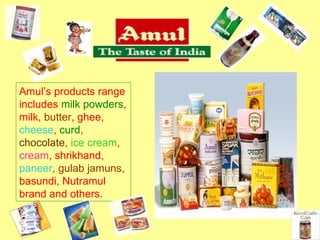
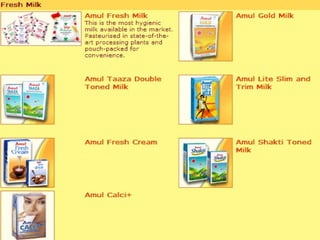
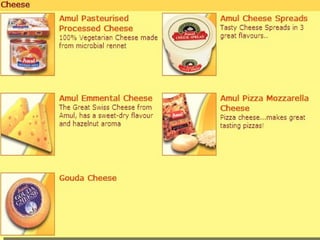
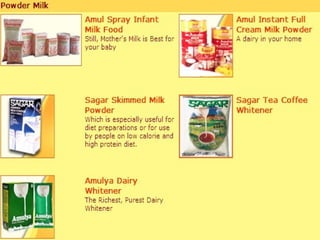
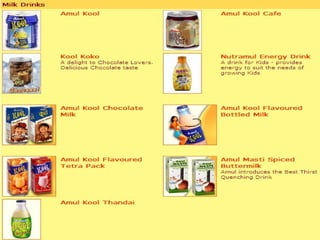
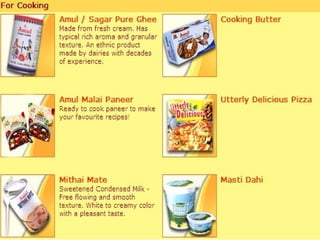
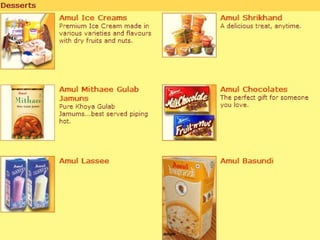
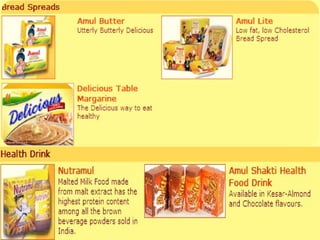
Amul’s products range includes  milk powders , milk,  butter , ghee,  cheese ,  curd ,  chocolate ,  ice cream ,  cream , shrikhand,  paneer ,  gulab jamuns , basundi, Nutramul brand and others.


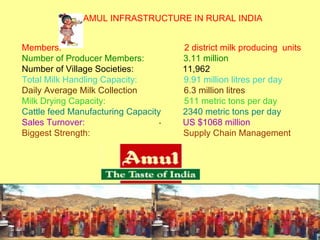
. Members:  2 district milk producing  units   Number of Producer Members:  3.11 million Number of Village Societies:  11,962 Total Milk Handling Capacity:  9.91 million litres per day Daily Average Milk Collection  6.3 million litres Milk Drying Capacity:  511 metric tons per day Cattle feed Manufacturing Capacity  2340 metric tons per day Sales Turnover:  US $1068 million Biggest Strength:  Supply Chain Management AMUL INFRASTRUCTURE IN RURAL INDIA
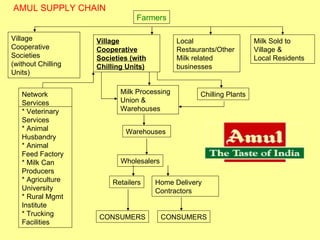
Farmers Village Cooperative Societies (with Chilling Units) Village Cooperative Societies (without Chilling Units) Local Restaurants/Other Milk related businesses Milk Sold to Village & Local Residents Milk Processing Union & Warehouses Warehouses Wholesalers Retailers Home Delivery Contractors CONSUMERS Network Services * Veterinary Services * Animal Husbandry * Animal Feed Factory * Milk Can Producers * Agriculture University * Rural Mgmt Institute * Trucking Facilities Chilling Plants CONSUMERS AMUL SUPPLY CHAIN
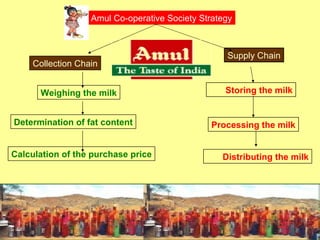
Collection   Chain Supply   Chain Weighing the milk Determination of fat content Calculation of the purchase price Storing the milk Processing the milk Distributing the milk Amul Co-operative Society Strategy
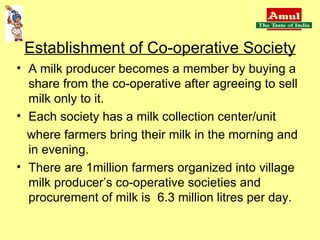
Establishment of Co-operative Society A milk producer becomes a member by buying a share from the co-operative after agreeing to sell milk only to it. Each society has a milk collection center/unit where farmers bring their milk in the morning and in evening. There are 1million farmers organized into village milk producer’s co-operative societies and procurement of milk is  6.3 million litres per day.
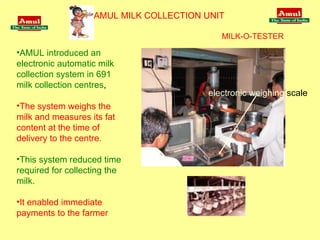
AMUL introduced an electronic automatic milk collection system in 691 milk collection centres ,  The system weighs the milk and measures its fat content at the time of delivery to the centre. This system reduced time required for collecting the milk. It enabled immediate payments to the farmer AMUL MILK COLLECTION UNIT electronic weighing  scale MILK-O-TESTER
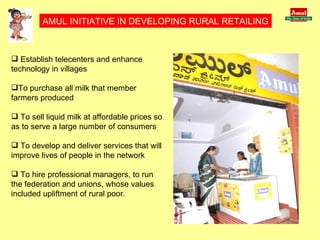
AMUL INITIATIVE IN DEVELOPING RURAL RETAILING Establish telecenters and enhance technology in villages To purchase all milk that member farmers produced To sell liquid milk at affordable prices so as to serve a large number of consumers To develop and deliver services that will improve lives of people in the network To hire professional managers, to run the federation and unions, whose values included upliftment of rural poor.
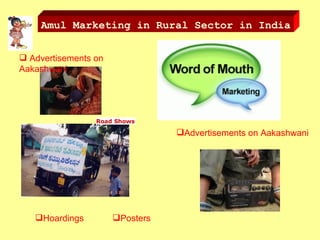
Amul Marketing in Rural Sector in India Advertisements on Aakashwani Advertisements on Aakashwani Hoardings Posters
 
Pricing Strategy Adopted a low-cost price strategy to make its products affordable and attractive to consumers by guaranteeing them value for money.
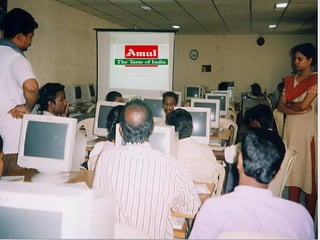
e-initiative Implementation   of   GIS (Geographic Information System)   which helps in tracking movement at Milk Collecting Centers.   Establishment  of The Dairy Information and Services Kiosk (DISK). Data analysis and decision support to help rural milk collection society in improving its performance. Data analysis to improve productivity yield from cattle. Farmers with facilities to place orders for goods and service offered by different agencies in the dairying sector and collaborates on subjects of interest.
 
Services offered at this centers are: Information service related to dairying Access to multimedia database on innovations captured by SRISHTI (NGO working IIM-A) from all the villages over Gujarat. Communication facilities such as e-mail, fax, net phone. Banking centers for payment for the farmers by using the milk cards which are already in place The e-governance and e-procurement Effective medium of communication for the rural areas.
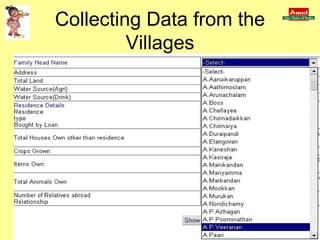
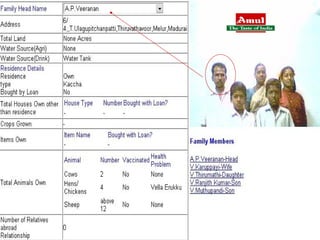
Collecting Data from the Villages
 
Project Goals To build transparency among the farmers towards cooperative society Training the rural people towards the quality supply of milk Getting the whole activity chain of GCMMF under uninterrupted information flow network. To reduce the pilferage To remove the complexity associated with the village cooperative society milk collection process. Empowering the rural masses towards self-development activities To build the competencies in the area of it To build the transparency and trust amongst the rural people towards the cooperative system. To face the global competition by effective decision-making.
Radical changes in business processes -  eliminating middlemen and bringing the producers closer to the customers.  Improved delivery mechanisms and transparency of business operations.  Due to this process, AMUL is able to collect six million litres of milk per day. REAPING RETURNS
Huge reduction in processing time for effective payments to the farmers from a week to couple of minutes  after implementing the electronic collection unit. Processing of 10 Million payments daily, amounting to transactions worth USD 2 million in cash daily.  Controlling the movement of 5000 trucks to 200 dairy processing plants twice a day in a most optimum manner. REAPING RETURNS
Uses automated milk collection system units for collection of milk Use of data analysis software for forecasting milk production and increasing productivity All zonal, regional and member diaries connected through Internet. One of the first five Indian organization to have web presence. Made IT education compulsory for all its employees. Opted for the  .coop  domain to position its brand in a distinct way. AMUL’S IT ROADMAP
Competitive Strategy Matching demand and supply. Vast and complex supply chain. Developing demand. Introducing higher value products. Umbrella Branding Strategy. e-initiative strategy.
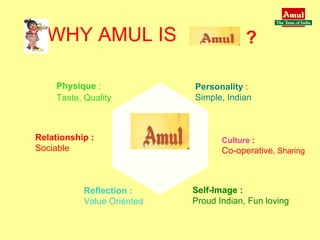
WHY AMUL IS  ? Physique  : Taste, Quality Personality  : Simple, Indian Self-Image : Proud Indian, Fun loving Reflection : Value Oriented Culture  : Co-operative , Sharing Relationship : Sociable
Thank You

Amul rural marketing

  • 1.
    Presented to- Presented By- N.H.Mullick Anil Kumar Faculty-ISMC Roll No.-PG07-01 PGPIMC
  • 2.
    The Kaira DistrictCo-operative Milk Producers Union Limited, popularly known as Amul Dairy is a US $ 1068 million turnover institution. It is an institution built up with a network of over 10000 Village Co-operative Societies and 500,000 plus members Managed by an Apex cooperative organisation, Gujarat Co-operative Milk Marketing Federation Ltd. (GCMMF), which today is jointly owned by some 3.11 million milk producers in Gujarat, India
  • 3.
    Currently Amul has3.11 million producer members with milk collection average of 6.3 million litres/day. Amul is the largest producer of milk and milk products in the world. 2007-08 1068 850 2005-06 672 2004-05 616 2003-04 575 2002-03 500 2001-02 500 2000-01 493 1999-00 493 1998-99 455 1997-98 450 1996-97 400 1995-96 355 1994-95 US $ (million) Sales Turnover
  • 4.
    Amul’s products rangeincludes milk powders , milk, butter , ghee, cheese , curd , chocolate , ice cream , cream , shrikhand, paneer , gulab jamuns , basundi, Nutramul brand and others.
  • 5.
  • 6.
  • 7.
  • 8.
  • 9.
  • 10.
  • 11.
  • 12.
    . Members: 2 district milk producing units Number of Producer Members: 3.11 million Number of Village Societies: 11,962 Total Milk Handling Capacity: 9.91 million litres per day Daily Average Milk Collection 6.3 million litres Milk Drying Capacity: 511 metric tons per day Cattle feed Manufacturing Capacity 2340 metric tons per day Sales Turnover: US $1068 million Biggest Strength: Supply Chain Management AMUL INFRASTRUCTURE IN RURAL INDIA
  • 13.
    Farmers Village CooperativeSocieties (with Chilling Units) Village Cooperative Societies (without Chilling Units) Local Restaurants/Other Milk related businesses Milk Sold to Village & Local Residents Milk Processing Union & Warehouses Warehouses Wholesalers Retailers Home Delivery Contractors CONSUMERS Network Services * Veterinary Services * Animal Husbandry * Animal Feed Factory * Milk Can Producers * Agriculture University * Rural Mgmt Institute * Trucking Facilities Chilling Plants CONSUMERS AMUL SUPPLY CHAIN
  • 14.
    Collection Chain Supply Chain Weighing the milk Determination of fat content Calculation of the purchase price Storing the milk Processing the milk Distributing the milk Amul Co-operative Society Strategy
  • 15.
    Establishment of Co-operativeSociety A milk producer becomes a member by buying a share from the co-operative after agreeing to sell milk only to it. Each society has a milk collection center/unit where farmers bring their milk in the morning and in evening. There are 1million farmers organized into village milk producer’s co-operative societies and procurement of milk is 6.3 million litres per day.
  • 16.
    AMUL introduced anelectronic automatic milk collection system in 691 milk collection centres , The system weighs the milk and measures its fat content at the time of delivery to the centre. This system reduced time required for collecting the milk. It enabled immediate payments to the farmer AMUL MILK COLLECTION UNIT electronic weighing scale MILK-O-TESTER
  • 17.
    AMUL INITIATIVE INDEVELOPING RURAL RETAILING Establish telecenters and enhance technology in villages To purchase all milk that member farmers produced To sell liquid milk at affordable prices so as to serve a large number of consumers To develop and deliver services that will improve lives of people in the network To hire professional managers, to run the federation and unions, whose values included upliftment of rural poor.
  • 18.
    Amul Marketing inRural Sector in India Advertisements on Aakashwani Advertisements on Aakashwani Hoardings Posters
  • 19.
  • 20.
    Pricing Strategy Adopteda low-cost price strategy to make its products affordable and attractive to consumers by guaranteeing them value for money.
  • 21.
    e-initiative Implementation of GIS (Geographic Information System) which helps in tracking movement at Milk Collecting Centers. Establishment of The Dairy Information and Services Kiosk (DISK). Data analysis and decision support to help rural milk collection society in improving its performance. Data analysis to improve productivity yield from cattle. Farmers with facilities to place orders for goods and service offered by different agencies in the dairying sector and collaborates on subjects of interest.
  • 22.
  • 23.
    Services offered atthis centers are: Information service related to dairying Access to multimedia database on innovations captured by SRISHTI (NGO working IIM-A) from all the villages over Gujarat. Communication facilities such as e-mail, fax, net phone. Banking centers for payment for the farmers by using the milk cards which are already in place The e-governance and e-procurement Effective medium of communication for the rural areas.
  • 24.
  • 25.
  • 26.
    Project Goals Tobuild transparency among the farmers towards cooperative society Training the rural people towards the quality supply of milk Getting the whole activity chain of GCMMF under uninterrupted information flow network. To reduce the pilferage To remove the complexity associated with the village cooperative society milk collection process. Empowering the rural masses towards self-development activities To build the competencies in the area of it To build the transparency and trust amongst the rural people towards the cooperative system. To face the global competition by effective decision-making.
  • 27.
    Radical changes inbusiness processes - eliminating middlemen and bringing the producers closer to the customers. Improved delivery mechanisms and transparency of business operations. Due to this process, AMUL is able to collect six million litres of milk per day. REAPING RETURNS
  • 28.
    Huge reduction inprocessing time for effective payments to the farmers from a week to couple of minutes after implementing the electronic collection unit. Processing of 10 Million payments daily, amounting to transactions worth USD 2 million in cash daily. Controlling the movement of 5000 trucks to 200 dairy processing plants twice a day in a most optimum manner. REAPING RETURNS
  • 29.
    Uses automated milkcollection system units for collection of milk Use of data analysis software for forecasting milk production and increasing productivity All zonal, regional and member diaries connected through Internet. One of the first five Indian organization to have web presence. Made IT education compulsory for all its employees. Opted for the .coop domain to position its brand in a distinct way. AMUL’S IT ROADMAP
  • 30.
    Competitive Strategy Matchingdemand and supply. Vast and complex supply chain. Developing demand. Introducing higher value products. Umbrella Branding Strategy. e-initiative strategy.
  • 31.
    WHY AMUL IS ? Physique : Taste, Quality Personality : Simple, Indian Self-Image : Proud Indian, Fun loving Reflection : Value Oriented Culture : Co-operative , Sharing Relationship : Sociable
  • 32.