AMUL
ANAND MILK UNION
LIMITED
INTRODUCTION
• The largest food brand in India and world's Largest Pouched Milk Brand
‘Amul’ is a brand name managed by Gujarat Co-operative Milk Marketing
Federation Ltd. (GCMMF).
• This name has its origin in the Sanskrit word "Amoolya," (meaning
Priceless) and was actually suggested by an employee of Gujarat Co-
operative Milk Marketing Federation Ltd. (GCMMF)
• With a turnover of INR 67.11 billion GCMMF has created an economic
network that links :
• millions of consumers in India and abroad,
• 2.8 million village milk producers,
• a cooperative system that includes 13,141 Village Dairy
Cooperative Societies (VDCS) at the village level,
• further affiliated to 13 District Cooperative Milk Producers’
Unions at the District level and GCMMF at the State level.
AMUL MANTHAN
HISTORY
• Condition of dairy farmers
• Role of Sardar Vallabh Bhai Patel
• Formation of first District Co-operative ‘Kaira’
• Formation of ‘GCMMF’
CONDITION OF DAIRY FARMERS
• There was exploitation of marginal milk producers by traders or agents of existing
dairies in the small town named Anand (in Kaira District of Gujarat) and Polson
Dairy .
• Other problems faced by dairy farmers in Gujarat.
ROLE OF A SARDAR VALLABH BHAI PATEL
• Unfair trade practices and minimal returns angered dairy farmers.
• So under the leadership of Tribhuvandas Patel dairy farmers approached
Sardar Vallabh Bhai Patel for a solution.
FORMATION OF DISTRICT CO-OPERATIVE
“KAIRA”
• Thus the first District Cooperative was established to collect and process
milk in the District of Kaira in 1946.
• Milk collection was also decentralized and village level cooperatives were
established to organize the marginal milk producers in each of these
villages.
• The brand Amul was formally registered on December 14th, 1946
• This union selected the brand name AMUL in 1955
FORMATION OF “GCMMF”
(GUJARAT CO-OPERATIVE MILK
MARKETING FEDERATION LTD.)
• Later on with the help of Dr. Verghese Kurien and Shri H M Dalaya this
revolution spread to most of the districts in Gujarat.
• Thus GCMMF came into being in the year 1973.
• Initially, the brand name Amul was with Kaira district dairy cooperative,
but later they decided to give it to GCMMF
FATHER OF WHITE REVOLUTION
Born: November 26, 1921 in Kozhikode, Kerala
Achievement: Known as the "father of the white revolution"
in India; Winner of Ramon Magsaysay Award; Awarded with
Padma Shri (1965), Padma Bhushan (1966), and Padma
Vibhushan (1999).
He is also called as the Milkman of India.
He graduated with Physics from Loyola College, Madras in
1940. Subsequently, he did his B.E.(Mechanical) from the
Madras University and went to USA on a government
scholarship to do his Masters in Mechanical Engineering from
Michigan State University.
When he was returned from America in 1948 and joined the
Dairy Department of the Government of India. In May 1949, he
was posted as Dairy Engineer at the Government Research
Creamery , in Anand, Gujarat.
In 1965, Prime Minister Lal Bahadur Shastri, created the
(NDDB) under the leadership of Dr. Verghese Kurien to
replicate the success story of Amul throughout the country.
WHITE REVOLUTION IN INDIA
What makes
AMUL
successful???
AMUL BUSINESS MODEL
• Objective :
• Deliver profitable and equitable returns to a large number
of farmers for a long period of time
• Additional objective
• Develop the supplier over the long term through social
change.
THE MEANING OF FOUR HAND’S
First hand of
FARMERS
Second hand of
PROCESSORS
Fourth hand of
CUSTOMERS
Third hand of
MARKETER
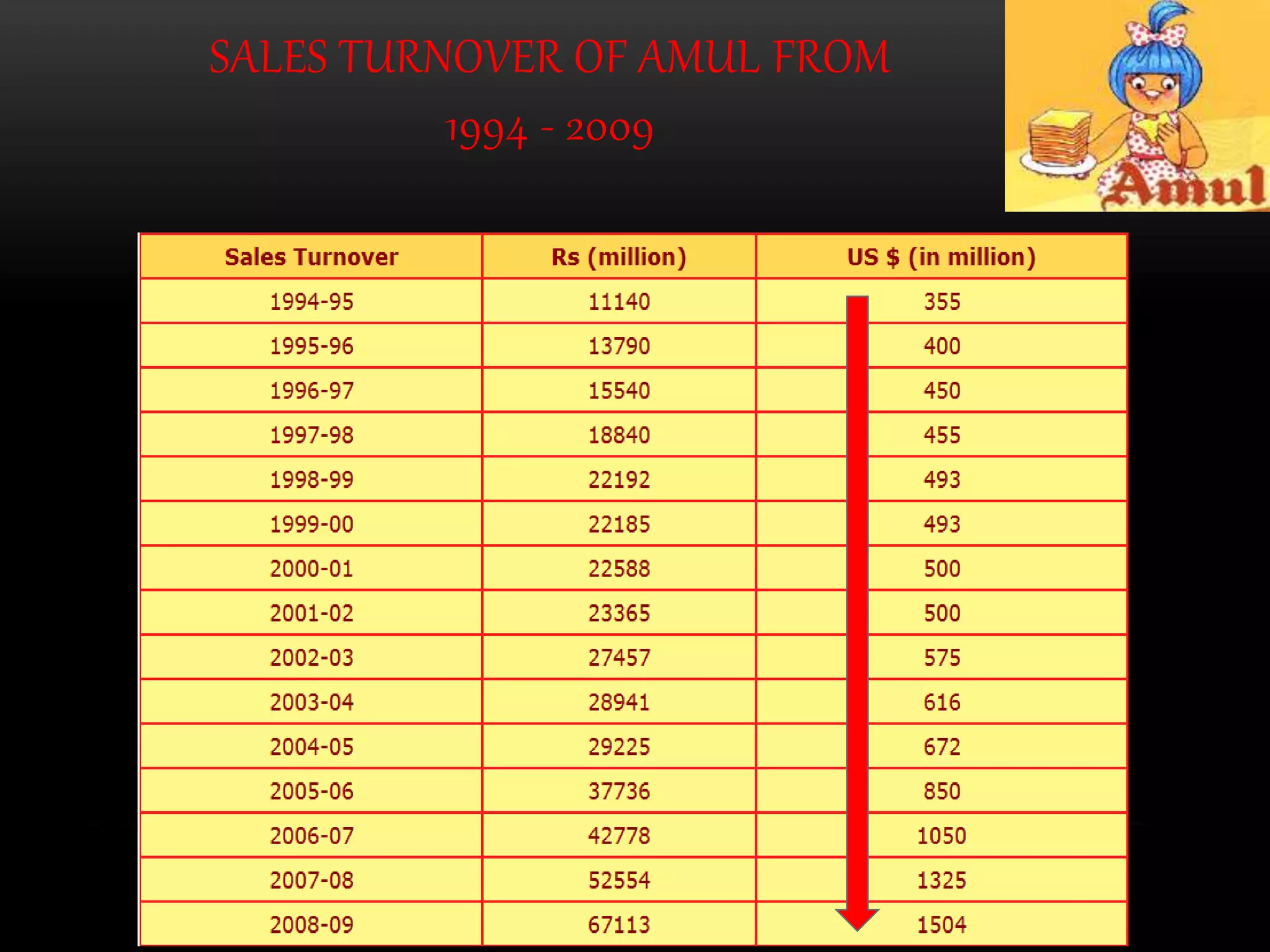
SALES TURNOVER OF AMUL FROM
1994 - 2009
AMUL’S SUCCESS DEPENDS ON
High collection rate of milk
Required increasing membership with more village societies
Better Cattle management- Better milk yield
Ensure cost to farmers and high quality to customer at low prices
Q. Where is the first milk plant of amul was
established ?????
A. In “ANAND”
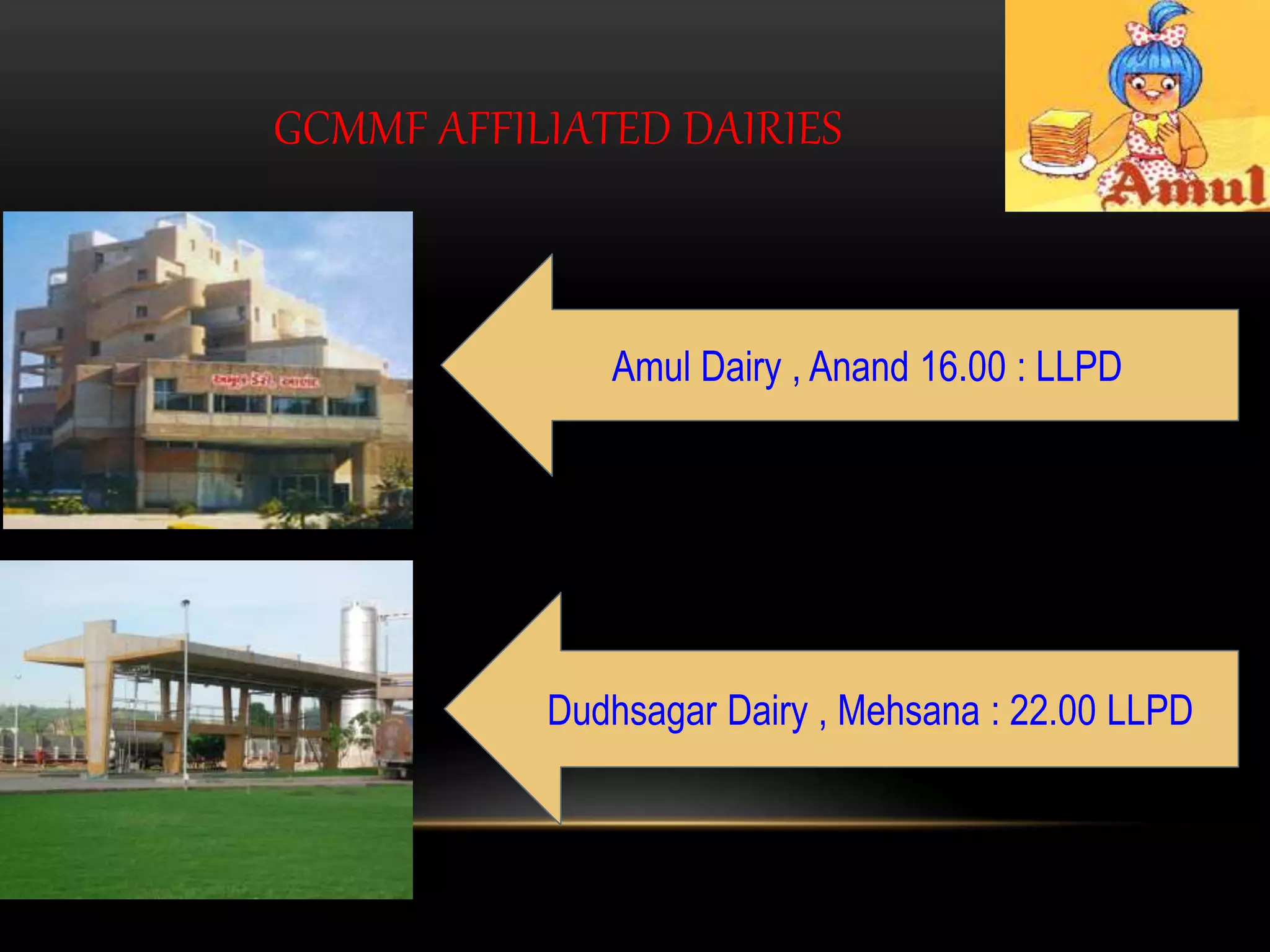
GCMMF AFFILIATED DAIRIES
Amul Dairy , Anand 16.00 : LLPD
Dudhsagar Dairy , Mehsana : 22.00 LLPD
Sabar Dairy , Himatnagar : 12.00 LLPD
Banas Dairy , Palanpur : 22.00 LLPD
Sumul Dairy , Surat :9.50 LLPD
Panchamrut Dairy , Godhra : 4.00 LLPD
Rajkot Dairy , Rajkot : 2.50 LLPD
Dudhmansagar Dairy Plant , Manesar :9.61
LLPD
Vasudhara Dairy Plant , Boisar : 3.00 LLPD
Vasudhara Dairy , Valsad : 3.00 LLPD
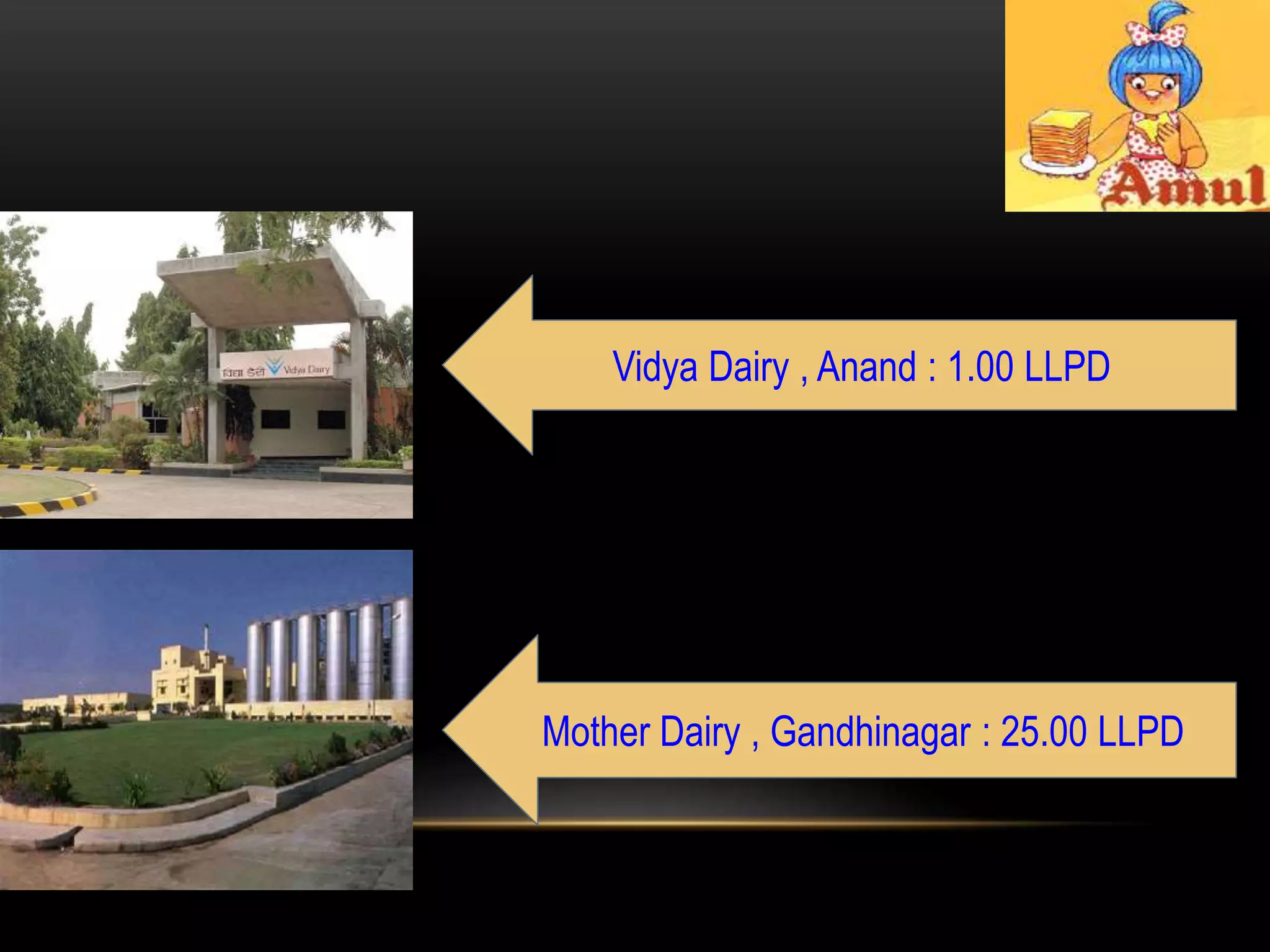
Vidya Dairy , Anand : 1.00 LLPD
Mother Dairy , Gandhinagar : 25.00 LLPD
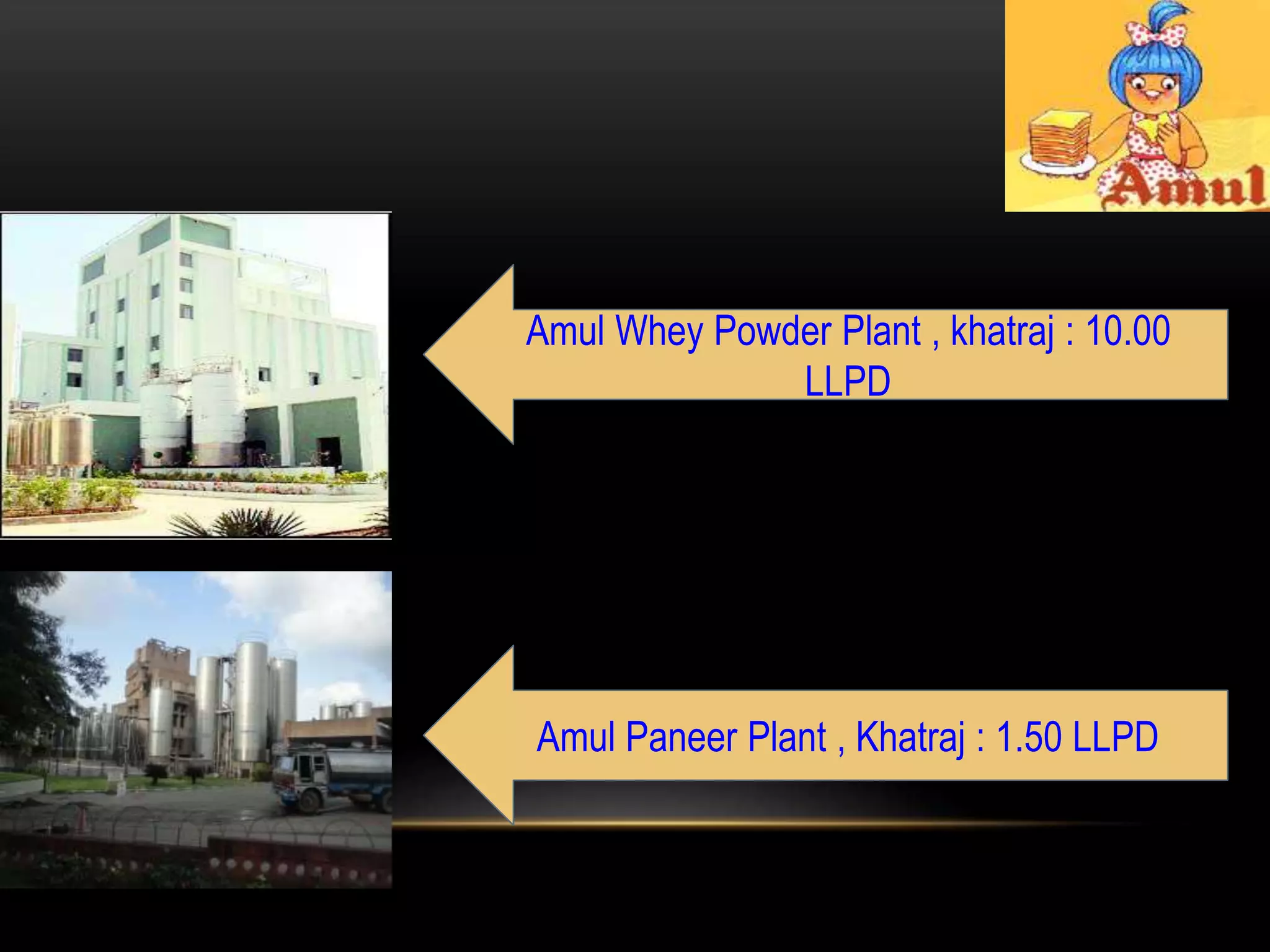
Amul Whey Powder Plant , khatraj : 10.00
LLPD
Amul Paneer Plant , Khatraj : 1.50 LLPD
SOME HISTORICAL MOVEMENTS OF
AMUL
Pt. Jawahar lal Nehru visiting the Amul’s milk plant
with
Dr. Verghese Kurien
Dr. Radhakrishnan visited Amul Dairy at Anand in
1962
With Dr. Verghese Kurien
MARKETING AND ADVERTISING STRATEGIES
1. Quality :-
• No brand can survive long if it’s quality is not equal or exceed
customer expectations.
• Incase of food product hygienic, taste, bacteriological &
organoleptic standard –main essence.
2 . Value for Money :-
• Customers get more than what they pay.
• Keep price fair & do best to ensure that retailers don’t
gain at the expense of customer.
3.) Availability :-
• Brand available when and where customers want.
• Amul has nation’s finest distribution network.
4.) Service :-
• Committed to total quality.
PRODUCT POSITIONING
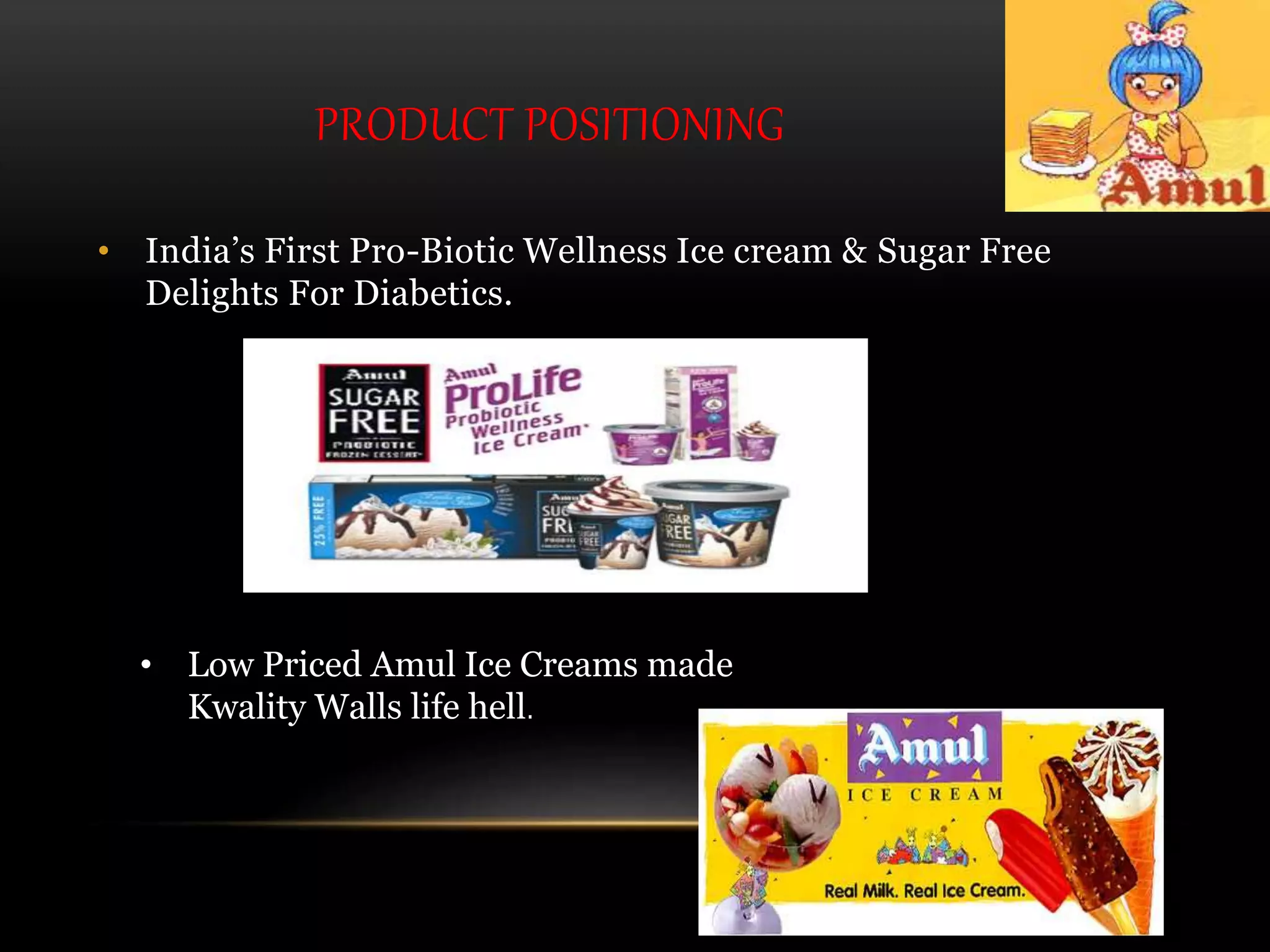
• India’s First Pro-Biotic Wellness Ice cream & Sugar Free
Delights For Diabetics.
• Low Priced Amul Ice Creams made
Kwality Walls life hell.
Flank Attack.. Age Wise..
Aug 25 2007
• Amul launches Chocolate milk under brand name of ‘Amul Kool
Koko’.
• This is targeted at teenagers and youths.
Nov 11, 2007
• Amul in Multinational Arena With Snack Launch:
“Munch Time”.
Flavors: Masala , Mint and Tomato
 New Product Activity.
Nov 26, 2007
• Amul Launches “Fresh Paneer” (Free From Any Harmful
Chemicals)
Flank Attack—Expanding its Cheese Segment.
Current market share 65%.
PRODUCT REPOSITIONING
 Amul marketed bottled water product named “JALDHARA”
but due to less potential in the market it turned out to be
blunder.
 Now Amul is all set to launch bottled water “NARMADA
NEER”.
0
10
20
30
40
50
60
70
80
90
100
AMULYA AMUL
BUTTER
CHEESE
SPREAD
MOZARELLA
OTHERS
MARKET SHARE
Current Market Share
SEGMENTATION
• Wide range of product categories caters to consumers across all
market segments. For example, Amul Kool is targeted at
children, while teenagers prefer Kool Café, as it has a cool
imagery associated with it.
• Segmentation is not as easy in curd and low fat products, due to
mixed audiences, various culinary applications , eg. ghee,
butter and cheese.
“In India, the most used spread is ghee, then butter, cheese, low
fat butter, margarine, cheese spread and mozzarella cheese.
TARGETING
• Changing retail environment
• Striking out on its own, with Amul Outlets or parlors to deliver
consumers total brand experience
• Launched in 2002, there are now 400 Amul parlors across the
country, which contributed 3% to the brand’s total turnover last
year.
High profile locations: Amul parlors are today present on
campuses of Infosys, Wipro, IIM-A, IIT-B, Temples, Metro rail
and railway stations in Gujarat.
PROMOTION
• Given this wide product portfolio, Amul’s approach is to
promote its brands in a rotational cycle of two to three years.
• After ice-creams were launched in 1996, the category was re-
visited in 1999, in order to improve availability of the product
and make it affordable.
• Below-the-line activity has grown too — such as the Amul food
festival, which has been held for the last four year between
October and December in about 50,000 retail outlets.
• The Chef Of India promo invites hotel chefs to come up with
recipes using as many Amul products as possible, and is
conducted at city, state and national level
THE FIRST ADVERTISING STRATEGY
• 1966 sees the creation of the Amul girl by Sylvester da Cunha of the
ASP Advertising agency as a rival to the Polson .
• In 1967 the first hoarding was put up in Mumbai with the Amul girl.
• The tag line of “Utterly Butterly Delicious” came out in October of
1967.
• The first Topical ad came out in 1969 at the beginning of the Hare Rama
Hare Krishna movement.
• One of the most conservative FMCG entities — GCMMF — spends a mere
1% of its turnover on promotions.
• Amul butter girl is one of the longest run ad campaigns in the country for
43 years.
• Entered in the Guinness Book Of World Records for being the longest
running campaign ever.
AMUL’S PRODUCTS
AMUL’S COMPETITORS
Butter
• Britannia
• Nestle
Cheese
• Britannia
Baby Food
• Nestle
• Heinz
Dairy Whitener Segment
• Nestle
• Britannia
Ice creams
• Kwality walls
Chocolates & Confectionaries
• Cadbury
• Nestle
Pizza
• Pizza Hut
• Dominos
• Nirulas Frozen pizza
Curd
• Nestle
• Mother Dairy
Ultra High Treated Milk
• Nestle
• Britannia
Sweet Condensed milk
• Nestle
Cottage Cheese (Paneer)
• Britannia
Milk Additives
• Cadbury
• Smith Kline Beecham
Flavored Milk
• Britannia
• Nestle
AMUL IN OVERSEAS
SOME ADVERTISEMENTS
T.V. COMMERCIAL AD
T.V. COMMERCIAL AD
MISSION 2020 OF AMUL
• Amul envisages that the dairy cooperatives of Gujarat will
have a group turnover of Rs. 27000 crores by the year 2020.
This will be a three-fold increase over its current group
turnover of approx. Rs. 9600 crores. Milk production in milk
shed area will increase to 231 lakh kg per day (23.1 million kg
per day), at an annual growth rate of 4%.
• Plan to double to processing capacity of dairy plants to 20.7
million kg per day, by 2020. This would include multi-fold
capacity expansion for major product categories including milk
powders, Ice-cream, paneer, cheese, ethnic sweets, curd, ghee
and other dairy products.
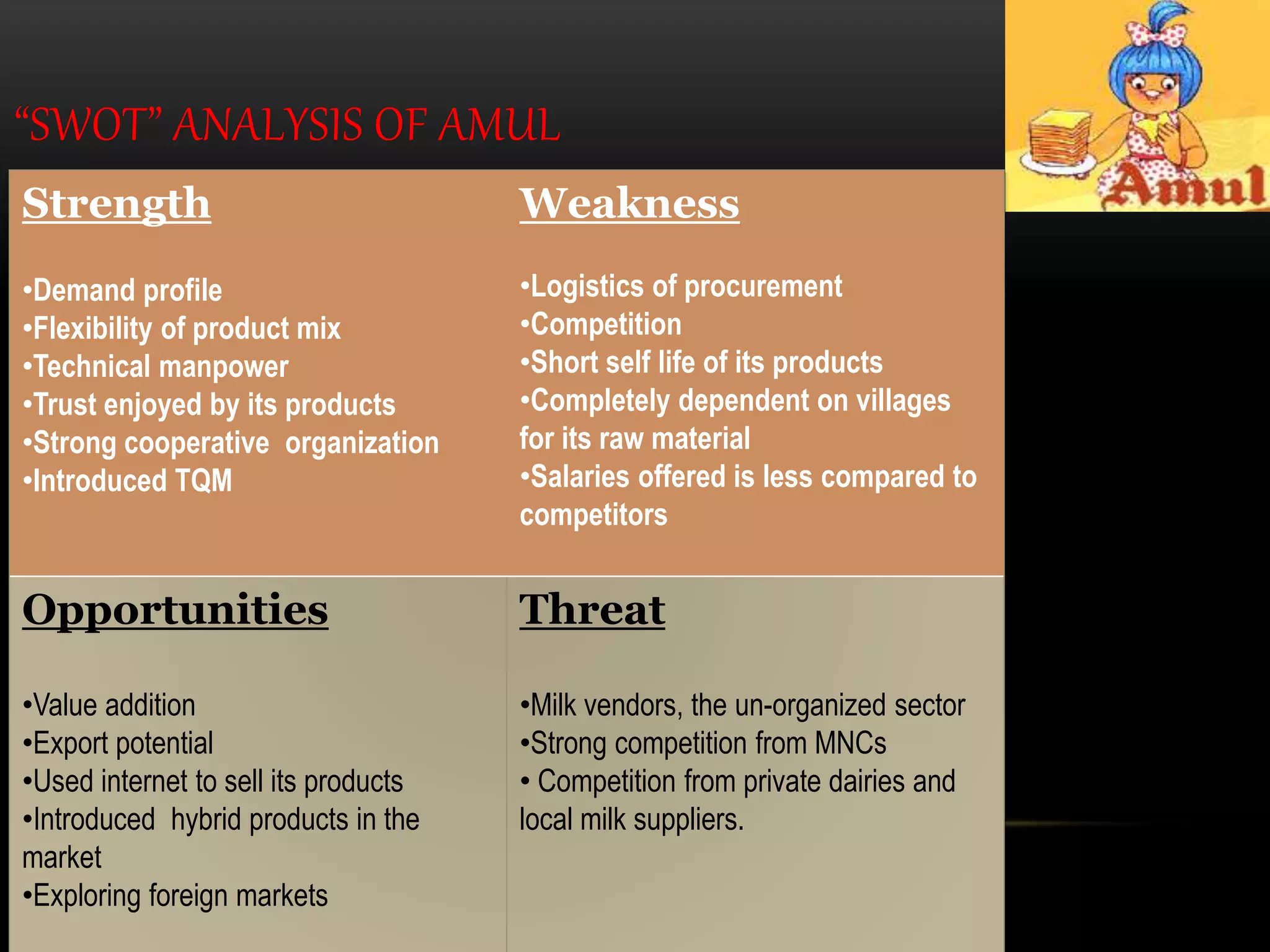
“SWOT” ANALYSIS OF AMUL
Strength
•Demand profile
•Flexibility of product mix
•Technical manpower
•Trust enjoyed by its products
•Strong cooperative organization
•Introduced TQM
Weakness
•Logistics of procurement
•Competition
•Short self life of its products
•Completely dependent on villages
for its raw material
•Salaries offered is less compared to
competitors
Opportunities
•Value addition
•Export potential
•Used internet to sell its products
•Introduced hybrid products in the
market
•Exploring foreign markets
Threat
•Milk vendors, the un-organized sector
•Strong competition from MNCs
• Competition from private dairies and
local milk suppliers.
Amul

Amul

  • 1.
  • 2.
    INTRODUCTION • The largestfood brand in India and world's Largest Pouched Milk Brand ‘Amul’ is a brand name managed by Gujarat Co-operative Milk Marketing Federation Ltd. (GCMMF). • This name has its origin in the Sanskrit word "Amoolya," (meaning Priceless) and was actually suggested by an employee of Gujarat Co- operative Milk Marketing Federation Ltd. (GCMMF) • With a turnover of INR 67.11 billion GCMMF has created an economic network that links :
  • 3.
    • millions ofconsumers in India and abroad, • 2.8 million village milk producers, • a cooperative system that includes 13,141 Village Dairy Cooperative Societies (VDCS) at the village level, • further affiliated to 13 District Cooperative Milk Producers’ Unions at the District level and GCMMF at the State level.
  • 4.
  • 5.
    HISTORY • Condition ofdairy farmers • Role of Sardar Vallabh Bhai Patel • Formation of first District Co-operative ‘Kaira’ • Formation of ‘GCMMF’
  • 6.
    CONDITION OF DAIRYFARMERS • There was exploitation of marginal milk producers by traders or agents of existing dairies in the small town named Anand (in Kaira District of Gujarat) and Polson Dairy . • Other problems faced by dairy farmers in Gujarat.
  • 7.
    ROLE OF ASARDAR VALLABH BHAI PATEL • Unfair trade practices and minimal returns angered dairy farmers. • So under the leadership of Tribhuvandas Patel dairy farmers approached Sardar Vallabh Bhai Patel for a solution.
  • 8.
    FORMATION OF DISTRICTCO-OPERATIVE “KAIRA” • Thus the first District Cooperative was established to collect and process milk in the District of Kaira in 1946. • Milk collection was also decentralized and village level cooperatives were established to organize the marginal milk producers in each of these villages. • The brand Amul was formally registered on December 14th, 1946 • This union selected the brand name AMUL in 1955
  • 9.
    FORMATION OF “GCMMF” (GUJARATCO-OPERATIVE MILK MARKETING FEDERATION LTD.) • Later on with the help of Dr. Verghese Kurien and Shri H M Dalaya this revolution spread to most of the districts in Gujarat. • Thus GCMMF came into being in the year 1973. • Initially, the brand name Amul was with Kaira district dairy cooperative, but later they decided to give it to GCMMF
  • 10.
    FATHER OF WHITEREVOLUTION Born: November 26, 1921 in Kozhikode, Kerala Achievement: Known as the "father of the white revolution" in India; Winner of Ramon Magsaysay Award; Awarded with Padma Shri (1965), Padma Bhushan (1966), and Padma Vibhushan (1999). He is also called as the Milkman of India. He graduated with Physics from Loyola College, Madras in 1940. Subsequently, he did his B.E.(Mechanical) from the Madras University and went to USA on a government scholarship to do his Masters in Mechanical Engineering from Michigan State University. When he was returned from America in 1948 and joined the Dairy Department of the Government of India. In May 1949, he was posted as Dairy Engineer at the Government Research Creamery , in Anand, Gujarat. In 1965, Prime Minister Lal Bahadur Shastri, created the (NDDB) under the leadership of Dr. Verghese Kurien to replicate the success story of Amul throughout the country.
  • 11.
  • 12.
  • 13.
    AMUL BUSINESS MODEL •Objective : • Deliver profitable and equitable returns to a large number of farmers for a long period of time • Additional objective • Develop the supplier over the long term through social change.
  • 14.
    THE MEANING OFFOUR HAND’S First hand of FARMERS Second hand of PROCESSORS Fourth hand of CUSTOMERS Third hand of MARKETER
  • 15.
    SALES TURNOVER OFAMUL FROM 1994 - 2009
  • 16.
    AMUL’S SUCCESS DEPENDSON High collection rate of milk Required increasing membership with more village societies Better Cattle management- Better milk yield Ensure cost to farmers and high quality to customer at low prices
  • 17.
    Q. Where isthe first milk plant of amul was established ????? A. In “ANAND”
  • 18.
    GCMMF AFFILIATED DAIRIES AmulDairy , Anand 16.00 : LLPD Dudhsagar Dairy , Mehsana : 22.00 LLPD
  • 19.
    Sabar Dairy ,Himatnagar : 12.00 LLPD Banas Dairy , Palanpur : 22.00 LLPD
  • 20.
    Sumul Dairy ,Surat :9.50 LLPD Panchamrut Dairy , Godhra : 4.00 LLPD
  • 21.
    Rajkot Dairy ,Rajkot : 2.50 LLPD Dudhmansagar Dairy Plant , Manesar :9.61 LLPD
  • 22.
    Vasudhara Dairy Plant, Boisar : 3.00 LLPD Vasudhara Dairy , Valsad : 3.00 LLPD
  • 23.
    Vidya Dairy ,Anand : 1.00 LLPD Mother Dairy , Gandhinagar : 25.00 LLPD
  • 24.
    Amul Whey PowderPlant , khatraj : 10.00 LLPD Amul Paneer Plant , Khatraj : 1.50 LLPD
  • 25.
    SOME HISTORICAL MOVEMENTSOF AMUL Pt. Jawahar lal Nehru visiting the Amul’s milk plant with Dr. Verghese Kurien Dr. Radhakrishnan visited Amul Dairy at Anand in 1962 With Dr. Verghese Kurien
  • 26.
    MARKETING AND ADVERTISINGSTRATEGIES 1. Quality :- • No brand can survive long if it’s quality is not equal or exceed customer expectations. • Incase of food product hygienic, taste, bacteriological & organoleptic standard –main essence. 2 . Value for Money :- • Customers get more than what they pay. • Keep price fair & do best to ensure that retailers don’t gain at the expense of customer.
  • 27.
    3.) Availability :- •Brand available when and where customers want. • Amul has nation’s finest distribution network. 4.) Service :- • Committed to total quality.
  • 28.
    PRODUCT POSITIONING • India’sFirst Pro-Biotic Wellness Ice cream & Sugar Free Delights For Diabetics. • Low Priced Amul Ice Creams made Kwality Walls life hell.
  • 29.
    Flank Attack.. AgeWise.. Aug 25 2007 • Amul launches Chocolate milk under brand name of ‘Amul Kool Koko’. • This is targeted at teenagers and youths.
  • 30.
    Nov 11, 2007 •Amul in Multinational Arena With Snack Launch: “Munch Time”. Flavors: Masala , Mint and Tomato  New Product Activity. Nov 26, 2007 • Amul Launches “Fresh Paneer” (Free From Any Harmful Chemicals) Flank Attack—Expanding its Cheese Segment. Current market share 65%.
  • 31.
    PRODUCT REPOSITIONING  Amulmarketed bottled water product named “JALDHARA” but due to less potential in the market it turned out to be blunder.  Now Amul is all set to launch bottled water “NARMADA NEER”.
  • 32.
  • 33.
    SEGMENTATION • Wide rangeof product categories caters to consumers across all market segments. For example, Amul Kool is targeted at children, while teenagers prefer Kool Café, as it has a cool imagery associated with it. • Segmentation is not as easy in curd and low fat products, due to mixed audiences, various culinary applications , eg. ghee, butter and cheese. “In India, the most used spread is ghee, then butter, cheese, low fat butter, margarine, cheese spread and mozzarella cheese.
  • 34.
    TARGETING • Changing retailenvironment • Striking out on its own, with Amul Outlets or parlors to deliver consumers total brand experience • Launched in 2002, there are now 400 Amul parlors across the country, which contributed 3% to the brand’s total turnover last year. High profile locations: Amul parlors are today present on campuses of Infosys, Wipro, IIM-A, IIT-B, Temples, Metro rail and railway stations in Gujarat.
  • 35.
    PROMOTION • Given thiswide product portfolio, Amul’s approach is to promote its brands in a rotational cycle of two to three years. • After ice-creams were launched in 1996, the category was re- visited in 1999, in order to improve availability of the product and make it affordable. • Below-the-line activity has grown too — such as the Amul food festival, which has been held for the last four year between October and December in about 50,000 retail outlets. • The Chef Of India promo invites hotel chefs to come up with recipes using as many Amul products as possible, and is conducted at city, state and national level
  • 36.
    THE FIRST ADVERTISINGSTRATEGY • 1966 sees the creation of the Amul girl by Sylvester da Cunha of the ASP Advertising agency as a rival to the Polson . • In 1967 the first hoarding was put up in Mumbai with the Amul girl. • The tag line of “Utterly Butterly Delicious” came out in October of 1967. • The first Topical ad came out in 1969 at the beginning of the Hare Rama Hare Krishna movement. • One of the most conservative FMCG entities — GCMMF — spends a mere 1% of its turnover on promotions. • Amul butter girl is one of the longest run ad campaigns in the country for 43 years. • Entered in the Guinness Book Of World Records for being the longest running campaign ever.
  • 37.
  • 38.
    AMUL’S COMPETITORS Butter • Britannia •Nestle Cheese • Britannia Baby Food • Nestle • Heinz Dairy Whitener Segment • Nestle • Britannia Ice creams • Kwality walls
  • 39.
    Chocolates & Confectionaries •Cadbury • Nestle Pizza • Pizza Hut • Dominos • Nirulas Frozen pizza Curd • Nestle • Mother Dairy Ultra High Treated Milk • Nestle • Britannia
  • 40.
    Sweet Condensed milk •Nestle Cottage Cheese (Paneer) • Britannia Milk Additives • Cadbury • Smith Kline Beecham Flavored Milk • Britannia • Nestle
  • 41.
  • 42.
  • 45.
  • 46.
  • 47.
    MISSION 2020 OFAMUL • Amul envisages that the dairy cooperatives of Gujarat will have a group turnover of Rs. 27000 crores by the year 2020. This will be a three-fold increase over its current group turnover of approx. Rs. 9600 crores. Milk production in milk shed area will increase to 231 lakh kg per day (23.1 million kg per day), at an annual growth rate of 4%. • Plan to double to processing capacity of dairy plants to 20.7 million kg per day, by 2020. This would include multi-fold capacity expansion for major product categories including milk powders, Ice-cream, paneer, cheese, ethnic sweets, curd, ghee and other dairy products.
  • 48.
    “SWOT” ANALYSIS OFAMUL Strength •Demand profile •Flexibility of product mix •Technical manpower •Trust enjoyed by its products •Strong cooperative organization •Introduced TQM Weakness •Logistics of procurement •Competition •Short self life of its products •Completely dependent on villages for its raw material •Salaries offered is less compared to competitors Opportunities •Value addition •Export potential •Used internet to sell its products •Introduced hybrid products in the market •Exploring foreign markets Threat •Milk vendors, the un-organized sector •Strong competition from MNCs • Competition from private dairies and local milk suppliers.