Mangifera Indica- Amra
Introduction:- 
Mango is the national fruit of India, Philippines and 
Pakistan. It finds mention in the songs of 4th century CE 
Sanskrit poet, Kalidasa, prior to it is believed to have been 
tasted by Alexander (3rd century BCE) and Chinese pilgrim, 
Hieun Tsang (7th century CE). Later in 16th century Mughal 
Emperor, Akbar planted 100,000 mango trees in 
Darbhanga, Bihar at a place now known as Lakhi Bagh. 
It is found in the wild in India and cultivated varieties 
have been introduced to other warm regions of the world. 
It is the largest fruit-tree in the world, capable of a height 
of one-hundred feet and an average circumference of 
twelve to fourteen feet, sometimes reaching twenty.
Traditional Importance of Mango 
The Jain goddess Ambika is traditionally represented as sitting under a 
mango tree. 
In Hinduism, the perfectly ripe mango is often held by Lord Ganesha as a 
symbol of attainment, regarding the devotees potential perfection. 
Mango blossoms are also used in the worship of the goddess Saraswati. 
Telugu/Kannada New Year's Day called Ugadi passes without eating ugadi 
pacchadi made with mango pieces as one of the ingredients. 
In Tamil Brahmin homes mango is an ingredient in making vadai paruppu 
on Sri Rama Navami day (Lord Ram's Birth Day) and also in preparation of 
pachchadi on Tamil New Year's Day.
Mango leaves are used to decorate archways and doors in Indian houses 
and during weddings and celebrations like Ganesh Chaturthi. 
Mango motifs and paisleys are widely used in different Indian embroidery 
styles, and are found in Kashmiri shawls, Kanchipuram silk sarees, etc. 
Paisleys are also common to Iranian art, because of its pre-Islamic 
Zoroastrian past. 
In Tamil Nadu, the mango is considered, along with banana and jackfruit, as 
one of the three royal fruits (Mukkani-முக்கனி) occupying first place in 
terms of sweetness and flavor. Ma-pala-vazhai (மா-பலா-வாழை). 
Famous Urdu poet Mirza Asadullah Khan Ghalib was very fond of mangoes. 
There are many anecdotes concerning his love for mangoes. 
Rabindranath Tagore was fond of mangoes and has written poems about 
its flowers- aamer monjori.
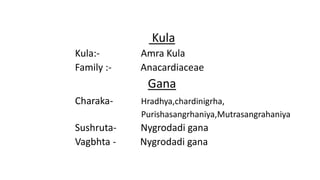
Kula 
Kula:- Amra Kula 
Family :- Anacardiaceae 
Gana 
Charaka- Hradhya,chardinigrha, 
Purishasangrhaniya,Mutrasangrahaniya 
Sushruta- Nygrodadi gana 
Vagbhta - Nygrodadi gana
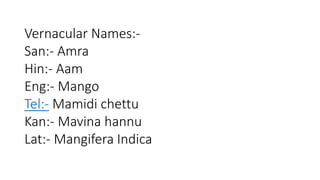
Vernacular Names:- 
San:- Amra 
Hin:- Aam 
Eng:- Mango 
Tel:- Mamidi chettu 
Kan:- Mavina hannu 
Lat:- Mangifera Indica
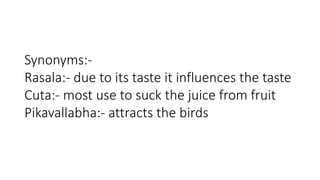
Synonyms:- 
Rasala:- due to its taste it influences the taste 
Cuta:- most use to suck the juice from fruit 
Pikavallabha:- attracts the birds
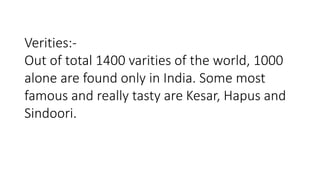
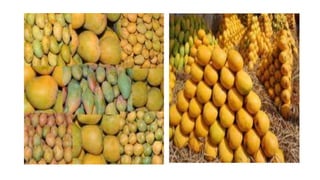
Verities:- 
Out of total 1400 varities of the world, 1000 
alone are found only in India. Some most 
famous and really tasty are Kesar, Hapus and 
Sindoori.
Habitat:- 
All over India
Morphology:- 
Tree grow up to 35–40 m (115–130 ft) tall, with a crown radius of 
10 m (33 ft). The trees are long-lived, as some specimens still fruit 
after 300 years. In deep soil, 
the taproot descends to a depth of 6 m (20 ft), the tree also sends 
down many roots. 
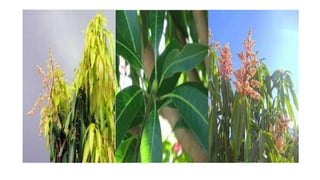
The leaves are evergreen, alternate, simple, 15–35 cm (5.9–14 in) 
long and 6–16 cm (2.4–6.3 in) broad; when the leaves are young 
they are orange-pink, rapidly changing to a dark, glossy red, then 
dark green as they mature. 
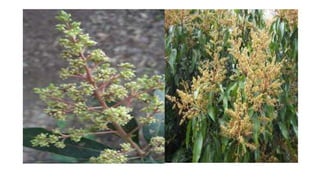
The flowers are produced in terminal panicles 10–40 cm (3.9– 
16 in) long; each flower is small and white with five petals 5– 
10 mm (0.20–0.39 in) long, with a mild, sweet odor suggestive of 
lily of the valley.
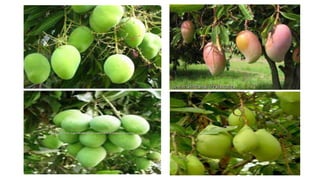
The fruit takes three to six months to ripen. The ripe fruit varies 
in size and color. Cultivars are variously yellow, orange, red or 
green, and carry a single flat, oblong pit that can be fibrous or 
hairy on the surface, and which does not separate easily from the 
pulp. Ripe, unpeeled mangoes give off a distinctive resinous, 
sweet smell. 
Inside the pit 1–2 mm (0.039–0.079 in) thick is a thin lining 
covering a single seed, 4–7 mm (0.16–0.28 in) long. The seed 
contains the plant embryo.
Chemical Composition:- 
Mangiferin 
Mangiferilicacid Antimicrobial, antioxidant 
Homonangiferin 
It is Richest source of Vit-A , & Vit-C
Properties:- 
Guna: Laghu 
Rasa: Kasaya ( Bark, Seed ) 
Veerya: Sheeta 
Vipaka: Katu
Dosha Karma:- 
Unrippen fruit- Kapha-pitthahara 
Ripen fruit - Vatahara
Therputic Uses:- 
Matsyabakshanajanya Ajeerna- Unripe fruit 
Raktapitta- amrasthi swarasa nasya 
Atisara- Paste of Amra & Kapittha leaves with 
Tandulodaka
Functions Acc to Diff Scholars 
Charaka:- 
Nasagata Raktapitta- Amrasthi Swarasa Nasya 
Chakradatta:- 
Plihodhara- Amra swarasa + Madhu 
Vrandha:- 
Raktatisara- latex + madhu 
Bhavaprakash:- 
Atisara- Amratwak
• Vangasena:- 
Shotha:-Gratha of Punarnava patra & Amra moola 
Balamukhapaka:- Amrasarachurna, Gairika, Madhu 
• Sharangadhar:- 
Jwara- Matulunga, Jambhu, Amra Putapakaswarasa pana
Useful Part:- 
Panchanga
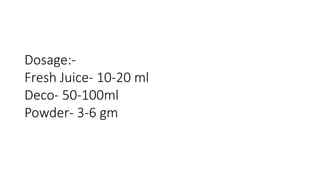
Dosage:- 
Fresh Juice- 10-20 ml 
Deco- 50-100ml 
Powder- 3-6 gm
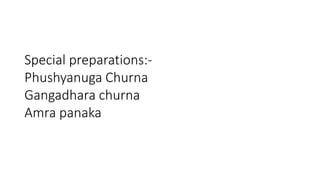
Special preparations:- 
Phushyanuga Churna 
Gangadhara churna 
Amra panaka
Amra

Amra

  • 1.
  • 2.
    Introduction:- Mango isthe national fruit of India, Philippines and Pakistan. It finds mention in the songs of 4th century CE Sanskrit poet, Kalidasa, prior to it is believed to have been tasted by Alexander (3rd century BCE) and Chinese pilgrim, Hieun Tsang (7th century CE). Later in 16th century Mughal Emperor, Akbar planted 100,000 mango trees in Darbhanga, Bihar at a place now known as Lakhi Bagh. It is found in the wild in India and cultivated varieties have been introduced to other warm regions of the world. It is the largest fruit-tree in the world, capable of a height of one-hundred feet and an average circumference of twelve to fourteen feet, sometimes reaching twenty.
  • 3.
    Traditional Importance ofMango The Jain goddess Ambika is traditionally represented as sitting under a mango tree. In Hinduism, the perfectly ripe mango is often held by Lord Ganesha as a symbol of attainment, regarding the devotees potential perfection. Mango blossoms are also used in the worship of the goddess Saraswati. Telugu/Kannada New Year's Day called Ugadi passes without eating ugadi pacchadi made with mango pieces as one of the ingredients. In Tamil Brahmin homes mango is an ingredient in making vadai paruppu on Sri Rama Navami day (Lord Ram's Birth Day) and also in preparation of pachchadi on Tamil New Year's Day.
  • 4.
    Mango leaves areused to decorate archways and doors in Indian houses and during weddings and celebrations like Ganesh Chaturthi. Mango motifs and paisleys are widely used in different Indian embroidery styles, and are found in Kashmiri shawls, Kanchipuram silk sarees, etc. Paisleys are also common to Iranian art, because of its pre-Islamic Zoroastrian past. In Tamil Nadu, the mango is considered, along with banana and jackfruit, as one of the three royal fruits (Mukkani-முக்கனி) occupying first place in terms of sweetness and flavor. Ma-pala-vazhai (மா-பலா-வாழை). Famous Urdu poet Mirza Asadullah Khan Ghalib was very fond of mangoes. There are many anecdotes concerning his love for mangoes. Rabindranath Tagore was fond of mangoes and has written poems about its flowers- aamer monjori.
  • 5.
    Kula Kula:- AmraKula Family :- Anacardiaceae Gana Charaka- Hradhya,chardinigrha, Purishasangrhaniya,Mutrasangrahaniya Sushruta- Nygrodadi gana Vagbhta - Nygrodadi gana
  • 6.
    Vernacular Names:- San:-Amra Hin:- Aam Eng:- Mango Tel:- Mamidi chettu Kan:- Mavina hannu Lat:- Mangifera Indica
  • 7.
    Synonyms:- Rasala:- dueto its taste it influences the taste Cuta:- most use to suck the juice from fruit Pikavallabha:- attracts the birds
  • 8.
    Verities:- Out oftotal 1400 varities of the world, 1000 alone are found only in India. Some most famous and really tasty are Kesar, Hapus and Sindoori.
  • 9.
  • 10.
    Morphology:- Tree growup to 35–40 m (115–130 ft) tall, with a crown radius of 10 m (33 ft). The trees are long-lived, as some specimens still fruit after 300 years. In deep soil, the taproot descends to a depth of 6 m (20 ft), the tree also sends down many roots. The leaves are evergreen, alternate, simple, 15–35 cm (5.9–14 in) long and 6–16 cm (2.4–6.3 in) broad; when the leaves are young they are orange-pink, rapidly changing to a dark, glossy red, then dark green as they mature. The flowers are produced in terminal panicles 10–40 cm (3.9– 16 in) long; each flower is small and white with five petals 5– 10 mm (0.20–0.39 in) long, with a mild, sweet odor suggestive of lily of the valley.
  • 11.
    The fruit takesthree to six months to ripen. The ripe fruit varies in size and color. Cultivars are variously yellow, orange, red or green, and carry a single flat, oblong pit that can be fibrous or hairy on the surface, and which does not separate easily from the pulp. Ripe, unpeeled mangoes give off a distinctive resinous, sweet smell. Inside the pit 1–2 mm (0.039–0.079 in) thick is a thin lining covering a single seed, 4–7 mm (0.16–0.28 in) long. The seed contains the plant embryo.
  • 16.
    Chemical Composition:- Mangiferin Mangiferilicacid Antimicrobial, antioxidant Homonangiferin It is Richest source of Vit-A , & Vit-C
  • 17.
    Properties:- Guna: Laghu Rasa: Kasaya ( Bark, Seed ) Veerya: Sheeta Vipaka: Katu
  • 18.
    Dosha Karma:- Unrippenfruit- Kapha-pitthahara Ripen fruit - Vatahara
  • 19.
    Therputic Uses:- MatsyabakshanajanyaAjeerna- Unripe fruit Raktapitta- amrasthi swarasa nasya Atisara- Paste of Amra & Kapittha leaves with Tandulodaka
  • 20.
    Functions Acc toDiff Scholars Charaka:- Nasagata Raktapitta- Amrasthi Swarasa Nasya Chakradatta:- Plihodhara- Amra swarasa + Madhu Vrandha:- Raktatisara- latex + madhu Bhavaprakash:- Atisara- Amratwak
  • 21.
    • Vangasena:- Shotha:-Grathaof Punarnava patra & Amra moola Balamukhapaka:- Amrasarachurna, Gairika, Madhu • Sharangadhar:- Jwara- Matulunga, Jambhu, Amra Putapakaswarasa pana
  • 22.
  • 23.
    Dosage:- Fresh Juice-10-20 ml Deco- 50-100ml Powder- 3-6 gm
  • 24.
    Special preparations:- PhushyanugaChurna Gangadhara churna Amra panaka