AMNIOTIC FLUID
Amniotic Fluid
Definition and Functions
■ Amniotic fluid is the clear yellowish protective liquid contained by amniotic sac of
gravid amniote.
■ It protects the fetus from mechanical injury
■ Permit movement of fetus while preventing limb contracture
■ Prevent adhesion between fetus and amnion
■ Permit fetal lung development
Formation and absorption
■ (upto 20 weeks)
Ultrafiltrate of maternal plasma,Transudate of fetal plasma
(through uterine decidua , through fetal skin and umbilical cord )
■ (20 weeks to term)
(majorly via fetal urine beacuse fetal skin undergo keratinization )
Reabsorbed by
■ ( upto 20 weeks)
Into maternal plasma
■ (After 20 weeks)
Fetal gut and lungs after swallowing
■ Amniotic fluid increases progressively
■ 10 weeks : 30ml
■ 20 weeks : 300ml
■ 30 weeks : 600ml
■ 38 weeks :1000ml
■ Amniotic fluid decreases rapidly after term
■ 40 weeks : 800ml
■ 42 weeks : 350ml
Amniotic Fluid Index
■ Total of deepest pool (DVP) in four quadrants of uterus
■ Deepest vertical pool /Maximum vertical pool is the vertical
measurement of fluid that is free of umbilical cord in each quadrant.
Their sum is called Amniotic Fluid Index (AFI)
Oligohydramnios
■ Reduced amniotic fluid i.e AMI <5cm or DVP <2cm
■ Diagnosed by
■ Vaginal leakage of fluid
■ Small size of uterus
■ Decreased movements of baby
■ Not gaining enough weight
■ Results in
■ Deformities
■ Preterm birth
■ Miscarriage
■ Stillbirth
■ infection
■ Cord compression, FGR, early delivery
Treatment
■ Adequate rest ,Oral / IV fluids
■ Serial AFI measurement,Non StressTest( Fetal USN and CTG)
■ Amniofusion
■ Delivering the baby if lung maturity attained, severe IUGR and
malfromations
Polyhydramnios
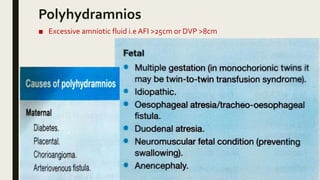
■ Excessive amniotic fluid i.e AFI >25cm or DVP >8cm
■ Signs
■ Enlarged uterus
■ Difficult to palpate fetal parts and auscultate fetal heart
■ Ballotable fetues
■ Symptoms
■ Dyspnea
■ Abdominal pain
■ Edema due to venous stasis
■ Contractions leading to preterm labour
Complications : cord prolapse, placental abruption, preterm delivery
uterine atony
Treatment
■ Bed rest
■ Mother’s glycemic control
■ NSAIDS
■ Amniodrainage
■ Laser ablation of placental vascular connection inTTTS

oligo and polyhydramnios.pptx

  • 1.
  • 2.
    Amniotic Fluid Definition andFunctions ■ Amniotic fluid is the clear yellowish protective liquid contained by amniotic sac of gravid amniote. ■ It protects the fetus from mechanical injury ■ Permit movement of fetus while preventing limb contracture ■ Prevent adhesion between fetus and amnion ■ Permit fetal lung development
  • 4.
    Formation and absorption ■(upto 20 weeks) Ultrafiltrate of maternal plasma,Transudate of fetal plasma (through uterine decidua , through fetal skin and umbilical cord ) ■ (20 weeks to term) (majorly via fetal urine beacuse fetal skin undergo keratinization ) Reabsorbed by ■ ( upto 20 weeks) Into maternal plasma ■ (After 20 weeks) Fetal gut and lungs after swallowing
  • 5.
    ■ Amniotic fluidincreases progressively ■ 10 weeks : 30ml ■ 20 weeks : 300ml ■ 30 weeks : 600ml ■ 38 weeks :1000ml ■ Amniotic fluid decreases rapidly after term ■ 40 weeks : 800ml ■ 42 weeks : 350ml
  • 6.
    Amniotic Fluid Index ■Total of deepest pool (DVP) in four quadrants of uterus ■ Deepest vertical pool /Maximum vertical pool is the vertical measurement of fluid that is free of umbilical cord in each quadrant. Their sum is called Amniotic Fluid Index (AFI)
  • 7.
    Oligohydramnios ■ Reduced amnioticfluid i.e AMI <5cm or DVP <2cm
  • 8.
    ■ Diagnosed by ■Vaginal leakage of fluid ■ Small size of uterus ■ Decreased movements of baby ■ Not gaining enough weight ■ Results in ■ Deformities ■ Preterm birth ■ Miscarriage ■ Stillbirth ■ infection ■ Cord compression, FGR, early delivery
  • 10.
    Treatment ■ Adequate rest,Oral / IV fluids ■ Serial AFI measurement,Non StressTest( Fetal USN and CTG) ■ Amniofusion ■ Delivering the baby if lung maturity attained, severe IUGR and malfromations
  • 11.
    Polyhydramnios ■ Excessive amnioticfluid i.e AFI >25cm or DVP >8cm
  • 12.
    ■ Signs ■ Enlargeduterus ■ Difficult to palpate fetal parts and auscultate fetal heart ■ Ballotable fetues ■ Symptoms ■ Dyspnea ■ Abdominal pain ■ Edema due to venous stasis ■ Contractions leading to preterm labour Complications : cord prolapse, placental abruption, preterm delivery uterine atony
  • 13.
    Treatment ■ Bed rest ■Mother’s glycemic control ■ NSAIDS ■ Amniodrainage ■ Laser ablation of placental vascular connection inTTTS