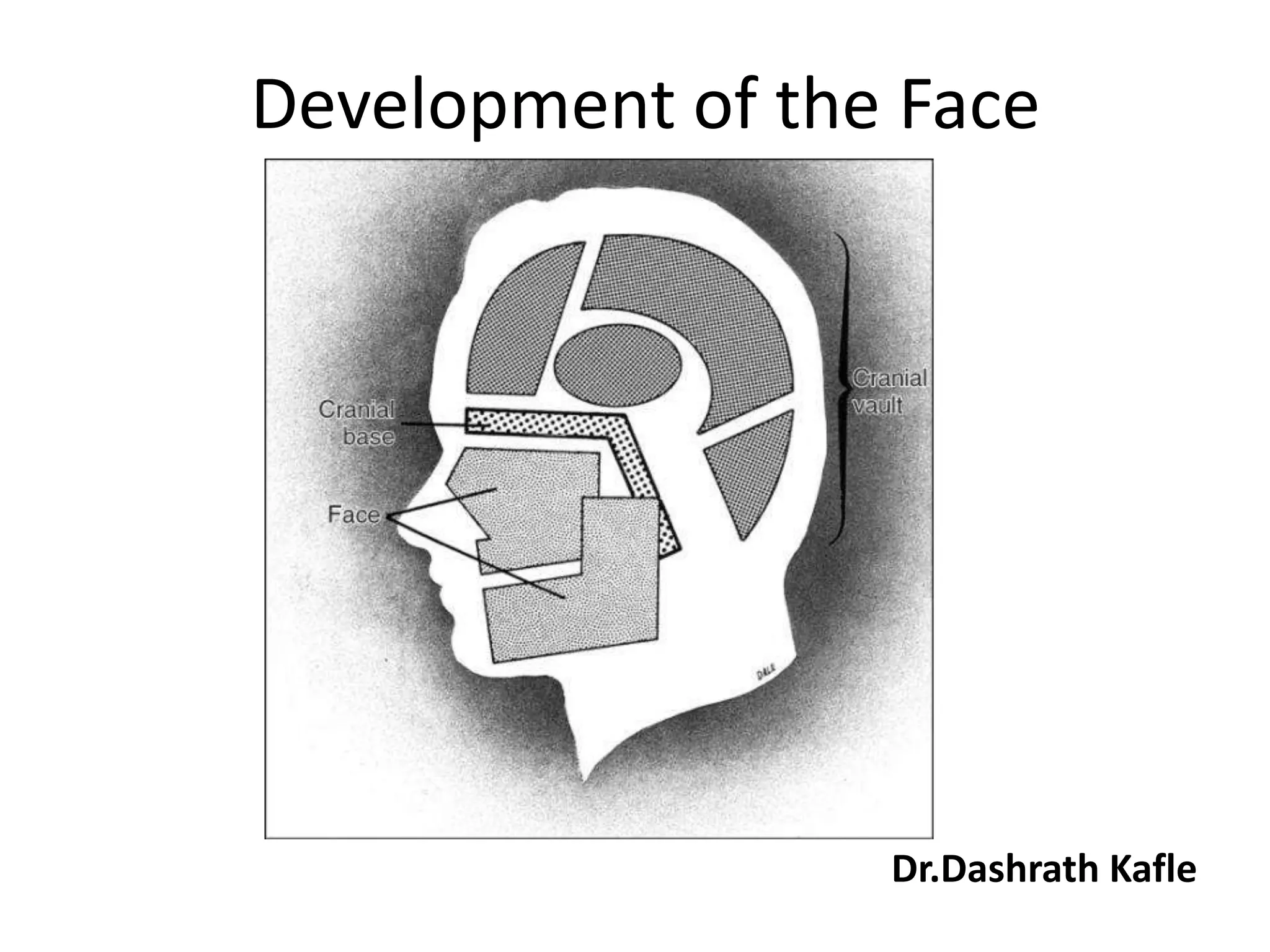
Development of the Face


                  Dr.Dashrath Kafle
Face
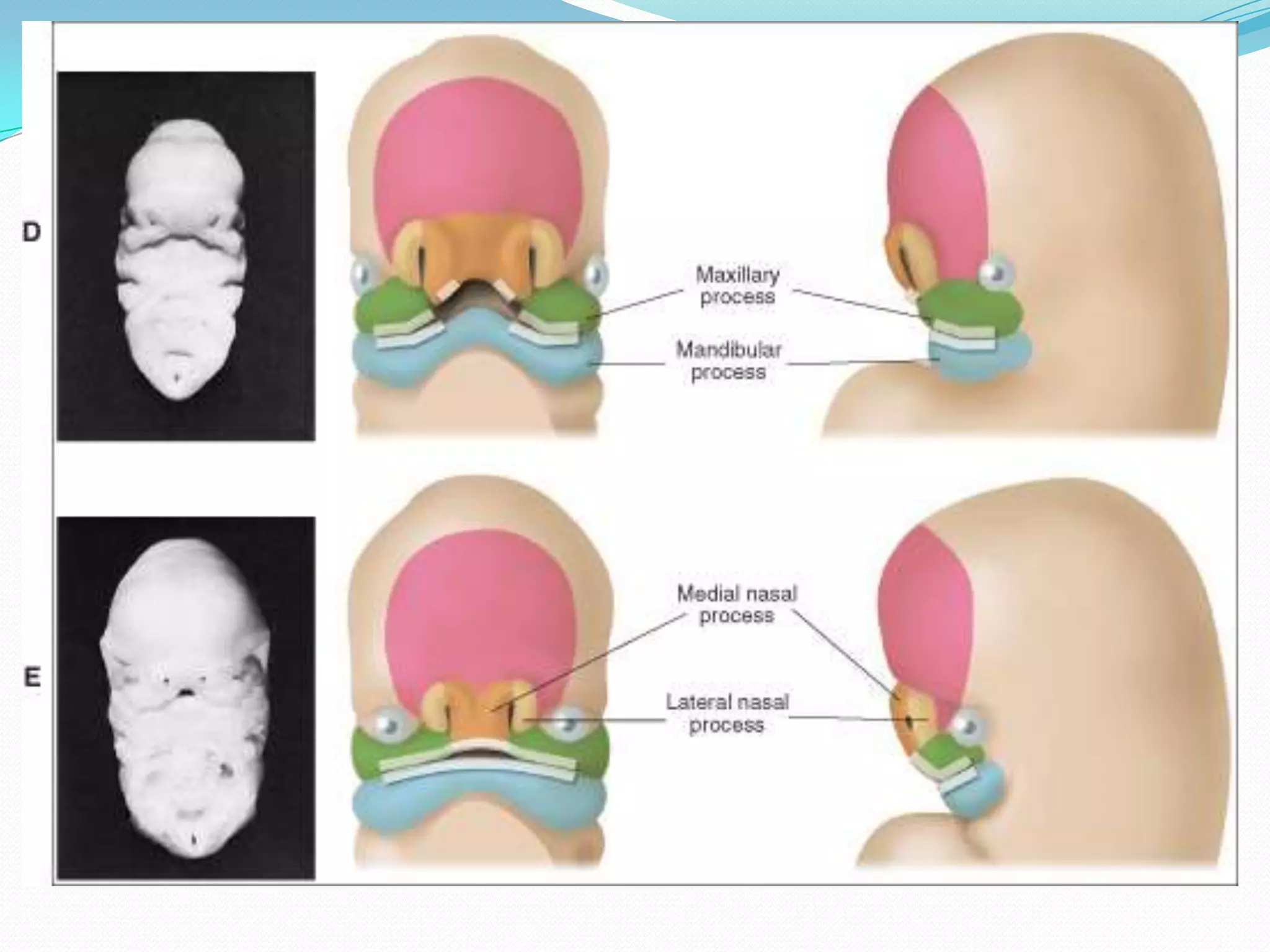
 At the end of the 4th week, facial prominences consisting
  primarily of neural crest-derived mesenchyme appear
 Maxillary prominences- lateral to the stomodeum
 mandibular prominences- caudal to stomodeum


                                                              2
Face contd...
 Frontonasal prominence - proliferation of mesenchyme
  ventral to the brain vesicles


 On both sides, local thickenings of the surface ectoderm,
  the nasal placodes originate


                                                              3
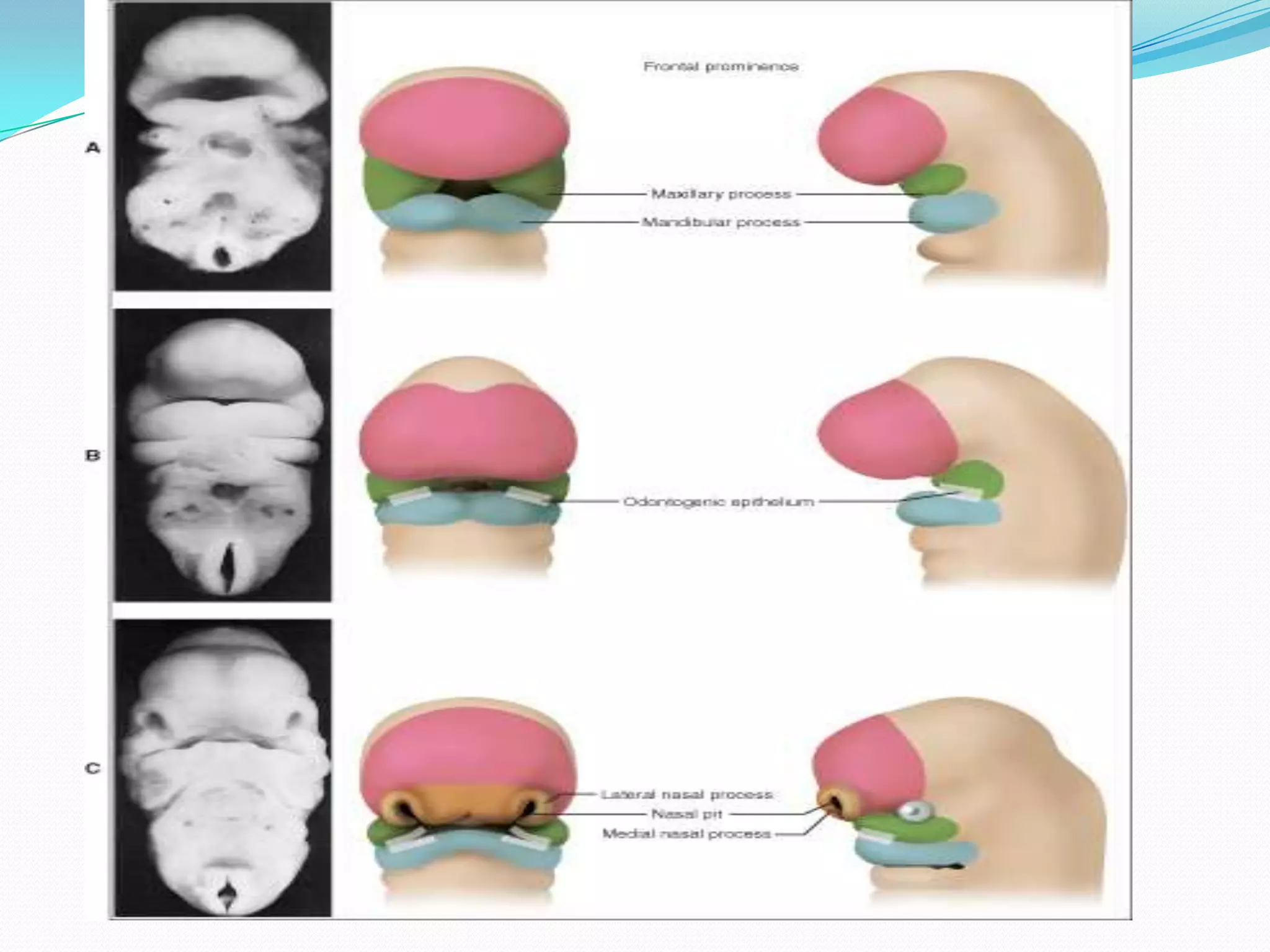
Face contd...
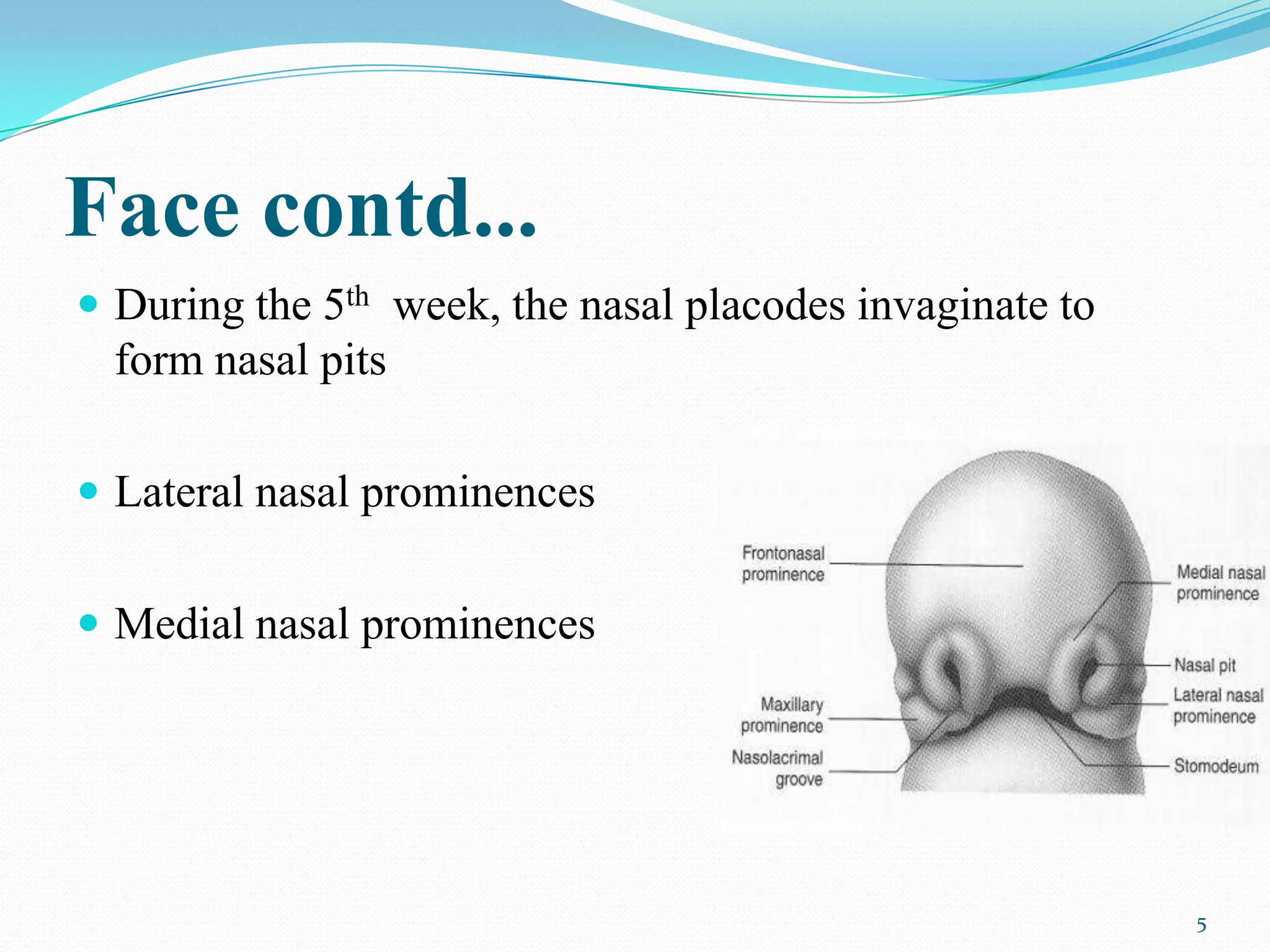
 During the 5th week, the nasal placodes invaginate to
  form nasal pits

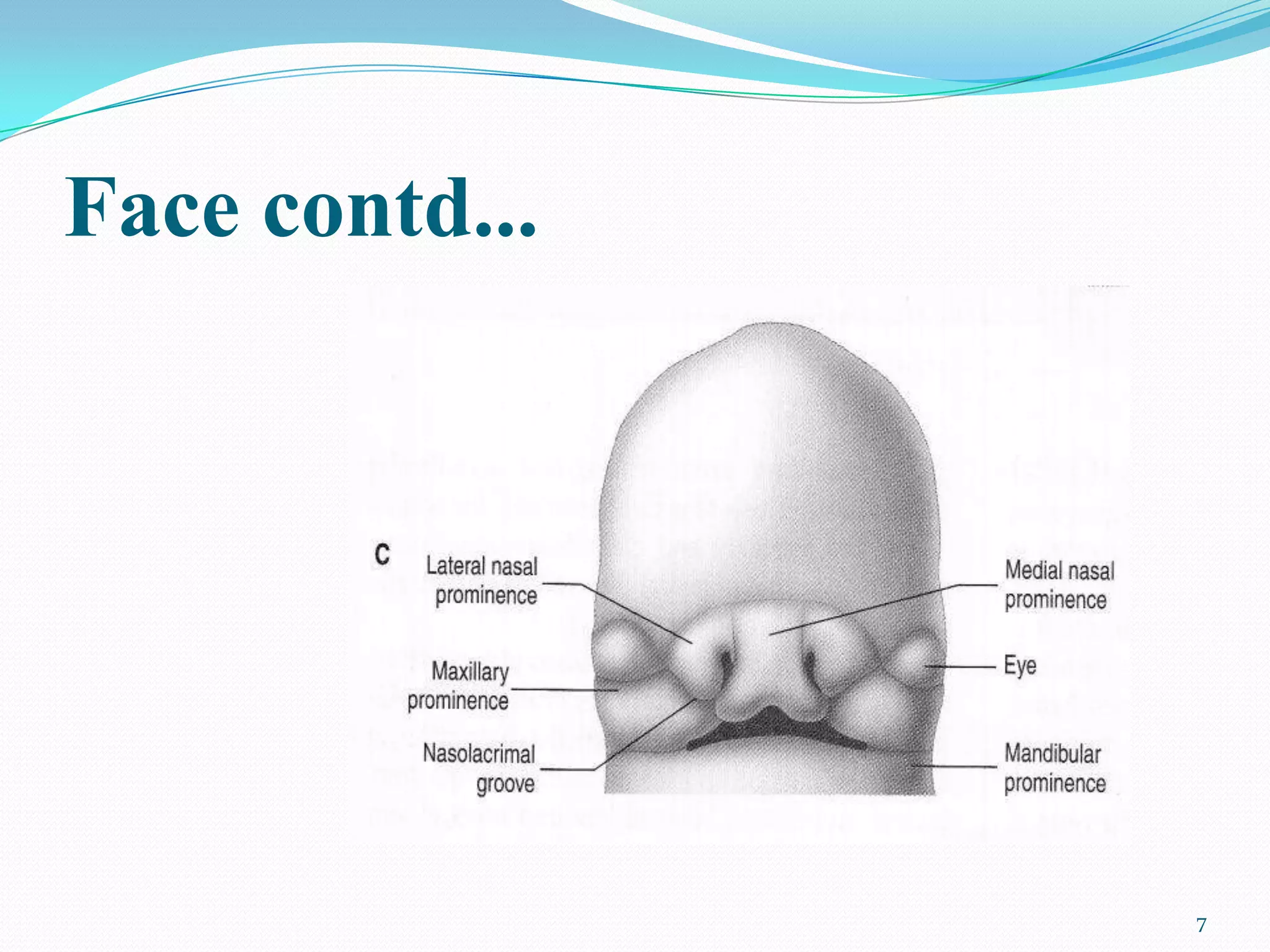
 Lateral nasal prominences


 Medial nasal prominences


                                                          5
Face contd...


                7
Formation of lip
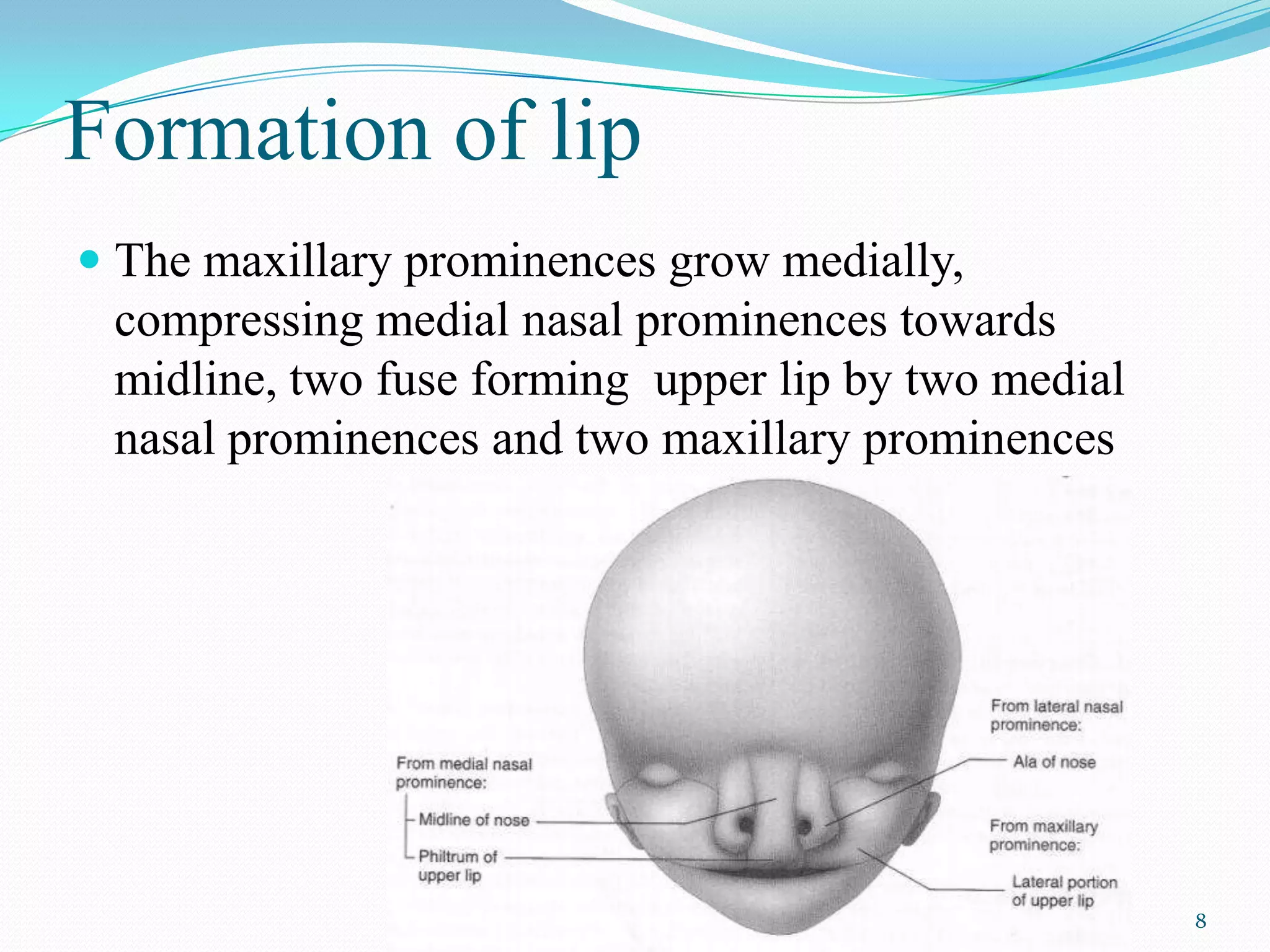
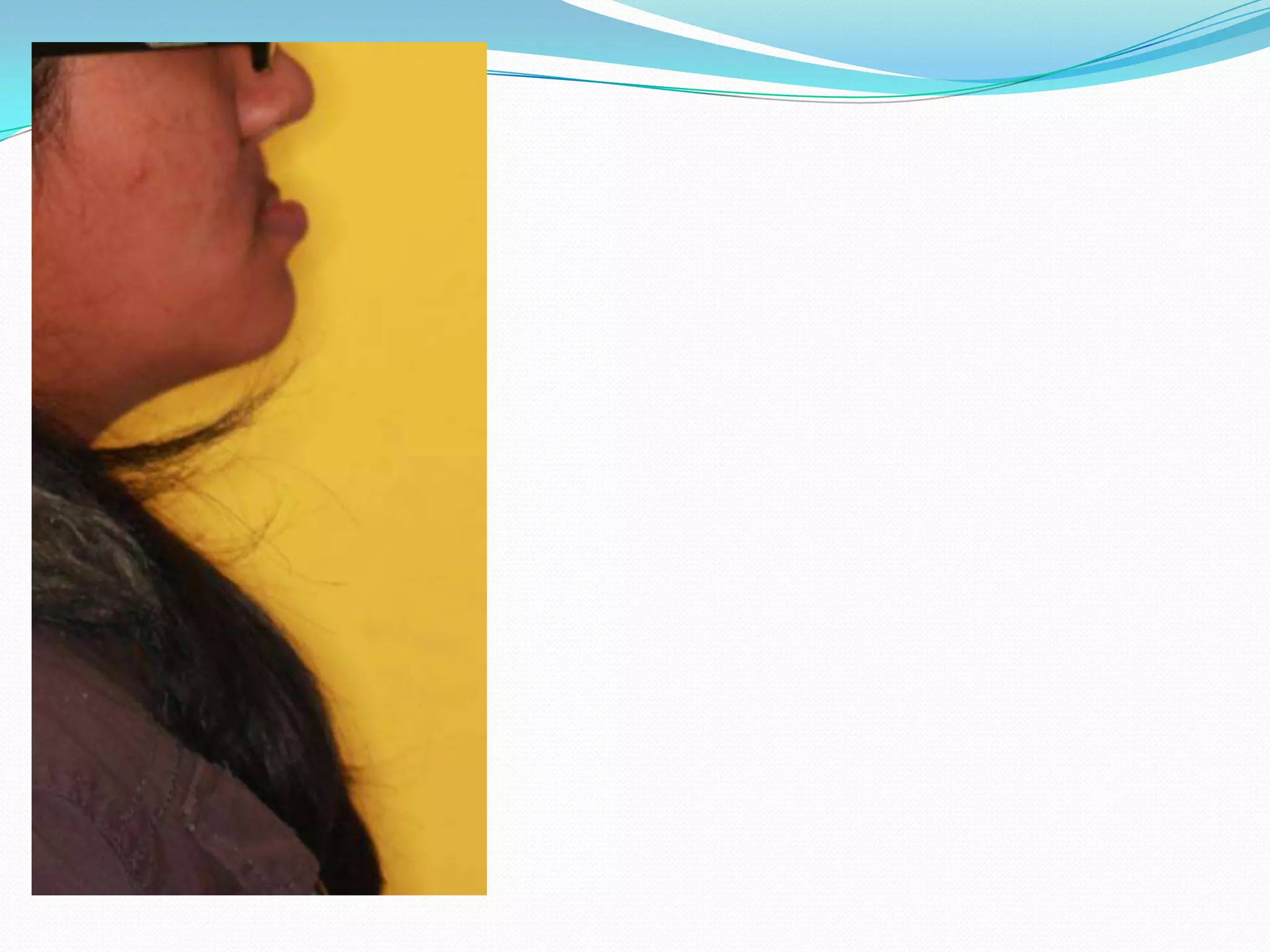
 The maxillary prominences grow medially,
 compressing medial nasal prominences towards
 midline, two fuse forming upper lip by two medial
 nasal prominences and two maxillary prominences


                                                     8
Development of nose
 Maxillary prominences enlarge to form the cheeks and
  maxilla
 Nose is formed from five facial prominences:
       - frontal prominence gives rise to bridge
       - merged medial nasal prominences provide the
  crest and tip
       - lateral nasal prominences form the alae


                                                         10
Intermaxillary Segment
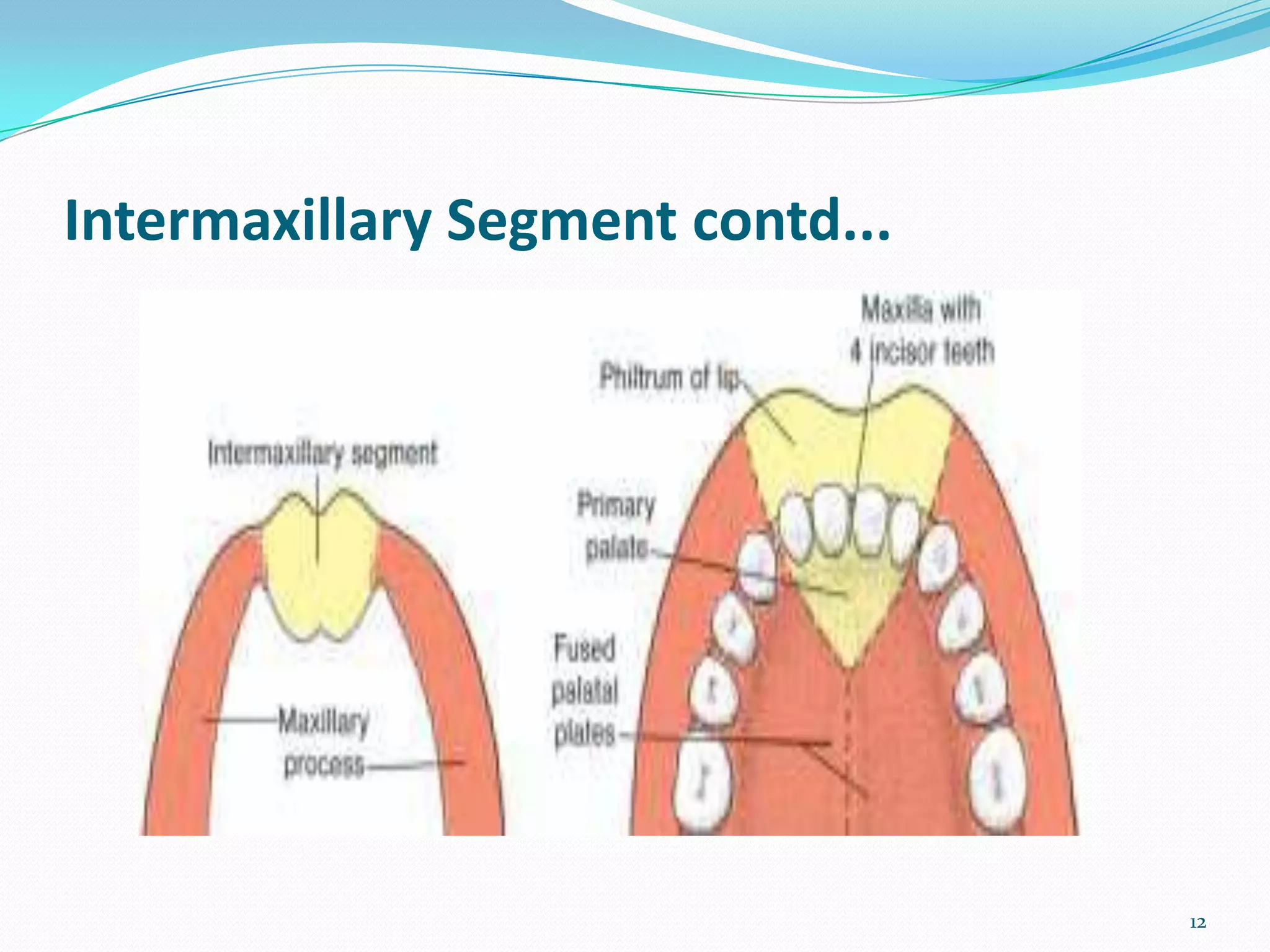
 Two medial nasal prominences merge at a deeper level
  forming the intermaxillary segment
 Composed of
   (a) philtrum of the upper lip
   (b) upper jaw component- carries the four incisor teeth
  (c) primary palate


                                                             11
Intermaxillary Segment contd...


                                  12
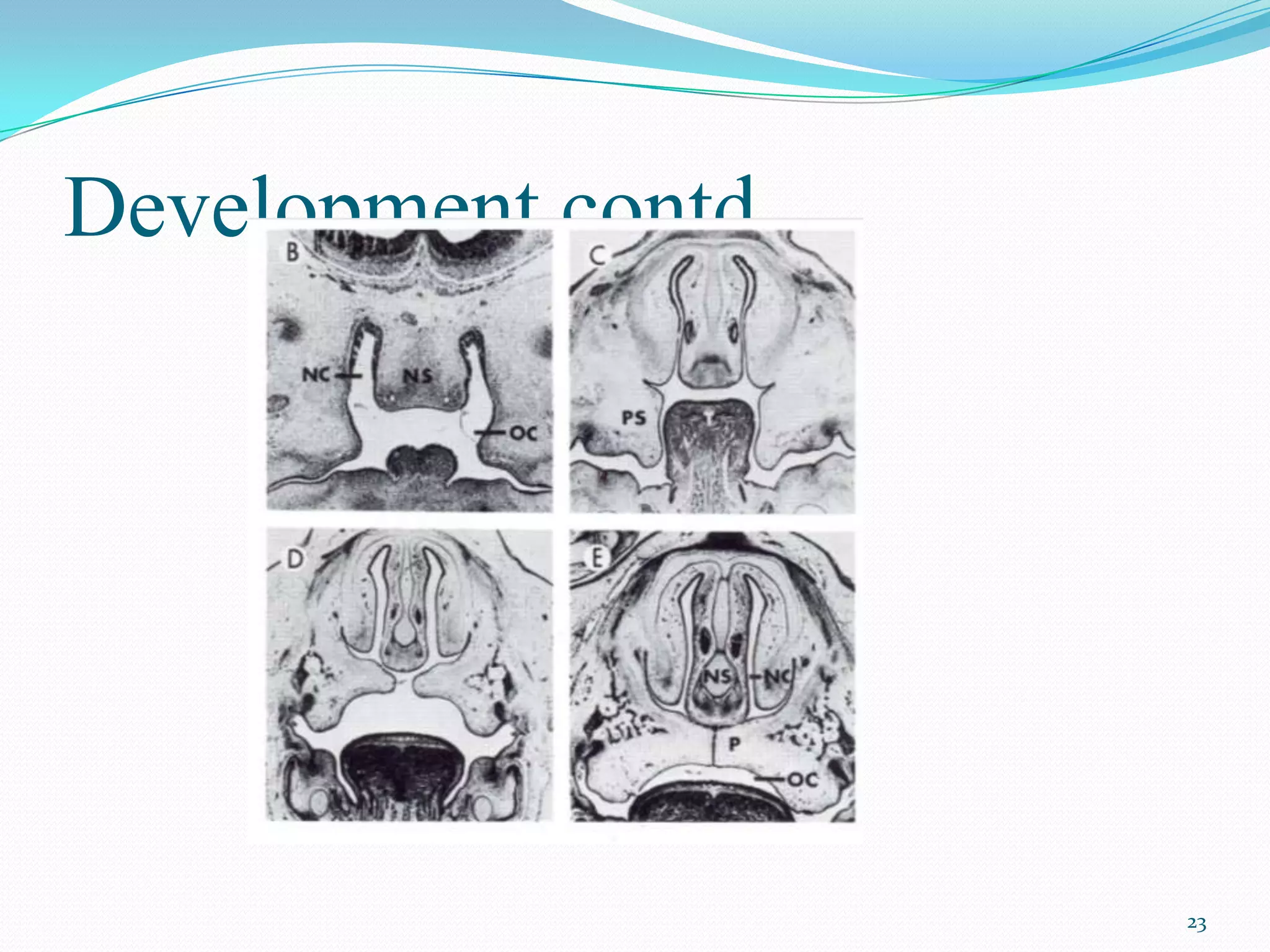
Secondary Palate
 Formed by two palatine shelves (6th week of
  development) –maxillary process
 Directed obliquely downward on each side of the tongue
 In the 7th week, the palatine shelves ascend to attain a
  horizontal position above the tongue and fuse, forming the
  secondary palate


                                                               13
Secondary Palate contd...


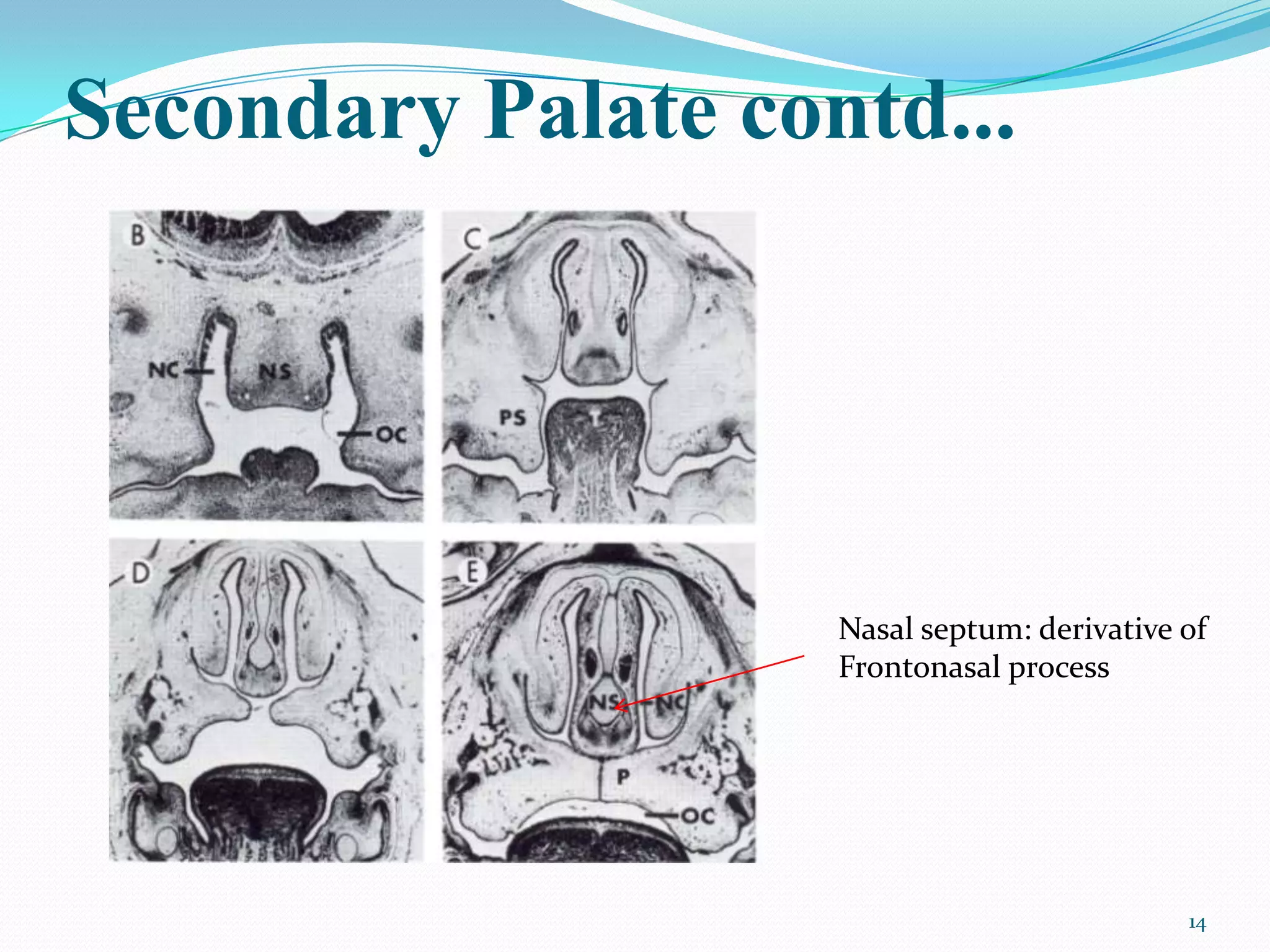
                    Nasal septum: derivative of
                    Frontonasal process


                                             14
Secondary Palate contd...
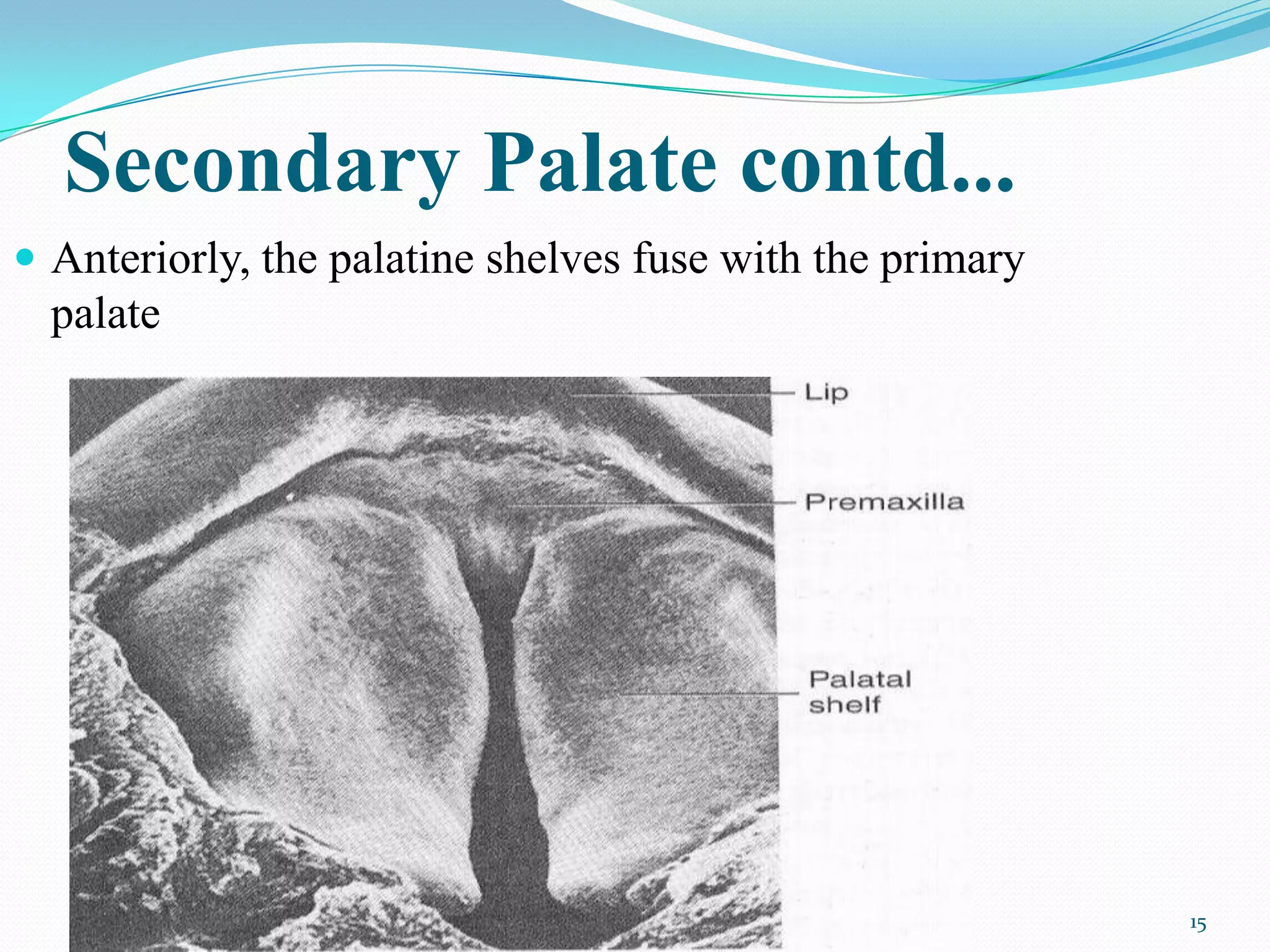
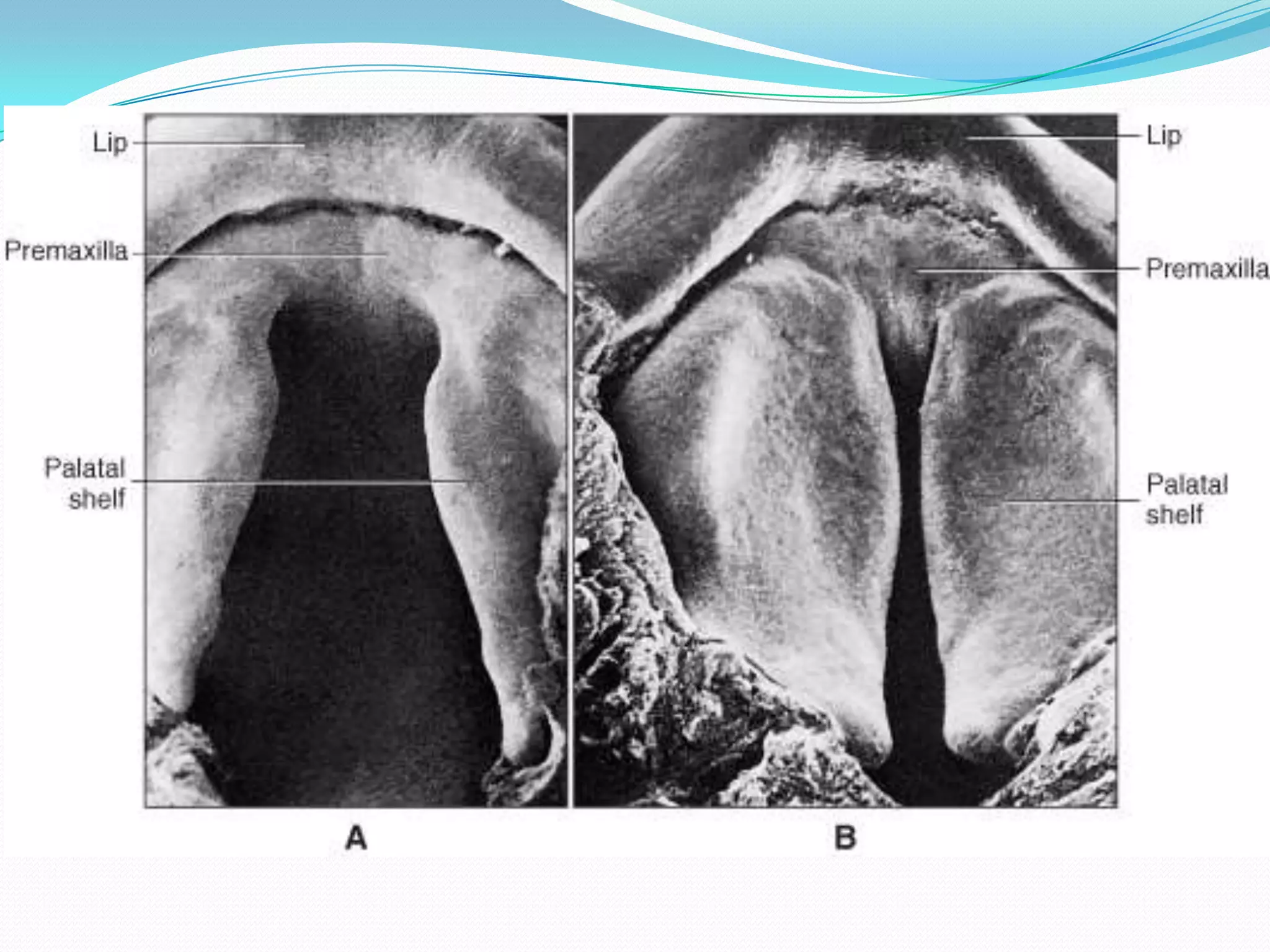
 Anteriorly, the palatine shelves fuse with the primary
  palate


                                                           15
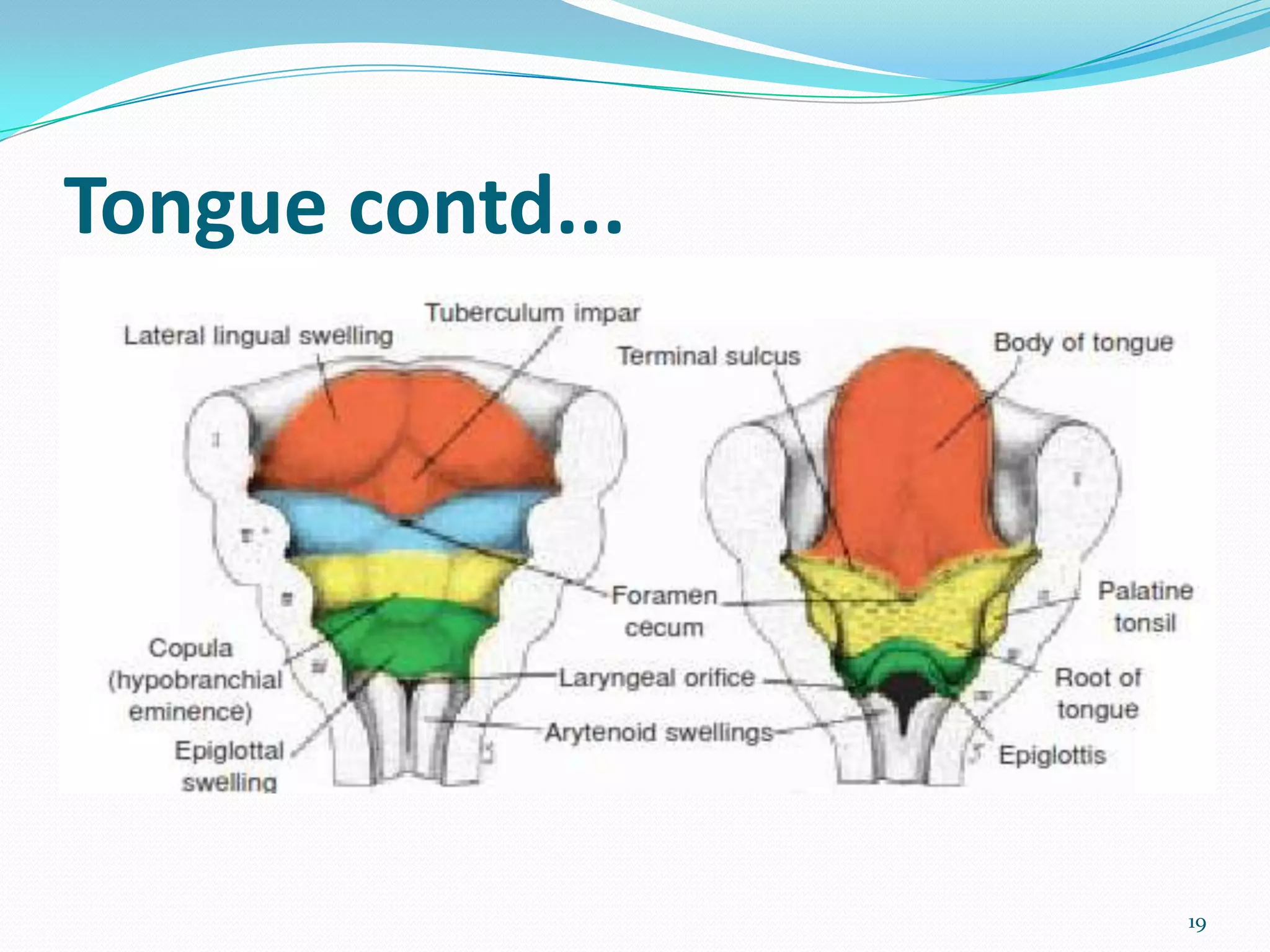
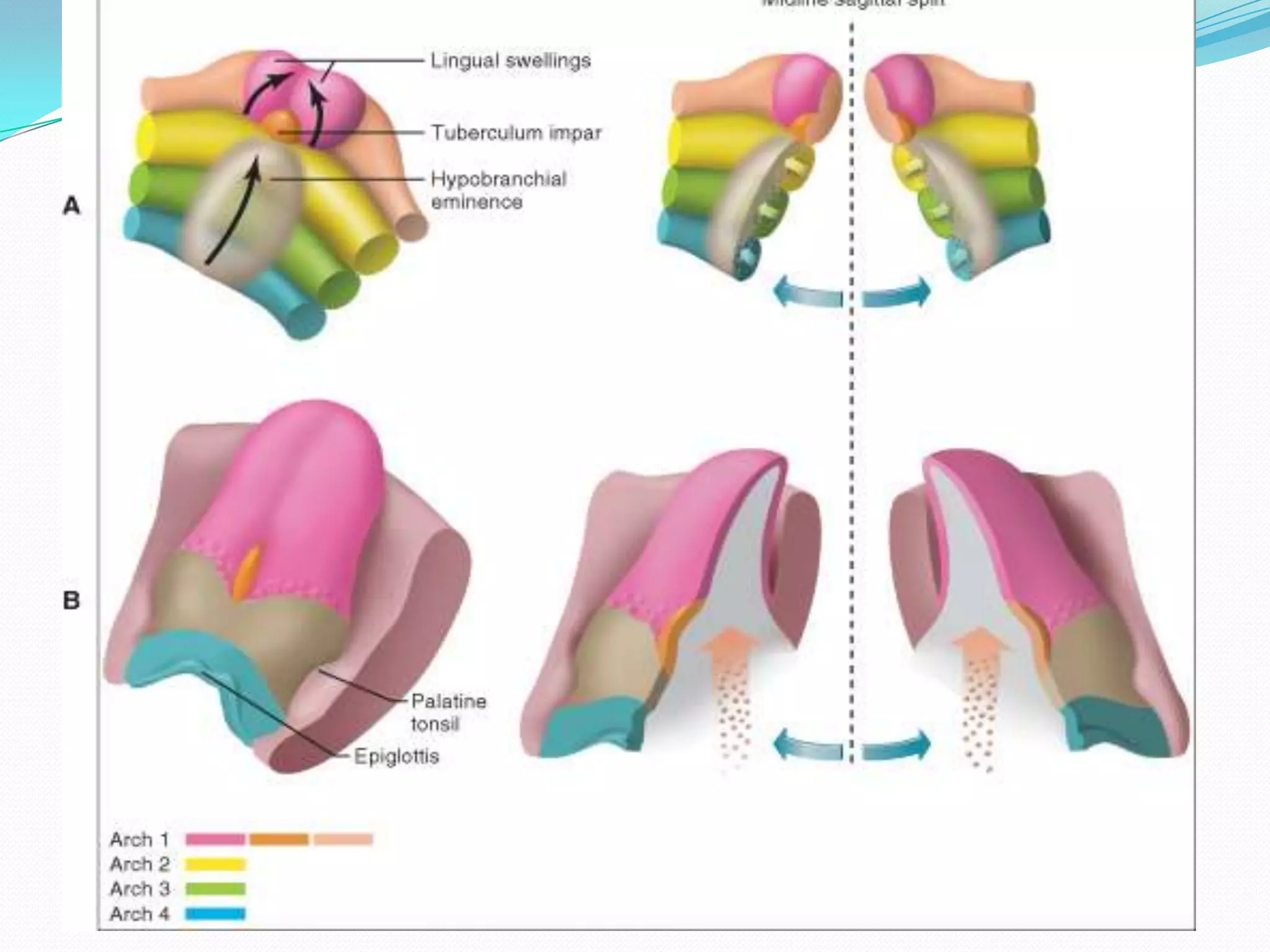
Development of Tongue
 Appear at 4 weeks
 As two lateral lingual swellings and one medial swelling,
  the tuberculum impar (all originate from the first
  pharyngeal arch)
 A second median swelling, the copula, formed by
  mesoderm of the second, third, and part of the fourth arch


                                                               18
Tongue contd...


                  19
Tongue contd...
 Lateral lingual swellings increase in size, overgrow the
  tuberculum impar and merge, forming the anterior two-
  thirds, or body, of the tongue
 The body of the tongue is separated from the posterior
  third by a V-shaped groove, the terminal sulcus


                                                             20
Tongue contd...
 A third median swelling, formed by the posterior part of
  the fourth arch, marks development of the epiglottis


                                                             22
Development contd....


                        23
Tongue contd...
 The mucosa covering the body of the tongue originates
  from the first pharyngeal arch
 Sensory innervation to the posterior part, or root part of
  the tongue is supplied by the glossopharyngeal nerve


                                                               24
Tongue contd...
 The epiglottis and the extreme posterior part of the tongue
  are innervated by the superior laryngeal nerve, reflecting
  their development from the fourth arch
 Most tongue muscles are derived from myoblasts
  originating in occipital somites. So innervated by the
  hypoglossal nerve


                                                                25
Tongue contd...
 Special sensory innervation (taste) to the anterior two
  thirds of the tongue is provided by the chorda tympani
  branch of the facial nerve, while the posterior third is
  supplied by the glossopharyngeal nerve


                                                             26
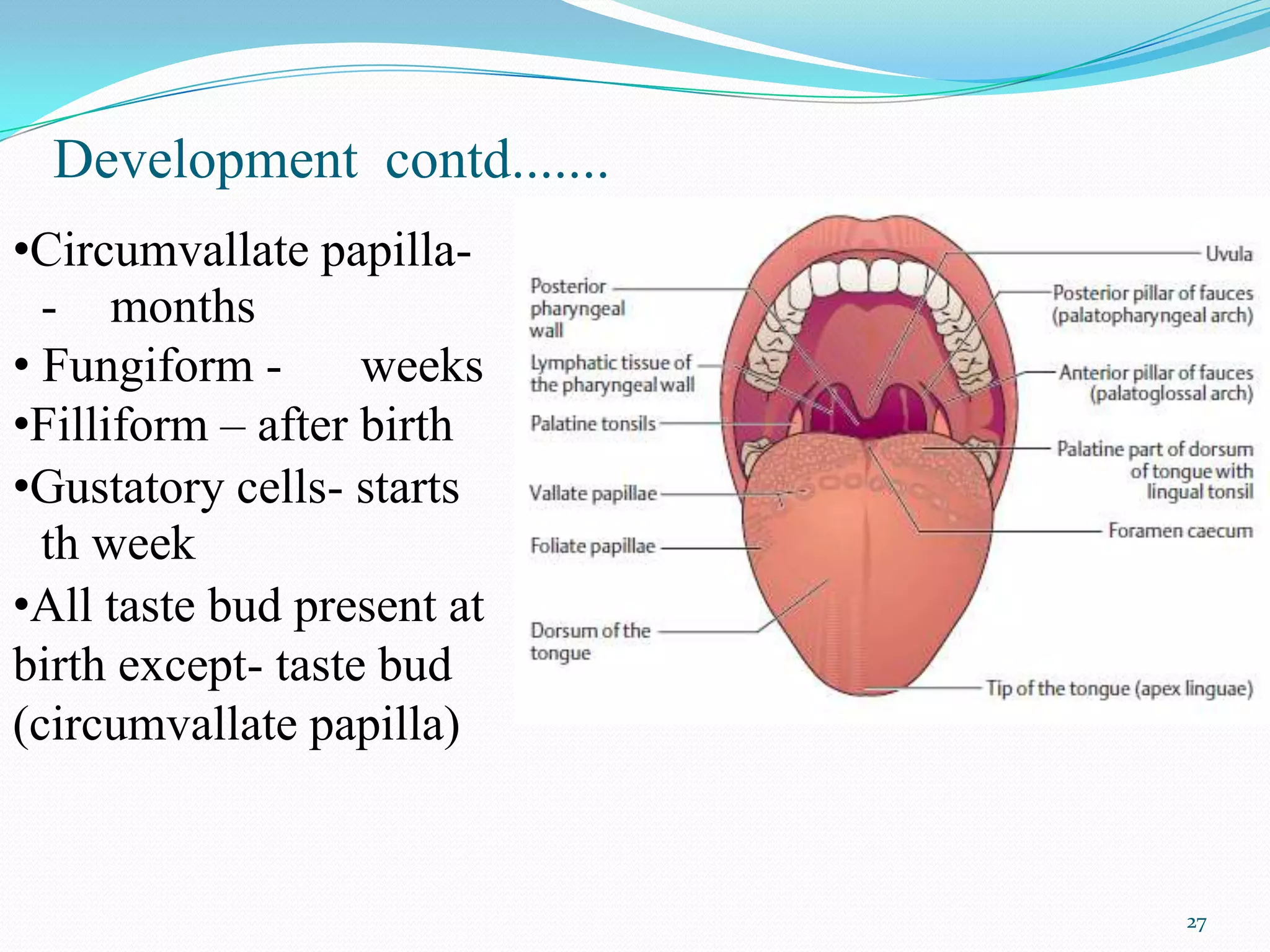
Development contd.......
•Circumvallate papilla-
  - months
• Fungiform -      weeks
•Filliform – after birth
•Gustatory cells- starts
  th week
•All taste bud present at
birth except- taste bud
(circumvallate papilla)


                             27
Development of the face

Development of the face

  • 1.
    Development of theFace Dr.Dashrath Kafle
  • 2.
    Face  At theend of the 4th week, facial prominences consisting primarily of neural crest-derived mesenchyme appear  Maxillary prominences- lateral to the stomodeum  mandibular prominences- caudal to stomodeum 2
  • 3.
    Face contd...  Frontonasalprominence - proliferation of mesenchyme ventral to the brain vesicles  On both sides, local thickenings of the surface ectoderm, the nasal placodes originate 3
  • 5.
    Face contd...  Duringthe 5th week, the nasal placodes invaginate to form nasal pits  Lateral nasal prominences  Medial nasal prominences 5
  • 7.
  • 8.
    Formation of lip The maxillary prominences grow medially, compressing medial nasal prominences towards midline, two fuse forming upper lip by two medial nasal prominences and two maxillary prominences 8
  • 10.
    Development of nose Maxillary prominences enlarge to form the cheeks and maxilla  Nose is formed from five facial prominences: - frontal prominence gives rise to bridge - merged medial nasal prominences provide the crest and tip - lateral nasal prominences form the alae 10
  • 11.
    Intermaxillary Segment  Twomedial nasal prominences merge at a deeper level forming the intermaxillary segment  Composed of (a) philtrum of the upper lip (b) upper jaw component- carries the four incisor teeth (c) primary palate 11
  • 12.
  • 13.
    Secondary Palate  Formedby two palatine shelves (6th week of development) –maxillary process  Directed obliquely downward on each side of the tongue  In the 7th week, the palatine shelves ascend to attain a horizontal position above the tongue and fuse, forming the secondary palate 13
  • 14.
    Secondary Palate contd... Nasal septum: derivative of Frontonasal process 14
  • 15.
    Secondary Palate contd... Anteriorly, the palatine shelves fuse with the primary palate 15
  • 18.
    Development of Tongue Appear at 4 weeks  As two lateral lingual swellings and one medial swelling, the tuberculum impar (all originate from the first pharyngeal arch)  A second median swelling, the copula, formed by mesoderm of the second, third, and part of the fourth arch 18
  • 19.
  • 20.
    Tongue contd...  Laterallingual swellings increase in size, overgrow the tuberculum impar and merge, forming the anterior two- thirds, or body, of the tongue  The body of the tongue is separated from the posterior third by a V-shaped groove, the terminal sulcus 20
  • 22.
    Tongue contd...  Athird median swelling, formed by the posterior part of the fourth arch, marks development of the epiglottis 22
  • 23.
  • 24.
    Tongue contd...  Themucosa covering the body of the tongue originates from the first pharyngeal arch  Sensory innervation to the posterior part, or root part of the tongue is supplied by the glossopharyngeal nerve 24
  • 25.
    Tongue contd...  Theepiglottis and the extreme posterior part of the tongue are innervated by the superior laryngeal nerve, reflecting their development from the fourth arch  Most tongue muscles are derived from myoblasts originating in occipital somites. So innervated by the hypoglossal nerve 25
  • 26.
    Tongue contd...  Specialsensory innervation (taste) to the anterior two thirds of the tongue is provided by the chorda tympani branch of the facial nerve, while the posterior third is supplied by the glossopharyngeal nerve 26
  • 27.
    Development contd....... •Circumvallate papilla- - months • Fungiform - weeks •Filliform – after birth •Gustatory cells- starts th week •All taste bud present at birth except- taste bud (circumvallate papilla) 27

Editor's Notes

  • #4 On both sides, local thickenings of the surface ectoderm, the nasal (olfactory) placodes, originate under inductive influence of the ventral portion of the forebrain
  • #6 In so doing, they create a ridge of tissue that surrounds each pit and forms the nasal prominences
  • #12 medial growth of the maxillary prominences helps two medial nasal prominences merge at a deeper level forming the intermaxillary segment
  • #25 sensory innervation to the posterior part, or root part of the tongue is supplied by the glossopharyngeal nerveindicates thattissue of the third arch overgrows that of the second