Ambient backscatter
Prepared by -Saumya pandey
16BSCSC020
Introduction-
Modulated backscatter technique was first introduced
by stockman in 1948.
Ambient backscatter uses exiting radio frequency
signals, such as radio television and mobile telephony,
to transmit data without a battery or grid connection.
Small computing devices are increasingly embedded
in objects and environments.
Came up with a novel concept that requires no
batteries or wires.
Backscatter
communication system
It can be classified into three major types:-
1. Monostatic backscatter(MBCS).
2. Bistatic backscatter (BBCS).
3. Ambient backscatter(ABCS).
Monostatic backscatter communication
system
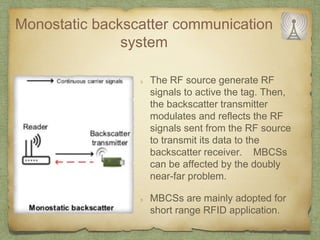
The RF source generate RF
signals to active the tag. Then,
the backscatter transmitter
modulates and reflects the RF
signals sent from the RF source
to transmit its data to the
backscatter receiver. MBCSs
can be affected by the doubly
near-far problem.
MBCSs are mainly adopted for
short range RFID application.
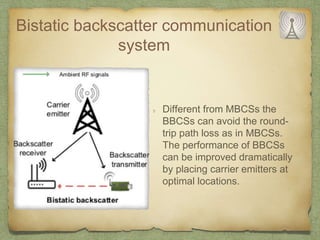
Bistatic backscatter communication
system
Different from MBCSs the
BBCSs can avoid the round-
trip path loss as in MBCSs.
The performance of BBCSs
can be improved dramatically
by placing carrier emitters at
optimal locations.
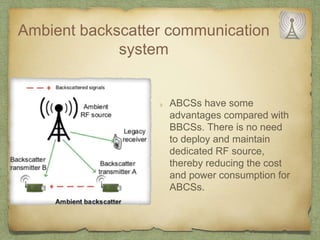
Ambient backscatter communication
system
ABCSs have some
advantages compared with
BBCSs. There is no need
to deploy and maintain
dedicated RF source,
thereby reducing the cost
and power consumption for
ABCSs.
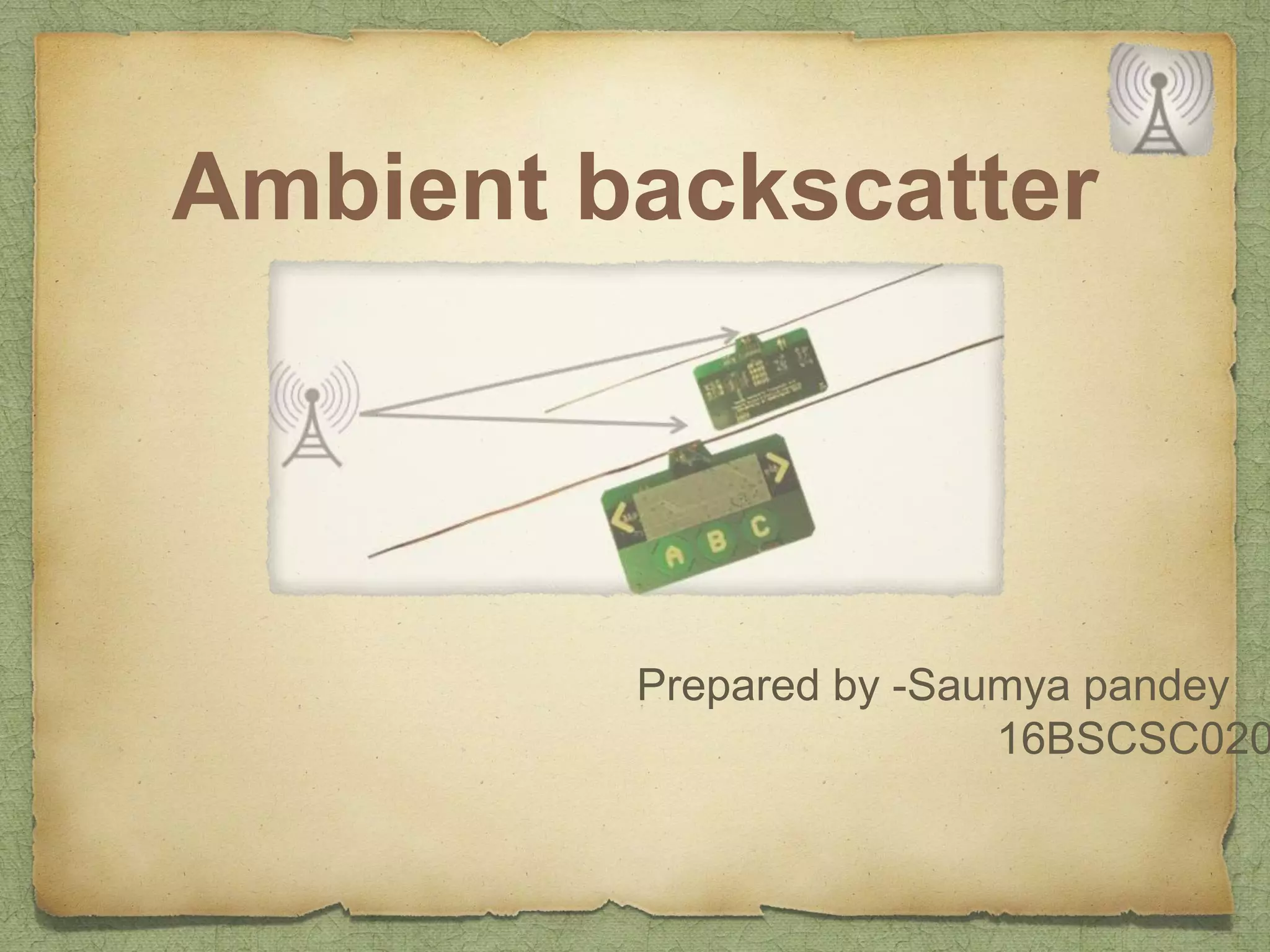
What is ambient backscatter
As device get smaller, providing room for wires
and batteries becomes more expensive.
Sans batteries.
Two device communicate with each other by
reflecting the existing signals to exchange
information.
What is ambient backscatter
(continued…)
Take advantage of ambient RF waves
• Tv, cellural and radio.
Small environmental footprint
• No additional energy consumed since it uses what’s
already in the air.
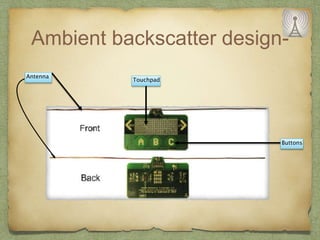
Ambient backscatter design-
Antenna
Touchpad
Buttons
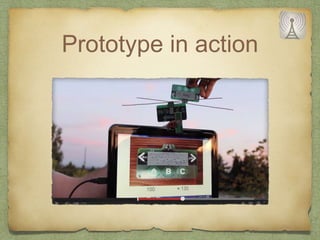
Prototype in action
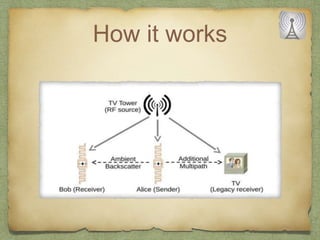
How it works
Two AB devices named Alice and Bob and a TV
tower in an urban environment as the ambience
source. Alice want to send a packet to Bob. She
does this by backscattering the ambient RF signals
to convey the bits in the packet.
How it works (continued..)
Ambient backscatter devices can use these
signals to power itself and reflect signals
• By reflecting or not, they transmit a 0 and 1
Bob can sense the backscattering signal changes
and decode Alice’s packet.
Also create “additional Multipath”.
TV Transmissions
Towers transmit upto 1MV` effective radiated power.
serve location: More than 100 miles in flat terrain.
Up to 45 miles in denser terrain
Broadcast uninterrupted, continuous signals.
Fast changing amplitude varying signals.
Ability of tv receivers to account for multi path
distortion.
Challenge in design
Backscatter signals are weak.
Traditional backscatter uses constant signal.
Ambient signals with information already encoded
in them.
No power hungry components like oscillators ,ADCs
etc. for battery-free receiver.
No centralized controller.
Legality
Illegal to broadcast random signal on tv spectrum.
Backscattering devices are unregulated and not
tested by FCC(federal communication
commission).
No active emission.
Only modulating the reflecting signals.
Future application
Embed into building, bridges, infrastructure to alert
engineers about potential weaknesses.
Because the are require no batteries, can be
imbedded into materials like concrete.
It can send an alert to the users phone that they
left their keys on the couch or table.
Future application (continued….)
Example from research paper:
• Grocery store:
• Ambient backscatter devices can be used for inventory
systems. To alert when stock needs refilled.
• Can also help customers locate items by transmitting the
location to a user’s phone.
More research needed to improve technology
Transfers are currently slow:
• More research needed to speed up transmission
• Can be possible to improve this using different signal
strengths.
Future application (continued….)
Thank you

Ambient backscatter

  • 1.
    Ambient backscatter Prepared by-Saumya pandey 16BSCSC020
  • 2.
    Introduction- Modulated backscatter techniquewas first introduced by stockman in 1948. Ambient backscatter uses exiting radio frequency signals, such as radio television and mobile telephony, to transmit data without a battery or grid connection. Small computing devices are increasingly embedded in objects and environments. Came up with a novel concept that requires no batteries or wires.
  • 3.
    Backscatter communication system It canbe classified into three major types:- 1. Monostatic backscatter(MBCS). 2. Bistatic backscatter (BBCS). 3. Ambient backscatter(ABCS).
  • 4.
    Monostatic backscatter communication system TheRF source generate RF signals to active the tag. Then, the backscatter transmitter modulates and reflects the RF signals sent from the RF source to transmit its data to the backscatter receiver. MBCSs can be affected by the doubly near-far problem. MBCSs are mainly adopted for short range RFID application.
  • 5.
    Bistatic backscatter communication system Differentfrom MBCSs the BBCSs can avoid the round- trip path loss as in MBCSs. The performance of BBCSs can be improved dramatically by placing carrier emitters at optimal locations.
  • 6.
    Ambient backscatter communication system ABCSshave some advantages compared with BBCSs. There is no need to deploy and maintain dedicated RF source, thereby reducing the cost and power consumption for ABCSs.
  • 7.
    What is ambientbackscatter As device get smaller, providing room for wires and batteries becomes more expensive. Sans batteries. Two device communicate with each other by reflecting the existing signals to exchange information.
  • 8.
    What is ambientbackscatter (continued…) Take advantage of ambient RF waves • Tv, cellural and radio. Small environmental footprint • No additional energy consumed since it uses what’s already in the air.
  • 9.
  • 10.
  • 11.
  • 12.
    Two AB devicesnamed Alice and Bob and a TV tower in an urban environment as the ambience source. Alice want to send a packet to Bob. She does this by backscattering the ambient RF signals to convey the bits in the packet.
  • 13.
    How it works(continued..) Ambient backscatter devices can use these signals to power itself and reflect signals • By reflecting or not, they transmit a 0 and 1 Bob can sense the backscattering signal changes and decode Alice’s packet. Also create “additional Multipath”.
  • 14.
    TV Transmissions Towers transmitupto 1MV` effective radiated power. serve location: More than 100 miles in flat terrain. Up to 45 miles in denser terrain Broadcast uninterrupted, continuous signals. Fast changing amplitude varying signals. Ability of tv receivers to account for multi path distortion.
  • 15.
    Challenge in design Backscattersignals are weak. Traditional backscatter uses constant signal. Ambient signals with information already encoded in them. No power hungry components like oscillators ,ADCs etc. for battery-free receiver. No centralized controller.
  • 16.
    Legality Illegal to broadcastrandom signal on tv spectrum. Backscattering devices are unregulated and not tested by FCC(federal communication commission). No active emission. Only modulating the reflecting signals.
  • 17.
    Future application Embed intobuilding, bridges, infrastructure to alert engineers about potential weaknesses. Because the are require no batteries, can be imbedded into materials like concrete. It can send an alert to the users phone that they left their keys on the couch or table.
  • 18.
    Future application (continued….) Examplefrom research paper: • Grocery store: • Ambient backscatter devices can be used for inventory systems. To alert when stock needs refilled. • Can also help customers locate items by transmitting the location to a user’s phone. More research needed to improve technology
  • 19.
    Transfers are currentlyslow: • More research needed to speed up transmission • Can be possible to improve this using different signal strengths. Future application (continued….)
  • 20.