McCabe, Thomas
Fairfield University
OM0140 A
Intro to Project Management
W 7:00:00
Spring 2011
IDEA Diagnostic Form Report
To learn more, see the Interpretive Guide: www.theideacenter.org/diagnosticguide.pdf
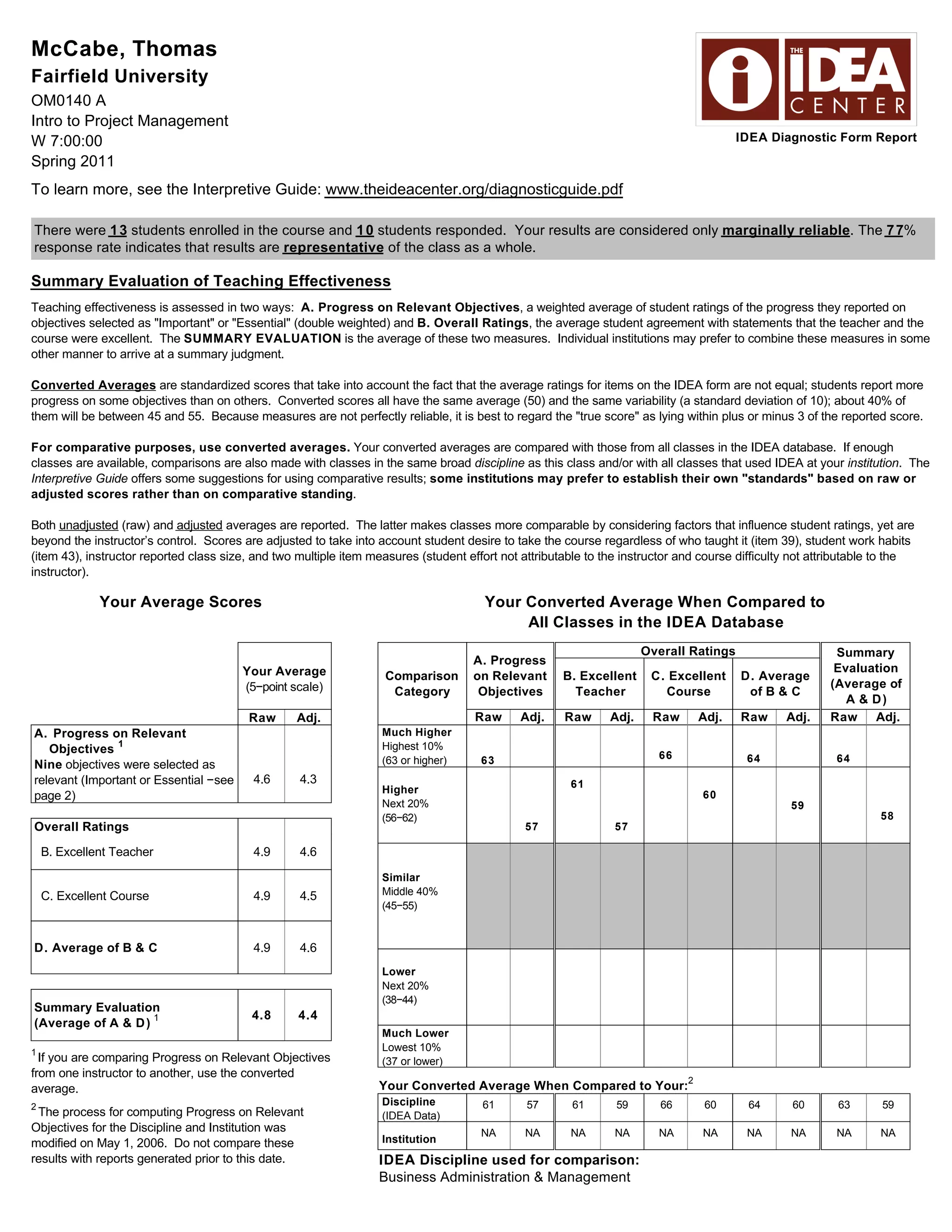
There were 13 students enrolled in the course and 10 students responded. Your results are considered only marginally reliable. The 77%
response rate indicates that results are representative of the class as a whole.
There were 13 students enrolled in the course and 10 students responded. Your results are considered only marginally reliable. The 77%
response rate indicates that results are representative of the class as a whole.
Summary Evaluation of Teaching Effectiveness
Teaching effectiveness is assessed in two ways: A. Progress on Relevant Objectives, a weighted average of student ratings of the progress they reported on
objectives selected as "Important" or "Essential" (double weighted) and B. Overall Ratings, the average student agreement with statements that the teacher and the
course were excellent. The SUMMARY EVALUATION is the average of these two measures. Individual institutions may prefer to combine these measures in some
other manner to arrive at a summary judgment.
Converted Averages are standardized scores that take into account the fact that the average ratings for items on the IDEA form are not equal; students report more
progress on some objectives than on others. Converted scores all have the same average (50) and the same variability (a standard deviation of 10); about 40% of
them will be between 45 and 55. Because measures are not perfectly reliable, it is best to regard the "true score" as lying within plus or minus 3 of the reported score.
For comparative purposes, use converted averages. Your converted averages are compared with those from all classes in the IDEA database. If enough
classes are available, comparisons are also made with classes in the same broad discipline as this class and/or with all classes that used IDEA at your institution. The
Interpretive Guide offers some suggestions for using comparative results; some institutions may prefer to establish their own "standards" based on raw or
adjusted scores rather than on comparative standing.
Both unadjusted (raw) and adjusted averages are reported. The latter makes classes more comparable by considering factors that influence student ratings, yet are
beyond the instructor’s control. Scores are adjusted to take into account student desire to take the course regardless of who taught it (item 39), student work habits
(item 43), instructor reported class size, and two multiple item measures (student effort not attributable to the instructor and course difficulty not attributable to the
instructor).
Your Average Scores
Your Average
(5−point scale)
Raw Adj.
A. Progress on Relevant
Objectives
1
Nine objectives were selected as
relevant (Important or Essential −see
page 2)
4.6 4.3
Overall Ratings
B. Excellent Teacher 4.9 4.6
C. Excellent Course 4.9 4.5
D. Average of B & C 4.9 4.6
Summary Evaluation
(Average of A & D)
1 4.8 4.4
1
If you are comparing Progress on Relevant Objectives
from one instructor to another, use the converted
average.
2
The process for computing Progress on Relevant
Objectives for the Discipline and Institution was
modified on May 1, 2006. Do not compare these
results with reports generated prior to this date.
Your Converted Average When Compared to
All Classes in the IDEA Database
Comparison
Category
Much Higher
Highest 10%
(63 or higher)
Higher
Next 20%
(56−62)
Similar
Middle 40%
(45−55)
Lower
Next 20%
(38−44)
Much Lower
Lowest 10%
(37 or lower)
Your Converted Average When Compared to Your:
2
Discipline
(IDEA Data)
Institution
IDEA Discipline used for comparison:
Business Administration & Management
A. Progress
on Relevant
Objectives
Raw Adj.
63
61
NA
57
57
NA
B. Excellent
Teacher
Raw Adj.
61
61
NA
57
59
NA
C. Excellent
Course
Raw Adj.
66
66
NA
60
60
NA
D. Average
of B & C
Raw Adj.
64
64
NA
59
60
NA
Overall Ratings Summary
Evaluation
(Average of
A & D)
Raw Adj.
64
63
NA
58
59
NA
Student Ratings of Learning on Relevant (Important and Essential) Objectives
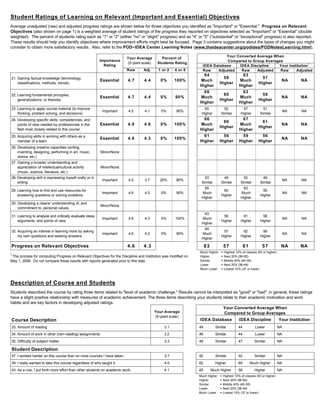
Average unadjusted (raw) and adjusted progress ratings are shown below for those objectives you identified as "Important" or "Essential." Progress on Relevant
Objectives (also shown on page 1) is a weighted average of student ratings of the progress they reported on objectives selected as "Important" or "Essential" (double
weighted). The percent of students rating each as "1" or "2" (either "no" or "slight" progress) and as "4" or "5" ("substantial" or "exceptional" progress) is also reported.
These results should help you identify objectives where improvement efforts might best be focused. Page 3 contains suggestions about the types of changes you might
consider to obtain more satisfactory results. Also, refer to the POD−IDEA Center Learning Notes (www.theideacenter.org/podidea/PODNotesLearning.html).
Importance
Rating
Your Average
(5−point scale)
Percent of
Students Rating
Raw Adj. 1 or 2 4 or 5
Your Converted Average When
Compared to Group Averages
IDEA Database IDEA Discipline
1
Your Institution
1
Raw Adjusted Raw Adjusted Raw Adjusted
21. Gaining factual knowledge (terminology,
classifications, methods, trends)
Essential 4.7 4.4 0% 100%
64
Much
Higher
58
Higher
63
Much
Higher
57
Higher
NA NA
22. Learning fundamental principles,
generalizations, or theories
Essential 4.7 4.4 0% 90%
66
Much
Higher
60
Higher
63
Much
Higher
58
Higher
NA NA
23. Learning to apply course material (to improve
thinking, problem solving, and decisions)
Important 4.5 4.1 0% 90%
60
Higher
52
Similar
57
Higher
51
Similar
NA NA
24. Developing specific skills, competencies, and
points of view needed by professionals in the
field most closely related to this course
Essential 4.9 4.6 0% 100%
66
Much
Higher
60
Higher
67
Much
Higher
61
Higher
NA NA
25. Acquiring skills in working with others as a
member of a team
Essential 4.6 4.3 0% 100%
61
Higher
56
Higher
59
Higher
56
Higher
NA NA
26. Developing creative capacities (writing,
inventing, designing, performing in art, music,
drama, etc.)
Minor/None
27. Gaining a broader understanding and
appreciation of intellectual/cultural activity
(music, science, literature, etc.)
Minor/None
28. Developing skill in expressing myself orally or in
writing
Important 4.0 3.7 20% 80%
53
Similar
49
Similar
52
Similar
49
Similar
NA NA
29. Learning how to find and use resources for
answering questions or solving problems
Important 4.6 4.3 0% 90%
65
Much
Higher
60
Higher
63
Much
Higher
59
Higher
NA NA
30. Developing a clearer understanding of, and
commitment to, personal values
Minor/None
31. Learning to analyze and critically evaluate ideas,
arguments, and points of view
Important 4.6 4.3 0% 100%
63
Much
Higher
58
Higher
61
Higher
58
Higher
NA NA
32. Acquiring an interest in learning more by asking
my own questions and seeking answers
Important 4.6 4.2 0% 90%
64
Much
Higher
57
Higher
62
Higher
56
Higher
NA NA
Progress on Relevant Objectives 4.6 4.3 63 57 61 57 NA NA
1
The process for computing Progress on Relevant Objectives for the Discipline and Institution was modified on
May 1, 2006. Do not compare these results with reports generated prior to this date.
Much Higher = Highest 10% of classes (63 or higher)
Higher = Next 20% (56−62)
Similar = Middle 40% (45−55)
Lower = Next 20% (38−44)
Much Lower = Lowest 10% (37 or lower)
Description of Course and Students
Students described the course by rating three items related to "level of academic challenge." Results cannot be interpreted as "good" or "bad"; in general, these ratings
have a slight positive relationship with measures of academic achievement. The three items describing your students relate to their academic motivation and work
habits and are key factors in developing adjusted ratings.
Your Average
(5−point scale)
Course Description
Your Converted Average When
Compared to Group Averages
IDEA Database IDEA Discipline Your Institution
33. Amount of reading 3.1 49 Similar 44 Lower NA
34. Amount of work in other (non−reading) assignments 3.2 46 Similar 44 Lower NA
35. Difficulty of subject matter 3.3 48 Similar 47 Similar NA
Student Description
37. I worked harder on this course than on most courses I have taken. 3.7 52 Similar 52 Similar NA
39. I really wanted to take this course regardless of who taught it. 4.0 62 Higher 65 Much Higher NA
43. As a rule, I put forth more effort than other students on academic work. 4.1 65 Much Higher 59 Higher NA
Much Higher = Highest 10% of classes (63 or higher)
Higher = Next 20% (56−62)
Similar = Middle 40% (45−55)
Lower = Next 20% (38−44)
Much Lower = Lowest 10% (37 or lower)
Improving Teaching Effectiveness
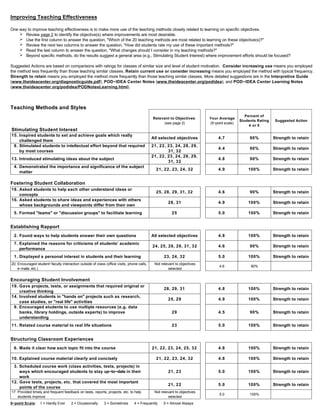
One way to improve teaching effectiveness is to make more use of the teaching methods closely related to learning on specific objectives.
Review page 2 to identify the objective(s) where improvements are most desirable.
Use the first column to answer the question, "Which of the 20 teaching methods are most related to learning on these objective(s)?"
Review the next two columns to answer the question, "How did students rate my use of these important methods?"
Read the last column to answer the question, "What changes should I consider in my teaching methods?"
Beyond specific methods, do the results suggest a general area (e.g., Stimulating Student Interest) where improvement efforts should be focused?
Suggested Actions are based on comparisons with ratings for classes of similar size and level of student motivation. Consider increasing use means you employed
the method less frequently than those teaching similar classes. Retain current use or consider increasing means you employed the method with typical frequency.
Strength to retain means you employed the method more frequently than those teaching similar classes. More detailed suggestions are in the Interpretive Guide
(www.theideacenter.org/diagnosticguide.pdf), POD−IDEA Center Notes (www.theideacenter.org/podidea), and POD−IDEA Center Learning Notes
(www.theideacenter.org/podidea/PODNotesLearning.html).
Teaching Methods and Styles
Relevant to Objectives:
(see page 2)
Stimulating Student Interest
Your Average
(5−point scale)
Percent of
Students Rating
4 or 5
Suggested Action
15. Inspired students to set and achieve goals which really
challenged them
All selected objectives 4.7 90% Strength to retain
8. Stimulated students to intellectual effort beyond that required
by most courses
21, 22, 23, 24, 28, 29,
31, 32
4.4 90% Strength to retain
13. Introduced stimulating ideas about the subject
21, 22, 23, 24, 28, 29,
31, 32
4.8 90% Strength to retain
4. Demonstrated the importance and significance of the subject
matter
21, 22, 23, 24, 32 4.9 100% Strength to retain
Fostering Student Collaboration
18. Asked students to help each other understand ideas or
concepts
25, 28, 29, 31, 32 4.6 90% Strength to retain
16. Asked students to share ideas and experiences with others
whose backgrounds and viewpoints differ from their own
28, 31 4.9 100% Strength to retain
5. Formed "teams" or "discussion groups" to facilitate learning 25 5.0 100% Strength to retain
Establishing Rapport
2. Found ways to help students answer their own questions All selected objectives 4.8 100% Strength to retain
7. Explained the reasons for criticisms of students’ academic
performance
24, 25, 28, 29, 31, 32 4.6 90% Strength to retain
1. Displayed a personal interest in students and their learning 23, 24, 32 5.0 100% Strength to retain
20. Encouraged student−faculty interaction outside of class (office visits, phone calls,
e−mails, etc.)
Not relevant to objectives
selected
4.6 90%
Encouraging Student Involvement
19. Gave projects, tests, or assignments that required original or
creative thinking
28, 29, 31 4.8 100% Strength to retain
14. Involved students in "hands on" projects such as research,
case studies, or "real life" activities
25, 29 4.9 100% Strength to retain
9. Encouraged students to use multiple resources (e.g. data
banks, library holdings, outside experts) to improve
understanding
29 4.5 90% Strength to retain
11. Related course material to real life situations 23 5.0 100% Strength to retain
Structuring Classroom Experiences
6. Made it clear how each topic fit into the course 21, 22, 23, 24, 25, 32 4.8 100% Strength to retain
10. Explained course material clearly and concisely 21, 22, 23, 24, 32 4.8 100% Strength to retain
3. Scheduled course work (class activities, tests, projects) in
ways which encouraged students to stay up−to−date in their
work
21, 23 5.0 100% Strength to retain
12. Gave tests, projects, etc. that covered the most important
points of the course
21, 22 5.0 100% Strength to retain
17. Provided timely and frequent feedback on tests, reports, projects, etc. to help
students improve
Not relevant to objectives
selected
5.0 100%
5−point Scale: 1 = Hardly Ever 2 = Occasionally 3 = Sometimes 4 = Frequently 5 = Almost Always
Statistical Detail Number Responding
1 2 3 4 5 Omit Avg. s.d.
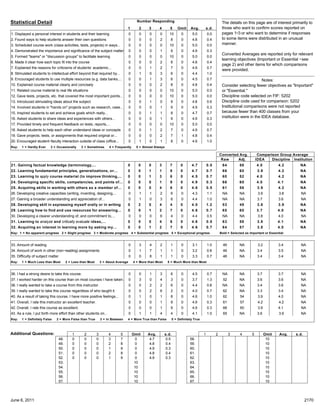
The details on this page are of interest primarily to
those who want to confirm scores reported on
pages 1−3 or who want to determine if responses
to some items were distributed in an unusual
manner.
Converted Averages are reported only for relevant
learning objectives (Important or Essential −see
page 2) and other items for which comparisons
were provided.
Notes:
Consider selecting fewer objectives as "Important"
or "Essential."
Discipline code selected on FIF: 5202
Discipline code used for comparison: 5202
Institutional comparisons were not reported
because fewer than 400 classes from your
institution were in the IDEA database.
1. Displayed a personal interest in students and their learning 0 0 0 0 10 0 5.0 0.0
2. Found ways to help students answer their own questions 0 0 0 2 8 0 4.8 0.4
3. Scheduled course work (class activities, tests, projects) in ways... 0 0 0 0 10 0 5.0 0.0
4. Demonstrated the importance and significance of the subject matter 0 0 0 1 9 0 4.9 0.3
5. Formed "teams" or "discussion groups" to facilitate learning 0 0 0 0 10 0 5.0 0.0
6. Made it clear how each topic fit into the course 0 0 0 2 8 0 4.8 0.4
7. Explained the reasons for criticisms of students’ academic... 0 0 1 2 7 0 4.6 0.7
8. Stimulated students to intellectual effort beyond that required by... 0 1 0 3 6 0 4.4 1.0
9. Encouraged students to use multiple resources (e.g. data banks,... 0 0 1 3 6 0 4.5 0.7
10. Explained course material clearly and concisely 0 0 0 2 8 0 4.8 0.4
11. Related course material to real life situations 0 0 0 0 10 0 5.0 0.0
12. Gave tests, projects, etc. that covered the most important points... 0 0 0 0 10 0 5.0 0.0
13. Introduced stimulating ideas about the subject 0 0 1 0 9 0 4.8 0.6
14. Involved students in "hands on" projects such as research, case... 0 0 0 1 9 0 4.9 0.3
15. Inspired students to set and achieve goals which really... 0 0 1 1 8 0 4.7 0.7
16. Asked students to share ideas and experiences with others... 0 0 0 1 9 0 4.9 0.3
17. Provided timely and frequent feedback on tests, reports,... 0 0 0 0 10 0 5.0 0.0
18. Asked students to help each other understand ideas or concepts 0 0 1 2 7 0 4.6 0.7
19. Gave projects, tests, or assignments that required original or... 0 0 0 2 7 1 4.8 0.4
20. Encouraged student−faculty interaction outside of class (office... 0 1 0 1 8 0 4.6 1.0
Key: 1 = Hardly Ever 2 = Occasionally 3 = Sometimes 4 = Frequently 5 = Almost Always
Converted Avg. Comparison Group Average
Raw Adj. IDEA Discipline Institution
21. Gaining factual knowledge (terminology,... 0 0 0 3 7 0 4.7 0.5 64 58 4.0 4.2 NA
22. Learning fundamental principles, generalizations, or... 0 0 1 1 8 0 4.7 0.7 66 60 3.9 4.2 NA
23. Learning to apply course material (to improve thinking,... 0 0 1 3 6 0 4.5 0.7 60 52 4.0 4.2 NA
24. Developing specific skills, competencies, and points of... 0 0 0 1 9 0 4.9 0.3 66 60 4.0 4.1 NA
25. Acquiring skills in working with others as a member of... 0 0 0 4 6 0 4.6 0.5 61 56 3.9 4.2 NA
26. Developing creative capacities (writing, inventing, designing,... 0 1 1 2 6 0 4.3 1.1 NA NA 3.9 3.8 NA
27. Gaining a broader understanding and appreciation of... 0 1 0 3 6 0 4.4 1.0 NA NA 3.7 3.6 NA
28. Developing skill in expressing myself orally or in writing 0 2 0 4 4 0 4.0 1.2 53 49 3.8 3.9 NA
29. Learning how to find and use resources for answering... 0 0 1 2 7 0 4.6 0.7 65 60 3.7 4.0 NA
30. Developing a clearer understanding of, and commitment to,... 0 0 0 6 4 0 4.4 0.5 NA NA 3.8 4.0 NA
31. Learning to analyze and critically evaluate ideas,... 0 0 0 4 6 0 4.6 0.5 63 58 3.8 4.1 NA
32. Acquiring an interest in learning more by asking my... 0 0 1 2 7 0 4.6 0.7 64 57 3.8 4.0 NA
Key: 1 = No apparent progress 2 = Slight progress 3 = Moderate progress 4 = Substantial progress 5 = Exceptional progress Bold = Selected as Important or Essential
33. Amount of reading 0 3 4 2 1 0 3.1 1.0 49 NA 3.2 3.4 NA
34. Amount of work in other (non−reading) assignments 0 1 7 1 1 0 3.2 0.8 46 NA 3.4 3.5 NA
35. Difficulty of subject matter 0 0 8 1 1 0 3.3 0.7 48 NA 3.4 3.4 NA
Key: 1 = Much Less than Most 2 = Less than Most 3 = About Average 4 = More than Most 5 = Much More than Most
36. I had a strong desire to take this course. 0 0 1 3 6 0 4.5 0.7 NA NA 3.7 3.7 NA
37. I worked harder on this course than on most courses I have taken. 0 3 0 4 3 0 3.7 1.3 52 NA 3.6 3.6 NA
38. I really wanted to take a course from this instructor. 0 0 2 2 6 0 4.4 0.8 NA NA 3.4 3.6 NA
39. I really wanted to take this course regardless of who taught it. 0 0 2 6 2 0 4.0 0.7 62 NA 3.3 3.4 NA
40. As a result of taking this course, I have more positive feelings... 0 1 0 1 8 0 4.6 1.0 62 54 3.9 4.0 NA
41. Overall, I rate this instructor an excellent teacher. 0 0 0 1 9 0 4.9 0.3 61 57 4.2 4.2 NA
42. Overall, I rate this course as excellent. 0 0 0 1 9 0 4.9 0.3 66 60 3.9 4.1 NA
43. As a rule, I put forth more effort than other students on... 0 1 1 4 4 0 4.1 1.0 65 NA 3.6 3.9 NA
Key: 1 = Definitely False 2 = More False than True 3 = In Between 4 = More True than False 5 = Definitely True
Additional Questions: 1 2 3 4 5 Omit Avg. s.d.
48. 0 0 0 3 7 0 4.7 0.5
49. 0 0 0 2 8 0 4.8 0.4
50. 0 0 0 1 9 0 4.9 0.3
51. 0 0 0 2 8 0 4.8 0.4
52. 0 0 0 1 9 0 4.9 0.3
53. 10
54. 10
55. 10
56. 10
57. 10
1 2 3 4 5 Omit Avg. s.d.
58. 10
59. 10
60. 10
61. 10
62. 10
63. 10
64. 10
65. 10
66. 10
67. 10
June 6, 2011 2170

2011 Spring - IDEA Diagnostic - Fairfield U - Student Feedack - Prof McCabe, Thomas

  • 1.
    McCabe, Thomas Fairfield University OM0140A Intro to Project Management W 7:00:00 Spring 2011 IDEA Diagnostic Form Report To learn more, see the Interpretive Guide: www.theideacenter.org/diagnosticguide.pdf There were 13 students enrolled in the course and 10 students responded. Your results are considered only marginally reliable. The 77% response rate indicates that results are representative of the class as a whole. There were 13 students enrolled in the course and 10 students responded. Your results are considered only marginally reliable. The 77% response rate indicates that results are representative of the class as a whole. Summary Evaluation of Teaching Effectiveness Teaching effectiveness is assessed in two ways: A. Progress on Relevant Objectives, a weighted average of student ratings of the progress they reported on objectives selected as "Important" or "Essential" (double weighted) and B. Overall Ratings, the average student agreement with statements that the teacher and the course were excellent. The SUMMARY EVALUATION is the average of these two measures. Individual institutions may prefer to combine these measures in some other manner to arrive at a summary judgment. Converted Averages are standardized scores that take into account the fact that the average ratings for items on the IDEA form are not equal; students report more progress on some objectives than on others. Converted scores all have the same average (50) and the same variability (a standard deviation of 10); about 40% of them will be between 45 and 55. Because measures are not perfectly reliable, it is best to regard the "true score" as lying within plus or minus 3 of the reported score. For comparative purposes, use converted averages. Your converted averages are compared with those from all classes in the IDEA database. If enough classes are available, comparisons are also made with classes in the same broad discipline as this class and/or with all classes that used IDEA at your institution. The Interpretive Guide offers some suggestions for using comparative results; some institutions may prefer to establish their own "standards" based on raw or adjusted scores rather than on comparative standing. Both unadjusted (raw) and adjusted averages are reported. The latter makes classes more comparable by considering factors that influence student ratings, yet are beyond the instructor’s control. Scores are adjusted to take into account student desire to take the course regardless of who taught it (item 39), student work habits (item 43), instructor reported class size, and two multiple item measures (student effort not attributable to the instructor and course difficulty not attributable to the instructor). Your Average Scores Your Average (5−point scale) Raw Adj. A. Progress on Relevant Objectives 1 Nine objectives were selected as relevant (Important or Essential −see page 2) 4.6 4.3 Overall Ratings B. Excellent Teacher 4.9 4.6 C. Excellent Course 4.9 4.5 D. Average of B & C 4.9 4.6 Summary Evaluation (Average of A & D) 1 4.8 4.4 1 If you are comparing Progress on Relevant Objectives from one instructor to another, use the converted average. 2 The process for computing Progress on Relevant Objectives for the Discipline and Institution was modified on May 1, 2006. Do not compare these results with reports generated prior to this date. Your Converted Average When Compared to All Classes in the IDEA Database Comparison Category Much Higher Highest 10% (63 or higher) Higher Next 20% (56−62) Similar Middle 40% (45−55) Lower Next 20% (38−44) Much Lower Lowest 10% (37 or lower) Your Converted Average When Compared to Your: 2 Discipline (IDEA Data) Institution IDEA Discipline used for comparison: Business Administration & Management A. Progress on Relevant Objectives Raw Adj. 63 61 NA 57 57 NA B. Excellent Teacher Raw Adj. 61 61 NA 57 59 NA C. Excellent Course Raw Adj. 66 66 NA 60 60 NA D. Average of B & C Raw Adj. 64 64 NA 59 60 NA Overall Ratings Summary Evaluation (Average of A & D) Raw Adj. 64 63 NA 58 59 NA
  • 2.
    Student Ratings ofLearning on Relevant (Important and Essential) Objectives Average unadjusted (raw) and adjusted progress ratings are shown below for those objectives you identified as "Important" or "Essential." Progress on Relevant Objectives (also shown on page 1) is a weighted average of student ratings of the progress they reported on objectives selected as "Important" or "Essential" (double weighted). The percent of students rating each as "1" or "2" (either "no" or "slight" progress) and as "4" or "5" ("substantial" or "exceptional" progress) is also reported. These results should help you identify objectives where improvement efforts might best be focused. Page 3 contains suggestions about the types of changes you might consider to obtain more satisfactory results. Also, refer to the POD−IDEA Center Learning Notes (www.theideacenter.org/podidea/PODNotesLearning.html). Importance Rating Your Average (5−point scale) Percent of Students Rating Raw Adj. 1 or 2 4 or 5 Your Converted Average When Compared to Group Averages IDEA Database IDEA Discipline 1 Your Institution 1 Raw Adjusted Raw Adjusted Raw Adjusted 21. Gaining factual knowledge (terminology, classifications, methods, trends) Essential 4.7 4.4 0% 100% 64 Much Higher 58 Higher 63 Much Higher 57 Higher NA NA 22. Learning fundamental principles, generalizations, or theories Essential 4.7 4.4 0% 90% 66 Much Higher 60 Higher 63 Much Higher 58 Higher NA NA 23. Learning to apply course material (to improve thinking, problem solving, and decisions) Important 4.5 4.1 0% 90% 60 Higher 52 Similar 57 Higher 51 Similar NA NA 24. Developing specific skills, competencies, and points of view needed by professionals in the field most closely related to this course Essential 4.9 4.6 0% 100% 66 Much Higher 60 Higher 67 Much Higher 61 Higher NA NA 25. Acquiring skills in working with others as a member of a team Essential 4.6 4.3 0% 100% 61 Higher 56 Higher 59 Higher 56 Higher NA NA 26. Developing creative capacities (writing, inventing, designing, performing in art, music, drama, etc.) Minor/None 27. Gaining a broader understanding and appreciation of intellectual/cultural activity (music, science, literature, etc.) Minor/None 28. Developing skill in expressing myself orally or in writing Important 4.0 3.7 20% 80% 53 Similar 49 Similar 52 Similar 49 Similar NA NA 29. Learning how to find and use resources for answering questions or solving problems Important 4.6 4.3 0% 90% 65 Much Higher 60 Higher 63 Much Higher 59 Higher NA NA 30. Developing a clearer understanding of, and commitment to, personal values Minor/None 31. Learning to analyze and critically evaluate ideas, arguments, and points of view Important 4.6 4.3 0% 100% 63 Much Higher 58 Higher 61 Higher 58 Higher NA NA 32. Acquiring an interest in learning more by asking my own questions and seeking answers Important 4.6 4.2 0% 90% 64 Much Higher 57 Higher 62 Higher 56 Higher NA NA Progress on Relevant Objectives 4.6 4.3 63 57 61 57 NA NA 1 The process for computing Progress on Relevant Objectives for the Discipline and Institution was modified on May 1, 2006. Do not compare these results with reports generated prior to this date. Much Higher = Highest 10% of classes (63 or higher) Higher = Next 20% (56−62) Similar = Middle 40% (45−55) Lower = Next 20% (38−44) Much Lower = Lowest 10% (37 or lower) Description of Course and Students Students described the course by rating three items related to "level of academic challenge." Results cannot be interpreted as "good" or "bad"; in general, these ratings have a slight positive relationship with measures of academic achievement. The three items describing your students relate to their academic motivation and work habits and are key factors in developing adjusted ratings. Your Average (5−point scale) Course Description Your Converted Average When Compared to Group Averages IDEA Database IDEA Discipline Your Institution 33. Amount of reading 3.1 49 Similar 44 Lower NA 34. Amount of work in other (non−reading) assignments 3.2 46 Similar 44 Lower NA 35. Difficulty of subject matter 3.3 48 Similar 47 Similar NA Student Description 37. I worked harder on this course than on most courses I have taken. 3.7 52 Similar 52 Similar NA 39. I really wanted to take this course regardless of who taught it. 4.0 62 Higher 65 Much Higher NA 43. As a rule, I put forth more effort than other students on academic work. 4.1 65 Much Higher 59 Higher NA Much Higher = Highest 10% of classes (63 or higher) Higher = Next 20% (56−62) Similar = Middle 40% (45−55) Lower = Next 20% (38−44) Much Lower = Lowest 10% (37 or lower)
  • 3.
    Improving Teaching Effectiveness Oneway to improve teaching effectiveness is to make more use of the teaching methods closely related to learning on specific objectives. Review page 2 to identify the objective(s) where improvements are most desirable. Use the first column to answer the question, "Which of the 20 teaching methods are most related to learning on these objective(s)?" Review the next two columns to answer the question, "How did students rate my use of these important methods?" Read the last column to answer the question, "What changes should I consider in my teaching methods?" Beyond specific methods, do the results suggest a general area (e.g., Stimulating Student Interest) where improvement efforts should be focused? Suggested Actions are based on comparisons with ratings for classes of similar size and level of student motivation. Consider increasing use means you employed the method less frequently than those teaching similar classes. Retain current use or consider increasing means you employed the method with typical frequency. Strength to retain means you employed the method more frequently than those teaching similar classes. More detailed suggestions are in the Interpretive Guide (www.theideacenter.org/diagnosticguide.pdf), POD−IDEA Center Notes (www.theideacenter.org/podidea), and POD−IDEA Center Learning Notes (www.theideacenter.org/podidea/PODNotesLearning.html). Teaching Methods and Styles Relevant to Objectives: (see page 2) Stimulating Student Interest Your Average (5−point scale) Percent of Students Rating 4 or 5 Suggested Action 15. Inspired students to set and achieve goals which really challenged them All selected objectives 4.7 90% Strength to retain 8. Stimulated students to intellectual effort beyond that required by most courses 21, 22, 23, 24, 28, 29, 31, 32 4.4 90% Strength to retain 13. Introduced stimulating ideas about the subject 21, 22, 23, 24, 28, 29, 31, 32 4.8 90% Strength to retain 4. Demonstrated the importance and significance of the subject matter 21, 22, 23, 24, 32 4.9 100% Strength to retain Fostering Student Collaboration 18. Asked students to help each other understand ideas or concepts 25, 28, 29, 31, 32 4.6 90% Strength to retain 16. Asked students to share ideas and experiences with others whose backgrounds and viewpoints differ from their own 28, 31 4.9 100% Strength to retain 5. Formed "teams" or "discussion groups" to facilitate learning 25 5.0 100% Strength to retain Establishing Rapport 2. Found ways to help students answer their own questions All selected objectives 4.8 100% Strength to retain 7. Explained the reasons for criticisms of students’ academic performance 24, 25, 28, 29, 31, 32 4.6 90% Strength to retain 1. Displayed a personal interest in students and their learning 23, 24, 32 5.0 100% Strength to retain 20. Encouraged student−faculty interaction outside of class (office visits, phone calls, e−mails, etc.) Not relevant to objectives selected 4.6 90% Encouraging Student Involvement 19. Gave projects, tests, or assignments that required original or creative thinking 28, 29, 31 4.8 100% Strength to retain 14. Involved students in "hands on" projects such as research, case studies, or "real life" activities 25, 29 4.9 100% Strength to retain 9. Encouraged students to use multiple resources (e.g. data banks, library holdings, outside experts) to improve understanding 29 4.5 90% Strength to retain 11. Related course material to real life situations 23 5.0 100% Strength to retain Structuring Classroom Experiences 6. Made it clear how each topic fit into the course 21, 22, 23, 24, 25, 32 4.8 100% Strength to retain 10. Explained course material clearly and concisely 21, 22, 23, 24, 32 4.8 100% Strength to retain 3. Scheduled course work (class activities, tests, projects) in ways which encouraged students to stay up−to−date in their work 21, 23 5.0 100% Strength to retain 12. Gave tests, projects, etc. that covered the most important points of the course 21, 22 5.0 100% Strength to retain 17. Provided timely and frequent feedback on tests, reports, projects, etc. to help students improve Not relevant to objectives selected 5.0 100% 5−point Scale: 1 = Hardly Ever 2 = Occasionally 3 = Sometimes 4 = Frequently 5 = Almost Always
  • 4.
    Statistical Detail NumberResponding 1 2 3 4 5 Omit Avg. s.d. The details on this page are of interest primarily to those who want to confirm scores reported on pages 1−3 or who want to determine if responses to some items were distributed in an unusual manner. Converted Averages are reported only for relevant learning objectives (Important or Essential −see page 2) and other items for which comparisons were provided. Notes: Consider selecting fewer objectives as "Important" or "Essential." Discipline code selected on FIF: 5202 Discipline code used for comparison: 5202 Institutional comparisons were not reported because fewer than 400 classes from your institution were in the IDEA database. 1. Displayed a personal interest in students and their learning 0 0 0 0 10 0 5.0 0.0 2. Found ways to help students answer their own questions 0 0 0 2 8 0 4.8 0.4 3. Scheduled course work (class activities, tests, projects) in ways... 0 0 0 0 10 0 5.0 0.0 4. Demonstrated the importance and significance of the subject matter 0 0 0 1 9 0 4.9 0.3 5. Formed "teams" or "discussion groups" to facilitate learning 0 0 0 0 10 0 5.0 0.0 6. Made it clear how each topic fit into the course 0 0 0 2 8 0 4.8 0.4 7. Explained the reasons for criticisms of students’ academic... 0 0 1 2 7 0 4.6 0.7 8. Stimulated students to intellectual effort beyond that required by... 0 1 0 3 6 0 4.4 1.0 9. Encouraged students to use multiple resources (e.g. data banks,... 0 0 1 3 6 0 4.5 0.7 10. Explained course material clearly and concisely 0 0 0 2 8 0 4.8 0.4 11. Related course material to real life situations 0 0 0 0 10 0 5.0 0.0 12. Gave tests, projects, etc. that covered the most important points... 0 0 0 0 10 0 5.0 0.0 13. Introduced stimulating ideas about the subject 0 0 1 0 9 0 4.8 0.6 14. Involved students in "hands on" projects such as research, case... 0 0 0 1 9 0 4.9 0.3 15. Inspired students to set and achieve goals which really... 0 0 1 1 8 0 4.7 0.7 16. Asked students to share ideas and experiences with others... 0 0 0 1 9 0 4.9 0.3 17. Provided timely and frequent feedback on tests, reports,... 0 0 0 0 10 0 5.0 0.0 18. Asked students to help each other understand ideas or concepts 0 0 1 2 7 0 4.6 0.7 19. Gave projects, tests, or assignments that required original or... 0 0 0 2 7 1 4.8 0.4 20. Encouraged student−faculty interaction outside of class (office... 0 1 0 1 8 0 4.6 1.0 Key: 1 = Hardly Ever 2 = Occasionally 3 = Sometimes 4 = Frequently 5 = Almost Always Converted Avg. Comparison Group Average Raw Adj. IDEA Discipline Institution 21. Gaining factual knowledge (terminology,... 0 0 0 3 7 0 4.7 0.5 64 58 4.0 4.2 NA 22. Learning fundamental principles, generalizations, or... 0 0 1 1 8 0 4.7 0.7 66 60 3.9 4.2 NA 23. Learning to apply course material (to improve thinking,... 0 0 1 3 6 0 4.5 0.7 60 52 4.0 4.2 NA 24. Developing specific skills, competencies, and points of... 0 0 0 1 9 0 4.9 0.3 66 60 4.0 4.1 NA 25. Acquiring skills in working with others as a member of... 0 0 0 4 6 0 4.6 0.5 61 56 3.9 4.2 NA 26. Developing creative capacities (writing, inventing, designing,... 0 1 1 2 6 0 4.3 1.1 NA NA 3.9 3.8 NA 27. Gaining a broader understanding and appreciation of... 0 1 0 3 6 0 4.4 1.0 NA NA 3.7 3.6 NA 28. Developing skill in expressing myself orally or in writing 0 2 0 4 4 0 4.0 1.2 53 49 3.8 3.9 NA 29. Learning how to find and use resources for answering... 0 0 1 2 7 0 4.6 0.7 65 60 3.7 4.0 NA 30. Developing a clearer understanding of, and commitment to,... 0 0 0 6 4 0 4.4 0.5 NA NA 3.8 4.0 NA 31. Learning to analyze and critically evaluate ideas,... 0 0 0 4 6 0 4.6 0.5 63 58 3.8 4.1 NA 32. Acquiring an interest in learning more by asking my... 0 0 1 2 7 0 4.6 0.7 64 57 3.8 4.0 NA Key: 1 = No apparent progress 2 = Slight progress 3 = Moderate progress 4 = Substantial progress 5 = Exceptional progress Bold = Selected as Important or Essential 33. Amount of reading 0 3 4 2 1 0 3.1 1.0 49 NA 3.2 3.4 NA 34. Amount of work in other (non−reading) assignments 0 1 7 1 1 0 3.2 0.8 46 NA 3.4 3.5 NA 35. Difficulty of subject matter 0 0 8 1 1 0 3.3 0.7 48 NA 3.4 3.4 NA Key: 1 = Much Less than Most 2 = Less than Most 3 = About Average 4 = More than Most 5 = Much More than Most 36. I had a strong desire to take this course. 0 0 1 3 6 0 4.5 0.7 NA NA 3.7 3.7 NA 37. I worked harder on this course than on most courses I have taken. 0 3 0 4 3 0 3.7 1.3 52 NA 3.6 3.6 NA 38. I really wanted to take a course from this instructor. 0 0 2 2 6 0 4.4 0.8 NA NA 3.4 3.6 NA 39. I really wanted to take this course regardless of who taught it. 0 0 2 6 2 0 4.0 0.7 62 NA 3.3 3.4 NA 40. As a result of taking this course, I have more positive feelings... 0 1 0 1 8 0 4.6 1.0 62 54 3.9 4.0 NA 41. Overall, I rate this instructor an excellent teacher. 0 0 0 1 9 0 4.9 0.3 61 57 4.2 4.2 NA 42. Overall, I rate this course as excellent. 0 0 0 1 9 0 4.9 0.3 66 60 3.9 4.1 NA 43. As a rule, I put forth more effort than other students on... 0 1 1 4 4 0 4.1 1.0 65 NA 3.6 3.9 NA Key: 1 = Definitely False 2 = More False than True 3 = In Between 4 = More True than False 5 = Definitely True Additional Questions: 1 2 3 4 5 Omit Avg. s.d. 48. 0 0 0 3 7 0 4.7 0.5 49. 0 0 0 2 8 0 4.8 0.4 50. 0 0 0 1 9 0 4.9 0.3 51. 0 0 0 2 8 0 4.8 0.4 52. 0 0 0 1 9 0 4.9 0.3 53. 10 54. 10 55. 10 56. 10 57. 10 1 2 3 4 5 Omit Avg. s.d. 58. 10 59. 10 60. 10 61. 10 62. 10 63. 10 64. 10 65. 10 66. 10 67. 10 June 6, 2011 2170