The Psychiatrist – saviour of
the cash strapped NHS?
Akmal Makhdum & Hashim Reza
May you live in interesting
times
NHS 1997-2010
 NSH Plan
 National Service Frameworks
 National Institute of Clinical Excellence
 Healthcare Commission
 National Patient Surveys
 National Staff Surveys
 Foundation Trusts
 QIPP / QSIP / CQUIN
NHS 1997-2010 – what changed?
 Waiting times
 Deaths from cancer & CV disease
 Health care associated infections
 National standards of care for major diseases
 Information on performance
 Smoking rates
Mental Health Services 1997-2010
 Suicide Prevention Toolkit
 Assertive Community Treatment
 Crisis Resolution & Home Treatment
 Early Intervention in Psychosis
 Payment by Results
 HoNOS PbR / Care Packages Programme /
MH Clustering
A high performing NHS
 Access
 Safety
 Clinical effectiveness
 Patient experience
 Equity
 Efficiency
 Accountability
 Health promotion
 Management of long-term conditions
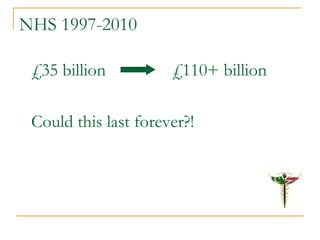
NHS 1997-2010
£35 billion £110+ billion
Could this last forever?!
Liberating the NHS and an Information Revolution
The White Paper ‘Liberating the NHS’, published on the 12th July,
outlined government plans for a new direction for the NHS, including
an ‘information revolution’ and greater patient choice and control.
Vision for an information revolution
People have access to their health records and the information they
need to make informed choices about their health and care.
“No decision about me, without me”
Liberating NHS information will help drive better care, improving
outcomes , innovation and the better use of resources.
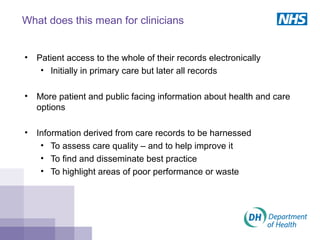
What does this mean for clinicians
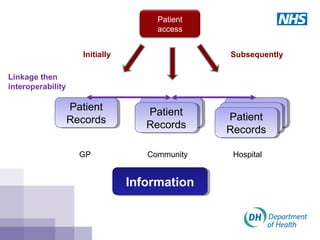
• Patient access to the whole of their records electronically
• Initially in primary care but later all records
• More patient and public facing information about health and care
options
• Information derived from care records to be harnessed
• To assess care quality – and to help improve it
• To find and disseminate best practice
• To highlight areas of poor performance or waste
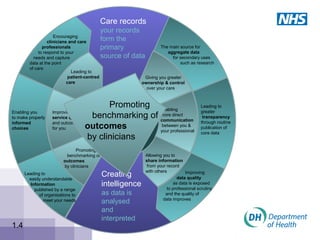
Care records
your records
form the
primary
source of data
Creating
intelligence
as data is
analysed
and
interpreted
The
Information
revolution
The
Information
Revolution
Creating
intelligence
as data is
analysed
and
interpreted
Care records
your records
form the
primary
source of data
The
Information
revolution
1.4
Leading to
patient-centred
care
Improving
service quality
and outcomes
for you
Giving you greater
ownership & control
over your care
Encouraging
clinicians and care
professionals
to respond to your
needs and capture
data at the point
of care
Enabling you
to make properly
informed
choices
Leading to
easily understandable
Information
published by a range
of organisations to
meet your needs
Improving
data quality
as data is exposed
to professional scrutiny
and the quality of
data improves
Leading to
greater
transparency
through routine
publication of
core data
The main source for
aggregate data
for secondary uses
such as research
Enabling
more direct
communication
between you &
your professional
Allowing you to
share information
from your record
with others
Promoting
benchmarking of
outcomes
by clinicians
Promoting
benchmarking of
outcomes
by clinicians
Creating
intelligence
as data is
analysed
and
interpreted
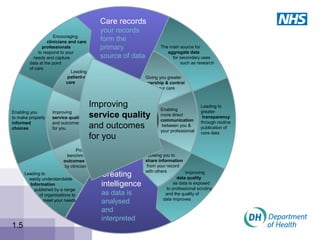
Care records
your records
form the
primary
source of data
The
Information
revolution
1.5
Leading to
patient-centred
care
Giving you greater
ownership & control
over your care
Encouraging
clinicians and care
professionals
to respond to your
needs and capture
data at the point
of care
Enabling you
to make properly
informed
choices
Leading to
easily understandable
Information
published by a range
of organisations to
meet your needs
Improving
data quality
as data is exposed
to professional scrutiny
and the quality of
data improves
Leading to
greater
transparency
through routine
publication of
core data
The main source for
aggregate data
for secondary uses
such as research
Enabling
more direct
communication
between you &
your professional
Allowing you to
share information
from your record
with others
Promoting
benchmarking of
outcomes
by clinicians
Improving
service quality
and outcomes
for you
Improving
service quality
and outcomes
for you
Creating
intelligence
as data is
analysed
and
interpreted
Care records
your records
form the
primary
source of data
The
Information
revolution
2.4
Giving you greater
ownership & control
over your care
Encouraging
clinicians and care
professionals
to respond to your
needs and capture
data at the point
of care
Enabling you
to make properly
informed
choices
Enabling
more direct
communication
between you &
your professional
Allowing you to
share information
from your record
with others
Promoting
benchmarking of
outcomes
by clinicians
Improving
service quality
and outcomes
for you
Leading to
patient-centred
care
The main source for
aggregate data
for secondary uses
such as research
Leading to
greater
transparency
through routine
publication of
core data
Improving
data quality
as data is exposed
to professional scrutiny
and the quality of
data improves
Leading to
easily understandable
Information
published by a range
of organisations to
meet your needs
Leading to
easily understandable
Information
published by a range
of organisations to
meet your needs
Moving away from targets to outcomes
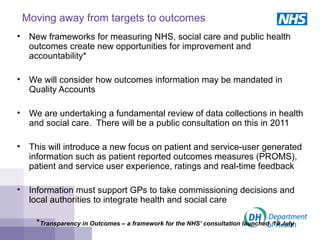
• New frameworks for measuring NHS, social care and public health
outcomes create new opportunities for improvement and
accountability*
• We will consider how outcomes information may be mandated in
Quality Accounts
• We are undertaking a fundamental review of data collections in health
and social care. There will be a public consultation on this in 2011
• This will introduce a new focus on patient and service-user generated
information such as patient reported outcomes measures (PROMS),
patient and service user experience, ratings and real-time feedback
• Information must support GPs to take commissioning decisions and
local authorities to integrate health and social care
*Transparency in Outcomes – a framework for the NHS’ consultation launched 19 July
InformationInformation
What is meant by ‘Information’?
InformationInformation
Patient
Records
Patient
Records
Patient
Records
Patient
Records
Patient
Records
Patient
Records
Patient
Records
Patient
Records
Patient
Records
Patient
Records
Patient
Records
Patient
Records
GP HospitalCommunity
Linkage then
interoperability
Patient
access
Initially Subsequently
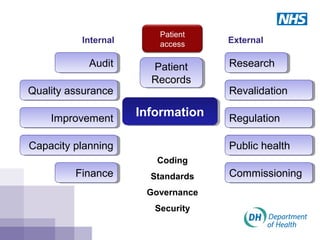
InformationInformation
Patient
Records
Patient
Records
Patient
access
Coding
Standards
Governance
Security
Internal External
AuditAudit
Quality assuranceQuality assurance
Capacity planningCapacity planning
FinanceFinance
ResearchResearch
RevalidationRevalidation
Public healthPublic health
CommissioningCommissioning
ImprovementImprovement RegulationRegulation
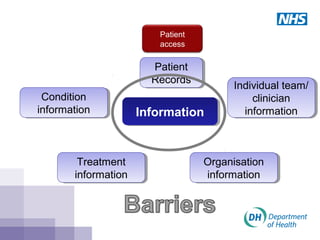
InformationInformation
Patient
Records
Patient
Records
Patient
access
Condition
information
Condition
information
Treatment
information
Treatment
information
Organisation
information
Organisation
information
Individual team/
clinician
information
Individual team/
clinician
information
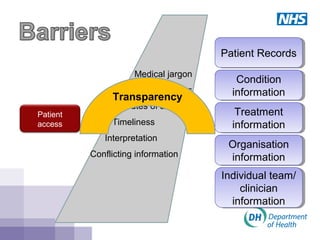
Patient RecordsPatient Records
Patient
access
Condition
information
Condition
information
Treatment
information
Treatment
information
Organisation
information
Organisation
information
Individual team/
clinician
information
Individual team/
clinician
information
Medical jargon
Trustworthiness
Routes of access
Timeliness
Interpretation
Conflicting information
Transparency
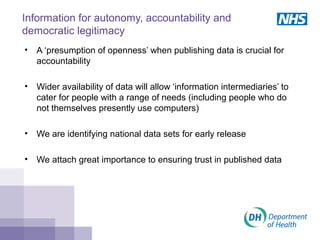
Information for autonomy, accountability and
democratic legitimacy
• A ‘presumption of openness’ when publishing data is crucial for
accountability
• Wider availability of data will allow ‘information intermediaries’ to
cater for people with a range of needs (including people who do
not themselves presently use computers)
• We are identifying national data sets for early release
• We attach great importance to ensuring trust in published data
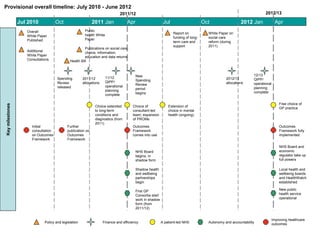
Jul 2010 Oct 2011 Jan Apr Jul Oct 2012 Jan Apr
Provisional overall timeline: July 2010 - June 2012Keymilestones
Overall
White Paper
Published
Health Bill
Public
health White
Paper
NHS Board
begins. in
shadow form
NHS Board and
economic
regulator take up
full powers
New public
health service
operational
2012/132011/12
Report on
funding of long-
term care and
support
White Paper on
social care
reform (during
2011)
Shadow health
and wellbeing
partnerships
begin
Publications on social care,
choice, information,
education and data returns
Spending
Review
released
New
Spending
Review
period
begins
2011/12
allocations
11/12
QIPP/
operational
planning
complete
2012/13
allocations
12/13
QIPP/
operational
planning
complete
First GP
Consortia start
work in shadow
form (from
2011/12)
Finance and efficiency Autonomy and accountabilityPolicy and legislation
Additional
White Paper
Consultations
Local health and
wellbeing boards
and HealthWatch
established
Choice extended
to long-term
conditions and
diagnostics (from
2011)
Choice of
consultant-led
team; expansion
of PROMs
Free choice of
GP practiceExtension of
choice in mental
health (ongoing)
A patient-led NHS
Outcomes
Framework fully
implemented
Outcomes
Framework
comes into use
Further
publication on
Outcomes
Framework
Initial
consultation
on Outcomes
Framework
Improving healthcare
outcomes
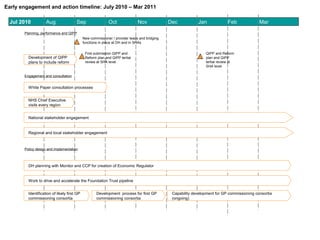
Jul 2010 Aug Sep Oct Nov Dec Jan Feb Mar
Early engagement and action timeline: July 2010 – Mar 2011
Planning, performance and QIPP
First submission QIPP and
Reform plan and QIPP tertial
review at SHA level
QIPP and Reform
plan and QIPP
tertial review at
SHA level
White Paper consultation processes
NHS Chief Executive
visits every region
National stakeholder engagement
Regional and local stakeholder engagement
Development of QIPP
plans to include reform
New commissioner / provider leads and bridging
functions in place at DH and in SHAs
DH planning with Monitor and CCP for creation of Economic Regulator
Identification of likely first GP
commissioning consortia
Development process for first GP
commissioning consortia
Capability development for GP commissioning consortia
(ongoing)
Engagement and consultation
Policy design and implementation
Work to drive and accelerate the Foundation Trust pipeline
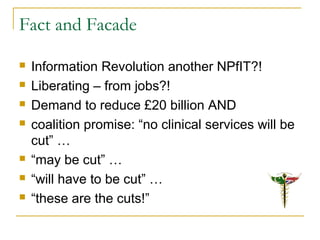
Fact and Facade
 Information Revolution another NPfIT?!
 Liberating – from jobs?!
 Demand to reduce £20 billion AND
 coalition promise: “no clinical services will be
cut” …
 “may be cut” …
 “will have to be cut” …
 “these are the cuts!”
The Process
 Monitoring
 Monitoring
 Monitoring
Monitoring
 Where you are?
 What are you doing?
 How are you doing it?
 How much of it are you doing?
Big Brother is watching you!
Unique Selling Product
What is your NHS Trust selling?
 Your Expertise
 Your Credentials
 Your Experience
Do you know that they know?
The new drivers
Current changes:
 What ideology?
 What place for ideology?
 What attachment NHS staff can have / afford?
 Stock market – the new god that failed
Time for psychiatrists to
reconsider their options
Local options
 PBC
 Specialist commissioning
 Local types of specialist commissioning
 What out of county expenditure on each?
 What are your local PBC priorities?
Enter the saviour!
 Meet the commissioner(s)
 Identify needs of specialist commissioning in
your area
Think outside the box!
 Create a consortium
 Create a social enterprise
 Employee-Employer partnership
 Develop new businesses
None of these options possible
without YOUR clinical leadership
 Think of business within …
 … and business without NHS
Your unique value
 Practice based experience
 Experience based evidence
 Basis for a new model of delivery
How will you market the new model?
Marketing the new model
 Your organisation
 Others
Yourself, your ideas
Coherently expressed in business jargon
Survival skills
 Seen a bid?
 Written a bid?
 What about a business plan?
Do nothing!
 Salary freeze – already here
 Job cuts – proposed & planned
When is your turn?
May you come to the
attention of powerful people
May you find what you are
looking for

Psychiatrist - Saviour of the Cash Trapped NHS - Akmal Makhdum and Hashim Reza

  • 1.
    The Psychiatrist –saviour of the cash strapped NHS? Akmal Makhdum & Hashim Reza
  • 2.
    May you livein interesting times
  • 3.
    NHS 1997-2010  NSHPlan  National Service Frameworks  National Institute of Clinical Excellence  Healthcare Commission  National Patient Surveys  National Staff Surveys  Foundation Trusts  QIPP / QSIP / CQUIN
  • 4.
    NHS 1997-2010 –what changed?  Waiting times  Deaths from cancer & CV disease  Health care associated infections  National standards of care for major diseases  Information on performance  Smoking rates
  • 5.
    Mental Health Services1997-2010  Suicide Prevention Toolkit  Assertive Community Treatment  Crisis Resolution & Home Treatment  Early Intervention in Psychosis  Payment by Results  HoNOS PbR / Care Packages Programme / MH Clustering
  • 6.
    A high performingNHS  Access  Safety  Clinical effectiveness  Patient experience  Equity  Efficiency  Accountability  Health promotion  Management of long-term conditions
  • 7.
    NHS 1997-2010 £35 billion£110+ billion Could this last forever?!
  • 8.
    Liberating the NHSand an Information Revolution The White Paper ‘Liberating the NHS’, published on the 12th July, outlined government plans for a new direction for the NHS, including an ‘information revolution’ and greater patient choice and control. Vision for an information revolution People have access to their health records and the information they need to make informed choices about their health and care. “No decision about me, without me” Liberating NHS information will help drive better care, improving outcomes , innovation and the better use of resources.

  • 9.
    What does thismean for clinicians • Patient access to the whole of their records electronically • Initially in primary care but later all records • More patient and public facing information about health and care options • Information derived from care records to be harnessed • To assess care quality – and to help improve it • To find and disseminate best practice • To highlight areas of poor performance or waste
  • 10.
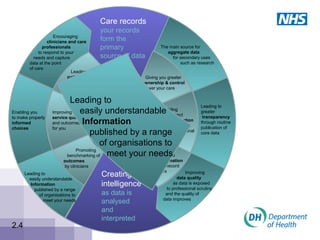
    Care records your records formthe primary source of data Creating intelligence as data is analysed and interpreted The Information revolution The Information Revolution
  • 11.
    Creating intelligence as data is analysed and interpreted Carerecords your records form the primary source of data The Information revolution 1.4 Leading to patient-centred care Improving service quality and outcomes for you Giving you greater ownership & control over your care Encouraging clinicians and care professionals to respond to your needs and capture data at the point of care Enabling you to make properly informed choices Leading to easily understandable Information published by a range of organisations to meet your needs Improving data quality as data is exposed to professional scrutiny and the quality of data improves Leading to greater transparency through routine publication of core data The main source for aggregate data for secondary uses such as research Enabling more direct communication between you & your professional Allowing you to share information from your record with others Promoting benchmarking of outcomes by clinicians Promoting benchmarking of outcomes by clinicians
  • 12.
    Creating intelligence as data is analysed and interpreted Carerecords your records form the primary source of data The Information revolution 1.5 Leading to patient-centred care Giving you greater ownership & control over your care Encouraging clinicians and care professionals to respond to your needs and capture data at the point of care Enabling you to make properly informed choices Leading to easily understandable Information published by a range of organisations to meet your needs Improving data quality as data is exposed to professional scrutiny and the quality of data improves Leading to greater transparency through routine publication of core data The main source for aggregate data for secondary uses such as research Enabling more direct communication between you & your professional Allowing you to share information from your record with others Promoting benchmarking of outcomes by clinicians Improving service quality and outcomes for you Improving service quality and outcomes for you
  • 13.
    Creating intelligence as data is analysed and interpreted Carerecords your records form the primary source of data The Information revolution 2.4 Giving you greater ownership & control over your care Encouraging clinicians and care professionals to respond to your needs and capture data at the point of care Enabling you to make properly informed choices Enabling more direct communication between you & your professional Allowing you to share information from your record with others Promoting benchmarking of outcomes by clinicians Improving service quality and outcomes for you Leading to patient-centred care The main source for aggregate data for secondary uses such as research Leading to greater transparency through routine publication of core data Improving data quality as data is exposed to professional scrutiny and the quality of data improves Leading to easily understandable Information published by a range of organisations to meet your needs Leading to easily understandable Information published by a range of organisations to meet your needs
  • 14.
    Moving away fromtargets to outcomes • New frameworks for measuring NHS, social care and public health outcomes create new opportunities for improvement and accountability* • We will consider how outcomes information may be mandated in Quality Accounts • We are undertaking a fundamental review of data collections in health and social care. There will be a public consultation on this in 2011 • This will introduce a new focus on patient and service-user generated information such as patient reported outcomes measures (PROMS), patient and service user experience, ratings and real-time feedback • Information must support GPs to take commissioning decisions and local authorities to integrate health and social care *Transparency in Outcomes – a framework for the NHS’ consultation launched 19 July
  • 15.
  • 16.
  • 17.
    InformationInformation Patient Records Patient Records Patient access Coding Standards Governance Security Internal External AuditAudit Quality assuranceQualityassurance Capacity planningCapacity planning FinanceFinance ResearchResearch RevalidationRevalidation Public healthPublic health CommissioningCommissioning ImprovementImprovement RegulationRegulation
  • 18.
  • 19.
    Patient RecordsPatient Records Patient access Condition information Condition information Treatment information Treatment information Organisation information Organisation information Individualteam/ clinician information Individual team/ clinician information Medical jargon Trustworthiness Routes of access Timeliness Interpretation Conflicting information Transparency
  • 20.
    Information for autonomy,accountability and democratic legitimacy • A ‘presumption of openness’ when publishing data is crucial for accountability • Wider availability of data will allow ‘information intermediaries’ to cater for people with a range of needs (including people who do not themselves presently use computers) • We are identifying national data sets for early release • We attach great importance to ensuring trust in published data
  • 21.
    Jul 2010 Oct2011 Jan Apr Jul Oct 2012 Jan Apr Provisional overall timeline: July 2010 - June 2012Keymilestones Overall White Paper Published Health Bill Public health White Paper NHS Board begins. in shadow form NHS Board and economic regulator take up full powers New public health service operational 2012/132011/12 Report on funding of long- term care and support White Paper on social care reform (during 2011) Shadow health and wellbeing partnerships begin Publications on social care, choice, information, education and data returns Spending Review released New Spending Review period begins 2011/12 allocations 11/12 QIPP/ operational planning complete 2012/13 allocations 12/13 QIPP/ operational planning complete First GP Consortia start work in shadow form (from 2011/12) Finance and efficiency Autonomy and accountabilityPolicy and legislation Additional White Paper Consultations Local health and wellbeing boards and HealthWatch established Choice extended to long-term conditions and diagnostics (from 2011) Choice of consultant-led team; expansion of PROMs Free choice of GP practiceExtension of choice in mental health (ongoing) A patient-led NHS Outcomes Framework fully implemented Outcomes Framework comes into use Further publication on Outcomes Framework Initial consultation on Outcomes Framework Improving healthcare outcomes

  • 22.
    Jul 2010 AugSep Oct Nov Dec Jan Feb Mar Early engagement and action timeline: July 2010 – Mar 2011 Planning, performance and QIPP First submission QIPP and Reform plan and QIPP tertial review at SHA level QIPP and Reform plan and QIPP tertial review at SHA level White Paper consultation processes NHS Chief Executive visits every region National stakeholder engagement Regional and local stakeholder engagement Development of QIPP plans to include reform New commissioner / provider leads and bridging functions in place at DH and in SHAs DH planning with Monitor and CCP for creation of Economic Regulator Identification of likely first GP commissioning consortia Development process for first GP commissioning consortia Capability development for GP commissioning consortia (ongoing) Engagement and consultation Policy design and implementation Work to drive and accelerate the Foundation Trust pipeline
  • 23.
    Fact and Facade Information Revolution another NPfIT?!  Liberating – from jobs?!  Demand to reduce £20 billion AND  coalition promise: “no clinical services will be cut” …  “may be cut” …  “will have to be cut” …  “these are the cuts!”
  • 24.
    The Process  Monitoring Monitoring  Monitoring
  • 25.
    Monitoring  Where youare?  What are you doing?  How are you doing it?  How much of it are you doing? Big Brother is watching you!
  • 26.
    Unique Selling Product Whatis your NHS Trust selling?  Your Expertise  Your Credentials  Your Experience Do you know that they know?
  • 27.
    The new drivers Currentchanges:  What ideology?  What place for ideology?  What attachment NHS staff can have / afford?  Stock market – the new god that failed Time for psychiatrists to reconsider their options
  • 28.
    Local options  PBC Specialist commissioning  Local types of specialist commissioning  What out of county expenditure on each?  What are your local PBC priorities?
  • 29.
    Enter the saviour! Meet the commissioner(s)  Identify needs of specialist commissioning in your area
  • 30.
    Think outside thebox!  Create a consortium  Create a social enterprise  Employee-Employer partnership  Develop new businesses None of these options possible without YOUR clinical leadership
  • 31.
     Think ofbusiness within …  … and business without NHS
  • 32.
    Your unique value Practice based experience  Experience based evidence  Basis for a new model of delivery How will you market the new model?
  • 33.
    Marketing the newmodel  Your organisation  Others Yourself, your ideas Coherently expressed in business jargon
  • 34.
    Survival skills  Seena bid?  Written a bid?  What about a business plan?
  • 35.
    Do nothing!  Salaryfreeze – already here  Job cuts – proposed & planned When is your turn?
  • 36.
    May you cometo the attention of powerful people
  • 37.
    May you findwhat you are looking for

Editor's Notes

  • #8 68.9 billion in 2002-03 63.2 billion in 2001-02