Sophia Frangou  MD PhD FRCPsych Institute of Psychiatry, London Bipolar Disorder
Overview Clinical Presentation Aetiology  Endophenotypes Cognition  Brain structure Brain Function
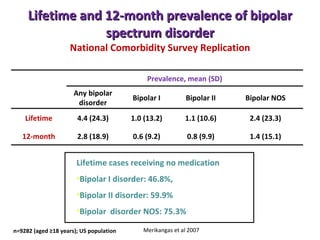
Lifetime and 12-month prevalence of bipolar spectrum disorder National Comorbidity Survey Replication Merikangas et al 2007 Lifetime cases receiving no medication Bipolar I disorder: 46.8%,  Bipolar II disorder: 59.9% Bipolar  disorder NOS: 75.3% n=9282 (aged ≥18 years); US population Prevalence, mean (SD) Any bipolar disorder Bipolar I Bipolar II Bipolar NOS Lifetime 4.4 (24.3) 1.0 (13.2) 1.1 (10.6) 2.4 (23.3) 12-month 2.8 (18.9) 0.6 (9.2) 0.8 (9.9) 1.4 (15.1)
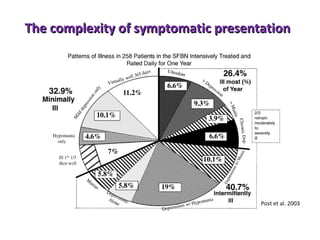
The complexity of symptomatic presentation  Post et al. 2003
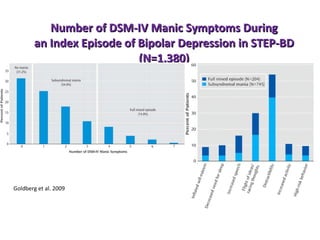
Number of DSM-IV Manic Symptoms During  an Index Episode of Bipolar Depression in STEP-BD  (N=1,380) Goldberg et al. 2009
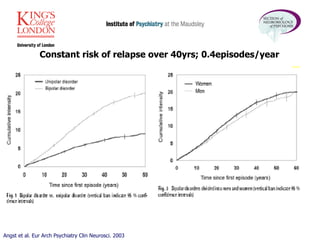
Constant risk of relapse over 40yrs; 0.4episodes/year Angst et al. Eur Arch Psychiatry Clin Neurosci. 2003
Aetiology
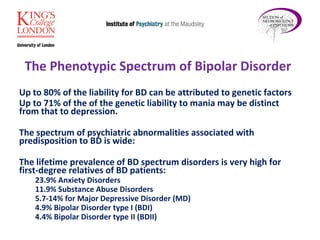
Up to 80% of the liability for BD can be attributed to genetic factors Up to 71% of the  of the genetic liability to mania may be distinct from that to depression. The spectrum of psychiatric abnormalities associated with predisposition to BD is wide:  The lifetime prevalence of BD spectrum disorders is very high for first-degree relatives of BD patients:  23.9% Anxiety Disorders 11.9% Substance Abuse Disorders 5.7-14% for Major Depressive Disorder (MD)  4.9% Bipolar Disorder type I (BDI) 4.4% Bipolar Disorder type II (BDII)  The Phenotypic Spectrum of Bipolar Disorder
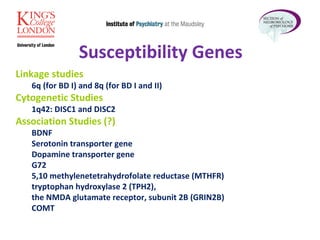
Linkage studies   6q (for BD I) and 8q (for BD I and II) Cytogenetic Studies   1q42: DISC1 and DISC2 Association Studies (?) BDNF Serotonin transporter gene Dopamine transporter gene  G72  5,10 methylenetetrahydrofolate reductase (MTHFR) tryptophan hydroxylase 2 (TPH2),  the NMDA glutamate receptor, subunit 2B (GRIN2B) COMT  Susceptibility Genes
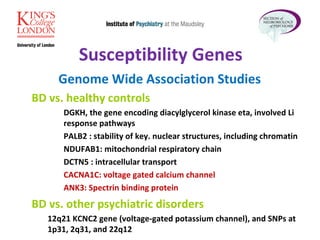
Susceptibility Genes Genome Wide Association Studies   BD vs. healthy controls   DGKH, the gene encoding diacylglycerol kinase eta, involved Li response pathways  PALB2 : stability of key. nuclear structures, including chromatin  NDUFAB1: mitochondrial respiratory chain DCTN5 : intracellular transport  CACNA1C: voltage gated calcium channel ANK3: Spectrin binding protein BD vs. other psychiatric disorders 12q21 KCNC2 gene (voltage-gated potassium channel), and SNPs at 1p31, 2q31, and 22q12
Beyond Symptoms Brain Structure Cognition Brain Function
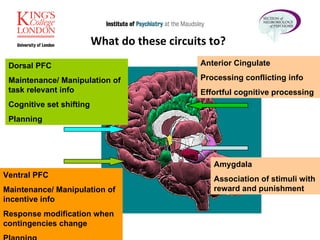
What do these circuits to?   Amygdala Association of stimuli with reward and punishment   Anterior Cingulate  Processing conflicting info  Effortful cognitive processing  Dorsal PFC  Maintenance/ Manipulation of task relevant info  Cognitive set shifting Planning  Ventral PFC  Maintenance/ Manipulation of incentive info  Response modification when contingencies change  Planning
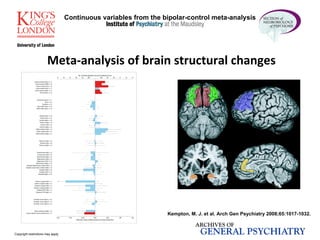
Copyright restrictions may apply. Kempton, M. J. et al. Arch Gen Psychiatry 2008;65:1017-1032. Continuous variables from the bipolar-control meta-analysis Meta-analysis of brain structural changes
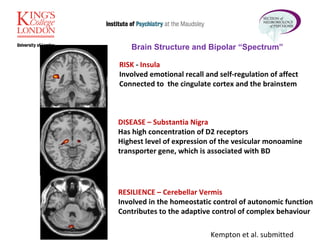
RISK  -  Insula Involved emotional recall and self-regulation of affect  Connected to  the cingulate cortex and the brainstem RESILIENCE – Cerebellar Vermis Involved in the homeostatic control of autonomic function Contributes to the adaptive control of complex behaviour DISEASE – Substantia Nigra  Has high concentration of D2 receptors Highest level of expression of the vesicular monoamine transporter gene, which is associated with BD Kempton et al. submitted Brain Structure and Bipolar “Spectrum”
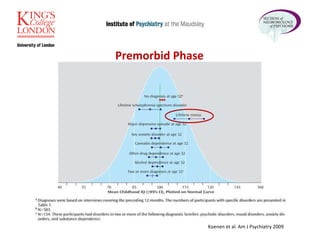
Premorbid Phase  Koenen et al. Am J Psychiatry 2009
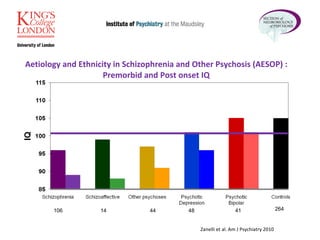
Aetiology and Ethnicity in Schizophrenia and Other Psychosis (AESOP)  : Premorbid and Post onset IQ Zanelli et al. Am J Psychiatry 2010 106 44 14 48 41 264
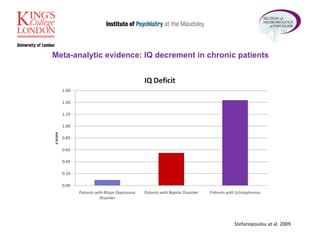
Stefanopoulou at al. 2009 Meta-analytic evidence: IQ decrement in chronic patients
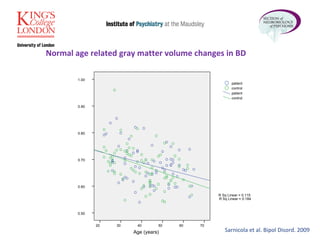
Normal age related gray matter volume changes in BD Sarnicola et al. Bipol Disord. 2009 age from scanned 70.00 60.00 50.00 40.00 30.00 20.00 grey 1.000000 0.900000 0.800000 0.700000 0.600000 0.500000 control patient control patient pat_code1 R Sq Linear = 0.115 R Sq Linear = 0.184 Age (years) 70 60 50 40 30 20 1.00 0.90 0.80 0.70 0.60 0.50 control patient control patient R Sq Linear = 0.115 R Sq Linear = 0.184
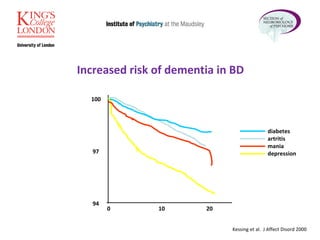
Increased risk of dementia in BD Kessing et al.  J Affect Disord 2000 100 97 94 0   10  20 diabetes artritis mania depression
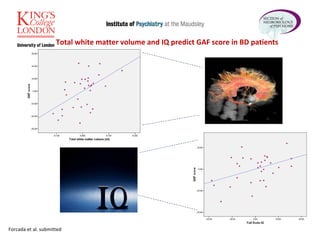
Total white matter volume and IQ predict GAF score in BD patients  Forcada et al. submitted
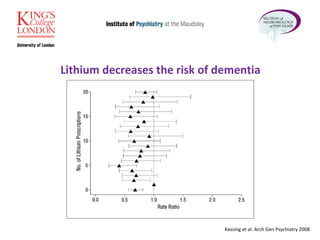
Lithium decreases the risk of dementia Kessing et al. Arch Gen Psychiatry 2008
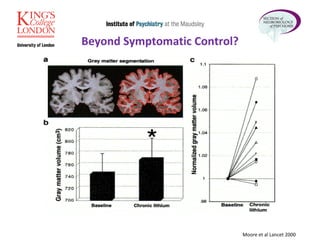
Beyond Symptomatic Control? Moore et al Lancet 2000
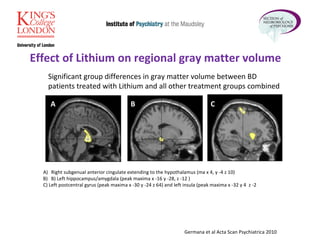
Germana et al Acta Scan Psychiatrica 2010 Effect of Lithium on regional gray matter volume A B C Right subgenual anterior cingulate extending to the hypothalamus (ma x 4, y -4 z 10) B) Left hippocampus/amygdala (peak maxima x -16 y -28, z -12 ) C) Left postcentral gyrus (peak maxima x -30 y -24 z 64) and left insula (peak maxima x -32 y 4  z -2  Significant group differences in gray matter volume between BD  patients treated with Lithium and all other treatment groups combined
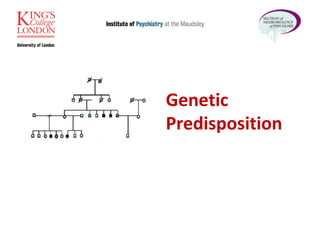
Genetic  Predisposition
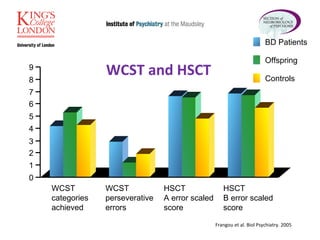
WCST and HSCT  Frangou  et al.  Biol Psychiatry. 2005  9 8 7 6 5 4 3 2 1 0 WCST categories achieved WCST perseverative errors HSCT A error scaled score HSCT B error scaled score BD Patients Offspring Controls
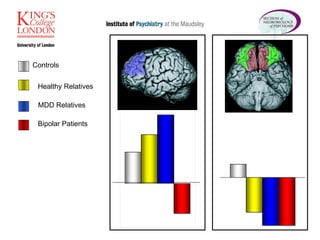
Controls Healthy Relatives MDD Relatives  Bipolar Patients
 

Updates on Bipolar Disorder

  • 1.
    Sophia Frangou MD PhD FRCPsych Institute of Psychiatry, London Bipolar Disorder
  • 2.
    Overview Clinical PresentationAetiology Endophenotypes Cognition Brain structure Brain Function
  • 3.
    Lifetime and 12-monthprevalence of bipolar spectrum disorder National Comorbidity Survey Replication Merikangas et al 2007 Lifetime cases receiving no medication Bipolar I disorder: 46.8%, Bipolar II disorder: 59.9% Bipolar disorder NOS: 75.3% n=9282 (aged ≥18 years); US population Prevalence, mean (SD) Any bipolar disorder Bipolar I Bipolar II Bipolar NOS Lifetime 4.4 (24.3) 1.0 (13.2) 1.1 (10.6) 2.4 (23.3) 12-month 2.8 (18.9) 0.6 (9.2) 0.8 (9.9) 1.4 (15.1)
  • 4.
    The complexity ofsymptomatic presentation Post et al. 2003
  • 5.
    Number of DSM-IVManic Symptoms During an Index Episode of Bipolar Depression in STEP-BD (N=1,380) Goldberg et al. 2009
  • 6.
    Constant risk ofrelapse over 40yrs; 0.4episodes/year Angst et al. Eur Arch Psychiatry Clin Neurosci. 2003
  • 7.
  • 8.
    Up to 80%of the liability for BD can be attributed to genetic factors Up to 71% of the of the genetic liability to mania may be distinct from that to depression. The spectrum of psychiatric abnormalities associated with predisposition to BD is wide: The lifetime prevalence of BD spectrum disorders is very high for first-degree relatives of BD patients: 23.9% Anxiety Disorders 11.9% Substance Abuse Disorders 5.7-14% for Major Depressive Disorder (MD) 4.9% Bipolar Disorder type I (BDI) 4.4% Bipolar Disorder type II (BDII) The Phenotypic Spectrum of Bipolar Disorder
  • 9.
    Linkage studies 6q (for BD I) and 8q (for BD I and II) Cytogenetic Studies 1q42: DISC1 and DISC2 Association Studies (?) BDNF Serotonin transporter gene Dopamine transporter gene G72 5,10 methylenetetrahydrofolate reductase (MTHFR) tryptophan hydroxylase 2 (TPH2), the NMDA glutamate receptor, subunit 2B (GRIN2B) COMT Susceptibility Genes
  • 10.
    Susceptibility Genes GenomeWide Association Studies BD vs. healthy controls DGKH, the gene encoding diacylglycerol kinase eta, involved Li response pathways PALB2 : stability of key. nuclear structures, including chromatin NDUFAB1: mitochondrial respiratory chain DCTN5 : intracellular transport CACNA1C: voltage gated calcium channel ANK3: Spectrin binding protein BD vs. other psychiatric disorders 12q21 KCNC2 gene (voltage-gated potassium channel), and SNPs at 1p31, 2q31, and 22q12
  • 11.
    Beyond Symptoms BrainStructure Cognition Brain Function
  • 12.
    What do thesecircuits to? Amygdala Association of stimuli with reward and punishment Anterior Cingulate Processing conflicting info Effortful cognitive processing Dorsal PFC Maintenance/ Manipulation of task relevant info Cognitive set shifting Planning Ventral PFC Maintenance/ Manipulation of incentive info Response modification when contingencies change Planning
  • 13.
    Copyright restrictions mayapply. Kempton, M. J. et al. Arch Gen Psychiatry 2008;65:1017-1032. Continuous variables from the bipolar-control meta-analysis Meta-analysis of brain structural changes
  • 14.
    RISK - Insula Involved emotional recall and self-regulation of affect Connected to the cingulate cortex and the brainstem RESILIENCE – Cerebellar Vermis Involved in the homeostatic control of autonomic function Contributes to the adaptive control of complex behaviour DISEASE – Substantia Nigra Has high concentration of D2 receptors Highest level of expression of the vesicular monoamine transporter gene, which is associated with BD Kempton et al. submitted Brain Structure and Bipolar “Spectrum”
  • 15.
    Premorbid Phase Koenen et al. Am J Psychiatry 2009
  • 16.
    Aetiology and Ethnicityin Schizophrenia and Other Psychosis (AESOP) : Premorbid and Post onset IQ Zanelli et al. Am J Psychiatry 2010 106 44 14 48 41 264
  • 17.
    Stefanopoulou at al.2009 Meta-analytic evidence: IQ decrement in chronic patients
  • 18.
    Normal age relatedgray matter volume changes in BD Sarnicola et al. Bipol Disord. 2009 age from scanned 70.00 60.00 50.00 40.00 30.00 20.00 grey 1.000000 0.900000 0.800000 0.700000 0.600000 0.500000 control patient control patient pat_code1 R Sq Linear = 0.115 R Sq Linear = 0.184 Age (years) 70 60 50 40 30 20 1.00 0.90 0.80 0.70 0.60 0.50 control patient control patient R Sq Linear = 0.115 R Sq Linear = 0.184
  • 19.
    Increased risk ofdementia in BD Kessing et al. J Affect Disord 2000 100 97 94 0 10 20 diabetes artritis mania depression
  • 20.
    Total white mattervolume and IQ predict GAF score in BD patients Forcada et al. submitted
  • 21.
    Lithium decreases therisk of dementia Kessing et al. Arch Gen Psychiatry 2008
  • 22.
    Beyond Symptomatic Control?Moore et al Lancet 2000
  • 23.
    Germana et alActa Scan Psychiatrica 2010 Effect of Lithium on regional gray matter volume A B C Right subgenual anterior cingulate extending to the hypothalamus (ma x 4, y -4 z 10) B) Left hippocampus/amygdala (peak maxima x -16 y -28, z -12 ) C) Left postcentral gyrus (peak maxima x -30 y -24 z 64) and left insula (peak maxima x -32 y 4 z -2 Significant group differences in gray matter volume between BD patients treated with Lithium and all other treatment groups combined
  • 24.
  • 25.
    WCST and HSCT Frangou et al. Biol Psychiatry. 2005 9 8 7 6 5 4 3 2 1 0 WCST categories achieved WCST perseverative errors HSCT A error scaled score HSCT B error scaled score BD Patients Offspring Controls
  • 26.
    Controls Healthy RelativesMDD Relatives Bipolar Patients
  • 27.

Editor's Notes

  • #7 One off the most common questions asked by patients and relatives is how long the need to stay on medication. Angst and his colleagues estimated the risk of relapse in patients with mood disorders over a 40 year period. Bipolar patients had a higher risk of relapse than unipolar depressives but for both conditions the risk remained constant throughout the 40 year period and averaged a rate of one episode every two years. No gender differences were noted. This evidence suggests that there is no period when the risk of relapse is zero and is therefore safe to discontinue treatment. Patients should be made aware of this but of course the decision of how to manage the risk of relapse rests with them.
  • #23 I have added this slide to alert you to new evidence regarding the role of lithium and perhaps valproate in other aspects of treatment of bipolar disorder. There is some evidence that lithium may have neuroprotective properties as shown in this study. Here patients treated with lithium for a period of the month showed an increase in the grey matter volume. There is a lot of research currently focusing on exploring further the neuroprotective effects of lithium. At the very least such evidence suggests that recommendations for long-term treatment with lithium are probably unlikely to have adverse effects on the brain.