Functional model: Mind the GapDr AnkushSinghalMBBS, MD (AIIMS), MRCPsychST6  (General adult psychiatry)BIPA Annual Conference 2010
My ContributionConceived the idea and led the study.Literature review, the protocol and ethics approval. Collected the data. Co-ordinated.Merged the data & analysed it.Prepared the manuscript and sent for publication. Revisions as first & corresponding author.Presented in RCPsych AGM, Liverpool and in my Trust.
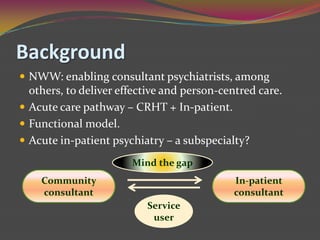
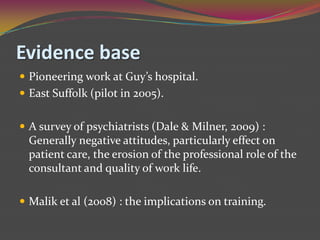
BackgroundNWW: enabling consultant psychiatrists, among others, to deliver effective and person-centred care.Acute care pathway – CRHT + In-patient.Functional model.Acute in-patient psychiatry – a subspecialty?Mind the gapCommunity consultantIn-patient consultantService user
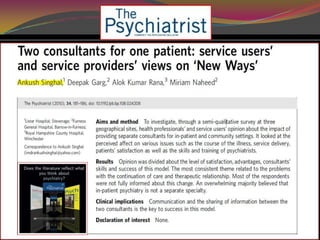
AimTo investigate health professionals’, service users’ and carers’ opinions about the provision of separate consultants for in-patient settings and the community
DesignMulticentre study : North Hertfordshire; the south lakes region of Cumbria; and Winchester. Tool	semi-structured semi-qualitativequestionnaire 	(paper and online version)An information leaflet (without introducing any bias).
Data CollectionPersonally, by post and online.Through CMHTs, out-patient clinics, mental health wards and other places (e.g. the local centre of MIND).Admitted patients were not invited.Reminder - after a month.
AnalysisQuantitative data – descriptive statistics. Qualitative data – framework analysis.Carers: too few to be included in the analysis.
Results
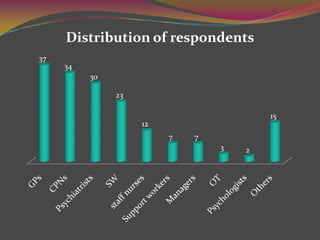
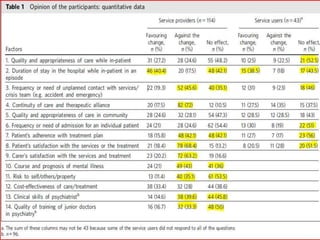
Quantitative: Service providers170/330 responded - response rate about 50%.56 participants left after introductory questions.72% participants having > 6 years experience in mental health.
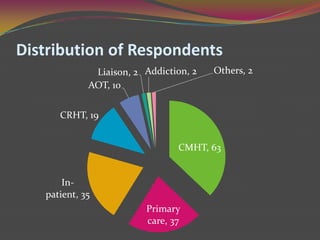
Distribution of Respondents
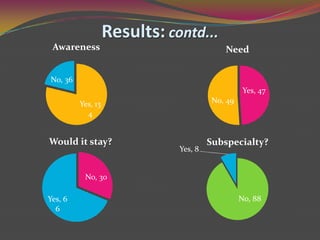
Results:contd...
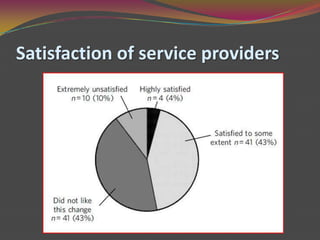
Satisfaction of service providers
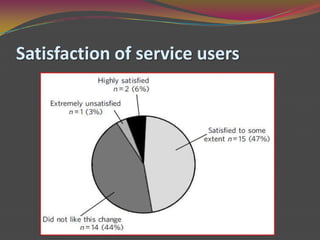
Quantitative: Service users20/43 respondents had a history of admission.Duration of contact with mental health: 2-10 years.Awareness: 16/43 (36%) aware
Satisfaction of service users
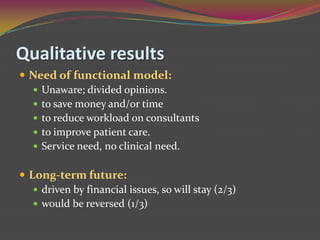
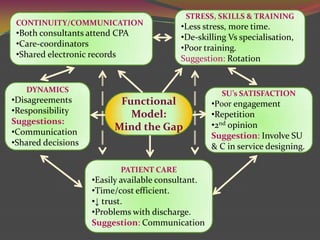
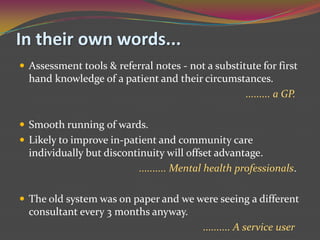
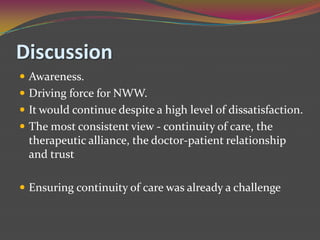
Qualitative resultsNeed of functional model: Unaware; divided opinions.to save money and/or time to reduce workload on consultantsto improve patient care.Service need, no clinical need.Long-term future:driven by financial issues, so will stay (2/3)would be reversed (1/3)
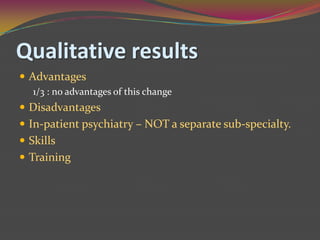
Qualitative resultsAdvantages 1/3 : no advantages of this changeDisadvantagesIn-patient psychiatry – NOT a separate sub-specialty.Skills Training
STRESS, SKILLS & TRAININGLess stress, more time.
De-skilling Vs specialisation,
Poor training.Suggestion: RotationCONTINUITY/COMMUNICATIONBoth consultants attend CPA
Care-coordinators
Shared electronic recordsQualitative dataDYNAMICSDisagreements
ResponsibilitySuggestions:Communication
Shared decisionsSU’s SATISFACTIONPoor engagement

Functional Model : Mind the Gap - Prize Presentation