The power of information
Putting all of us in control of the health
and care information we need
the vision: people first

  • Joined up systems and shared data standards will facilitate and drive integration
  within and between organisations and care settings to ensure that care is focused
  around the person and their health and care needs. This is why the strategy spans the
  NHS, public health and social care.


  • Getting the right information to the right people at the right time – in a form they can
  understand, engage with and contribute to – will help individuals take control of their
  own care, improving self-management, shared decision making, and more informed
  choices.


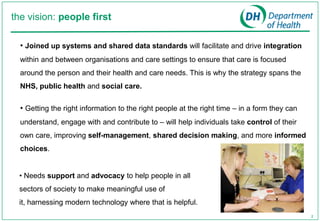
 • Needs support and advocacy to help people in all
 sectors of society to make meaningful use of
 it, harnessing modern technology where that is helpful.
                                                                                               2
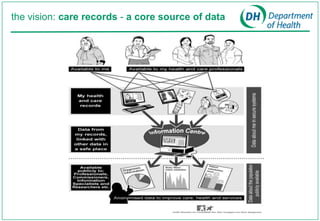
the vision: care records - a core source of data
the information strategy: main ambitions


 • Information used to drive integrated care
   across the entire health and social care sector

 • Information regarded as a health and care service in its own right –
   with appropriate support in using information available for those who need it, so that
   information benefits everyone and helps reduce inequalities

 • A change in culture and mindset, in which our health and care
   professionals, organisations and systems recognise that information in our own care
   records is fundamentally about us - so it becomes normal for us to access our own
   records

 • Information recorded once, at our first contact with professional
   staff, and shared securely between those providing our care – supported by
   consistent use of information standards that enable data to flow between systems
   whilst keeping our confidential information safe and secure
the information strategy: main ambitions


 • Our electronic care records become the source for core information
   used to improve our care, improve services and to inform research, etc. – reducing
   bureaucratic data collections and enabling us to measure quality

 • A culture of transparency
   where access to high-quality, evidence-based information about services and the
   quality of care held by Government and health and care services is openly and easily
   available to us all

 • An information-led culture where all health and care professionals take
   responsibility for recording, sharing and using information to improve care

 • The widespread use of modern technology
   to make health and care services more convenient, accessible and efficient

 • An information system built on innovative and integrated solutions and
   local decision-making, within a framework of national standards that ensure
   information can move freely, safely, and securely around the system
key themes: records access


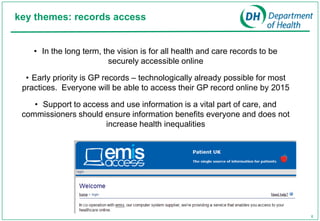
    • In the long term, the vision is for all health and care records to be
                          securely accessible online

  • Early priority is GP records – technologically already possible for most
 practices. Everyone will be able to access their GP record online by 2015

    • Support to access and use information is a vital part of care, and
 commissioners should ensure information benefits everyone and does not
                      increase health inequalities


                                                                               6
key themes: integration


  First steps:

    • GP letters and hospital discharge letters to be available electronically

    • Clinical portals and other mechanisms to support clinicians to access
    relevant records easily

    • We need to re-balance the approach to information governance to
    encourage greater sharing of information to improve care. An
    independent review will look at this in more detail

  Longer term:

    • Information to be shared securely across care pathways, using the
    NHS number in all settings

    • Information from care records aggregated and anonymised to support
    research, service improvement and commissioning
                                                                                 7
key themes: transparency


 • Transparency will be the norm, with clear commitments for the datasets
 that will be made available from the Information Centre

 • There will be clear routes to information through:

     • 999 for emergencies

     • 111 for urgent care

     • A comprehensive online ‘portal’ for everything else – both
       information government provides and a link to trusted information
       from others

 • Greater use of feedback and clinical benchmarking


                                                                            8
key themes: culture


 Many of the changes needed to meet our vision are cultural, and there are
            several aspects of the strategy influencing culture:

  • An emphasis on training for all professionals

  • A stronger professional identity for informatics professionals

  • Considering a Chief Clinical Information Officer role in providers

  • The Information Governance review will understand and influence the
  culture in our services around sharing information


                                                                             9
the vision: how we‟ll get there

The strategy includes a number of central and local level actions -
all require partnership working
                Centrally                                    Locally

  • A standards „route map’ will be          • Organisations will seek and respond to
  developed                                  patient and service user feedback
  • A comprehensive online „portal‟ will     • Procurement decisions will be made in
  bring together the best of the relevant    line with the information standards
  information on health, public              roadmap
  health, care and support                   • Support for interpreting information
  • All nationally held clinical datasets    will be provided to those who need it
  will be published by 2014, but not at      • Electronic transactions will be made
  a level which allows identification of     available to patients
  patients                                   • There will be better use of
  • Central bodies (the                      pharmaceuticals
  CQC, Monitor, the NHS CB) will             • The informatics profession will be
  consider how they can incentivise          developed
  the vision in this strategy                • Online professional access to records
  • An independent review of                 will allow the sharing of records
  information governance will be led         • Patients will, in time, have access to
  by Dame Fiona Caldicott                    records beyond general practice
the strategy online: aimed at real people


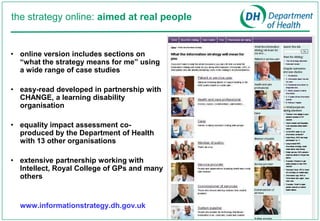
• online version includes sections on
  “what the strategy means for me” using
  a wide range of case studies

• easy-read developed in partnership with
  CHANGE, a learning disability
  organisation

• equality impact assessment co-
  produced by the Department of Health
  with 13 other organisations

• extensive partnership working with
  Intellect, Royal College of GPs and many
  others


  www.informationstrategy.dh.gov.uk
Anne Cooper
National Clinical Lead for Nursing
Department of Health
Informatics Directorate


anne.cooper@nhs.net

                @anniecoops


                                     12

Information strategy summary slides - annes set (1)

  • 1.
    The power ofinformation Putting all of us in control of the health and care information we need
  • 2.
    the vision: peoplefirst • Joined up systems and shared data standards will facilitate and drive integration within and between organisations and care settings to ensure that care is focused around the person and their health and care needs. This is why the strategy spans the NHS, public health and social care. • Getting the right information to the right people at the right time – in a form they can understand, engage with and contribute to – will help individuals take control of their own care, improving self-management, shared decision making, and more informed choices. • Needs support and advocacy to help people in all sectors of society to make meaningful use of it, harnessing modern technology where that is helpful. 2
  • 3.
    the vision: carerecords - a core source of data
  • 4.
    the information strategy:main ambitions • Information used to drive integrated care across the entire health and social care sector • Information regarded as a health and care service in its own right – with appropriate support in using information available for those who need it, so that information benefits everyone and helps reduce inequalities • A change in culture and mindset, in which our health and care professionals, organisations and systems recognise that information in our own care records is fundamentally about us - so it becomes normal for us to access our own records • Information recorded once, at our first contact with professional staff, and shared securely between those providing our care – supported by consistent use of information standards that enable data to flow between systems whilst keeping our confidential information safe and secure
  • 5.
    the information strategy:main ambitions • Our electronic care records become the source for core information used to improve our care, improve services and to inform research, etc. – reducing bureaucratic data collections and enabling us to measure quality • A culture of transparency where access to high-quality, evidence-based information about services and the quality of care held by Government and health and care services is openly and easily available to us all • An information-led culture where all health and care professionals take responsibility for recording, sharing and using information to improve care • The widespread use of modern technology to make health and care services more convenient, accessible and efficient • An information system built on innovative and integrated solutions and local decision-making, within a framework of national standards that ensure information can move freely, safely, and securely around the system
  • 6.
    key themes: recordsaccess • In the long term, the vision is for all health and care records to be securely accessible online • Early priority is GP records – technologically already possible for most practices. Everyone will be able to access their GP record online by 2015 • Support to access and use information is a vital part of care, and commissioners should ensure information benefits everyone and does not increase health inequalities 6
  • 7.
    key themes: integration First steps: • GP letters and hospital discharge letters to be available electronically • Clinical portals and other mechanisms to support clinicians to access relevant records easily • We need to re-balance the approach to information governance to encourage greater sharing of information to improve care. An independent review will look at this in more detail Longer term: • Information to be shared securely across care pathways, using the NHS number in all settings • Information from care records aggregated and anonymised to support research, service improvement and commissioning 7
  • 8.
    key themes: transparency • Transparency will be the norm, with clear commitments for the datasets that will be made available from the Information Centre • There will be clear routes to information through: • 999 for emergencies • 111 for urgent care • A comprehensive online ‘portal’ for everything else – both information government provides and a link to trusted information from others • Greater use of feedback and clinical benchmarking 8
  • 9.
    key themes: culture Many of the changes needed to meet our vision are cultural, and there are several aspects of the strategy influencing culture: • An emphasis on training for all professionals • A stronger professional identity for informatics professionals • Considering a Chief Clinical Information Officer role in providers • The Information Governance review will understand and influence the culture in our services around sharing information 9
  • 10.
    the vision: howwe‟ll get there The strategy includes a number of central and local level actions - all require partnership working Centrally Locally • A standards „route map’ will be • Organisations will seek and respond to developed patient and service user feedback • A comprehensive online „portal‟ will • Procurement decisions will be made in bring together the best of the relevant line with the information standards information on health, public roadmap health, care and support • Support for interpreting information • All nationally held clinical datasets will be provided to those who need it will be published by 2014, but not at • Electronic transactions will be made a level which allows identification of available to patients patients • There will be better use of • Central bodies (the pharmaceuticals CQC, Monitor, the NHS CB) will • The informatics profession will be consider how they can incentivise developed the vision in this strategy • Online professional access to records • An independent review of will allow the sharing of records information governance will be led • Patients will, in time, have access to by Dame Fiona Caldicott records beyond general practice
  • 11.
    the strategy online:aimed at real people • online version includes sections on “what the strategy means for me” using a wide range of case studies • easy-read developed in partnership with CHANGE, a learning disability organisation • equality impact assessment co- produced by the Department of Health with 13 other organisations • extensive partnership working with Intellect, Royal College of GPs and many others www.informationstrategy.dh.gov.uk
  • 12.
    Anne Cooper National ClinicalLead for Nursing Department of Health Informatics Directorate anne.cooper@nhs.net @anniecoops 12