Information = power?
         Mark Duman
         6 March 2006
 Chair, Patient Information Forum
Scope


•   The White Paper and beyond

•   Some solutions

•   Sharing


                                 2
The White Paper and beyond
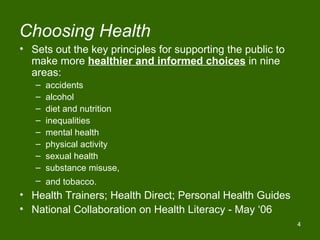
Choosing Health
• Sets out the key principles for supporting the public to
  make more healthier and informed choices in nine
  areas:
   –   accidents
   –   alcohol
   –   diet and nutrition
   –   inequalities
   –   mental health
   –   physical activity
   –   sexual health
   –   substance misuse,
   –   and tobacco.
• Health Trainers; Health Direct; Personal Health Guides
• National Collaboration on Health Literacy - May ‘06
                                                             4
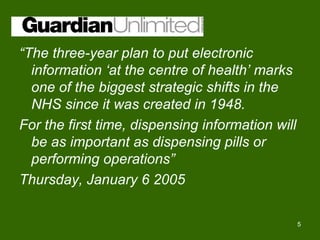
“The three-year plan to put electronic
  information ‘at the centre of health’ marks
  one of the biggest strategic shifts in the
  NHS since it was created in 1948.
For the first time, dispensing information will
  be as important as dispensing pills or
  performing operations”
Thursday, January 6 2005

                                                  5
‘Better information, better choices,
    better health’
• Information Prescriptions

• Community info-mediaries

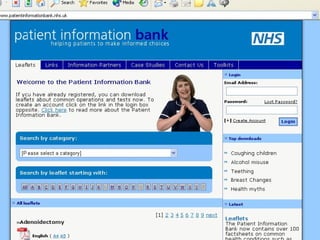
• Patient Information Bank


Source: www.dh.gov.uk/assetRoot/04/09/85/99/04098599.pdf

                                                           6
7
‘Better information, better choices,
    better health’
• Information Prescriptions

• Community info-mediaries

• Patient Information Bank

• Power questions

• Information Accreditation System (IAS)
Source: www.dh.gov.uk/assetRoot/04/09/85/99/04098599.pdf
                                                           8
January 2006 - DH Choice
About Choose and Book
• By December 2005 all patients in England will be offered at least four
   providers for elective care.
How we are treated
• People will be able to record their lifestyle preferences on electronic medical
   records. This will mainly happen through Healthspace.
Prescriptions
• By December 2004 patients will be able to pick up repeat prescriptions from
   a pharmacy of their choice. By 2005 physiotherapists, radiographers,
   podiatrists, optometrists and pharmacists will have prescribing authority.
Primary care
• People will be able to access primary care services in more flexible ways
   such as walk in centres at train stations or football stadiums. Primary care
   practices will be able to offer a wider range of services such as diagnostics.
Information to help patients choose
• How patients and the public will be supported to make informed choices
   about their health and healthcare.


                                                                                9
10
The new White Paper
 5.24 “give all people with long-term health and
  social care needs and their carers an
  ‘information prescription’
 5.25 “By 2008, we would expect everyone with a
  long-term condition … to routinely receive
  information about their condition”
 5.26 “By 2010 we would expect everyone with a
  long-term condition to be offered a care plan.”
  (good practice guidance early in 2007)


                                                11
The new White Paper cont…

 2.29 Life Checks

 2.91 QOF Rewards

 4.81 Improving Immunization Rates

 4.101 Improving End-of-Life Care

 8.32 Patient Safety Outside of Hospitals   12
'Supporting people with long-term conditions to self-car
•   Examples of what central government, professionals and PCTs
    have done and need to do in making sure those with chronic illness
    can manage their health effectively.
•   Information and tools are cited as important for empowering people:
     – e.g. NHS Direct Interactive TV helps to keep elderly people up-
        to-date and informed, and the medium is effective because they
        usually both hard to reach and tend to suffer from long-term
        conditions.
•   However, it warns that many people without access to the internet
    who "tend to make little use of self care information" must be
    helped.
•   The role of health professionals is to direct people towards
    meaningful information and give "guidance on how to access it so
    that people feel confident enough to use it."


                                                                     13
“Now I feel tall”
I strongly encourage all NHS organisations to take a close
   look at how they deliver their services and to ask their
   patients if their emotional needs are being met as well as
   their physical ones.
They should ask patients if they are:
•   getting good treatment in a comfortable, caring and safe
         environment, delivered in a calm and reassuring way
•   having information to make choices, to feel confident and feel
         in control
•   being talked to and listened to as an equal, and
•   being treated with honesty, respect and dignity.
Sir Nigel Crisp NHS Chief Executive, November 2005


                                                                14
Some solutions
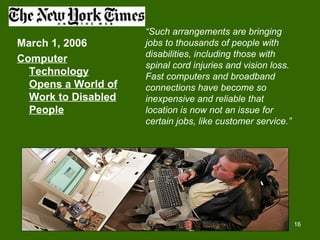
“Such arrangements are bringing
March 1, 2006        jobs to thousands of people with
                     disabilities, including those with
Computer
                     spinal cord injuries and vision loss.
  Technology         Fast computers and broadband
  Opens a World of   connections have become so
  Work to Disabled   inexpensive and reliable that
  People             location is now not an issue for
                     certain jobs, like customer service.”


                                                             16
NCC & Social Marketing – April ‘06
•   Integrate health understanding and improvement education & action into all
    of our lives and communities to achieve social justice, tackle wider causes
    of ill health, reduce childhood poverty and support healthier ways of living
     – Maximise the effectiveness of NHS Stop Smoking Services
     – Improve services to help people who are overweight or obese & prevent
          weight gain from an early age and encourage healthy eating
     – Strengthen services to improve sexual health
     – Deliver better services to prevent & treat alcohol problems
     – Improve the lives of those who face lifelong illnesses, particularly older
          people
     – Provide support to improve mental well-being
•   Develop, implement and evaluate a co-ordinated, evidence-based and cost-
    effective approach to the management and delivery of all future marketing
    communications activity related to health improvement


                                                                               17
Lloydspharmacy


                 “Ever since
                 Lloydspharmacy launched
                 this free [diabetes testing]
                 service in 2003, we have
                 tested over 750,000
                 people.”
                                                18
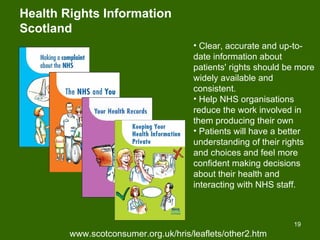
Health Rights Information
Scotland
                                      • Clear, accurate and up-to-
                                      date information about
                                      patients' rights should be more
                                      widely available and
                                      consistent.
                                      • Help NHS organisations
                                      reduce the work involved in
                                      them producing their own
                                      • Patients will have a better
                                      understanding of their rights
                                      and choices and feel more
                                      confident making decisions
                                      about their health and
                                      interacting with NHS staff.


                                                               19
        www.scotconsumer.org.uk/hris/leaflets/other2.htm
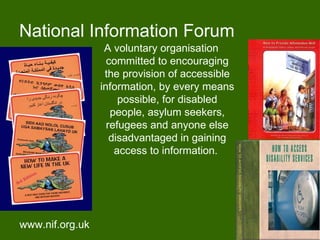
National Information Forum
                  A voluntary organisation
                   committed to encouraging
                  the provision of accessible
                 information, by every means
                      possible, for disabled
                    people, asylum seekers,
                   refugees and anyone else
                    disadvantaged in gaining
                     access to information.


www.nif.org.uk                                  20
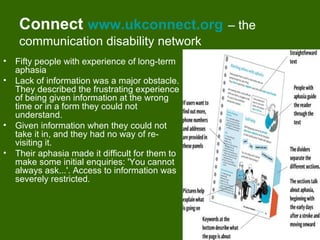
Connect www.ukconnect.org                    – the
     communication disability network
•   Fifty people with experience of long-term
    aphasia
•   Lack of information was a major obstacle.
    They described the frustrating experience
    of being given information at the wrong
    time or in a form they could not
    understand.
•   Given information when they could not
    take it in, and they had no way of re-
    visiting it.
•   Their aphasia made it difficult for them to
    make some initial enquiries: 'You cannot
    always ask...'. Access to information was
    severely restricted.


                                                          21
National Programme for IT
• NHS Care Record Service

• NHS.uk

• NHS Direct Online

• Healthspace

• Choose & Book re appointments

                                  22
Advocacy

•   Expert Patient Programme
•   Patient Care Advisors (PCAs)
•   Health Trainers
•   Community info-mediaries
•   Health Librarians
•   Health professionals?

                                   23
Is the NHS getting better or worse?
• 1 million patients surveyed between 1998-2005
• Over half of their priorities were information-led:
   – Fast access to health advice
   – Involvement in decisions and respect for patients’ preferences
   – Clear, comprehensible information and support for self-care
   – Emotional support and alleviation of anxiety
   – Involvement of family and friends and support for carers
www.pickereurope.org


                                                                      24
Summary
•   Information for “patients” has come of age
•   Seems that ‘everybody’s doing it’
•   But…still issues of quality, access and utility
•   Widening the health inequalities gap?
•   Where is consistency, joined-up thinking, and
    help at grassroots level?


                                                      25
Sharing
The Patient Information Forum (PiF)
•   Established with King’s Fund in 1997
•   Original focus on acute trusts
•   Umbrella group of just under 300 members involved in ‘health
    communication’
          • NHS Trusts, and NHS24, NHS Direct, NHS Direct Wales,
            Picker , NICE, UK National Screening Committee (50%)
          • Commercial e.g. BUPA, EMIS, Pfizer (20%)
          • Patient groups e.g. Blood Pressure Association, British Lung
            Foundation, Diabetes UK, MS Society (20%)
•   Funding primarily from membership dues
•   Efforts of Steering Group and Regional Co-ordinators members are
    purely voluntary


                                                                       27
28
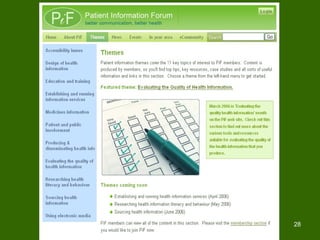
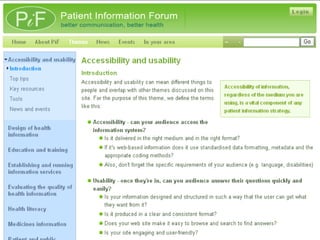
PiF Current Products & Services

•   [PiF aware] – daily/ weekly email alerts
•   Website
•   Annual conference(s)
•   Workshops – 25 people meet to ‘improve’ a
    common theme
    – Health information centres
    – Information on screening
    – Patient access to medical records
• Sharing experience, policies and proposals
• Training (with BMA Library and ABPI IPI)      29
30
Top tips
•   Health: Does it reinforce (or not contradict) our support for health and healthy
    lifestyles?
•   Care: Does it show respect for the audience and avoid unfair stereotypes? Does
    the tone of the wording show care and empathy?
•   Professionalism: Does it demonstrate pride in what we are doing? Are the
    spelling and grammar right? Are we able to challenge poor standards in any
    existing communications?
•   Efficiency: Is the budget right for the task? Are the tone and style right for the
    audience you are speaking to?
•   Equality: Do the images span ages and cultures (where appropriate)?
•   Clear: Is it easy to read and easy to understand?
•   Straightforward: Does it avoid gimmicks and over-complicated design or
    wording?
•   Honest: Does it avoid misleading information and false promises? Does it
    withhold information that the receiver has a right to know?
•   Accessible: Has it been tested with the target audience? Do they understand it?
    Are versions in other languages, symbols or formats needed? Is it easy to obtain?
•   Respectful: Does it show respect for the receivers’ feelings and beliefs? Does that
    ‘funny’ drawing or headline risk offending anyone?


                                                                                    31
32
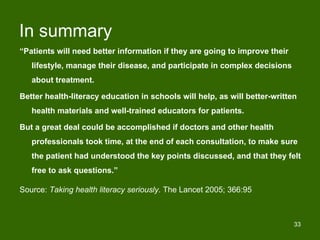
In summary
“Patients will need better information if they are going to improve their
   lifestyle, manage their disease, and participate in complex decisions
   about treatment.

Better health-literacy education in schools will help, as will better-written
   health materials and well-trained educators for patients.

But a great deal could be accomplished if doctors and other health
   professionals took time, at the end of each consultation, to make sure
   the patient had understood the key points discussed, and that they felt
   free to ask questions.”

Source: Taking health literacy seriously. The Lancet 2005; 366:95


                                                                            33
Contact Details
Mark Duman
Chair
Handel House
13 Park Road
Manchester
M8 4HT

Tel: 07985 639 887
Email: chair@pifonline.org.uk
Web: www.pifonline.org.uk
                                34

Knowledge in Power

  • 1.
    Information = power? Mark Duman 6 March 2006 Chair, Patient Information Forum
  • 2.
    Scope • The White Paper and beyond • Some solutions • Sharing 2
  • 3.
    The White Paperand beyond
  • 4.
    Choosing Health • Setsout the key principles for supporting the public to make more healthier and informed choices in nine areas: – accidents – alcohol – diet and nutrition – inequalities – mental health – physical activity – sexual health – substance misuse, – and tobacco. • Health Trainers; Health Direct; Personal Health Guides • National Collaboration on Health Literacy - May ‘06 4
  • 5.
    “The three-year planto put electronic information ‘at the centre of health’ marks one of the biggest strategic shifts in the NHS since it was created in 1948. For the first time, dispensing information will be as important as dispensing pills or performing operations” Thursday, January 6 2005 5
  • 6.
    ‘Better information, betterchoices, better health’ • Information Prescriptions • Community info-mediaries • Patient Information Bank Source: www.dh.gov.uk/assetRoot/04/09/85/99/04098599.pdf 6
  • 7.
  • 8.
    ‘Better information, betterchoices, better health’ • Information Prescriptions • Community info-mediaries • Patient Information Bank • Power questions • Information Accreditation System (IAS) Source: www.dh.gov.uk/assetRoot/04/09/85/99/04098599.pdf 8
  • 9.
    January 2006 -DH Choice About Choose and Book • By December 2005 all patients in England will be offered at least four providers for elective care. How we are treated • People will be able to record their lifestyle preferences on electronic medical records. This will mainly happen through Healthspace. Prescriptions • By December 2004 patients will be able to pick up repeat prescriptions from a pharmacy of their choice. By 2005 physiotherapists, radiographers, podiatrists, optometrists and pharmacists will have prescribing authority. Primary care • People will be able to access primary care services in more flexible ways such as walk in centres at train stations or football stadiums. Primary care practices will be able to offer a wider range of services such as diagnostics. Information to help patients choose • How patients and the public will be supported to make informed choices about their health and healthcare. 9
  • 10.
  • 11.
    The new WhitePaper  5.24 “give all people with long-term health and social care needs and their carers an ‘information prescription’  5.25 “By 2008, we would expect everyone with a long-term condition … to routinely receive information about their condition”  5.26 “By 2010 we would expect everyone with a long-term condition to be offered a care plan.” (good practice guidance early in 2007) 11
  • 12.
    The new WhitePaper cont…  2.29 Life Checks  2.91 QOF Rewards  4.81 Improving Immunization Rates  4.101 Improving End-of-Life Care  8.32 Patient Safety Outside of Hospitals 12
  • 13.
    'Supporting people withlong-term conditions to self-car • Examples of what central government, professionals and PCTs have done and need to do in making sure those with chronic illness can manage their health effectively. • Information and tools are cited as important for empowering people: – e.g. NHS Direct Interactive TV helps to keep elderly people up- to-date and informed, and the medium is effective because they usually both hard to reach and tend to suffer from long-term conditions. • However, it warns that many people without access to the internet who "tend to make little use of self care information" must be helped. • The role of health professionals is to direct people towards meaningful information and give "guidance on how to access it so that people feel confident enough to use it." 13
  • 14.
    “Now I feeltall” I strongly encourage all NHS organisations to take a close look at how they deliver their services and to ask their patients if their emotional needs are being met as well as their physical ones. They should ask patients if they are: • getting good treatment in a comfortable, caring and safe environment, delivered in a calm and reassuring way • having information to make choices, to feel confident and feel in control • being talked to and listened to as an equal, and • being treated with honesty, respect and dignity. Sir Nigel Crisp NHS Chief Executive, November 2005 14
  • 15.
  • 16.
    “Such arrangements arebringing March 1, 2006 jobs to thousands of people with disabilities, including those with Computer spinal cord injuries and vision loss. Technology Fast computers and broadband Opens a World of connections have become so Work to Disabled inexpensive and reliable that People location is now not an issue for certain jobs, like customer service.” 16
  • 17.
    NCC & SocialMarketing – April ‘06 • Integrate health understanding and improvement education & action into all of our lives and communities to achieve social justice, tackle wider causes of ill health, reduce childhood poverty and support healthier ways of living – Maximise the effectiveness of NHS Stop Smoking Services – Improve services to help people who are overweight or obese & prevent weight gain from an early age and encourage healthy eating – Strengthen services to improve sexual health – Deliver better services to prevent & treat alcohol problems – Improve the lives of those who face lifelong illnesses, particularly older people – Provide support to improve mental well-being • Develop, implement and evaluate a co-ordinated, evidence-based and cost- effective approach to the management and delivery of all future marketing communications activity related to health improvement 17
  • 18.
    Lloydspharmacy “Ever since Lloydspharmacy launched this free [diabetes testing] service in 2003, we have tested over 750,000 people.” 18
  • 19.
    Health Rights Information Scotland • Clear, accurate and up-to- date information about patients' rights should be more widely available and consistent. • Help NHS organisations reduce the work involved in them producing their own • Patients will have a better understanding of their rights and choices and feel more confident making decisions about their health and interacting with NHS staff. 19 www.scotconsumer.org.uk/hris/leaflets/other2.htm
  • 20.
    National Information Forum A voluntary organisation committed to encouraging the provision of accessible information, by every means possible, for disabled people, asylum seekers, refugees and anyone else disadvantaged in gaining access to information. www.nif.org.uk 20
  • 21.
    Connect www.ukconnect.org – the communication disability network • Fifty people with experience of long-term aphasia • Lack of information was a major obstacle. They described the frustrating experience of being given information at the wrong time or in a form they could not understand. • Given information when they could not take it in, and they had no way of re- visiting it. • Their aphasia made it difficult for them to make some initial enquiries: 'You cannot always ask...'. Access to information was severely restricted. 21
  • 22.
    National Programme forIT • NHS Care Record Service • NHS.uk • NHS Direct Online • Healthspace • Choose & Book re appointments 22
  • 23.
    Advocacy • Expert Patient Programme • Patient Care Advisors (PCAs) • Health Trainers • Community info-mediaries • Health Librarians • Health professionals? 23
  • 24.
    Is the NHSgetting better or worse? • 1 million patients surveyed between 1998-2005 • Over half of their priorities were information-led: – Fast access to health advice – Involvement in decisions and respect for patients’ preferences – Clear, comprehensible information and support for self-care – Emotional support and alleviation of anxiety – Involvement of family and friends and support for carers www.pickereurope.org 24
  • 25.
    Summary • Information for “patients” has come of age • Seems that ‘everybody’s doing it’ • But…still issues of quality, access and utility • Widening the health inequalities gap? • Where is consistency, joined-up thinking, and help at grassroots level? 25
  • 26.
  • 27.
    The Patient InformationForum (PiF) • Established with King’s Fund in 1997 • Original focus on acute trusts • Umbrella group of just under 300 members involved in ‘health communication’ • NHS Trusts, and NHS24, NHS Direct, NHS Direct Wales, Picker , NICE, UK National Screening Committee (50%) • Commercial e.g. BUPA, EMIS, Pfizer (20%) • Patient groups e.g. Blood Pressure Association, British Lung Foundation, Diabetes UK, MS Society (20%) • Funding primarily from membership dues • Efforts of Steering Group and Regional Co-ordinators members are purely voluntary 27
  • 28.
  • 29.
    PiF Current Products& Services • [PiF aware] – daily/ weekly email alerts • Website • Annual conference(s) • Workshops – 25 people meet to ‘improve’ a common theme – Health information centres – Information on screening – Patient access to medical records • Sharing experience, policies and proposals • Training (with BMA Library and ABPI IPI) 29
  • 30.
  • 31.
    Top tips • Health: Does it reinforce (or not contradict) our support for health and healthy lifestyles? • Care: Does it show respect for the audience and avoid unfair stereotypes? Does the tone of the wording show care and empathy? • Professionalism: Does it demonstrate pride in what we are doing? Are the spelling and grammar right? Are we able to challenge poor standards in any existing communications? • Efficiency: Is the budget right for the task? Are the tone and style right for the audience you are speaking to? • Equality: Do the images span ages and cultures (where appropriate)? • Clear: Is it easy to read and easy to understand? • Straightforward: Does it avoid gimmicks and over-complicated design or wording? • Honest: Does it avoid misleading information and false promises? Does it withhold information that the receiver has a right to know? • Accessible: Has it been tested with the target audience? Do they understand it? Are versions in other languages, symbols or formats needed? Is it easy to obtain? • Respectful: Does it show respect for the receivers’ feelings and beliefs? Does that ‘funny’ drawing or headline risk offending anyone? 31
  • 32.
  • 33.
    In summary “Patients willneed better information if they are going to improve their lifestyle, manage their disease, and participate in complex decisions about treatment. Better health-literacy education in schools will help, as will better-written health materials and well-trained educators for patients. But a great deal could be accomplished if doctors and other health professionals took time, at the end of each consultation, to make sure the patient had understood the key points discussed, and that they felt free to ask questions.” Source: Taking health literacy seriously. The Lancet 2005; 366:95 33
  • 34.
    Contact Details Mark Duman Chair HandelHouse 13 Park Road Manchester M8 4HT Tel: 07985 639 887 Email: chair@pifonline.org.uk Web: www.pifonline.org.uk 34