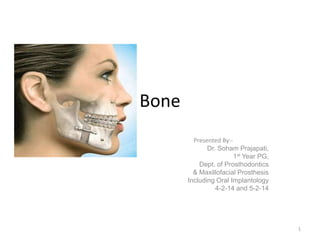
Bone
Presented By:-
Dr. Soham Prajapati,
1st Year PG,
Dept. of Prosthodontics
& Maxillofacial Prosthesis
Including Oral Implantology
4-2-14 and 5-2-14
1
CONTENTS
• Definition
• Introduction
• Classification of Bone
• Chemical composition of Bone
• Mechanical Properties
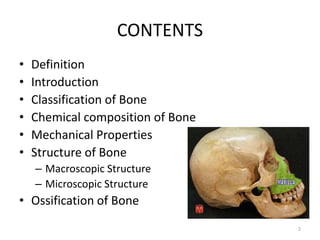
• Structure of Bone
– Macroscopic Structure
– Microscopic Structure
• Ossification of Bone
2
CONTENTS
• Alveolar Bone
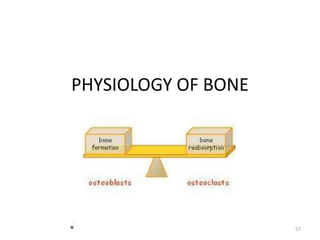
• Physiology Of Bone
• Wolf’s Law
• Function
• Metabolism
• Diseases Of Bone
• Prosthodontic Implication
• Conclusion
• References
3
DEFINITION
• The hard portion of the connective tissue which
constitutes the majority of the skeleton; it
consists of an inorganic or mineral component
and an organic component (the matrix and cells);
the matrix is composed of collagenous fibers and
is impregnated with minerals, chiefly calcium
phosphate (approx. 85%) and calcium carbonate
(approx. 10%), thus imparting the quality of
rigidity to bone—called also osseous tissue.
-GPT 8TH EDITION.
4
INTRODUCTION
• At birth, there are over 270 bones in an infant
human's body, but many of these fuse
together as the child grows, leaving a total of
206 separate bones in an adult.
• Largest Bone:- Femur
• Smallest Bone:- Auditory Ossicles
5
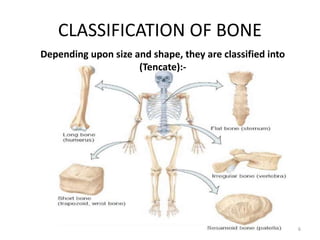
CLASSIFICATION OF BONE
Depending upon size and shape, they are classified into
(Tencate):-
6
CLASSIFICATION OF BONE
• According to Development of Bone:-
- Intracartilagineous
- Intramembraneous
7
CLASSIFICATION OF BONE (MISCH)
• Woven Bone
• Lamellar Bone
• Composite Bone
• Bundle Bone
8
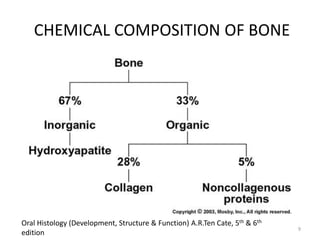
CHEMICAL COMPOSITION OF BONE
9
Oral Histology (Development, Structure & Function) A.R.Ten Cate, 5th & 6th
edition
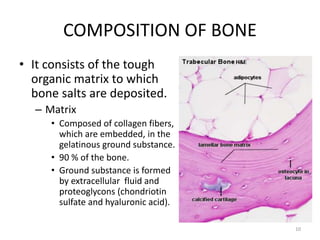
COMPOSITION OF BONE
• It consists of the tough
organic matrix to which
bone salts are deposited.
– Matrix
• Composed of collagen fibers,
which are embedded, in the
gelatinous ground substance.
• 90 % of the bone.
• Ground substance is formed
by extracellular fluid and
proteoglycons (chondriotin
sulfate and hyaluronic acid).
10
COMPOSITION OF BONE
- BONE SALTS
• Crystalline salts present in bones are called
Hydroxyapatites [Ca10(PO4)6(OH)2], which contains
calcium and phosphate.
• Others salts are also present.
• Strengthen the bone matrix.
11
Oral Histology (Development, Structure &
Function) A.R.Ten Cate, 5th & 6th edition
MECHANICAL PROPERTIES
• High Compressive Strength of about 170 MPa
• Poor Tensile Strength of 104–121 Mpa
• Very Low Shear Stress strength (51.6 MPa)
• It resists pushing forces well, but not pulling or
torsional forces.
• Bone is essentially brittle.
12
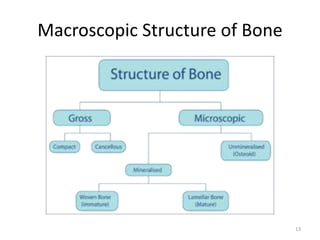
Macroscopic Structure of Bone
13
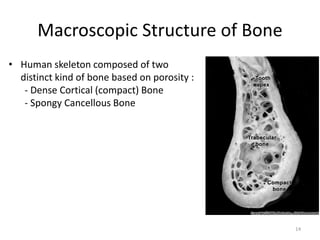
Macroscopic Structure of Bone
• Human skeleton composed of two
distinct kind of bone based on porosity :
- Dense Cortical (compact) Bone
- Spongy Cancellous Bone
14
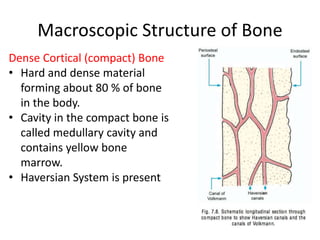
Macroscopic Structure of Bone
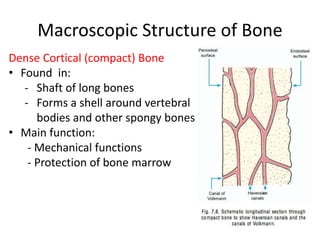
Dense Cortical (compact) Bone
• Hard and dense material
forming about 80 % of bone
in the body.
• Cavity in the compact bone is
called medullary cavity and
contains yellow bone
marrow.
• Haversian System is present
15
Macroscopic Structure of Bone
Dense Cortical (compact) Bone
• Found in:
- Shaft of long bones
- Forms a shell around vertebral
bodies and other spongy bones
• Main function:
- Mechanical functions
- Protection of bone marrow
16
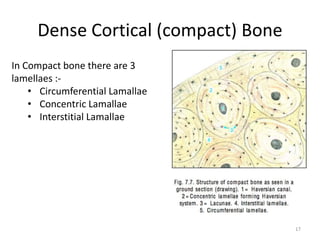
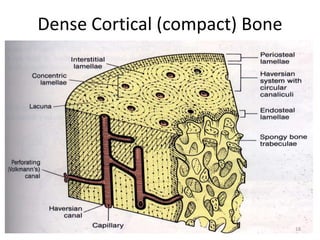
Dense Cortical (compact) Bone
In Compact bone there are 3
lamellaes :-
• Circumferential Lamallae
• Concentric Lamallae
• Interstitial Lamallae
17
Dense Cortical (compact) Bone
18
Macroscopic Structure of Bone
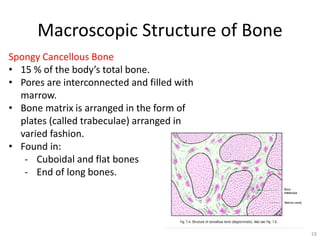
Spongy Cancellous Bone
• 15 % of the body’s total bone.
• Pores are interconnected and filled with
marrow.
• Bone matrix is arranged in the form of
plates (called trabeculae) arranged in
varied fashion.
• Found in:
- Cuboidal and flat bones
- End of long bones.
19
Macroscopic Structure of Bone
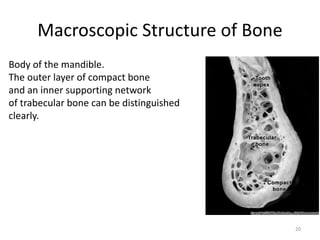
Body of the mandible.
The outer layer of compact bone
and an inner supporting network
of trabecular bone can be distinguished
clearly.
20
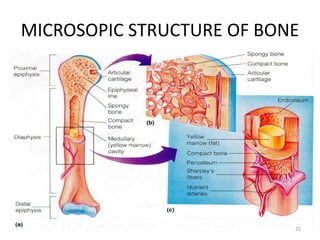
MICROSOPIC STRUCTURE OF BONE
• Osteogenic Cells
– Osteoblasts
– Osteocytes
– Bone lining cells
• Osteoclasts
21
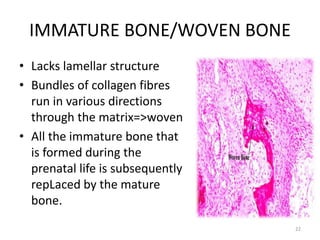
IMMATURE BONE/WOVEN BONE
• Lacks lamellar structure
• Bundles of collagen fibres
run in various directions
through the matrix=>woven
• All the immature bone that
is formed during the
prenatal life is subsequently
repLaced by the mature
bone.
22
MATURE BONE
• Also called as lamellar bone
• Characterized by a orderly arrangement which is the
result of repeated addition of uniform lamellae to
bone surfaces during appositional growth.
• Lamellae are 4 – 12 µm thick
• Direction of collagen fibers in any given lamellae lies
at right angle to that of the fibrils in the adjacent
lamellae.
23
Some microscopic features of mature bone to
differentiate from immature bone
• Evenly acidophilic staining
• Regular arrangement of its lamellae
• Osteocyte cells are very few, more evenly
arranged
24
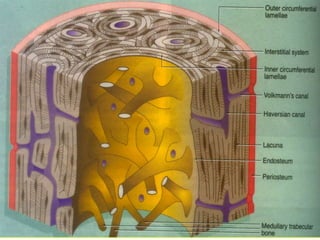
OSTEON
• Represents the basic structural unit of the
compact bone.
• It consists of haversian canal in the center which
harbors a blood vessels.
• This is surrounded by concentric, mineralized
lamellae to form the osteon; known as concentric
lamellae.
• Spaces between the different osteon is filled with
interstitial lamellae.
25
26
OSTEOID
• In histology, osteoid is the unmineralized, organic
portion of the bone matrix that forms prior to the
maturation of bone tissue.
• When the osteoid becomes mineralized, it and
the adjacent bone cells have developed into new
bone tissue.
• The predominant fiber-type is Type I collagen and
comprises ninety percent of the osteoid. The
ground substance is mostly made up of
chondroitin sulfate and osteocalcin.
27
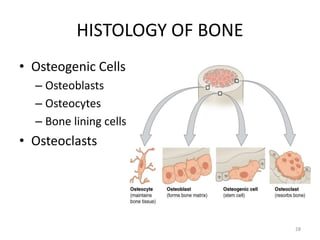
HISTOLOGY OF BONE
• Osteogenic Cells
– Osteoblasts
– Osteocytes
– Bone lining cells
• Osteoclasts
28
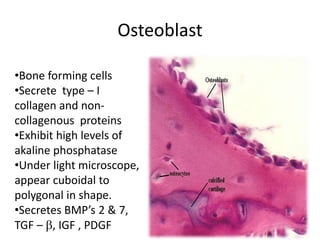
Osteoblast
•Bone forming cells
•Secrete type – I
collagen and non-
collagenous proteins
•Exhibit high levels of
akaline phosphatase
•Under light microscope,
appear cuboidal to
polygonal in shape.
•Secretes BMP’s 2 & 7,
TGF – b, IGF , PDGF 29
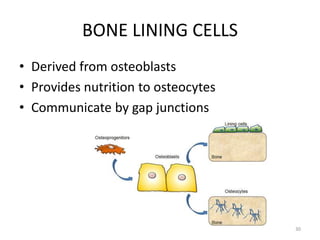
BONE LINING CELLS
• Derived from osteoblasts
• Provides nutrition to osteocytes
• Communicate by gap junctions
30
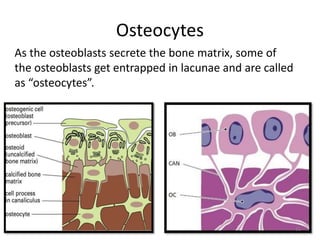
Osteocytes
As the osteoblasts secrete the bone matrix, some of
the osteoblasts get entrapped in lacunae and are called
as “osteocytes”.
31
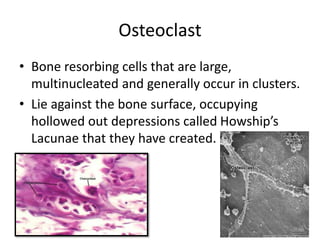
• Bone resorbing cells that are large,
multinucleated and generally occur in clusters.
• Lie against the bone surface, occupying
hollowed out depressions called Howship’s
Lacunae that they have created.
Osteoclast
32
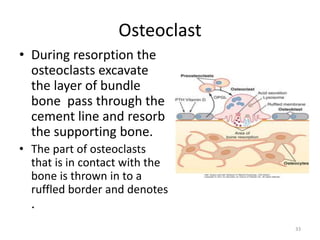
• During resorption the
osteoclasts excavate
the layer of bundle
bone pass through the
cement line and resorb
the supporting bone.
• The part of osteoclasts
that is in contact with the
bone is thrown in to a
ruffled border and denotes
.
Osteoclast
33
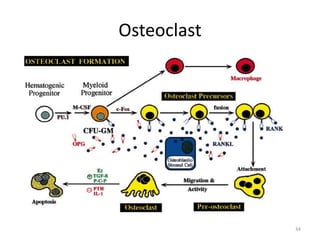
Osteoclast
34
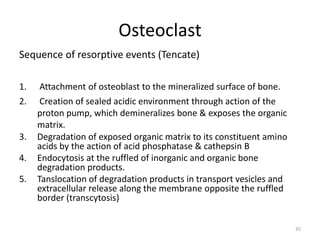
Sequence of resorptive events (Tencate)
1. Attachment of osteoblast to the mineralized surface of bone.
2. Creation of sealed acidic environment through action of the
proton pump, which demineralizes bone & exposes the organic
matrix.
3. Degradation of exposed organic matrix to its constituent amino
acids by the action of acid phosphatase & cathepsin B
4. Endocytosis at the ruffled of inorganic and organic bone
degradation products.
5. Tanslocation of degradation products in transport vesicles and
extracellular release along the membrane opposite the ruffled
border (transcytosis)
Osteoclast
35
OSSIFICATION OF BONE
• All bone is of mesodermal origin.
• The process of bone formation is called
ossification.
• Types of bone formation:-
• Endocondral ossification
• Intramembranous ossification
36
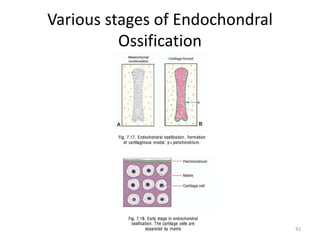
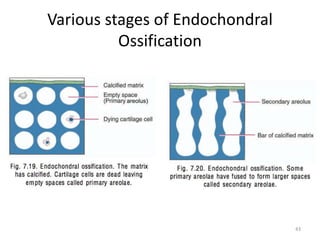
Endocondral ossification
• Formation of most bone is preceded by the
formation of a cartilaginous model, which is
subsequently replaced by bone. This kind of
ossification is called Endocondral Ossification.
• Bones formed in this way are called Cartilage
Bones.
37
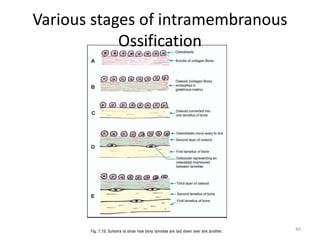
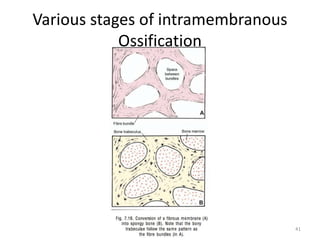
Intramembranous ossification
• When bone is laid directly in a fibrous manner,
this process is called Intramembranous
ossification.
• Bones formed in this way are called
membrane bones.
• E.g. vault of the skull, the mandible, and the
clavicle.
38
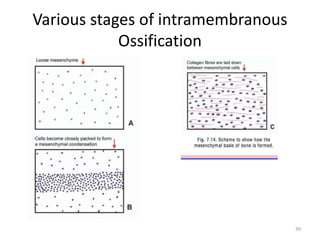
Various stages of intramembranous
Ossification
39
Various stages of intramembranous
Ossification
40
Various stages of intramembranous
Ossification
41
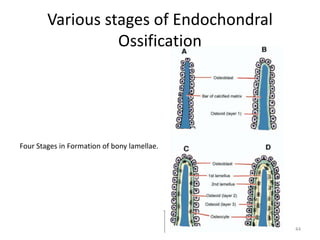
Various stages of Endochondral
Ossification
42
Various stages of Endochondral
Ossification
43
Various stages of Endochondral
Ossification
Four Stages in Formation of bony lamellae.
44
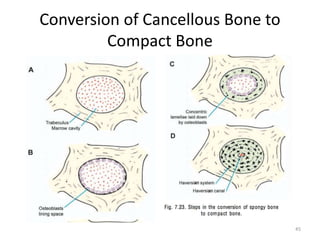
Conversion of Cancellous Bone to
Compact Bone
45
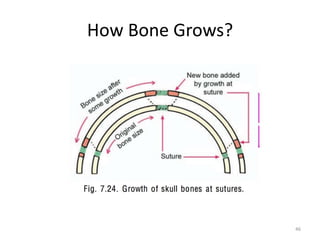
How Bone Grows?
GROWTH OF BONES AT SUTURES
46
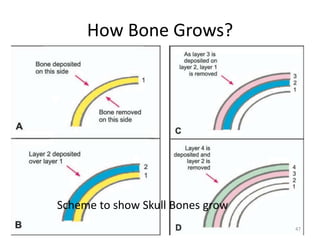
How Bone Grows?
Scheme to show Skull Bones grow
47
How Bone Grows?
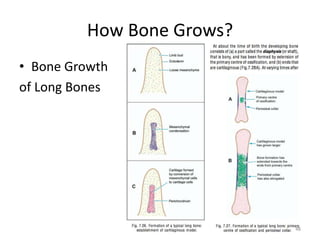
• Bone Growth
of Long Bones
48
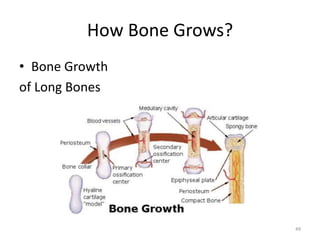
How Bone Grows?
• Bone Growth
of Long Bones
49
Bone Marrow
• Medullary cavities filled with marrow.
• Red, when active production of stem cells or a
reserve population of mesenchymal stem cells.
• Yellow, when aging causes the cavity to be
converted into a site for fat storage.
• Function:-
– Generate principle cells in the body
– Highly osteogenic material that can stimulate bone
formation.
50
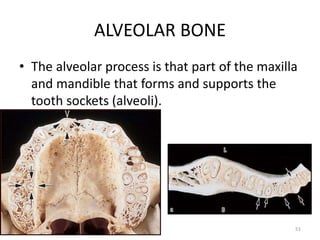
ALVEOLAR BONE
• The alveolar process is that part of the maxilla
and mandible that forms and supports the
tooth sockets (alveoli).
51
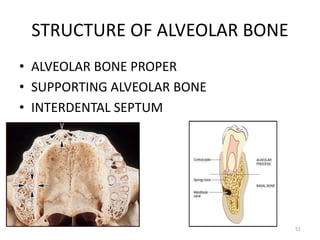
STRUCTURE OF ALVEOLAR BONE
• ALVEOLAR BONE PROPER
• SUPPORTING ALVEOLAR BONE
• INTERDENTAL SEPTUM
52
ALVEOLAR BONE PROPER
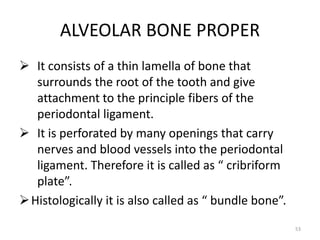
 It consists of a thin lamella of bone that
surrounds the root of the tooth and give
attachment to the principle fibers of the
periodontal ligament.
 It is perforated by many openings that carry
nerves and blood vessels into the periodontal
ligament. Therefore it is called as “ cribriform
plate”.
Histologically it is also called as “ bundle bone”.
53
ALVEOLAR BONE PROPER
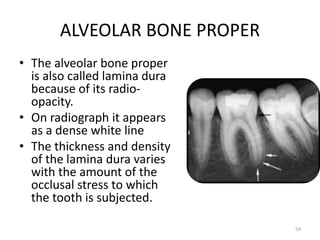
• The alveolar bone proper
is also called lamina dura
because of its radio-
opacity.
• On radiograph it appears
as a dense white line
• The thickness and density
of the lamina dura varies
with the amount of the
occlusal stress to which
the tooth is subjected.
54
SUPPORTING ALVEOLAR BONE
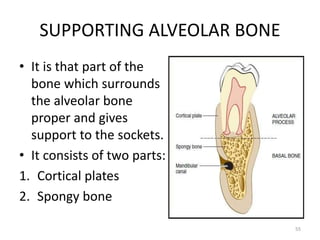
• It is that part of the
bone which surrounds
the alveolar bone
proper and gives
support to the sockets.
• It consists of two parts:
1. Cortical plates
2. Spongy bone
55
INTERDENTAL SEPTUM
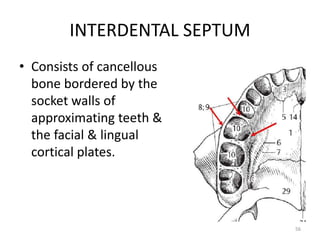
• Consists of cancellous
bone bordered by the
socket walls of
approximating teeth &
the facial & lingual
cortical plates.
56
PHYSIOLOGY OF BONE
57
Bone Modeling
• Refers to sculpting and shaping of bones after
they have grown in length.
• Process involves independent, uncoupled action
of osteoclasts and osteoblasts.
• e.g. orthodontic tooth movement
wound healing (during stabilization of
endosseous implants) and in response to bone
loading.
• Can change both the size and shapes of the bone.
58
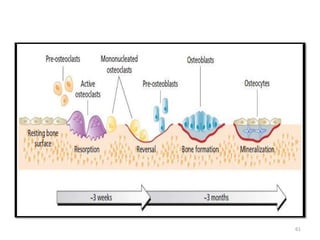
Bone Remodeling
• Refers to sequential, coupled actions by these
two types of cells (osteoclasts and
osteoblasts).
• Does not change the size and shape of bone.
• Removes a portion of old bone and replaces it
with new bone.
• Occurs throughout lifetime.
59
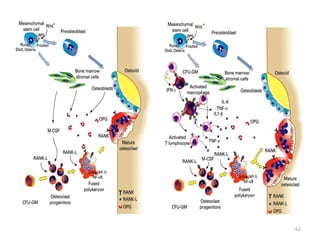
Bone Remodeling
• Activation is controlled locally, possibly by an
auto regulatory mechanism such as autocrine
or paracrine factors generated in bone
microenvironment.
• E.g wound healing
60
61
62
FUNCTIONS OF REMODELING
1. To prevent the accumulation of damaged or
fatigued bone by regenerating new bone.
2. To allow the bone to respond to changes in
mechanical forces.
3. To facilitate mineral homeostasis.
63
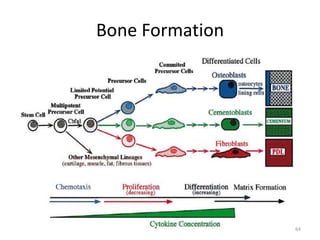
Bone Formation
64
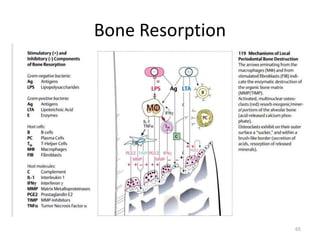
Bone Resorption
65
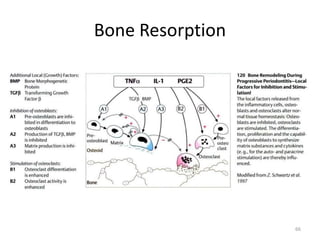
Bone Resorption
66
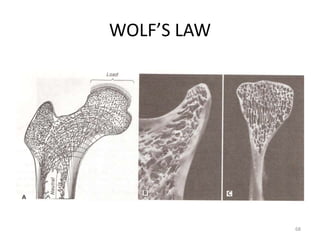
WOLF’S LAW
• Wolff’s Law [Julius Wolff, German anatomist,
1836-1902]
• “For a uniform or constant fact or principle,
more specifically, that a bone, either normal
or abnormal, will develop the structure most
suited to resist those forces acting on it.”
GPT, 8TH EDITION
67
WOLF’S LAW
68
Functions
• Protective Function
– Provides the framework
– Protects the soft and vital organs of the body.
• Mechanical Function
– Support the Body
– Their attachment to the muscles and tendons, the
bone acts as levers in bringing about the
movements.
69
Functions
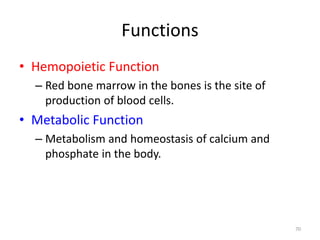
• Hemopoietic Function
– Red bone marrow in the bones is the site of
production of blood cells.
• Metabolic Function
– Metabolism and homeostasis of calcium and
phosphate in the body.
70
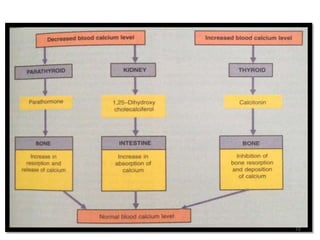
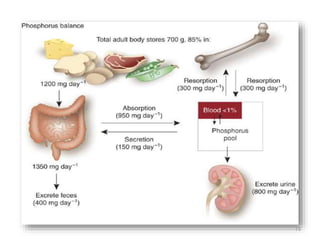
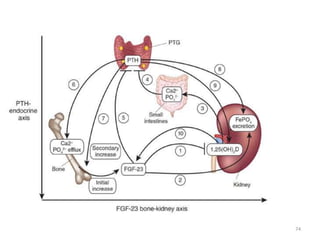
METABOLISM OF CALCIUM AND
PHOSPHORUS.
71
72
73
74
Diseases of Bones
75
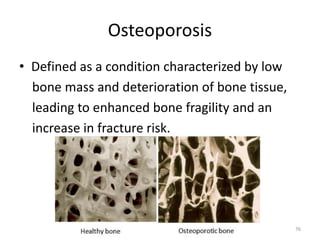
Osteoporosis
• Defined as a condition characterized by low
bone mass and deterioration of bone tissue,
leading to enhanced bone fragility and an
increase in fracture risk.
76
Osteopetrosis
• Also known as marble bone disease and
Albers-Schonberg disease is an extremely rare
inherited disorder whereby the bones harden,
becoming denser
77
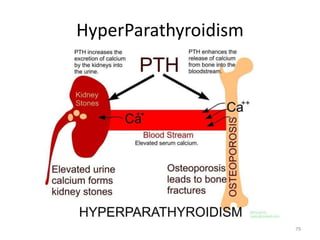
HyperParathyroidism
• 2 types: 1. Primary hyperparathyroidism
2. Secondary hyperparathyroidism
• Age: middle aged females
• RADIOGRAPHIC FEATURES:
• generalized osteoporosis is seen
• Thinning of the cortical plates & increased
resorption of medullary bone
• HISTOLOGIC FEATURES:
• Osteoclastic resorptions of bony trabecuale as
well as formation of new bone by osteoblasts.
78
HyperParathyroidism
79
Osteogenesis imperfecta
• Osteogenesis imperfecta (OI) literally means
imperfectly formed bones. People with OI
have an error (mutation) in the genetic
instructions on how to make strong bones. As
a result, their bones break easily
• One of the genes that tells the body how to
make a specific protein (type I collagen) is
defective in people with OI.
80
Paget’s Disease
• Also c/a Osteitis Deformans
• Disease characterized by abnormal deposition
and resorption of bone resulting in distortion
and weakening of affected bones.
• Unknown etiology
• Age: above 40 years
81
Paget’s Disease
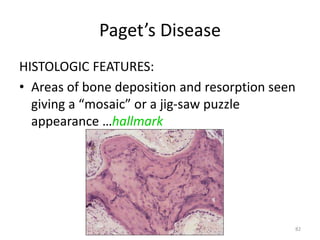
HISTOLOGIC FEATURES:
• Areas of bone deposition and resorption seen
giving a “mosaic” or a jig-saw puzzle
appearance …hallmark
82
Fibrous Dysplasia
• Characterized by replacement of normal bone by excessive
proliferation of cellular fibrous connective tissue intermixed with
bony trabeculae
ETIOLOGY:
1. Idiopathic
2. Trauma
3. Viral
4. Altered mesenchymal cells
5. Mutation of GNAS -1 gene
RADIOGRAPHIC FEATURES
• Ground glass appearance/orange peel appearance on radiographs
• Expansion of cortical plates
83
Osteoarthritis
• Also known as
– degenerative arthritis
– degenerative joint disease
– osteoarthrosis,
• It is a group of mechanical abnormalities
involving degradation of joints,including
articular cartilage and subchondral bone.
• Symptoms may include joint pain, tenderness,
stiffness, locking, and sometimes an effusion
84
Osteoarthritis
• When bone surfaces become less well
protected by cartilage, bone may be exposed
and damaged. As a result of decreased
movement secondary to pain, regional
muscles may atrophy, and ligaments may
become more lax.
85
Role of Estrogen and Bone
• Estrogen defend against PTH- mediated
resorption of bone.
• In estrogen- deficient conditions, such as
after menopause, the effect of PTH on
bone contributes to the development of
osteoporosis.
• Estrogen replacement therapy, which
should be accompanied by progesterone,
is useful for women at high risk for
developing osteoporosis.
86
DIABETES AND BONE
• Diabetes show no distinct pattern or
consistent pattern.
• Severe bone loss and periodontal abscess are
common in diabetic patients with poor oral
hygiene.
87
DIABETES AND BONE
• Children with Type I diabetes tend to have
more bone destruction around the first molar
and incisors, but this destruction becomes
more generalized in older ages.
• In juvenile diabetics, extensive periodontal
destruction often occurs due to the age of this
patients.
88
OSSEOUS TOPOGRAPHY IN DISEASE
• There are four chief types of bone defects that
present in the alveolar bone:
1. Horizontal defects
2. Vertical, or angular defects
3. Fenestrations
4. Dehiscenses
89
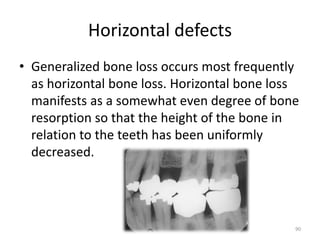
Horizontal defects
• Generalized bone loss occurs most frequently
as horizontal bone loss. Horizontal bone loss
manifests as a somewhat even degree of bone
resorption so that the height of the bone in
relation to the teeth has been uniformly
decreased.
90
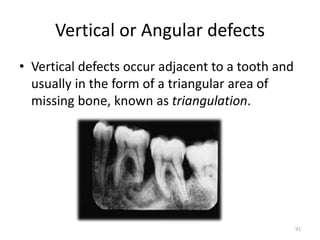
Vertical or Angular defects
• Vertical defects occur adjacent to a tooth and
usually in the form of a triangular area of
missing bone, known as triangulation.
91
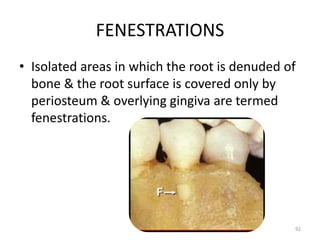
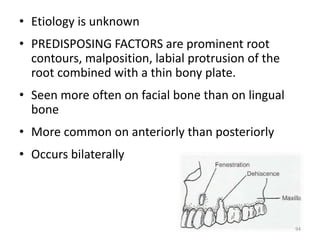
FENESTRATIONS
• Isolated areas in which the root is denuded of
bone & the root surface is covered only by
periosteum & overlying gingiva are termed
fenestrations.
92
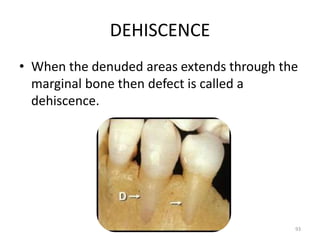
DEHISCENCE
• When the denuded areas extends through the
marginal bone then defect is called a
dehiscence.
93
• Etiology is unknown
• PREDISPOSING FACTORS are prominent root
contours, malposition, labial protrusion of the
root combined with a thin bony plate.
• Seen more often on facial bone than on lingual
bone
• More common on anteriorly than posteriorly
• Occurs bilaterally
94
Prosthodontic Implication
95
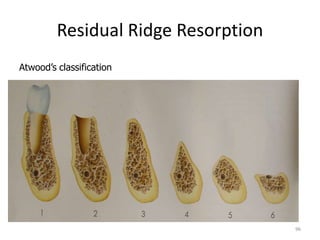
Residual Ridge Resorption
Atwood’s classification
96
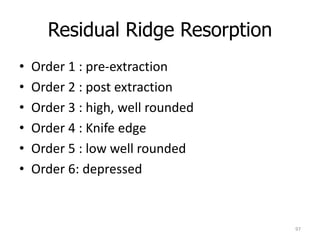
Residual Ridge Resorption
• Order 1 : pre-extraction
• Order 2 : post extraction
• Order 3 : high, well rounded
• Order 4 : Knife edge
• Order 5 : low well rounded
• Order 6: depressed
97
Residual Ridge Resorption
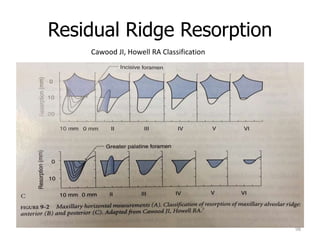
98
Cawood JI, Howell RA Classification
Residual Ridge Resorption
99
• The posterior edentulous mandible resorbs at
a rate about four times faster than the
anterior edentulous mandible.
• However, the original height of available bone
in the mandible is twice as much as the
maxilla. Therefore the resultant maxillary
atrophy, although slower, affects the potential
implant patient with equal frequency
Pre-Prosthetic Surgery
According to GPT (1999) PRE- PROSTHETIC SURGERY –
“Surgical procedures designed to
facilitate fabrication of prosthesis
or to improve the prognosis of
Prosthodontic care”
100
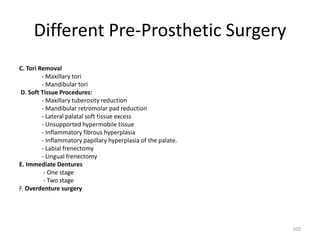
Different Pre-Prosthetic Surgery
I. Basic pre-prosthetic surgical procedures
A. Removal of Teeth
- Erupted
- Unerupted
- Partially erupted
- Root stumps
- Cysts
B. Bony recontouring of alveolar ridges
- Simple alveoloplasty associated with removal of multiple teeth.
- Intraseptal alveoloplasty
- Maxillary tuberosity reduction
- Buccal exostosis and excessive undercuts
- Lateral palatal exostosis
- Mylohyoid ridge reduction
- Genial tubercle reduction
101
Different Pre-Prosthetic Surgery
C. Tori Removal
- Maxillary tori
- Mandibular tori
D. Soft Tissue Procedures:
- Maxillary tuberosity reduction
- Mandibular retromolar pad reduction
- Lateral palatal soft tissue excess
- Unsupported hypermobile tissue
- Inflammatory fibrous hyperplasia
- Inflammatory papillary hyperplasia of the palate.
- Labial frenectomy
- Lingual frenectomy
E. Immediate Dentures
- One stage
- Two stage
F. Overdenture surgery
102
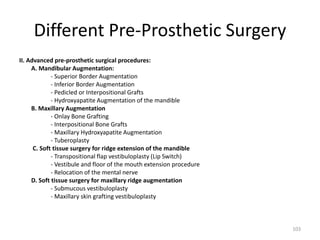
Different Pre-Prosthetic Surgery
II. Advanced pre-prosthetic surgical procedures:
A. Mandibular Augmentation:
- Superior Border Augmentation
- Inferior Border Augmentation
- Pedicled or Interpositional Grafts
- Hydroxyapatite Augmentation of the mandible
B. Maxillary Augmentation
- Onlay Bone Grafting
- Interpositional Bone Grafts
- Maxillary Hydroxyapatite Augmentation
- Tuberoplasty
C. Soft tissue surgery for ridge extension of the mandible
- Transpositional flap vestibuloplasty (Lip Switch)
- Vestibule and floor of the mouth extension procedure
- Relocation of the mental nerve
D. Soft tissue surgery for maxillary ridge augmentation
- Submucous vestibuloplasty
- Maxillary skin grafting vestibuloplasty
103
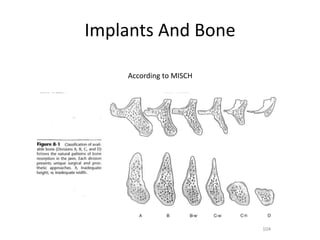
Implants And Bone
104
According to MISCH
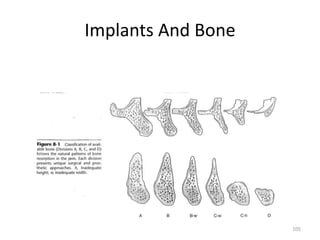
Implants And Bone
105
Implants And Bone
106
• D1; bone is primarily dense cortical bone.
• D2; bone has dense to thick porous
cortical bone on the crest and within
coarse trabecular bone.
• D3; has a thinner porous cortical crest and
fine trabecular bone
Implants And Bone
107
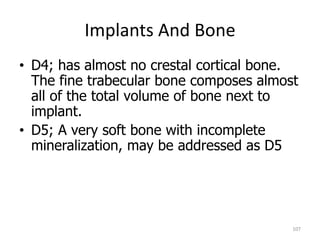
• D4; has almost no crestal cortical bone.
The fine trabecular bone composes almost
all of the total volume of bone next to
implant.
• D5; A very soft bone with incomplete
mineralization, may be addressed as D5
Implants And Bone
• Five important things to remember are:-
– Available Bone Height
– Available Bone Width
– Available Bone Length
– Available Bone Angulation
– Crown Height
108
Implants And Bone
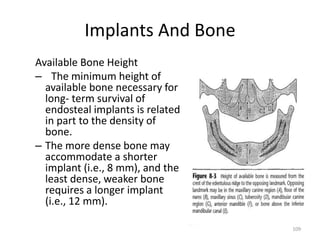
Available Bone Height
– The minimum height of
available bone necessary for
long- term survival of
endosteal implants is related
in part to the density of
bone.
– The more dense bone may
accommodate a shorter
implant (i.e., 8 mm), and the
least dense, weaker bone
requires a longer implant
(i.e., 12 mm).
109
Implants And Bone
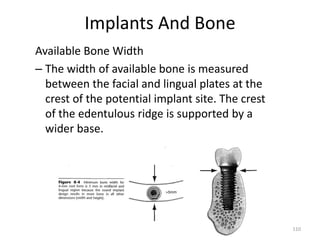
Available Bone Width
– The width of available bone is measured
between the facial and lingual plates at the
crest of the potential implant site. The crest
of the edentulous ridge is supported by a
wider base.
110
Implants And Bone
Available Bone Length
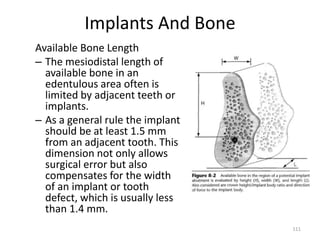
– The mesiodistal length of
available bone in an
edentulous area often is
limited by adjacent teeth or
implants.
– As a general rule the implant
should be at least 1.5 mm
from an adjacent tooth. This
dimension not only allows
surgical error but also
compensates for the width
of an implant or tooth
defect, which is usually less
than 1.4 mm.
111
Implants And Bone
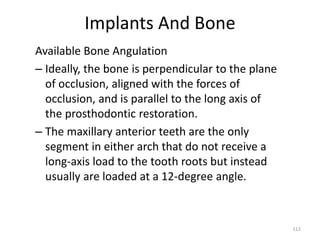
Available Bone Angulation
– Ideally, the bone is perpendicular to the plane
of occlusion, aligned with the forces of
occlusion, and is parallel to the long axis of
the prosthodontic restoration.
– The maxillary anterior teeth are the only
segment in either arch that do not receive a
long-axis load to the tooth roots but instead
usually are loaded at a 12-degree angle.
112
Implants And Bone
Available Bone Angulation
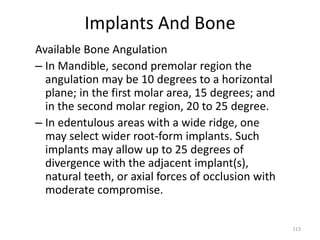
– In Mandible, second premolar region the
angulation may be 10 degrees to a horizontal
plane; in the first molar area, 15 degrees; and
in the second molar region, 20 to 25 degree.
– In edentulous areas with a wide ridge, one
may select wider root-form implants. Such
implants may allow up to 25 degrees of
divergence with the adjacent implant(s),
natural teeth, or axial forces of occlusion with
moderate compromise.
113
Implants And Bone
Crown Height
– It affects the appearance of the final
prosthesis and also affects the amount of
moment force on the implant and
surrounding crestal bone during occlusal
loading.
– The crown height is measured from the
occlusal or incisal plane to the crest of the
ridge and may be considered a vertical
cantilever.
114
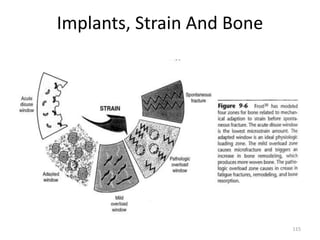
Implants, Strain And Bone
115
Implants And Bone
116
• As Bone density decreases, incidence of micro
fracture increases, so the strain to the bone is
decreases.
• Factor of load is also influenced by direction of
the implant placed.
• Increased implant number decreased stress
in functional loading area.
Implants and Bone
• For every 0.5-mm increase in width there is an
increased surface area between 10-15%.
• Because the greatest stresses are concentrated at
the crestal region of the implant, width is more
significant than length.
• D4 bone benefits from relatively longer implants
for initial fixation.
117
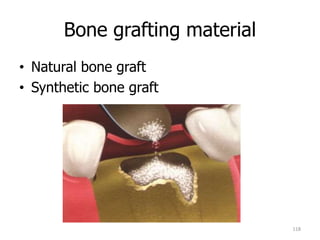
Bone grafting material
• Natural bone graft
• Synthetic bone graft
118
Natural bone graft material
• Auto graft:- iliac crest
• Allograft:-cadavers , bone bank
• There are three types of bone allograft
available:
Fresh or fresh-frozen bone
Freeze-dried bone allograft (FDBA)
Demineralized freeze-dried bone
allograft (DFDBA)
119
Synthetic bone grafts material
• Xenografts:-bovine
• Alloplastic grafts:-hydroxylapatite,
bioactive glass
120
OSSEOUS INTEGRATION
• The process and resultant apparent direct
connection of an exogenous material’s surface
and the host bone tissues, without intervening
fibrous connective tissue present.
- GPT, 8TH EDITION
121
Osseointegration and Prosthodontics
• Osseointegration, the direct structual and
function adhesion between bone and implant
surface, is a prerequisite for the long term
succes of dental implants.
122
Osseointegration and Prosthodontics
• Six important factors for estrablishing reliable
osseointegration:
– Implant material
– Implant design
– Surface quality
– Bone status
– Surgical technique
– Loading conditions.
123
CONCLUSION
• Bones are rigid organs that constitute part of
the endoskeleton of vertebrates. They support
and protect the various organs of the body,
produce red and white blood cells and store
minerals. Bone tissue is a type of dense
connective tissue. Bones come in a variety of
shapes and have a complex internal and
external structure, are lightweight yet strong
and hard, and serve multiple functions.
124
References
• Oral Histology (Development, Structure & Function) A.R.Ten
Cate, 5th & 6th edition
• Essential Of Complete Denture – Winkler,2nd edition
• Contemporary Implant Dentistry - Carl.E.Misch,3rd & 4th
edition
• Bone : Biology , Harvesting , Grafting for Dental Imlants
Arun K. Garg
• TextBook of Histology – Inderbir Singh
• Color Atlas of Dental Medicine, Wolf Rateitachak and
Hassell,3rd Edition
• Peterson’s Priciple of oral and Maxillofacial Surgery, Volume 1,
Michael Miloro Edition 125
References
• Atwood DA: Reduction Of Residual Ridges: A Major Oral
Disease Entity. J Prosthet Dent 1971;26:266-279.
• Modeling And Remodeling Of Human Extraction Sockets – By -
J Clin Periodontal 2008; 35: 630–639
• Molecular And Cellular Periodontology 2000, Vol. 24, 2000,
99–126 Copyright C Munksgaard 2000
• Caranza- clinical periodontology 9 edition
• Bone Loss and Bone Turnover in Diabetes
• Jesse C. Krakauer, Malachi J. McKenna, Nancy Fenn Buderer,
D. Sudhaker Rao, Fred W. Whitehouse, and A. Michael Parfitt ,
DIABETES, VOL. 44, JULY 1995
• GPT, 8TH EDITION
126
Thank You
127

Bone & Its Importance to Prosthodontist

  • 1.
    Bone Presented By:- Dr. SohamPrajapati, 1st Year PG, Dept. of Prosthodontics & Maxillofacial Prosthesis Including Oral Implantology 4-2-14 and 5-2-14 1
  • 2.
    CONTENTS • Definition • Introduction •Classification of Bone • Chemical composition of Bone • Mechanical Properties • Structure of Bone – Macroscopic Structure – Microscopic Structure • Ossification of Bone 2
  • 3.
    CONTENTS • Alveolar Bone •Physiology Of Bone • Wolf’s Law • Function • Metabolism • Diseases Of Bone • Prosthodontic Implication • Conclusion • References 3
  • 4.
    DEFINITION • The hardportion of the connective tissue which constitutes the majority of the skeleton; it consists of an inorganic or mineral component and an organic component (the matrix and cells); the matrix is composed of collagenous fibers and is impregnated with minerals, chiefly calcium phosphate (approx. 85%) and calcium carbonate (approx. 10%), thus imparting the quality of rigidity to bone—called also osseous tissue. -GPT 8TH EDITION. 4
  • 5.
    INTRODUCTION • At birth,there are over 270 bones in an infant human's body, but many of these fuse together as the child grows, leaving a total of 206 separate bones in an adult. • Largest Bone:- Femur • Smallest Bone:- Auditory Ossicles 5
  • 6.
    CLASSIFICATION OF BONE Dependingupon size and shape, they are classified into (Tencate):- 6
  • 7.
    CLASSIFICATION OF BONE •According to Development of Bone:- - Intracartilagineous - Intramembraneous 7
  • 8.
    CLASSIFICATION OF BONE(MISCH) • Woven Bone • Lamellar Bone • Composite Bone • Bundle Bone 8
  • 9.
    CHEMICAL COMPOSITION OFBONE 9 Oral Histology (Development, Structure & Function) A.R.Ten Cate, 5th & 6th edition
  • 10.
    COMPOSITION OF BONE •It consists of the tough organic matrix to which bone salts are deposited. – Matrix • Composed of collagen fibers, which are embedded, in the gelatinous ground substance. • 90 % of the bone. • Ground substance is formed by extracellular fluid and proteoglycons (chondriotin sulfate and hyaluronic acid). 10
  • 11.
    COMPOSITION OF BONE -BONE SALTS • Crystalline salts present in bones are called Hydroxyapatites [Ca10(PO4)6(OH)2], which contains calcium and phosphate. • Others salts are also present. • Strengthen the bone matrix. 11 Oral Histology (Development, Structure & Function) A.R.Ten Cate, 5th & 6th edition
  • 12.
    MECHANICAL PROPERTIES • HighCompressive Strength of about 170 MPa • Poor Tensile Strength of 104–121 Mpa • Very Low Shear Stress strength (51.6 MPa) • It resists pushing forces well, but not pulling or torsional forces. • Bone is essentially brittle. 12
  • 13.
  • 14.
    Macroscopic Structure ofBone • Human skeleton composed of two distinct kind of bone based on porosity : - Dense Cortical (compact) Bone - Spongy Cancellous Bone 14
  • 15.
    Macroscopic Structure ofBone Dense Cortical (compact) Bone • Hard and dense material forming about 80 % of bone in the body. • Cavity in the compact bone is called medullary cavity and contains yellow bone marrow. • Haversian System is present 15
  • 16.
    Macroscopic Structure ofBone Dense Cortical (compact) Bone • Found in: - Shaft of long bones - Forms a shell around vertebral bodies and other spongy bones • Main function: - Mechanical functions - Protection of bone marrow 16
  • 17.
    Dense Cortical (compact)Bone In Compact bone there are 3 lamellaes :- • Circumferential Lamallae • Concentric Lamallae • Interstitial Lamallae 17
  • 18.
  • 19.
    Macroscopic Structure ofBone Spongy Cancellous Bone • 15 % of the body’s total bone. • Pores are interconnected and filled with marrow. • Bone matrix is arranged in the form of plates (called trabeculae) arranged in varied fashion. • Found in: - Cuboidal and flat bones - End of long bones. 19
  • 20.
    Macroscopic Structure ofBone Body of the mandible. The outer layer of compact bone and an inner supporting network of trabecular bone can be distinguished clearly. 20
  • 21.
    MICROSOPIC STRUCTURE OFBONE • Osteogenic Cells – Osteoblasts – Osteocytes – Bone lining cells • Osteoclasts 21
  • 22.
    IMMATURE BONE/WOVEN BONE •Lacks lamellar structure • Bundles of collagen fibres run in various directions through the matrix=>woven • All the immature bone that is formed during the prenatal life is subsequently repLaced by the mature bone. 22
  • 23.
    MATURE BONE • Alsocalled as lamellar bone • Characterized by a orderly arrangement which is the result of repeated addition of uniform lamellae to bone surfaces during appositional growth. • Lamellae are 4 – 12 µm thick • Direction of collagen fibers in any given lamellae lies at right angle to that of the fibrils in the adjacent lamellae. 23
  • 24.
    Some microscopic featuresof mature bone to differentiate from immature bone • Evenly acidophilic staining • Regular arrangement of its lamellae • Osteocyte cells are very few, more evenly arranged 24
  • 25.
    OSTEON • Represents thebasic structural unit of the compact bone. • It consists of haversian canal in the center which harbors a blood vessels. • This is surrounded by concentric, mineralized lamellae to form the osteon; known as concentric lamellae. • Spaces between the different osteon is filled with interstitial lamellae. 25
  • 26.
  • 27.
    OSTEOID • In histology,osteoid is the unmineralized, organic portion of the bone matrix that forms prior to the maturation of bone tissue. • When the osteoid becomes mineralized, it and the adjacent bone cells have developed into new bone tissue. • The predominant fiber-type is Type I collagen and comprises ninety percent of the osteoid. The ground substance is mostly made up of chondroitin sulfate and osteocalcin. 27
  • 28.
    HISTOLOGY OF BONE •Osteogenic Cells – Osteoblasts – Osteocytes – Bone lining cells • Osteoclasts 28
  • 29.
    Osteoblast •Bone forming cells •Secretetype – I collagen and non- collagenous proteins •Exhibit high levels of akaline phosphatase •Under light microscope, appear cuboidal to polygonal in shape. •Secretes BMP’s 2 & 7, TGF – b, IGF , PDGF 29
  • 30.
    BONE LINING CELLS •Derived from osteoblasts • Provides nutrition to osteocytes • Communicate by gap junctions 30
  • 31.
    Osteocytes As the osteoblastssecrete the bone matrix, some of the osteoblasts get entrapped in lacunae and are called as “osteocytes”. 31
  • 32.
    • Bone resorbingcells that are large, multinucleated and generally occur in clusters. • Lie against the bone surface, occupying hollowed out depressions called Howship’s Lacunae that they have created. Osteoclast 32
  • 33.
    • During resorptionthe osteoclasts excavate the layer of bundle bone pass through the cement line and resorb the supporting bone. • The part of osteoclasts that is in contact with the bone is thrown in to a ruffled border and denotes . Osteoclast 33
  • 34.
  • 35.
    Sequence of resorptiveevents (Tencate) 1. Attachment of osteoblast to the mineralized surface of bone. 2. Creation of sealed acidic environment through action of the proton pump, which demineralizes bone & exposes the organic matrix. 3. Degradation of exposed organic matrix to its constituent amino acids by the action of acid phosphatase & cathepsin B 4. Endocytosis at the ruffled of inorganic and organic bone degradation products. 5. Tanslocation of degradation products in transport vesicles and extracellular release along the membrane opposite the ruffled border (transcytosis) Osteoclast 35
  • 36.
    OSSIFICATION OF BONE •All bone is of mesodermal origin. • The process of bone formation is called ossification. • Types of bone formation:- • Endocondral ossification • Intramembranous ossification 36
  • 37.
    Endocondral ossification • Formationof most bone is preceded by the formation of a cartilaginous model, which is subsequently replaced by bone. This kind of ossification is called Endocondral Ossification. • Bones formed in this way are called Cartilage Bones. 37
  • 38.
    Intramembranous ossification • Whenbone is laid directly in a fibrous manner, this process is called Intramembranous ossification. • Bones formed in this way are called membrane bones. • E.g. vault of the skull, the mandible, and the clavicle. 38
  • 39.
    Various stages ofintramembranous Ossification 39
  • 40.
    Various stages ofintramembranous Ossification 40
  • 41.
    Various stages ofintramembranous Ossification 41
  • 42.
    Various stages ofEndochondral Ossification 42
  • 43.
    Various stages ofEndochondral Ossification 43
  • 44.
    Various stages ofEndochondral Ossification Four Stages in Formation of bony lamellae. 44
  • 45.
    Conversion of CancellousBone to Compact Bone 45
  • 46.
    How Bone Grows? GROWTHOF BONES AT SUTURES 46
  • 47.
    How Bone Grows? Schemeto show Skull Bones grow 47
  • 48.
    How Bone Grows? •Bone Growth of Long Bones 48
  • 49.
    How Bone Grows? •Bone Growth of Long Bones 49
  • 50.
    Bone Marrow • Medullarycavities filled with marrow. • Red, when active production of stem cells or a reserve population of mesenchymal stem cells. • Yellow, when aging causes the cavity to be converted into a site for fat storage. • Function:- – Generate principle cells in the body – Highly osteogenic material that can stimulate bone formation. 50
  • 51.
    ALVEOLAR BONE • Thealveolar process is that part of the maxilla and mandible that forms and supports the tooth sockets (alveoli). 51
  • 52.
    STRUCTURE OF ALVEOLARBONE • ALVEOLAR BONE PROPER • SUPPORTING ALVEOLAR BONE • INTERDENTAL SEPTUM 52
  • 53.
    ALVEOLAR BONE PROPER It consists of a thin lamella of bone that surrounds the root of the tooth and give attachment to the principle fibers of the periodontal ligament.  It is perforated by many openings that carry nerves and blood vessels into the periodontal ligament. Therefore it is called as “ cribriform plate”. Histologically it is also called as “ bundle bone”. 53
  • 54.
    ALVEOLAR BONE PROPER •The alveolar bone proper is also called lamina dura because of its radio- opacity. • On radiograph it appears as a dense white line • The thickness and density of the lamina dura varies with the amount of the occlusal stress to which the tooth is subjected. 54
  • 55.
    SUPPORTING ALVEOLAR BONE •It is that part of the bone which surrounds the alveolar bone proper and gives support to the sockets. • It consists of two parts: 1. Cortical plates 2. Spongy bone 55
  • 56.
    INTERDENTAL SEPTUM • Consistsof cancellous bone bordered by the socket walls of approximating teeth & the facial & lingual cortical plates. 56
  • 57.
  • 58.
    Bone Modeling • Refersto sculpting and shaping of bones after they have grown in length. • Process involves independent, uncoupled action of osteoclasts and osteoblasts. • e.g. orthodontic tooth movement wound healing (during stabilization of endosseous implants) and in response to bone loading. • Can change both the size and shapes of the bone. 58
  • 59.
    Bone Remodeling • Refersto sequential, coupled actions by these two types of cells (osteoclasts and osteoblasts). • Does not change the size and shape of bone. • Removes a portion of old bone and replaces it with new bone. • Occurs throughout lifetime. 59
  • 60.
    Bone Remodeling • Activationis controlled locally, possibly by an auto regulatory mechanism such as autocrine or paracrine factors generated in bone microenvironment. • E.g wound healing 60
  • 61.
  • 62.
  • 63.
    FUNCTIONS OF REMODELING 1.To prevent the accumulation of damaged or fatigued bone by regenerating new bone. 2. To allow the bone to respond to changes in mechanical forces. 3. To facilitate mineral homeostasis. 63
  • 64.
  • 65.
  • 66.
  • 67.
    WOLF’S LAW • Wolff’sLaw [Julius Wolff, German anatomist, 1836-1902] • “For a uniform or constant fact or principle, more specifically, that a bone, either normal or abnormal, will develop the structure most suited to resist those forces acting on it.” GPT, 8TH EDITION 67
  • 68.
  • 69.
    Functions • Protective Function –Provides the framework – Protects the soft and vital organs of the body. • Mechanical Function – Support the Body – Their attachment to the muscles and tendons, the bone acts as levers in bringing about the movements. 69
  • 70.
    Functions • Hemopoietic Function –Red bone marrow in the bones is the site of production of blood cells. • Metabolic Function – Metabolism and homeostasis of calcium and phosphate in the body. 70
  • 71.
    METABOLISM OF CALCIUMAND PHOSPHORUS. 71
  • 72.
  • 73.
  • 74.
  • 75.
  • 76.
    Osteoporosis • Defined asa condition characterized by low bone mass and deterioration of bone tissue, leading to enhanced bone fragility and an increase in fracture risk. 76
  • 77.
    Osteopetrosis • Also knownas marble bone disease and Albers-Schonberg disease is an extremely rare inherited disorder whereby the bones harden, becoming denser 77
  • 78.
    HyperParathyroidism • 2 types:1. Primary hyperparathyroidism 2. Secondary hyperparathyroidism • Age: middle aged females • RADIOGRAPHIC FEATURES: • generalized osteoporosis is seen • Thinning of the cortical plates & increased resorption of medullary bone • HISTOLOGIC FEATURES: • Osteoclastic resorptions of bony trabecuale as well as formation of new bone by osteoblasts. 78
  • 79.
  • 80.
    Osteogenesis imperfecta • Osteogenesisimperfecta (OI) literally means imperfectly formed bones. People with OI have an error (mutation) in the genetic instructions on how to make strong bones. As a result, their bones break easily • One of the genes that tells the body how to make a specific protein (type I collagen) is defective in people with OI. 80
  • 81.
    Paget’s Disease • Alsoc/a Osteitis Deformans • Disease characterized by abnormal deposition and resorption of bone resulting in distortion and weakening of affected bones. • Unknown etiology • Age: above 40 years 81
  • 82.
    Paget’s Disease HISTOLOGIC FEATURES: •Areas of bone deposition and resorption seen giving a “mosaic” or a jig-saw puzzle appearance …hallmark 82
  • 83.
    Fibrous Dysplasia • Characterizedby replacement of normal bone by excessive proliferation of cellular fibrous connective tissue intermixed with bony trabeculae ETIOLOGY: 1. Idiopathic 2. Trauma 3. Viral 4. Altered mesenchymal cells 5. Mutation of GNAS -1 gene RADIOGRAPHIC FEATURES • Ground glass appearance/orange peel appearance on radiographs • Expansion of cortical plates 83
  • 84.
    Osteoarthritis • Also knownas – degenerative arthritis – degenerative joint disease – osteoarthrosis, • It is a group of mechanical abnormalities involving degradation of joints,including articular cartilage and subchondral bone. • Symptoms may include joint pain, tenderness, stiffness, locking, and sometimes an effusion 84
  • 85.
    Osteoarthritis • When bonesurfaces become less well protected by cartilage, bone may be exposed and damaged. As a result of decreased movement secondary to pain, regional muscles may atrophy, and ligaments may become more lax. 85
  • 86.
    Role of Estrogenand Bone • Estrogen defend against PTH- mediated resorption of bone. • In estrogen- deficient conditions, such as after menopause, the effect of PTH on bone contributes to the development of osteoporosis. • Estrogen replacement therapy, which should be accompanied by progesterone, is useful for women at high risk for developing osteoporosis. 86
  • 87.
    DIABETES AND BONE •Diabetes show no distinct pattern or consistent pattern. • Severe bone loss and periodontal abscess are common in diabetic patients with poor oral hygiene. 87
  • 88.
    DIABETES AND BONE •Children with Type I diabetes tend to have more bone destruction around the first molar and incisors, but this destruction becomes more generalized in older ages. • In juvenile diabetics, extensive periodontal destruction often occurs due to the age of this patients. 88
  • 89.
    OSSEOUS TOPOGRAPHY INDISEASE • There are four chief types of bone defects that present in the alveolar bone: 1. Horizontal defects 2. Vertical, or angular defects 3. Fenestrations 4. Dehiscenses 89
  • 90.
    Horizontal defects • Generalizedbone loss occurs most frequently as horizontal bone loss. Horizontal bone loss manifests as a somewhat even degree of bone resorption so that the height of the bone in relation to the teeth has been uniformly decreased. 90
  • 91.
    Vertical or Angulardefects • Vertical defects occur adjacent to a tooth and usually in the form of a triangular area of missing bone, known as triangulation. 91
  • 92.
    FENESTRATIONS • Isolated areasin which the root is denuded of bone & the root surface is covered only by periosteum & overlying gingiva are termed fenestrations. 92
  • 93.
    DEHISCENCE • When thedenuded areas extends through the marginal bone then defect is called a dehiscence. 93
  • 94.
    • Etiology isunknown • PREDISPOSING FACTORS are prominent root contours, malposition, labial protrusion of the root combined with a thin bony plate. • Seen more often on facial bone than on lingual bone • More common on anteriorly than posteriorly • Occurs bilaterally 94
  • 95.
  • 96.
  • 97.
    Residual Ridge Resorption •Order 1 : pre-extraction • Order 2 : post extraction • Order 3 : high, well rounded • Order 4 : Knife edge • Order 5 : low well rounded • Order 6: depressed 97
  • 98.
    Residual Ridge Resorption 98 CawoodJI, Howell RA Classification
  • 99.
    Residual Ridge Resorption 99 •The posterior edentulous mandible resorbs at a rate about four times faster than the anterior edentulous mandible. • However, the original height of available bone in the mandible is twice as much as the maxilla. Therefore the resultant maxillary atrophy, although slower, affects the potential implant patient with equal frequency
  • 100.
    Pre-Prosthetic Surgery According toGPT (1999) PRE- PROSTHETIC SURGERY – “Surgical procedures designed to facilitate fabrication of prosthesis or to improve the prognosis of Prosthodontic care” 100
  • 101.
    Different Pre-Prosthetic Surgery I.Basic pre-prosthetic surgical procedures A. Removal of Teeth - Erupted - Unerupted - Partially erupted - Root stumps - Cysts B. Bony recontouring of alveolar ridges - Simple alveoloplasty associated with removal of multiple teeth. - Intraseptal alveoloplasty - Maxillary tuberosity reduction - Buccal exostosis and excessive undercuts - Lateral palatal exostosis - Mylohyoid ridge reduction - Genial tubercle reduction 101
  • 102.
    Different Pre-Prosthetic Surgery C.Tori Removal - Maxillary tori - Mandibular tori D. Soft Tissue Procedures: - Maxillary tuberosity reduction - Mandibular retromolar pad reduction - Lateral palatal soft tissue excess - Unsupported hypermobile tissue - Inflammatory fibrous hyperplasia - Inflammatory papillary hyperplasia of the palate. - Labial frenectomy - Lingual frenectomy E. Immediate Dentures - One stage - Two stage F. Overdenture surgery 102
  • 103.
    Different Pre-Prosthetic Surgery II.Advanced pre-prosthetic surgical procedures: A. Mandibular Augmentation: - Superior Border Augmentation - Inferior Border Augmentation - Pedicled or Interpositional Grafts - Hydroxyapatite Augmentation of the mandible B. Maxillary Augmentation - Onlay Bone Grafting - Interpositional Bone Grafts - Maxillary Hydroxyapatite Augmentation - Tuberoplasty C. Soft tissue surgery for ridge extension of the mandible - Transpositional flap vestibuloplasty (Lip Switch) - Vestibule and floor of the mouth extension procedure - Relocation of the mental nerve D. Soft tissue surgery for maxillary ridge augmentation - Submucous vestibuloplasty - Maxillary skin grafting vestibuloplasty 103
  • 104.
  • 105.
  • 106.
    Implants And Bone 106 •D1; bone is primarily dense cortical bone. • D2; bone has dense to thick porous cortical bone on the crest and within coarse trabecular bone. • D3; has a thinner porous cortical crest and fine trabecular bone
  • 107.
    Implants And Bone 107 •D4; has almost no crestal cortical bone. The fine trabecular bone composes almost all of the total volume of bone next to implant. • D5; A very soft bone with incomplete mineralization, may be addressed as D5
  • 108.
    Implants And Bone •Five important things to remember are:- – Available Bone Height – Available Bone Width – Available Bone Length – Available Bone Angulation – Crown Height 108
  • 109.
    Implants And Bone AvailableBone Height – The minimum height of available bone necessary for long- term survival of endosteal implants is related in part to the density of bone. – The more dense bone may accommodate a shorter implant (i.e., 8 mm), and the least dense, weaker bone requires a longer implant (i.e., 12 mm). 109
  • 110.
    Implants And Bone AvailableBone Width – The width of available bone is measured between the facial and lingual plates at the crest of the potential implant site. The crest of the edentulous ridge is supported by a wider base. 110
  • 111.
    Implants And Bone AvailableBone Length – The mesiodistal length of available bone in an edentulous area often is limited by adjacent teeth or implants. – As a general rule the implant should be at least 1.5 mm from an adjacent tooth. This dimension not only allows surgical error but also compensates for the width of an implant or tooth defect, which is usually less than 1.4 mm. 111
  • 112.
    Implants And Bone AvailableBone Angulation – Ideally, the bone is perpendicular to the plane of occlusion, aligned with the forces of occlusion, and is parallel to the long axis of the prosthodontic restoration. – The maxillary anterior teeth are the only segment in either arch that do not receive a long-axis load to the tooth roots but instead usually are loaded at a 12-degree angle. 112
  • 113.
    Implants And Bone AvailableBone Angulation – In Mandible, second premolar region the angulation may be 10 degrees to a horizontal plane; in the first molar area, 15 degrees; and in the second molar region, 20 to 25 degree. – In edentulous areas with a wide ridge, one may select wider root-form implants. Such implants may allow up to 25 degrees of divergence with the adjacent implant(s), natural teeth, or axial forces of occlusion with moderate compromise. 113
  • 114.
    Implants And Bone CrownHeight – It affects the appearance of the final prosthesis and also affects the amount of moment force on the implant and surrounding crestal bone during occlusal loading. – The crown height is measured from the occlusal or incisal plane to the crest of the ridge and may be considered a vertical cantilever. 114
  • 115.
  • 116.
    Implants And Bone 116 •As Bone density decreases, incidence of micro fracture increases, so the strain to the bone is decreases. • Factor of load is also influenced by direction of the implant placed. • Increased implant number decreased stress in functional loading area.
  • 117.
    Implants and Bone •For every 0.5-mm increase in width there is an increased surface area between 10-15%. • Because the greatest stresses are concentrated at the crestal region of the implant, width is more significant than length. • D4 bone benefits from relatively longer implants for initial fixation. 117
  • 118.
    Bone grafting material •Natural bone graft • Synthetic bone graft 118
  • 119.
    Natural bone graftmaterial • Auto graft:- iliac crest • Allograft:-cadavers , bone bank • There are three types of bone allograft available: Fresh or fresh-frozen bone Freeze-dried bone allograft (FDBA) Demineralized freeze-dried bone allograft (DFDBA) 119
  • 120.
    Synthetic bone graftsmaterial • Xenografts:-bovine • Alloplastic grafts:-hydroxylapatite, bioactive glass 120
  • 121.
    OSSEOUS INTEGRATION • Theprocess and resultant apparent direct connection of an exogenous material’s surface and the host bone tissues, without intervening fibrous connective tissue present. - GPT, 8TH EDITION 121
  • 122.
    Osseointegration and Prosthodontics •Osseointegration, the direct structual and function adhesion between bone and implant surface, is a prerequisite for the long term succes of dental implants. 122
  • 123.
    Osseointegration and Prosthodontics •Six important factors for estrablishing reliable osseointegration: – Implant material – Implant design – Surface quality – Bone status – Surgical technique – Loading conditions. 123
  • 124.
    CONCLUSION • Bones arerigid organs that constitute part of the endoskeleton of vertebrates. They support and protect the various organs of the body, produce red and white blood cells and store minerals. Bone tissue is a type of dense connective tissue. Bones come in a variety of shapes and have a complex internal and external structure, are lightweight yet strong and hard, and serve multiple functions. 124
  • 125.
    References • Oral Histology(Development, Structure & Function) A.R.Ten Cate, 5th & 6th edition • Essential Of Complete Denture – Winkler,2nd edition • Contemporary Implant Dentistry - Carl.E.Misch,3rd & 4th edition • Bone : Biology , Harvesting , Grafting for Dental Imlants Arun K. Garg • TextBook of Histology – Inderbir Singh • Color Atlas of Dental Medicine, Wolf Rateitachak and Hassell,3rd Edition • Peterson’s Priciple of oral and Maxillofacial Surgery, Volume 1, Michael Miloro Edition 125
  • 126.
    References • Atwood DA:Reduction Of Residual Ridges: A Major Oral Disease Entity. J Prosthet Dent 1971;26:266-279. • Modeling And Remodeling Of Human Extraction Sockets – By - J Clin Periodontal 2008; 35: 630–639 • Molecular And Cellular Periodontology 2000, Vol. 24, 2000, 99–126 Copyright C Munksgaard 2000 • Caranza- clinical periodontology 9 edition • Bone Loss and Bone Turnover in Diabetes • Jesse C. Krakauer, Malachi J. McKenna, Nancy Fenn Buderer, D. Sudhaker Rao, Fred W. Whitehouse, and A. Michael Parfitt , DIABETES, VOL. 44, JULY 1995 • GPT, 8TH EDITION 126
  • 127.

Editor's Notes

  • #7 Long bones are characterized by a shaft, the diaphysis, that is much longer than it is wide. They are made up mostly of compact bone, with lesser amounts of marrow, located within the medullary cavity, and spongy bone. Most bones of the limbs, including those of the fingers and toes, are long bones. The exceptions are those of the wrist, ankle and kneecap.[citation needed] Short bones are roughly cube-shaped, and have only a thin layer of compact bone surrounding a spongy interior. The bones of the wrist and ankle are short bones, as are the sesamoid bones.[citation needed] Flat bones are thin and generally curved, with two parallel layers of compact bones sandwiching a layer of spongy bone. Most of the bones of the skull are flat bones, as is the sternum.[citation needed] Sesamoid bones are bones embedded in tendons. Since they act to hold the tendon further away from the joint, the angle of the tendon is increased and thus the leverage of the muscle is increased. Examples of sesamoid bones are the patella and the pisiform.[citation needed] Irregular bones do not fit into the above categories. They consist of thin layers of compact bone surrounding a spongy interior. As implied by the name, their shapes are irregular and complicated. Often this irregular shape is due to their many centers of ossification or because they contain bony sinuses. The bones of the spine, Pelvis, and some bones of the skull are irregular bones. Examples include the ethmoid and sphenoid bones.[13]
  • #10 INORGANIC COMPONENT:- Ions: calcium, phosphate, hydroxyl , carbonate
  • #11 Matrix is composed of protein fibers called collagen fibers. Proteoglycons – concerned with the regulation and deposition of bone salts.
  • #12 Hydroxylapatite is the hydroxyl endmember of the complex apatite group. The OH- ion can be replaced by fluoride, chloride or carbonate, producing fluorapatite or chlorapatite. It crystallizes in the hexagonal crystal system. Up to 50% of bone by weight is a modified form of hydroxylapatite (known as bone mineral).[4] Carbonated calcium-deficient hydroxylapatite is the main mineral of which dental enamel and dentin are composed. Hydroxylapatite crystals are also found in the small calcifications (within the pineal gland and other structures) known as corpora arenacea or 'brain sand'.
  • #13 BONE RESISTS COMPRESSIVE FORCES BEST AND TENSILE FORCES LEAST RESIST FORCES APPLIED ALONG THE AXIS OF ITS FIBROUS COMPONENT AND FRACTURE OCCURS MORE READILY BECAUSE OF SLICING OR TENSILE STRESSES. While bone is essentially brittle, it does have a significant degree of elasticity, contributed chiefly by collagen.
  • #14 CHARACTERISTIC OF ALL BONES ARE A DENSE OUTER SHEET OF COMPACT BONE AND A CENTRAL, MEDULLARY CAVITY. IN LIVING BONE, THE CAVITY IS FILLED WITH RED OR YELLOW BONE MARROW THAT IS INTERRUPTED PARTICULARLY AT THE END OF LONG BONES, BY A NETWOK OF BONE TRABECULAE.
  • #15 CHARACTERISTIC OF ALL BONES ARE A DENSE OUTER SHEET OF CPPACT BONE AND A CENTRAL, MEDULLARY CAVITY. IN LIVING BONE, THE CAVITY IS FILLED WITH RED OR YELLOW BONE MARROW THAT IS INTERRUPTED PARTICULARLY AT THE END OF LONG BONES, BY A NETWOK OF BONE TRABECULAE.
  • #16 Tissue is organized in bony cylinders consolidated around central a central blood vessels, called haversian system. Haversian canals , contain capillaries and nerves … connected to each other. To the outside surface of bone by short transverse volkmann canals.
  • #17 Tissue is organized in bony cylinders consolidated around central a central blood vessels, called haversian system. Haversian canals , contain capillaries and nerves … connected to each other. To the outside surface of bone by short transverse volkmann canals.
  • #20 Tissue is organized in bony cylinders consolidated around central a central blood vessels, called haversian system. Haversian canals , contain capillaries and nerves … connected to each other. To the outside surface of bone by short transverse volkmann canals.
  • #21 CHARACTERISTIC OF ALL BONES ARE A DENSE OUTER SHEET OF CPPACT BONE AND A CENTRAL, MEDULLARY CAVITY. IN LIVING BONE, THE CAVITY IS FILLED WITH RED OR YELLOW BONE MARROW THAT IS INTERRUPTED PARTICULARLY AT THE END OF LONG BONES, BY A NETWOK OF BONE TRABECULAE.
  • #30 Tgf transformation growth factor Bmp Pdgf platelet derived growth factor Igf insulin like growth factor
  • #32 Tgf transformation growth factor Bmp Pdgf platelet derived growth factor Igf insulin like growth factor
  • #33 H L are often shallo troughs with an irregular shape
  • #34 H L are often shallo troughs with an irregular shape
  • #35 H L are often shallo troughs with an irregular shape
  • #36 H L are often shallo troughs with an irregular shape
  • #40 Photo inderbir singh 105. Read and explain the picture
  • #41 Photo inderbir singh 105. Read and explain the picture
  • #42 Photo inderbir singh 105. Read and explain the picture
  • #43 Photo inderbir singh 107 108. Read and explain the picture
  • #44 Photo inderbir singh 107 108. Read and explain the picture
  • #45 Photo inderbir singh 107 108. Read and explain the picture
  • #47 Apposition explain( inderbir singh pg 110) Bone Growth at sutures
  • #48 Apposition explain( inderbir singh pg 110) Bone Growth at sutures
  • #59 2ns point so bone is added in some areas and added in others.
  • #70 Framework = body supported the skull protecting the brain or the ribs protecting the heart and lungs Lever = the whole body can be manipulated in three-dimensional space
  • #71 RBC are manufactured in red bone marrow which is situated in spongy tissue at the ends of long bones.
  • #73 Read subba 303 pg