PREFABRICATION STUCTURES
DEPT. OF CIVIL ENGG, SJBIT PAGE 1
1.INTRODUCTION
1.1 Concept Of Prefabrication Structure
A prefabricated structure or building is a structure that has several factory built components that are
assembled on a site. These pre-made components can consist of panels, modules or transportable
sections. In precast also known as prefabricated construction, the majority of structural components are
standardized and manufactured in dedicated facilities by industrial methods based on mass production.
These are then transported to the site and by suitable handling and erection schemes they are assembled
like building blocks. Special techniques for connecting different precast components are necessary. A
stable structural system is formed only after proper assembly of structural components. Hence structural
connections are vital links to ensure intended structural behavior. Special structural considerations are also
necessary for stability and safety at all stages of construction.
Prefabrication is the production of housing or housing components using factorymechanisation. The
factory setting enhances affordability through a combination ofbulk purchase of materials, mass production
assembly techniques and the use of lessskilled labour. Prefabrication can take one of three forms:
prefabricated components,modular housing, and manufactured housing.
The prefabrication of housing components, such as windows, doors, and cabinets,has long been a mainstay
of the construction industry, keeping costs down by reducingon-site, high- cost labour. Continuing
development in this facet of prefabrication provides a growing range of construction products that may
further reduce construction costs.
Modular housing involves the prefabrication of sections of housing that are then assembled on-site thereby
reducing on-site labour costs. Modular housing is based on prefabricated, factory-produced, easy-to-
transport modular units, which minimize the cost of production. Final structures are designed from the
inside out using a seriesof standard “modules of use” and dwellings composed of these modules have the
potential to be configured in a variety of ways, according to the specific requirement
of the site or client
Manufactured homes are typically purchased from a retail sales company, initially assembled by a local
contracting company, and follow-up repairs performed by the manufactured home company under
warranty.
A manufactured home, once assembled, goes through a "settling-in" period, where the home will settle into
its location. During this period, some drywall cracking may appear, and any incorrectly installed
appliances, wiring, or plumbing should be repaired, hopefully under warranty. If not covered under
warranty, the costs will be borne by the consumer. For this reason, it is important that the consumer ensure
that a reputable and honest contractor is used for the initial set-up. If any repairs are not completed by the
initial set-up crew, the manufacturer will send repair crews to repair anything covered by the warranty. The
secondary repair team must be scheduled, and may not be available immediately for most repairs. Just
because a manufactured home has been assembled does not mean it is immediately inhabitable; appropriate
ventilation, heating, plumbing, and electrical systemsmust be installed by a set-up crew, otherwise, the
buyer must wait for the manufacturer repair team or do it themselves.
PREFABRICATION STUCTURES
DEPT. OF CIVIL ENGG, SJBIT PAGE 2
1.2 History Of Prefabrication Buildings
Buildings have been built in one place and reassembled in another throughout history. Possibly the first
advertised prefab house was the Manning Portable Cottage. A London carpenter, Henry Manning,
constructed a house that was built in components, then shipped and assembled by British emigrants.
This was published at the time (advertisement, South Australian Record, 1837) and a few still stand in
Australia. One such is the “Friends Meeting House, Adelaide”. The peak year for the importation of
portable buildings to Australia was 1853, when several hundred arrived. These have been identified as
coming from Liverpool, Boston and Singapore (with Chinese instructions for re-
assembly). In Barbados the Chattel house was a form of prefabricated building which was developed by
emancipated slaves who had limited rights to build upon land they did not own. As the buildings were
moveable they were legally regarded as chattels.
PREFABRICATION STUCTURES
DEPT. OF CIVIL ENGG, SJBIT PAGE 3
2.SCOPE OF PREFABRICATION STRUCTURES
1. Economy in large scale project with high degree of repetition in work execution.
2. Special architectural requirement in finishing
3. Consistency in structural quality control
4. Fast speed of construction
5. Constraints in availability of site resources
PREFABRICATION STUCTURES
DEPT. OF CIVIL ENGG, SJBIT PAGE 4
3.LITERATURE REVIEW
1. Rinkesh patel, et al (2016) ''Study Of Prefabrication In India"
The total cost and total duration for the double storey residential building have been determined for both
prefab and conventional construction. And also we had known about the advantages and disadvantages of
both prefabrication and conventional construction by the survey conducted in similar companies. The
comparison showed there is enormous cost difference between the methods, which the prefab is very high
when compared to conventional on this type of individual houses. The main advantages for prefab
construction and also it helps when there is labor shortage. This is main drawback for prefab construction
which is not economical to construct in this case.
2. Fred Edmond Boafo , et al (2016)''Performance of Modular Prefabricated structure"
A technique of building construction, referred to as prefabricated architecture (prefab), is increasing in
reputation. Prefab encompasses the offsite fabrication of building components to a greater degree of finish
as bulk building structures and systems, and their assembly on-site. In this context, prefab improves the
speed of construction, quality of architecture, efficiency of materials, and worker safety, while limiting
environmental impacts of construction, as compared to conventional site-built construction practices. Quite
recently, a 57 story skyscraper was built in 19 days using prefabricated modules. From the building physics
point of view, the bulk systems and tighter integration method of prefab minimizes thermal bridges. This
study seeks to clearly characterize the levels of prefab and to investigate the performance of modular
prefab; considering acoustic constrain, seismic resistance, thermal behaviour, energy consumption, and life
cycle analysis of existing prefab cases and, thus, provides a dynamic case study-based review. Generally,
prefab can be categorized into components, panels (2D), modules (3D), hybrids, and unitized whole
buildings. On average ,greenhouse gas emissions from conventional construction were higher than for
modular construction not discounting some individual discrepancies. Few studies have focus on
monitored data on prefab and occupants’ comfort but additional studies are required to understand the
public’s perception of the technology. The scope of the work examined will be of interest to building
engineers, manufacturers, and energy experts, as well as serve as a foundational reference for future study.
3. Kristen Strobel,et al (2013) 'Modular Prefabricated Residential Construction''
Modular prefabrication is expected to result in schedule savings for most projects with more pronounced
benefits for projects that are designed and planned as modular construction from the early stages. This
allows for the maximum overlap between site-work and fabrication. Module fabrication varies greatly by
project and manufacturer. Given the controlled nature of fabrication, rates could likely be increased as
required by adjusting the number of labourers at the factory.
Modular buildings in general have the potential to benefit from higher quality with respect to improved
material quality, improved building performance, sustainability, etc. In addition, production in factory
environment results in higher worker productivity and a safer and healthier environment in modular
construction compared with on-site construction.
PREFABRICATION STUCTURES
DEPT. OF CIVIL ENGG, SJBIT PAGE 5
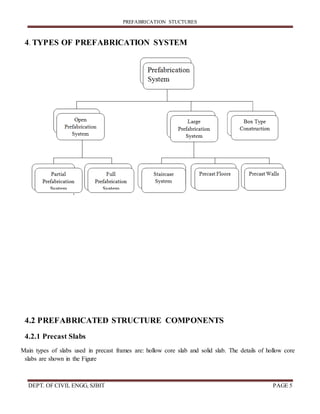
4. TYPES OF PREFABRICATION SYSTEM
4.2 PREFABRICATED STRUCTURE COMPONENTS
4.2.1 Precast Slabs
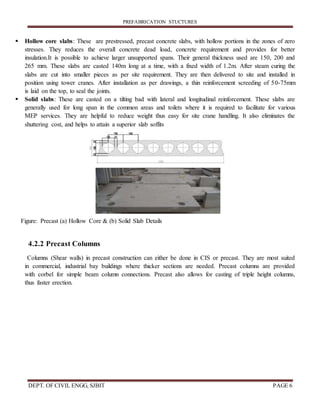
Main types of slabs used in precast frames are: hollow core slab and solid slab. The details of hollow core
slabs are shown in the Figure
PREFABRICATION STUCTURES
DEPT. OF CIVIL ENGG, SJBIT PAGE 6
 Hollow core slabs: These are prestressed, precast concrete slabs, with hollow portions in the zones of zero
stresses. They reduces the overall concrete dead load, concrete requirement and provides for better
insulation.It is possible to achieve larger unsupported spans. Their general thickness used are 150, 200 and
265 mm. These slabs are casted 140m long at a time, with a fixed width of 1.2m. After steam curing the
slabs are cut into smaller pieces as per site requirement. They are then delivered to site and installed in
position using tower cranes. After installation as per drawings, a thin reinforcement screeding of 50-75mm
is laid on the top, to seal the joints.
 Solid slabs: These are casted on a tilting bad with lateral and longitudinal reinforcement. These slabs are
generally used for long span in the common areas and toilets where it is required to facilitate for various
MEP services. They are helpful to reduce weight thus easy for site crane handling. It also eliminates the
shuttering cost, and helps to attain a superior slab soffits
Figure: Precast (a) Hollow Core & (b) Solid Slab Details
4.2.2 Precast Columns
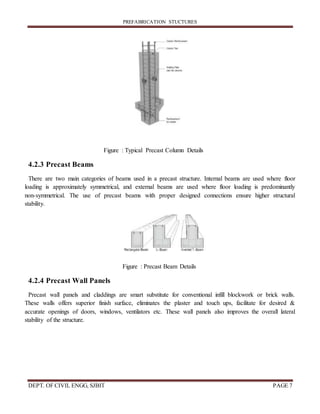
Columns (Shear walls) in precast construction can either be done in CIS or precast. They are most suited
in commercial, industrial bay buildings where thicker sections are needed. Precast columns are provided
with corbel for simple beam column connections. Precast also allows for casting of triple height columns,
thus faster erection.
PREFABRICATION STUCTURES
DEPT. OF CIVIL ENGG, SJBIT PAGE 7
Figure : Typical Precast Column Details
4.2.3 Precast Beams
There are two main categories of beams used in a precast structure. Internal beams are used where floor
loading is approximately symmetrical, and external beams are used where floor loading is predominantly
non-symmetrical. The use of precast beams with proper designed connections ensure higher structural
stability.
Figure : Precast Beam Details
4.2.4 Precast Wall Panels
Precast wall panels and claddings are smart substitute for conventional infill blockwork or brick walls.
These walls offers superior finish surface, eliminates the plaster and touch ups, facilitate for desired &
accurate openings of doors, windows, ventilators etc. These wall panels also improves the overall lateral
stability of the structure.
PREFABRICATION STUCTURES
DEPT. OF CIVIL ENGG, SJBIT PAGE 8
4.3 PREFABRICATED HOUSE COMPONENTS
Prefabrication of windows, doors, kitchen cabinets, and roof trusses has long had a place in home
construction. Recent innovations have resulted in an even wider variety of prefabricated components,
which increase affordability. The following are descriptions of some of these innovations and how they
enhance affordability.
4.3.1 Walls and Roofing
There are many materials which may be used for the construction of walls. These include rammed earth,
conventional bricks, soil cement blocks, hollow clay blocks, dense concrete blocks, and modular panels of
various sizes. Although bricks are still the backbone of the building industry, large size panels made of
low-density materials have increasingly been used for the construction of modular walls. The size of the
panels depends on client requirements and the material used for construction. These materials include
industrial wastes, such as blast furnace slag and fly ash, or a sustainable medium such as straw. This
technology is economical in comparison with traditional brick wall construction due to greater speed of
construction and lower mortar consumption.
Prefabricated panels framed with wood or light-weight steel framing clad in arrange of exterior and interior
finishes can be used for exterior walls. The wall assembly usually contains insulation, wiring, and pre-cut
openings for windows and doors. Costs are reduced as a result of a reduction in on-site labour. A
“panelised home” uses factory-made panels that include whole walls with windows, doors, wiring or
outside siding. components are brought to the site to be erected or assembled as required .Structural
floors/roofs account for a substantial cost of most buildings. Therefore, any savings achieved in floor/roof
construction considerably reduce the cost of the building. A traditional cast-in-situ concrete roof involves
the use of temporary shuttering which adds to the cost of construction and time. Use of standardised and
optimised roofing components where shuttering is avoided has been shown to be economical, fast and of
higher quality. Some prefabricated roofing/flooring components found to be suitable in low-cost housing
projects are precast RC planks, precast hollow concrete panels, precast RB panels, precast RB curved
panels, precast concrete/ferro cement panels and precast RC channel units.
4.3.2 Modular Housing
A modular house is highly engineered. It is constructed in sections and put together by a builder on the site.
Modular houses are designed, engineered and built in a factory-controlled environment. Most modular
producers use state of the art computer aided design programs. Speed of construction and consistent quality
are two of the major advantages of modular housing. For example, a house consisting of two sections can
be built in the factory in a couple of weeks. Once the manufacturing is completed, the sections are
transported to the housing site where they are placed on the foundations. Final completion is handled by a
local builder or general contractor who connects utilities and carries out finishing work.
All building components are prefabricated and completely modular in design. Prefabricated Buildings can be
designed for Interior or Exterior use.
PREFABRICATION STUCTURES
DEPT. OF CIVIL ENGG, SJBIT PAGE 9
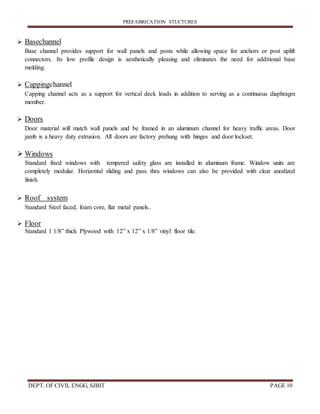
 Panels
The prefabricated building wall and ceiling panels are nominal 3-inch thick with standard sizes from 4’ *8’
to 4’*10’ tall. Custom heights over 10’ are also available. Standard Metal wall panels will have either
Embossed 24 ga. repainted steel or .019 prepainted aluminium skins laminated to 1/8" tempered hardboard
both sides of honeycomb or expanded polystyrene foam core. Many more custom panel configurations are
available.
 Posts
Posts are to be of four-piece design to form a non-progressive wall system. Cavity of posts will allow use
of approved steel electrical boxes that are now required by building codes.Prefabricated building posts
shall also act as raceways for phone lines, data lines, and other electrical lines. The structural elements of
the posts shall be connected by machine bolts and nuts
PREFABRICATION STUCTURES
DEPT. OF CIVIL ENGG, SJBIT PAGE 10
 Basechannel
Base channel provides support for wall panels and posts while allowing space for anchors or post uplift
connectors. Its low profile design is aesthetically pleasing and eliminates the need for additional base
molding.
 Cappingchannel
Capping channel acts as a support for vertical deck loads in addition to serving as a continuous diaphragm
member.
 Doors
Door material will match wall panels and be framed in an aluminum channel for heavy traffic areas. Door
jamb is a heavy duty extrusion. All doors are factory prehung with hinges and door lockset.
 Windows
Standard fixed windows with tempered safety glass are installed in aluminum frame. Window units are
completely modular. Horizontal sliding and pass thru windows can also be provided with clear anodized
finish.
 Roof system
Standard Steel faced, foam core, flat metal panels..
 Floor
Standard 1 1/8” thick Plywood with 12” x 12” x 1/8” vinyl floor tile.
PREFABRICATION STUCTURES
DEPT. OF CIVIL ENGG, SJBIT PAGE 11
4.4 MATERIALS USED:
Prefabricated building materials are used for buildings that are manufactured off site and shipped later to
assemble at the final location some of the commonly used prefabricated building. The materials used in the
prefabricated components are many. The modern trend is to use concrete steel, treated wood, aluminium
cellular concrete, light weight concrete, ceramic products etc. While choosing the materials for
prefabrication the special characteristics are to be considered.
 Light weight for easy handling and transport and to economic an sections and sizes of
foundations,
 Thermal insulation property
 Easy workability
 Durability in all weather conditions
 Non combustibility
 Economy in cost
 Sound insulation
4.5 PRODUCTION OF PREFABRICATED STRUCTURES
The location of precasting yards consist of storage facilities suitable for transporting and erection
equipments and availability of raw materials are the critical factors which should be carefully planned and
provided for effective and economic use of pre-cast concrete components in construction.
The manufacture of the components can be done in a centrally located factor of in a site where precasting
yards set-up at or near the site of work.
4.5.1 Factory Prefabrication;
 Factory prefabrication is restored in a centrally located plant for manufacture of standardized components
on a long form basis.
 It is a capital intensive production where work is done throughout the year preferably under a covered shed
to avoid the effects of seasonal variations high level of mechanization can always be introduced in this
system where the work can be organized in a factory like manner with the help of constant team of
workmen.
 The basic disadvantage in factory prefabricated, is the extra cost in occurred in transportation of elements
from plant to site of work sometimes the shape and size of prefabricable are to be limited due to lack of
suitable transportation equipment roads controls etc.
PREFABRICATION STUCTURES
DEPT. OF CIVIL ENGG, SJBIT PAGE 12
4.5.2 Site Prefabrication
 In this scheme, the components are manufactured at site near the site of work as possible.
 This system is normally adopted for a specific job order for a short period.
 The work is normally carried out in open space with locally a valuable labour force. The equipment
machinery and moulds are of mobile nature.
4.6 Manufacture Process Of Prefabrication Structure
The various processes involved in the manufacture of precast elements are classified as follows:
1) Main process 2) Secondary process 3) Subsidiary process
4.6.1 Main Process:
It involves the following steps.
1) Providing and assembling the moulds, placing reinforcement cage in position for reinforced concrete
work
2) Fixing of inserts and tubes where necessary.
3) Depositing the concrete in to the moulds.
4) Vibrating the deposited concrete into the moulds.
5) Demoulding the forms.
6) Curing (steam curing if necessary)
7) Stacking the precast products.
4.6.2 Secondary Process:
This process is necessary for the successful completion of the process covered by the main process.
1) Mixing or manufacture of fresh concrete (done in a mixing station or by a matching plant).
2) Prefabrication of reinforcement cage (done in a steel yard of workshop)
3) Manufacture of inserts and other finishing items to be incorporated in the main precast products.
4) Finishing the precast products.
5) Testing the precast products
PREFABRICATION STUCTURES
DEPT. OF CIVIL ENGG, SJBIT PAGE 13
5. 1 TRANSPORT OF PREFABRICATION STRUCTURES
Transport of prefabrication elements must be carried out and with extreme care
 Avoid any flock and distress in elements and handled as far as possible to be placed in final portion
 Transport of prefab elements inside the factory depends on the method of production selected for the
manufacture.
 Transport of prefab elements from the factory to the site of action should be planned in conformity with the
trafficable rules and regulations as stipulated by the authouritic the size of the elements is often restricted
by the availability of suitable transport equipment, such as tractor-am-tailor, to suits the load and
dimension of the member in addition to the load carrying capacity of the bridges on the way. While
transporting the prefab elements in various systems, such as wages, trucks, bullock cards etc. care should
be taken to avoid excessive cantilever actions
 Special care should be taken in negotiating sharp beds uneven of slushy roads to avoid undesirable stresses
in elements and in transport vehicles.
 Care should be taken to ensure the base packing for supporting the elements are located at specified portion
5.2 ERECTION
It is the process of assembling the Prefabrication element in the find portion as per the drawing.
In the erection of prefab elements the following items of work are to be carried out.
1) Slinging of the prefab elements.
2) Tying up of erection slopes connecting to the erection hooks.
3) Cleaning the elements and the site of erection.
4) Adjustments to get the stipulated level line and plumb.
5) Changing of the erection tackles.
6) Putting up and removing the necessary scaffolding or supports.
PREFABRICATION STUCTURES
DEPT. OF CIVIL ENGG, SJBIT PAGE 14
6.1.1 ADVANTAGE OF PREFABRICATION
greatly reduced.
Construction time is reduced and buildings are completed sooner allowing on earlier return of the capital
invested.
-site construction and congestion is minimized.
ite setting.
ed.
6.1.2 DISADVANTAGES
o Prefabricated houses are not necessarily 'better' for the environment than conventional houses. In fact, both
prefabricated houses and conventional houses are bad for the environment. This is mostly because of the
building materials and energy inputs they demand.
o Most prefab and most conventional homes do not use renewable building materials, and instead use
materials that involve a great deal of energy to create. Brick, concrete, steel - all of these are high-energy
materials that typically must be shipped long distances.
PREFABRICATION STUCTURES
DEPT. OF CIVIL ENGG, SJBIT PAGE 15
7. CASE STUDY OF PREFABRICATION STRUCTURE
7.1 SandeepJain (IIT Delhi)
7.1.1 Introduction
After successful developing the foundation of precast construction technology in the aforementioned
details of the research paper, an effort is made hereafter to present a detailed case study with a focus to
share the real life experiences for use of precast concrete construction technology at Amrapali Dream
Valley, mixed CIS Precast high-rise residential towers, designed by Architects Gian P Mathur (GPM,
India), and E. Construct, U.A.E are the structural designers. The project is vetted by IIT Delhi.
Dream Valley project is located in Greater Noida (West), Delhi NCR, India. It’s a residential township
with total 47 high-rise residential towers, 379 villas, commercial & institutional building, and other
developments. The total built-up area of project is more than 10 million Sqft. The high-rise residential
towers are divided in to six series from A to F with further classification as A1 to A7, B1 to B6, C1 to C12,
D1 to D2, E1 to E8, and F1 to F12. After a lot of brainstorming and feasibility study, Series A, D, E & F
were planned to be constructed by using precast construction technology. All towers of series A (2B+G+18
Floors), D, E1 & F (2B+G+24 Floors) rise about 60m above ground with floor to floor height of 3.05m. A
total of 3.7 million Sqft area was planned to be constructed with precast. To make the case easy to
understand, this study will discuss the construction of series A having total seven towers. As of today all
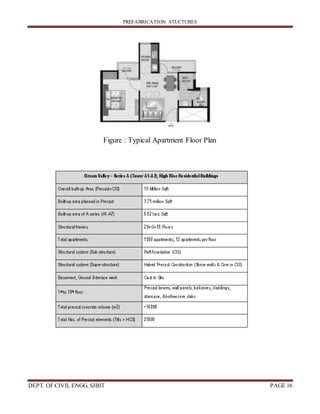
the seven towers are nearing completion. There are 12 apartments per floor with carpet area of about 430
Sqft. for 1BHK. All apartments at of series A are identical that made precast technology a viable option.
It was a mammoth task to construct a high-rise residential building using precast construction technology.
It was a roller-coaster ride for everyone involved which, towards the end became a steep learning curve.
This learning experience made it possible to develop a deeper understanding of the technology, global
standard practices, & apply these learnings to the other projects in a workable way with available resource
constraints. Several design, production & erection aspects of standard practices used abroad were
modified to suit the Indian scenario. Following are some of the key learning challenges which were
encountered on the way.
erection, which was overcome by providing detailed training.
t was difficult to counter the typical mind-set of people to adapt to change in construction technology,
patience & willingness to experiment with a new technology.
lity of IS
codes was deemed important. The designers from India had only few Indian Standard to refer.
The knowledge and understanding acquired during this case was carried forward to the projects
underway. Many improvisations were based on the experiences of this projects.
PREFABRICATION STUCTURES
DEPT. OF CIVIL ENGG, SJBIT PAGE 16
Figure : Typical Apartment Floor Plan
PREFABRICATION STUCTURES
DEPT. OF CIVIL ENGG, SJBIT PAGE 17
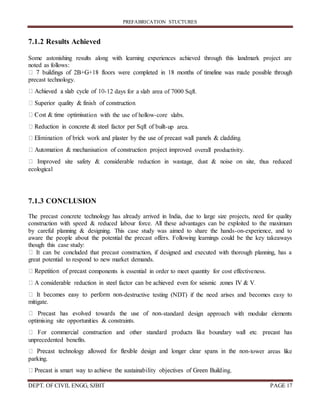
7.1.2 Results Achieved
Some astonishing results along with learning experiences achieved through this landmark project are
noted as follows:
precast technology.
-12 days for a slab area of 7000 Sqft.
tion with the use of hollow-core slabs.
-up area.
overall productivity.
ecological
7.1.3 CONCLUSION
The precast concrete technology has already arrived in India, due to large size projects, need for quality
construction with speed & reduced labour force. All these advantages can be exploited to the maximum
by careful planning & designing. This case study was aimed to share the hands-on-experience, and to
aware the people about the potential the precast offers. Following learnings could be the key takeaways
though this case study:
It can be concluded that precast construction, if designed and executed with thorough planning, has a
great potential to respond to new market demands.
mponents is essential in order to meet quantity for cost effectiveness.
-destructive testing (NDT) if the need arises and becomes easy to
mitigate.
-standard design approach with modular elements
optimising site opportunities & constraints.
unprecedented benefits.
-tower areas like
parking.
.
PREFABRICATION STUCTURES
DEPT. OF CIVIL ENGG, SJBIT PAGE 18
7.2. IBA Hamburg
7.2.1 Project Outline
The prefabricated construction is the end result of highly effective manufacturing processes that enable the
building to be erected in a cost-effective way
.It can therefore be applied in many different settings, and thus serves as a model for development within
metro zones. Its versatility comes from its modular space concept, which allows different space divisions
and living configurations, even across whole floors. Like lofts, the interiors of the modules are clearly
structured, with minimal decoration, and are extremely flexible. The adaptable floor plan leaves room for
the residents to express their individuality, as well as allowing the space to meet their many and changing
needs.
7.2.2 Project Details
Building Service Concept
The building is a composite construction. Primary structure consists of precast reinforced concrete
components: the floors above the basement and the ground, first, and second floors consist of industrially
prefabricated elements such as prestressed concrete false ceilings. The technical building equipment was
integrated into the supporting and reinforcing exterior wall components at the factory. The non-load-
bearing wood panel elements positioned in front of these provide protection against heat and the weather
generally, as well as adding to the building class 4, which has high fire protection requirements that have
been ingeniously met through the construction methods used.
Exterior Wall Construction : The exterior wall is a concrete bracing wall covered in a wood panel wall. The
double wall system allows vertical load transfer and reinforcement, primarily through the finished concrete
components and the wall panels on the inner side. The curtain wall wood panel construction provides
protection against heat and weather. Prior to this project, this system was used only in redevelopment.
Using this combination in a multistorey building is a pioneering move. The building therefore has a U-
value of 0.134 watts per square metre per degree Kelvin and a sound reduction value of 58 decibels. Its fire
resistance rating meets the REI 90 test standard.
The wall structure is divided into the following components: the façade features wood cladding made of
dark, varnished spruce. primarily achieved by the high degree of prefabrication, the materials used, and the
support-free construction of the ceiling elements to ensure extensive flexibility, as well as by the modular
design itself. The structure and modular design will be explained in greater detail below, as these paved the
way for the implementation of the innovative building concept.
The envisioned two or three storey building was given another floor. The loft concept featuring modules
from 45 square metres that could be joined up vertically or horizontally remained unchanged. All building
components had a high degree of prefabrication and were simply assembled at the building site. Ceilings
PREFABRICATION STUCTURES
DEPT. OF CIVIL ENGG, SJBIT PAGE 19
were made of pre-stressed concrete with an inbuilt heating system, and were fitted into the other building
components. The outer walls were produced as two-part wood and concrete boards in the form of large
panels that could be fitted together and pulled apart, with windows and building services components
already in place
7.2.3 Assessment
This project sees the prefabricated building reinterpreted as a townhouse that brings innovative
construction methods to a multistorey building together with low levels of total construction costs and
sustainability issues. As such, it is a pioneering building that acts as a showcase within the IBA, and
demonstrates a vast range of design, spatial and technical solutions and configurations for forward-looking
urban living.takes an extremely fresh approach to its materials, of which it features countless innovative
combinations in the outer walls and ceiling structures, made possible by the degree of prefabrication:
reinforcement in the factory ensured that the assembly was quick and problem-free, as assistance was not
required, and the division of the supporting structure from the thermal insulating shell permitted various
façade systems with different levels of insulation. As the building contractor, system producer, and
architect formed a team as early as the competition stage, and the team went over the project intensively at
that point, it was possible to deliver a design that could be executed with as few conceptual changes as
possible, both in terms of the technology used and the expenditure required. Unfortunately, the decision
was made not to go through with the concept of different ceiling systems, due to difficulties in acquiring
the correct permits. In this case the building contractor, who is not a project manager or property developer
in the normal sense, tried to reach a compromise solution too quickly, without checking which permits
apply to wooden ceiling structures by seeking advice or opening discussions with the building authorities.
• This is the type of building that can be set in a green meadow, constructed as a block or linear structure,
or inserted into a vacant lot, and can comprise from one to seven storeys
. • An interior concept that allows for different apartment sizes and types (apartment over one floor,
maisonette) and also the possibility of retaining the open layout of the lofts or dividing them into individual
rooms.
• Prefabrication ensures the optimal use of resources (energy and material flows) and high-quality
execution, combined with a sustainable, recyclable material concept. The two-part nature of the building’s
shell also allows its energy profile to be upgraded in due course through the prefabricated components and
by changing the outer components of the insulated wooden board elements.
PREFABRICATION STUCTURES
DEPT. OF CIVIL ENGG, SJBIT PAGE 20
8. CONCLUSION:
o Due to the flexibility of the structure in expandability and appearance this prefab houses are the choice.
from the several advantage like reuseability, high scrap value ,durability and less construction time
o The prefabrication components and prefab structure eliminate space and time over convectional
construction
o The use of precast concrete construction can significantly reduce the amount of construction waste
generated on construction sites
o Reduce adverse environment impact on sites
o Enhance quality control of concreting work

prefabrication structure report

  • 1.
    PREFABRICATION STUCTURES DEPT. OFCIVIL ENGG, SJBIT PAGE 1 1.INTRODUCTION 1.1 Concept Of Prefabrication Structure A prefabricated structure or building is a structure that has several factory built components that are assembled on a site. These pre-made components can consist of panels, modules or transportable sections. In precast also known as prefabricated construction, the majority of structural components are standardized and manufactured in dedicated facilities by industrial methods based on mass production. These are then transported to the site and by suitable handling and erection schemes they are assembled like building blocks. Special techniques for connecting different precast components are necessary. A stable structural system is formed only after proper assembly of structural components. Hence structural connections are vital links to ensure intended structural behavior. Special structural considerations are also necessary for stability and safety at all stages of construction. Prefabrication is the production of housing or housing components using factorymechanisation. The factory setting enhances affordability through a combination ofbulk purchase of materials, mass production assembly techniques and the use of lessskilled labour. Prefabrication can take one of three forms: prefabricated components,modular housing, and manufactured housing. The prefabrication of housing components, such as windows, doors, and cabinets,has long been a mainstay of the construction industry, keeping costs down by reducingon-site, high- cost labour. Continuing development in this facet of prefabrication provides a growing range of construction products that may further reduce construction costs. Modular housing involves the prefabrication of sections of housing that are then assembled on-site thereby reducing on-site labour costs. Modular housing is based on prefabricated, factory-produced, easy-to- transport modular units, which minimize the cost of production. Final structures are designed from the inside out using a seriesof standard “modules of use” and dwellings composed of these modules have the potential to be configured in a variety of ways, according to the specific requirement of the site or client Manufactured homes are typically purchased from a retail sales company, initially assembled by a local contracting company, and follow-up repairs performed by the manufactured home company under warranty. A manufactured home, once assembled, goes through a "settling-in" period, where the home will settle into its location. During this period, some drywall cracking may appear, and any incorrectly installed appliances, wiring, or plumbing should be repaired, hopefully under warranty. If not covered under warranty, the costs will be borne by the consumer. For this reason, it is important that the consumer ensure that a reputable and honest contractor is used for the initial set-up. If any repairs are not completed by the initial set-up crew, the manufacturer will send repair crews to repair anything covered by the warranty. The secondary repair team must be scheduled, and may not be available immediately for most repairs. Just because a manufactured home has been assembled does not mean it is immediately inhabitable; appropriate ventilation, heating, plumbing, and electrical systemsmust be installed by a set-up crew, otherwise, the buyer must wait for the manufacturer repair team or do it themselves.
  • 2.
    PREFABRICATION STUCTURES DEPT. OFCIVIL ENGG, SJBIT PAGE 2 1.2 History Of Prefabrication Buildings Buildings have been built in one place and reassembled in another throughout history. Possibly the first advertised prefab house was the Manning Portable Cottage. A London carpenter, Henry Manning, constructed a house that was built in components, then shipped and assembled by British emigrants. This was published at the time (advertisement, South Australian Record, 1837) and a few still stand in Australia. One such is the “Friends Meeting House, Adelaide”. The peak year for the importation of portable buildings to Australia was 1853, when several hundred arrived. These have been identified as coming from Liverpool, Boston and Singapore (with Chinese instructions for re- assembly). In Barbados the Chattel house was a form of prefabricated building which was developed by emancipated slaves who had limited rights to build upon land they did not own. As the buildings were moveable they were legally regarded as chattels.
  • 3.
    PREFABRICATION STUCTURES DEPT. OFCIVIL ENGG, SJBIT PAGE 3 2.SCOPE OF PREFABRICATION STRUCTURES 1. Economy in large scale project with high degree of repetition in work execution. 2. Special architectural requirement in finishing 3. Consistency in structural quality control 4. Fast speed of construction 5. Constraints in availability of site resources
  • 4.
    PREFABRICATION STUCTURES DEPT. OFCIVIL ENGG, SJBIT PAGE 4 3.LITERATURE REVIEW 1. Rinkesh patel, et al (2016) ''Study Of Prefabrication In India" The total cost and total duration for the double storey residential building have been determined for both prefab and conventional construction. And also we had known about the advantages and disadvantages of both prefabrication and conventional construction by the survey conducted in similar companies. The comparison showed there is enormous cost difference between the methods, which the prefab is very high when compared to conventional on this type of individual houses. The main advantages for prefab construction and also it helps when there is labor shortage. This is main drawback for prefab construction which is not economical to construct in this case. 2. Fred Edmond Boafo , et al (2016)''Performance of Modular Prefabricated structure" A technique of building construction, referred to as prefabricated architecture (prefab), is increasing in reputation. Prefab encompasses the offsite fabrication of building components to a greater degree of finish as bulk building structures and systems, and their assembly on-site. In this context, prefab improves the speed of construction, quality of architecture, efficiency of materials, and worker safety, while limiting environmental impacts of construction, as compared to conventional site-built construction practices. Quite recently, a 57 story skyscraper was built in 19 days using prefabricated modules. From the building physics point of view, the bulk systems and tighter integration method of prefab minimizes thermal bridges. This study seeks to clearly characterize the levels of prefab and to investigate the performance of modular prefab; considering acoustic constrain, seismic resistance, thermal behaviour, energy consumption, and life cycle analysis of existing prefab cases and, thus, provides a dynamic case study-based review. Generally, prefab can be categorized into components, panels (2D), modules (3D), hybrids, and unitized whole buildings. On average ,greenhouse gas emissions from conventional construction were higher than for modular construction not discounting some individual discrepancies. Few studies have focus on monitored data on prefab and occupants’ comfort but additional studies are required to understand the public’s perception of the technology. The scope of the work examined will be of interest to building engineers, manufacturers, and energy experts, as well as serve as a foundational reference for future study. 3. Kristen Strobel,et al (2013) 'Modular Prefabricated Residential Construction'' Modular prefabrication is expected to result in schedule savings for most projects with more pronounced benefits for projects that are designed and planned as modular construction from the early stages. This allows for the maximum overlap between site-work and fabrication. Module fabrication varies greatly by project and manufacturer. Given the controlled nature of fabrication, rates could likely be increased as required by adjusting the number of labourers at the factory. Modular buildings in general have the potential to benefit from higher quality with respect to improved material quality, improved building performance, sustainability, etc. In addition, production in factory environment results in higher worker productivity and a safer and healthier environment in modular construction compared with on-site construction.
  • 5.
    PREFABRICATION STUCTURES DEPT. OFCIVIL ENGG, SJBIT PAGE 5 4. TYPES OF PREFABRICATION SYSTEM 4.2 PREFABRICATED STRUCTURE COMPONENTS 4.2.1 Precast Slabs Main types of slabs used in precast frames are: hollow core slab and solid slab. The details of hollow core slabs are shown in the Figure
  • 6.
    PREFABRICATION STUCTURES DEPT. OFCIVIL ENGG, SJBIT PAGE 6  Hollow core slabs: These are prestressed, precast concrete slabs, with hollow portions in the zones of zero stresses. They reduces the overall concrete dead load, concrete requirement and provides for better insulation.It is possible to achieve larger unsupported spans. Their general thickness used are 150, 200 and 265 mm. These slabs are casted 140m long at a time, with a fixed width of 1.2m. After steam curing the slabs are cut into smaller pieces as per site requirement. They are then delivered to site and installed in position using tower cranes. After installation as per drawings, a thin reinforcement screeding of 50-75mm is laid on the top, to seal the joints.  Solid slabs: These are casted on a tilting bad with lateral and longitudinal reinforcement. These slabs are generally used for long span in the common areas and toilets where it is required to facilitate for various MEP services. They are helpful to reduce weight thus easy for site crane handling. It also eliminates the shuttering cost, and helps to attain a superior slab soffits Figure: Precast (a) Hollow Core & (b) Solid Slab Details 4.2.2 Precast Columns Columns (Shear walls) in precast construction can either be done in CIS or precast. They are most suited in commercial, industrial bay buildings where thicker sections are needed. Precast columns are provided with corbel for simple beam column connections. Precast also allows for casting of triple height columns, thus faster erection.
  • 7.
    PREFABRICATION STUCTURES DEPT. OFCIVIL ENGG, SJBIT PAGE 7 Figure : Typical Precast Column Details 4.2.3 Precast Beams There are two main categories of beams used in a precast structure. Internal beams are used where floor loading is approximately symmetrical, and external beams are used where floor loading is predominantly non-symmetrical. The use of precast beams with proper designed connections ensure higher structural stability. Figure : Precast Beam Details 4.2.4 Precast Wall Panels Precast wall panels and claddings are smart substitute for conventional infill blockwork or brick walls. These walls offers superior finish surface, eliminates the plaster and touch ups, facilitate for desired & accurate openings of doors, windows, ventilators etc. These wall panels also improves the overall lateral stability of the structure.
  • 8.
    PREFABRICATION STUCTURES DEPT. OFCIVIL ENGG, SJBIT PAGE 8 4.3 PREFABRICATED HOUSE COMPONENTS Prefabrication of windows, doors, kitchen cabinets, and roof trusses has long had a place in home construction. Recent innovations have resulted in an even wider variety of prefabricated components, which increase affordability. The following are descriptions of some of these innovations and how they enhance affordability. 4.3.1 Walls and Roofing There are many materials which may be used for the construction of walls. These include rammed earth, conventional bricks, soil cement blocks, hollow clay blocks, dense concrete blocks, and modular panels of various sizes. Although bricks are still the backbone of the building industry, large size panels made of low-density materials have increasingly been used for the construction of modular walls. The size of the panels depends on client requirements and the material used for construction. These materials include industrial wastes, such as blast furnace slag and fly ash, or a sustainable medium such as straw. This technology is economical in comparison with traditional brick wall construction due to greater speed of construction and lower mortar consumption. Prefabricated panels framed with wood or light-weight steel framing clad in arrange of exterior and interior finishes can be used for exterior walls. The wall assembly usually contains insulation, wiring, and pre-cut openings for windows and doors. Costs are reduced as a result of a reduction in on-site labour. A “panelised home” uses factory-made panels that include whole walls with windows, doors, wiring or outside siding. components are brought to the site to be erected or assembled as required .Structural floors/roofs account for a substantial cost of most buildings. Therefore, any savings achieved in floor/roof construction considerably reduce the cost of the building. A traditional cast-in-situ concrete roof involves the use of temporary shuttering which adds to the cost of construction and time. Use of standardised and optimised roofing components where shuttering is avoided has been shown to be economical, fast and of higher quality. Some prefabricated roofing/flooring components found to be suitable in low-cost housing projects are precast RC planks, precast hollow concrete panels, precast RB panels, precast RB curved panels, precast concrete/ferro cement panels and precast RC channel units. 4.3.2 Modular Housing A modular house is highly engineered. It is constructed in sections and put together by a builder on the site. Modular houses are designed, engineered and built in a factory-controlled environment. Most modular producers use state of the art computer aided design programs. Speed of construction and consistent quality are two of the major advantages of modular housing. For example, a house consisting of two sections can be built in the factory in a couple of weeks. Once the manufacturing is completed, the sections are transported to the housing site where they are placed on the foundations. Final completion is handled by a local builder or general contractor who connects utilities and carries out finishing work. All building components are prefabricated and completely modular in design. Prefabricated Buildings can be designed for Interior or Exterior use.
  • 9.
    PREFABRICATION STUCTURES DEPT. OFCIVIL ENGG, SJBIT PAGE 9  Panels The prefabricated building wall and ceiling panels are nominal 3-inch thick with standard sizes from 4’ *8’ to 4’*10’ tall. Custom heights over 10’ are also available. Standard Metal wall panels will have either Embossed 24 ga. repainted steel or .019 prepainted aluminium skins laminated to 1/8" tempered hardboard both sides of honeycomb or expanded polystyrene foam core. Many more custom panel configurations are available.  Posts Posts are to be of four-piece design to form a non-progressive wall system. Cavity of posts will allow use of approved steel electrical boxes that are now required by building codes.Prefabricated building posts shall also act as raceways for phone lines, data lines, and other electrical lines. The structural elements of the posts shall be connected by machine bolts and nuts
  • 10.
    PREFABRICATION STUCTURES DEPT. OFCIVIL ENGG, SJBIT PAGE 10  Basechannel Base channel provides support for wall panels and posts while allowing space for anchors or post uplift connectors. Its low profile design is aesthetically pleasing and eliminates the need for additional base molding.  Cappingchannel Capping channel acts as a support for vertical deck loads in addition to serving as a continuous diaphragm member.  Doors Door material will match wall panels and be framed in an aluminum channel for heavy traffic areas. Door jamb is a heavy duty extrusion. All doors are factory prehung with hinges and door lockset.  Windows Standard fixed windows with tempered safety glass are installed in aluminum frame. Window units are completely modular. Horizontal sliding and pass thru windows can also be provided with clear anodized finish.  Roof system Standard Steel faced, foam core, flat metal panels..  Floor Standard 1 1/8” thick Plywood with 12” x 12” x 1/8” vinyl floor tile.
  • 11.
    PREFABRICATION STUCTURES DEPT. OFCIVIL ENGG, SJBIT PAGE 11 4.4 MATERIALS USED: Prefabricated building materials are used for buildings that are manufactured off site and shipped later to assemble at the final location some of the commonly used prefabricated building. The materials used in the prefabricated components are many. The modern trend is to use concrete steel, treated wood, aluminium cellular concrete, light weight concrete, ceramic products etc. While choosing the materials for prefabrication the special characteristics are to be considered.  Light weight for easy handling and transport and to economic an sections and sizes of foundations,  Thermal insulation property  Easy workability  Durability in all weather conditions  Non combustibility  Economy in cost  Sound insulation 4.5 PRODUCTION OF PREFABRICATED STRUCTURES The location of precasting yards consist of storage facilities suitable for transporting and erection equipments and availability of raw materials are the critical factors which should be carefully planned and provided for effective and economic use of pre-cast concrete components in construction. The manufacture of the components can be done in a centrally located factor of in a site where precasting yards set-up at or near the site of work. 4.5.1 Factory Prefabrication;  Factory prefabrication is restored in a centrally located plant for manufacture of standardized components on a long form basis.  It is a capital intensive production where work is done throughout the year preferably under a covered shed to avoid the effects of seasonal variations high level of mechanization can always be introduced in this system where the work can be organized in a factory like manner with the help of constant team of workmen.  The basic disadvantage in factory prefabricated, is the extra cost in occurred in transportation of elements from plant to site of work sometimes the shape and size of prefabricable are to be limited due to lack of suitable transportation equipment roads controls etc.
  • 12.
    PREFABRICATION STUCTURES DEPT. OFCIVIL ENGG, SJBIT PAGE 12 4.5.2 Site Prefabrication  In this scheme, the components are manufactured at site near the site of work as possible.  This system is normally adopted for a specific job order for a short period.  The work is normally carried out in open space with locally a valuable labour force. The equipment machinery and moulds are of mobile nature. 4.6 Manufacture Process Of Prefabrication Structure The various processes involved in the manufacture of precast elements are classified as follows: 1) Main process 2) Secondary process 3) Subsidiary process 4.6.1 Main Process: It involves the following steps. 1) Providing and assembling the moulds, placing reinforcement cage in position for reinforced concrete work 2) Fixing of inserts and tubes where necessary. 3) Depositing the concrete in to the moulds. 4) Vibrating the deposited concrete into the moulds. 5) Demoulding the forms. 6) Curing (steam curing if necessary) 7) Stacking the precast products. 4.6.2 Secondary Process: This process is necessary for the successful completion of the process covered by the main process. 1) Mixing or manufacture of fresh concrete (done in a mixing station or by a matching plant). 2) Prefabrication of reinforcement cage (done in a steel yard of workshop) 3) Manufacture of inserts and other finishing items to be incorporated in the main precast products. 4) Finishing the precast products. 5) Testing the precast products
  • 13.
    PREFABRICATION STUCTURES DEPT. OFCIVIL ENGG, SJBIT PAGE 13 5. 1 TRANSPORT OF PREFABRICATION STRUCTURES Transport of prefabrication elements must be carried out and with extreme care  Avoid any flock and distress in elements and handled as far as possible to be placed in final portion  Transport of prefab elements inside the factory depends on the method of production selected for the manufacture.  Transport of prefab elements from the factory to the site of action should be planned in conformity with the trafficable rules and regulations as stipulated by the authouritic the size of the elements is often restricted by the availability of suitable transport equipment, such as tractor-am-tailor, to suits the load and dimension of the member in addition to the load carrying capacity of the bridges on the way. While transporting the prefab elements in various systems, such as wages, trucks, bullock cards etc. care should be taken to avoid excessive cantilever actions  Special care should be taken in negotiating sharp beds uneven of slushy roads to avoid undesirable stresses in elements and in transport vehicles.  Care should be taken to ensure the base packing for supporting the elements are located at specified portion 5.2 ERECTION It is the process of assembling the Prefabrication element in the find portion as per the drawing. In the erection of prefab elements the following items of work are to be carried out. 1) Slinging of the prefab elements. 2) Tying up of erection slopes connecting to the erection hooks. 3) Cleaning the elements and the site of erection. 4) Adjustments to get the stipulated level line and plumb. 5) Changing of the erection tackles. 6) Putting up and removing the necessary scaffolding or supports.
  • 14.
    PREFABRICATION STUCTURES DEPT. OFCIVIL ENGG, SJBIT PAGE 14 6.1.1 ADVANTAGE OF PREFABRICATION greatly reduced. Construction time is reduced and buildings are completed sooner allowing on earlier return of the capital invested. -site construction and congestion is minimized. ite setting. ed. 6.1.2 DISADVANTAGES o Prefabricated houses are not necessarily 'better' for the environment than conventional houses. In fact, both prefabricated houses and conventional houses are bad for the environment. This is mostly because of the building materials and energy inputs they demand. o Most prefab and most conventional homes do not use renewable building materials, and instead use materials that involve a great deal of energy to create. Brick, concrete, steel - all of these are high-energy materials that typically must be shipped long distances.
  • 15.
    PREFABRICATION STUCTURES DEPT. OFCIVIL ENGG, SJBIT PAGE 15 7. CASE STUDY OF PREFABRICATION STRUCTURE 7.1 SandeepJain (IIT Delhi) 7.1.1 Introduction After successful developing the foundation of precast construction technology in the aforementioned details of the research paper, an effort is made hereafter to present a detailed case study with a focus to share the real life experiences for use of precast concrete construction technology at Amrapali Dream Valley, mixed CIS Precast high-rise residential towers, designed by Architects Gian P Mathur (GPM, India), and E. Construct, U.A.E are the structural designers. The project is vetted by IIT Delhi. Dream Valley project is located in Greater Noida (West), Delhi NCR, India. It’s a residential township with total 47 high-rise residential towers, 379 villas, commercial & institutional building, and other developments. The total built-up area of project is more than 10 million Sqft. The high-rise residential towers are divided in to six series from A to F with further classification as A1 to A7, B1 to B6, C1 to C12, D1 to D2, E1 to E8, and F1 to F12. After a lot of brainstorming and feasibility study, Series A, D, E & F were planned to be constructed by using precast construction technology. All towers of series A (2B+G+18 Floors), D, E1 & F (2B+G+24 Floors) rise about 60m above ground with floor to floor height of 3.05m. A total of 3.7 million Sqft area was planned to be constructed with precast. To make the case easy to understand, this study will discuss the construction of series A having total seven towers. As of today all the seven towers are nearing completion. There are 12 apartments per floor with carpet area of about 430 Sqft. for 1BHK. All apartments at of series A are identical that made precast technology a viable option. It was a mammoth task to construct a high-rise residential building using precast construction technology. It was a roller-coaster ride for everyone involved which, towards the end became a steep learning curve. This learning experience made it possible to develop a deeper understanding of the technology, global standard practices, & apply these learnings to the other projects in a workable way with available resource constraints. Several design, production & erection aspects of standard practices used abroad were modified to suit the Indian scenario. Following are some of the key learning challenges which were encountered on the way. erection, which was overcome by providing detailed training. t was difficult to counter the typical mind-set of people to adapt to change in construction technology, patience & willingness to experiment with a new technology. lity of IS codes was deemed important. The designers from India had only few Indian Standard to refer. The knowledge and understanding acquired during this case was carried forward to the projects underway. Many improvisations were based on the experiences of this projects.
  • 16.
    PREFABRICATION STUCTURES DEPT. OFCIVIL ENGG, SJBIT PAGE 16 Figure : Typical Apartment Floor Plan
  • 17.
    PREFABRICATION STUCTURES DEPT. OFCIVIL ENGG, SJBIT PAGE 17 7.1.2 Results Achieved Some astonishing results along with learning experiences achieved through this landmark project are noted as follows: precast technology. -12 days for a slab area of 7000 Sqft. tion with the use of hollow-core slabs. -up area. overall productivity. ecological 7.1.3 CONCLUSION The precast concrete technology has already arrived in India, due to large size projects, need for quality construction with speed & reduced labour force. All these advantages can be exploited to the maximum by careful planning & designing. This case study was aimed to share the hands-on-experience, and to aware the people about the potential the precast offers. Following learnings could be the key takeaways though this case study: It can be concluded that precast construction, if designed and executed with thorough planning, has a great potential to respond to new market demands. mponents is essential in order to meet quantity for cost effectiveness. -destructive testing (NDT) if the need arises and becomes easy to mitigate. -standard design approach with modular elements optimising site opportunities & constraints. unprecedented benefits. -tower areas like parking. .
  • 18.
    PREFABRICATION STUCTURES DEPT. OFCIVIL ENGG, SJBIT PAGE 18 7.2. IBA Hamburg 7.2.1 Project Outline The prefabricated construction is the end result of highly effective manufacturing processes that enable the building to be erected in a cost-effective way .It can therefore be applied in many different settings, and thus serves as a model for development within metro zones. Its versatility comes from its modular space concept, which allows different space divisions and living configurations, even across whole floors. Like lofts, the interiors of the modules are clearly structured, with minimal decoration, and are extremely flexible. The adaptable floor plan leaves room for the residents to express their individuality, as well as allowing the space to meet their many and changing needs. 7.2.2 Project Details Building Service Concept The building is a composite construction. Primary structure consists of precast reinforced concrete components: the floors above the basement and the ground, first, and second floors consist of industrially prefabricated elements such as prestressed concrete false ceilings. The technical building equipment was integrated into the supporting and reinforcing exterior wall components at the factory. The non-load- bearing wood panel elements positioned in front of these provide protection against heat and the weather generally, as well as adding to the building class 4, which has high fire protection requirements that have been ingeniously met through the construction methods used. Exterior Wall Construction : The exterior wall is a concrete bracing wall covered in a wood panel wall. The double wall system allows vertical load transfer and reinforcement, primarily through the finished concrete components and the wall panels on the inner side. The curtain wall wood panel construction provides protection against heat and weather. Prior to this project, this system was used only in redevelopment. Using this combination in a multistorey building is a pioneering move. The building therefore has a U- value of 0.134 watts per square metre per degree Kelvin and a sound reduction value of 58 decibels. Its fire resistance rating meets the REI 90 test standard. The wall structure is divided into the following components: the façade features wood cladding made of dark, varnished spruce. primarily achieved by the high degree of prefabrication, the materials used, and the support-free construction of the ceiling elements to ensure extensive flexibility, as well as by the modular design itself. The structure and modular design will be explained in greater detail below, as these paved the way for the implementation of the innovative building concept. The envisioned two or three storey building was given another floor. The loft concept featuring modules from 45 square metres that could be joined up vertically or horizontally remained unchanged. All building components had a high degree of prefabrication and were simply assembled at the building site. Ceilings
  • 19.
    PREFABRICATION STUCTURES DEPT. OFCIVIL ENGG, SJBIT PAGE 19 were made of pre-stressed concrete with an inbuilt heating system, and were fitted into the other building components. The outer walls were produced as two-part wood and concrete boards in the form of large panels that could be fitted together and pulled apart, with windows and building services components already in place 7.2.3 Assessment This project sees the prefabricated building reinterpreted as a townhouse that brings innovative construction methods to a multistorey building together with low levels of total construction costs and sustainability issues. As such, it is a pioneering building that acts as a showcase within the IBA, and demonstrates a vast range of design, spatial and technical solutions and configurations for forward-looking urban living.takes an extremely fresh approach to its materials, of which it features countless innovative combinations in the outer walls and ceiling structures, made possible by the degree of prefabrication: reinforcement in the factory ensured that the assembly was quick and problem-free, as assistance was not required, and the division of the supporting structure from the thermal insulating shell permitted various façade systems with different levels of insulation. As the building contractor, system producer, and architect formed a team as early as the competition stage, and the team went over the project intensively at that point, it was possible to deliver a design that could be executed with as few conceptual changes as possible, both in terms of the technology used and the expenditure required. Unfortunately, the decision was made not to go through with the concept of different ceiling systems, due to difficulties in acquiring the correct permits. In this case the building contractor, who is not a project manager or property developer in the normal sense, tried to reach a compromise solution too quickly, without checking which permits apply to wooden ceiling structures by seeking advice or opening discussions with the building authorities. • This is the type of building that can be set in a green meadow, constructed as a block or linear structure, or inserted into a vacant lot, and can comprise from one to seven storeys . • An interior concept that allows for different apartment sizes and types (apartment over one floor, maisonette) and also the possibility of retaining the open layout of the lofts or dividing them into individual rooms. • Prefabrication ensures the optimal use of resources (energy and material flows) and high-quality execution, combined with a sustainable, recyclable material concept. The two-part nature of the building’s shell also allows its energy profile to be upgraded in due course through the prefabricated components and by changing the outer components of the insulated wooden board elements.
  • 20.
    PREFABRICATION STUCTURES DEPT. OFCIVIL ENGG, SJBIT PAGE 20 8. CONCLUSION: o Due to the flexibility of the structure in expandability and appearance this prefab houses are the choice. from the several advantage like reuseability, high scrap value ,durability and less construction time o The prefabrication components and prefab structure eliminate space and time over convectional construction o The use of precast concrete construction can significantly reduce the amount of construction waste generated on construction sites o Reduce adverse environment impact on sites o Enhance quality control of concreting work