
Aluminium cans
Aluminium cans would make inroads into the soft drink market in 1964, when Royal Crown
Cola released both its RC Cola and Diet Rite beverages in a two-piece, 12-oz. aluminium
container. In addition to being lighter-weight than their steel predecessors, these new
aluminium cans provided a superior surface upon which to print text and graphics to help
promote brand awareness. In their first year on the market, one million cases of soda were
packaged in aluminium cans.
Glass is reaching its limits in terms of
light-weighting, and there is growing
doubt among the brand owners about
its ability to evolve with market needs.
The growing emphasis on the carbon
footprint of packaging supply and end of
life management will prove a compelling
competitive advantage for can
packaging for beverages.
The potential in beer and alcoholic
drinks is highlighted by the low
penetration achieved to date with plastic
bottles and the various innovations in the use of Aluminium bottles.
A range of other factors contributed to the aluminium can’s early adoption by beverage
manufacturers: it was easily moulded (and hence its ability to be formed in only two pieces),
it was highly resistant to corrosion and would not rust, and it admirably supported the
carbonation pressure required to package soda (aluminium cans withstand pressure of up to
90 lbs. per square inch).
Sleek beverage cans, a new style of beverage can that is now available, utilize innovative
and new age shapes to attract consumer attention. For this reason sleek beverage cans
have become increasingly popular and an effective marketing tool for beverage companies.
The latest technology in custom beverage cans allows for the production of many different
shapes and sizes from subtle to highly innovative asymmetrical designs with fine detail and
significant expansion capability.
Cans are getting lighter all the time. Today, aluminium cans are about 30% lighter than they
were 25 years ago. Thinner, stronger sections are now being used with less metal, less
energy and more savings in weight. An average aluminium can (without its contents, of
course) weighed 16.55 grams in 1992. By 2005 the aluminium can weighed about 14.7
grams.
The average can contains between to 92-99% Aluminium with other metals like magnesium,
manganese, iron, silicon, and copper making up the remaining constituent. Based on
present weight a can contains between 13.5- 14.6g of Aluminium.
Aluminium Recycling.
Much like glass recycling, aluminium can recycling is a cyclical process that begins once
consumers toss the cans into their curb side recycling bins, where it is picked up and
shipped off to the recycling plant. In the United States, approximately two out of three cans
produced make it to local recycling centres. Upon collection at regional scrap processing
plants, the cans are compacted into dense briquettes or bales. These masses can range
anywhere from 30 to 1,200 pounds (13.6 to 544 kilograms), and they are shipped off to
aluminium companies for melting into new cans.
Here’s how the process works:
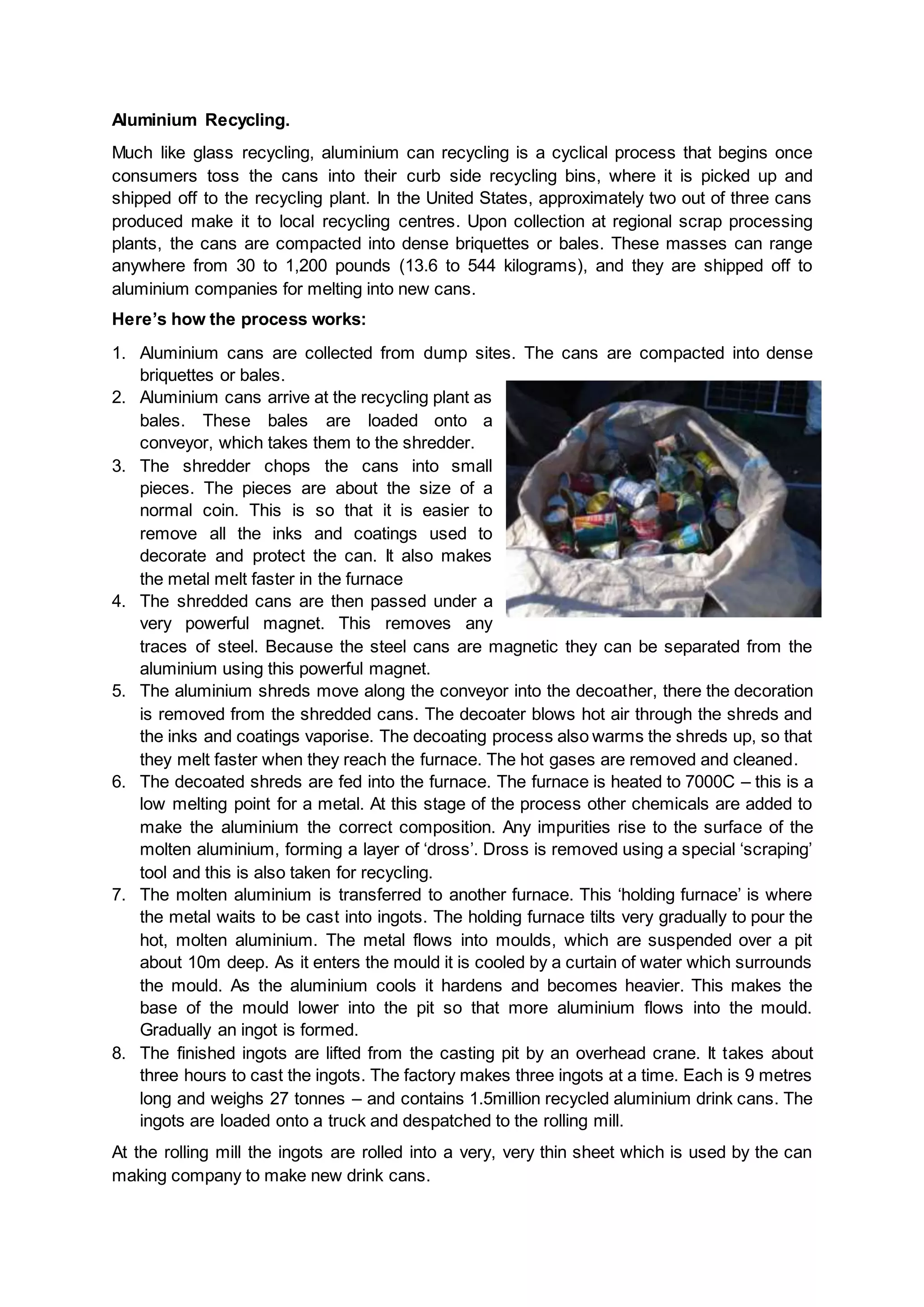
1. Aluminium cans are collected from dump sites. The cans are compacted into dense
briquettes or bales.
2. Aluminium cans arrive at the recycling plant as
bales. These bales are loaded onto a
conveyor, which takes them to the shredder.
3. The shredder chops the cans into small
pieces. The pieces are about the size of a
normal coin. This is so that it is easier to
remove all the inks and coatings used to
decorate and protect the can. It also makes
the metal melt faster in the furnace
4. The shredded cans are then passed under a
very powerful magnet. This removes any
traces of steel. Because the steel cans are magnetic they can be separated from the
aluminium using this powerful magnet.
5. The aluminium shreds move along the conveyor into the decoather, there the decoration
is removed from the shredded cans. The decoater blows hot air through the shreds and
the inks and coatings vaporise. The decoating process also warms the shreds up, so that
they melt faster when they reach the furnace. The hot gases are removed and cleaned.
6. The decoated shreds are fed into the furnace. The furnace is heated to 7000C – this is a
low melting point for a metal. At this stage of the process other chemicals are added to
make the aluminium the correct composition. Any impurities rise to the surface of the
molten aluminium, forming a layer of ‘dross’. Dross is removed using a special ‘scraping’
tool and this is also taken for recycling.
7. The molten aluminium is transferred to another furnace. This ‘holding furnace’ is where
the metal waits to be cast into ingots. The holding furnace tilts very gradually to pour the
hot, molten aluminium. The metal flows into moulds, which are suspended over a pit
about 10m deep. As it enters the mould it is cooled by a curtain of water which surrounds
the mould. As the aluminium cools it hardens and becomes heavier. This makes the
base of the mould lower into the pit so that more aluminium flows into the mould.
Gradually an ingot is formed.
8. The finished ingots are lifted from the casting pit by an overhead crane. It takes about
three hours to cast the ingots. The factory makes three ingots at a time. Each is 9 metres
long and weighs 27 tonnes – and contains 1.5million recycled aluminium drink cans. The
ingots are loaded onto a truck and despatched to the rolling mill.
At the rolling mill the ingots are rolled into a very, very thin sheet which is used by the can
making company to make new drink cans.
And the whole process starts all over again!
Aluminium Can Recycling Facts on
 It is also an efficient process, which takes as little as 60 days for a can to be collected,
melted and made into a new can.
 Recycling companies use an industrial shredder to create
shredded bales of plastic bottles, aluminium cans,
glassware, and other materials so they can be sent to
other facilities to prepare them for reuse.
 Recycling aluminium cans saves 95% of the energy used
to make aluminium cans from virgin ore.
 Recycling diverted 1.7 billion pounds from landfills.
 There is no limit to how many times aluminium can be
recycled. Aluminium cans are 100-percent recyclable
Nigerian Drink Market
Nigerian beverages market is heavily driven by beer and carbonated soft drink (CSD), with
both controlling about 87% of beverages consumption. While the products in the beverages
space have some level of complementarities in production, traditionally there is a clear line
of focus among the key players in Nigeria. Total volume of canned portion of total production
is still less than 10% for both CSD, non-alcoholic and alcoholic drinks.
Alcoholic Drinks - Beer
Total beer production capacity is 23million hectolitres.
Beer volume sales compound annual growth to 2014: 7.3%
Beer value sales compound annual growth to 2014: 13.3%
Soft Drinks –Carbonates
Total Carbonated drink production capacity is 21.5million hectolitres
Carbonates volume sales compound annual growth to 2014: 5.9%
Carbonates value sales compound annual growth to 2014: 11.9%
Rationale for Aluminium Recycling in Nigeria
 In Nigeria two of the three operational rolling mills in the country – Qualitec
Aluminium Industries and First Aluminium Nigeria plc – have suspended operations.
A fourth rolling mill, Aloy Aluminium Ltd in Enugu, though completed, did not start
production because of very hostile operating environment, leaving only Tower
Aluminium Nigeria plc, which is also operating under limited capacity.
 Aluminium Smelter Company of Nigeria (ALSCON) is embroiled in ownership
controversy
 Aluminium scrap, exported with no value added, enjoys undue benefit of Export
Expansion Grant (EEG) of 20%. As a result, aluminium scraps have become scarce
to local manufacturers.
 Import duty on raw materials (ingots and billets) is the same as semifinished and
finished products, encouraging importation
 There is no large scale recycling plant in the country, so landfills and dump site are
filled with Aluminium products.
 Using recycled material in new aluminium beverage cans uses 95% less energy and
emits 95% less greenhouse gas emissions than manufacturing cans from virgin
materials.
 Cans help reduce spending on waste management because the per pound scrap
value for aluminum is higher than anything other solid waste.
 Cans are a smart and responsible solution to the ever-increasing consumer demand
for green products and packaging.
 Aluminium recycling creates jobs
 As the table below shows the importation of Aluminium products have an average
increase of over 100% over the last 5 years
Some Aluminium Product Imported by Nigeria Updated on June 6th, 2013
(Source http://countries.bridgat.com)
Aluminium Can Manufactures in Nigeria
GZ Industries
GZ Industries Limited (“GZI”) was incorporated in Nigeria on June 3, 2006.
GZI has established a factory in Agbara Industrial Estate, Ogun State near Lagos, to
manufacture Aluminium beverage cans for brewers and bottling companies in Nigeria and
other West African countries. The factory was commissioned on the 26th of August 2010 by
His Excellency Dr. Goodluck Ebele Jonathan, GCFR, President, Commander-in-chief of the
Armed Forces, Federal Republic of Nigeria.
GZI’s initial factory production capacity was 600 million cans. However, GZI’s commitment to
progressive expansion has resulted in a capacity of 900 million cans by 2011 and has
achieved 1.2 billion cans per annum in 2012.
Based on present can weight and Aluminium content GZI uses a little under 20,000MT of
Aluminium yearly.
GZI is an indigenous Company owned by a group of foreign investors, Verod Capital
Management; a Nigerian investment and financial advisory firm, and Standard Chartered
Private Equity.
It sources its raw materials mainly from Brazil and from Aluminium Smelter Company of
Nigeria (ALSCON), but with the never ending issues with its main source of raw material is
Brazil.
Brazil recycles 98.2% of its aluminium production, equivalent to 14.7 billion beverage cans
per year, ranking first in the world, more than Japan's 82.5% recovery rate. Brazil has
topped the aluminium can recycling charts eight years in a row. It is therefore easy to
conclude that most of the raw materials used by GZI are from recycled Aluminium.
Alucan Packaging Ltd.
Production at Nigeria's second two-piece beverage can making plant started September
2012. The factory will produce 1billion cans per year. The factory is located in Agbara.
Aba Can Manufacturing Company.
It will be Africa’s largest can manufacturing plant, starting with a production capacity of
1.2billion cans a year. It will therefore need a little under 20,000MT of Aluminium yearly. The
project is being financed by Fidelity Bank Plc.
Volume of liquid canned in Millions of Litres and can sizes (Source Canadean Consulting)
Land-fills.
Lagos
There are 3 major landfills and 2 temporary sites serving Lagos State.
The Olusosun landfill is situated in the Northern part of Lagos within Ikeja Local
Government and receives approximately 40% of the total waste deposits from Lagos. The
size is 42.7 hectares and a residual life span of 20 years. It is the largest in Africa and one of
the largest in the world. The site receives up to 10,000 tons of rubbish each day.
Abule-Egba Landfill Site: The site occupies a land of about 10.2 hectares in the Western
part of Lagos in Alimosho Local Government and receives waste from the densely populated
area. The residual life span is approximately 8 years.
The Solous Sites:
Soluos I - Situated along Lagos State University – IBA Road.
Soluos II - is on 7.8 hectares of land with average life span of 5 years.
Soluos III- a new site with approximately 5 hectares of land with average life span of 5
years.
Each site receives an average of about 2,250 m3
of waste per day.
Satellite Sites
These Satellite Sites comprise of Owutu (Ikorodu), Sangotedo (Eti–Osa) and Temu (Epe)
dumpsites. These sites serve as back–ups for other three main landfill sites, and also have
an advantage of proximity. They are temporary sites, and receive an average waste of about
1,864.29m3
per day.
Ibadan
The average waste generation per capita per day in Ibadan is about 0.3kg. With an
estimated population of 2,550,593 (2006 census), waste generation in Ibadan can be
estimated at 279,289,934 kg/year
It has 4 major landfill sites.
Afofunra Dumpsite: The dumpsite is located along Akanra -Ijebu Igbo road in an area of
over 10 hectare. The site was opened in 1997 and is still active.
Awotan Dumpsite: Awotan (also known as Apete) dump site was opened in 1998 and is
situated along Akufo - Ibadan Polytechnic road over an approximate 25 -hectare area.
Lapite Dumpsite: Lapite dumpsite was opened in 1998 and is situated over an approximate
20 -hectare land along Oyo road.
Ajakanga Dumpsite: Ajakanga dumpsite was opened in 1996 and is located over an
approximate 10 -hectare area along Challenge road.

Aluminium cans

  • 1.
    Aluminium cans Aluminium canswould make inroads into the soft drink market in 1964, when Royal Crown Cola released both its RC Cola and Diet Rite beverages in a two-piece, 12-oz. aluminium container. In addition to being lighter-weight than their steel predecessors, these new aluminium cans provided a superior surface upon which to print text and graphics to help promote brand awareness. In their first year on the market, one million cases of soda were packaged in aluminium cans. Glass is reaching its limits in terms of light-weighting, and there is growing doubt among the brand owners about its ability to evolve with market needs. The growing emphasis on the carbon footprint of packaging supply and end of life management will prove a compelling competitive advantage for can packaging for beverages. The potential in beer and alcoholic drinks is highlighted by the low penetration achieved to date with plastic bottles and the various innovations in the use of Aluminium bottles. A range of other factors contributed to the aluminium can’s early adoption by beverage manufacturers: it was easily moulded (and hence its ability to be formed in only two pieces), it was highly resistant to corrosion and would not rust, and it admirably supported the carbonation pressure required to package soda (aluminium cans withstand pressure of up to 90 lbs. per square inch). Sleek beverage cans, a new style of beverage can that is now available, utilize innovative and new age shapes to attract consumer attention. For this reason sleek beverage cans have become increasingly popular and an effective marketing tool for beverage companies. The latest technology in custom beverage cans allows for the production of many different shapes and sizes from subtle to highly innovative asymmetrical designs with fine detail and significant expansion capability. Cans are getting lighter all the time. Today, aluminium cans are about 30% lighter than they were 25 years ago. Thinner, stronger sections are now being used with less metal, less energy and more savings in weight. An average aluminium can (without its contents, of course) weighed 16.55 grams in 1992. By 2005 the aluminium can weighed about 14.7 grams. The average can contains between to 92-99% Aluminium with other metals like magnesium, manganese, iron, silicon, and copper making up the remaining constituent. Based on present weight a can contains between 13.5- 14.6g of Aluminium.
  • 2.
    Aluminium Recycling. Much likeglass recycling, aluminium can recycling is a cyclical process that begins once consumers toss the cans into their curb side recycling bins, where it is picked up and shipped off to the recycling plant. In the United States, approximately two out of three cans produced make it to local recycling centres. Upon collection at regional scrap processing plants, the cans are compacted into dense briquettes or bales. These masses can range anywhere from 30 to 1,200 pounds (13.6 to 544 kilograms), and they are shipped off to aluminium companies for melting into new cans. Here’s how the process works: 1. Aluminium cans are collected from dump sites. The cans are compacted into dense briquettes or bales. 2. Aluminium cans arrive at the recycling plant as bales. These bales are loaded onto a conveyor, which takes them to the shredder. 3. The shredder chops the cans into small pieces. The pieces are about the size of a normal coin. This is so that it is easier to remove all the inks and coatings used to decorate and protect the can. It also makes the metal melt faster in the furnace 4. The shredded cans are then passed under a very powerful magnet. This removes any traces of steel. Because the steel cans are magnetic they can be separated from the aluminium using this powerful magnet. 5. The aluminium shreds move along the conveyor into the decoather, there the decoration is removed from the shredded cans. The decoater blows hot air through the shreds and the inks and coatings vaporise. The decoating process also warms the shreds up, so that they melt faster when they reach the furnace. The hot gases are removed and cleaned. 6. The decoated shreds are fed into the furnace. The furnace is heated to 7000C – this is a low melting point for a metal. At this stage of the process other chemicals are added to make the aluminium the correct composition. Any impurities rise to the surface of the molten aluminium, forming a layer of ‘dross’. Dross is removed using a special ‘scraping’ tool and this is also taken for recycling. 7. The molten aluminium is transferred to another furnace. This ‘holding furnace’ is where the metal waits to be cast into ingots. The holding furnace tilts very gradually to pour the hot, molten aluminium. The metal flows into moulds, which are suspended over a pit about 10m deep. As it enters the mould it is cooled by a curtain of water which surrounds the mould. As the aluminium cools it hardens and becomes heavier. This makes the base of the mould lower into the pit so that more aluminium flows into the mould. Gradually an ingot is formed. 8. The finished ingots are lifted from the casting pit by an overhead crane. It takes about three hours to cast the ingots. The factory makes three ingots at a time. Each is 9 metres long and weighs 27 tonnes – and contains 1.5million recycled aluminium drink cans. The ingots are loaded onto a truck and despatched to the rolling mill. At the rolling mill the ingots are rolled into a very, very thin sheet which is used by the can making company to make new drink cans.
  • 3.
    And the wholeprocess starts all over again! Aluminium Can Recycling Facts on  It is also an efficient process, which takes as little as 60 days for a can to be collected, melted and made into a new can.  Recycling companies use an industrial shredder to create shredded bales of plastic bottles, aluminium cans, glassware, and other materials so they can be sent to other facilities to prepare them for reuse.  Recycling aluminium cans saves 95% of the energy used to make aluminium cans from virgin ore.  Recycling diverted 1.7 billion pounds from landfills.  There is no limit to how many times aluminium can be recycled. Aluminium cans are 100-percent recyclable Nigerian Drink Market Nigerian beverages market is heavily driven by beer and carbonated soft drink (CSD), with both controlling about 87% of beverages consumption. While the products in the beverages space have some level of complementarities in production, traditionally there is a clear line of focus among the key players in Nigeria. Total volume of canned portion of total production is still less than 10% for both CSD, non-alcoholic and alcoholic drinks. Alcoholic Drinks - Beer Total beer production capacity is 23million hectolitres. Beer volume sales compound annual growth to 2014: 7.3% Beer value sales compound annual growth to 2014: 13.3%
  • 4.
    Soft Drinks –Carbonates TotalCarbonated drink production capacity is 21.5million hectolitres Carbonates volume sales compound annual growth to 2014: 5.9% Carbonates value sales compound annual growth to 2014: 11.9% Rationale for Aluminium Recycling in Nigeria  In Nigeria two of the three operational rolling mills in the country – Qualitec Aluminium Industries and First Aluminium Nigeria plc – have suspended operations. A fourth rolling mill, Aloy Aluminium Ltd in Enugu, though completed, did not start production because of very hostile operating environment, leaving only Tower Aluminium Nigeria plc, which is also operating under limited capacity.  Aluminium Smelter Company of Nigeria (ALSCON) is embroiled in ownership controversy  Aluminium scrap, exported with no value added, enjoys undue benefit of Export Expansion Grant (EEG) of 20%. As a result, aluminium scraps have become scarce to local manufacturers.  Import duty on raw materials (ingots and billets) is the same as semifinished and finished products, encouraging importation  There is no large scale recycling plant in the country, so landfills and dump site are filled with Aluminium products.  Using recycled material in new aluminium beverage cans uses 95% less energy and emits 95% less greenhouse gas emissions than manufacturing cans from virgin materials.  Cans help reduce spending on waste management because the per pound scrap value for aluminum is higher than anything other solid waste.  Cans are a smart and responsible solution to the ever-increasing consumer demand for green products and packaging.  Aluminium recycling creates jobs  As the table below shows the importation of Aluminium products have an average increase of over 100% over the last 5 years Some Aluminium Product Imported by Nigeria Updated on June 6th, 2013 (Source http://countries.bridgat.com)
  • 5.
    Aluminium Can Manufacturesin Nigeria GZ Industries GZ Industries Limited (“GZI”) was incorporated in Nigeria on June 3, 2006. GZI has established a factory in Agbara Industrial Estate, Ogun State near Lagos, to manufacture Aluminium beverage cans for brewers and bottling companies in Nigeria and other West African countries. The factory was commissioned on the 26th of August 2010 by His Excellency Dr. Goodluck Ebele Jonathan, GCFR, President, Commander-in-chief of the Armed Forces, Federal Republic of Nigeria. GZI’s initial factory production capacity was 600 million cans. However, GZI’s commitment to progressive expansion has resulted in a capacity of 900 million cans by 2011 and has achieved 1.2 billion cans per annum in 2012. Based on present can weight and Aluminium content GZI uses a little under 20,000MT of Aluminium yearly. GZI is an indigenous Company owned by a group of foreign investors, Verod Capital Management; a Nigerian investment and financial advisory firm, and Standard Chartered Private Equity. It sources its raw materials mainly from Brazil and from Aluminium Smelter Company of Nigeria (ALSCON), but with the never ending issues with its main source of raw material is Brazil. Brazil recycles 98.2% of its aluminium production, equivalent to 14.7 billion beverage cans per year, ranking first in the world, more than Japan's 82.5% recovery rate. Brazil has topped the aluminium can recycling charts eight years in a row. It is therefore easy to conclude that most of the raw materials used by GZI are from recycled Aluminium. Alucan Packaging Ltd. Production at Nigeria's second two-piece beverage can making plant started September 2012. The factory will produce 1billion cans per year. The factory is located in Agbara. Aba Can Manufacturing Company. It will be Africa’s largest can manufacturing plant, starting with a production capacity of 1.2billion cans a year. It will therefore need a little under 20,000MT of Aluminium yearly. The project is being financed by Fidelity Bank Plc.
  • 7.
    Volume of liquidcanned in Millions of Litres and can sizes (Source Canadean Consulting)
  • 8.
    Land-fills. Lagos There are 3major landfills and 2 temporary sites serving Lagos State. The Olusosun landfill is situated in the Northern part of Lagos within Ikeja Local Government and receives approximately 40% of the total waste deposits from Lagos. The size is 42.7 hectares and a residual life span of 20 years. It is the largest in Africa and one of the largest in the world. The site receives up to 10,000 tons of rubbish each day. Abule-Egba Landfill Site: The site occupies a land of about 10.2 hectares in the Western part of Lagos in Alimosho Local Government and receives waste from the densely populated area. The residual life span is approximately 8 years. The Solous Sites: Soluos I - Situated along Lagos State University – IBA Road. Soluos II - is on 7.8 hectares of land with average life span of 5 years. Soluos III- a new site with approximately 5 hectares of land with average life span of 5 years. Each site receives an average of about 2,250 m3 of waste per day. Satellite Sites These Satellite Sites comprise of Owutu (Ikorodu), Sangotedo (Eti–Osa) and Temu (Epe) dumpsites. These sites serve as back–ups for other three main landfill sites, and also have an advantage of proximity. They are temporary sites, and receive an average waste of about 1,864.29m3 per day. Ibadan The average waste generation per capita per day in Ibadan is about 0.3kg. With an estimated population of 2,550,593 (2006 census), waste generation in Ibadan can be estimated at 279,289,934 kg/year It has 4 major landfill sites. Afofunra Dumpsite: The dumpsite is located along Akanra -Ijebu Igbo road in an area of over 10 hectare. The site was opened in 1997 and is still active. Awotan Dumpsite: Awotan (also known as Apete) dump site was opened in 1998 and is situated along Akufo - Ibadan Polytechnic road over an approximate 25 -hectare area. Lapite Dumpsite: Lapite dumpsite was opened in 1998 and is situated over an approximate 20 -hectare land along Oyo road. Ajakanga Dumpsite: Ajakanga dumpsite was opened in 1996 and is located over an approximate 10 -hectare area along Challenge road.