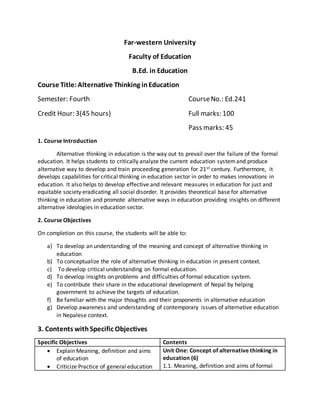
Far-western University
Faculty of Education
B.Ed. in Education
Course Title:Alternative Thinking inEducation
Semester: Fourth CourseNo.: Ed.241
Credit Hour: 3(45 hours) Full marks: 100
Pass marks: 45
1. Course Introduction
Alternative thinking in education is the way out to prevail over the failure of the formal
education. It helps students to critically analyze the current education systemand produce
alternative way to develop and train proceeding generation for 21st century. Furthermore, it
develops capabilities for critical thinking in education sector in order to makes innovations in
education. It also helps to develop effective and relevant measures in education for just and
equitable society eradicating all social disorder. It provides theoretical base for alternative
thinking in education and promote alternative ways in education providing insights on different
alternative ideologies in education sector.
2. Course Objectives
On completion on this course, the students will be able to:
a) To develop an understanding of the meaning and concept of alternative thinking in
education
b) To conceptualize the role of alternative thinking in education in present context.
c) To develop critical understanding on formal education.
d) To develop insights on problems and difficulties of formal education system.
e) To contribute their share in the educational development of Nepal by helping
government to achieve the targets of education.
f) Be familiar with the major thoughts and their proponents in alternative education
g) Develop awareness and understanding of contemporary issues of alternative education
in Nepalese context.
3. Contents withSpecific Objectives
Specific Objectives Contents
 Explain Meaning, definition and aims
of education
 Criticize Practice of general education
Unit One: Concept of alternative thinking in
education (6)
1.1. Meaning, definition and aims of formal
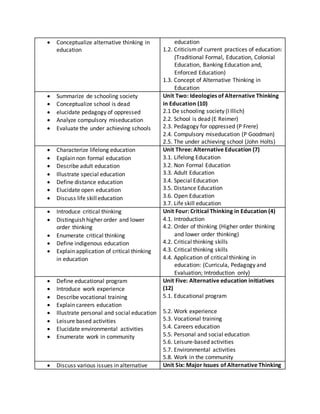
 Conceptualize alternative thinking in
education
education
1.2. Criticismof current practices of education:
(Traditional Formal, Education, Colonial
Education, Banking Education and,
Enforced Education)
1.3. Concept of Alternative Thinking in
Education
 Summarize de schooling society
 Conceptualize school is dead
 elucidate pedagogy of oppressed
 Analyze compulsory miseducation
 Evaluate the under achieving schools
Unit Two: Ideologies of Alternative Thinking
in Education (10)
2.1 De schooling society (I Illich)
2.2. School is dead (E Reimer)
2.3. Pedagogy for oppressed (P Frere)
2.4. Compulsory miseducation (P Goodman)
2.5. The under achieving school (John Holts)
 Characterize lifelong education
 Explain non formal education
 Describe adult education
 Illustrate special education
 Define distance education
 Elucidate open education
 Discuss life skilleducation
Unit Three: Alternative Education (7)
3.1. Lifelong Education
3.2. Non Formal Education
3.3. Adult Education
3.4. Special Education
3.5. Distance Education
3.6. Open Education
3.7. Life skill education
 Introduce critical thinking
 Distinguish higher order and lower
order thinking
 Enumerate critical thinking
 Define indigenous education
 Explain application of critical thinking
in education
Unit Four: Critical Thinking in Education (4)
4.1. Introduction
4.2. Order of thinking (Higher order thinking
and lower order thinking)
4.2. Critical thinking skills
4.3. Critical thinking skills
4.4. Application of critical thinking in
education: (Curricula, Pedagogy and
Evaluation; Introduction only)
 Define educational program
 Introduce work experience
 Describe vocational training
 Explain careers education
 Illustrate personal and social education
 Leisure based activities
 Elucidate environmental activities
 Enumerate work in community
Unit Five: Alternative education initiatives
(12)
5.1. Educational program
5.2. Work experience
5.3. Vocational training
5.4. Careers education
5.5. Personal and social education
5.6. Leisure-based activities
5.7. Environmental activities
5.8. Work in the community
 Discuss various issues in alternative Unit Six: Major Issues of Alternative Thinking
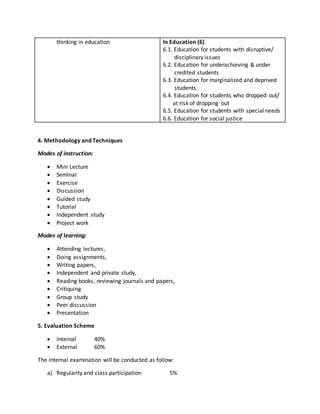
thinking in education In Education (6)
6.1. Education for students with disruptive/
disciplinary issues
6.2. Education for underachieving & under
credited students
6.3. Education for marginalized and deprived
students
6.4. Education for students who dropped out/
at risk of dropping out
6.5. Education for students with special needs
6.6. Education for social justice
4. Methodology and Techniques
Modes of instruction:
 Mini Lecture
 Seminar
 Exercise
 Discussion
 Guided study
 Tutorial
 Independent study
 Project work
Modes of learning:
 Attending lectures,
 Doing assignments,
 Writing papers,
 Independent and private study,
 Reading books, reviewing journals and papers,
 Critiquing
 Group study
 Peer discussion
 Presentation
5. Evaluation Scheme
 Internal 40%
 External 60%
The internal examination will be conducted as follow:
a) Regularity and class participation 5%
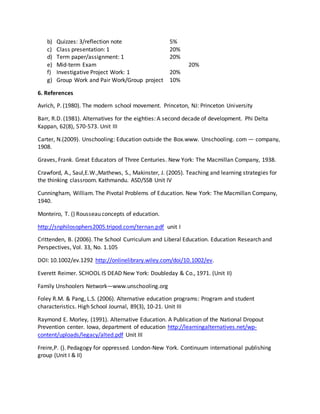
b) Quizzes: 3/reflection note 5%
c) Class presentation: 1 20%
d) Term paper/assignment: 1 20%
e) Mid-term Exam 20%
f) Investigative Project Work: 1 20%
g) Group Work and Pair Work/Group project 10%
6. References
Avrich, P. (1980). The modern school movement. Princeton, NJ: Princeton University
Barr, R.D. (1981). Alternatives for the eighties: A second decade of development. Phi Delta
Kappan, 62(8), 570-573. Unit III
Carter, N.(2009). Unschooling: Education outside the Box.www. Unschooling. com — company,
1908.
Graves, Frank. Great Educators of Three Centuries. New York: The Macmillan Company, 1938.
Crawford, A., Saul,E.W.,Mathews, S., Makinster, J. (2005). Teaching and learning strategies for
the thinking classroom. Kathmandu. ASD/SSB Unit IV
Cunningham, William. The Pivotal Problems of Education. New York: The Macmillan Company,
1940.
Monteiro, T. () Rousseau concepts of education.
http://snphilosophers2005.tripod.com/ternan.pdf unit I
Crittenden, B. (2006). The School Curriculum and Liberal Education. Education Research and
Perspectives, Vol. 33, No. 1.105
DOI: 10.1002/ev.1292 http://onlinelibrary.wiley.com/doi/10.1002/ev.
Everett Reimer. SCHOOL IS DEAD New York: Doubleday & Co., 1971. (Unit II)
Family Unshoolers Network—www.unschooling.org
Foley R.M. & Pang, L.S. (2006). Alternative education programs: Program and student
characteristics. High School Journal, 89(3), 10-21. Unit III
Raymond E. Morley, (1991). Alternative Education. A Publication of the National Dropout
Prevention center. Iowa, department of education http://learningalternatives.net/wp-
content/uploads/legacy/alted.pdf Unit III
Freire,P. (). Pedagogy for oppressed. London-New York. Continuum international publishing
group (Unit I & II)
Gabbard, D. A. (2003). Education is enforcement!: The centrality of compulsory schooling in
market societies. In K. Saltman & D. Gabbard (Eds.), Education as enforcement: The
militarization and corporatization of schools (pp. 61-80). New York: RoutledgeFalmer Unit I
Hanbury, C. (2008). Lifeskill handbook. www.lifeskillshandbooks.com
Holts John.(). the under achieving school. Berkeley; California (Unit II)
Hopkins, R.L. (1979). Freedom and education: The beginnings of a new philosophy. Washington,
D.C.: University Press of America.
Graubard, A. (1972). The free school movement. Harvard Educational Review, 42(3), 351-373.
Illich, I (1971). Deschooling society. New York, Harper & Row [1971]ISBN:
00601213949780060121396 (Unit II)
Jennings, J. & Rentner, D.S. (2006). How public schools are impacted by No Child Left Behind.
Education Digest,72(4), 4-9.
Joad, C.E.M. :Adult Education,Faber and Faber Ltd.Kellmayer, J. (1995). How to establish an
alternative school. Thousand Oaks, CA: Corwin Press.
John Holt & Growing Without Schooling –www.holtgws.com
John Taylor Gatto—www.johntaylorgatto.com
Kurfiss, J. G., Critical Thinking: Theory, Research, practice and Possiblities, ASHE-ERIC Higher
Education Report # 2, Washington DC, 1988. Unit IV
Lange, C., & Sletten, S. (2002). Alternative education: A brief history and synthesis. Unit V
Miller, R. (1990). What are schools for? Brandon, VT: Holistic Education Press.
Monroe, Paul. A Brief Course in the history of Education. New York: The Macmillan Nick L.
Smith .(2004). Creating alternative methods for educational evaluation.
Paul Goodman (1964). Compulsory Mis-Education. New York: Horizon Press, 188 Pp. (Unit II)
Press
Real life learning & Delight Directed learning—www.homesschooloasis.com
Sally Kendall et al, (2003). An Evaluation of Alternative Education Initiatives. Research report,
Norwich, Queen's Printer (ISBN 1 84185 922 2) Unit V
Smith, G., Gregory, T., & Pugh, R. (1981). Meeting student needs: Evidence for the superiority of
alternative schools. Phi Delta Kappan, 62, 561-564.
Rutherford, R., & Quinn, M. (1999). Special education in alternative education programs. The
Clearing House, 73(2), 79-81.
Raywid, M.A. (1994). Alternative schools: The state of the art. Educational Leadership, 52(1),
26-31.
New York State Education Department (1997). Introductory Guide to Alternative Education.
Albany, NY: Author.
The Moore Foundation—www.moorefoundation.com
Unschooling High School & College by Allison McKee WHO (1997) life education for children
and adolescents in schools. www.http://whqlibdoc.who.int/hq/1994/who_mnh.pdf
www.homeschool.com/advisors/McKee/default.asp
Young, T. (1990). Public Alternative Education. New York, NY: Teachers College Press Unit V

B.ed. 4th sem alternative thinking in educartion

  • 1.
    Far-western University Faculty ofEducation B.Ed. in Education Course Title:Alternative Thinking inEducation Semester: Fourth CourseNo.: Ed.241 Credit Hour: 3(45 hours) Full marks: 100 Pass marks: 45 1. Course Introduction Alternative thinking in education is the way out to prevail over the failure of the formal education. It helps students to critically analyze the current education systemand produce alternative way to develop and train proceeding generation for 21st century. Furthermore, it develops capabilities for critical thinking in education sector in order to makes innovations in education. It also helps to develop effective and relevant measures in education for just and equitable society eradicating all social disorder. It provides theoretical base for alternative thinking in education and promote alternative ways in education providing insights on different alternative ideologies in education sector. 2. Course Objectives On completion on this course, the students will be able to: a) To develop an understanding of the meaning and concept of alternative thinking in education b) To conceptualize the role of alternative thinking in education in present context. c) To develop critical understanding on formal education. d) To develop insights on problems and difficulties of formal education system. e) To contribute their share in the educational development of Nepal by helping government to achieve the targets of education. f) Be familiar with the major thoughts and their proponents in alternative education g) Develop awareness and understanding of contemporary issues of alternative education in Nepalese context. 3. Contents withSpecific Objectives Specific Objectives Contents  Explain Meaning, definition and aims of education  Criticize Practice of general education Unit One: Concept of alternative thinking in education (6) 1.1. Meaning, definition and aims of formal
  • 2.
     Conceptualize alternativethinking in education education 1.2. Criticismof current practices of education: (Traditional Formal, Education, Colonial Education, Banking Education and, Enforced Education) 1.3. Concept of Alternative Thinking in Education  Summarize de schooling society  Conceptualize school is dead  elucidate pedagogy of oppressed  Analyze compulsory miseducation  Evaluate the under achieving schools Unit Two: Ideologies of Alternative Thinking in Education (10) 2.1 De schooling society (I Illich) 2.2. School is dead (E Reimer) 2.3. Pedagogy for oppressed (P Frere) 2.4. Compulsory miseducation (P Goodman) 2.5. The under achieving school (John Holts)  Characterize lifelong education  Explain non formal education  Describe adult education  Illustrate special education  Define distance education  Elucidate open education  Discuss life skilleducation Unit Three: Alternative Education (7) 3.1. Lifelong Education 3.2. Non Formal Education 3.3. Adult Education 3.4. Special Education 3.5. Distance Education 3.6. Open Education 3.7. Life skill education  Introduce critical thinking  Distinguish higher order and lower order thinking  Enumerate critical thinking  Define indigenous education  Explain application of critical thinking in education Unit Four: Critical Thinking in Education (4) 4.1. Introduction 4.2. Order of thinking (Higher order thinking and lower order thinking) 4.2. Critical thinking skills 4.3. Critical thinking skills 4.4. Application of critical thinking in education: (Curricula, Pedagogy and Evaluation; Introduction only)  Define educational program  Introduce work experience  Describe vocational training  Explain careers education  Illustrate personal and social education  Leisure based activities  Elucidate environmental activities  Enumerate work in community Unit Five: Alternative education initiatives (12) 5.1. Educational program 5.2. Work experience 5.3. Vocational training 5.4. Careers education 5.5. Personal and social education 5.6. Leisure-based activities 5.7. Environmental activities 5.8. Work in the community  Discuss various issues in alternative Unit Six: Major Issues of Alternative Thinking
  • 3.
    thinking in educationIn Education (6) 6.1. Education for students with disruptive/ disciplinary issues 6.2. Education for underachieving & under credited students 6.3. Education for marginalized and deprived students 6.4. Education for students who dropped out/ at risk of dropping out 6.5. Education for students with special needs 6.6. Education for social justice 4. Methodology and Techniques Modes of instruction:  Mini Lecture  Seminar  Exercise  Discussion  Guided study  Tutorial  Independent study  Project work Modes of learning:  Attending lectures,  Doing assignments,  Writing papers,  Independent and private study,  Reading books, reviewing journals and papers,  Critiquing  Group study  Peer discussion  Presentation 5. Evaluation Scheme  Internal 40%  External 60% The internal examination will be conducted as follow: a) Regularity and class participation 5%
  • 4.
    b) Quizzes: 3/reflectionnote 5% c) Class presentation: 1 20% d) Term paper/assignment: 1 20% e) Mid-term Exam 20% f) Investigative Project Work: 1 20% g) Group Work and Pair Work/Group project 10% 6. References Avrich, P. (1980). The modern school movement. Princeton, NJ: Princeton University Barr, R.D. (1981). Alternatives for the eighties: A second decade of development. Phi Delta Kappan, 62(8), 570-573. Unit III Carter, N.(2009). Unschooling: Education outside the Box.www. Unschooling. com — company, 1908. Graves, Frank. Great Educators of Three Centuries. New York: The Macmillan Company, 1938. Crawford, A., Saul,E.W.,Mathews, S., Makinster, J. (2005). Teaching and learning strategies for the thinking classroom. Kathmandu. ASD/SSB Unit IV Cunningham, William. The Pivotal Problems of Education. New York: The Macmillan Company, 1940. Monteiro, T. () Rousseau concepts of education. http://snphilosophers2005.tripod.com/ternan.pdf unit I Crittenden, B. (2006). The School Curriculum and Liberal Education. Education Research and Perspectives, Vol. 33, No. 1.105 DOI: 10.1002/ev.1292 http://onlinelibrary.wiley.com/doi/10.1002/ev. Everett Reimer. SCHOOL IS DEAD New York: Doubleday & Co., 1971. (Unit II) Family Unshoolers Network—www.unschooling.org Foley R.M. & Pang, L.S. (2006). Alternative education programs: Program and student characteristics. High School Journal, 89(3), 10-21. Unit III Raymond E. Morley, (1991). Alternative Education. A Publication of the National Dropout Prevention center. Iowa, department of education http://learningalternatives.net/wp- content/uploads/legacy/alted.pdf Unit III Freire,P. (). Pedagogy for oppressed. London-New York. Continuum international publishing group (Unit I & II)
  • 5.
    Gabbard, D. A.(2003). Education is enforcement!: The centrality of compulsory schooling in market societies. In K. Saltman & D. Gabbard (Eds.), Education as enforcement: The militarization and corporatization of schools (pp. 61-80). New York: RoutledgeFalmer Unit I Hanbury, C. (2008). Lifeskill handbook. www.lifeskillshandbooks.com Holts John.(). the under achieving school. Berkeley; California (Unit II) Hopkins, R.L. (1979). Freedom and education: The beginnings of a new philosophy. Washington, D.C.: University Press of America. Graubard, A. (1972). The free school movement. Harvard Educational Review, 42(3), 351-373. Illich, I (1971). Deschooling society. New York, Harper & Row [1971]ISBN: 00601213949780060121396 (Unit II) Jennings, J. & Rentner, D.S. (2006). How public schools are impacted by No Child Left Behind. Education Digest,72(4), 4-9. Joad, C.E.M. :Adult Education,Faber and Faber Ltd.Kellmayer, J. (1995). How to establish an alternative school. Thousand Oaks, CA: Corwin Press. John Holt & Growing Without Schooling –www.holtgws.com John Taylor Gatto—www.johntaylorgatto.com Kurfiss, J. G., Critical Thinking: Theory, Research, practice and Possiblities, ASHE-ERIC Higher Education Report # 2, Washington DC, 1988. Unit IV Lange, C., & Sletten, S. (2002). Alternative education: A brief history and synthesis. Unit V Miller, R. (1990). What are schools for? Brandon, VT: Holistic Education Press. Monroe, Paul. A Brief Course in the history of Education. New York: The Macmillan Nick L. Smith .(2004). Creating alternative methods for educational evaluation. Paul Goodman (1964). Compulsory Mis-Education. New York: Horizon Press, 188 Pp. (Unit II) Press Real life learning & Delight Directed learning—www.homesschooloasis.com Sally Kendall et al, (2003). An Evaluation of Alternative Education Initiatives. Research report, Norwich, Queen's Printer (ISBN 1 84185 922 2) Unit V Smith, G., Gregory, T., & Pugh, R. (1981). Meeting student needs: Evidence for the superiority of alternative schools. Phi Delta Kappan, 62, 561-564. Rutherford, R., & Quinn, M. (1999). Special education in alternative education programs. The Clearing House, 73(2), 79-81.
  • 6.
    Raywid, M.A. (1994).Alternative schools: The state of the art. Educational Leadership, 52(1), 26-31. New York State Education Department (1997). Introductory Guide to Alternative Education. Albany, NY: Author. The Moore Foundation—www.moorefoundation.com Unschooling High School & College by Allison McKee WHO (1997) life education for children and adolescents in schools. www.http://whqlibdoc.who.int/hq/1994/who_mnh.pdf www.homeschool.com/advisors/McKee/default.asp Young, T. (1990). Public Alternative Education. New York, NY: Teachers College Press Unit V