“11th Conference for
Teachers of English”

“Integrating
Phonology following
the ALTE levels”
by Prof. Silvia A. Schnitzler
“Teacher development is the process of
becoming the best teacher you can be. It
means becoming a student of learning, your
own as well as that of others” (Maley 2000).
The aim of this workshop is to provide a ‘learning
space’ from a person-centered learning
approach.
We will briefly analyze the Common European
Framework of Reference for Languages and
see how the phonological aspect can be
integrated to the other areas of language
teaching.
“Integrating Phonology following the ALTE levels” - Prof. Silvia A. Schnitzler
What is the
Common European Framework?
It provides a common basis for the elaboration of
language syllabuses, curriculum guidelines,
examinations, textbooks, etc. across Europe.
Europe
It describes in a comprehensive way what language
learners have to learn to do in order to use a language
for communication and what knowledge and skills they
have to develop so as to be able to act effectively.
The description also covers the cultural context in which
language is set. The Framework also defines levels of
proficiency which allow learners’ progress to be
measured at each stage of learning and on a life-long
basis.
http://www.coe.int/t/dg4/linguistic/source/framework_en.pdf
Association of Language
Testers in Europe (ALTE)
It is an association of providers of
European foreign language examinations.
Registered in 1992 as a European
Economic Interest Group (EEIG), it
provides a context for transnational
collaboration between some of the major
international providers in the field of
language testing.
http://www.alte.org/
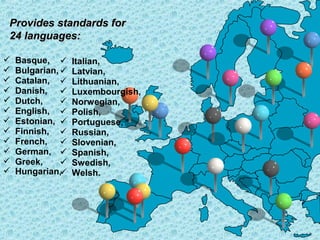
Provides standards for
24 languages:













Basque, 
Bulgarian, 
Catalan, 
Danish, 
Dutch,

English, 
Estonian, 
Finnish, 
French, 
German, 
Greek,

Hungarian,


Italian,
Latvian,
Lithuanian,
Luxembourgish,
Norwegian,
Polish,
Portuguese,
Russian,
Slovenian,
Spanish,
Swedish,
Welsh.
Objectives
“… In the light of these objectives, the Committee
of Ministers stressed ‘the political importance
at the present time and in the future of
developing specific fields of action, such as
strategies for diversifying and intensifying
language learning in order to promote
plurilingualism in a pan-European context’ and
context
drew attention to the value of further
developing educational links and exchanges
and of exploiting the full potential of new
communication and information technologies.”
p4
“Integrating Phonology following the ALTE levels” - Prof. Silvia A. Schnitzler
What criteria must CEF meet?
COMPREHENSIVE

• By ‘comprehensive’ is meant that the
comprehensive
C E F should attempt to specify as
full a range of language knowledge,
skills and use as possible, and that
all users should be able to describe
their objectives by reference to it.
“Integrating Phonology following the ALTE levels” - Prof. Silvia A. Schnitzler
What criteria must CEF meet?
TRANSPARENT
• By ‘transparent’ is meant that
transparent
information must be clearly
formulated and explicit, available
and readily comprehensible to
users.

“Integrating Phonology following the ALTE levels” - Prof. Silvia A. Schnitzler
What criteria must CEF meet?
COHERENT
• By ‘coherent’ is meant that the
coherent
description is free from internal
contradictions. With regard to
educational systems, coherence
requires that there is a harmonious
relation among their components.
“Integrating Phonology following the ALTE levels” - Prof. Silvia A. Schnitzler
The ALTE levels
ALTE level
Level 5
Level 4
Level 3
Level 2
Level 1
Breakthrough

CEFR level
C2
C1
B2
B1
A2
A1

ESOL exam
CPE
CAE
FCE
PET
KET
-

IELTS exam
7.5+
6.5 - 7
5-6
3.5 - 4.5
3
1-2

TOEIC
910+
701 - 910
541 - 700
381 - 540
246 - 380
-

TOEFL
276+
236 - 275
176 - 235
126 - 175
96 - 125
-

“Integrating Phonology following the ALTE levels” - Prof. Silvia A. Schnitzler
General phonetic awareness and skills
Sts ability to pronounce new languages
facilitated by:
• an ability to distinguish and produce unfamiliar
sounds and prosodic patterns;
• an ability to perceive and catenate unfamiliar
sound sequences;
• an ability, as a listener, to resolve (i.e. divide
into distinct and significant parts) a continuous
stream of sound into a meaningful structured
string of phonological elements;
• an understanding/mastery of the processes of
sound perception and production applicable to
new language learning. (p 107)
Phonological competence
involves a knowledge of, and skill in the perception and production of:

• the sound-units (phonemes) of the language and
phonemes
their realisation in particular contexts (allophones);
allophones
• the phonetic features which distinguish phonemes
(distinctive features: voicing, rounding, nasality,
plosion);
• the phonetic composition of words (syllable
structure, sequence of phonemes, word stress, word
tones);
• sentence phonetics (prosody): sentence stress and
prosody
rhythm; intonation;
• phonetic reduction: vowel reduction; strong and
weak forms; assimilation; elision. (p 116)
“Integrating Phonology following the ALTE levels” - Prof. Silvia A. Schnitzler
Ludic uses of language p 55
Social & language games, puzzles,
media games, verbal joking (punning)
Aesthetic uses of language p 56
 singing (nursery rhymes, folk songs, pop songs, etc.)
 retelling and rewriting stories, etc.
 listening to, reading, writing and speaking imaginative
texts (stories, rhymes, etc.)
 including audio-visual texts, cartoons, picture stories, etc.
 performing scripted or unscripted plays, etc.
 the production, reception and performance of literary texts,
e.g.: reading and writing
 texts (short stories, novels, poetry, etc.) and performing
and watching/listening to
 recitals, drama, opera, etc.
The ALTE Framework
The ALTE ‘Can Do’ statements constitute a
central part of a long-term research
programme set by ALTE, the aim of which is to
establish a framework of ‘key levels’ of
language performance, within which exams
can be objectively described.
Much work has already been done to place the
exam systems of ALTE members within this
framework, based on an analysis of exam
content and task types, and candidate profiles.
types
profiles
A comprehensive introduction to these exam
systems is available in the ALTE Handbook of
European Language Examinations and
Examination Systems.
“Integrating Phonology following the ALTE levels” - Prof. Silvia A. Schnitzler
The ALTE ‘Can Dos’
A checklist of what the L2 users can do
 define the stage they’re at.
• User-oriented
• Basis for developing an activity-based curricula
and teaching materials.
• Means of carrying out an activity-based
linguistic audit.
• Means of comparing the objectives of courses
and materials in different languages in the
same context.
• Multilingual - L2 relating to the real-world
language skills.
“Integrating Phonology following the ALTE levels” - Prof. Silvia A. Schnitzler
LEVELS

Listening/Speaking

Reading

Writing

C2
Level 5

CAN advise on or talk
about complex or
sensitive issues,
understanding colloquial
references and dealing
confidently with hostile
questions.

CAN understand
documents,
correspondence and
reports, including the
finer points of complex
texts.

CAN write letters on any
subject and full notes of
meetings or seminars
with good expression
and accuracy.

C1
Level 4

CAN contribute
effectively to meetings
and seminars within own
area of work or keep up
a casual conversation
with a good degree of
fluency, coping with
abstract expressions.

CAN read quickly
enough to cope with an
academic course, to
read the media for
information or to
understand nonstandard
correspondence.

CAN prepare/draft
professional
correspondence, take
reasonably accurate
notes in meetings or
write an essay which
shows an ability to
communicate.

B2
Level 3

CAN follow or give a talk
on a familiar topic or
keep up a conversation
on a fairly wide range of
topics.

CAN scan texts for
relevant information,
and understand
detailed instructions or
advice.

CAN make notes while
someone is talking or
write a letter including
non-standard requests.

B1
Level 2

CAN express opinions
on abstract/cultural
matters in a limited way
or offer advice within a
known area, and
understand instructions
or public
announcements.

CAN understand
routine information and
CAN write letters or
articles, and the general
make notes on familiar
meaning of non-routine
or predictable matters.
information within a
familiar area.

A2
Level 1

CAN understand
straightforward
information within a
CAN express simple
known area, such as on
opinions or requirements
products and signs and
in a familiar context.
simple textbooks or
reports on familiar
matters.

CAN complete forms
and write short simple
letters or postcards
related to personal
information.

A1
ALTE
breakthrough
level

CAN understand basic
instructions or take part
in a basic factual
conversation on a
predictable topic.

CAN complete basic
forms, and write notes
including times, dates
and places.

CAN understand basic
notices, instructions or
information.
Organisation of the ‘Can Do’
statements
The ‘Can Do’ scales consist currently of about 400
statements, organised into three general areas:
Social and Tourist, Work, and Study.
Each includes a number of more particular areas,
e.g. the Social and Tourist area has sections on
Shopping, Eating out, Accommodation, etc.
Each of these includes up to three scales, for the
skills of Listening/Speaking (combine the
scales relating to interaction), Reading and
Writing.
“Integrating Phonology following the ALTE levels” - Prof. Silvia A. Schnitzler
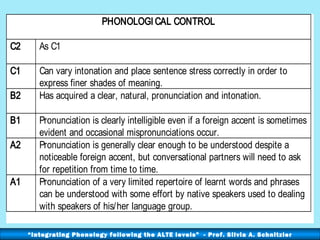
PHONOLOGI CAL CONTROL
C2

As C1

C1

Can vary intonation and place sentence stress correctly in order to
express finer shades of meaning.
Has acquired a clear, natural, pronunciation and intonation.

B2
B1
A2
A1

Pronunciation is clearly intelligible even if a foreign accent is sometimes
evident and occasional mispronunciations occur.
Pronunciation is generally clear enough to be understood despite a
noticeable foreign accent, but conversational partners will need to ask
for repetition from time to time.
Pronunciation of a very limited repertoire of learnt words and phrases
can be understood with some effort by native speakers used to dealing
with speakers of his/her language group.
“Integrating Phonology following the ALTE levels” - Prof. Silvia A. Schnitzler
Thank
you !!!
Contact me @:
silviasteach@yahoo.com
Facebook: Silvia Schnitzler Mondino
https://www.facebook.com/SilviaAlejandraSchnitzler

Twitter: Silstorm
www.silvias.com.ar

AlteLevels apizals2013-sschnitzler

  • 1.
    “11th Conference for Teachersof English” “Integrating Phonology following the ALTE levels” by Prof. Silvia A. Schnitzler
  • 2.
    “Teacher development isthe process of becoming the best teacher you can be. It means becoming a student of learning, your own as well as that of others” (Maley 2000). The aim of this workshop is to provide a ‘learning space’ from a person-centered learning approach. We will briefly analyze the Common European Framework of Reference for Languages and see how the phonological aspect can be integrated to the other areas of language teaching. “Integrating Phonology following the ALTE levels” - Prof. Silvia A. Schnitzler
  • 3.
    What is the CommonEuropean Framework? It provides a common basis for the elaboration of language syllabuses, curriculum guidelines, examinations, textbooks, etc. across Europe. Europe It describes in a comprehensive way what language learners have to learn to do in order to use a language for communication and what knowledge and skills they have to develop so as to be able to act effectively. The description also covers the cultural context in which language is set. The Framework also defines levels of proficiency which allow learners’ progress to be measured at each stage of learning and on a life-long basis. http://www.coe.int/t/dg4/linguistic/source/framework_en.pdf
  • 4.
    Association of Language Testersin Europe (ALTE) It is an association of providers of European foreign language examinations. Registered in 1992 as a European Economic Interest Group (EEIG), it provides a context for transnational collaboration between some of the major international providers in the field of language testing. http://www.alte.org/
  • 5.
    Provides standards for 24languages:             Basque,  Bulgarian,  Catalan,  Danish,  Dutch,  English,  Estonian,  Finnish,  French,  German,  Greek,  Hungarian,  Italian, Latvian, Lithuanian, Luxembourgish, Norwegian, Polish, Portuguese, Russian, Slovenian, Spanish, Swedish, Welsh.
  • 6.
    Objectives “… In thelight of these objectives, the Committee of Ministers stressed ‘the political importance at the present time and in the future of developing specific fields of action, such as strategies for diversifying and intensifying language learning in order to promote plurilingualism in a pan-European context’ and context drew attention to the value of further developing educational links and exchanges and of exploiting the full potential of new communication and information technologies.” p4 “Integrating Phonology following the ALTE levels” - Prof. Silvia A. Schnitzler
  • 7.
    What criteria mustCEF meet? COMPREHENSIVE • By ‘comprehensive’ is meant that the comprehensive C E F should attempt to specify as full a range of language knowledge, skills and use as possible, and that all users should be able to describe their objectives by reference to it. “Integrating Phonology following the ALTE levels” - Prof. Silvia A. Schnitzler
  • 8.
    What criteria mustCEF meet? TRANSPARENT • By ‘transparent’ is meant that transparent information must be clearly formulated and explicit, available and readily comprehensible to users. “Integrating Phonology following the ALTE levels” - Prof. Silvia A. Schnitzler
  • 9.
    What criteria mustCEF meet? COHERENT • By ‘coherent’ is meant that the coherent description is free from internal contradictions. With regard to educational systems, coherence requires that there is a harmonious relation among their components. “Integrating Phonology following the ALTE levels” - Prof. Silvia A. Schnitzler
  • 10.
    The ALTE levels ALTElevel Level 5 Level 4 Level 3 Level 2 Level 1 Breakthrough CEFR level C2 C1 B2 B1 A2 A1 ESOL exam CPE CAE FCE PET KET - IELTS exam 7.5+ 6.5 - 7 5-6 3.5 - 4.5 3 1-2 TOEIC 910+ 701 - 910 541 - 700 381 - 540 246 - 380 - TOEFL 276+ 236 - 275 176 - 235 126 - 175 96 - 125 - “Integrating Phonology following the ALTE levels” - Prof. Silvia A. Schnitzler
  • 11.
    General phonetic awarenessand skills Sts ability to pronounce new languages facilitated by: • an ability to distinguish and produce unfamiliar sounds and prosodic patterns; • an ability to perceive and catenate unfamiliar sound sequences; • an ability, as a listener, to resolve (i.e. divide into distinct and significant parts) a continuous stream of sound into a meaningful structured string of phonological elements; • an understanding/mastery of the processes of sound perception and production applicable to new language learning. (p 107)
  • 12.
    Phonological competence involves aknowledge of, and skill in the perception and production of: • the sound-units (phonemes) of the language and phonemes their realisation in particular contexts (allophones); allophones • the phonetic features which distinguish phonemes (distinctive features: voicing, rounding, nasality, plosion); • the phonetic composition of words (syllable structure, sequence of phonemes, word stress, word tones); • sentence phonetics (prosody): sentence stress and prosody rhythm; intonation; • phonetic reduction: vowel reduction; strong and weak forms; assimilation; elision. (p 116) “Integrating Phonology following the ALTE levels” - Prof. Silvia A. Schnitzler
  • 13.
    Ludic uses oflanguage p 55 Social & language games, puzzles, media games, verbal joking (punning) Aesthetic uses of language p 56  singing (nursery rhymes, folk songs, pop songs, etc.)  retelling and rewriting stories, etc.  listening to, reading, writing and speaking imaginative texts (stories, rhymes, etc.)  including audio-visual texts, cartoons, picture stories, etc.  performing scripted or unscripted plays, etc.  the production, reception and performance of literary texts, e.g.: reading and writing  texts (short stories, novels, poetry, etc.) and performing and watching/listening to  recitals, drama, opera, etc.
  • 14.
    The ALTE Framework TheALTE ‘Can Do’ statements constitute a central part of a long-term research programme set by ALTE, the aim of which is to establish a framework of ‘key levels’ of language performance, within which exams can be objectively described. Much work has already been done to place the exam systems of ALTE members within this framework, based on an analysis of exam content and task types, and candidate profiles. types profiles A comprehensive introduction to these exam systems is available in the ALTE Handbook of European Language Examinations and Examination Systems. “Integrating Phonology following the ALTE levels” - Prof. Silvia A. Schnitzler
  • 15.
    The ALTE ‘CanDos’ A checklist of what the L2 users can do  define the stage they’re at. • User-oriented • Basis for developing an activity-based curricula and teaching materials. • Means of carrying out an activity-based linguistic audit. • Means of comparing the objectives of courses and materials in different languages in the same context. • Multilingual - L2 relating to the real-world language skills. “Integrating Phonology following the ALTE levels” - Prof. Silvia A. Schnitzler
  • 16.
    LEVELS Listening/Speaking Reading Writing C2 Level 5 CAN adviseon or talk about complex or sensitive issues, understanding colloquial references and dealing confidently with hostile questions. CAN understand documents, correspondence and reports, including the finer points of complex texts. CAN write letters on any subject and full notes of meetings or seminars with good expression and accuracy. C1 Level 4 CAN contribute effectively to meetings and seminars within own area of work or keep up a casual conversation with a good degree of fluency, coping with abstract expressions. CAN read quickly enough to cope with an academic course, to read the media for information or to understand nonstandard correspondence. CAN prepare/draft professional correspondence, take reasonably accurate notes in meetings or write an essay which shows an ability to communicate. B2 Level 3 CAN follow or give a talk on a familiar topic or keep up a conversation on a fairly wide range of topics. CAN scan texts for relevant information, and understand detailed instructions or advice. CAN make notes while someone is talking or write a letter including non-standard requests. B1 Level 2 CAN express opinions on abstract/cultural matters in a limited way or offer advice within a known area, and understand instructions or public announcements. CAN understand routine information and CAN write letters or articles, and the general make notes on familiar meaning of non-routine or predictable matters. information within a familiar area. A2 Level 1 CAN understand straightforward information within a CAN express simple known area, such as on opinions or requirements products and signs and in a familiar context. simple textbooks or reports on familiar matters. CAN complete forms and write short simple letters or postcards related to personal information. A1 ALTE breakthrough level CAN understand basic instructions or take part in a basic factual conversation on a predictable topic. CAN complete basic forms, and write notes including times, dates and places. CAN understand basic notices, instructions or information.
  • 17.
    Organisation of the‘Can Do’ statements The ‘Can Do’ scales consist currently of about 400 statements, organised into three general areas: Social and Tourist, Work, and Study. Each includes a number of more particular areas, e.g. the Social and Tourist area has sections on Shopping, Eating out, Accommodation, etc. Each of these includes up to three scales, for the skills of Listening/Speaking (combine the scales relating to interaction), Reading and Writing. “Integrating Phonology following the ALTE levels” - Prof. Silvia A. Schnitzler
  • 19.
    PHONOLOGI CAL CONTROL C2 AsC1 C1 Can vary intonation and place sentence stress correctly in order to express finer shades of meaning. Has acquired a clear, natural, pronunciation and intonation. B2 B1 A2 A1 Pronunciation is clearly intelligible even if a foreign accent is sometimes evident and occasional mispronunciations occur. Pronunciation is generally clear enough to be understood despite a noticeable foreign accent, but conversational partners will need to ask for repetition from time to time. Pronunciation of a very limited repertoire of learnt words and phrases can be understood with some effort by native speakers used to dealing with speakers of his/her language group. “Integrating Phonology following the ALTE levels” - Prof. Silvia A. Schnitzler
  • 20.
    Thank you !!! Contact me@: silviasteach@yahoo.com Facebook: Silvia Schnitzler Mondino https://www.facebook.com/SilviaAlejandraSchnitzler Twitter: Silstorm www.silvias.com.ar