Spanish Alphabet
El abecedario
company name
El abecedario
company name
A = ah
B = bay
C = thay/ say
D = day
E = eh
F = F.A.
G = hay
H = atchay
I = ee
J = hota
K = kah
L = L.A.
M = M.A
N = N.A.
Ñ = enyay
O = oh
P = pay
Q = koo
R = airay
S = essay
T = tay
U = oo
V = ubay
V = ubay doblay
X = eh – kiss
Y = ee-gree-ay-gah
Z = thay-tah
Pronunciation
in English
company name
¿Cómo se escribe?
Tom = T. O. M.
Jack = J. A. C. K
Sophia = S. O. P. H. I. A
¿Cómo se escribe tu nombre?
company name
A E I O U
H G J K F
L C N Ñ Z
X S T W B
D M P Q R
company name
F
company name
A
company name
D
company name
Z
company name
Y
company name
M
company name
I
company name
K
company name
V
company name
E
company name
B
company name
J
company name
G
Spanish Pronunciation
La pronunciación
In Spanish you must pronounce
every single letter except ‘h’.
Once you have learnt the sounds of
Spanish you can pronounce ANY
Spanish word!
In mainland Spain the letter ‘v’ is
pronounced as a ‘b’, so the word holidays
‘vacaciones’ is said more like [bacaciones].
¿Puedes decir palabras con B y V?
Can you say words with B and V?
bajo - short (height)
bueno – good bien - well
vaca – cow vivo - I live
verde – green televisión - television
In Spanish, 'll' is pronounced like 'y' in
English. Although “ll” is not an official
letter in the Spanish alphabet, it is a very
commonly used in the Spanish language.
¿Puedes decir palabras con L y LL?
Can you say words with L and LL?
¡Hola! - Hello! color – Colour
luna – moon pelo – hair
ala – wing loro – parrot
collar – necklace ella - She
billete – ticket allá - over there
millón – million pollo - chicken
In Spanish the 'r' sound is rolled
when doubled 'rr', and if it's at
the beginning or end of a word.
¿Puedes decir palabras con R y RR?
Can you say words with R and RR?
rubio – blonde río – river
grande – big pera - pear
rojo – red árbol - tree
arroz – rice perro - dog
torre – tower arriba -above
The curly line or 'tilde' over an 'n' in
Spanish means it is pronounced 'ny', like
the first 'n' in 'onion'. So 'baño' (which
means toilet or bath) is pronounced
[banyo].
¿Puedes decir palabras con N y Ñ?
Can you say words with N and Ñ?
mano – hand
uno – one
mañana - morning/tomorrow
uña - nail
¡ ñam ñam! - yum yum!
The 'j' in Spanish is pronounced in the
back of the throat.
¿Puedes decir palabras con G y J?
Can you say words with G and J?
garaje – garage gato – cat
reloj - watch goma - rubber
mujer – woman guitarra – guitar
jamón – ham gorro - woolly hat
ojo – eye ángel - angel
Spanish can sound different in different
regions.For example, in northern Spain
people usually say 'z' like the English 'th' in
'think'. However, in most of Latin America
people say 'z' like the English 's’.
The letter ‘c’ is pronounced like the English
‘th’ too before the vowels e and i. It is
pronounced with a hard ‘c’ sound like English
before the vowels. a,o,u
¿Puedes decir palabras con C y Z?
Can you say words with C and Z?
casa – house color - color
cuatro – four catorce – fourteen
cinco – five quince – fifteen
taza – cup zumo - juice
H – this letter is never pronounced in
Spanish.
Eg: Hola Helena, ¿Has hablado con
Hector?
(Hello Helena, have you spoken to
Hector?)
¿Puedes decir palabras con H?
Can you say words with H?
hola – hello
hablo - I speak
hamburguesa – hamburger
huevo – egg
historia - history
I/Y – these letters sound like the ‘ee’ in
tree.
Eg: Sí, Madrid es divertido y bonito.
(Yes, Madrid is fun and beautiful.)
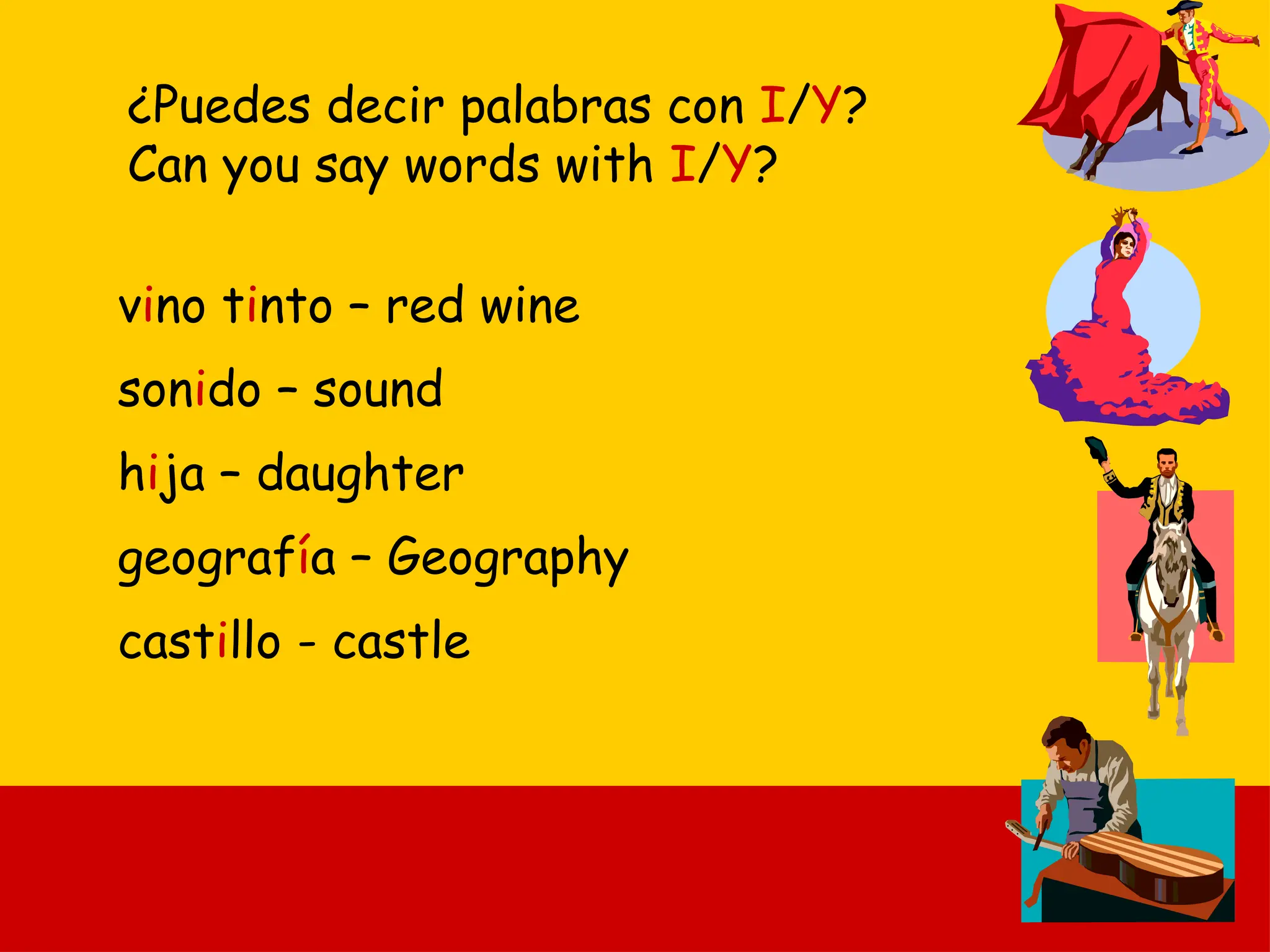
¿Puedes decir palabras con I/Y?
Can you say words with I/Y?
vino tinto – red wine
sonido – sound
hija – daughter
geografía – Geography
castillo - castle
Qu – this is pronounced like the English
letter ‘K’.
Eg: ¿Qué quieres?. Quiero queso por favor.
(What do you want? I want cheese please.)
¿Puedes decir palabras con Q?
Can you say words with Q?
¿Qué tal? - How are you?
¿Quién es? – Who is it?
¿Qué disastre! – What a disaster!
¡Qué asco! – How awful!
bloque – block
queso – cheese
quince – fifteen
¡A practicar!
A = ana
B = bien
C = casa / cielo
D = dedo
E = Eduardo
F = foto
G = gato / género
H = historia
I = Inés
J = julio
K = kilo
L = loco
M = mamá
N = no
Ñ = niño
O = ola
P = Pedro
Q = queso
R = Ramón
S = sol
T = tonto
U = huracán
V = vaca
W = Washington
X = México
Y = yate
Z = zanahoria
company name
¡A practicar!
vamos
jueves
años
pollo
playa
padres
hambre
falso
cerveza
vino
Accents/Stresses
Spanish uses accents or stressed letters
to help with the pronunciation of words.
There is only ONE type of accent and it
only goes in this direction (/)
Emphasize the syllable where you see the
accent.
Eg: María = Mary
las matemáticas = math
cómodo = comfortable
For words that don’t have visible accents
the following rule applies…
Stress the last syllable for words ending in
a consonant.
Eg: animal = animal
Stress the second last syllable for words
ending in a vowel.
Eg: libro = book
company name
¡A practicar!
A = ana
B = bien
C = casa
D = dedo
E = Eduardo
F = foto
G = gato / género
H = historia
I = Inés
J = julio
K = kilo
L = loco
M = mamá
N = no
Ñ = niño
O = ola
P = Pedro
Q = queso
R = Ramón
S = sol
T = tonto
U = huracán
V = vaca
W = Washington
X = México
Y = yo /
Z = zanahoria
Fin

Alphabet and pronunciation - Spanish Beginner

  • 1.
  • 2.
  • 3.
    company name A =ah B = bay C = thay/ say D = day E = eh F = F.A. G = hay H = atchay I = ee J = hota K = kah L = L.A. M = M.A N = N.A. Ñ = enyay O = oh P = pay Q = koo R = airay S = essay T = tay U = oo V = ubay V = ubay doblay X = eh – kiss Y = ee-gree-ay-gah Z = thay-tah Pronunciation in English
  • 4.
    company name ¿Cómo seescribe? Tom = T. O. M. Jack = J. A. C. K Sophia = S. O. P. H. I. A ¿Cómo se escribe tu nombre?
  • 5.
    company name A EI O U H G J K F L C N Ñ Z X S T W B D M P Q R
  • 6.
  • 7.
  • 8.
  • 9.
  • 10.
  • 11.
  • 12.
  • 13.
  • 14.
  • 15.
  • 16.
  • 17.
  • 18.
  • 19.
  • 20.
    In Spanish youmust pronounce every single letter except ‘h’. Once you have learnt the sounds of Spanish you can pronounce ANY Spanish word!
  • 21.
    In mainland Spainthe letter ‘v’ is pronounced as a ‘b’, so the word holidays ‘vacaciones’ is said more like [bacaciones].
  • 22.
    ¿Puedes decir palabrascon B y V? Can you say words with B and V? bajo - short (height) bueno – good bien - well vaca – cow vivo - I live verde – green televisión - television
  • 23.
    In Spanish, 'll'is pronounced like 'y' in English. Although “ll” is not an official letter in the Spanish alphabet, it is a very commonly used in the Spanish language.
  • 24.
    ¿Puedes decir palabrascon L y LL? Can you say words with L and LL? ¡Hola! - Hello! color – Colour luna – moon pelo – hair ala – wing loro – parrot collar – necklace ella - She billete – ticket allá - over there millón – million pollo - chicken
  • 25.
    In Spanish the'r' sound is rolled when doubled 'rr', and if it's at the beginning or end of a word.
  • 26.
    ¿Puedes decir palabrascon R y RR? Can you say words with R and RR? rubio – blonde río – river grande – big pera - pear rojo – red árbol - tree arroz – rice perro - dog torre – tower arriba -above
  • 27.
    The curly lineor 'tilde' over an 'n' in Spanish means it is pronounced 'ny', like the first 'n' in 'onion'. So 'baño' (which means toilet or bath) is pronounced [banyo].
  • 28.
    ¿Puedes decir palabrascon N y Ñ? Can you say words with N and Ñ? mano – hand uno – one mañana - morning/tomorrow uña - nail ¡ ñam ñam! - yum yum!
  • 29.
    The 'j' inSpanish is pronounced in the back of the throat.
  • 30.
    ¿Puedes decir palabrascon G y J? Can you say words with G and J? garaje – garage gato – cat reloj - watch goma - rubber mujer – woman guitarra – guitar jamón – ham gorro - woolly hat ojo – eye ángel - angel
  • 31.
    Spanish can sounddifferent in different regions.For example, in northern Spain people usually say 'z' like the English 'th' in 'think'. However, in most of Latin America people say 'z' like the English 's’. The letter ‘c’ is pronounced like the English ‘th’ too before the vowels e and i. It is pronounced with a hard ‘c’ sound like English before the vowels. a,o,u
  • 32.
    ¿Puedes decir palabrascon C y Z? Can you say words with C and Z? casa – house color - color cuatro – four catorce – fourteen cinco – five quince – fifteen taza – cup zumo - juice
  • 33.
    H – thisletter is never pronounced in Spanish. Eg: Hola Helena, ¿Has hablado con Hector? (Hello Helena, have you spoken to Hector?)
  • 34.
    ¿Puedes decir palabrascon H? Can you say words with H? hola – hello hablo - I speak hamburguesa – hamburger huevo – egg historia - history
  • 35.
    I/Y – theseletters sound like the ‘ee’ in tree. Eg: Sí, Madrid es divertido y bonito. (Yes, Madrid is fun and beautiful.)
  • 36.
    ¿Puedes decir palabrascon I/Y? Can you say words with I/Y? vino tinto – red wine sonido – sound hija – daughter geografía – Geography castillo - castle
  • 37.
    Qu – thisis pronounced like the English letter ‘K’. Eg: ¿Qué quieres?. Quiero queso por favor. (What do you want? I want cheese please.)
  • 38.
    ¿Puedes decir palabrascon Q? Can you say words with Q? ¿Qué tal? - How are you? ¿Quién es? – Who is it? ¿Qué disastre! – What a disaster! ¡Qué asco! – How awful! bloque – block queso – cheese quince – fifteen
  • 39.
    ¡A practicar! A =ana B = bien C = casa / cielo D = dedo E = Eduardo F = foto G = gato / género H = historia I = Inés J = julio K = kilo L = loco M = mamá N = no Ñ = niño O = ola P = Pedro Q = queso R = Ramón S = sol T = tonto U = huracán V = vaca W = Washington X = México Y = yate Z = zanahoria
  • 40.
  • 41.
  • 42.
    Spanish uses accentsor stressed letters to help with the pronunciation of words. There is only ONE type of accent and it only goes in this direction (/) Emphasize the syllable where you see the accent. Eg: María = Mary las matemáticas = math cómodo = comfortable
  • 43.
    For words thatdon’t have visible accents the following rule applies… Stress the last syllable for words ending in a consonant. Eg: animal = animal Stress the second last syllable for words ending in a vowel. Eg: libro = book
  • 44.
    company name ¡A practicar! A= ana B = bien C = casa D = dedo E = Eduardo F = foto G = gato / género H = historia I = Inés J = julio K = kilo L = loco M = mamá N = no Ñ = niño O = ola P = Pedro Q = queso R = Ramón S = sol T = tonto U = huracán V = vaca W = Washington X = México Y = yo / Z = zanahoria
  • 45.

Editor's Notes

  • #2 https://www.youtube.com/watch?v=qamVo3_wIps&ab_channel=TioSpanish%3Aaprenderespa%C3%B1olonline
  • #30 G: - pronunciation is soft before the vowels ”e” and “I” - ángel / gimnasio