James River Partnership VIII
FUNDING TRENDS
MAINTENANCE DREDGING SINCE LAST PARTNERSHIP
FY 04 SCHEDULED MAINTENANCE
ANNUAL CONTRACT STATUS
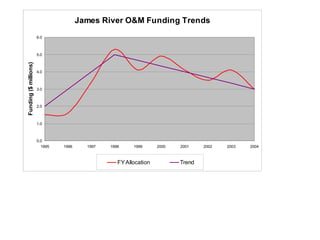
James River O&M Funding Trends
0.0
1.0
2.0
3.0
4.0
5.0
6.0
1995 1996 1997 1998 1999 2000 2001 2002 2003 2004
Funding($millions)
FYAllocation Trend
James River Federal Navigation Project
Environmental Coordination
Review of Permit Issues
Betty Grey Waring
Chief, Technical Support Section
Operations Branch
US Army Corps of Engineers
Norfolk District
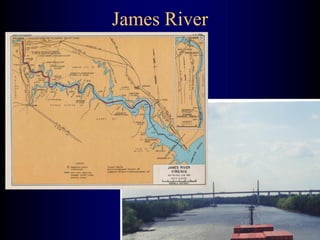
James River
The Corps of Engineers navigation
mission carries out one of the primary
needs and uses of the James River.
It is our job to keep the channel open and
navigable.
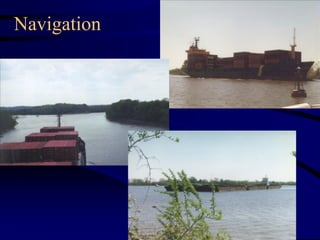
Navigation
In order to maintain the channel, the Corps
must obtain
» DEQ 401 Water Quality Certification
» VMRC permit
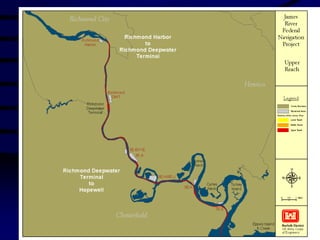
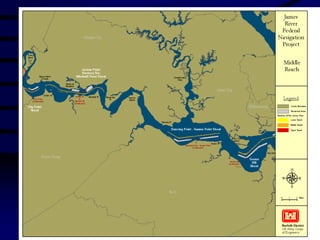
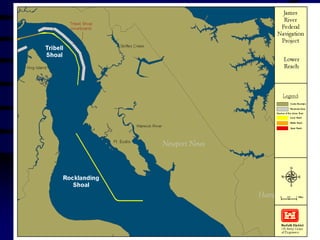
For permitting purposes, the 90 mile James
River navigation channel is separated into
three parts:
– Upper – Mile 90 to mile 70 (Richmond Harbor
to Hopewell)
– Middle – Mile 69 to mile 27 (Hopewell to Hog
Island)
– Lower – Mile 27 to mile 5 (Hog Island to the
river mouth)
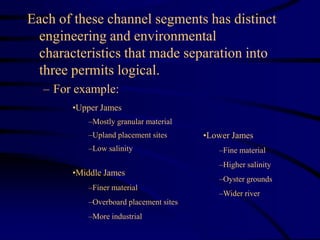
Each of these channel segments has distinct
engineering and environmental
characteristics that made separation into
three permits logical.
– For example:
•Middle James
–Finer material
–Overboard placement sites
–More industrial
•Lower James
–Fine material
–Higher salinity
–Oyster grounds
–Wider river
•Upper James
–Mostly granular material
–Upland placement sites
–Low salinity
The state permits must be renewed every 5
years (VMRC) or 10 years (DEQ).
In 2004, 3 permits will expire:
– Upper James – 401 Certificate
– Middle James – 401 Certificate & VMRC
permit
Conditions placed on previous permits
required to be completed before renewal.
– Middle James River Dredged Material
Placement Alternatives Study 2002
– Sediment Sampling/Testing City Point Channel
1999
– Before Dredging Benthic Surveys 1999-2000
– Richmond Harbor Core Sampling and Analysis
1993
Conditions continued:
– Richmond Deepwater Terminal Sediment Sampling
2002
– Sampling and Analysis Plan for Turkey Island Cut-off
and Richmond Deepwater Terminal 2003
– Navigation Project Evaluations & Sediment Fate
• City Point Channel
• Jordon Point-Harrison Bar-Windmill Point
• Goose Hill Channel
• Dancing Point-Swann Point
In addition, the Corps undertook the following
engineering and other studies in the James
River to learn more about the river
processes:
– Surface Tidal Current and Sediment Distribution-Turkey Island
Cut-off 1997
– Long-term Dredged Material Management Plan for the Upper
James River 1995
– Preliminary Analysis for Alternative Upland Dredged Material
Placement Sites at Turkey Island Cut-off 1998
– Anadromous Fish Study 2002
– Underwater Archeological Investigations 1995
We now have a good understanding of the
river and how it is affected by dredging and
placement of dredged material.
The results of some of these studies will be
discussed in more detail this afternoon.
Status of Permit Renewals:
– Middle James
• VMRC – On Commission Agenda January/February
• DEQ – Awaiting draft permit
– Upper James
• DEQ – Awaiting draft permit after completion of
current testing at Turkey Island and Richmond
Deepwater Terminal
Possible condition to test before every dredging
event
Where do we stand?
– The Corps has spent significant effort and funds
to study the James River to satisfy permit
conditions and for our own engineering
navigation needs.
– Renewing permits is becoming more and more
difficult
• greater time required
• more questions to answer
• more studies and sediment testing
As our partners, all of you need to know and
understand the costs associated with
meeting permit requirements, particularly in
these times of reduced funding
• sediment testing requires significant time
and effort and must follow strict protocols
• High cost for preparation, collection, and
chemical analysis
If we do not obtain permits, we cannot dredge
– Affects current navigation in river
– Uncertainty affects future plans to send
additional ships up the James
– Economic consequences for Commonwealth of
Virginia
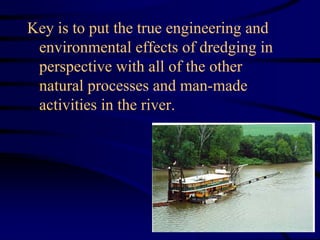
Key is to put the true engineering and
environmental effects of dredging in
perspective with all of the other
natural processes and man-made
activities in the river.
• Norfolk District, Corps of Engineers continues to
look for ways to maximize navigation, while
meeting state regulatory requirements.
• Good working relationships with agencies has
assured unrestricted navigation.
• Requirements are becoming more difficult while
funding is getting tighter.
• The Corps continues to take pride in balancing the
navigation needs of the James River with the true
environmental impacts of dredging.
Conclusions:
Thank You
US Army Corps of Engineers
Norfolk District
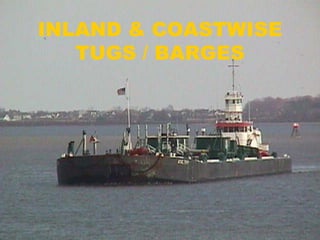
INLAND & COASTWISE
TUGS / BARGES
THE JAMES RIVER
&
WHAT IT MEANS TO
ALLIED
KEY CONTRACT WITH MAJOR PLANT
SCHEDULE IS CRITICAL
RESTRICTIONS = DELAYS
SOME BARGES ARE DRAFT SENSTIVE
KEEPING BUSINESS
GOING
ADEQUATE NAVIGATION CHANNEL
PROPER AIDS TO NAVIGATION
CUSTOMER VIABILITY
AVOID IMPEDIMENTS TO
COMMERCE
ENVIRONMENTALLY SOUND
OPERATIONS
THE TOWING INDUSTRY
PROVIDES TANGIBLE BENEFITS
SAFETY & ENVIRONMENTAL
PROTECTION
EFFICIENCY OF OPERATIONS
TAKES TRUCKS OFF THE ROADS
PROVIDES EMPLOYMENT
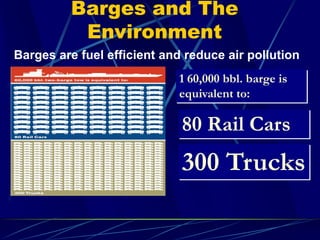
Barges and The
Environment
1 60,000 bbl. barge is
equivalent to:
300 Trucks
80 Rail Cars
Barges are fuel efficient and reduce air pollution
Barges and The Environment
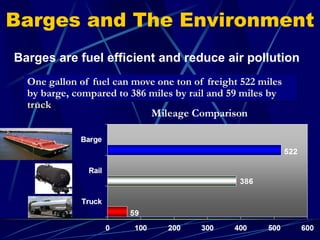
One gallon of fuel can move one ton of freight 522 miles
by barge, compared to 386 miles by rail and 59 miles by
truck
Barges are fuel efficient and reduce air pollution
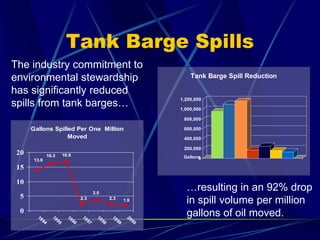
Tank Barge Spills
0
200,000
400,000
600,000
800,000
1,000,000
1,200,000
Gallons
Tank Barge Spill Reduction
Gallons Spilled Per One Million
Moved
1.92.3
3.5
2.3
16.916.3
13.9
0
5
10
15
20
1994
1995
1996
1997
1998
1999
2000
…resulting in an 92% drop
in spill volume per million
gallons of oil moved.
The industry commitment to
environmental stewardship
has significantly reduced
spills from tank barges…
AWO Responsible
Carrier Program
A comprehensive safety
and environmental code
of practice for the towing
industry
Ever since 2000 all AWO members have
been required to undergo an audit to ensure
compliance.
What Is The
Responsible Carrier
Program?
• Developed By AWO For Barge And
Towing Companies
• A Safety Code Of Practice That
Encompasses Every Aspect Of Fleet
Operations
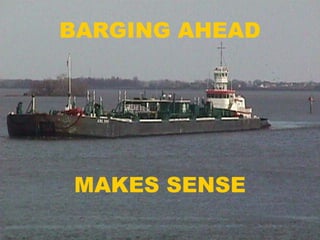
BARGING AHEAD
MAKES SENSE
Tiered Evaluations for
Dredged Material
James River Partnership Meeting
December 03, 2003
by
Norman R. Francingues
OA Systems Corporation
Regulatory Considerations
• Dredged material is regulated as a CWA
Section 404 discharge to waters of the US
• State Issues a Section 401 Water Quality
Certification
• NEPA requires consideration for all
pathways of concern
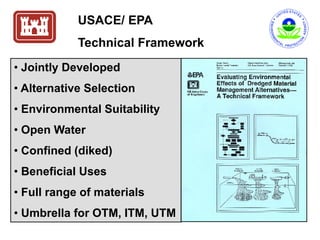
USACE/ EPA
Technical Framework
• Jointly Developed
• Alternative Selection
• Environmental Suitability
• Open Water
• Confined (diked)
• Beneficial Uses
• Full range of materials
• Umbrella for OTM, ITM, UTM
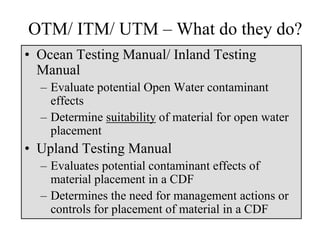
OTM/ ITM/ UTM – What do they do?
• Ocean Testing Manual/ Inland Testing
Manual
– Evaluate potential Open Water contaminant
effects
– Determine suitability of material for open water
placement
• Upland Testing Manual
– Evaluates potential contaminant effects of
material placement in a CDF
– Determines the need for management actions or
controls for placement of material in a CDF
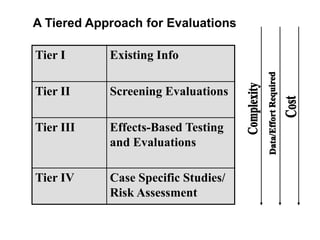
Tier I Existing Info
Tier II Screening Evaluations
Tier III Effects-Based Testing
and Evaluations
Tier IV Case Specific Studies/
Risk Assessment
A Tiered Approach for Evaluations
http://www.wes.army.mil/el/dots/pdfs/
trel03-1.pdf
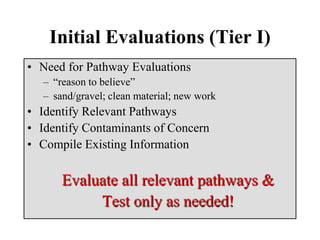
Initial Evaluations (Tier I)
• Need for Pathway Evaluations
– “reason to believe”
– sand/gravel; clean material; new work
• Identify Relevant Pathways
• Identify Contaminants of Concern
• Compile Existing Information
Evaluate all relevant pathways &
Test only as needed!
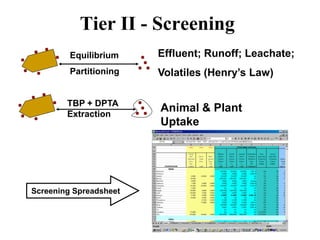
Equilibrium
Partitioning
TBP + DPTA
Extraction
Effluent; Runoff; Leachate;
Volatiles (Henry’s Law)
Animal & Plant
Uptake
Tier II - Screening
Screening Spreadsheet
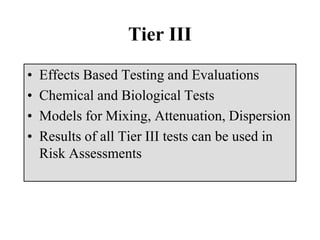
Tier III
• Effects Based Testing and Evaluations
• Chemical and Biological Tests
• Models for Mixing, Attenuation, Dispersion
• Results of all Tier III tests can be used in
Risk Assessments
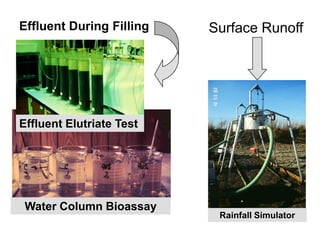
Effluent During Filling
Effluent Elutriate Test
Water Column Bioassay
Surface Runoff
Rainfall Simulator
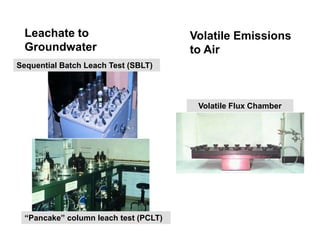
“Pancake” column leach test (PCLT)
Leachate to
Groundwater
Sequential Batch Leach Test (SBLT)
Volatile Flux Chamber
Volatile Emissions
to Air
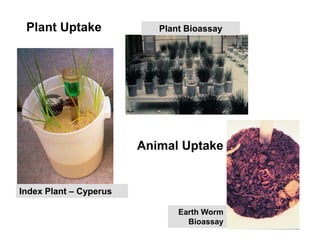
Plant Uptake Plant Bioassay
Index Plant – Cyperus
Animal Uptake
Earth Worm
Bioassay
Guidance Documents
• DOTS Website
– http://www.wes.army.mil/el/dots
• USACE/EPA Technical Framework
– http://www.epa.gov/OWOW/oceans/framework/
• Upland Testing Manual
– http://www.wes.army.mil/el/dots/pdfs/trel03-1.pdf
Take Home Message
• Over 30 years and $150 Million in background and
technical data bases
• Joint EPA and Corps developed protocols and
evaluation guidelines
• OTM/ITM/UTM provide a tiered approach for
evaluations
• Contaminant pathways must be appropriately
evaluated
• Testing/ evaluation procedures are available for all
pathways
• Evaluate all relevant pathways and test only as needed
Norman R. Francingues
1Honeywell Confidential and Proprietary
James River Partnership
Williamsburg, Va.
Honeywell Overview
2Honeywell Confidential and Proprietary
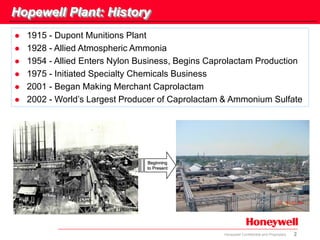
Hopewell Plant: History
 1915 - Dupont Munitions Plant
 1928 - Allied Atmospheric Ammonia
 1954 - Allied Enters Nylon Business, Begins Caprolactam Production
 1975 - Initiated Specialty Chemicals Business
 2001 - Began Making Merchant Caprolactam
 2002 - World’s Largest Producer of Caprolactam & Ammonium Sulfate
Beginning
to Present
3Honeywell Confidential and Proprietary
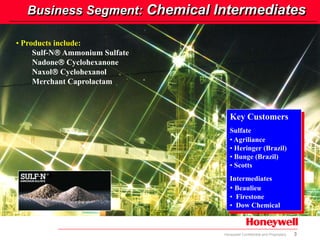
Business Segment: Chemical Intermediates
• Products include:
Sulf-N Ammonium Sulfate
Nadone Cyclohexanone
Naxol Cyclohexanol
Merchant Caprolactam
Key Customers
Sulfate
• Agriliance
• Heringer (Brazil)
• Bunge (Brazil)
• Scotts
Intermediates
• Beaulieu
• Firestone
• Dow Chemical
4Honeywell Confidential and Proprietary
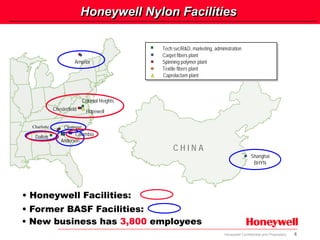
Shanghai
BHYN
Tech svc/R&D, marketing, administration
Carpet fibers plant
Spinning polymer plant
Textile fibers plant
Caprolactam plant
Tech svc/R&D, marketing, administration
Carpet fibers plant
Spinning polymer plant
Textile fibers plant
Caprolactam plant
Anderson
Clemson
Arnprior
C H I N A
HopewellChesterfield
Columbia
Dalton
Colonial Heights
• Honeywell Facilities:
• Former BASF Facilities:
• New business has 3,800 employees
Charlotte
Honeywell Nylon Facilities
5Honeywell Confidential and Proprietary
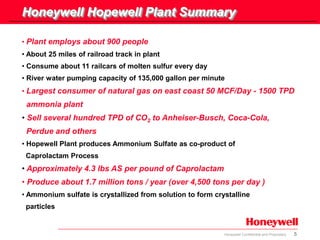
• Plant employs about 900 people
• About 25 miles of railroad track in plant
• Consume about 11 railcars of molten sulfur every day
• River water pumping capacity of 135,000 gallon per minute
• Largest consumer of natural gas on east coast 50 MCF/Day - 1500 TPD
ammonia plant
• Sell several hundred TPD of CO2 to Anheiser-Busch, Coca-Cola,
Perdue and others
• Hopewell Plant produces Ammonium Sulfate as co-product of
Caprolactam Process
• Approximately 4.3 lbs AS per pound of Caprolactam
• Produce about 1.7 million tons / year (over 4,500 tons per day )
• Ammonium sulfate is crystallized from solution to form crystalline
particles
Honeywell Hopewell Plant Summary
6Honeywell Confidential and Proprietary
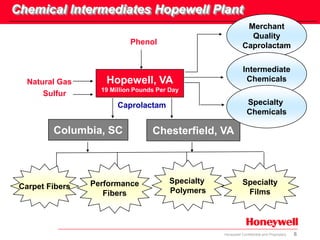
Merchant
Quality
CaprolactamPhenol
Hopewell, VA
19 Million Pounds Per Day
Natural Gas
Sulfur
Caprolactam
Columbia, SC Chesterfield, VA
Carpet Fibers Performance
Fibers
Specialty
Polymers
Specialty
Films
Intermediate
Chemicals
Specialty
Chemicals
Chemical Intermediates Hopewell Plant
7Honeywell Confidential and Proprietary
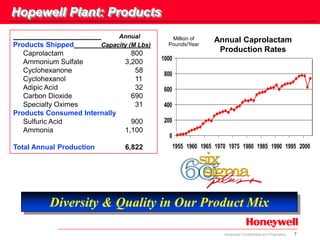
Hopewell Plant: Products
Annual Caprolactam
Production Rates
0
200
400
600
800
1000
1955 1960 1965 1970 1975 1980 1985 1990 1995 2000
Million of
Pounds/Year
Annual
Products Shipped Capacity (M Lbs)
Caprolactam 800
Ammonium Sulfate 3,200
Cyclohexanone 58
Cyclohexanol 11
Adipic Acid 32
Carbon Dioxide 690
Specialty Oximes 31
Products Consumed Internally
Sulfuric Acid 900
Ammonia 1,100
Total Annual Production 6,822
Diversity & Quality in Our Product Mix
8Honeywell Confidential and Proprietary
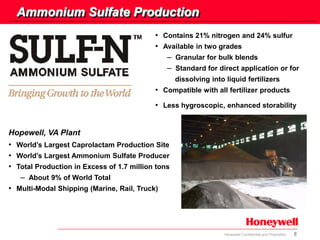
Ammonium Sulfate Production
• Contains 21% nitrogen and 24% sulfur
• Available in two grades
– Granular for bulk blends
– Standard for direct application or for
dissolving into liquid fertilizers
• Compatible with all fertilizer products
• Less hygroscopic, enhanced storability
• World’s Largest Caprolactam Production Site
• World’s Largest Ammonium Sulfate Producer
• Total Production in Excess of 1.7 million tons
– About 9% of World Total
• Multi-Modal Shipping (Marine, Rail, Truck)
Hopewell, VA Plant
9Honeywell Confidential and Proprietary
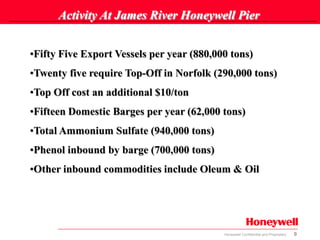
Activity At James River Honeywell Pier
•Fifty Five Export Vessels per year (880,000 tons)
•Twenty five require Top-Off in Norfolk (290,000 tons)
•Top Off cost an additional $10/ton
•Fifteen Domestic Barges per year (62,000 tons)
•Total Ammonium Sulfate (940,000 tons)
•Phenol inbound by barge (700,000 tons)
•Other inbound commodities include Oleum & Oil
10Honeywell Confidential and Proprietary
Environmental Performance
11Honeywell Confidential and Proprietary
1988 1989 1990 1991 1992 1993 1994 1995 1996 1997 1998 1999 2000 2001 2002
Tons/Year
To Hopewell
Treatment Plant
To James River
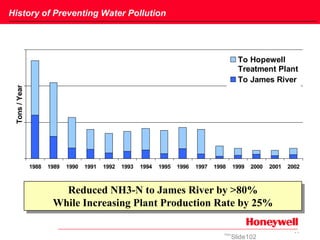
History of Preventing Water Pollution
Reduced NH3-N to James River by >80%
While Increasing Plant Production Rate by 25%
Slide102Slide102
12Honeywell Confidential and Proprietary
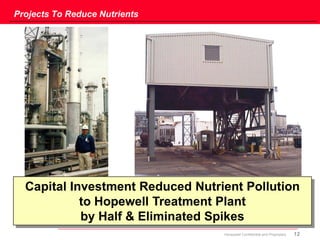
Projects To Reduce Nutrients
Capital Investment Reduced Nutrient Pollution
to Hopewell Treatment Plant
by Half & Eliminated Spikes
13Honeywell Confidential and Proprietary
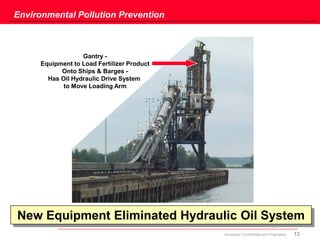
Environmental Pollution Prevention
Gantry -
Equipment to Load Fertilizer Product
Onto Ships & Barges -
Has Oil Hydraulic Drive System
to Move Loading Arm
New Equipment Eliminated Hydraulic Oil System
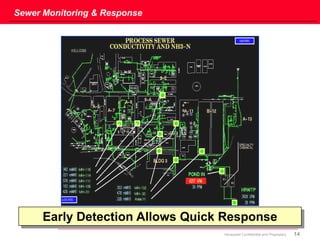
14Honeywell Confidential and Proprietary
Sewer Monitoring & Response
Early Detection Allows Quick Response
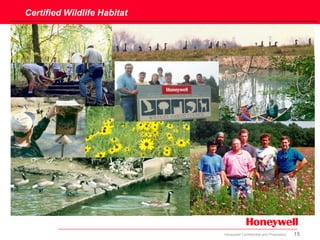
15Honeywell Confidential and Proprietary
Certified Wildlife Habitat
16Honeywell Confidential and Proprietary
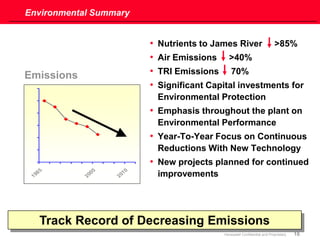
Environmental Summary
• Nutrients to James River >85%
• Air Emissions >40%
• TRI Emissions 70%
• Significant Capital investments for
Environmental Protection
• Emphasis throughout the plant on
Environmental Performance
• Year-To-Year Focus on Continuous
Reductions With New Technology
• New projects planned for continued
improvements
1985
2000
2010
Emissions
Track Record of Decreasing Emissions
17Honeywell Confidential and Proprietary
Availability of Ships
18Honeywell Confidential and Proprietary
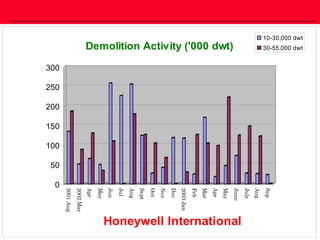
0
50
100
150
200
250
300 2001Aug
2002Mar
Apr
May
Jun
Jul
Aug
Sept
Oct
Nov
Dec
2003Jan
Feb
Mar
Apr
May
June
July
Aug
Sep
Honeywell International
Demolition Activity ('000 dwt)
10-30,000 dwt
30-55,000 dwt
19Honeywell Confidential and Proprietary
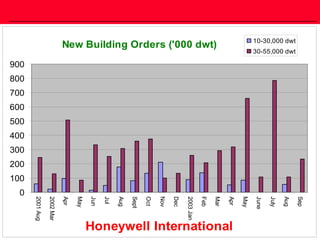
New Building Orders ('000 dwt)
0
100
200
300
400
500
600
700
800
900
2001Aug
2002Mar
Apr
May
Jun
Jul
Aug
Sept
Oct
Nov
Dec
2003Jan
Feb
Mar
Apr
May
June
July
Aug
Sep
Honeywell International
10-30,000 dwt
30-55,000 dwt
20Honeywell Confidential and Proprietary
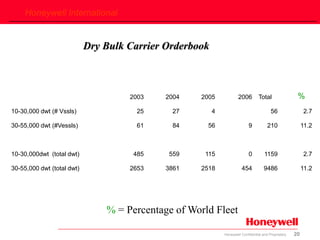
Honeywell International
11.2948645425183861265330-55,000 dwt (total dwt)
2.71159011555948510-30,000dwt (total dwt)
11.2210956846130-55,000 dwt (#Vessls)
2.7564272510-30,000 dwt (# Vssls)
%Total2006200520042003
% = Percentage of World Fleet
Dry Bulk Carrier Orderbook
21Honeywell Confidential and Proprietary
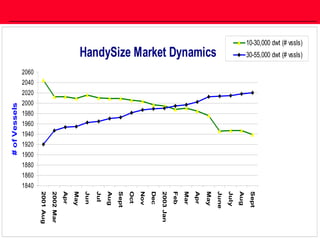
HandySize Market Dynamics
1840
1860
1880
1900
1920
1940
1960
1980
2000
2020
2040
2060
2001Aug
2002Mar
Apr
May
Jun
Jul
Aug
Sept
Oct
Nov
Dec
2003Jan
Feb
Mar
Apr
May
June
July
Aug
Sept
#ofVessels
10-30,000 dwt (# vssls)
30-55,000 dwt (# vssls)
22Honeywell Confidential and Proprietary
Honeywell Wish List
•Maintain the James River at current conditions
•Deepen and widen river for larger vessels
•Identify an upriver anchorage
23Honeywell Confidential and Proprietary
What Makes A Successful Partnership
• Understanding of what makes each partner successful
• Creating win-win scenarios
• Trust
• Execution on commitments… do what you say you’re going
to do
We Believe in Building Successful Partnerships
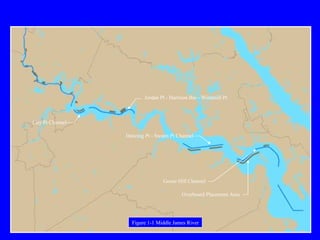
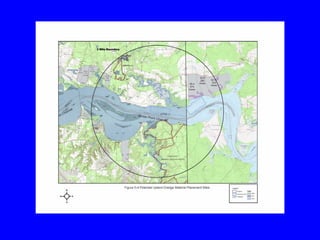
Figure 1-1 Middle James River
Jordan Pt - Harrison Bar - Windmill Pt
Dancing Pt - Swann Pt Channel
City Pt Channel
Goose Hill Channel
Overboard Placement Area
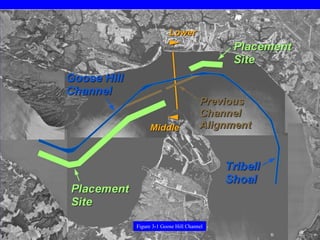
Figure 3-1 Goose Hill Channel
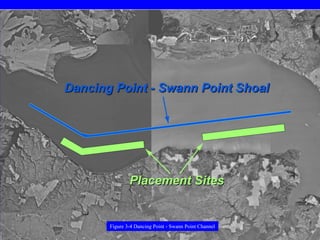
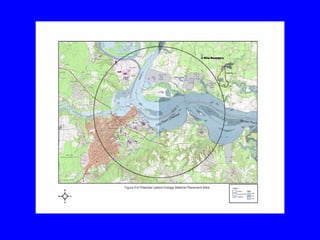
Figure 3-4 Dancing Point - Swann Point Channel
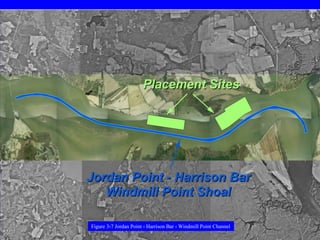
Figure 3-7 Jordan Point - Harrison Bar - Windmill Point Channel
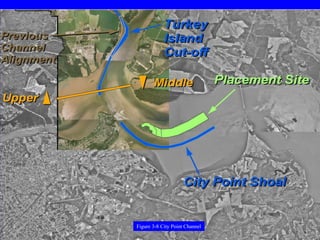
Figure 3-8 City Point Channel
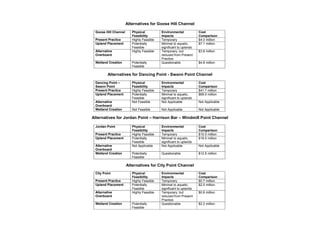
Alternatives for Goose Hill Channel
Goose Hill Channel Physical
Feasibility
Environmental
Impacts
Cost
Comparison
Present Practice Highly Feasible Temporary $4.0 million
Upland Placement Potentially
Feasible
Minimal to aquatic,
significant to uplands
$7.1 million
Alternative
Overboard
Highly Feasible Temporary, but
reduced from Present
Practice
$3.8 million
Wetland Creation Potentially
Feasible
Questionable $4.8 million
Alternatives for Dancing Point - Swann Point Channel
Dancing Point –
Swann Point
Physical
Feasibility
Environmental
Impacts
Cost
Comparison
Present Practice Highly Feasible Temporary $41.1 million
Upland Placement Potentially
Feasible
Minimal to aquatic,
significant to uplands
$69.0 million
Alternative
Overboard
Not Feasible Not Applicable Not Applicable
Wetland Creation Not Feasible Not Applicable Not Applicable
Alternatives for Jordan Point – Harrison Bar – Windmill Point Channel
Jordan Point Physical
Feasibility
Environmental
Impacts
Cost
Comparison
Present Practice Highly Feasible Temporary $10.0 million
Upland Placement Potentially
Feasible
Minimal to aquatic,
significant to uplands
$19.5 million
Alternative
Overboard
Not Applicable Not Applicable Not Applicable
Wetland Creation Potentially
Feasible
Questionable $12.5 million
Alternatives for City Point Channel
City Point Physical
Feasibility
Environmental
Impacts
Cost
Comparison
Present Practice Highly Feasible Temporary $0.7 million
Upland Placement Potentially
Feasible
Minimal to aquatic,
significant to uplands
$2.0 million
Alternative
Overboard
Highly Feasible Temporary, but
reduced from Present
Practice
$0.6 million
Wetland Creation Potentially
Feasible
Questionable $2.2 million
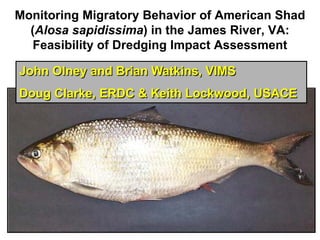
Monitoring Migratory Behavior of American Shad
(Alosa sapidissima) in the James River, VA:
Feasibility of Dredging Impact Assessment
John Olney and Brian Watkins, VIMS
Doug Clarke, ERDC & Keith Lockwood, USACE
Summary Report for
Anadromous Fish Studies in
Goose Hill Channel and
Turkey Island Cutoff on the
James River
April 17, 2002
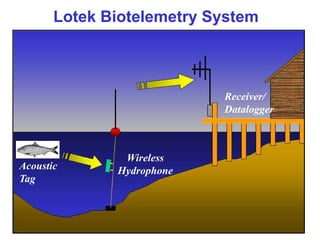
Lotek Biotelemetry System
Acoustic
Tag
Wireless
Hydrophone
Receiver/
Datalogger
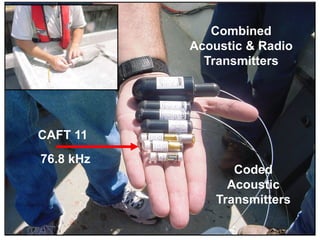
Coded
Acoustic
Transmitters
Combined
Acoustic & Radio
Transmitters
CAFT 11
76.8 kHz
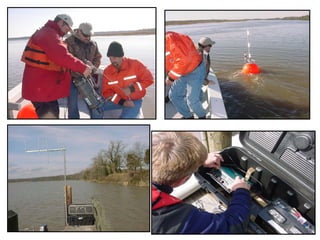
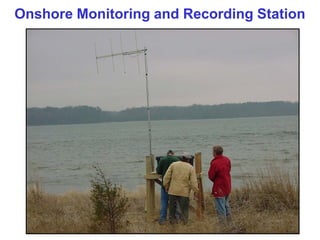
Onshore Monitoring and Recording Station
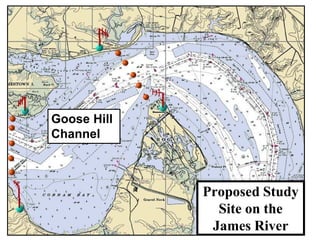
Proposed Study
Site on the
James River
Goose Hill
Channel
Study Objectives
• Evaluate effectiveness of catching
and tracking American Shad in the
James River.
• Refine methods for future tracking
of shad when dredge is operating in
the channel.
Primary Goal
• Establish if shad are affected by
dredging operations.
–If not, can restrictions be reduced to
allow more time to dredge in the
spring to better manage navigation
requirements?
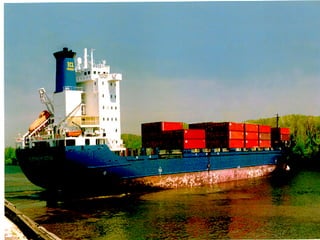
•Ship calls (-51%) and commodity types (-100% change in
forest product traffic which now goes to Hampton Roads)
have changed substantially since 1999
Richmond Deepwater Terminal Turning Basin Expansion
•2001 – Disposal Area Issue Raised, Numerous Sites Evaluated
•2003 – Disposal Area Issue Resolved
Dredged Material Testing In The James
River
Contact:
Robert Pruhs
Technical Support Section
Operations Branch
US Army Corps of Engineers
Norfolk District
Why Test Dredged Material?
• Section 401 CWA, Water Quality
Certification (WQC)
– WQC required for the discharge of dredged
material into waters of the U.S.
– Discharge must be certified as complying with
applicable State Water Quality Standards
(WQS)
Why Test Dredged Material? (Cont’d)
• Currently, Corps is renewing the Upper
James River Virginia Water Protection
Permit (WQC) through DEQ for
maintenance dredging activities (mile
marker 90 to mile marker 70)
– DEQ has raised concerns that dredged material
may contain contaminants
– Specifically TBT, PCB, PAH, and Metals
Where Will Dredged Material Testing
Occur?
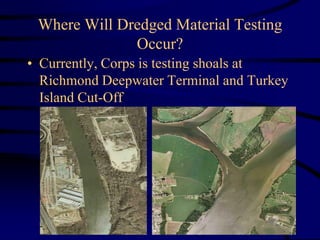
• Currently, Corps is testing shoals at
Richmond Deepwater Terminal and Turkey
Island Cut-Off
Where Will Dredged Material Testing
Occur?
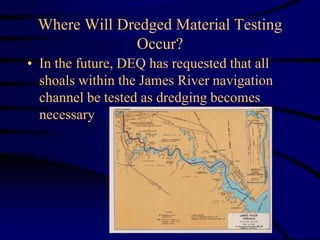
• In the future, DEQ has requested that all
shoals within the James River navigation
channel be tested as dredging becomes
necessary
How is Dredged Material Evaluation to
be Performed?
• Goal
– Utilize the tiered approach and perform only
the amount of testing necessary to make factual
determinations
– Implement the “Reason to Believe” principle
for future sampling/testing events to ensure
good stewardship of taxpayers dollars
How is Dredged Material Testing to be
Performed?
• Corps has conducted a Tier I evaluation
– Determined that additional information was needed
• Tier II & III: The Corps has developed a Sampling
& Analysis Plan (SAP) utilizing the tiered
approach developed under the framework
established by the EPA & USACE manual
“Evaluation of Dredged Material For Discharge in
Waters of the U.S. – Testing Manual”
How is Dredged Material Testing to be
Performed?
• Tier II: Involve determination of sediment
and water chemistry
• Tier III: Effluent elutriate test will predict if
effluent water from the respective upland
placement sites act as a pathway for the
migration of contaminants
How is Dredged Material Testing to be
Performed?
• Tier III: Effluent elutriate test mimics the
dredged material placement process in
upland placement sites and predicts the
release of contaminants (if present) as a
result of placement operations
• Effluent elutriate test is a conservative
evaluation of impacts to the water column
What are the Benefits of Dredged
Material Testing?
• Tier III evaluation for the current testing event at
Richmond Deepwater Terminal and Turkey Island
Cut-Off can be used to predict performance of
potential contaminants in similar upland
placement sites along the James River
• Conducting dredged material testing in accordance
with the EPA and USACE guidance will validate
dredged material testing protocols
What are the Costs of Dredged Material
Testing?
• Cost of dredged material testing at
Richmond Deepwater Terminal and Turkey
Island Cut-Off
– $65,000 for sample collection and analysis
• What are the costs for testing dredged
material at every shoal along the entire
navigable James River?
What are the Potential Impacts to
Navigation?
• Withholding of Water Quality Certification
– Result: No dredging, restricted navigation
• Increased testing costs to meet
environmental regulatory requirements
– Result: Limited annual funding for James
River Navigation Project may impact ability to
maintain navigation
What are the Potential Impacts to
Navigation?
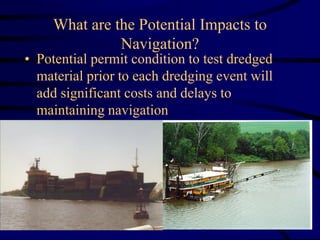
• Potential permit condition to test dredged
material prior to each dredging event will
add significant costs and delays to
maintaining navigation
Questions?
Maritime Security in
Hampton Roads
Presented by
LCDR Steve Midas
Chief, Planning & Risk
Management Department
Presentation Agenda
• Impact of Maritime Transportation Security Act
(MTSA) Regulations
• Virginia Area Maritime Security (AMS) Committee
– Responsibilities
– Members
– Charter
– Efforts
• Current maritime security measures in place
MTSA Regulations
• MTSA Regulations Final Rule released on October 22,
2003
• Requirements include:
– Designation of Facility Security Officers and submission of
Facility Security Plans for each applicable facility
– Designation of Vessel Security Officers and submission of
Vessel Security Plans for all applicable vessels
– Formation of AMS Committee for each COTP zone
– Development of AMS Plan for each COTP zone
Virginia AMS Committee
Responsibilities
• Provide advice and assistance to the Federal Maritime
Security Coordinator (FMSC) in the development of
the AMS Plan
• Develop and coordinate a comprehensive area strategy
to minimize and/or respond to the threat of a
Transportation Security Incident (TSI)
• Complete an AMS Assessment and update as necessary
Virginia AMS Committee
Membership
• Executive Committee responsible for oversight and
management of all AMSC efforts
• Members must have at least 5 years of maritime or port
security operations experience
• Minimum of 7 members
• Subcommittees may be formed to address short-term or
long-term projects
• Subcommittees may include non-AMSC members to
obtain advice/technical expertise as necessary
Virginia AMS Committee
Charter
• Virginia AMS Committee Charter signed October 23,
2003
• Formalizes relationship and responsibilities of AMSC
• Executive Committee membership includes:
- USCG COTP (Chair) - Norfolk FBI (Co-Chair)
- USCG Group HR - U.S. Asst. Attorney
- NAVSTA Norfolk - Office of the Governor
- Navy Mid-Atlantic Region - HRMA
- BICE - Virginia Port Authority
- BCBP - Port of Richmond
Virginia AMS Committee
Efforts
• Development of Law Enforcement Subcommittee
– Completed numerous training events between USCG,
federal and local law enforcement personnel
• Creation of AMS Assessment Subcommittee
• Making relationships more formal between AMSC and
existing committees/groups in Hampton Roads region
• Completion of AMS Plan in progress
(due to USCG D5 by April 1, 2004)
Maritime Security Measures
in Hampton Roads
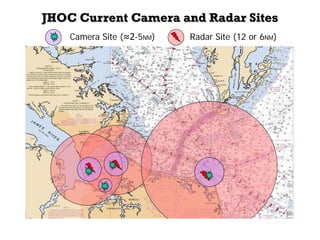
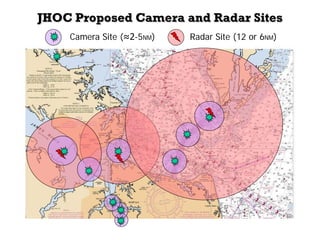
• Joint Harbor Operations Center (JHOC)
• Regulated Navigation Area (RNA)
• Joint Law Enforcement training
• USN Patrol Craft (PC-170’s)
• Virginia AMSC
• USCG overflights
• Daily, random waterside patrols
• Exercise coordination
JHOC Current Camera and Radar Sites
Camera Site (≈2-5NM) Radar Site (12 or 6NM)
JHOC Proposed Camera and Radar Sites
Camera Site (≈2-5NM) Radar Site (12 or 6NM)
Hampton Roads FMSC
Top Concerns
• Expanding AMS efforts to incorporate all of AOR
• Identifying/Developing communications process to
support MTSA requirements (i.e. facilities, vessels,
LE/response personnel, etc.)
• Continued coordination with the many stakeholders
• Completion of Area Maritime Security Plan
Area Maritime Security Plan
Communications
• Identify methods to communicate with Facility
Security Officers, Company Security Officers,
Vessel Security Officers, public safety officers,
emergency response personnel and crisis
management organization representatives within
the port, including 24 hour contact details.
Area Maritime Security Plan
Threat Response
• Procedures…for responding to security threats or
breaches of security, including provisions for
maintaining infrastructure and operations in the port;
• Procedures for reporting transportation security
incidents
• Procedures for communicating appropriate security and
threat information to the public
• Procedures for handling reports from public and
maritime industry regarding suspicious activity
Area Maritime Security Plan
TSI Response & Recovery
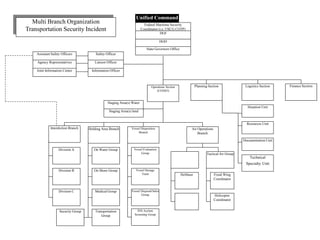
• Details of the security incident command and response
structure;
• Procedures for evacuation within the port in case of
security threats or breaches of security;
• Security resources available for incident response and
their capabilities;
• Procedures for responding to a TSI;
• Procedures to facilitate the recovery of marine
transportation system
Unified Command
Federal Maritime Security
Coordinator (i.e. USCG COTP)
Safety Officer
DOJ
DOD
State Governors Office
Liaison Officer
Information Officer
Assistant Safety Officers
Agency Representatives
Joint Information Center
Operations Section
(CGD(O)
Planning Section Finance Section
Staging Area(s) Water
Interdiction Branch Holding Area Branch Vessel Disposition
Branch
Air Operations
Branch
Logistics Section
Division A
Division B
Division C
Security Group
On Water Group
On Shore Group
Medical Group
Transportation
Group
Vessel Evaluation
Group
Vessel Storage
Team
Vessel Disposal/Sales
Group
INS Asylum
Screening Group
Tactical Air Group
Helibase Fixed Wing
Coordinator
Helicopter
Coordinator
Multi Branch Organization
Transportation Security Incident
Staging Area(s) land
Technical
Specialty Unit
Situation Unit
Resources Unit
Documentation Unit

James riverpartnership2003

  • 1.
    James River PartnershipVIII FUNDING TRENDS MAINTENANCE DREDGING SINCE LAST PARTNERSHIP FY 04 SCHEDULED MAINTENANCE ANNUAL CONTRACT STATUS
  • 2.
    James River O&MFunding Trends 0.0 1.0 2.0 3.0 4.0 5.0 6.0 1995 1996 1997 1998 1999 2000 2001 2002 2003 2004 Funding($millions) FYAllocation Trend
  • 5.
    James River FederalNavigation Project Environmental Coordination Review of Permit Issues Betty Grey Waring Chief, Technical Support Section Operations Branch US Army Corps of Engineers Norfolk District
  • 6.
  • 7.
    The Corps ofEngineers navigation mission carries out one of the primary needs and uses of the James River. It is our job to keep the channel open and navigable.
  • 8.
  • 9.
    In order tomaintain the channel, the Corps must obtain » DEQ 401 Water Quality Certification » VMRC permit
  • 10.
    For permitting purposes,the 90 mile James River navigation channel is separated into three parts: – Upper – Mile 90 to mile 70 (Richmond Harbor to Hopewell) – Middle – Mile 69 to mile 27 (Hopewell to Hog Island) – Lower – Mile 27 to mile 5 (Hog Island to the river mouth)
  • 14.
    Each of thesechannel segments has distinct engineering and environmental characteristics that made separation into three permits logical. – For example: •Middle James –Finer material –Overboard placement sites –More industrial •Lower James –Fine material –Higher salinity –Oyster grounds –Wider river •Upper James –Mostly granular material –Upland placement sites –Low salinity
  • 15.
    The state permitsmust be renewed every 5 years (VMRC) or 10 years (DEQ). In 2004, 3 permits will expire: – Upper James – 401 Certificate – Middle James – 401 Certificate & VMRC permit
  • 16.
    Conditions placed onprevious permits required to be completed before renewal. – Middle James River Dredged Material Placement Alternatives Study 2002 – Sediment Sampling/Testing City Point Channel 1999 – Before Dredging Benthic Surveys 1999-2000 – Richmond Harbor Core Sampling and Analysis 1993
  • 17.
    Conditions continued: – RichmondDeepwater Terminal Sediment Sampling 2002 – Sampling and Analysis Plan for Turkey Island Cut-off and Richmond Deepwater Terminal 2003 – Navigation Project Evaluations & Sediment Fate • City Point Channel • Jordon Point-Harrison Bar-Windmill Point • Goose Hill Channel • Dancing Point-Swann Point
  • 18.
    In addition, theCorps undertook the following engineering and other studies in the James River to learn more about the river processes: – Surface Tidal Current and Sediment Distribution-Turkey Island Cut-off 1997 – Long-term Dredged Material Management Plan for the Upper James River 1995 – Preliminary Analysis for Alternative Upland Dredged Material Placement Sites at Turkey Island Cut-off 1998 – Anadromous Fish Study 2002 – Underwater Archeological Investigations 1995
  • 19.
    We now havea good understanding of the river and how it is affected by dredging and placement of dredged material. The results of some of these studies will be discussed in more detail this afternoon.
  • 20.
    Status of PermitRenewals: – Middle James • VMRC – On Commission Agenda January/February • DEQ – Awaiting draft permit – Upper James • DEQ – Awaiting draft permit after completion of current testing at Turkey Island and Richmond Deepwater Terminal Possible condition to test before every dredging event
  • 21.
    Where do westand? – The Corps has spent significant effort and funds to study the James River to satisfy permit conditions and for our own engineering navigation needs. – Renewing permits is becoming more and more difficult • greater time required • more questions to answer • more studies and sediment testing
  • 22.
    As our partners,all of you need to know and understand the costs associated with meeting permit requirements, particularly in these times of reduced funding • sediment testing requires significant time and effort and must follow strict protocols • High cost for preparation, collection, and chemical analysis
  • 23.
    If we donot obtain permits, we cannot dredge – Affects current navigation in river – Uncertainty affects future plans to send additional ships up the James – Economic consequences for Commonwealth of Virginia
  • 24.
    Key is toput the true engineering and environmental effects of dredging in perspective with all of the other natural processes and man-made activities in the river.
  • 25.
    • Norfolk District,Corps of Engineers continues to look for ways to maximize navigation, while meeting state regulatory requirements. • Good working relationships with agencies has assured unrestricted navigation. • Requirements are becoming more difficult while funding is getting tighter. • The Corps continues to take pride in balancing the navigation needs of the James River with the true environmental impacts of dredging. Conclusions:
  • 26.
    Thank You US ArmyCorps of Engineers Norfolk District
  • 28.
  • 29.
    THE JAMES RIVER & WHATIT MEANS TO ALLIED KEY CONTRACT WITH MAJOR PLANT SCHEDULE IS CRITICAL RESTRICTIONS = DELAYS SOME BARGES ARE DRAFT SENSTIVE
  • 30.
    KEEPING BUSINESS GOING ADEQUATE NAVIGATIONCHANNEL PROPER AIDS TO NAVIGATION CUSTOMER VIABILITY AVOID IMPEDIMENTS TO COMMERCE ENVIRONMENTALLY SOUND OPERATIONS
  • 31.
    THE TOWING INDUSTRY PROVIDESTANGIBLE BENEFITS SAFETY & ENVIRONMENTAL PROTECTION EFFICIENCY OF OPERATIONS TAKES TRUCKS OFF THE ROADS PROVIDES EMPLOYMENT
  • 32.
    Barges and The Environment 160,000 bbl. barge is equivalent to: 300 Trucks 80 Rail Cars Barges are fuel efficient and reduce air pollution
  • 33.
    Barges and TheEnvironment One gallon of fuel can move one ton of freight 522 miles by barge, compared to 386 miles by rail and 59 miles by truck Barges are fuel efficient and reduce air pollution
  • 34.
    Tank Barge Spills 0 200,000 400,000 600,000 800,000 1,000,000 1,200,000 Gallons TankBarge Spill Reduction Gallons Spilled Per One Million Moved 1.92.3 3.5 2.3 16.916.3 13.9 0 5 10 15 20 1994 1995 1996 1997 1998 1999 2000 …resulting in an 92% drop in spill volume per million gallons of oil moved. The industry commitment to environmental stewardship has significantly reduced spills from tank barges…
  • 35.
    AWO Responsible Carrier Program Acomprehensive safety and environmental code of practice for the towing industry Ever since 2000 all AWO members have been required to undergo an audit to ensure compliance.
  • 36.
    What Is The ResponsibleCarrier Program? • Developed By AWO For Barge And Towing Companies • A Safety Code Of Practice That Encompasses Every Aspect Of Fleet Operations
  • 37.
  • 38.
    Tiered Evaluations for DredgedMaterial James River Partnership Meeting December 03, 2003 by Norman R. Francingues OA Systems Corporation
  • 39.
    Regulatory Considerations • Dredgedmaterial is regulated as a CWA Section 404 discharge to waters of the US • State Issues a Section 401 Water Quality Certification • NEPA requires consideration for all pathways of concern
  • 40.
    USACE/ EPA Technical Framework •Jointly Developed • Alternative Selection • Environmental Suitability • Open Water • Confined (diked) • Beneficial Uses • Full range of materials • Umbrella for OTM, ITM, UTM
  • 41.
    OTM/ ITM/ UTM– What do they do? • Ocean Testing Manual/ Inland Testing Manual – Evaluate potential Open Water contaminant effects – Determine suitability of material for open water placement • Upland Testing Manual – Evaluates potential contaminant effects of material placement in a CDF – Determines the need for management actions or controls for placement of material in a CDF
  • 42.
    Tier I ExistingInfo Tier II Screening Evaluations Tier III Effects-Based Testing and Evaluations Tier IV Case Specific Studies/ Risk Assessment A Tiered Approach for Evaluations
  • 43.
  • 44.
    Initial Evaluations (TierI) • Need for Pathway Evaluations – “reason to believe” – sand/gravel; clean material; new work • Identify Relevant Pathways • Identify Contaminants of Concern • Compile Existing Information Evaluate all relevant pathways & Test only as needed!
  • 45.
    Equilibrium Partitioning TBP + DPTA Extraction Effluent;Runoff; Leachate; Volatiles (Henry’s Law) Animal & Plant Uptake Tier II - Screening Screening Spreadsheet
  • 46.
    Tier III • EffectsBased Testing and Evaluations • Chemical and Biological Tests • Models for Mixing, Attenuation, Dispersion • Results of all Tier III tests can be used in Risk Assessments
  • 47.
    Effluent During Filling EffluentElutriate Test Water Column Bioassay Surface Runoff Rainfall Simulator
  • 48.
    “Pancake” column leachtest (PCLT) Leachate to Groundwater Sequential Batch Leach Test (SBLT) Volatile Flux Chamber Volatile Emissions to Air
  • 49.
    Plant Uptake PlantBioassay Index Plant – Cyperus Animal Uptake Earth Worm Bioassay
  • 50.
    Guidance Documents • DOTSWebsite – http://www.wes.army.mil/el/dots • USACE/EPA Technical Framework – http://www.epa.gov/OWOW/oceans/framework/ • Upland Testing Manual – http://www.wes.army.mil/el/dots/pdfs/trel03-1.pdf
  • 51.
    Take Home Message •Over 30 years and $150 Million in background and technical data bases • Joint EPA and Corps developed protocols and evaluation guidelines • OTM/ITM/UTM provide a tiered approach for evaluations • Contaminant pathways must be appropriately evaluated • Testing/ evaluation procedures are available for all pathways • Evaluate all relevant pathways and test only as needed
  • 52.
  • 53.
    1Honeywell Confidential andProprietary James River Partnership Williamsburg, Va. Honeywell Overview
  • 54.
    2Honeywell Confidential andProprietary Hopewell Plant: History  1915 - Dupont Munitions Plant  1928 - Allied Atmospheric Ammonia  1954 - Allied Enters Nylon Business, Begins Caprolactam Production  1975 - Initiated Specialty Chemicals Business  2001 - Began Making Merchant Caprolactam  2002 - World’s Largest Producer of Caprolactam & Ammonium Sulfate Beginning to Present
  • 55.
    3Honeywell Confidential andProprietary Business Segment: Chemical Intermediates • Products include: Sulf-N Ammonium Sulfate Nadone Cyclohexanone Naxol Cyclohexanol Merchant Caprolactam Key Customers Sulfate • Agriliance • Heringer (Brazil) • Bunge (Brazil) • Scotts Intermediates • Beaulieu • Firestone • Dow Chemical
  • 56.
    4Honeywell Confidential andProprietary Shanghai BHYN Tech svc/R&D, marketing, administration Carpet fibers plant Spinning polymer plant Textile fibers plant Caprolactam plant Tech svc/R&D, marketing, administration Carpet fibers plant Spinning polymer plant Textile fibers plant Caprolactam plant Anderson Clemson Arnprior C H I N A HopewellChesterfield Columbia Dalton Colonial Heights • Honeywell Facilities: • Former BASF Facilities: • New business has 3,800 employees Charlotte Honeywell Nylon Facilities
  • 57.
    5Honeywell Confidential andProprietary • Plant employs about 900 people • About 25 miles of railroad track in plant • Consume about 11 railcars of molten sulfur every day • River water pumping capacity of 135,000 gallon per minute • Largest consumer of natural gas on east coast 50 MCF/Day - 1500 TPD ammonia plant • Sell several hundred TPD of CO2 to Anheiser-Busch, Coca-Cola, Perdue and others • Hopewell Plant produces Ammonium Sulfate as co-product of Caprolactam Process • Approximately 4.3 lbs AS per pound of Caprolactam • Produce about 1.7 million tons / year (over 4,500 tons per day ) • Ammonium sulfate is crystallized from solution to form crystalline particles Honeywell Hopewell Plant Summary
  • 58.
    6Honeywell Confidential andProprietary Merchant Quality CaprolactamPhenol Hopewell, VA 19 Million Pounds Per Day Natural Gas Sulfur Caprolactam Columbia, SC Chesterfield, VA Carpet Fibers Performance Fibers Specialty Polymers Specialty Films Intermediate Chemicals Specialty Chemicals Chemical Intermediates Hopewell Plant
  • 59.
    7Honeywell Confidential andProprietary Hopewell Plant: Products Annual Caprolactam Production Rates 0 200 400 600 800 1000 1955 1960 1965 1970 1975 1980 1985 1990 1995 2000 Million of Pounds/Year Annual Products Shipped Capacity (M Lbs) Caprolactam 800 Ammonium Sulfate 3,200 Cyclohexanone 58 Cyclohexanol 11 Adipic Acid 32 Carbon Dioxide 690 Specialty Oximes 31 Products Consumed Internally Sulfuric Acid 900 Ammonia 1,100 Total Annual Production 6,822 Diversity & Quality in Our Product Mix
  • 60.
    8Honeywell Confidential andProprietary Ammonium Sulfate Production • Contains 21% nitrogen and 24% sulfur • Available in two grades – Granular for bulk blends – Standard for direct application or for dissolving into liquid fertilizers • Compatible with all fertilizer products • Less hygroscopic, enhanced storability • World’s Largest Caprolactam Production Site • World’s Largest Ammonium Sulfate Producer • Total Production in Excess of 1.7 million tons – About 9% of World Total • Multi-Modal Shipping (Marine, Rail, Truck) Hopewell, VA Plant
  • 61.
    9Honeywell Confidential andProprietary Activity At James River Honeywell Pier •Fifty Five Export Vessels per year (880,000 tons) •Twenty five require Top-Off in Norfolk (290,000 tons) •Top Off cost an additional $10/ton •Fifteen Domestic Barges per year (62,000 tons) •Total Ammonium Sulfate (940,000 tons) •Phenol inbound by barge (700,000 tons) •Other inbound commodities include Oleum & Oil
  • 62.
    10Honeywell Confidential andProprietary Environmental Performance
  • 63.
    11Honeywell Confidential andProprietary 1988 1989 1990 1991 1992 1993 1994 1995 1996 1997 1998 1999 2000 2001 2002 Tons/Year To Hopewell Treatment Plant To James River History of Preventing Water Pollution Reduced NH3-N to James River by >80% While Increasing Plant Production Rate by 25% Slide102Slide102
  • 64.
    12Honeywell Confidential andProprietary Projects To Reduce Nutrients Capital Investment Reduced Nutrient Pollution to Hopewell Treatment Plant by Half & Eliminated Spikes
  • 65.
    13Honeywell Confidential andProprietary Environmental Pollution Prevention Gantry - Equipment to Load Fertilizer Product Onto Ships & Barges - Has Oil Hydraulic Drive System to Move Loading Arm New Equipment Eliminated Hydraulic Oil System
  • 66.
    14Honeywell Confidential andProprietary Sewer Monitoring & Response Early Detection Allows Quick Response
  • 67.
    15Honeywell Confidential andProprietary Certified Wildlife Habitat
  • 68.
    16Honeywell Confidential andProprietary Environmental Summary • Nutrients to James River >85% • Air Emissions >40% • TRI Emissions 70% • Significant Capital investments for Environmental Protection • Emphasis throughout the plant on Environmental Performance • Year-To-Year Focus on Continuous Reductions With New Technology • New projects planned for continued improvements 1985 2000 2010 Emissions Track Record of Decreasing Emissions
  • 69.
    17Honeywell Confidential andProprietary Availability of Ships
  • 70.
    18Honeywell Confidential andProprietary 0 50 100 150 200 250 300 2001Aug 2002Mar Apr May Jun Jul Aug Sept Oct Nov Dec 2003Jan Feb Mar Apr May June July Aug Sep Honeywell International Demolition Activity ('000 dwt) 10-30,000 dwt 30-55,000 dwt
  • 71.
    19Honeywell Confidential andProprietary New Building Orders ('000 dwt) 0 100 200 300 400 500 600 700 800 900 2001Aug 2002Mar Apr May Jun Jul Aug Sept Oct Nov Dec 2003Jan Feb Mar Apr May June July Aug Sep Honeywell International 10-30,000 dwt 30-55,000 dwt
  • 72.
    20Honeywell Confidential andProprietary Honeywell International 11.2948645425183861265330-55,000 dwt (total dwt) 2.71159011555948510-30,000dwt (total dwt) 11.2210956846130-55,000 dwt (#Vessls) 2.7564272510-30,000 dwt (# Vssls) %Total2006200520042003 % = Percentage of World Fleet Dry Bulk Carrier Orderbook
  • 73.
    21Honeywell Confidential andProprietary HandySize Market Dynamics 1840 1860 1880 1900 1920 1940 1960 1980 2000 2020 2040 2060 2001Aug 2002Mar Apr May Jun Jul Aug Sept Oct Nov Dec 2003Jan Feb Mar Apr May June July Aug Sept #ofVessels 10-30,000 dwt (# vssls) 30-55,000 dwt (# vssls)
  • 74.
    22Honeywell Confidential andProprietary Honeywell Wish List •Maintain the James River at current conditions •Deepen and widen river for larger vessels •Identify an upriver anchorage
  • 75.
    23Honeywell Confidential andProprietary What Makes A Successful Partnership • Understanding of what makes each partner successful • Creating win-win scenarios • Trust • Execution on commitments… do what you say you’re going to do We Believe in Building Successful Partnerships
  • 77.
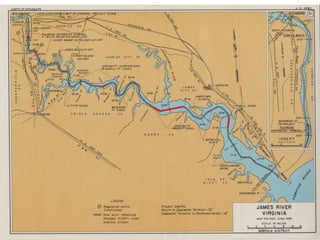
    Figure 1-1 MiddleJames River Jordan Pt - Harrison Bar - Windmill Pt Dancing Pt - Swann Pt Channel City Pt Channel Goose Hill Channel Overboard Placement Area
  • 79.
    Figure 3-1 GooseHill Channel
  • 80.
    Figure 3-4 DancingPoint - Swann Point Channel
  • 81.
    Figure 3-7 JordanPoint - Harrison Bar - Windmill Point Channel
  • 82.
    Figure 3-8 CityPoint Channel
  • 87.
    Alternatives for GooseHill Channel Goose Hill Channel Physical Feasibility Environmental Impacts Cost Comparison Present Practice Highly Feasible Temporary $4.0 million Upland Placement Potentially Feasible Minimal to aquatic, significant to uplands $7.1 million Alternative Overboard Highly Feasible Temporary, but reduced from Present Practice $3.8 million Wetland Creation Potentially Feasible Questionable $4.8 million Alternatives for Dancing Point - Swann Point Channel Dancing Point – Swann Point Physical Feasibility Environmental Impacts Cost Comparison Present Practice Highly Feasible Temporary $41.1 million Upland Placement Potentially Feasible Minimal to aquatic, significant to uplands $69.0 million Alternative Overboard Not Feasible Not Applicable Not Applicable Wetland Creation Not Feasible Not Applicable Not Applicable Alternatives for Jordan Point – Harrison Bar – Windmill Point Channel Jordan Point Physical Feasibility Environmental Impacts Cost Comparison Present Practice Highly Feasible Temporary $10.0 million Upland Placement Potentially Feasible Minimal to aquatic, significant to uplands $19.5 million Alternative Overboard Not Applicable Not Applicable Not Applicable Wetland Creation Potentially Feasible Questionable $12.5 million Alternatives for City Point Channel City Point Physical Feasibility Environmental Impacts Cost Comparison Present Practice Highly Feasible Temporary $0.7 million Upland Placement Potentially Feasible Minimal to aquatic, significant to uplands $2.0 million Alternative Overboard Highly Feasible Temporary, but reduced from Present Practice $0.6 million Wetland Creation Potentially Feasible Questionable $2.2 million
  • 88.
    Monitoring Migratory Behaviorof American Shad (Alosa sapidissima) in the James River, VA: Feasibility of Dredging Impact Assessment John Olney and Brian Watkins, VIMS Doug Clarke, ERDC & Keith Lockwood, USACE
  • 89.
    Summary Report for AnadromousFish Studies in Goose Hill Channel and Turkey Island Cutoff on the James River April 17, 2002
  • 90.
  • 91.
  • 93.
    Onshore Monitoring andRecording Station
  • 94.
    Proposed Study Site onthe James River Goose Hill Channel
  • 95.
    Study Objectives • Evaluateeffectiveness of catching and tracking American Shad in the James River. • Refine methods for future tracking of shad when dredge is operating in the channel.
  • 96.
    Primary Goal • Establishif shad are affected by dredging operations. –If not, can restrictions be reduced to allow more time to dredge in the spring to better manage navigation requirements?
  • 98.
    •Ship calls (-51%)and commodity types (-100% change in forest product traffic which now goes to Hampton Roads) have changed substantially since 1999 Richmond Deepwater Terminal Turning Basin Expansion •2001 – Disposal Area Issue Raised, Numerous Sites Evaluated •2003 – Disposal Area Issue Resolved
  • 99.
    Dredged Material TestingIn The James River Contact: Robert Pruhs Technical Support Section Operations Branch US Army Corps of Engineers Norfolk District
  • 100.
    Why Test DredgedMaterial? • Section 401 CWA, Water Quality Certification (WQC) – WQC required for the discharge of dredged material into waters of the U.S. – Discharge must be certified as complying with applicable State Water Quality Standards (WQS)
  • 101.
    Why Test DredgedMaterial? (Cont’d) • Currently, Corps is renewing the Upper James River Virginia Water Protection Permit (WQC) through DEQ for maintenance dredging activities (mile marker 90 to mile marker 70) – DEQ has raised concerns that dredged material may contain contaminants – Specifically TBT, PCB, PAH, and Metals
  • 102.
    Where Will DredgedMaterial Testing Occur? • Currently, Corps is testing shoals at Richmond Deepwater Terminal and Turkey Island Cut-Off
  • 103.
    Where Will DredgedMaterial Testing Occur? • In the future, DEQ has requested that all shoals within the James River navigation channel be tested as dredging becomes necessary
  • 104.
    How is DredgedMaterial Evaluation to be Performed? • Goal – Utilize the tiered approach and perform only the amount of testing necessary to make factual determinations – Implement the “Reason to Believe” principle for future sampling/testing events to ensure good stewardship of taxpayers dollars
  • 105.
    How is DredgedMaterial Testing to be Performed? • Corps has conducted a Tier I evaluation – Determined that additional information was needed • Tier II & III: The Corps has developed a Sampling & Analysis Plan (SAP) utilizing the tiered approach developed under the framework established by the EPA & USACE manual “Evaluation of Dredged Material For Discharge in Waters of the U.S. – Testing Manual”
  • 106.
    How is DredgedMaterial Testing to be Performed? • Tier II: Involve determination of sediment and water chemistry • Tier III: Effluent elutriate test will predict if effluent water from the respective upland placement sites act as a pathway for the migration of contaminants
  • 107.
    How is DredgedMaterial Testing to be Performed? • Tier III: Effluent elutriate test mimics the dredged material placement process in upland placement sites and predicts the release of contaminants (if present) as a result of placement operations • Effluent elutriate test is a conservative evaluation of impacts to the water column
  • 108.
    What are theBenefits of Dredged Material Testing? • Tier III evaluation for the current testing event at Richmond Deepwater Terminal and Turkey Island Cut-Off can be used to predict performance of potential contaminants in similar upland placement sites along the James River • Conducting dredged material testing in accordance with the EPA and USACE guidance will validate dredged material testing protocols
  • 109.
    What are theCosts of Dredged Material Testing? • Cost of dredged material testing at Richmond Deepwater Terminal and Turkey Island Cut-Off – $65,000 for sample collection and analysis • What are the costs for testing dredged material at every shoal along the entire navigable James River?
  • 110.
    What are thePotential Impacts to Navigation? • Withholding of Water Quality Certification – Result: No dredging, restricted navigation • Increased testing costs to meet environmental regulatory requirements – Result: Limited annual funding for James River Navigation Project may impact ability to maintain navigation
  • 111.
    What are thePotential Impacts to Navigation? • Potential permit condition to test dredged material prior to each dredging event will add significant costs and delays to maintaining navigation
  • 112.
  • 113.
    Maritime Security in HamptonRoads Presented by LCDR Steve Midas Chief, Planning & Risk Management Department
  • 114.
    Presentation Agenda • Impactof Maritime Transportation Security Act (MTSA) Regulations • Virginia Area Maritime Security (AMS) Committee – Responsibilities – Members – Charter – Efforts • Current maritime security measures in place
  • 115.
    MTSA Regulations • MTSARegulations Final Rule released on October 22, 2003 • Requirements include: – Designation of Facility Security Officers and submission of Facility Security Plans for each applicable facility – Designation of Vessel Security Officers and submission of Vessel Security Plans for all applicable vessels – Formation of AMS Committee for each COTP zone – Development of AMS Plan for each COTP zone
  • 116.
    Virginia AMS Committee Responsibilities •Provide advice and assistance to the Federal Maritime Security Coordinator (FMSC) in the development of the AMS Plan • Develop and coordinate a comprehensive area strategy to minimize and/or respond to the threat of a Transportation Security Incident (TSI) • Complete an AMS Assessment and update as necessary
  • 117.
    Virginia AMS Committee Membership •Executive Committee responsible for oversight and management of all AMSC efforts • Members must have at least 5 years of maritime or port security operations experience • Minimum of 7 members • Subcommittees may be formed to address short-term or long-term projects • Subcommittees may include non-AMSC members to obtain advice/technical expertise as necessary
  • 118.
    Virginia AMS Committee Charter •Virginia AMS Committee Charter signed October 23, 2003 • Formalizes relationship and responsibilities of AMSC • Executive Committee membership includes: - USCG COTP (Chair) - Norfolk FBI (Co-Chair) - USCG Group HR - U.S. Asst. Attorney - NAVSTA Norfolk - Office of the Governor - Navy Mid-Atlantic Region - HRMA - BICE - Virginia Port Authority - BCBP - Port of Richmond
  • 119.
    Virginia AMS Committee Efforts •Development of Law Enforcement Subcommittee – Completed numerous training events between USCG, federal and local law enforcement personnel • Creation of AMS Assessment Subcommittee • Making relationships more formal between AMSC and existing committees/groups in Hampton Roads region • Completion of AMS Plan in progress (due to USCG D5 by April 1, 2004)
  • 120.
    Maritime Security Measures inHampton Roads • Joint Harbor Operations Center (JHOC) • Regulated Navigation Area (RNA) • Joint Law Enforcement training • USN Patrol Craft (PC-170’s) • Virginia AMSC • USCG overflights • Daily, random waterside patrols • Exercise coordination
  • 121.
    JHOC Current Cameraand Radar Sites Camera Site (≈2-5NM) Radar Site (12 or 6NM)
  • 122.
    JHOC Proposed Cameraand Radar Sites Camera Site (≈2-5NM) Radar Site (12 or 6NM)
  • 123.
    Hampton Roads FMSC TopConcerns • Expanding AMS efforts to incorporate all of AOR • Identifying/Developing communications process to support MTSA requirements (i.e. facilities, vessels, LE/response personnel, etc.) • Continued coordination with the many stakeholders • Completion of Area Maritime Security Plan
  • 124.
    Area Maritime SecurityPlan Communications • Identify methods to communicate with Facility Security Officers, Company Security Officers, Vessel Security Officers, public safety officers, emergency response personnel and crisis management organization representatives within the port, including 24 hour contact details.
  • 125.
    Area Maritime SecurityPlan Threat Response • Procedures…for responding to security threats or breaches of security, including provisions for maintaining infrastructure and operations in the port; • Procedures for reporting transportation security incidents • Procedures for communicating appropriate security and threat information to the public • Procedures for handling reports from public and maritime industry regarding suspicious activity
  • 126.
    Area Maritime SecurityPlan TSI Response & Recovery • Details of the security incident command and response structure; • Procedures for evacuation within the port in case of security threats or breaches of security; • Security resources available for incident response and their capabilities; • Procedures for responding to a TSI; • Procedures to facilitate the recovery of marine transportation system
  • 127.
    Unified Command Federal MaritimeSecurity Coordinator (i.e. USCG COTP) Safety Officer DOJ DOD State Governors Office Liaison Officer Information Officer Assistant Safety Officers Agency Representatives Joint Information Center Operations Section (CGD(O) Planning Section Finance Section Staging Area(s) Water Interdiction Branch Holding Area Branch Vessel Disposition Branch Air Operations Branch Logistics Section Division A Division B Division C Security Group On Water Group On Shore Group Medical Group Transportation Group Vessel Evaluation Group Vessel Storage Team Vessel Disposal/Sales Group INS Asylum Screening Group Tactical Air Group Helibase Fixed Wing Coordinator Helicopter Coordinator Multi Branch Organization Transportation Security Incident Staging Area(s) land Technical Specialty Unit Situation Unit Resources Unit Documentation Unit