Algae Biofuel: The
Solution to the Future’s
Liquid Fuel Problems
The Problem
The problem we face today is that we will
eventually run out of petroleum oil, and we need
to find an abundant, efficient, environmentally-
friendly, and plausible alternative energy source
that we can exploit with as few side effects as
possible. The optimistic news is that other
solutions are right in front of us like corn ethanol,
soybean biodiesel, and algae biofuel which are
among today’s top alternative fuel sources, but
none of these solutions are able to compete with
petroleum’s mass production despite their positive
impacts on society. So the question is, which
solution is and can be the best alternative
transportation liquid fuel source?
Oil Refinery
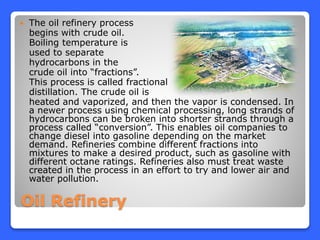
 The oil refinery process
begins with crude oil.
Boiling temperature is
used to separate
hydrocarbons in the
crude oil into “fractions”.
This process is called fractional
distillation. The crude oil is
heated and vaporized, and then the vapor is condensed. In
a newer process using chemical processing, long strands of
hydrocarbons can be broken into shorter strands through a
process called “conversion”. This enables oil companies to
change diesel into gasoline depending on the market
demand. Refineries combine different fractions into
mixtures to make a desired product, such as gasoline with
different octane ratings. Refineries also must treat waste
created in the process in an effort to try and lower air and
water pollution.
Oil Benefits
 One benefit of gasoline engines is that
they produce much more power than
alternative fuel sources.
 Another benefit of oil is its ease of access.
Refilling a car with gas is a very easy
process. There are so many gas stations,
and such a high demand for gas that it is
never hard to get to a pump.
Oil Problems
 There are two main problems involved with
burning gasoline in combustion engines. The
first problem is smog and ozone in big cities.
Smog is created when nitrogen oxides are
released from the engine. Ozone is created
hydrocarbons go unburned. Ozone is
beneficial when it is in the atmosphere,
because it prevents UV radiation from
reaching us. But, ozone is a very reactive
gas, and it is very harsh on lung tissue. So,
when ozone is at ground level it is very
dangerous to society. In the picture to the
right, the plant on the
left is damaged by
ozone, and the plant
on the right is normal.
Oil Problems
 The second main problem with gasoline is the
emission of greenhouse gases. Carbon
Dioxide is a greenhouse gas released by
burning gasoline. Burning a gallon of gasoline
releases around 5 to 6 pounds of carbon
dioxide. In the United States alone, around 2
billion pounds of carbon dioxide are released
every day. This much carbon dioxide can
cause global climate change such as sea
levels rising and flooding. Another poisonous
gas released from burning gasoline is Carbon
Monoxide. Carbon Monoxide poisoning is the
most common type of fatal air poisoning in
many countries. It is colorless, tasteless, and
odorless, but it is highly toxic.
Possible Solutions
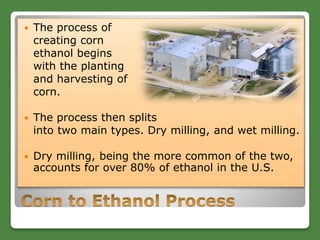
 The process of
creating corn
ethanol begins
with the planting
and harvesting of
corn.
 The process then splits
into two main types. Dry milling, and wet milling.
 Dry milling, being the more common of the two,
accounts for over 80% of ethanol in the U.S.
 The dry milling process begins with the corn being
ground into a flour called the “meal”. Water is then
added to the meal, and then enzymes are added to
convert the starch to glucose. Ammonia is added to
control the pH, and also as a nutrient for the yeast,
which is added later. They process the mixture at high
temperatures to keep the bacteria levels low, and
then the mixture is transferred into fermenters and
cooled. The yeast is then added, and the conversion
from sugar to ethanol begins. The whole process
takes around 45 hours. After the process is
completed, the ethanol is removed from the “stillage”.
The ethanol then gets dehydrated, and a denaturant
is added to make it undrinkable. The product is now
ready to be shipped to gasoline retailers.
 The wet milling process begins with the
corn grain going into a mixture of sulfuric
acid and water for up to 48 hours. The
slurry goes through grinders to separate
out the corn germ. The remaining
components go through various
separators. The remaining corn starch and
water is fermented into ethanol through a
similar process as dry milling.
 One benefit of ethanol is that it is better
for the environment than gasoline.
Ethanol blends reduce carbon monoxide
emissions by 10-30%. Using 10% ethanol
blends reduces greenhouse gas emissions
by 12-19% compared to regular gasoline.
 One main problem with Ethanol is that it
raises food prices. Another problem with
Ethanol is its effect on the environment. If
corn is used as both fuel and food, then corn
production will increase drastically. With
more land being used for farming, then there
will be less land for wild areas. Another
problem is the extra water needed as the
farming expands. With water levels dropping
from excessive water use already, Ethanol
could make this problem worse.
Hydrogen Fuel
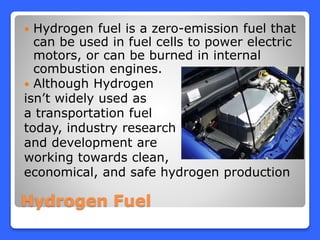
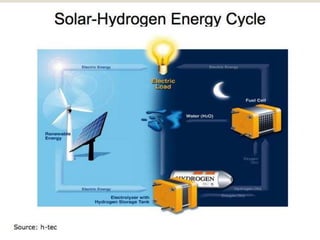
 Hydrogen fuel is a zero-emission fuel that
can be used in fuel cells to power electric
motors, or can be burned in internal
combustion engines.
 Although Hydrogen
isn’t widely used as
a transportation fuel
today, industry research
and development are
working towards clean,
economical, and safe hydrogen production
Advantages of Hydrogen Fuel
 The major advantage of hydrogen fuel is its
effects on the environment. When used in
fuel cells, hydrogen produces no air
pollutants or greenhouse gases.
 Another advantage of hydrogen fuel is that it
can reduce our dependency on foreign oil,
because it can be produced domestically.
 Also, Hydrogen is the most abundant element
in the universe. The only trick is that
hydrogen is usually mixed with something, so
it has to be removed through chemical
processes
Disadvantages of Hydrogen Fuel
 A disadvantage of hydrogen fuel is that it
is expensive to produce, and it is
currently only available in California.
 Another disadvantage is that fuel cell
vehicles are very expensive.
 Also, hydrogen powered vehicles cannot
go as far as conventional gasoline
powered vehicles, because hydrogen
contains much less energy than gasoline
or diesel.
Solar Power
 Solar Power is defined to be power
obtained by harnessing the energy of the
sun’s rays. Solar panels use large silicon
crystals that can produce an electrical
current when light hits them. The
electrons in silicon create electricity when
they are exposed to light because they
get up and move, instead of vibrating in
place to produce heat.
Solar Benefits
 One benefit of solar power is that it is a
completely renewable energy source. As
long as there is sun, then you can have
solar power.
 Another benefit of solar power is that it is
completely silent. They make no noise
while extracting energy from the sun.
 Finally, solar panels require very little
maintenance. Since there are no moving
parts in solar panels, they are hard to
damage.
Solar Problems
 The problems with solar power involve cost.
Solar energy is expensive due to the cost of the
large silicon crystals. Solar power is about five
times as expensive as the electricity running
through today's outlets.
 Newer materials such as copper, indium, gallium,
and selenide use smaller crystals. They are also
much cheaper than silicon. But, the problem with
this new technology is that it doesn’t harness as
much energy from the sun as the expensive
silicon can.
 Another disadvantage with solar power is that it
is useless if there is no sun. If it is cloudy
outside, or if there is a storm, then solar panels
become useless.
 Algae growth requires CO2, water, optimal
temperature, efficient exposure to light, and
culture density.
 All of these requirements are met by
photobioreactors, which are closed systems
that provide controlled environments and
enable high productivity of algae.
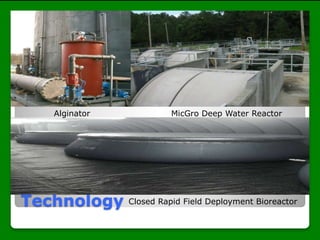
 There are also many types of
photobioreactors like the MICGRO Deep
Water Reactor.
Algae to Biofuel
 After growing the algae, the next step is
harvesting and dewatering the algae. There
are three techniques for harvesting
microalgae which are filtration, most
common, centrifugation, which uses the
sedimentation principle, and flocculation,
which uses chemicals. Some examples of
technology that can accomplish these
processes are the AQ Harvester patented by
Aquaflow and the Shepherd's Harvester
developed by Algae to Energy.
Algae to Biofuel
 The next step is extracting the oil from the
harvested algae. The two methods of oil
extraction are chemical and mechanical
which include technology like the Alginator
Technology patented by Algae to Energy.
Depending on the technology, some
harvesters are able to complete this job as
well.
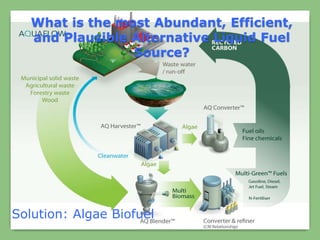
 The result is a algal slurry which is then
converted into Green Crude which is a
derivative that exhibits similar characteristics
to crude oil.
Algae to Biofuel
 Through algal oil extraction technology, other
byproducts are recovered like omega 3; for
example, there are pills available that have
omega 3 from algae because algae is very
high in omega 3.
 The last step is refining in which the Green
Crude is refined into biofuels, fine chemicals,
kerosene, diesel, petroleum fractions,
surfactants, pre-cursor for polymer
manufacture, and pharmaceutical
components.
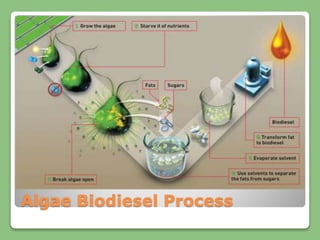
Algae Biodiesel Process
Algae Biofuel Challenges
There are 5 major challenges to making algae biofuel:
 1. Algae strain: Generally the "best" algae for biofuel are not very robust. For
example claims of a 49% oil content algae have been made, but growing such
algae is next to impossible.
 2. Infection: If you have a very specific algae you are trying to grow in an open
pond, it is likely it will get outcompeted by natural algae and bacteria from
the environment. The solutions to this include growing a very dense inoculum
in a photobioreactor or simply using a photobioreactor instead of an open
pond.
 3. Water: This is the biggest issue. Algae grown in open ponds reaches a
concentration of about 0.1%. That means for every one unit of algae you have
to remove 1000 units of water. This is very expensive and energy intensive.
 4. Cell Walls: The unique cell wall of algae can be an issue if you are trying to
disrupt the cell to get to the oil. This is also energy intensive and technically
challenging.
 5. Conversion to biodiesel: The oil from algae has a lot of contaminants in it
that prevent easy conversion to biodiesel. The oil has to be purified before
conversion adding more cost and technical challenge to the process.
Technology
MicGro Deep Water ReactorAlginator
Closed Rapid Field Deployment Bioreactor
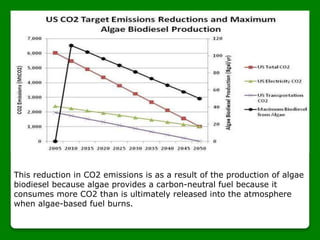
This reduction in CO2 emissions is as a result of the production of algae
biodiesel because algae provides a carbon-neutral fuel because it
consumes more CO2 than is ultimately released into the atmosphere
when algae-based fuel burns.
0
20
40
60
80
100
120
140
160
Corn Ethanol Algae Biodiesel Soybean
Biodiesel
Amountofland(millionacres)
Type of Biofuel
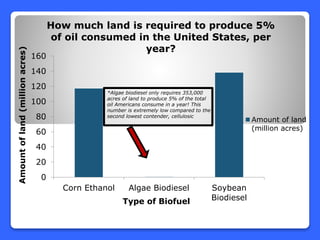
How much land is required to produce 5%
of oil consumed in the United States, per
year?
Amount of land
(million acres)
*Algae biodiesel only requires 353,000
acres of land to produce 5% of the total
oil Americans consume in a year! This
number is extremely low compared to the
second lowest contender, cellulosic
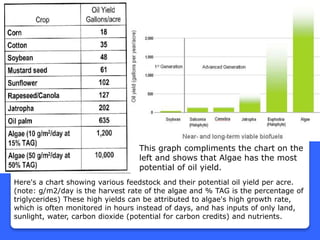
Here's a chart showing various feedstock and their potential oil yield per acre.
(note: g/m2/day is the harvest rate of the algae and % TAG is the percentage of
triglycerides) These high yields can be attributed to algae's high growth rate,
which is often monitored in hours instead of days, and has inputs of only land,
sunlight, water, carbon dioxide (potential for carbon credits) and nutrients.
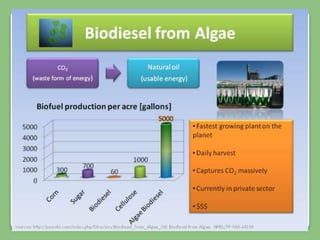
This graph compliments the chart on the
left and shows that Algae has the most
potential of oil yield.
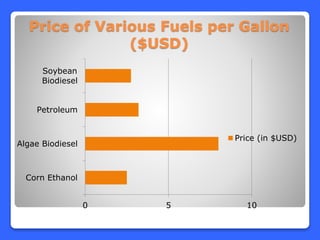
Price of Various Fuels per Gallon
($USD)
0 5 10
Corn Ethanol
Algae Biodiesel
Petroleum
Soybean
Biodiesel
Price (in $USD)
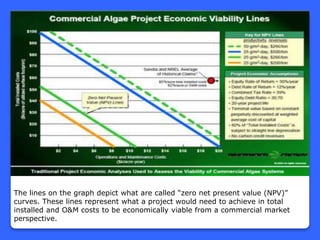
The lines on the graph depict what are called “zero net present value (NPV)”
curves. These lines represent what a project would need to achieve in total
installed and O&M costs to be economically viable from a commercial market
perspective.
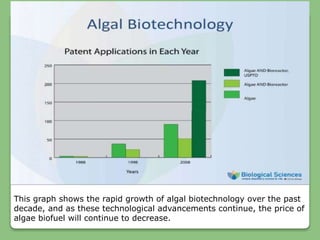
This graph shows the rapid growth of algal biotechnology over the past
decade, and as these technological advancements continue, the price of
algae biofuel will continue to decrease.
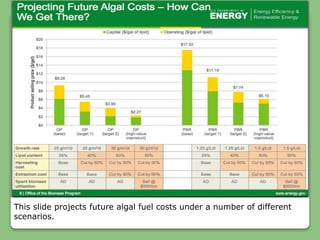
This slide projects future algal fuel costs under a number of different
scenarios.
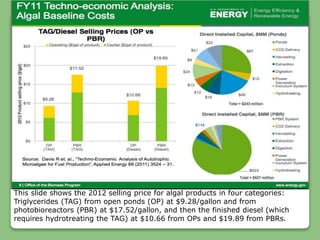
This slide shows the 2012 selling price for algal products in four categories:
Triglycerides (TAG) from open ponds (OP) at $9.28/gallon and from
photobioreactors (PBR) at $17.52/gallon, and then the finished diesel (which
requires hydrotreating the TAG) at $10.66 from OPs and $19.89 from PBRs.
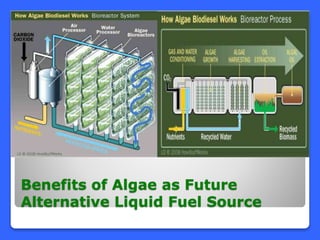
Benefits of Algae as Future
Alternative Liquid Fuel Source
 Q:What transportation fuels can algae
produce?
 A: Algae produce a variety of fuel and fuel
precursor molecules, including
triglycerides and fatty acids that can be
converted to biodiesel, as well as lipids
and isoprenoids that can be directly
converted to actual gasoline and
traditional diesel fuel. Algae can also be
used to produce hydrogen or biomass,
which can then be digested into methane.
Algae Fuels
Fuel Production
 Q: How much fuel can algae produce?
 A: The United States consumes 140 billion
gallons per year of liquid fuel. Algae can
produce 3,000 gallons of liquid fuel per
acre in a year, so it would take 45 million
acres of algae to provide 100% of our
liquid fuel requirements.
 For comparison, in 2008 the United States
had 90 million acres of corn and 67
million acres of soybeans in production.
So growing 45 million acres of algae,
while challenging, is certainly possible.
Algae Growth
 Q: Where could this type of algae grow?
 A: Algae perform best under consistent
warm temperatures between 60 and 90
degrees and climates with plenty of
sunshine offer optimal conditions. Ideal
U.S. locations include many of the
southern and southwestern states, such
as New Mexico, Arizona, Texas, Nevada,
and California (including the counties of
San Diego and Imperial).
Cost of Algae Biofuel
 Q: How much would a gallon of algae-based
transportation fuel cost if it were available at
a service station today?
 A: Today, the cost would be relatively
expensive. Additional investment in research
is needed to further refine and enhance the
algae strains that generate such fuels. Also,
more infrastructure needs to be developed to
achieve the necessary economies of scale
that will come with large-scale commercial
production. Once overall efficiency increases,
the cost of producing a gallon of gasoline
from algae will dramatically reduce.
Algae as a Future Solution
 Q: What can accelerate the commercial
availability of algae biofuel?
 A: As viable and potentially transformational
as algae-based transportation fuels have
already proven, we need a much better
knowledge base on algae at the microbial
level. We also need to build on this platform
to develop the tools and train the next
generation of scientists that will help usher in
the age of accessible, affordable, and
sustainable fuels made from algae. That is a
central component of the San Diego Center
for Algae Biofuels (SD-CAB).
Algae Benefits the Environment
 Q: How will algae-based transportation fuels
impact greenhouse gas emissions?
 A: Production of alternative transportation fuels
from algae will help reduce the amount of CO2 in
the environment. Algae provide a carbon-neutral
fuel because they consume more CO2 than is
ultimately released into the atmosphere when
algae-based fuel burns. The amount of carbon
removed from the environment will depend on
the number of algae farms built and the
efficiency with which algae can be modified to
convert CO2 to fuel products. Eventually, algae
farms will likely be located adjacent to CO2
producing facilities, like power plants, resulting in
potentially significant CO2 sequestration
benefits.
Availability of Algae Production
 Q: Is the process capable of being replicated at
the local level to increase energy efficiency and
promote low-energy overhead?
 A: Absolutely. There are huge advantages to
locating algae farms near urban centers. The
algae consume industrial waste and
contaminants, which are usually found in higher
concentrations near cities. A perfect location is
near a power plant, where the algae can
consume flue gas and other waste, or near a
wastewater treatment plant where the algae
could consume significant amounts of nitrates
and phosphates from the waste stream. This
could result in cleaner effluent discharge, and
perhaps eventually create “new” sources of non-
potable water for industrial or agricultural use.
Algae as Practible Replacement
 Q: Could algae-based fuels be used in
developing countries to help them bypass
fossil fuel dependence?
 A: Algae-based fuels (and the protein
byproducts derived from their production)
definitely have the potential to positively
impact developing countries. The
requirements for farming algae are fairly
straightforward and can be done almost
anywhere in the world with an adequate
supply of sunshine. In Africa, for example,
millions of algae acres could be farmed in its
less-populated regions, resulting in a reduced
dependence on foreign oil and a reliable and
sustainable energy supply.
Other uses of Algae
 Q: What can you do with material derived
from algae production not used for fuel?
 A: Production of 140 billion gallons of fuel
from algae would also yield about 1 trillion
pounds of protein. Since algae-produced
protein is very high quality, this protein
could be used to feed livestock, chicken,
or fish. Presently, all livestock in this
country consume about 770 billion pounds
of protein per year.
Solution
There are many alternative fuel sources that can be found today from
hydrogen fuel to algae biofuel. Hydrogen liquid fuel and solar energy are two
alternative fuel sources, but solar energy is not exactly a fuel and therefore
its capabilities are not as promising as ordinary fuels even though it is a
great alternative energy source. While hydrogen fuel is an ideal alternative
fuel source, it faces two significant drawbacks with current technology. The
preferred hydrogen fuel requires four times the storage space of ordinary
petroleum-based fuels, and it is produced from raw petroleum of which
supplies may become limited in the near future. Another two alternatives are
corn ethanol and soybean biodiesel, but ethanol also faces drawbacks, such
as, rise in corn prices and being incapable of providing enough energy to
support a large population while the biodiesel encounters the same problems
as ethanol plus its inability to work as fuel other than biodiesel. At last,
there is algae biofuel, which faces costs up to three times more expensive
than other fuel sources and does not yet possess the technology to mass
produce the biofuel. However, future technological advances will allow this
and will be needed, as petroleum will become exhausted. Compared to all of
the other solutions, algae biofuel is the most abundant, efficient, and
plausible alternative liquid fuel source.
What is the most Abundant, Efficient,
and Plausible Alternative Liquid Fuel
Source?
Solution: Algae Biofuel
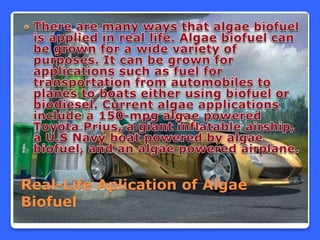
Real-Life Aplication of Algae
Biofuel
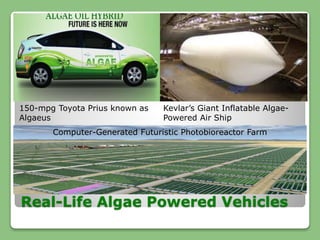
Real-Life Algae Powered Vehicles
150-mpg Toyota Prius known as
Algaeus
Kevlar’s Giant Inflatable Algae-
Powered Air Ship
Computer-Generated Futuristic Photobioreactor Farm

Algae to Biofuel

  • 1.
    Algae Biofuel: The Solutionto the Future’s Liquid Fuel Problems
  • 2.
    The Problem The problemwe face today is that we will eventually run out of petroleum oil, and we need to find an abundant, efficient, environmentally- friendly, and plausible alternative energy source that we can exploit with as few side effects as possible. The optimistic news is that other solutions are right in front of us like corn ethanol, soybean biodiesel, and algae biofuel which are among today’s top alternative fuel sources, but none of these solutions are able to compete with petroleum’s mass production despite their positive impacts on society. So the question is, which solution is and can be the best alternative transportation liquid fuel source?
  • 3.
    Oil Refinery  Theoil refinery process begins with crude oil. Boiling temperature is used to separate hydrocarbons in the crude oil into “fractions”. This process is called fractional distillation. The crude oil is heated and vaporized, and then the vapor is condensed. In a newer process using chemical processing, long strands of hydrocarbons can be broken into shorter strands through a process called “conversion”. This enables oil companies to change diesel into gasoline depending on the market demand. Refineries combine different fractions into mixtures to make a desired product, such as gasoline with different octane ratings. Refineries also must treat waste created in the process in an effort to try and lower air and water pollution.
  • 4.
    Oil Benefits  Onebenefit of gasoline engines is that they produce much more power than alternative fuel sources.  Another benefit of oil is its ease of access. Refilling a car with gas is a very easy process. There are so many gas stations, and such a high demand for gas that it is never hard to get to a pump.
  • 5.
    Oil Problems  Thereare two main problems involved with burning gasoline in combustion engines. The first problem is smog and ozone in big cities. Smog is created when nitrogen oxides are released from the engine. Ozone is created hydrocarbons go unburned. Ozone is beneficial when it is in the atmosphere, because it prevents UV radiation from reaching us. But, ozone is a very reactive gas, and it is very harsh on lung tissue. So, when ozone is at ground level it is very dangerous to society. In the picture to the right, the plant on the left is damaged by ozone, and the plant on the right is normal.
  • 6.
    Oil Problems  Thesecond main problem with gasoline is the emission of greenhouse gases. Carbon Dioxide is a greenhouse gas released by burning gasoline. Burning a gallon of gasoline releases around 5 to 6 pounds of carbon dioxide. In the United States alone, around 2 billion pounds of carbon dioxide are released every day. This much carbon dioxide can cause global climate change such as sea levels rising and flooding. Another poisonous gas released from burning gasoline is Carbon Monoxide. Carbon Monoxide poisoning is the most common type of fatal air poisoning in many countries. It is colorless, tasteless, and odorless, but it is highly toxic.
  • 7.
  • 8.
     The processof creating corn ethanol begins with the planting and harvesting of corn.  The process then splits into two main types. Dry milling, and wet milling.  Dry milling, being the more common of the two, accounts for over 80% of ethanol in the U.S.
  • 9.
     The drymilling process begins with the corn being ground into a flour called the “meal”. Water is then added to the meal, and then enzymes are added to convert the starch to glucose. Ammonia is added to control the pH, and also as a nutrient for the yeast, which is added later. They process the mixture at high temperatures to keep the bacteria levels low, and then the mixture is transferred into fermenters and cooled. The yeast is then added, and the conversion from sugar to ethanol begins. The whole process takes around 45 hours. After the process is completed, the ethanol is removed from the “stillage”. The ethanol then gets dehydrated, and a denaturant is added to make it undrinkable. The product is now ready to be shipped to gasoline retailers.
  • 10.
     The wetmilling process begins with the corn grain going into a mixture of sulfuric acid and water for up to 48 hours. The slurry goes through grinders to separate out the corn germ. The remaining components go through various separators. The remaining corn starch and water is fermented into ethanol through a similar process as dry milling.
  • 11.
     One benefitof ethanol is that it is better for the environment than gasoline. Ethanol blends reduce carbon monoxide emissions by 10-30%. Using 10% ethanol blends reduces greenhouse gas emissions by 12-19% compared to regular gasoline.
  • 12.
     One mainproblem with Ethanol is that it raises food prices. Another problem with Ethanol is its effect on the environment. If corn is used as both fuel and food, then corn production will increase drastically. With more land being used for farming, then there will be less land for wild areas. Another problem is the extra water needed as the farming expands. With water levels dropping from excessive water use already, Ethanol could make this problem worse.
  • 13.
    Hydrogen Fuel  Hydrogenfuel is a zero-emission fuel that can be used in fuel cells to power electric motors, or can be burned in internal combustion engines.  Although Hydrogen isn’t widely used as a transportation fuel today, industry research and development are working towards clean, economical, and safe hydrogen production
  • 14.
    Advantages of HydrogenFuel  The major advantage of hydrogen fuel is its effects on the environment. When used in fuel cells, hydrogen produces no air pollutants or greenhouse gases.  Another advantage of hydrogen fuel is that it can reduce our dependency on foreign oil, because it can be produced domestically.  Also, Hydrogen is the most abundant element in the universe. The only trick is that hydrogen is usually mixed with something, so it has to be removed through chemical processes
  • 15.
    Disadvantages of HydrogenFuel  A disadvantage of hydrogen fuel is that it is expensive to produce, and it is currently only available in California.  Another disadvantage is that fuel cell vehicles are very expensive.  Also, hydrogen powered vehicles cannot go as far as conventional gasoline powered vehicles, because hydrogen contains much less energy than gasoline or diesel.
  • 16.
    Solar Power  SolarPower is defined to be power obtained by harnessing the energy of the sun’s rays. Solar panels use large silicon crystals that can produce an electrical current when light hits them. The electrons in silicon create electricity when they are exposed to light because they get up and move, instead of vibrating in place to produce heat.
  • 17.
    Solar Benefits  Onebenefit of solar power is that it is a completely renewable energy source. As long as there is sun, then you can have solar power.  Another benefit of solar power is that it is completely silent. They make no noise while extracting energy from the sun.  Finally, solar panels require very little maintenance. Since there are no moving parts in solar panels, they are hard to damage.
  • 18.
    Solar Problems  Theproblems with solar power involve cost. Solar energy is expensive due to the cost of the large silicon crystals. Solar power is about five times as expensive as the electricity running through today's outlets.  Newer materials such as copper, indium, gallium, and selenide use smaller crystals. They are also much cheaper than silicon. But, the problem with this new technology is that it doesn’t harness as much energy from the sun as the expensive silicon can.  Another disadvantage with solar power is that it is useless if there is no sun. If it is cloudy outside, or if there is a storm, then solar panels become useless.
  • 20.
     Algae growthrequires CO2, water, optimal temperature, efficient exposure to light, and culture density.  All of these requirements are met by photobioreactors, which are closed systems that provide controlled environments and enable high productivity of algae.  There are also many types of photobioreactors like the MICGRO Deep Water Reactor.
  • 21.
    Algae to Biofuel After growing the algae, the next step is harvesting and dewatering the algae. There are three techniques for harvesting microalgae which are filtration, most common, centrifugation, which uses the sedimentation principle, and flocculation, which uses chemicals. Some examples of technology that can accomplish these processes are the AQ Harvester patented by Aquaflow and the Shepherd's Harvester developed by Algae to Energy.
  • 22.
    Algae to Biofuel The next step is extracting the oil from the harvested algae. The two methods of oil extraction are chemical and mechanical which include technology like the Alginator Technology patented by Algae to Energy. Depending on the technology, some harvesters are able to complete this job as well.  The result is a algal slurry which is then converted into Green Crude which is a derivative that exhibits similar characteristics to crude oil.
  • 23.
    Algae to Biofuel Through algal oil extraction technology, other byproducts are recovered like omega 3; for example, there are pills available that have omega 3 from algae because algae is very high in omega 3.  The last step is refining in which the Green Crude is refined into biofuels, fine chemicals, kerosene, diesel, petroleum fractions, surfactants, pre-cursor for polymer manufacture, and pharmaceutical components.
  • 24.
  • 26.
    Algae Biofuel Challenges Thereare 5 major challenges to making algae biofuel:  1. Algae strain: Generally the "best" algae for biofuel are not very robust. For example claims of a 49% oil content algae have been made, but growing such algae is next to impossible.  2. Infection: If you have a very specific algae you are trying to grow in an open pond, it is likely it will get outcompeted by natural algae and bacteria from the environment. The solutions to this include growing a very dense inoculum in a photobioreactor or simply using a photobioreactor instead of an open pond.  3. Water: This is the biggest issue. Algae grown in open ponds reaches a concentration of about 0.1%. That means for every one unit of algae you have to remove 1000 units of water. This is very expensive and energy intensive.  4. Cell Walls: The unique cell wall of algae can be an issue if you are trying to disrupt the cell to get to the oil. This is also energy intensive and technically challenging.  5. Conversion to biodiesel: The oil from algae has a lot of contaminants in it that prevent easy conversion to biodiesel. The oil has to be purified before conversion adding more cost and technical challenge to the process.
  • 27.
    Technology MicGro Deep WaterReactorAlginator Closed Rapid Field Deployment Bioreactor
  • 28.
    This reduction inCO2 emissions is as a result of the production of algae biodiesel because algae provides a carbon-neutral fuel because it consumes more CO2 than is ultimately released into the atmosphere when algae-based fuel burns.
  • 29.
    0 20 40 60 80 100 120 140 160 Corn Ethanol AlgaeBiodiesel Soybean Biodiesel Amountofland(millionacres) Type of Biofuel How much land is required to produce 5% of oil consumed in the United States, per year? Amount of land (million acres) *Algae biodiesel only requires 353,000 acres of land to produce 5% of the total oil Americans consume in a year! This number is extremely low compared to the second lowest contender, cellulosic
  • 30.
    Here's a chartshowing various feedstock and their potential oil yield per acre. (note: g/m2/day is the harvest rate of the algae and % TAG is the percentage of triglycerides) These high yields can be attributed to algae's high growth rate, which is often monitored in hours instead of days, and has inputs of only land, sunlight, water, carbon dioxide (potential for carbon credits) and nutrients. This graph compliments the chart on the left and shows that Algae has the most potential of oil yield.
  • 31.
    Price of VariousFuels per Gallon ($USD) 0 5 10 Corn Ethanol Algae Biodiesel Petroleum Soybean Biodiesel Price (in $USD)
  • 32.
    The lines onthe graph depict what are called “zero net present value (NPV)” curves. These lines represent what a project would need to achieve in total installed and O&M costs to be economically viable from a commercial market perspective.
  • 33.
    This graph showsthe rapid growth of algal biotechnology over the past decade, and as these technological advancements continue, the price of algae biofuel will continue to decrease.
  • 34.
    This slide projectsfuture algal fuel costs under a number of different scenarios.
  • 35.
    This slide showsthe 2012 selling price for algal products in four categories: Triglycerides (TAG) from open ponds (OP) at $9.28/gallon and from photobioreactors (PBR) at $17.52/gallon, and then the finished diesel (which requires hydrotreating the TAG) at $10.66 from OPs and $19.89 from PBRs.
  • 36.
    Benefits of Algaeas Future Alternative Liquid Fuel Source
  • 37.
     Q:What transportationfuels can algae produce?  A: Algae produce a variety of fuel and fuel precursor molecules, including triglycerides and fatty acids that can be converted to biodiesel, as well as lipids and isoprenoids that can be directly converted to actual gasoline and traditional diesel fuel. Algae can also be used to produce hydrogen or biomass, which can then be digested into methane. Algae Fuels
  • 38.
    Fuel Production  Q:How much fuel can algae produce?  A: The United States consumes 140 billion gallons per year of liquid fuel. Algae can produce 3,000 gallons of liquid fuel per acre in a year, so it would take 45 million acres of algae to provide 100% of our liquid fuel requirements.  For comparison, in 2008 the United States had 90 million acres of corn and 67 million acres of soybeans in production. So growing 45 million acres of algae, while challenging, is certainly possible.
  • 39.
    Algae Growth  Q:Where could this type of algae grow?  A: Algae perform best under consistent warm temperatures between 60 and 90 degrees and climates with plenty of sunshine offer optimal conditions. Ideal U.S. locations include many of the southern and southwestern states, such as New Mexico, Arizona, Texas, Nevada, and California (including the counties of San Diego and Imperial).
  • 40.
    Cost of AlgaeBiofuel  Q: How much would a gallon of algae-based transportation fuel cost if it were available at a service station today?  A: Today, the cost would be relatively expensive. Additional investment in research is needed to further refine and enhance the algae strains that generate such fuels. Also, more infrastructure needs to be developed to achieve the necessary economies of scale that will come with large-scale commercial production. Once overall efficiency increases, the cost of producing a gallon of gasoline from algae will dramatically reduce.
  • 41.
    Algae as aFuture Solution  Q: What can accelerate the commercial availability of algae biofuel?  A: As viable and potentially transformational as algae-based transportation fuels have already proven, we need a much better knowledge base on algae at the microbial level. We also need to build on this platform to develop the tools and train the next generation of scientists that will help usher in the age of accessible, affordable, and sustainable fuels made from algae. That is a central component of the San Diego Center for Algae Biofuels (SD-CAB).
  • 42.
    Algae Benefits theEnvironment  Q: How will algae-based transportation fuels impact greenhouse gas emissions?  A: Production of alternative transportation fuels from algae will help reduce the amount of CO2 in the environment. Algae provide a carbon-neutral fuel because they consume more CO2 than is ultimately released into the atmosphere when algae-based fuel burns. The amount of carbon removed from the environment will depend on the number of algae farms built and the efficiency with which algae can be modified to convert CO2 to fuel products. Eventually, algae farms will likely be located adjacent to CO2 producing facilities, like power plants, resulting in potentially significant CO2 sequestration benefits.
  • 43.
    Availability of AlgaeProduction  Q: Is the process capable of being replicated at the local level to increase energy efficiency and promote low-energy overhead?  A: Absolutely. There are huge advantages to locating algae farms near urban centers. The algae consume industrial waste and contaminants, which are usually found in higher concentrations near cities. A perfect location is near a power plant, where the algae can consume flue gas and other waste, or near a wastewater treatment plant where the algae could consume significant amounts of nitrates and phosphates from the waste stream. This could result in cleaner effluent discharge, and perhaps eventually create “new” sources of non- potable water for industrial or agricultural use.
  • 44.
    Algae as PractibleReplacement  Q: Could algae-based fuels be used in developing countries to help them bypass fossil fuel dependence?  A: Algae-based fuels (and the protein byproducts derived from their production) definitely have the potential to positively impact developing countries. The requirements for farming algae are fairly straightforward and can be done almost anywhere in the world with an adequate supply of sunshine. In Africa, for example, millions of algae acres could be farmed in its less-populated regions, resulting in a reduced dependence on foreign oil and a reliable and sustainable energy supply.
  • 45.
    Other uses ofAlgae  Q: What can you do with material derived from algae production not used for fuel?  A: Production of 140 billion gallons of fuel from algae would also yield about 1 trillion pounds of protein. Since algae-produced protein is very high quality, this protein could be used to feed livestock, chicken, or fish. Presently, all livestock in this country consume about 770 billion pounds of protein per year.
  • 46.
    Solution There are manyalternative fuel sources that can be found today from hydrogen fuel to algae biofuel. Hydrogen liquid fuel and solar energy are two alternative fuel sources, but solar energy is not exactly a fuel and therefore its capabilities are not as promising as ordinary fuels even though it is a great alternative energy source. While hydrogen fuel is an ideal alternative fuel source, it faces two significant drawbacks with current technology. The preferred hydrogen fuel requires four times the storage space of ordinary petroleum-based fuels, and it is produced from raw petroleum of which supplies may become limited in the near future. Another two alternatives are corn ethanol and soybean biodiesel, but ethanol also faces drawbacks, such as, rise in corn prices and being incapable of providing enough energy to support a large population while the biodiesel encounters the same problems as ethanol plus its inability to work as fuel other than biodiesel. At last, there is algae biofuel, which faces costs up to three times more expensive than other fuel sources and does not yet possess the technology to mass produce the biofuel. However, future technological advances will allow this and will be needed, as petroleum will become exhausted. Compared to all of the other solutions, algae biofuel is the most abundant, efficient, and plausible alternative liquid fuel source.
  • 47.
    What is themost Abundant, Efficient, and Plausible Alternative Liquid Fuel Source? Solution: Algae Biofuel
  • 48.
  • 49.
    Real-Life Algae PoweredVehicles 150-mpg Toyota Prius known as Algaeus Kevlar’s Giant Inflatable Algae- Powered Air Ship Computer-Generated Futuristic Photobioreactor Farm

Editor's Notes

  • #4 http://science.howstuffworks.com/environmental/energy/oil-refining3.htm
  • #5 http://www.ehow.com/list_6106999_benefits-gasoline-cars_.html
  • #6 http://science.howstuffworks.com/gasoline5.htm http://science.howstuffworks.com/environmental/green-science/ozone-pollution1.htm
  • #12 http://cleanburnfuels.com/benefits_ethanol.html
  • #13 http://ourfiniteworld.com/2011/01/10/what-are-the-problems-with-using-corn-ethanol-for-fuel/
  • #14 http://www.fueleconomy.gov/feg/hydrogen.shtml http://static.ddmcdn.com/gif/cg-fuel-cell-5.jpg
  • #17 http://www.scientificamerican.com/article.cfm?id=how-does-solar-power-work http://upload.wikimedia.org/wikipedia/commons/thumb/9/90/Solar_cell.png/220px-Solar_cell.png
  • #18 http://alternate-power.org/solar-power-advantages-and-disadvantages/