Maisa Martin 
University of Jyväskylä, Finland 
Alfarådet 19.9.2014
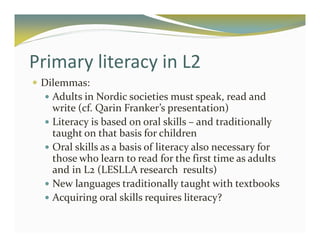
Primary literacy in L2 
 Dilemmas: 
 Adults in Nordic societies must speak, read and 
write (cf. Qarin Franker’s presentation) 
 Literacy is based on oral skills – and traditionally 
taught on that basis for children 
 Oral skills as a basis of literacy also necessary for 
those who learn to read for the first time as adults 
and in L2 (LESLLA research results) 
 New languages traditionally taught with textbooks 
 Acquiring oral skills requires literacy?
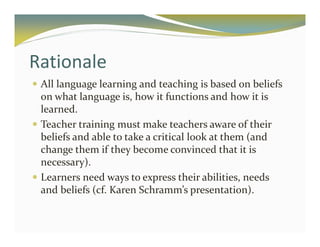
Rationale 
 All language learning and teaching is based on beliefs 
on what language is, how it functions and how it is 
learned. 
 Teacher training mustmake teachers aware of their 
beliefs and able to take a critical look at them (and 
change them if they become convinced that it is 
necessary). 
 Learners need ways to express their abilities, needs 
and beliefs (cf. Karen Schramm’s presentation).
Content 
 Language skills – unitary or separate? 
 Prerequisites for learning a language 
 Prerequisites for learning to read and write 
 Adults vs. children 
 Ways forward (e.g. DigLin, EU-Speak 2) 
 Conclusions
Language skills – unitary or separate? 
 Most research in the area of language testing: To test 
one must know what is tested. 
 Less in focus in SLA or pedagogical research: Skills are 
often assumed to be separate but overlap is allowed. 
 If unitary, not necessary to teach or test separately 
 If separate, each skill can/must be taught separately 
 repercussions for classroom 
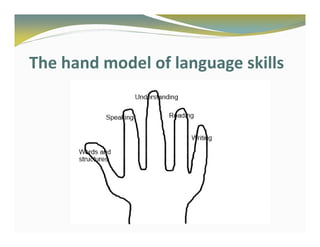
 The hand model of language skills to illustrate the 
research results
The hand model of language skills
Prerequisites for learning a language 
 Ability to hear 
 Memory 
 Ability to distinguish between speech and other sounds 
 Phonological awareness: 
 Segmentation 
 Ability to distinguish between speech sounds (same vs. 
different) 
 Ability to group sounds into phonemes 
 Natural differences in these abilities 
 Filter effects of L1
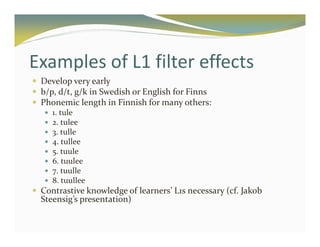
Examples of L1 filter effects 
 Develop very early 
 b/p, d/t, g/k in Swedish or English for Finns 
 Phonemic length in Finnish for many others: 
 1. tule 
 2. tulee 
 3. tulle 
 4. tullee 
 5. tuule 
 6. tuulee 
 7. tuulle 
 8. tuullee 
 Contrastive knowledge of learners’ L1s necessary (cf. Jakob 
Steensig’s presentation)
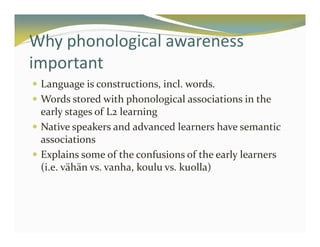
Why phonological awareness 
important 
 Language is constructions, incl. words. 
 Words stored with phonological associations in the 
early stages of L2 learning 
 Native speakers and advanced learners have semantic 
associations 
 Explains some of the confusions of the early learners 
(i.e. vähän vs. vanha, koulu vs. kuolla)
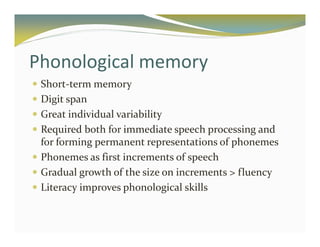
Phonological memory 
 Short-term memory 
 Digit span 
 Great individual variability 
 Required both for immediate speech processing and 
for forming permanent representations of phonemes 
 Phonemes as first increments of speech 
 Gradual growth of the size on increments  fluency 
 Literacy improves phonological skills
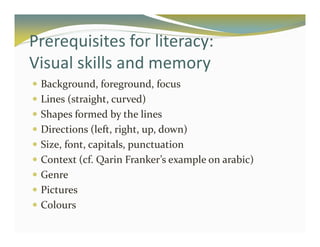
Prerequisites for literacy: 
Visual skills and memory 
 Background, foreground, focus 
 Lines (straight, curved) 
 Shapes formed by the lines 
 Directions (left, right, up, down) 
 Size, font, capitals, punctuation 
 Context (cf. Qarin Franker’s example on arabic) 
 Genre 
 Pictures 
 Colours
Does practice help? 
 Depends on your view on what language is and how it 
is acquired. 
 Nativist approach 
 Many theories of the connection between L1 and L2 
 Usage-based approach 
 Frequency and saliency of occurrencies the most 
important factors
How does practice help? 
 Environment determines affordances 
 Literacy requires practice 
 Literacy provides practice 
 Sound/letter correspondence can be practised 
 Many phonemic features can be practiced, e.g. 
Graphogame, DigLin 
 Blending difficult to teach 
 Comprehension requires fluency, fluency requires 
practice.
Reading   Writing 
 Letter by letter or whole words? 
 Language specific but in the long run holisticmethods 
fail 
 Reading  writing (reception  production) 
 Writing  reading (agency) 
 Fine motor coordination 
 Need reduced by typing, also smaller demand for visual 
memory
Some research results on early 
writing 
 Cefling  Topling research projects 
 Results on the relationships of fluency, accuracy and 
complexity. 
 At A1 level traditional complexitymeasures do not 
work, subordination common (in Finnish). 
 Fluency before accuracy. 
 Oral skills help a lot early on (up to B1).
Adults vs. children 
 Children ”wired” for language learning, particularly 
phonology and pronunciation. 
 Greater plasticity of the brain 
 Less L1 filter effects 
 Adults learn faster inititally (if educated) 
 More world knowledge  semantic and pragmatic skills 
 Variety of interests 
 Attitudes and motivation have greater influence 
 Higher expectations
The chicken and the egg? 
 Acquiring oral skills requires literacy? Not 
necessarily, of course, but alphabetic literacy 
promotes the phonological development, reading 
allows revision, writing taking notes (memory is 
aided by literacy). 
 Literacy without oral skills is mote in most 
contexts.
Ways forward 
 Oral skills first. 
 Tools for helping the co-development of oral skills and 
literacy. 
 Tools for promoting fluency and comprehension.
DigLin 
 Computer exercises for early stages of L2 and literacy 
learning for Dutch, English, Finnish and German 
 Expectations set by the teacher, way to reach them 
found by the learner 
 Unlimited practice, no set order  
 Promotes learner autonomy and agency 
 ASR (Automatic Speech Recognition) 
 www.diglin.eu
EU-Speak 2 
 Surveys of knowledge and skills required of literacy 
teachers (much based on the work of Alfarådet). 
 Newcastle, Amsterdam, Cologne, Granada, Jyväskylä, 
USA (LESLLA initiative) 
 Target: Curriculum guidelines for online in-service 
teacher workshops 
 One module piloted in 2014 - 2015
Why this in English? 
 Maybe we cannot help noticing errors? 
 Errors distract 
 Have to unlearn noticing them 
 Promoting this is a language policy issue 
 A positive note: Using more than one language across 
the lifespan delays the onset of dementia by four years 
(Bialystok).
Alfarådet 2014
Alfarådet 2014

Alfarådet 2014

  • 2.
    Maisa Martin Universityof Jyväskylä, Finland Alfarådet 19.9.2014
  • 3.
    Primary literacy inL2 Dilemmas: Adults in Nordic societies must speak, read and write (cf. Qarin Franker’s presentation) Literacy is based on oral skills – and traditionally taught on that basis for children Oral skills as a basis of literacy also necessary for those who learn to read for the first time as adults and in L2 (LESLLA research results) New languages traditionally taught with textbooks Acquiring oral skills requires literacy?
  • 4.
    Rationale Alllanguage learning and teaching is based on beliefs on what language is, how it functions and how it is learned. Teacher training mustmake teachers aware of their beliefs and able to take a critical look at them (and change them if they become convinced that it is necessary). Learners need ways to express their abilities, needs and beliefs (cf. Karen Schramm’s presentation).
  • 5.
    Content Languageskills – unitary or separate? Prerequisites for learning a language Prerequisites for learning to read and write Adults vs. children Ways forward (e.g. DigLin, EU-Speak 2) Conclusions
  • 6.
    Language skills –unitary or separate? Most research in the area of language testing: To test one must know what is tested. Less in focus in SLA or pedagogical research: Skills are often assumed to be separate but overlap is allowed. If unitary, not necessary to teach or test separately If separate, each skill can/must be taught separately repercussions for classroom The hand model of language skills to illustrate the research results
  • 7.
    The hand modelof language skills
  • 8.
    Prerequisites for learninga language Ability to hear Memory Ability to distinguish between speech and other sounds Phonological awareness: Segmentation Ability to distinguish between speech sounds (same vs. different) Ability to group sounds into phonemes Natural differences in these abilities Filter effects of L1
  • 9.
    Examples of L1filter effects Develop very early b/p, d/t, g/k in Swedish or English for Finns Phonemic length in Finnish for many others: 1. tule 2. tulee 3. tulle 4. tullee 5. tuule 6. tuulee 7. tuulle 8. tuullee Contrastive knowledge of learners’ L1s necessary (cf. Jakob Steensig’s presentation)
  • 10.
    Why phonological awareness important Language is constructions, incl. words. Words stored with phonological associations in the early stages of L2 learning Native speakers and advanced learners have semantic associations Explains some of the confusions of the early learners (i.e. vähän vs. vanha, koulu vs. kuolla)
  • 11.
    Phonological memory Short-term memory Digit span Great individual variability Required both for immediate speech processing and for forming permanent representations of phonemes Phonemes as first increments of speech Gradual growth of the size on increments fluency Literacy improves phonological skills
  • 12.
    Prerequisites for literacy: Visual skills and memory Background, foreground, focus Lines (straight, curved) Shapes formed by the lines Directions (left, right, up, down) Size, font, capitals, punctuation Context (cf. Qarin Franker’s example on arabic) Genre Pictures Colours
  • 13.
    Does practice help? Depends on your view on what language is and how it is acquired. Nativist approach Many theories of the connection between L1 and L2 Usage-based approach Frequency and saliency of occurrencies the most important factors
  • 14.
    How does practicehelp? Environment determines affordances Literacy requires practice Literacy provides practice Sound/letter correspondence can be practised Many phonemic features can be practiced, e.g. Graphogame, DigLin Blending difficult to teach Comprehension requires fluency, fluency requires practice.
  • 15.
    Reading Writing Letter by letter or whole words? Language specific but in the long run holisticmethods fail Reading writing (reception production) Writing reading (agency) Fine motor coordination Need reduced by typing, also smaller demand for visual memory
  • 16.
    Some research resultson early writing Cefling Topling research projects Results on the relationships of fluency, accuracy and complexity. At A1 level traditional complexitymeasures do not work, subordination common (in Finnish). Fluency before accuracy. Oral skills help a lot early on (up to B1).
  • 17.
    Adults vs. children Children ”wired” for language learning, particularly phonology and pronunciation. Greater plasticity of the brain Less L1 filter effects Adults learn faster inititally (if educated) More world knowledge semantic and pragmatic skills Variety of interests Attitudes and motivation have greater influence Higher expectations
  • 18.
    The chicken andthe egg? Acquiring oral skills requires literacy? Not necessarily, of course, but alphabetic literacy promotes the phonological development, reading allows revision, writing taking notes (memory is aided by literacy). Literacy without oral skills is mote in most contexts.
  • 19.
    Ways forward Oral skills first. Tools for helping the co-development of oral skills and literacy. Tools for promoting fluency and comprehension.
  • 20.
    DigLin Computerexercises for early stages of L2 and literacy learning for Dutch, English, Finnish and German Expectations set by the teacher, way to reach them found by the learner Unlimited practice, no set order Promotes learner autonomy and agency ASR (Automatic Speech Recognition) www.diglin.eu
  • 21.
    EU-Speak 2 Surveys of knowledge and skills required of literacy teachers (much based on the work of Alfarådet). Newcastle, Amsterdam, Cologne, Granada, Jyväskylä, USA (LESLLA initiative) Target: Curriculum guidelines for online in-service teacher workshops One module piloted in 2014 - 2015
  • 22.
    Why this inEnglish? Maybe we cannot help noticing errors? Errors distract Have to unlearn noticing them Promoting this is a language policy issue A positive note: Using more than one language across the lifespan delays the onset of dementia by four years (Bialystok).