By: Rebecca LeeDate: August, 24th, 2009Granicus River 334 B.CAlexander versus the persians
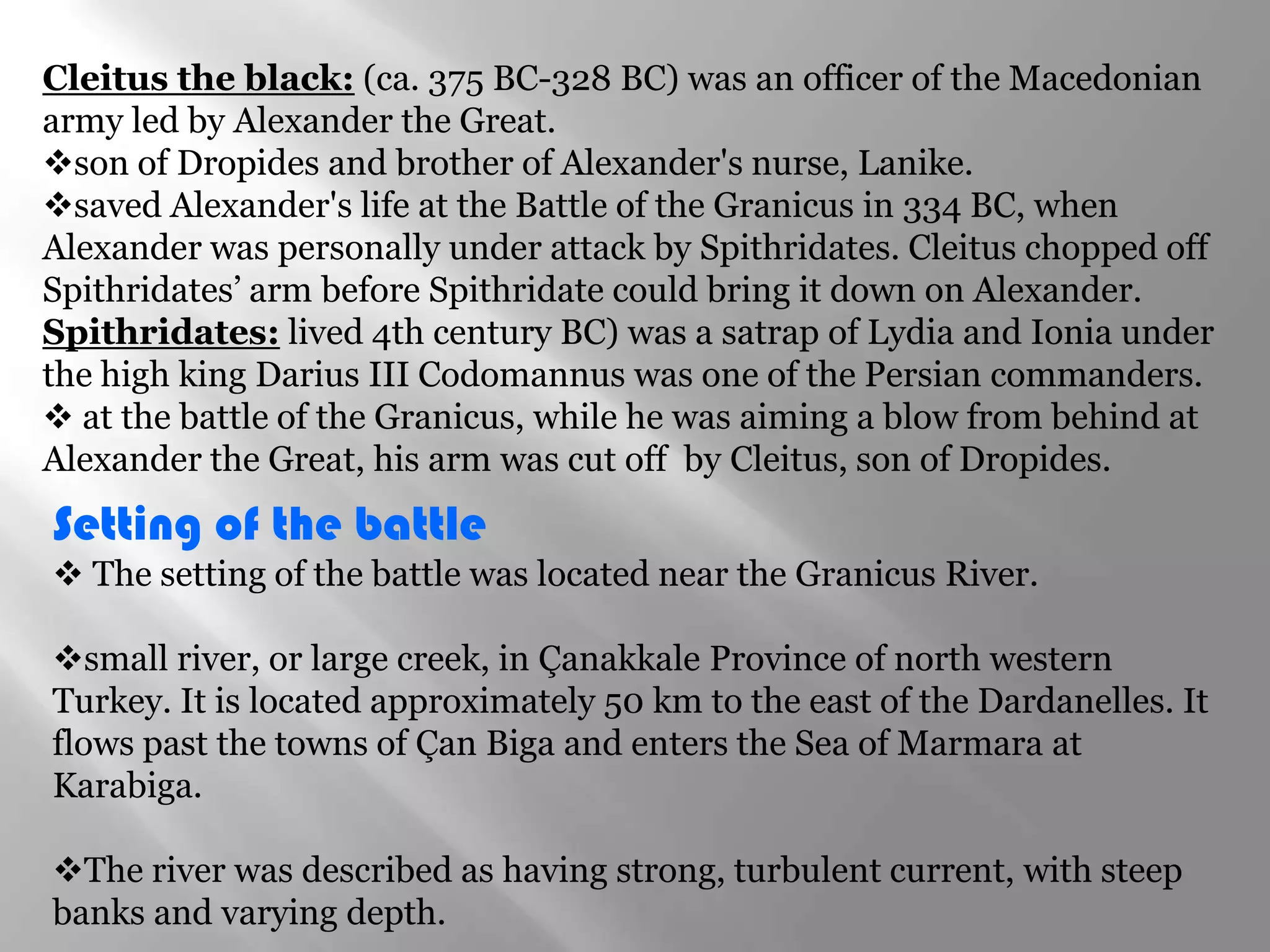
The Battle between Alexander and the PersiansThe Battle of the Granicus River in May 334 BC was the first of three major battles fought between Alexander the Great and the Persian Empire.In the early summer of 334 B.C, Alexander the Great, won his first victory in his invasion of the Persian Empire. The battle was fought in North western Asia Minor, near the site of Troy, in which it was here where Alexander defeated the Persian satraps of Asia Minor, also including a large force of Greek mercenaries led by Memnon of Rhodes. The battle took place on the road from Abydos to Dascylium, which is near modern day Ergili, Turkey, at the crossing of the Granicus River.
18,000 mercenaries were killed and 2,000 enslaved and sent back to Macedonia in chains for hard labor.
It is believed that Alexander had a strong majority of the mercenaries killed in fear of plague. Important Characters in the BattleAlexander the Great:was born at Pella, Macedonia in 356 B.C.E. His father was King Phillip II and his mother was Olympias, a deeply spiritual woman who taught her son that he was a descendant of Achilles and Hercules.
In 336 B.C.E. Phillip was assassinated and 20 year old Alexander took the throne of Macedonia.
Alexander the Great (356-323 BC), conquered the Persian Empire and annexed it to Macedonia, and is considered one of the greatest military geniuses of all times.
He is the first king to be called "the Great." Parmenion: (c.400-330): most trusted general of the Macedonian king Philip II, loyal supporter of Alexander the Great, but murdered on a false charge of treason.
Cleitus the black: (ca. 375 BC-328 BC) was an officer of the Macedonian army led by Alexander the Great. son of Dropides and brother of Alexander's nurse, Lanike.
saved Alexander's life at the Battle of the Granicus in 334 BC, when Alexander was personally under attack by Spithridates. Cleitus chopped off Spithridates’ arm before Spithridate could bring it down on Alexander. Spithridates: lived 4th century BC) was a satrap of Lydia and Ionia under the high king Darius III Codomannus was one of the Persian commanders. at the battle of the Granicus, while he was aiming a blow from behind at Alexander the Great, his arm was cut off  by Cleitus, son of Dropides. Setting of the battle  The setting of the battle was located near the Granicus River.

Battle.Presentation

  • 1.
    By: Rebecca LeeDate:August, 24th, 2009Granicus River 334 B.CAlexander versus the persians
  • 2.
    The Battle betweenAlexander and the PersiansThe Battle of the Granicus River in May 334 BC was the first of three major battles fought between Alexander the Great and the Persian Empire.In the early summer of 334 B.C, Alexander the Great, won his first victory in his invasion of the Persian Empire. The battle was fought in North western Asia Minor, near the site of Troy, in which it was here where Alexander defeated the Persian satraps of Asia Minor, also including a large force of Greek mercenaries led by Memnon of Rhodes. The battle took place on the road from Abydos to Dascylium, which is near modern day Ergili, Turkey, at the crossing of the Granicus River.
  • 3.
    18,000 mercenaries werekilled and 2,000 enslaved and sent back to Macedonia in chains for hard labor.
  • 4.
    It is believedthat Alexander had a strong majority of the mercenaries killed in fear of plague. Important Characters in the BattleAlexander the Great:was born at Pella, Macedonia in 356 B.C.E. His father was King Phillip II and his mother was Olympias, a deeply spiritual woman who taught her son that he was a descendant of Achilles and Hercules.
  • 5.
    In 336 B.C.E.Phillip was assassinated and 20 year old Alexander took the throne of Macedonia.
  • 6.
    Alexander the Great(356-323 BC), conquered the Persian Empire and annexed it to Macedonia, and is considered one of the greatest military geniuses of all times.
  • 7.
    He is thefirst king to be called "the Great." Parmenion: (c.400-330): most trusted general of the Macedonian king Philip II, loyal supporter of Alexander the Great, but murdered on a false charge of treason.
  • 8.
    Cleitus the black:(ca. 375 BC-328 BC) was an officer of the Macedonian army led by Alexander the Great. son of Dropides and brother of Alexander's nurse, Lanike.
  • 9.
    saved Alexander's lifeat the Battle of the Granicus in 334 BC, when Alexander was personally under attack by Spithridates. Cleitus chopped off Spithridates’ arm before Spithridate could bring it down on Alexander. Spithridates: lived 4th century BC) was a satrap of Lydia and Ionia under the high king Darius III Codomannus was one of the Persian commanders. at the battle of the Granicus, while he was aiming a blow from behind at Alexander the Great, his arm was cut off by Cleitus, son of Dropides. Setting of the battle The setting of the battle was located near the Granicus River.
  • 10.
    small river, orlarge creek, in Çanakkale Province of north western Turkey. It is located approximately 50 km to the east of the Dardanelles. It flows past the towns of ÇanBiga and enters the Sea of Marmara at Karabiga.
  • 11.
    The river wasdescribed as having strong, turbulent current, with steep banks and varying depth. Map and Battle Tatic
  • 12.
    Historical Background onthe battle Philip II of Macedonia had built a powerful army and used it to bring all of Greece under his control. After his assassination in 336 BC, Philip’s 20-year-old son Alexander inherited the throne.
  • 13.
    Alexander crossed theHellespont, which is the strait between the Aegean and the Sea of Marmara that separates European Turkey from Asian Turkey, with the intent on conquering the mighty Persian Empire.
  • 14.
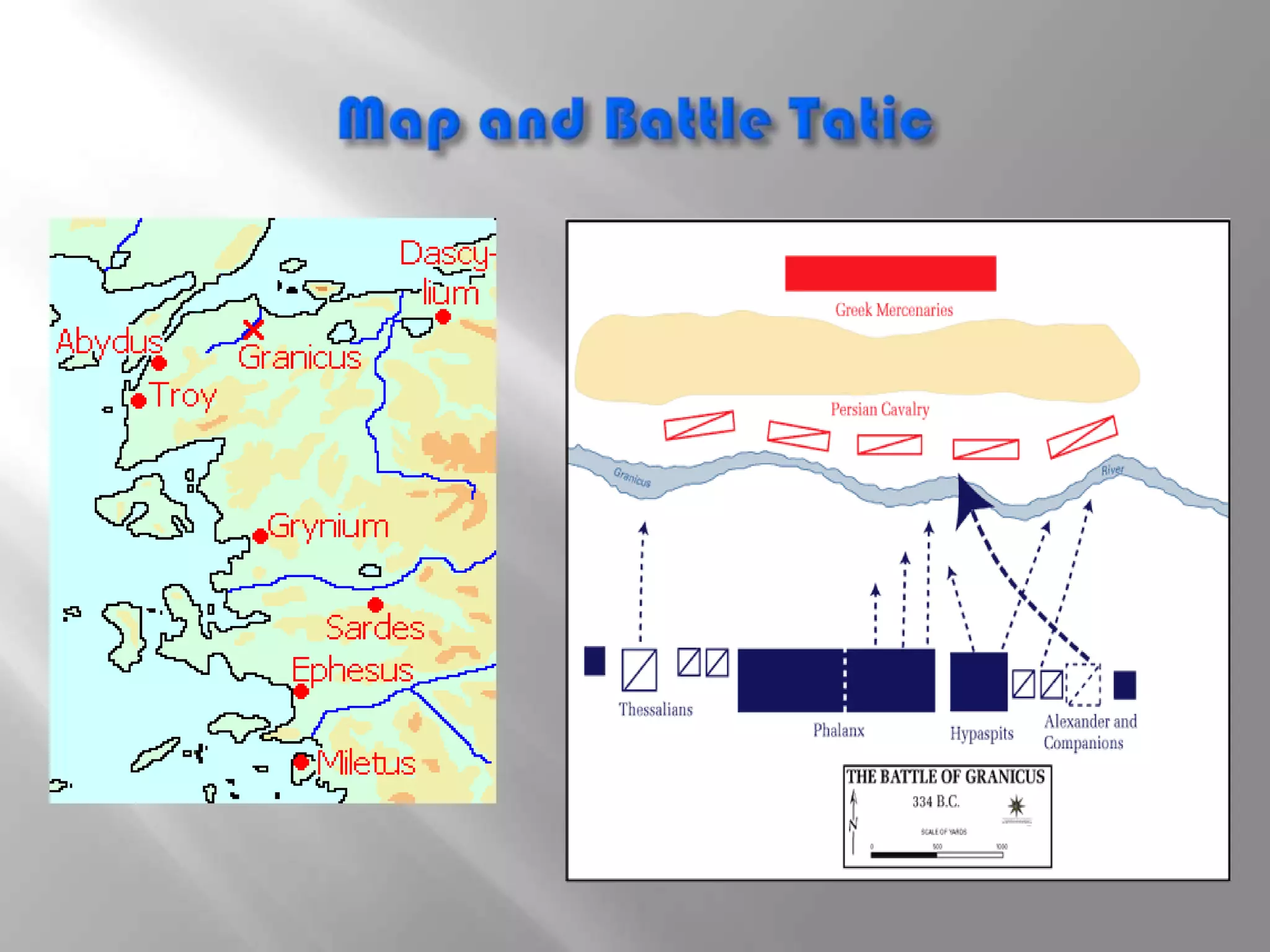
    The first majorbattle came at the Granicus River. Alexander led his elite Companion cavalry across the river to the Persians. It worked, almost too well. Alexander was nearly killed when the Persians counterattacked, but the tactic worked.
  • 15.
    Alexander’s Macedonian phalanxeswere able to cross the river and defeat the Persian army.
  • 16.
    Alexander’s victories wouldcontinue and his victorious army would travel as far as India before his death at the age of 33. Lifestyles of the people in the battle Alexander the Great took over his father’s throne when he was just 20 years old. His lifestyle was of course being a ruler and conquers. Until his death, he fought and conquered, and went one an epic journey that took him from his home, Greece, eastwards through to India. Marches, bloody battles, drunken nights, murderous feuds and the destruction of cities across the Persian Empire were all part of his journey.
  • 17.
    The Persians settledon relatively poor and remote lands where they were little troubled by first the Elamites to their west, then the Assyrians who destroyed the Elamites around 640 BC, and then the Medes (to their north) and resurgent Babylonians who conquered Assyria in 609 BC.
  • 18.
    The earlyPersian economy was based on herding because the land was so poor for agriculture. The Persians attributed their toughness to the meager lifestyle to which they had been acclimated for generations.
  • 19.
    The sudden acquisitionof the Median Empire, Lydia, Babylon, Egypt, and gold-rich areas in India made Persia an economic powerhouse. It controlled the rich agricultural areas of Mesopotomia, the grasslands of Anatolia, the trade routes in every direction, and rich deposits of metals and other resources. Impact of battle on civilizations and cultures This battle had several impacts on cultures and civilizations. For one, through this battle several cities of Asia Minor were liberated by Alexander the Great.
  • 20.
    Also, the deathsof Persian leaders which ultimately affected the overall strength of the Persian army. Satraps are governors of Persian provinces and through this battle, Alexander defeated these Persian governors.
  • 21.
    Those of whowere in Asia Minor were liberated of Persian rule.
  • 22.
    Culture wise aswell, since Persian influence is no longer present in Asia Minor, Alexander also defeated Memnon of Rhodes who was the commander of the Greek mercenaries working for the Persian king. Thank you for Listening!