SCHOOL AGRICULTURA
NORTH-EAST
MARROQUIN BELTETON, BRAYAN RICARDO
5to. P.A. Agrónomo Expert “A”
English
IIING. Oscar García Report
#5
Different types of pronous
Zacapa March 4th
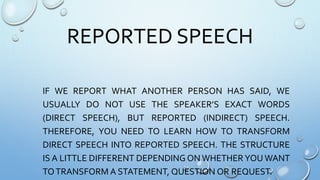
REPORTED SPEECH
REPORTED SPEECH
IF WE REPORT WHAT ANOTHER PERSON HAS SAID, WE
USUALLY DO NOT USE THE SPEAKER’S EXACT WORDS
(DIRECT SPEECH), BUT REPORTED (INDIRECT) SPEECH.
THEREFORE, YOU NEED TO LEARN HOW TO TRANSFORM
DIRECT SPEECH INTO REPORTED SPEECH. THE STRUCTURE
IS A LITTLE DIFFERENT DEPENDING ON WHETHER YOU WANT
TOTRANSFORM A STATEMENT, QUESTION OR REQUEST.
.
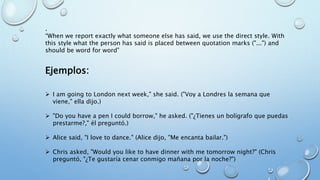
“When we report exactly what someone else has said, we use the direct style. With
this style what the person has said is placed between quotation marks ("...") and
should be word for word”
Ejemplos:
 I am going to London next week," she said. ("Voy a Londres la semana que
viene," ella dijo.)
 "Do you have a pen I could borrow," he asked. ("¿Tienes un bolígrafo que puedas
prestarme?," él preguntó.)
 Alice said, "I love to dance." (Alice dijo, "Me encanta bailar.")
 Chris asked, "Would you like to have dinner with me tomorrow night?" (Chris
preguntó, "¿Te gustaría cenar conmigo mañana por la noche?")
PRESENT AND PAST PARTICIPLE
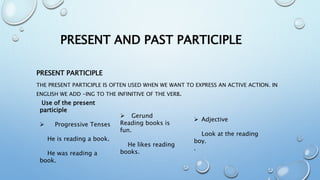
PRESENT PARTICIPLE
THE PRESENT PARTICIPLE IS OFTEN USED WHEN WE WANT TO EXPRESS AN ACTIVE ACTION. IN
ENGLISH WE ADD -ING TO THE INFINITIVE OF THE VERB.
Use of the present
participle
 Progressive Tenses
He is reading a book.
He was reading a
book.
 Gerund
Reading books is
fun.
He likes reading
books.
 Adjective
Look at the reading
boy.
.
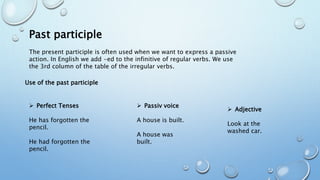
Past participle
The present participle is often used when we want to express a passive
action. In English we add -ed to the infinitive of regular verbs. We use
the 3rd column of the table of the irregular verbs.
Use of the past participle
 Perfect Tenses
He has forgotten the
pencil.
He had forgotten the
pencil.
 Passiv voice
A house is built.
A house was
built.
 Adjective
Look at the
washed car.
Uso del should
USO DEL SHOULD
SHOULD
IT IS USED TO GIVE ADVICE. IT INDICATESTHAT SOMETHING IS GOOD AND THEREFORE SHOULD BE DONE.
IT IS A RECOMMENDATION, NOT A REQUIREMENT. IT HAS LESS TAX FORCE "MUST" AND "HAVETO".
 If you feel bad you should go to the doctor
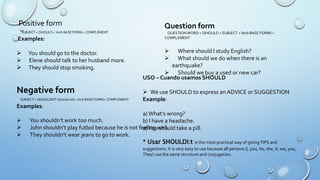
Positive form
SUBJECT + (SHOULD + Verb BASE FORM) + COMPLEMENT
Examples:
 You should go to the doctor.
 Elene should talk to her husband more.
 They should stop smoking.
Negative form
SUBJECT + (SHOULDN’T (should not)+ Verb BASE FORM)+ COMPLEMENT
Examples:
 You shouldn’t work too much.
 John shouldn’t play futbol because he is not feeling well.
 They shouldn’t wear jeans to go to work.
Question form
QUESTIONWORD + (SHOULD + SUBJECT +Verb BASE FORM) +
COMPLEMENT
 Where should I study English?
 What should we do when there is an
earthquake?
 Should we buy a used or new car?
USO – Cuando usamos SHOULD
 We use SHOULD to express an ADVICE or SUGGESTION
Example:
a) What’s wrong?
b) I have a headache.
a)You should take a pill.
* Usar SHOULDI:t is the most practical way of givingTIPS and
suggestions. It is very easy to use because all persons (I, you, he, she, it, we, you,
They) use the same structure and conjugation.
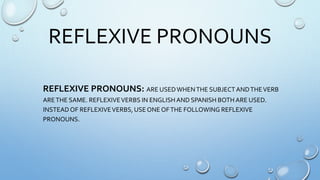
REFLEXIVE PRONOUNS
REFLEXIVE PRONOUNS
REFLEXIVE PRONOUNS: ARE USEDWHENTHE SUBJECTANDTHEVERB
ARETHE SAME. REFLEXIVEVERBS IN ENGLISHAND SPANISH BOTH ARE USED.
INSTEADOF REFLEXIVEVERBS, USE ONE OFTHE FOLLOWING REFLEXIVE
PRONOUNS.
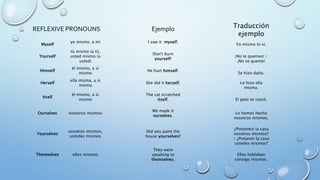
REFLEXIVE PRONOUNS
Myself
yo mismo, a mí
Yourself
tú mismo (a ti),
usted mismo (a
usted)
Himself
él mismo, a sí
mismo
Herself
ella misma, a sí
misma
Itself
él mismo, a sí
mismo
Ourselves nosotros mismos
Yourselves
vosotros mismos,
ustedes mismos
Themselves ellos mismos
Ejemplo
I saw it myself.
Don't burn
yourself!
He hurt himself.
She did it herself.
The cat scratched
itself.
We made it
ourselves.
Did you paint the
house yourselves?
They were
speaking to
themselves.
Traducción
ejemplo
Yo mismo lo vi.
¡No te quemes! /
¡No se queme!
Se hizo daño.
Lo hizo ella
misma.
El gato se rascó.
Lo hemos hecho
nosotros mismos.
¿Pintasteis la casa
vosotros mismos?
/ ¿Pintaron la casa
ustedes mismos?
Ellos hablaban
consigo mismos.
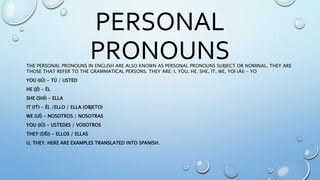
PERSONAL PRONOUNS
PERSONAL
PRONOUNSTHE PERSONAL PRONOUNS IN ENGLISH ARE ALSO KNOWN AS PERSONAL PRONOUNS SUBJECT OR NOMINAL. THEY ARE
THOSE THAT REFER TO THE GRAMMATICAL PERSONS. THEY ARE: I, YOU, HE, SHE, IT, WE, YOI (ÁI) - YO
YOU (IÚ) - TÚ / USTED
HE (JÍ) - ÉL
SHE (SHÍ) - ELLA
IT (IT) - ÉL /ELLO / ELLA (OBJETO)
WE (UÍ) - NOSOTROS / NOSOTRAS
YOU (IÚ) - USTEDES / VOSOTROS
THEY (DÉI) - ELLOS / ELLAS
U, THEY. HERE ARE EXAMPLES TRANSLATED INTO SPANISH.
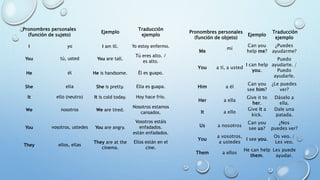
Pronombres personales
(función de sujeto)
Ejemplo
Traducción
ejemplo
I yo I am ill. Yo estoy enfermo.
You tú, usted You are tall.
Tú eres alto. /
es alto.
He él He is handsome. Él es guapo.
She ella She is pretty. Ella es guapa.
It ello (neutro) It is cold today. Hoy hace frío.
We nosotros We are tired.
Nosotros estamos
cansados.
You vosotros, ustedes You are angry.
Vosotros estáis
enfadados.
están enfadados.
They ellos, ellas
They are at the
cinema.
Ellos están en el
cine.
Pronombres personales
(función de objeto)
Ejemplo
Traducción
ejemplo
Me
mí
Can you
help me?
¿Puedes
ayudarme?
You a tí, a usted
I can help
you.
Puedo
ayudarte. /
Puedo
ayudarle.
Him a él
Can you
see him?
¿Le puedes
ver?
Her a ella
Give it to
her.
Dáselo a
ella.
It a ello
Give it a
kick.
Dale una
patada.
Us a nosotros
Can you
see us?
¿Nos
puedes ver?
You
a vosotros,
a ustedes
I see you.
Os veo. /
Les veo.
Them a ellos
He can help
them.
Les puede
ayudar.
INDEFINITE PRONOUNS
INDEFINITE
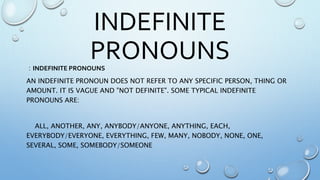
PRONOUNS: INDEFINITE PRONOUNS
AN INDEFINITE PRONOUN DOES NOT REFER TO ANY SPECIFIC PERSON, THING OR
AMOUNT. IT IS VAGUE AND "NOT DEFINITE". SOME TYPICAL INDEFINITE
PRONOUNS ARE:
ALL, ANOTHER, ANY, ANYBODY/ANYONE, ANYTHING, EACH,
EVERYBODY/EVERYONE, EVERYTHING, FEW, MANY, NOBODY, NONE, ONE,
SEVERAL, SOME, SOMEBODY/SOMEONE
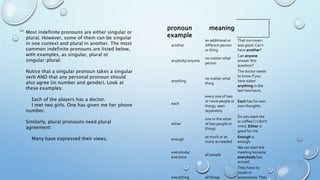
Most indefinite pronouns are either singular or
plural. However, some of them can be singular
in one context and plural in another. The most
common indefinite pronouns are listed below,
with examples, as singular, plural or
singular/plural.
Notice that a singular pronoun takes a singular
verb AND that any personal pronoun should
also agree (in number and gender). Look at
these examples:
Each of the players has a doctor.
I met two girls. One has given me her phone
number.
Similarly, plural pronouns need plural
agreement:
Many have expressed their views.
another
an additional or
different person
or thing
That ice-cream
was good. Can I
have another?
anybody/ anyone
no matter what
person
Can anyone
answer this
question?
anything
no matter what
thing
The doctor needs
to know if you
have eaten
anything in the
last two hours.
each
every one of two
or more people or
things, seen
separately
Each has his own
own thoughts.
either
one or the other
of two people or
things
Do you want tea
or coffee? / I don't
mind. Either is
good for me.
enough
as much or as
many as needed
Enough is
enough.
everybody/
everyone
all people
We can start the
meeting because
everybody has
arrived.
everything all things
They have no
house or
possessions. They
pronoun meaning
example

Presentación1 brayan marroquin

  • 1.
    SCHOOL AGRICULTURA NORTH-EAST MARROQUIN BELTETON,BRAYAN RICARDO 5to. P.A. Agrónomo Expert “A” English IIING. Oscar García Report #5 Different types of pronous Zacapa March 4th
  • 2.
  • 3.
    REPORTED SPEECH IF WEREPORT WHAT ANOTHER PERSON HAS SAID, WE USUALLY DO NOT USE THE SPEAKER’S EXACT WORDS (DIRECT SPEECH), BUT REPORTED (INDIRECT) SPEECH. THEREFORE, YOU NEED TO LEARN HOW TO TRANSFORM DIRECT SPEECH INTO REPORTED SPEECH. THE STRUCTURE IS A LITTLE DIFFERENT DEPENDING ON WHETHER YOU WANT TOTRANSFORM A STATEMENT, QUESTION OR REQUEST.
  • 4.
    . “When we reportexactly what someone else has said, we use the direct style. With this style what the person has said is placed between quotation marks ("...") and should be word for word” Ejemplos:  I am going to London next week," she said. ("Voy a Londres la semana que viene," ella dijo.)  "Do you have a pen I could borrow," he asked. ("¿Tienes un bolígrafo que puedas prestarme?," él preguntó.)  Alice said, "I love to dance." (Alice dijo, "Me encanta bailar.")  Chris asked, "Would you like to have dinner with me tomorrow night?" (Chris preguntó, "¿Te gustaría cenar conmigo mañana por la noche?")
  • 5.
    PRESENT AND PASTPARTICIPLE
  • 6.
    PRESENT AND PASTPARTICIPLE PRESENT PARTICIPLE THE PRESENT PARTICIPLE IS OFTEN USED WHEN WE WANT TO EXPRESS AN ACTIVE ACTION. IN ENGLISH WE ADD -ING TO THE INFINITIVE OF THE VERB. Use of the present participle  Progressive Tenses He is reading a book. He was reading a book.  Gerund Reading books is fun. He likes reading books.  Adjective Look at the reading boy. .
  • 7.
    Past participle The presentparticiple is often used when we want to express a passive action. In English we add -ed to the infinitive of regular verbs. We use the 3rd column of the table of the irregular verbs. Use of the past participle  Perfect Tenses He has forgotten the pencil. He had forgotten the pencil.  Passiv voice A house is built. A house was built.  Adjective Look at the washed car.
  • 8.
  • 9.
    USO DEL SHOULD SHOULD ITIS USED TO GIVE ADVICE. IT INDICATESTHAT SOMETHING IS GOOD AND THEREFORE SHOULD BE DONE. IT IS A RECOMMENDATION, NOT A REQUIREMENT. IT HAS LESS TAX FORCE "MUST" AND "HAVETO".  If you feel bad you should go to the doctor
  • 10.
    Positive form SUBJECT +(SHOULD + Verb BASE FORM) + COMPLEMENT Examples:  You should go to the doctor.  Elene should talk to her husband more.  They should stop smoking. Negative form SUBJECT + (SHOULDN’T (should not)+ Verb BASE FORM)+ COMPLEMENT Examples:  You shouldn’t work too much.  John shouldn’t play futbol because he is not feeling well.  They shouldn’t wear jeans to go to work. Question form QUESTIONWORD + (SHOULD + SUBJECT +Verb BASE FORM) + COMPLEMENT  Where should I study English?  What should we do when there is an earthquake?  Should we buy a used or new car? USO – Cuando usamos SHOULD  We use SHOULD to express an ADVICE or SUGGESTION Example: a) What’s wrong? b) I have a headache. a)You should take a pill. * Usar SHOULDI:t is the most practical way of givingTIPS and suggestions. It is very easy to use because all persons (I, you, he, she, it, we, you, They) use the same structure and conjugation.
  • 11.
  • 12.
    REFLEXIVE PRONOUNS REFLEXIVE PRONOUNS:ARE USEDWHENTHE SUBJECTANDTHEVERB ARETHE SAME. REFLEXIVEVERBS IN ENGLISHAND SPANISH BOTH ARE USED. INSTEADOF REFLEXIVEVERBS, USE ONE OFTHE FOLLOWING REFLEXIVE PRONOUNS.
  • 13.
    REFLEXIVE PRONOUNS Myself yo mismo,a mí Yourself tú mismo (a ti), usted mismo (a usted) Himself él mismo, a sí mismo Herself ella misma, a sí misma Itself él mismo, a sí mismo Ourselves nosotros mismos Yourselves vosotros mismos, ustedes mismos Themselves ellos mismos Ejemplo I saw it myself. Don't burn yourself! He hurt himself. She did it herself. The cat scratched itself. We made it ourselves. Did you paint the house yourselves? They were speaking to themselves. Traducción ejemplo Yo mismo lo vi. ¡No te quemes! / ¡No se queme! Se hizo daño. Lo hizo ella misma. El gato se rascó. Lo hemos hecho nosotros mismos. ¿Pintasteis la casa vosotros mismos? / ¿Pintaron la casa ustedes mismos? Ellos hablaban consigo mismos.
  • 14.
  • 15.
    PERSONAL PRONOUNSTHE PERSONAL PRONOUNSIN ENGLISH ARE ALSO KNOWN AS PERSONAL PRONOUNS SUBJECT OR NOMINAL. THEY ARE THOSE THAT REFER TO THE GRAMMATICAL PERSONS. THEY ARE: I, YOU, HE, SHE, IT, WE, YOI (ÁI) - YO YOU (IÚ) - TÚ / USTED HE (JÍ) - ÉL SHE (SHÍ) - ELLA IT (IT) - ÉL /ELLO / ELLA (OBJETO) WE (UÍ) - NOSOTROS / NOSOTRAS YOU (IÚ) - USTEDES / VOSOTROS THEY (DÉI) - ELLOS / ELLAS U, THEY. HERE ARE EXAMPLES TRANSLATED INTO SPANISH.
  • 16.
    Pronombres personales (función desujeto) Ejemplo Traducción ejemplo I yo I am ill. Yo estoy enfermo. You tú, usted You are tall. Tú eres alto. / es alto. He él He is handsome. Él es guapo. She ella She is pretty. Ella es guapa. It ello (neutro) It is cold today. Hoy hace frío. We nosotros We are tired. Nosotros estamos cansados. You vosotros, ustedes You are angry. Vosotros estáis enfadados. están enfadados. They ellos, ellas They are at the cinema. Ellos están en el cine. Pronombres personales (función de objeto) Ejemplo Traducción ejemplo Me mí Can you help me? ¿Puedes ayudarme? You a tí, a usted I can help you. Puedo ayudarte. / Puedo ayudarle. Him a él Can you see him? ¿Le puedes ver? Her a ella Give it to her. Dáselo a ella. It a ello Give it a kick. Dale una patada. Us a nosotros Can you see us? ¿Nos puedes ver? You a vosotros, a ustedes I see you. Os veo. / Les veo. Them a ellos He can help them. Les puede ayudar.
  • 17.
  • 18.
    INDEFINITE PRONOUNS: INDEFINITE PRONOUNS ANINDEFINITE PRONOUN DOES NOT REFER TO ANY SPECIFIC PERSON, THING OR AMOUNT. IT IS VAGUE AND "NOT DEFINITE". SOME TYPICAL INDEFINITE PRONOUNS ARE: ALL, ANOTHER, ANY, ANYBODY/ANYONE, ANYTHING, EACH, EVERYBODY/EVERYONE, EVERYTHING, FEW, MANY, NOBODY, NONE, ONE, SEVERAL, SOME, SOMEBODY/SOMEONE
  • 19.
    Most indefinite pronounsare either singular or plural. However, some of them can be singular in one context and plural in another. The most common indefinite pronouns are listed below, with examples, as singular, plural or singular/plural. Notice that a singular pronoun takes a singular verb AND that any personal pronoun should also agree (in number and gender). Look at these examples: Each of the players has a doctor. I met two girls. One has given me her phone number. Similarly, plural pronouns need plural agreement: Many have expressed their views. another an additional or different person or thing That ice-cream was good. Can I have another? anybody/ anyone no matter what person Can anyone answer this question? anything no matter what thing The doctor needs to know if you have eaten anything in the last two hours. each every one of two or more people or things, seen separately Each has his own own thoughts. either one or the other of two people or things Do you want tea or coffee? / I don't mind. Either is good for me. enough as much or as many as needed Enough is enough. everybody/ everyone all people We can start the meeting because everybody has arrived. everything all things They have no house or possessions. They pronoun meaning example