ALCOHOL ABUSE  AND  ASSOCIATED DISORDERS KARTHIKEYAPRASATH DEPARTMENT OF PSYCHIATRY
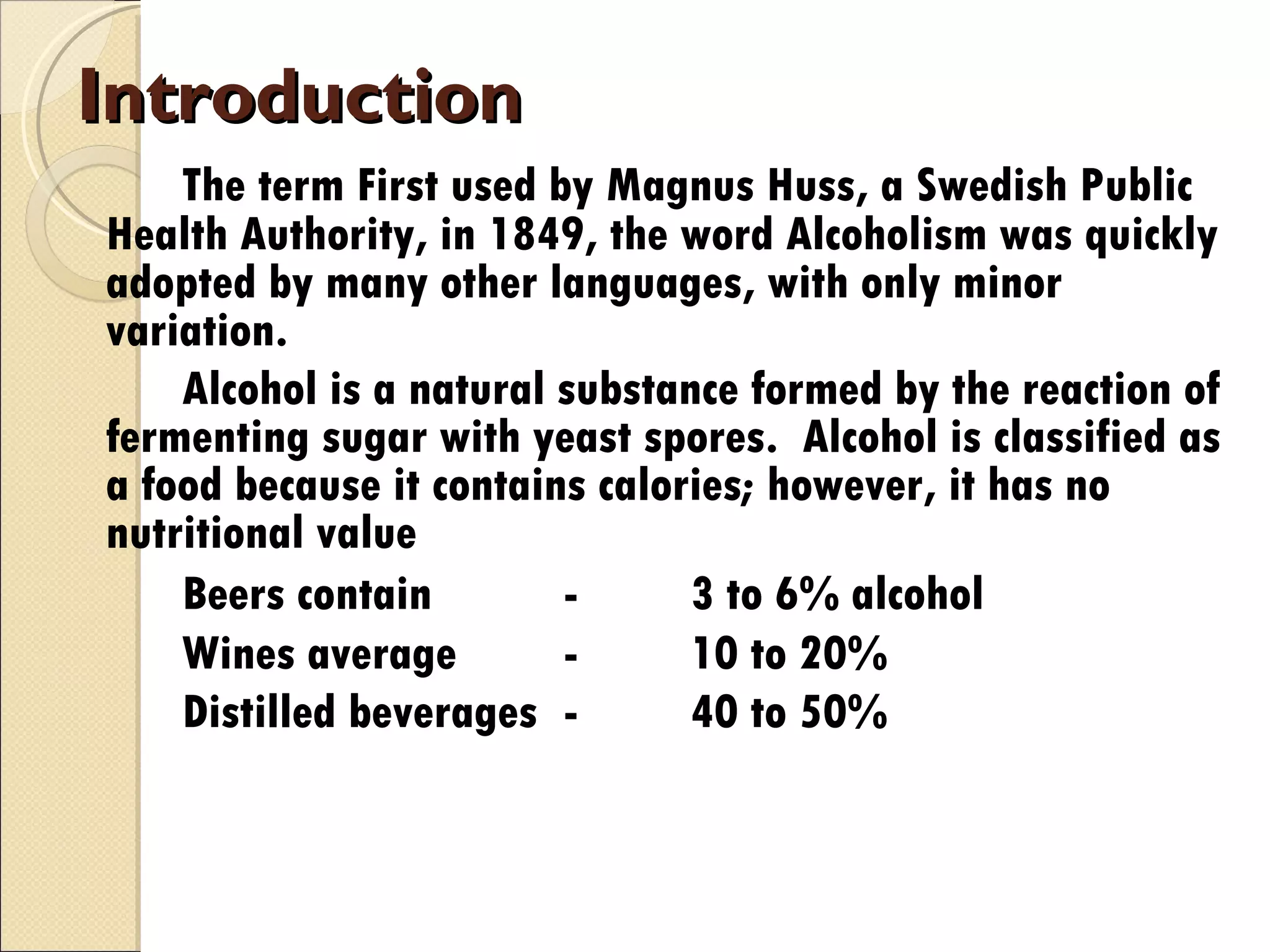
Introduction The term First used by Magnus Huss, a Swedish Public Health Authority, in 1849, the word Alcoholism was quickly adopted by many other languages, with only minor variation. Alcohol is a natural substance formed by the reaction of fermenting sugar with yeast spores.  Alcohol is classified as a food because it contains calories; however, it has no nutritional value Beers contain - 3 to 6% alcohol Wines average - 10 to 20% Distilled beverages - 40 to 50%
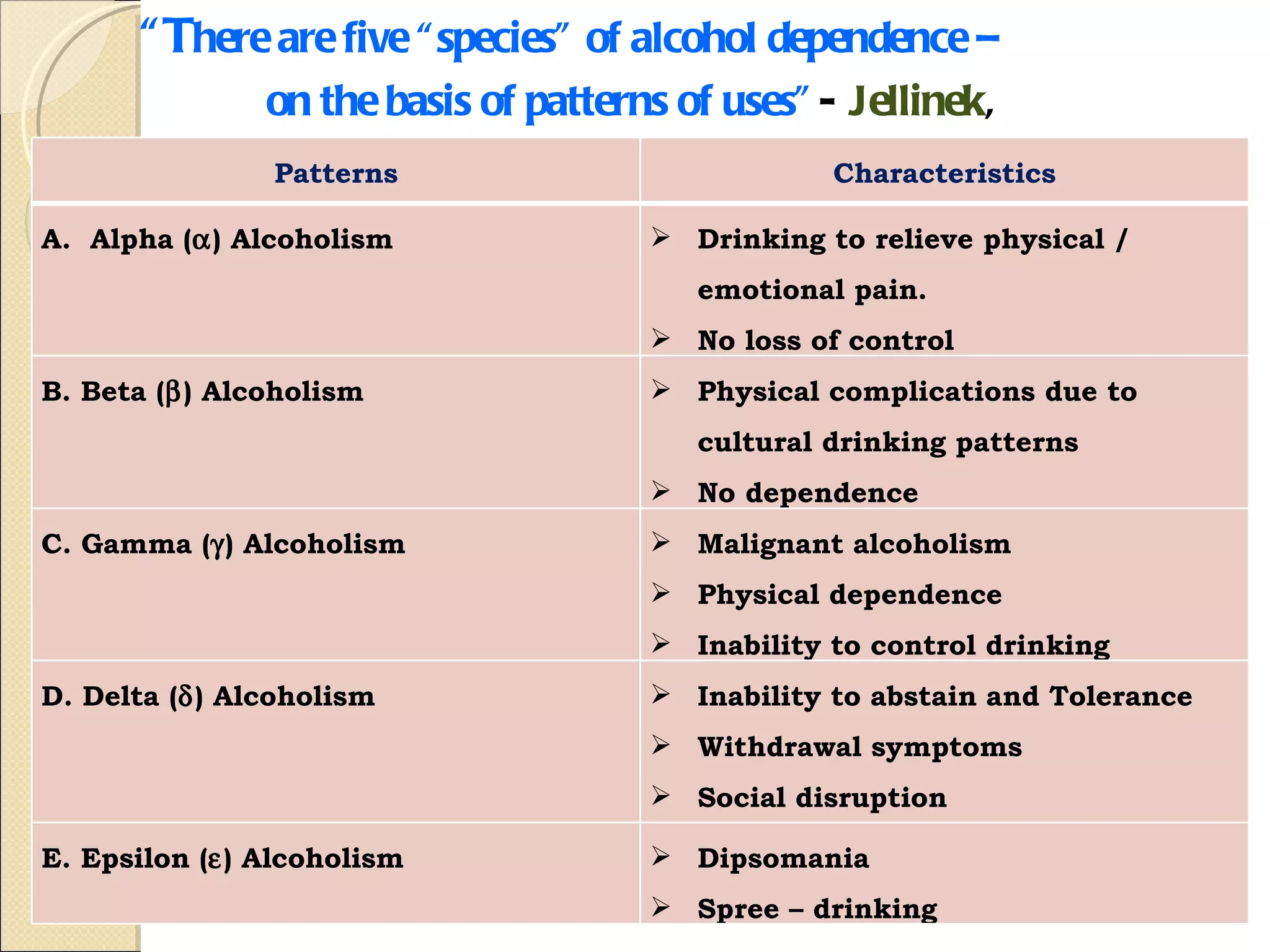
“ T here are five “species” of alcohol dependence –  on the basis of patterns of uses ” -   Jellinek ,    Patterns Characteristics A.  Alpha (  ) Alcoholism Drinking to relieve physical / emotional pain. No loss of control B. Beta (  ) Alcoholism Physical complications due to cultural drinking patterns No dependence C. Gamma (  ) Alcoholism  Malignant alcoholism Physical dependence Inability to control drinking D. Delta (  ) Alcoholism Inability to abstain and Tolerance Withdrawal symptoms Social disruption E. Epsilon (  ) Alcoholism Dipsomania Spree – drinking
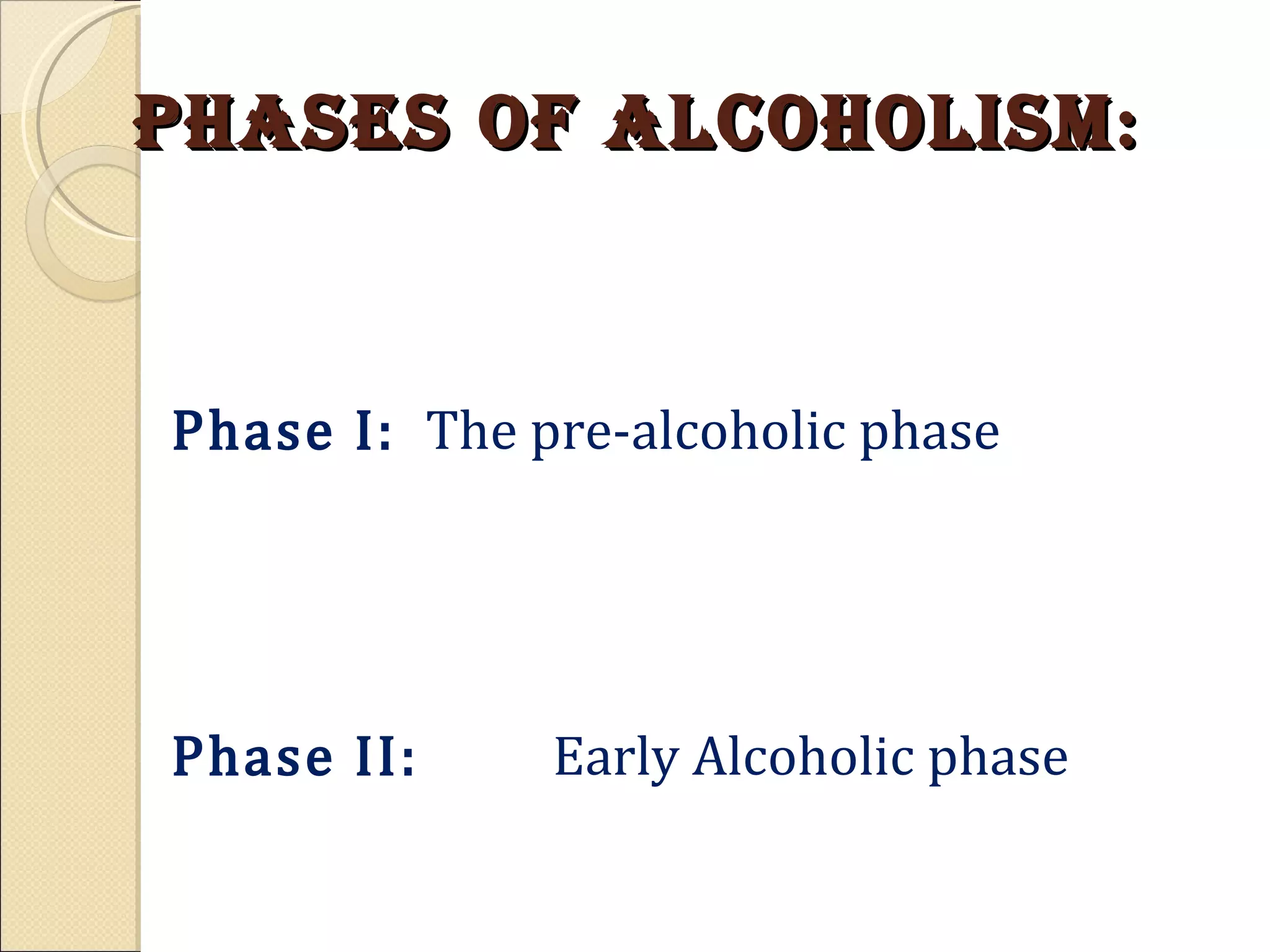
Phases of Alcoholism : Phase I: The pre-alcoholic phase Phase II:   Early Alcoholic phase Phase III:  True Alcoholics (Crucial Phase) Phase IV:   Chronic (Chronic Alcohol ic)
Phase I: The prealcoholic phase: This phase is characterized by the use of alcohol to relieve the everyday stress of tensions of life.  One individual drinks because of social motivations, and finds that alcohol relieves stress.  Overtime, needs to increase the amount of alcohol needed for relief.
Phase II: Early Alcoholic phase This phase begins the black outs – brief periods of amnesia that occur during or immediately following a period of drinking.  In this phase, person begins to drink alone and becomes preoccupation with the supply of drinks.  Person wakes up in the morning and needs a drink to control tremors
Phase III:  True Alcoholics (Crucial Phase ) In this phase the individual has lost control and physiological dependence is clearly evident.  In which, completely loses control over ability to choose whether or not to drink. The person experiences the following:  isolation from other’s aggression,  loss of interest in any activity that once brought pleasure,  impotence,  nutritional impairment.
Phase IV:   Chronic (Chronic Alcoholic) This phase is characterized by emotional and physical disintegration.  Emotional disintegration is evidenced by profound helplessness and self pity.  Hallucinations,  Tremors and convulsions,  severe agitation and panic are symptoms of alcoholism.  Depression and ideas of suicide are common.
Etiological Factors: Biological factors: Genetic vulnerability – family history of substance with disorder. Personality disorder Reinforcing effects of drugs Craving and withdrawal effects Biochemical factors
Etiological Factors: II.  Psychological factors: Curiosity Early initiation of alcohol and tobacco Poor impulse control Low self-esteem Poor stress management skills Childhood trauma / loss Psychological distress
Etiological Factors: III.  Social factors: Peer pressure Modeling Ease of availability of alcohol / drugs Religious reasons Poor social / familial support Rapid urbanization
Complications of alcohol dependence: I.  Medical complications: A.  Gastro – Intestinal system : Fatty liver, cirrhosis of liver, hepatitis, liver cell carcinoma, liver failure. Gastritis, reflux esophasitis, peptic ulcer, carcinoma stomach and esophagus. Malabsorption syndrome Pancreatitis, acute, chronic & relapsing
Complications of alcohol dependence: Medical complications: B.  Central Nervous System : Delirium tremens Rumfits Alcoholic hallucinosis Alcoholic dementia Sexual dysfunction Head injury & fractures
Complications of alcohol dependence: II.  Social Complications: Accidents Marital disharmony Divorce Occupational problems Criminality Financial difficulties
Complications by phases A.  Acute Intoxication: Symptoms of alcohol intoxication includes disinhibition of sexual or aggressive impulses, mood lability, impairment judgement, impaired social or occupational functioning, slurred speech, incoordination, unsteady gait, nystagmus & flushed face.  Intoxications usually occurs at blood alcohol levels between 100 and 200 mg/dl.
Complications by phases B.  Alcohol withdrawal syndrome:      
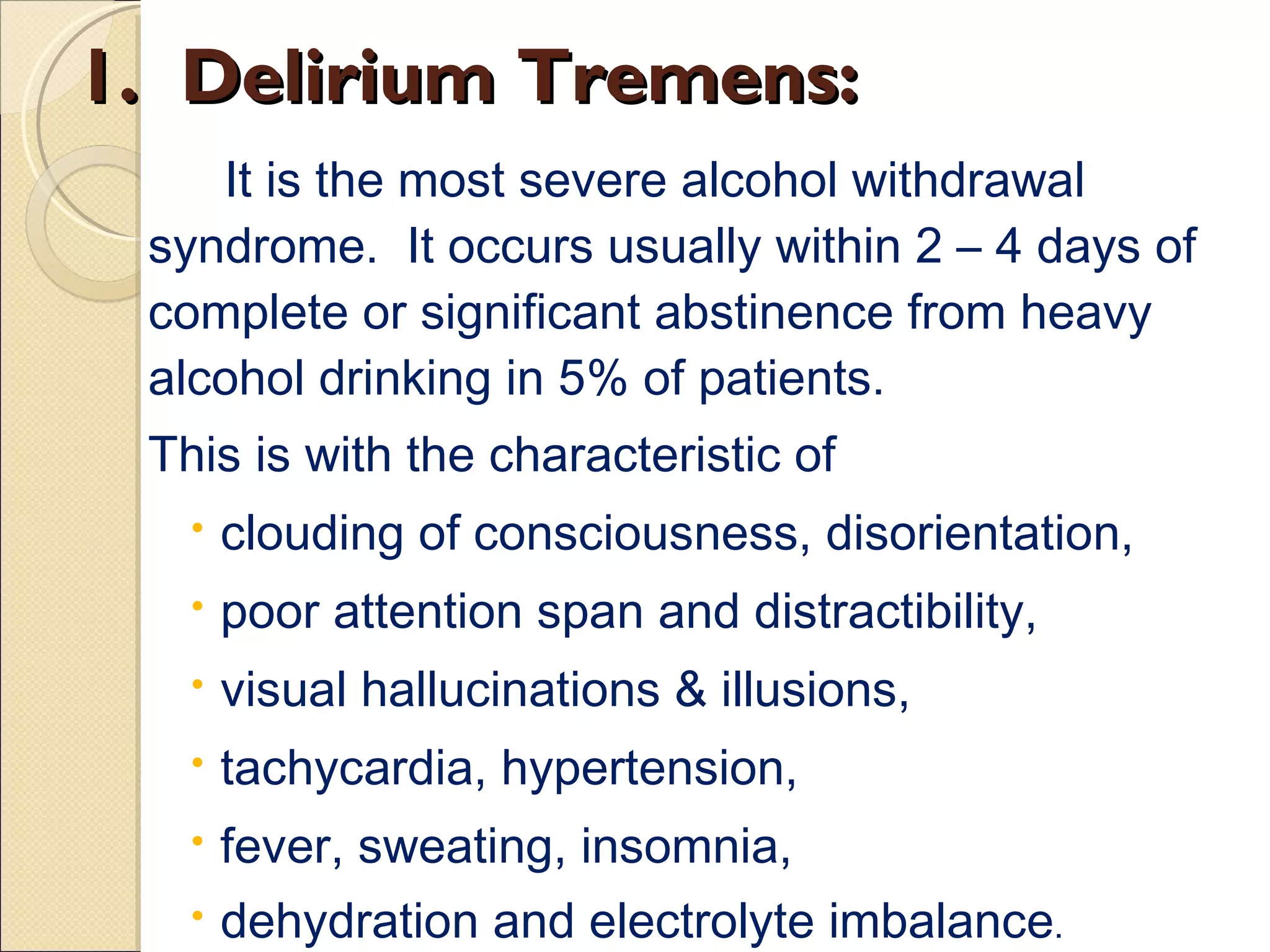
1.  Delirium Tremens: It is the most severe alcohol withdrawal syndrome.  It occurs usually within 2 – 4 days of complete or significant abstinence from heavy alcohol drinking in 5% of patients.  This is with the characteristic of  clouding of consciousness, disorientation,  poor attention span and distractibility,  visual hallucinations & illusions,  tachycardia, hypertension,  fever, sweating, insomnia,  dehydration and electrolyte imbalance .
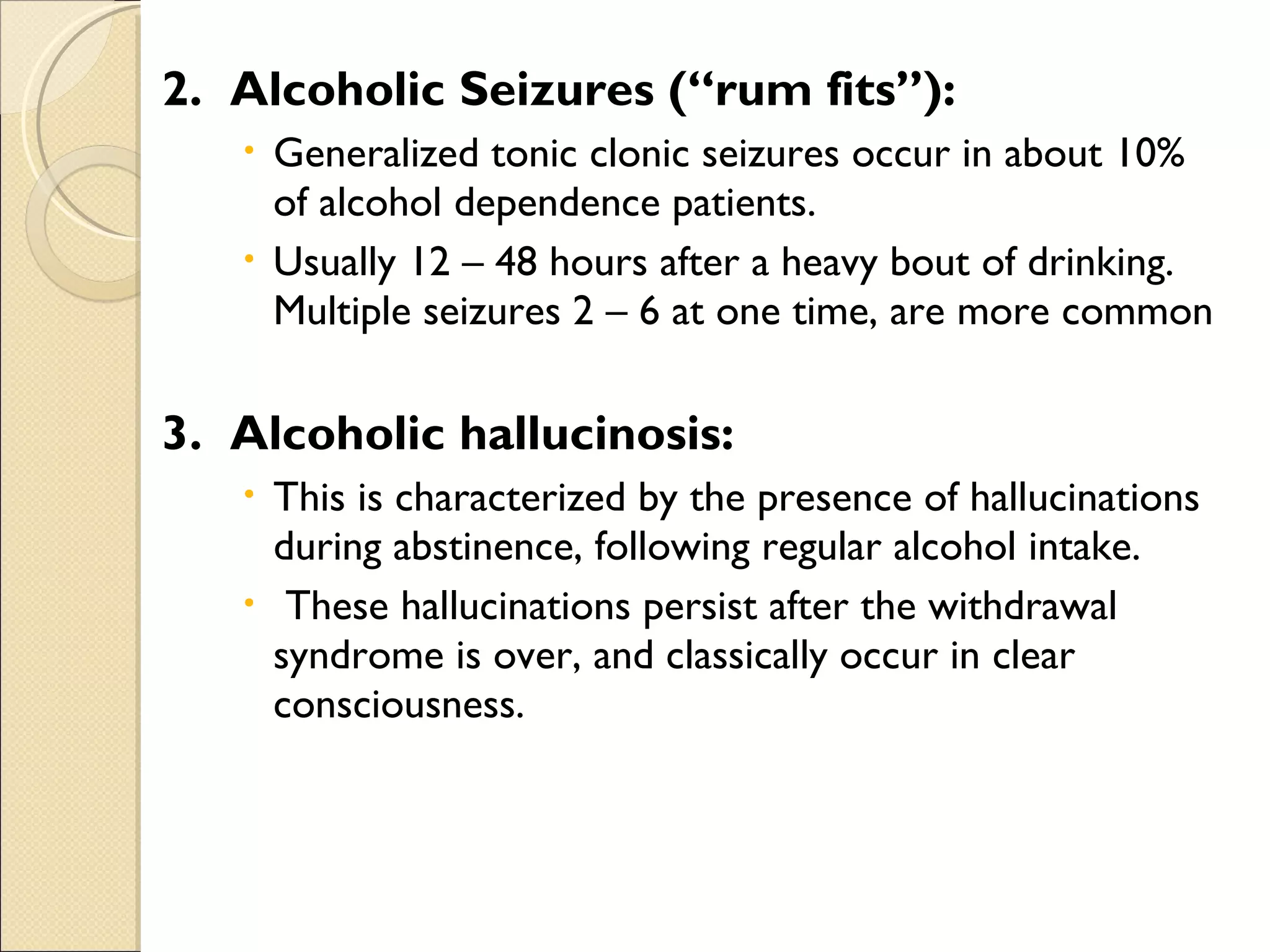
2.  Alcoholic Seizures (“rum fits”): Generalized tonic clonic seizures occur in about 10% of alcohol dependence patients.  Usually 12 – 48 hours after a heavy bout of drinking.  Multiple seizures 2 – 6 at one time, are more common 3.  Alcoholic hallucinosis: This is characterized by the presence of hallucinations during abstinence, following regular alcohol intake.  These hallucinations persist after the withdrawal syndrome is over, and classically occur in clear consciousness.
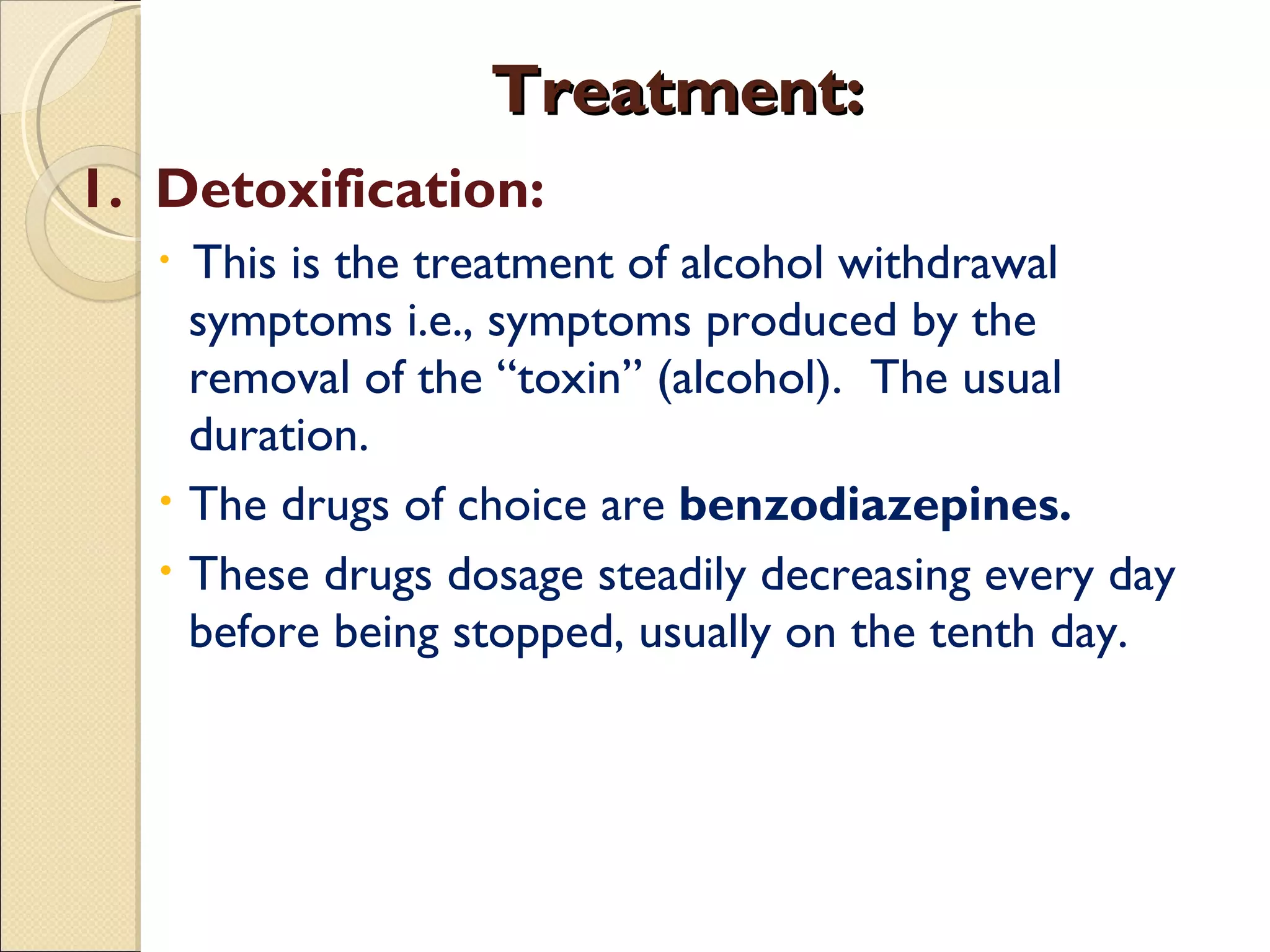
Treatment: 1.  Detoxification: This is the treatment of alcohol withdrawal symptoms i.e., symptoms produced by the removal of the “toxin” (alcohol).  The usual duration.  The drugs of choice are  benzodiazepines.  These drugs dosage steadily decreasing every day before being stopped, usually on the tenth day.
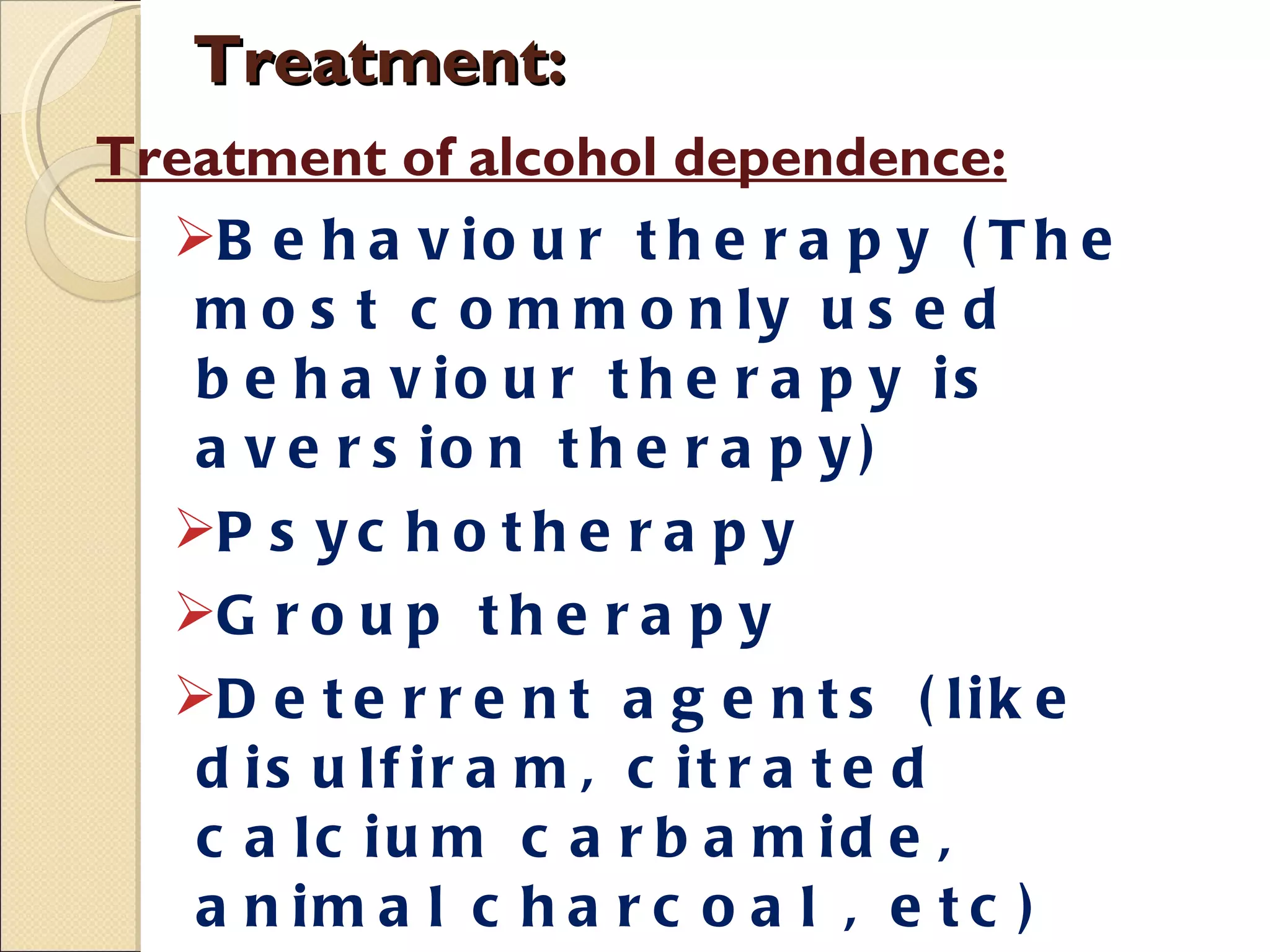
Treatment: Treatment of alcohol dependence: Behaviour therapy (The most commonly used behaviour therapy is aversion therapy) Psychotherapy Group therapy Deterrent agents (like disulfiram, citrated calcium carbamide, animal charcoal , etc)  Anti-craving agents: Ex: Acamprosate, Naltrexone, Fluoxetine etc. Psychosocial rehabilitation
Nursing diagnosis Alteration in mood and perception due to drug abuse  Alteration in thought process and familial interaction Alteration in nutritional status Altered social relationship and behaviour pattern  Potential complication for liver cirrhosis, and stroke
SUMMARY Here with we have seen about the alcohol abuse and associated disorders and its types , phases , etiology, complications, and treatment methods and nursing diagnosis.
Thank you

Alcoholism and associated disorders

  • 1.
    ALCOHOL ABUSE AND ASSOCIATED DISORDERS KARTHIKEYAPRASATH DEPARTMENT OF PSYCHIATRY
  • 2.
    Introduction The termFirst used by Magnus Huss, a Swedish Public Health Authority, in 1849, the word Alcoholism was quickly adopted by many other languages, with only minor variation. Alcohol is a natural substance formed by the reaction of fermenting sugar with yeast spores. Alcohol is classified as a food because it contains calories; however, it has no nutritional value Beers contain - 3 to 6% alcohol Wines average - 10 to 20% Distilled beverages - 40 to 50%
  • 3.
    “ T hereare five “species” of alcohol dependence – on the basis of patterns of uses ” - Jellinek ,   Patterns Characteristics A. Alpha (  ) Alcoholism Drinking to relieve physical / emotional pain. No loss of control B. Beta (  ) Alcoholism Physical complications due to cultural drinking patterns No dependence C. Gamma (  ) Alcoholism Malignant alcoholism Physical dependence Inability to control drinking D. Delta (  ) Alcoholism Inability to abstain and Tolerance Withdrawal symptoms Social disruption E. Epsilon (  ) Alcoholism Dipsomania Spree – drinking
  • 4.
    Phases of Alcoholism: Phase I: The pre-alcoholic phase Phase II: Early Alcoholic phase Phase III: True Alcoholics (Crucial Phase) Phase IV: Chronic (Chronic Alcohol ic)
  • 5.
    Phase I: Theprealcoholic phase: This phase is characterized by the use of alcohol to relieve the everyday stress of tensions of life. One individual drinks because of social motivations, and finds that alcohol relieves stress. Overtime, needs to increase the amount of alcohol needed for relief.
  • 6.
    Phase II: EarlyAlcoholic phase This phase begins the black outs – brief periods of amnesia that occur during or immediately following a period of drinking. In this phase, person begins to drink alone and becomes preoccupation with the supply of drinks. Person wakes up in the morning and needs a drink to control tremors
  • 7.
    Phase III: True Alcoholics (Crucial Phase ) In this phase the individual has lost control and physiological dependence is clearly evident. In which, completely loses control over ability to choose whether or not to drink. The person experiences the following: isolation from other’s aggression, loss of interest in any activity that once brought pleasure, impotence, nutritional impairment.
  • 8.
    Phase IV: Chronic (Chronic Alcoholic) This phase is characterized by emotional and physical disintegration. Emotional disintegration is evidenced by profound helplessness and self pity. Hallucinations, Tremors and convulsions, severe agitation and panic are symptoms of alcoholism. Depression and ideas of suicide are common.
  • 9.
    Etiological Factors: Biologicalfactors: Genetic vulnerability – family history of substance with disorder. Personality disorder Reinforcing effects of drugs Craving and withdrawal effects Biochemical factors
  • 10.
    Etiological Factors: II. Psychological factors: Curiosity Early initiation of alcohol and tobacco Poor impulse control Low self-esteem Poor stress management skills Childhood trauma / loss Psychological distress
  • 11.
    Etiological Factors: III. Social factors: Peer pressure Modeling Ease of availability of alcohol / drugs Religious reasons Poor social / familial support Rapid urbanization
  • 12.
    Complications of alcoholdependence: I. Medical complications: A. Gastro – Intestinal system : Fatty liver, cirrhosis of liver, hepatitis, liver cell carcinoma, liver failure. Gastritis, reflux esophasitis, peptic ulcer, carcinoma stomach and esophagus. Malabsorption syndrome Pancreatitis, acute, chronic & relapsing
  • 13.
    Complications of alcoholdependence: Medical complications: B. Central Nervous System : Delirium tremens Rumfits Alcoholic hallucinosis Alcoholic dementia Sexual dysfunction Head injury & fractures
  • 14.
    Complications of alcoholdependence: II. Social Complications: Accidents Marital disharmony Divorce Occupational problems Criminality Financial difficulties
  • 15.
    Complications by phasesA. Acute Intoxication: Symptoms of alcohol intoxication includes disinhibition of sexual or aggressive impulses, mood lability, impairment judgement, impaired social or occupational functioning, slurred speech, incoordination, unsteady gait, nystagmus & flushed face. Intoxications usually occurs at blood alcohol levels between 100 and 200 mg/dl.
  • 16.
    Complications by phasesB. Alcohol withdrawal syndrome:      
  • 17.
    1. DeliriumTremens: It is the most severe alcohol withdrawal syndrome. It occurs usually within 2 – 4 days of complete or significant abstinence from heavy alcohol drinking in 5% of patients. This is with the characteristic of clouding of consciousness, disorientation, poor attention span and distractibility, visual hallucinations & illusions, tachycardia, hypertension, fever, sweating, insomnia, dehydration and electrolyte imbalance .
  • 18.
    2. AlcoholicSeizures (“rum fits”): Generalized tonic clonic seizures occur in about 10% of alcohol dependence patients. Usually 12 – 48 hours after a heavy bout of drinking. Multiple seizures 2 – 6 at one time, are more common 3. Alcoholic hallucinosis: This is characterized by the presence of hallucinations during abstinence, following regular alcohol intake. These hallucinations persist after the withdrawal syndrome is over, and classically occur in clear consciousness.
  • 19.
    Treatment: 1. Detoxification: This is the treatment of alcohol withdrawal symptoms i.e., symptoms produced by the removal of the “toxin” (alcohol). The usual duration. The drugs of choice are benzodiazepines. These drugs dosage steadily decreasing every day before being stopped, usually on the tenth day.
  • 20.
    Treatment: Treatment ofalcohol dependence: Behaviour therapy (The most commonly used behaviour therapy is aversion therapy) Psychotherapy Group therapy Deterrent agents (like disulfiram, citrated calcium carbamide, animal charcoal , etc) Anti-craving agents: Ex: Acamprosate, Naltrexone, Fluoxetine etc. Psychosocial rehabilitation
  • 21.
    Nursing diagnosis Alterationin mood and perception due to drug abuse Alteration in thought process and familial interaction Alteration in nutritional status Altered social relationship and behaviour pattern Potential complication for liver cirrhosis, and stroke
  • 22.
    SUMMARY Here withwe have seen about the alcohol abuse and associated disorders and its types , phases , etiology, complications, and treatment methods and nursing diagnosis.
  • 23.