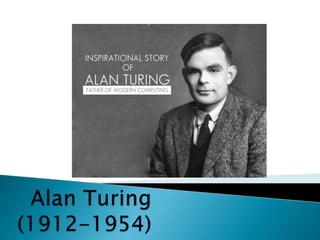
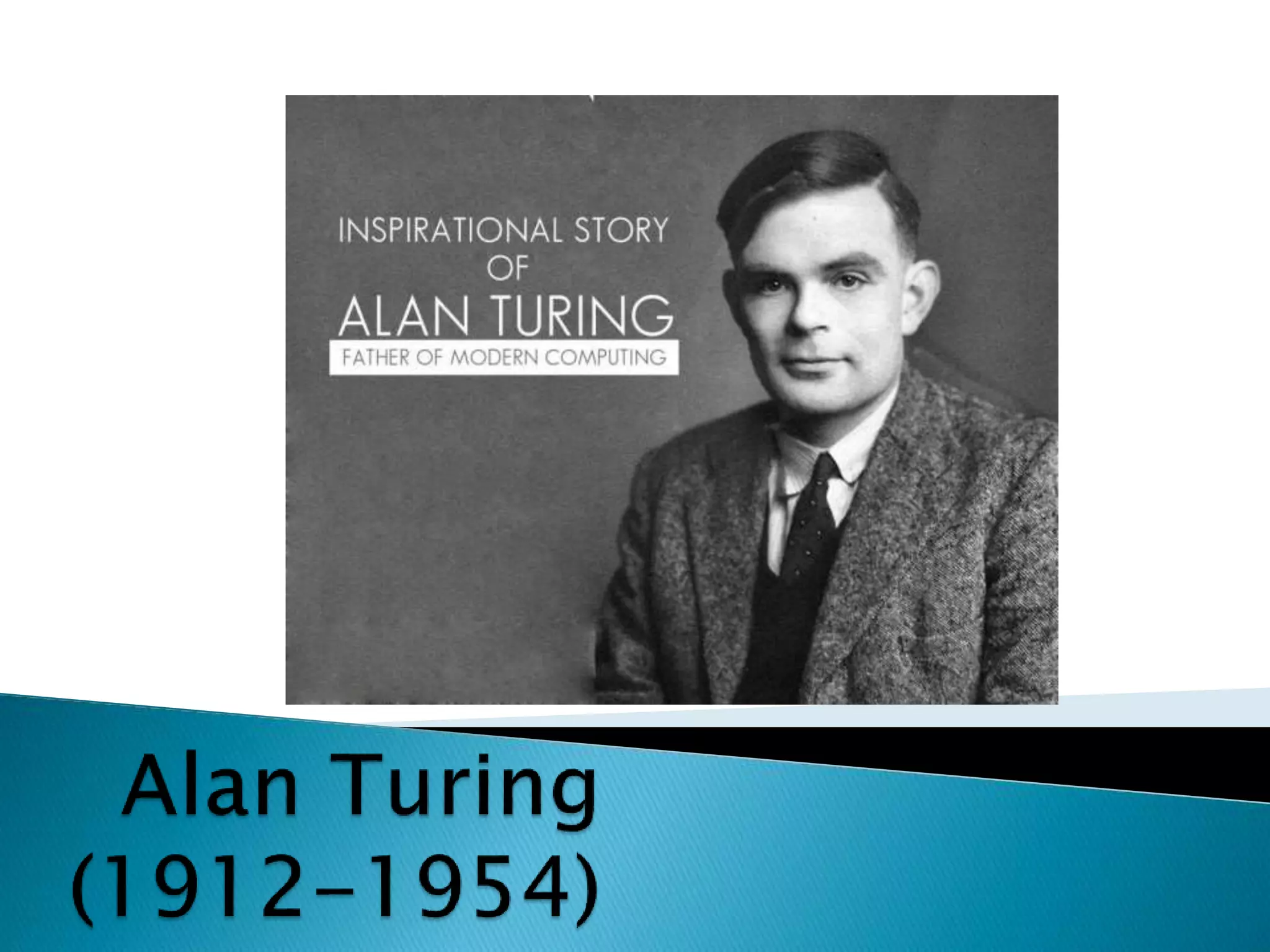
 Alan Mathison Turing was born to Julius Mathison and Ethel
Sara on June 23, 1912, in Paddington, London.
 His father was employed with the 'Indian Civil Service‘.
 He pursued his elementary education from 'St Michael's‘ &
'Sherborne School' in Dorset, starting from 1926.
 In 1931, he began attending 'King's College',
at the 'University of Cambridge', graduating
in mathematics three years later with top
scores.
 In 1935, he published the paper,
“On Computable Numbers, with an
Application to the Entscheidungsproblem”
(Decision problem)
 It was in this paper that he drew references from
Austrian mathematician Kurt Gödel's research to
develop simple imaginary devices called “Universal
machine“ which came to be called 'Turing machines'.
 According to his hypothesis, such a machine is
capable of calculating anything that is given to it.
 The modern computer came into existence because
of this assumption made by the young Turing.
 During 1936-38, at the 'Princeton University',
 Along with lessons in mathematics, Alan was
taught cryptology, & he was able to get his
PhD from the university.
 In September 1938, Turing took up a part-
time job at the 'Government Code and Cypher
School' ('GC&CS'), an organization that
specialized in breaking war codes.
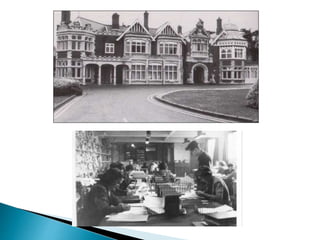
 The 'GC&CS' was located at Bletchley Park
during the World War II (1939 – 1945).
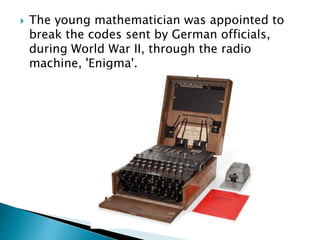
 The young mathematician was appointed to
break the codes sent by German officials,
during World War II, through the radio
machine, 'Enigma'.
 Against (Germany, Italy, Japan)
& (England, USA, Russia)
 Duration :
1 September 1939 – 2 September 1945
 With estimates of total deaths ranging from 50
million to more than 80 million.
 Germany surrendered to England in 1945.
 Later, Japan surrendered to USA after Hiroshima-
Nagasaki Bomb blast.
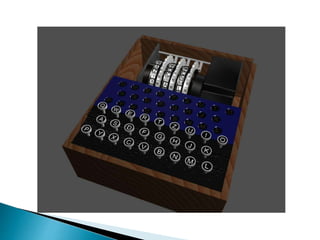
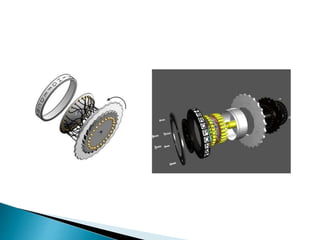
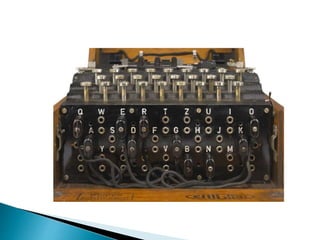
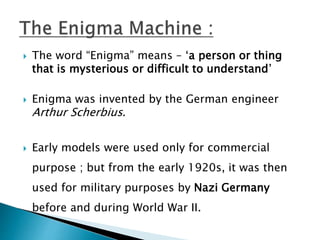
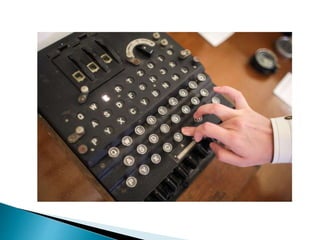
 The word “Enigma” means – ‘a person or thing
that is mysterious or difficult to understand’
 Enigma was invented by the German engineer
Arthur Scherbius.
 Early models were used only for commercial
purpose ; but from the early 1920s, it was then
used for military purposes by Nazi Germany
before and during World War II.
 158,962,555,217,826,360,000
(159 quantillion!) Possible combinations of
rotor settings.
 Had to be cracked before 12 Midnight.
 They exactly had 18 hours of time per day.
 Even with few clues they derived, with
manpower it was impossible to do within the
time available.
 So, Turing came up with the idea :
“Machine can be defeated only by another
machine.”
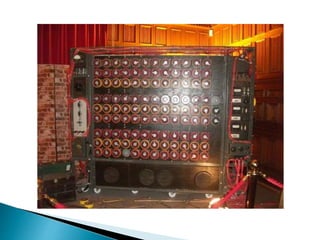
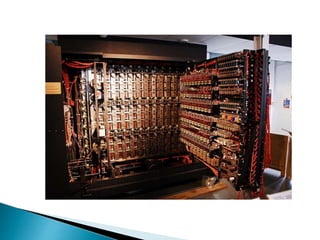
 The Bombes were 7ft wide, 6ft 6in tall and
weighed a ton.
 Bombe was an electromechanical machine
comprised of the equivalent of 36 different
Enigma machines, each one containing the
exact internal wiring of the German
counterpart.
 When the Bombe was switched on, each of
the Enigmas is allocated a pair of letters from
the obtained crib text (guessed word)
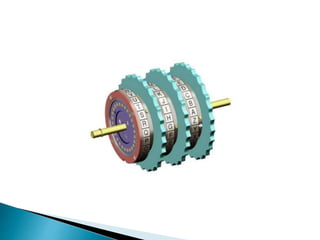
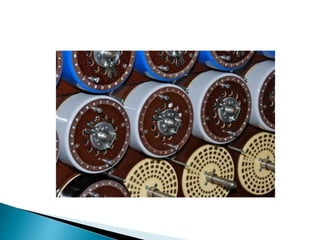
 Once the machine is switched on, each of the
three rotors moves at a rate mimicking the
Enigma itself, checking on approximately
17,500 possible positions until it finds a
match.
 The machine only stops when each of the
Enigma machines finds what it believes to be
the correct pair of letters at the same time
and opens up its electrical circuit.
 So rather than guessing the key, the Bombe
used logic to dismiss wrong possibilities.
 This gave the code breakers part of the key,
but not all of it. It was their duty to use the
knowledge provided by the Bombe and figure
out the rest of the key.
 Once the code was cracked, the workers at
Bletchley Park could set up an Enigma
machine with the correct key for the day and
reverse the code for every message
intercepted on that day.
 Once the Enigma machine was cracked, 211
Bombe machines were built and ran around
the clock. They were stationed at different
locations across Britain.
 At its peak, the Bombe was able to help crack
3,000 German messages per day.
 By the end of the war that amounted to 2.5
million messages, many of which gave the
Allies vital information about German
positions and strategy.
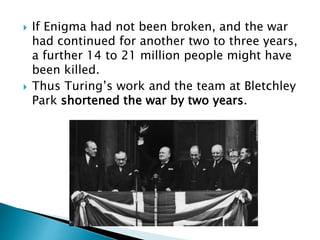
 If Enigma had not been broken, and the war
had continued for another two to three years,
a further 14 to 21 million people might have
been killed.
 Thus Turing’s work and the team at Bletchley
Park shortened the war by two years.
 During 1945-47, Turing began working at
the 'National Physical Laboratory' , where he
developed a machine called the 'Automatic
Computing Engine' ('ACE').
 And ultimately created a groundbreaking
blueprint for store-program computers.
 Influencing the design of the Bendix G-15
credited by many as the world’s first personal
computer.
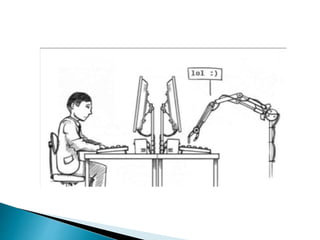
 He first addressed the issue of artificial
intelligence in his 1950 paper, "Computing
machinery and intelligence" & proposed an
experiment known as the “Turing Test”.
 Which can judge whether a machine is
"intelligent" or not.
 Over the past several decades, the test has
significantly influenced debates over artificial
intelligence.
 He developed a type of software named
'Manchester Mark 1', while continuing to
research on abstract mathematics and
artificial intelligence.
 From 1952-54, despite failing health, he
pursued research on mathematical biology,
and produced the thesis titled 'The Chemical
Basis of Morphogenesis'.
 Alan was awarded the 'Smith's Prize' in 1939,
by the 'University of Cambridge', for his
exceptional contribution in the field of
applied mathematics.
 In 1945, he was honored by King George VI,
with the
“Most Excellent Order of the British Empire”
for his services during the World War II.
 On June 8, 1954, Alan was found poisoned at
home, and after the autopsy, it was
concluded that he had taken his own life by
consuming large quantities of cyanide.
 Many biographies have been written, the
most notable being by the 'Royal Society'.
 A novel, 'Cryptonomicon', by Neal
Stephenson, published in 1999.
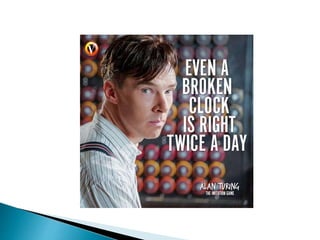
 The 2014 movie, 'The Imitation Game‘ was
featured on Alan's life.
Alan turing - Life History & how he broke enigma code?

Alan turing - Life History & how he broke enigma code?

  • 2.
     Alan MathisonTuring was born to Julius Mathison and Ethel Sara on June 23, 1912, in Paddington, London.  His father was employed with the 'Indian Civil Service‘.  He pursued his elementary education from 'St Michael's‘ & 'Sherborne School' in Dorset, starting from 1926.
  • 3.
     In 1931,he began attending 'King's College', at the 'University of Cambridge', graduating in mathematics three years later with top scores.  In 1935, he published the paper, “On Computable Numbers, with an Application to the Entscheidungsproblem” (Decision problem)
  • 4.
     It wasin this paper that he drew references from Austrian mathematician Kurt Gödel's research to develop simple imaginary devices called “Universal machine“ which came to be called 'Turing machines'.  According to his hypothesis, such a machine is capable of calculating anything that is given to it.  The modern computer came into existence because of this assumption made by the young Turing.
  • 5.
     During 1936-38,at the 'Princeton University',  Along with lessons in mathematics, Alan was taught cryptology, & he was able to get his PhD from the university.
  • 6.
     In September1938, Turing took up a part- time job at the 'Government Code and Cypher School' ('GC&CS'), an organization that specialized in breaking war codes.  The 'GC&CS' was located at Bletchley Park during the World War II (1939 – 1945).
  • 8.
     The youngmathematician was appointed to break the codes sent by German officials, during World War II, through the radio machine, 'Enigma'.
  • 9.
     Against (Germany,Italy, Japan) & (England, USA, Russia)  Duration : 1 September 1939 – 2 September 1945  With estimates of total deaths ranging from 50 million to more than 80 million.  Germany surrendered to England in 1945.  Later, Japan surrendered to USA after Hiroshima- Nagasaki Bomb blast.
  • 10.
     The word“Enigma” means – ‘a person or thing that is mysterious or difficult to understand’  Enigma was invented by the German engineer Arthur Scherbius.  Early models were used only for commercial purpose ; but from the early 1920s, it was then used for military purposes by Nazi Germany before and during World War II.
  • 16.
     158,962,555,217,826,360,000 (159 quantillion!)Possible combinations of rotor settings.  Had to be cracked before 12 Midnight.  They exactly had 18 hours of time per day.  Even with few clues they derived, with manpower it was impossible to do within the time available.  So, Turing came up with the idea : “Machine can be defeated only by another machine.”
  • 17.
     The Bombeswere 7ft wide, 6ft 6in tall and weighed a ton.  Bombe was an electromechanical machine comprised of the equivalent of 36 different Enigma machines, each one containing the exact internal wiring of the German counterpart.
  • 21.
     When theBombe was switched on, each of the Enigmas is allocated a pair of letters from the obtained crib text (guessed word)  Once the machine is switched on, each of the three rotors moves at a rate mimicking the Enigma itself, checking on approximately 17,500 possible positions until it finds a match.  The machine only stops when each of the Enigma machines finds what it believes to be the correct pair of letters at the same time and opens up its electrical circuit.
  • 22.
     So ratherthan guessing the key, the Bombe used logic to dismiss wrong possibilities.  This gave the code breakers part of the key, but not all of it. It was their duty to use the knowledge provided by the Bombe and figure out the rest of the key.  Once the code was cracked, the workers at Bletchley Park could set up an Enigma machine with the correct key for the day and reverse the code for every message intercepted on that day.
  • 23.
     Once theEnigma machine was cracked, 211 Bombe machines were built and ran around the clock. They were stationed at different locations across Britain.  At its peak, the Bombe was able to help crack 3,000 German messages per day.  By the end of the war that amounted to 2.5 million messages, many of which gave the Allies vital information about German positions and strategy.
  • 24.
     If Enigmahad not been broken, and the war had continued for another two to three years, a further 14 to 21 million people might have been killed.  Thus Turing’s work and the team at Bletchley Park shortened the war by two years.
  • 25.
     During 1945-47,Turing began working at the 'National Physical Laboratory' , where he developed a machine called the 'Automatic Computing Engine' ('ACE').  And ultimately created a groundbreaking blueprint for store-program computers.  Influencing the design of the Bendix G-15 credited by many as the world’s first personal computer.
  • 26.
     He firstaddressed the issue of artificial intelligence in his 1950 paper, "Computing machinery and intelligence" & proposed an experiment known as the “Turing Test”.  Which can judge whether a machine is "intelligent" or not.  Over the past several decades, the test has significantly influenced debates over artificial intelligence.
  • 28.
     He developeda type of software named 'Manchester Mark 1', while continuing to research on abstract mathematics and artificial intelligence.  From 1952-54, despite failing health, he pursued research on mathematical biology, and produced the thesis titled 'The Chemical Basis of Morphogenesis'.
  • 29.
     Alan wasawarded the 'Smith's Prize' in 1939, by the 'University of Cambridge', for his exceptional contribution in the field of applied mathematics.  In 1945, he was honored by King George VI, with the “Most Excellent Order of the British Empire” for his services during the World War II.
  • 30.
     On June8, 1954, Alan was found poisoned at home, and after the autopsy, it was concluded that he had taken his own life by consuming large quantities of cyanide.  Many biographies have been written, the most notable being by the 'Royal Society'.  A novel, 'Cryptonomicon', by Neal Stephenson, published in 1999.  The 2014 movie, 'The Imitation Game‘ was featured on Alan's life.