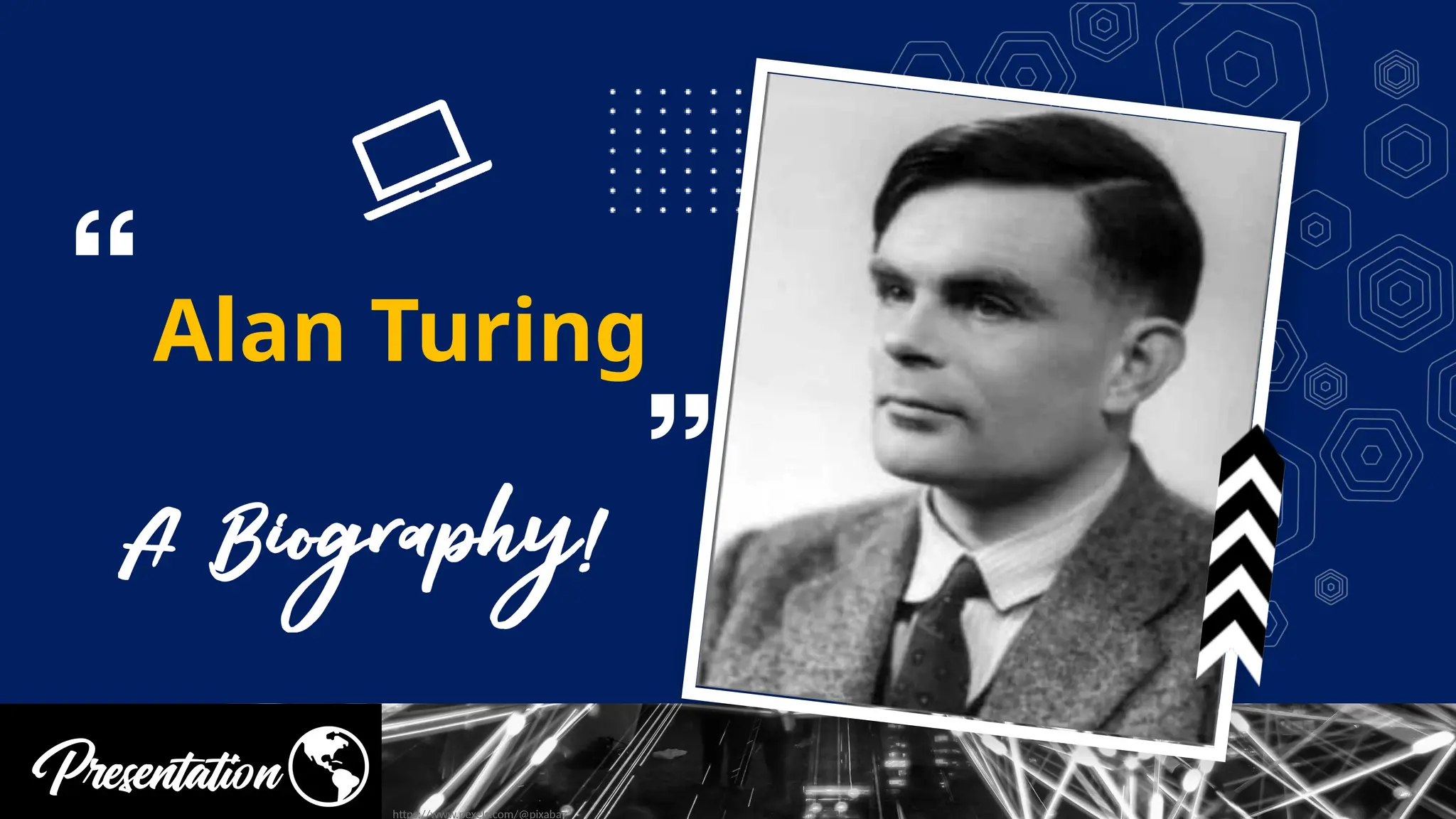
Alan Turing
This file is licensed under the Creative Commons Attribution-Share Alike 3.0 Unported license.
By https://en.wikipedia.org/wiki/User:Matt_Yohe
https://www.pexels.com/@pixabay
Presentation
Main Points
✔Introduction
✔Early life
✔Career & Education
✔Contribution
✔Personal Life
✔Major Achivements
✔Legacy
✔Conclusion
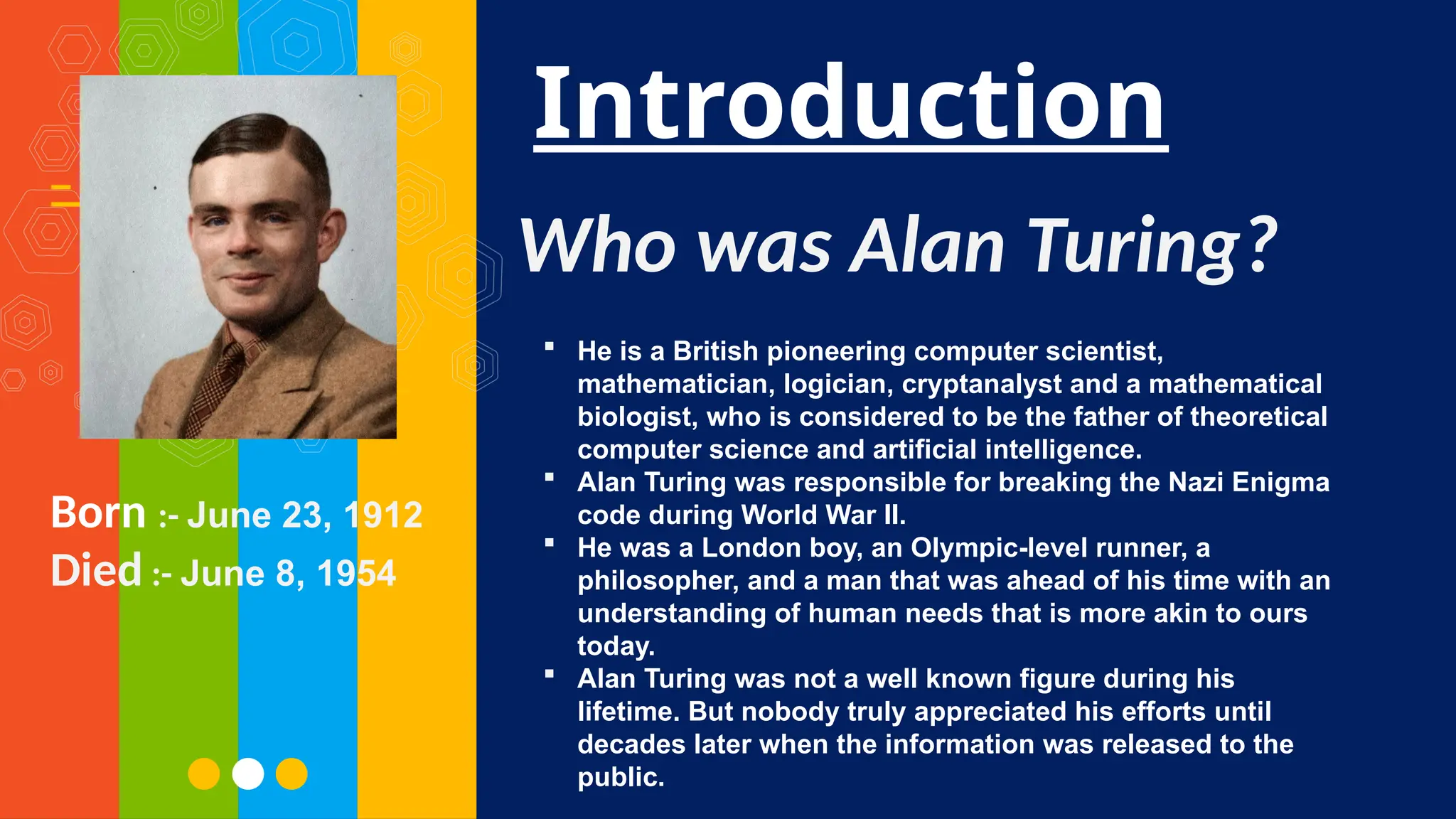
Introduction
Born :- June 23, 1912
Died :- June 8, 1954
Who was Alan Turing?
 He is a British pioneering computer scientist,
mathematician, logician, cryptanalyst and a mathematical
biologist, who is considered to be the father of theoretical
computer science and artificial intelligence.
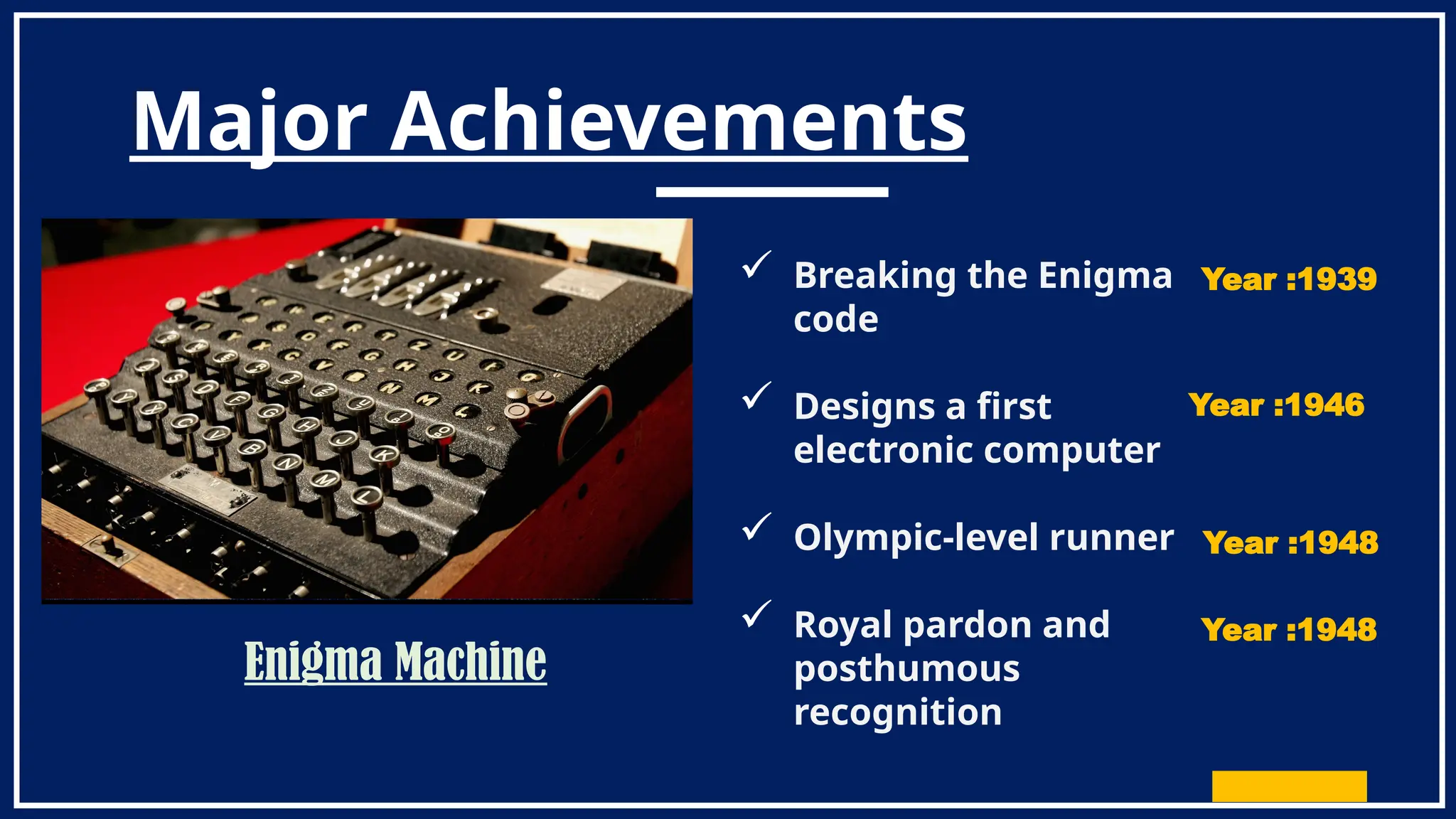
 Alan Turing was responsible for breaking the Nazi Enigma
code during World War II.
 He was a London boy, an Olympic-level runner, a
philosopher, and a man that was ahead of his time with an
understanding of human needs that is more akin to ours
today.
 Alan Turing was not a well known figure during his
lifetime. But nobody truly appreciated his efforts until
decades later when the information was released to the
public.
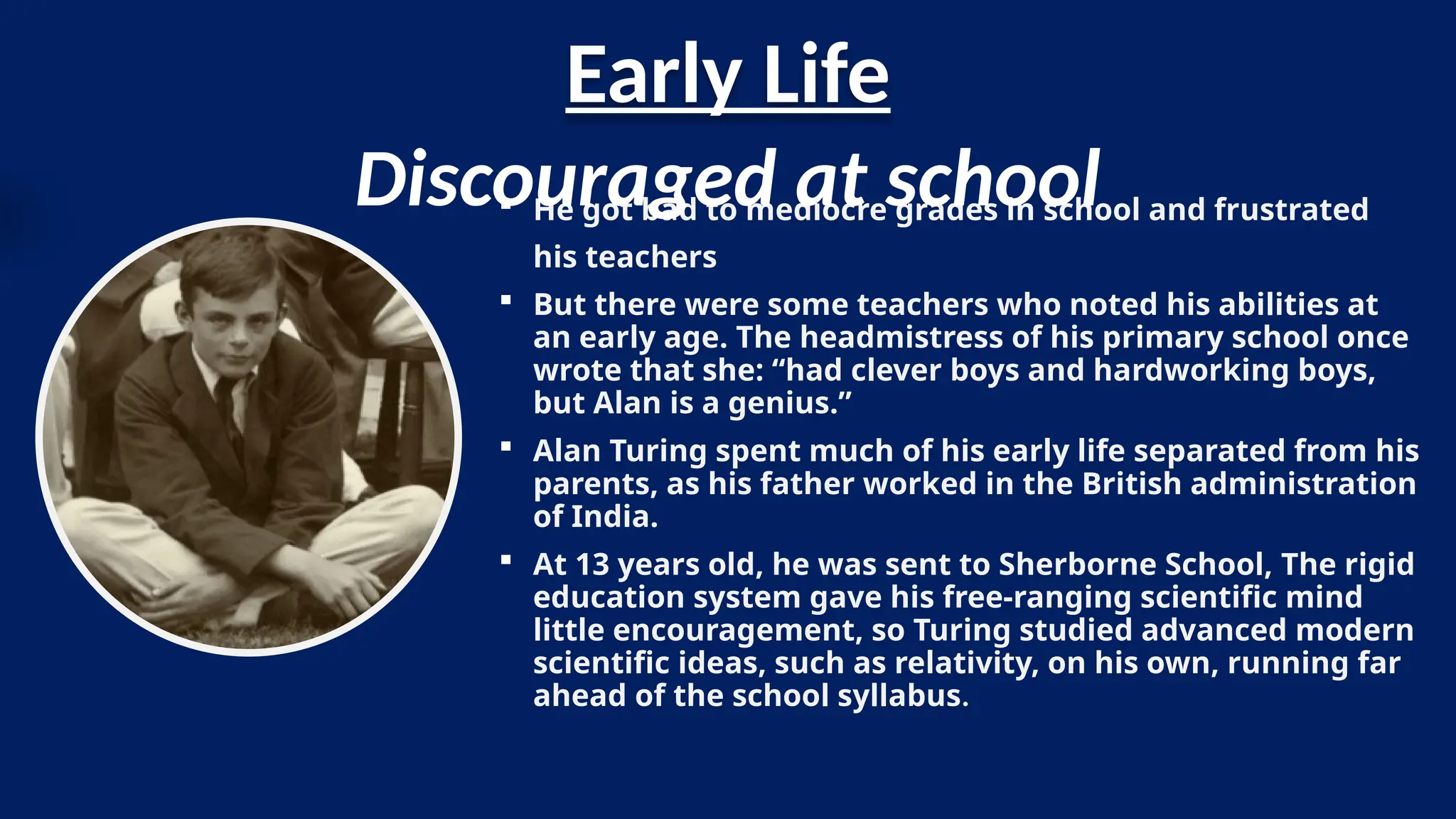
Early Life
 He got bad to mediocre grades in school and frustrated
his teachers
 But there were some teachers who noted his abilities at
an early age. The headmistress of his primary school once
wrote that she: “had clever boys and hardworking boys,
but Alan is a genius.”
 Alan Turing spent much of his early life separated from his
parents, as his father worked in the British administration
of India.
 At 13 years old, he was sent to Sherborne School, The rigid
education system gave his free-ranging scientific mind
little encouragement, so Turing studied advanced modern
scientific ideas, such as relativity, on his own, running far
ahead of the school syllabus.
Discouraged at school
At 13 years old,
he was sent to Sherborne School
a large boarding school in
Dorset.
Career & Education
● In 1931, Turing began studying mathematics
at King's College, Cambridge, where he
developed his interest in the theory of
computability.
● Later, He went to study under mathematician
Alonzo Church for two years and it was here he
became involved in cryptologyt and finally
recieved Ph.D. from Princeton University in
1938
Contribution
He released of his paper On Computable Numbers.
He mentioned the hypothetical Turing Machine and therefore gave birth to the idea of the
modern computer.
Breaking the Enigma code:-
After September 1939, joined by other mathematicians at Bletchley Park, Turing rapidly
developed a new machine (the ‘Bombe’) capable of breaking Enigma messages on an
industrial scale.
Designs a first electronic computer:-
In March 1946 Turing produced a detailed design for what was called the Automatic Computing
Engine ACE. This was a digital computer in the modern sense, storing programs in its memory.
His report emphasised the unlimited range of applications opened up by this technological
revolution, and software developments ahead of parallel American developments.
In 1950, he published a philosophical paper including the idea of an ‘imitation game’ for
comparing human and machine outputs, now called the Turing Test. This paper remains his best
known work and was a key contribution to the field of Artificial Intelligence.
Personal Life
 Alan Turing fell in love with another able
pupil, Christopher Morcom.
 He was inspired to communicate more and
also to become an academic success. But
Christopher died suddenly from
tuberculosis.
 Devastated, Turing wanted to believe that
Christopher’s mind somehow lived on. His
emotional turmoil involved a scientific
fascination with the problem of mind and
brain that underlay his later work.
 He stuttered when talking- he notes that a
BBC radio producer had called Turing a
very difficult person to interview for that
reason.He “took his time finding the right
words,” he explained
Personal Life
Convicted for gross indecency:-
 All male homosexual activity was illegal
until 1967, and Turing was
prosecuted when an affair with a young
man came to the notice of the police.
 The punishment for homosexuality was
chemical castration, a series of
hormone injections that left Turing
impotent.
 He refused to let a punishment of
chemical castration stop him from
working
Major Achievements
 Breaking the Enigma
code
 Designs a first
electronic computer
 Olympic-level runner
 Royal pardon and
posthumous
recognition
Year :1939
Year :1946
Year :1948
Year :1948
Enigma Machine
Death & Legacy
 Alan Turing was found dead in bed by his cleaner on 8 June 1954. He had died
from cyanide poisoning the day before. A partly eaten apple lay next to his
body.
 After many years of petitioning the government, Alan Turing was pardoned
by Her Majesty Queen Elizabeth II on Christmas Eve, 2014.
 The Alan Turing Law is now an informal name for the exoneration of other
men convicted for crimes based on their sexuality.
 The Bank of England's £50 note now features a portrait of Alan Turing,
released into circulation on what would have been his birthday on 23 June
2021.
 The ACM A. M. Turing Award is an annual prize given by the Association for
Computing Machinery (ACM) for contributions of lasting and major technical
importance to computer science. It is generally recognized as the highest
distinction in computer science and is colloquially known as or often referred
Quote
““Sometimes it is the people
no one can imagine anything of
who do the things
no one can imagine.”
~ Alan Turing
Conclusion
One of the main conclusions that can be drawn from
Alan Turing's biography is the importance of
acknowledging and valuing diversity in society. Turing's
life and work demonstrate how society's prejudice and
discrimination can hinder the progress and development
of brilliant minds, as well as cause immense personal
suffering.
Another important lesson from Turing's life is the value
of perseverance and determination in pursuing one's
goals. Despite facing numerous challenges and setbacks
throughout his life, Turing remained dedicated to his
work and continued to make significant contributions to
“Gaurav Bansode & Pranay Shinde”
Batch : G3
Date : 23-03-23
“If You Believe Then You Can Achieve”
-Gaurav Bansode
This Presentation is Prepared by:-

alan turing ppt.pptx biography of alan turing

  • 1.
    Alan Turing This fileis licensed under the Creative Commons Attribution-Share Alike 3.0 Unported license. By https://en.wikipedia.org/wiki/User:Matt_Yohe https://www.pexels.com/@pixabay
  • 2.
    Presentation Main Points ✔Introduction ✔Early life ✔Career& Education ✔Contribution ✔Personal Life ✔Major Achivements ✔Legacy ✔Conclusion
  • 3.
    Introduction Born :- June23, 1912 Died :- June 8, 1954 Who was Alan Turing?  He is a British pioneering computer scientist, mathematician, logician, cryptanalyst and a mathematical biologist, who is considered to be the father of theoretical computer science and artificial intelligence.  Alan Turing was responsible for breaking the Nazi Enigma code during World War II.  He was a London boy, an Olympic-level runner, a philosopher, and a man that was ahead of his time with an understanding of human needs that is more akin to ours today.  Alan Turing was not a well known figure during his lifetime. But nobody truly appreciated his efforts until decades later when the information was released to the public.
  • 4.
    Early Life  Hegot bad to mediocre grades in school and frustrated his teachers  But there were some teachers who noted his abilities at an early age. The headmistress of his primary school once wrote that she: “had clever boys and hardworking boys, but Alan is a genius.”  Alan Turing spent much of his early life separated from his parents, as his father worked in the British administration of India.  At 13 years old, he was sent to Sherborne School, The rigid education system gave his free-ranging scientific mind little encouragement, so Turing studied advanced modern scientific ideas, such as relativity, on his own, running far ahead of the school syllabus. Discouraged at school
  • 5.
    At 13 yearsold, he was sent to Sherborne School a large boarding school in Dorset. Career & Education ● In 1931, Turing began studying mathematics at King's College, Cambridge, where he developed his interest in the theory of computability. ● Later, He went to study under mathematician Alonzo Church for two years and it was here he became involved in cryptologyt and finally recieved Ph.D. from Princeton University in 1938
  • 6.
    Contribution He released ofhis paper On Computable Numbers. He mentioned the hypothetical Turing Machine and therefore gave birth to the idea of the modern computer. Breaking the Enigma code:- After September 1939, joined by other mathematicians at Bletchley Park, Turing rapidly developed a new machine (the ‘Bombe’) capable of breaking Enigma messages on an industrial scale. Designs a first electronic computer:- In March 1946 Turing produced a detailed design for what was called the Automatic Computing Engine ACE. This was a digital computer in the modern sense, storing programs in its memory. His report emphasised the unlimited range of applications opened up by this technological revolution, and software developments ahead of parallel American developments. In 1950, he published a philosophical paper including the idea of an ‘imitation game’ for comparing human and machine outputs, now called the Turing Test. This paper remains his best known work and was a key contribution to the field of Artificial Intelligence.
  • 7.
    Personal Life  AlanTuring fell in love with another able pupil, Christopher Morcom.  He was inspired to communicate more and also to become an academic success. But Christopher died suddenly from tuberculosis.  Devastated, Turing wanted to believe that Christopher’s mind somehow lived on. His emotional turmoil involved a scientific fascination with the problem of mind and brain that underlay his later work.  He stuttered when talking- he notes that a BBC radio producer had called Turing a very difficult person to interview for that reason.He “took his time finding the right words,” he explained
  • 8.
    Personal Life Convicted forgross indecency:-  All male homosexual activity was illegal until 1967, and Turing was prosecuted when an affair with a young man came to the notice of the police.  The punishment for homosexuality was chemical castration, a series of hormone injections that left Turing impotent.  He refused to let a punishment of chemical castration stop him from working
  • 9.
    Major Achievements  Breakingthe Enigma code  Designs a first electronic computer  Olympic-level runner  Royal pardon and posthumous recognition Year :1939 Year :1946 Year :1948 Year :1948 Enigma Machine
  • 10.
    Death & Legacy Alan Turing was found dead in bed by his cleaner on 8 June 1954. He had died from cyanide poisoning the day before. A partly eaten apple lay next to his body.  After many years of petitioning the government, Alan Turing was pardoned by Her Majesty Queen Elizabeth II on Christmas Eve, 2014.  The Alan Turing Law is now an informal name for the exoneration of other men convicted for crimes based on their sexuality.  The Bank of England's £50 note now features a portrait of Alan Turing, released into circulation on what would have been his birthday on 23 June 2021.  The ACM A. M. Turing Award is an annual prize given by the Association for Computing Machinery (ACM) for contributions of lasting and major technical importance to computer science. It is generally recognized as the highest distinction in computer science and is colloquially known as or often referred
  • 11.
    Quote ““Sometimes it isthe people no one can imagine anything of who do the things no one can imagine.” ~ Alan Turing
  • 12.
    Conclusion One of themain conclusions that can be drawn from Alan Turing's biography is the importance of acknowledging and valuing diversity in society. Turing's life and work demonstrate how society's prejudice and discrimination can hinder the progress and development of brilliant minds, as well as cause immense personal suffering. Another important lesson from Turing's life is the value of perseverance and determination in pursuing one's goals. Despite facing numerous challenges and setbacks throughout his life, Turing remained dedicated to his work and continued to make significant contributions to
  • 13.
    “Gaurav Bansode &Pranay Shinde” Batch : G3 Date : 23-03-23 “If You Believe Then You Can Achieve” -Gaurav Bansode This Presentation is Prepared by:-