ARTIFICIAL INTELLIGENCE (A.I.)
Presented by
PRAVEEN
CONTENTS
• INTRODUCTION
• HISTORY
• CURRENTSTATUS
• GOALS
• APPLICATIONS
• ADVANTAGES & DISADVANTAGES
• FUTURE SCOPES
• CONCLUSION
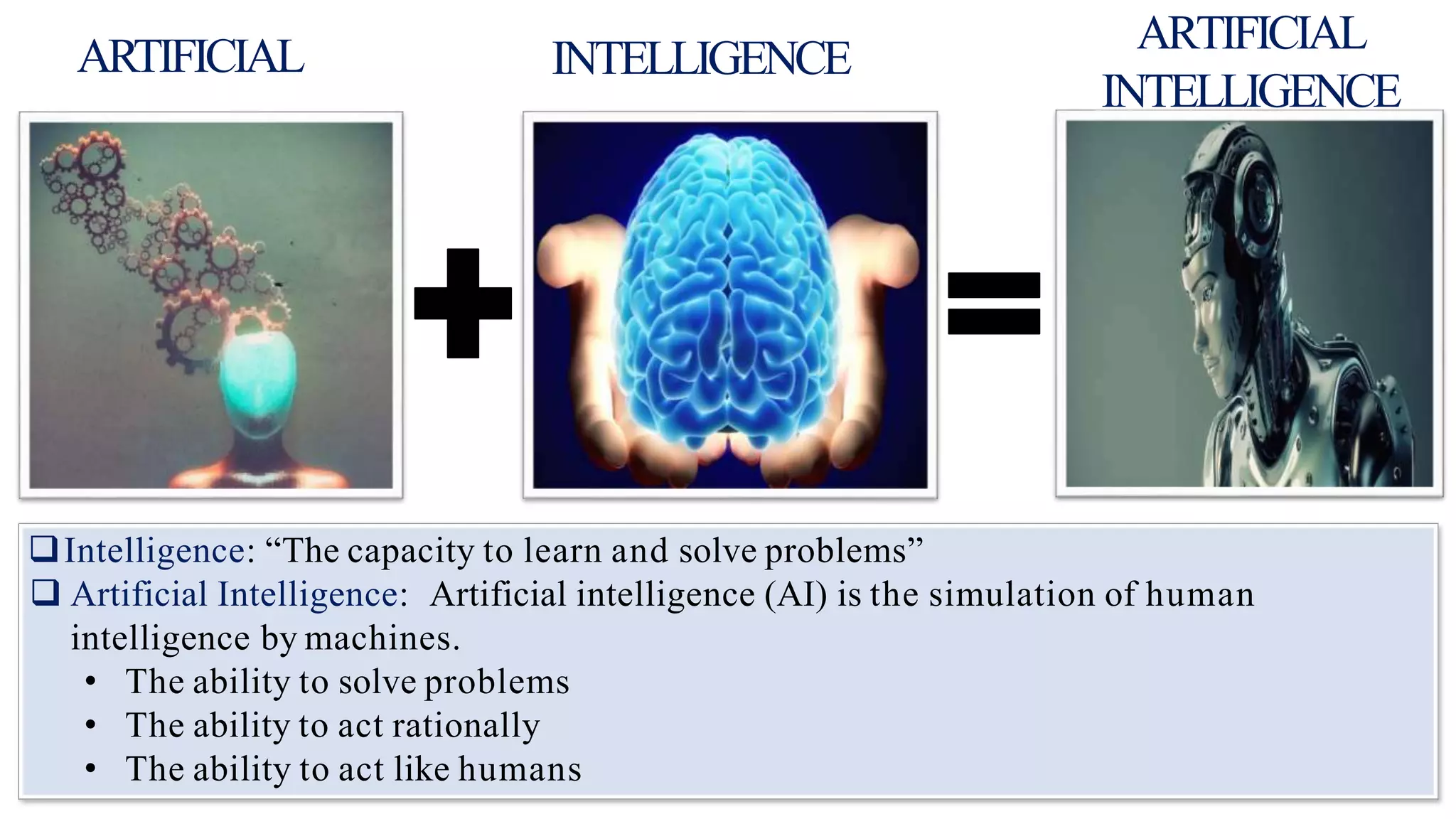
ARTIFICIAL INTELLIGENCE
ARTIFICIAL
INTELLIGENCE
Intelligence: “The capacity to learn and solve problems”
 Artificial Intelligence: Artificial intelligence (AI) is the simulation of human
intelligence by machines.
• The ability to solve problems
• The ability to act rationally
• The ability to act like humans
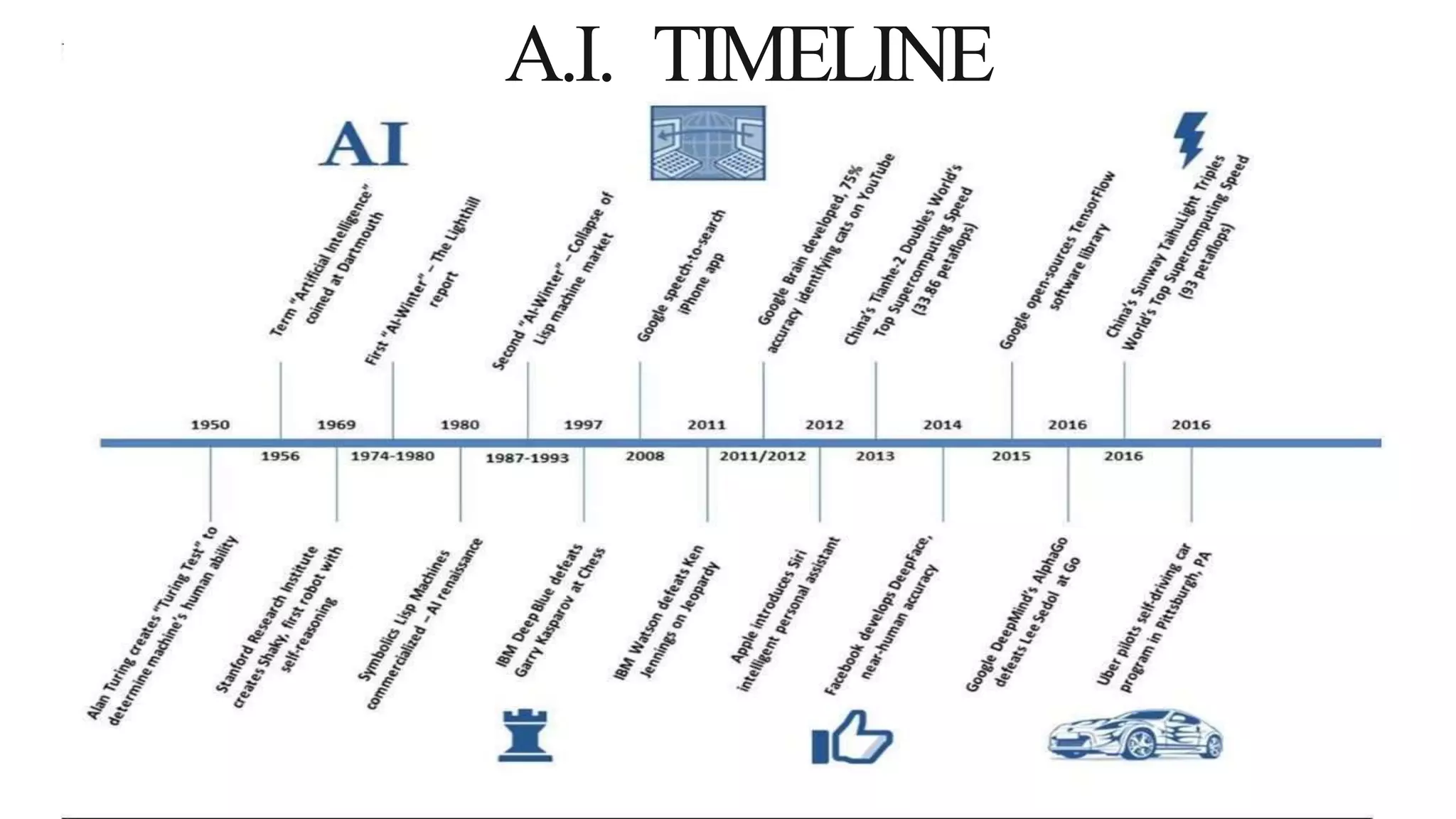
A.I. TIMELINE
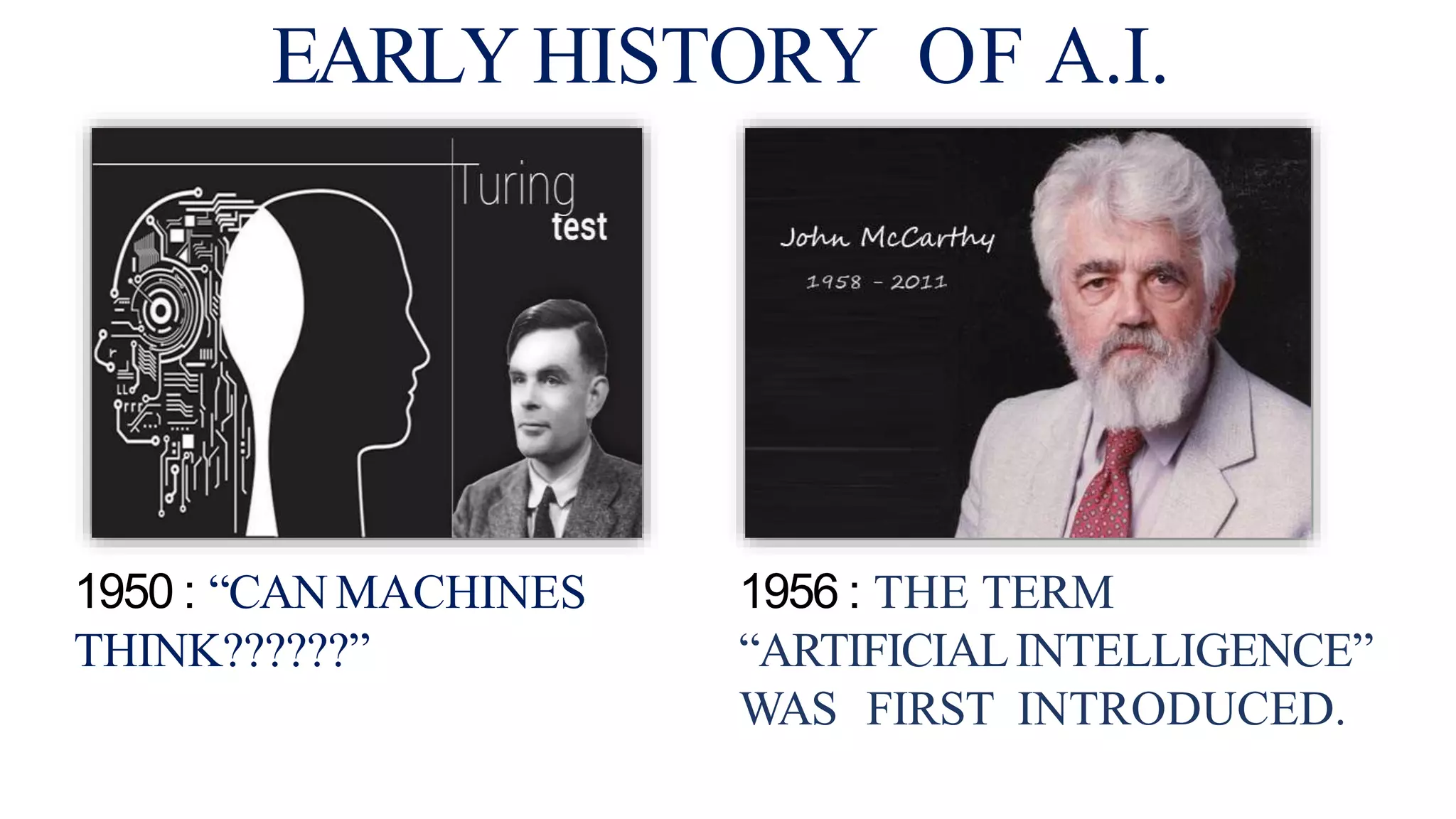
EARLY HISTORY OF A.I.
1950 : “CAN MACHINES
THINK??????”
1956 : THE TERM
“ARTIFICIALINTELLIGENCE”
WAS FIRST INTRODUCED.
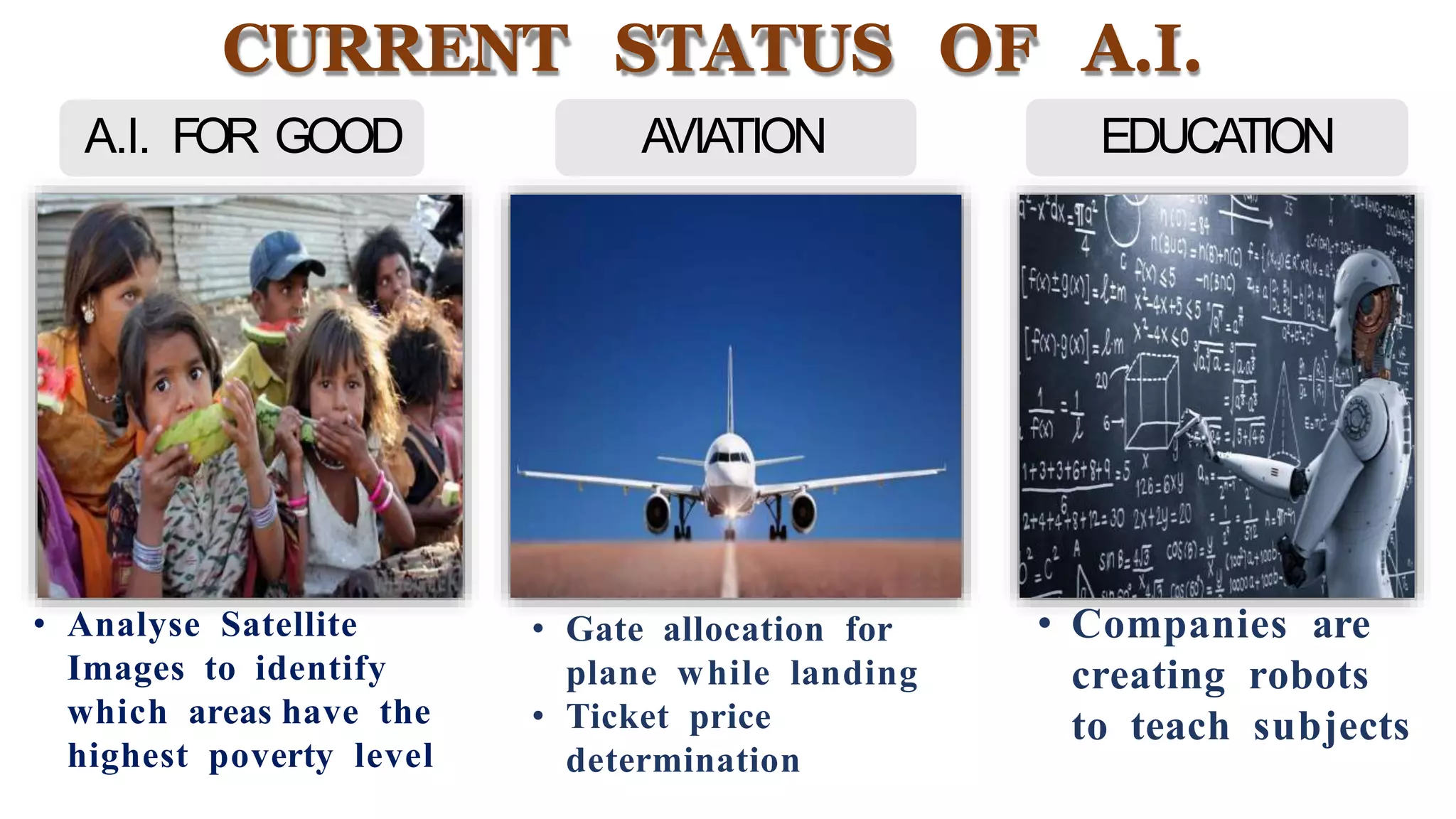
CURRENT STATUS OF A.I.
• Analyse Satellite
Images to identify
which areas have the
highest poverty level
• Gate allocation for
plane while landing
• Ticket price
determination
A.I. FOR GOOD AVIATION EDUCATION
• Companies are
creating robots
to teach subjects
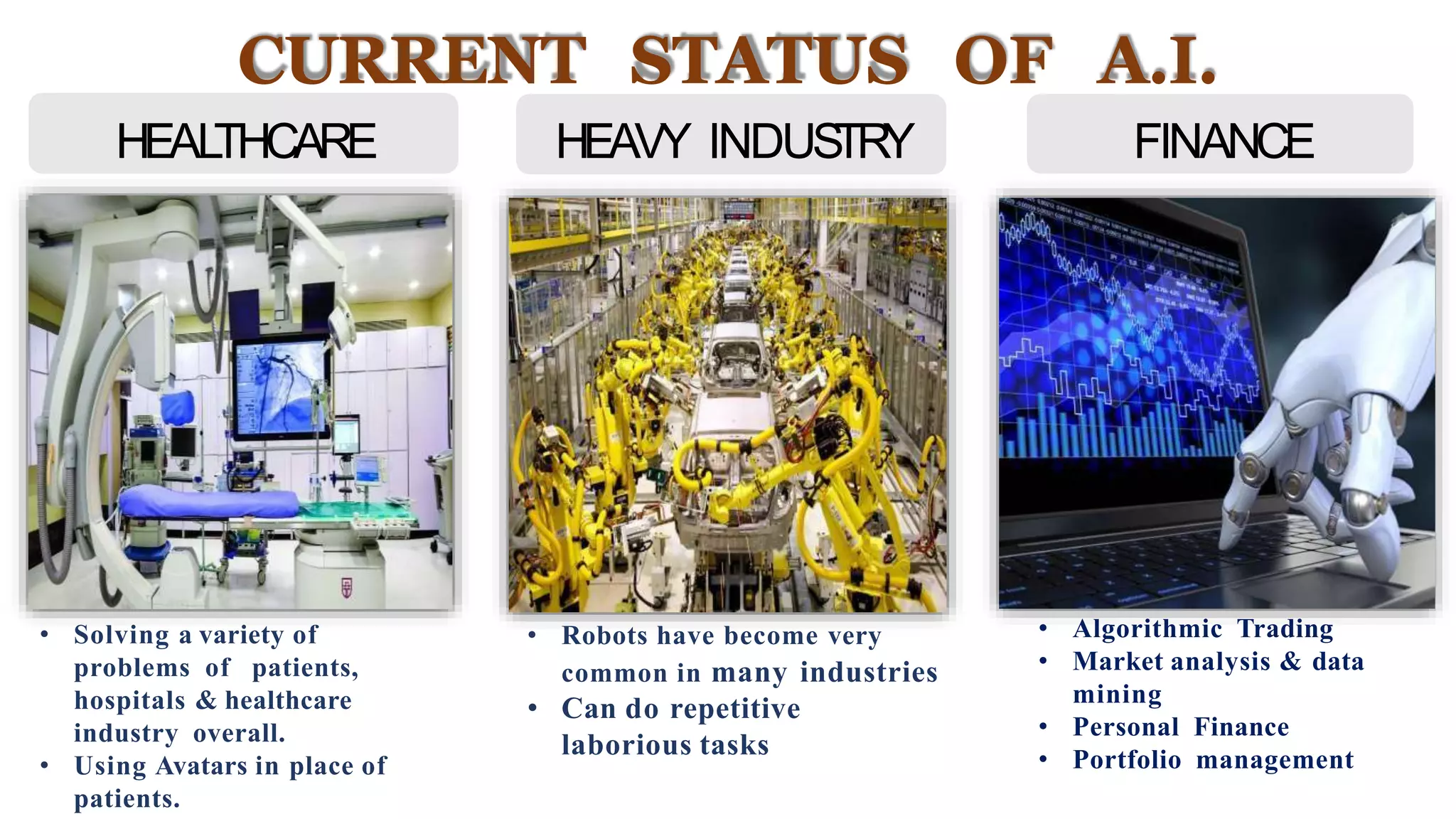
• Solving a variety of
problems of patients,
hospitals & healthcare
industry overall.
• Using Avatars in place of
patients.
• Robots have become very
common in many industries
• Can do repetitive
laborious tasks
CURRENT STATUS OF A.I.
HEALTHCARE HEAVY INDUSTRY FINANCE
• Algorithmic Trading
• Market analysis & data
mining
• Personal Finance
• Portfolio management
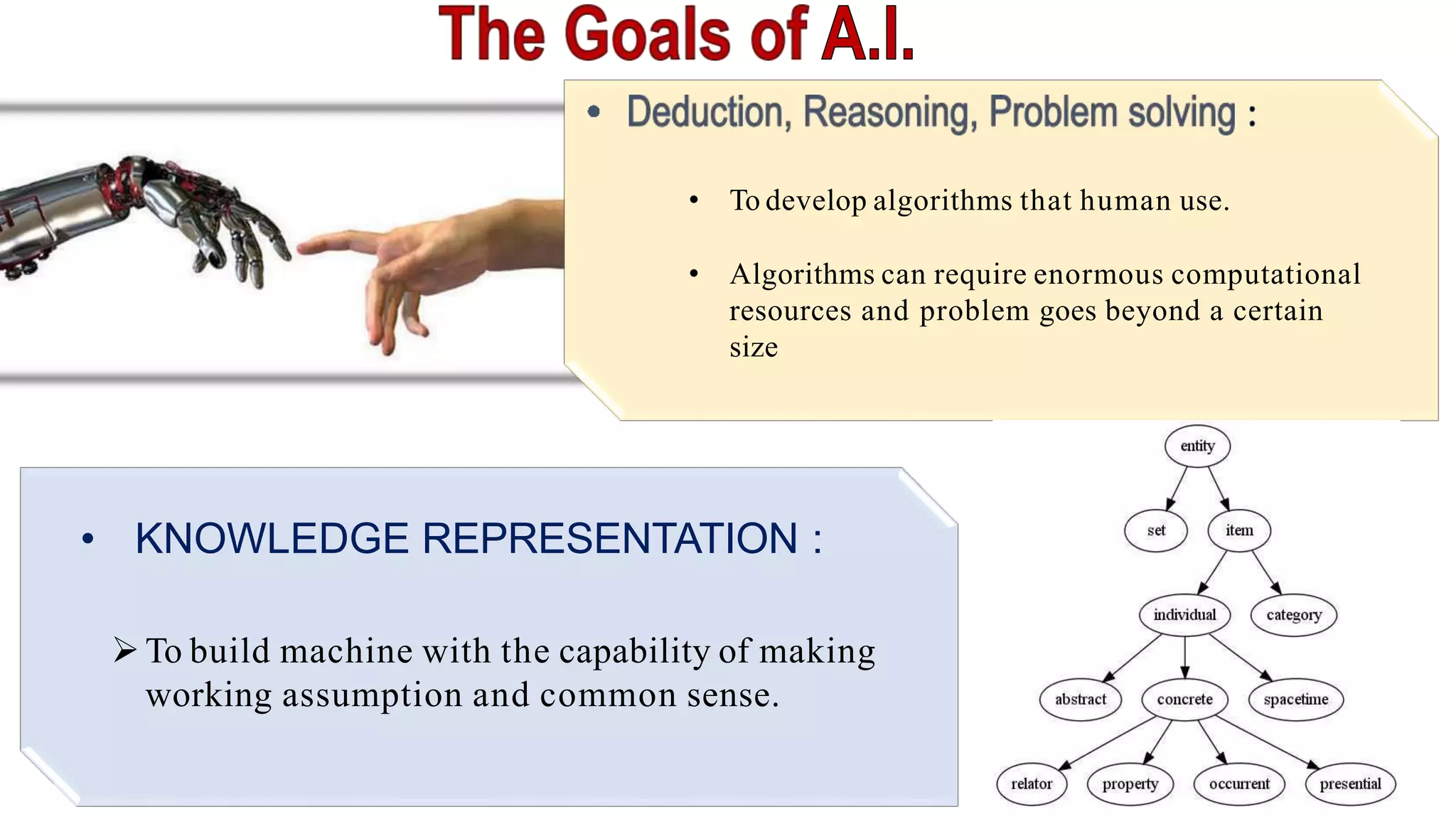
• To develop algorithms that human use.
• Algorithms can require enormous computational
resources and problem goes beyond a certain
size
• KNOWLEDGE REPRESENTATION :
To build machine with the capability of making
working assumption and common sense.
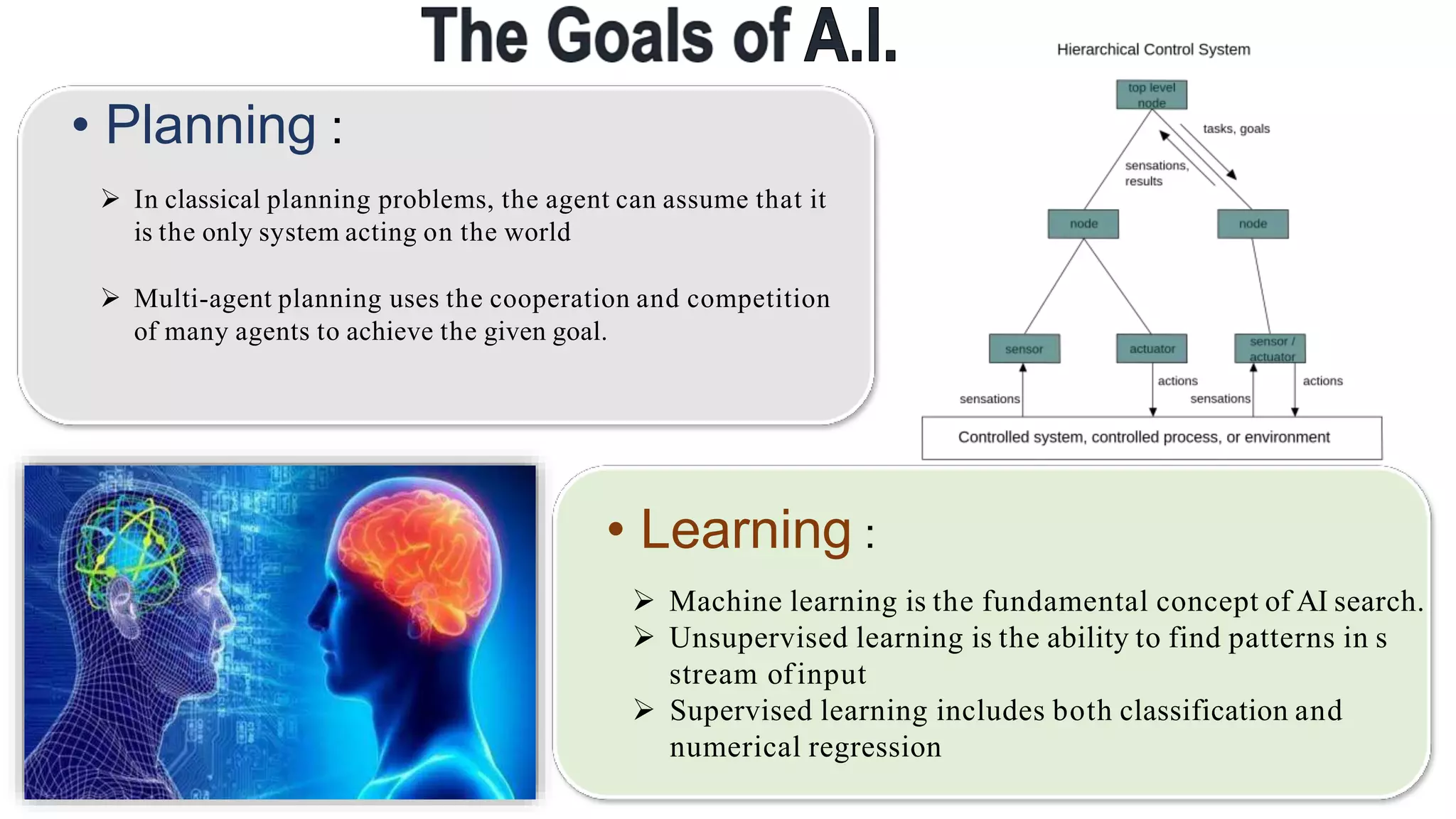
• Planning :
 In classical planning problems, the agent can assume that it
is the only system acting on the world
 Multi-agent planning uses the cooperation and competition
of many agents to achieve the given goal.
• Learning :
 Machine learning is the fundamental concept of AI search.
 Unsupervised learning is the ability to find patterns in s
stream ofinput
 Supervised learning includes both classification and
numerical regression
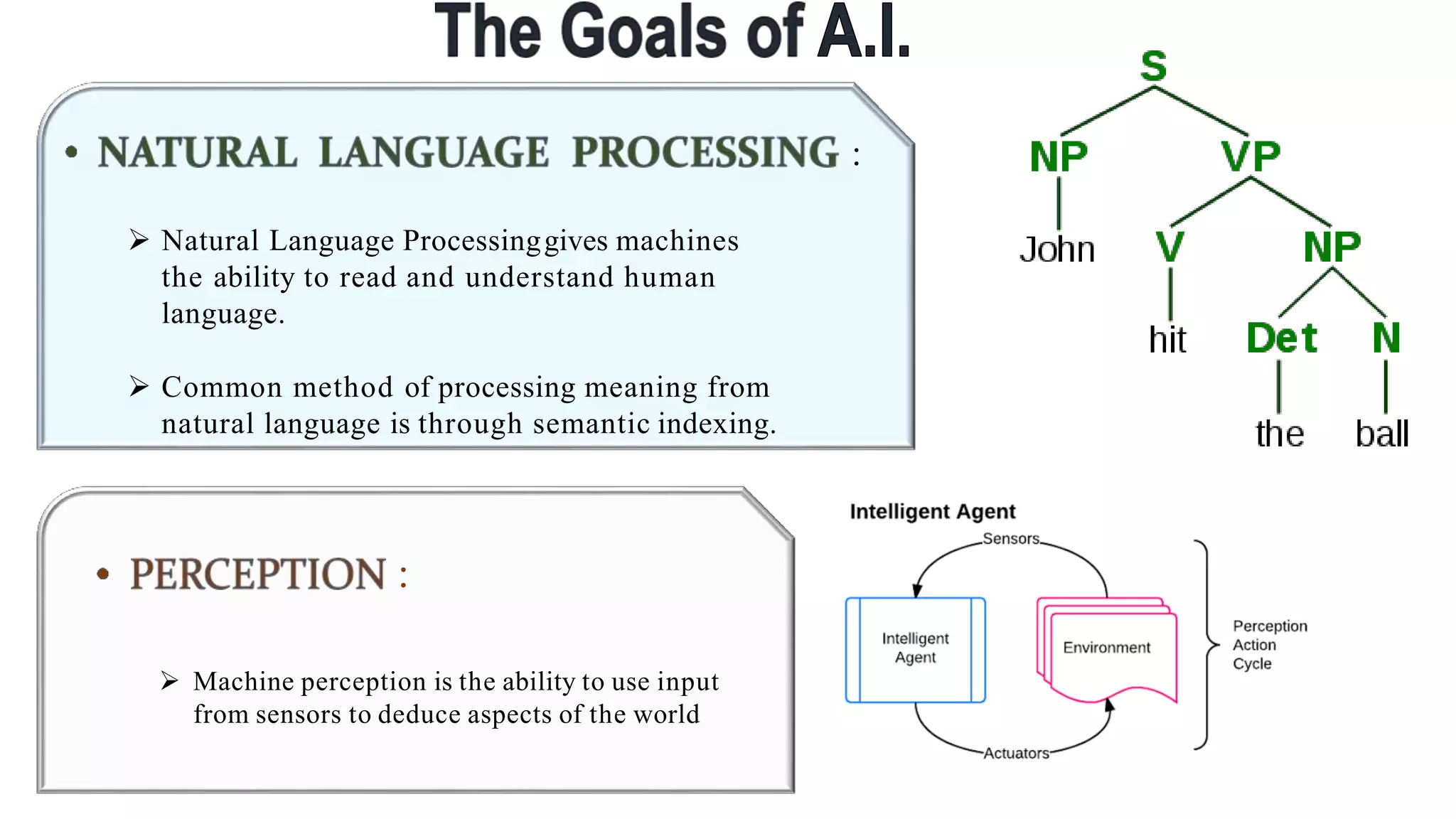
:
 Natural Language Processinggives machines
the ability to read and understand human
language.
 Common method of processing meaning from
natural language is through semantic indexing.
:
 Machine perception is the ability to use input
from sensors to deduce aspects of the world
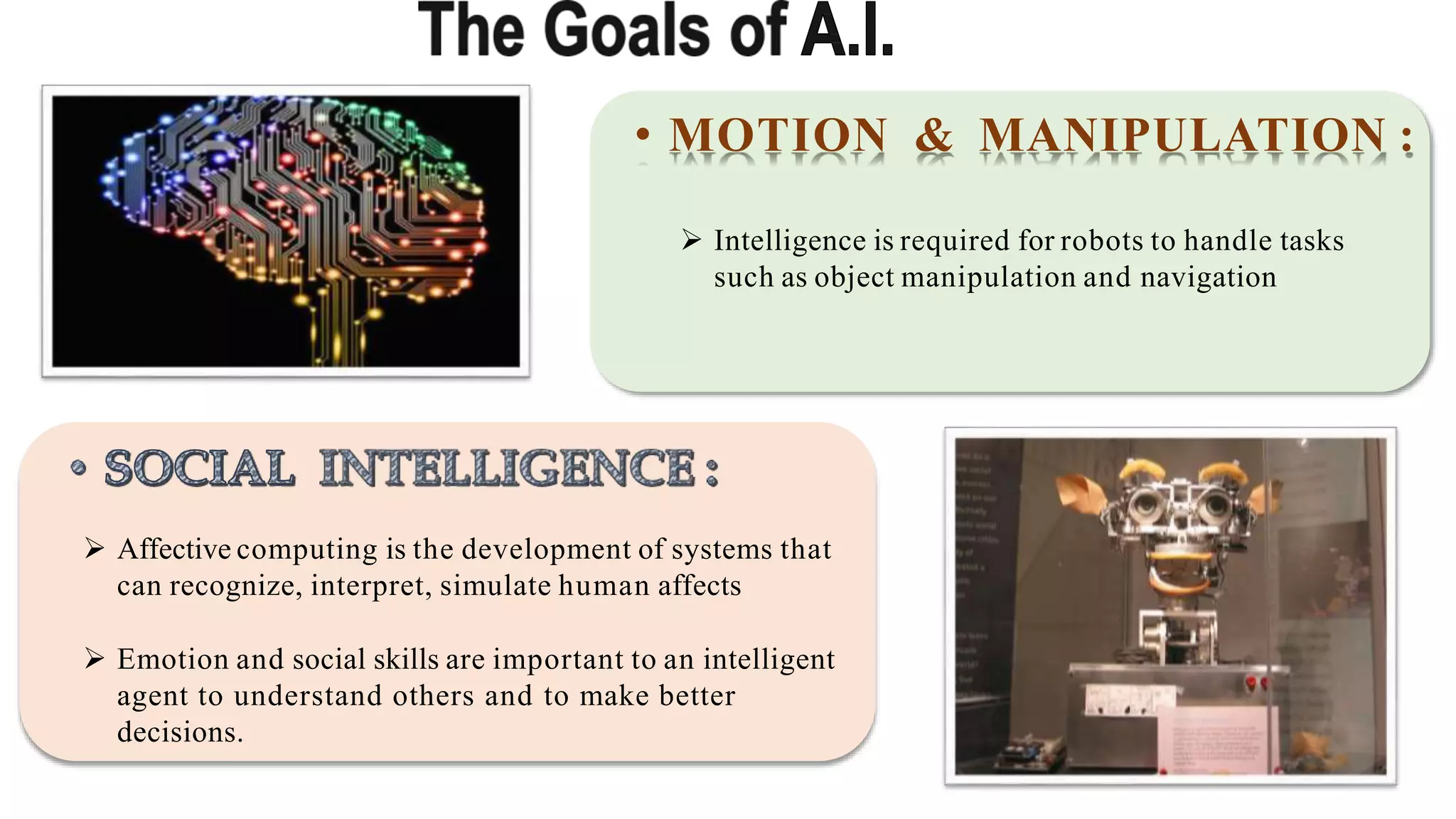
• MOTION & MANIPULATION :
 Intelligence is required for robots to handle tasks
such as object manipulation and navigation
 Affective computing is the development of systems that
can recognize, interpret, simulate human affects
 Emotion and social skills are important to an intelligent
agent to understand others and to make better
decisions.
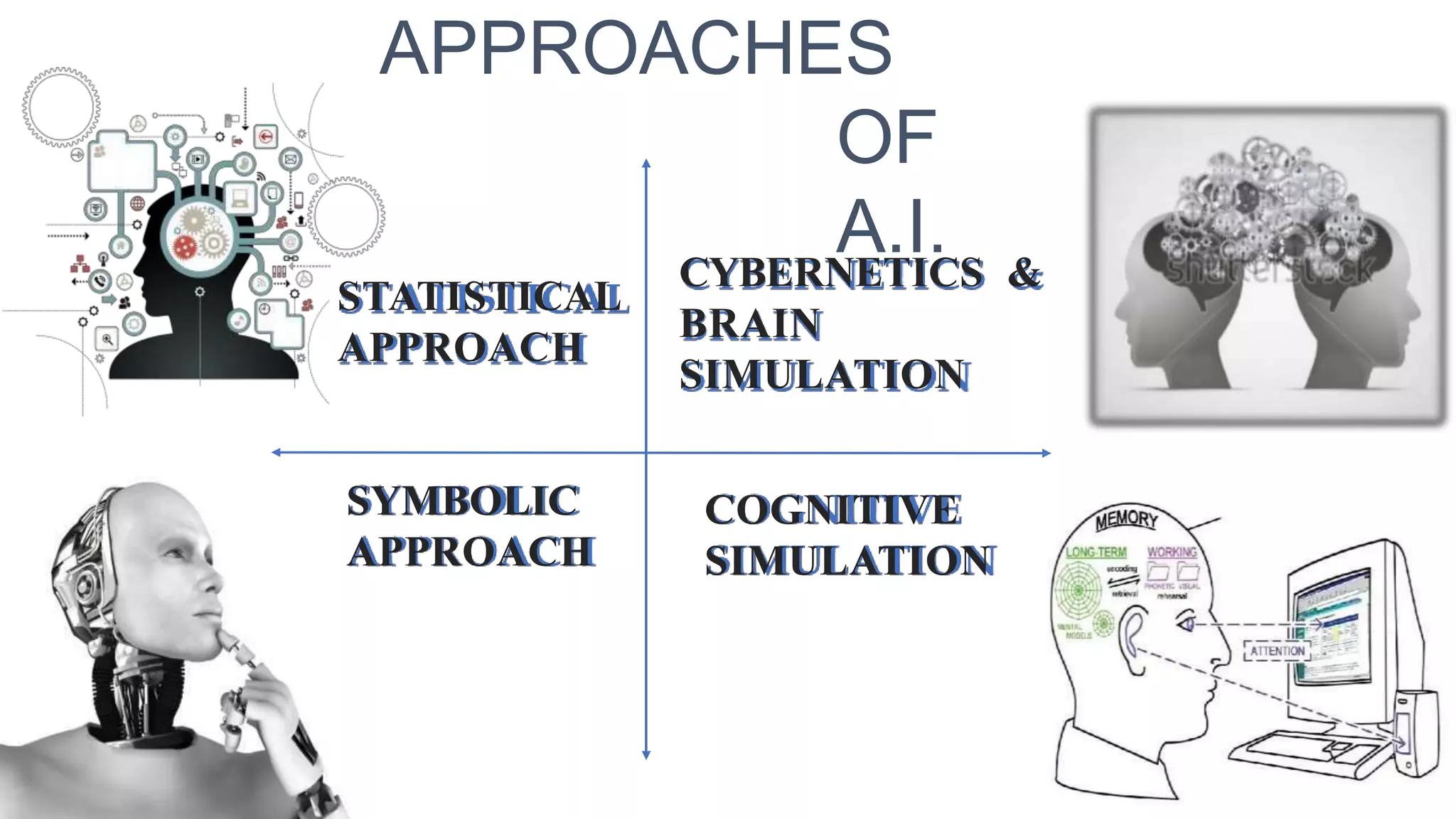
APPROACHES
OF
A.I.CYBERNETICS &
BRAIN
SIMULATION
COGNITIVE
SIMULATION
STATISTICAL
APPROACH
SYMBOLIC
APPROACH
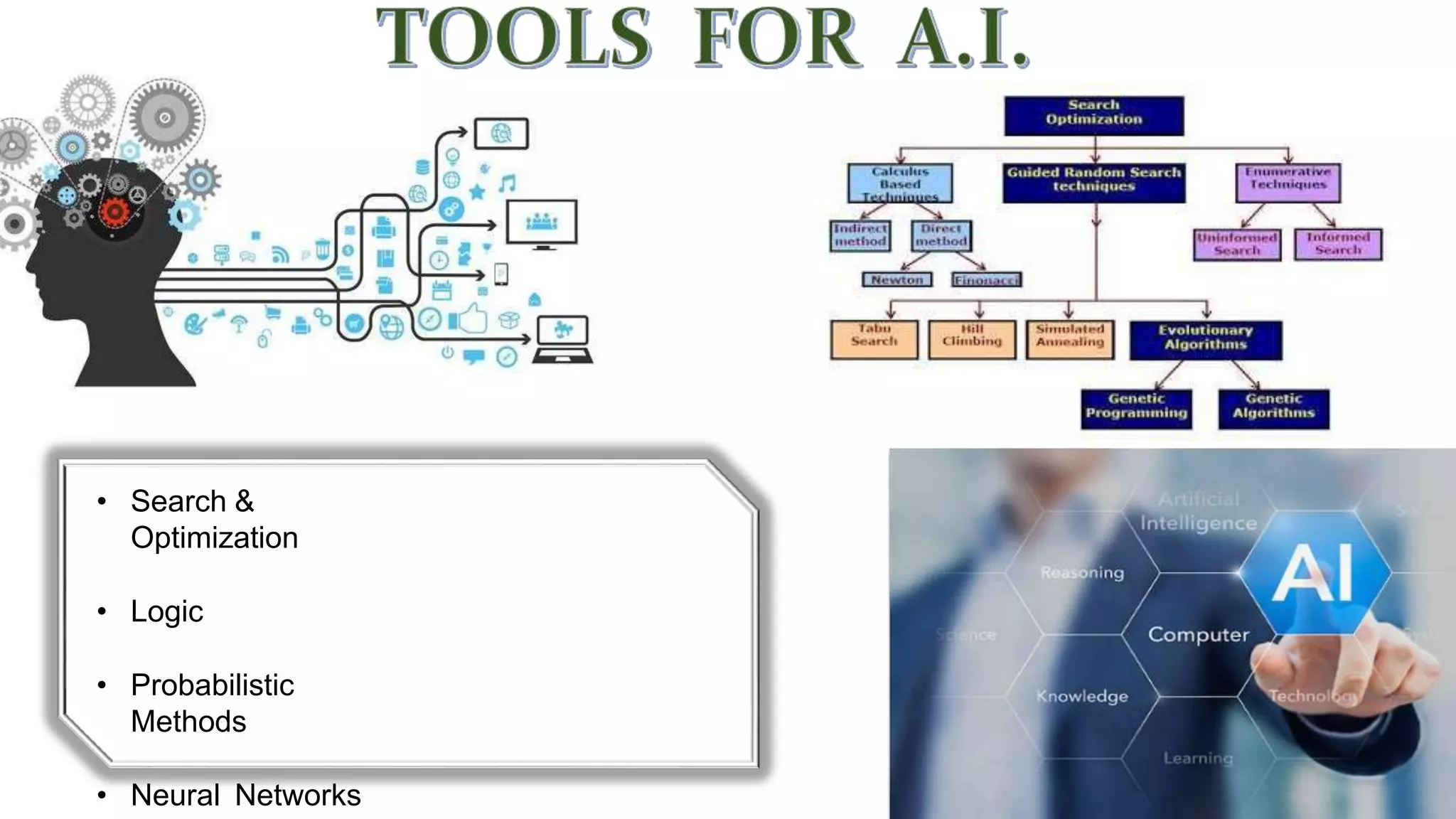
• Search &
Optimization
• Logic
• Probabilistic
Methods
• Neural Networks
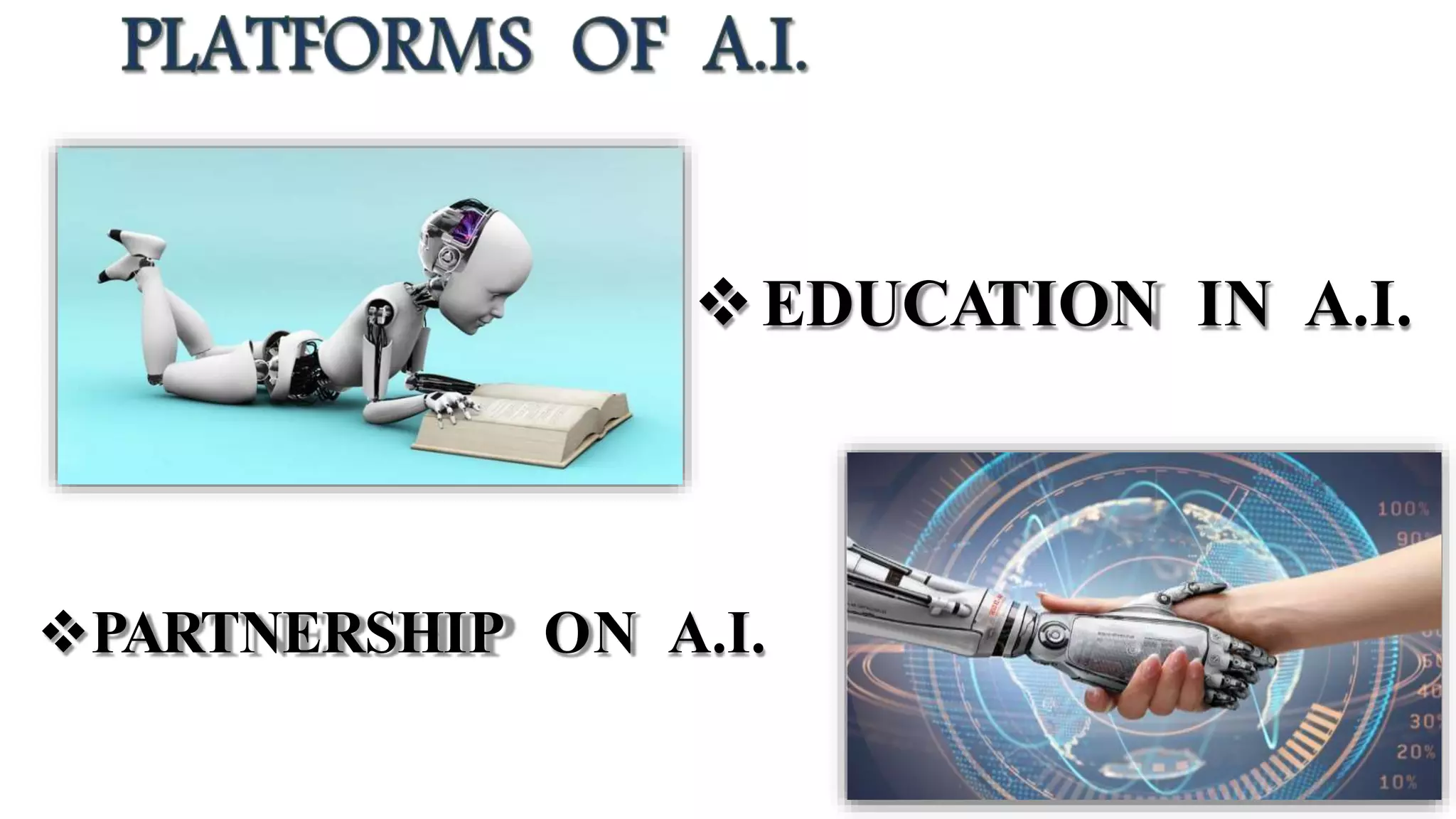
EDUCATION IN A.I.
PARTNERSHIP ON A.I.
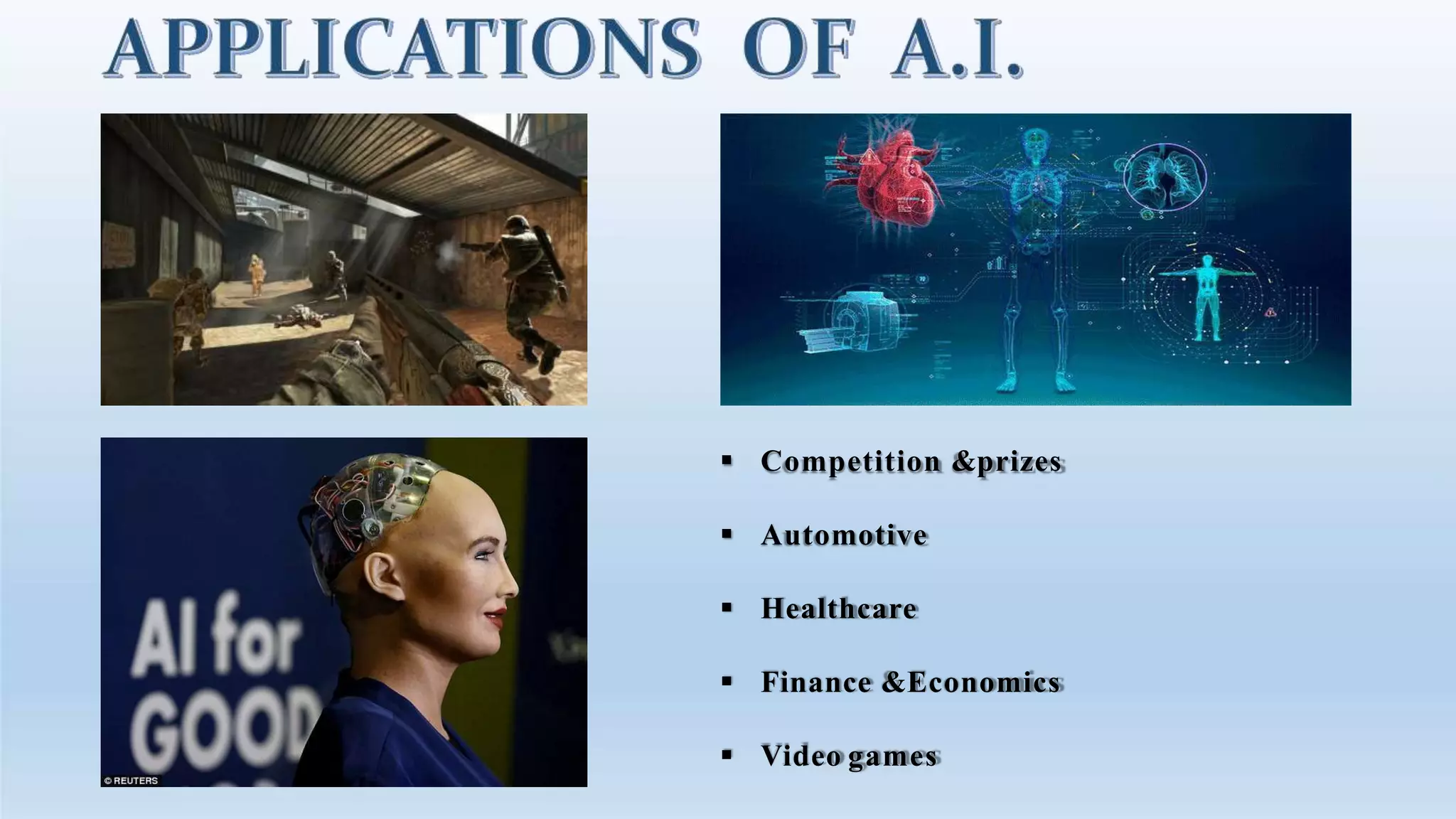
 Competition &prizes
 Automotive
 Healthcare
 Finance &Economics
 Video games
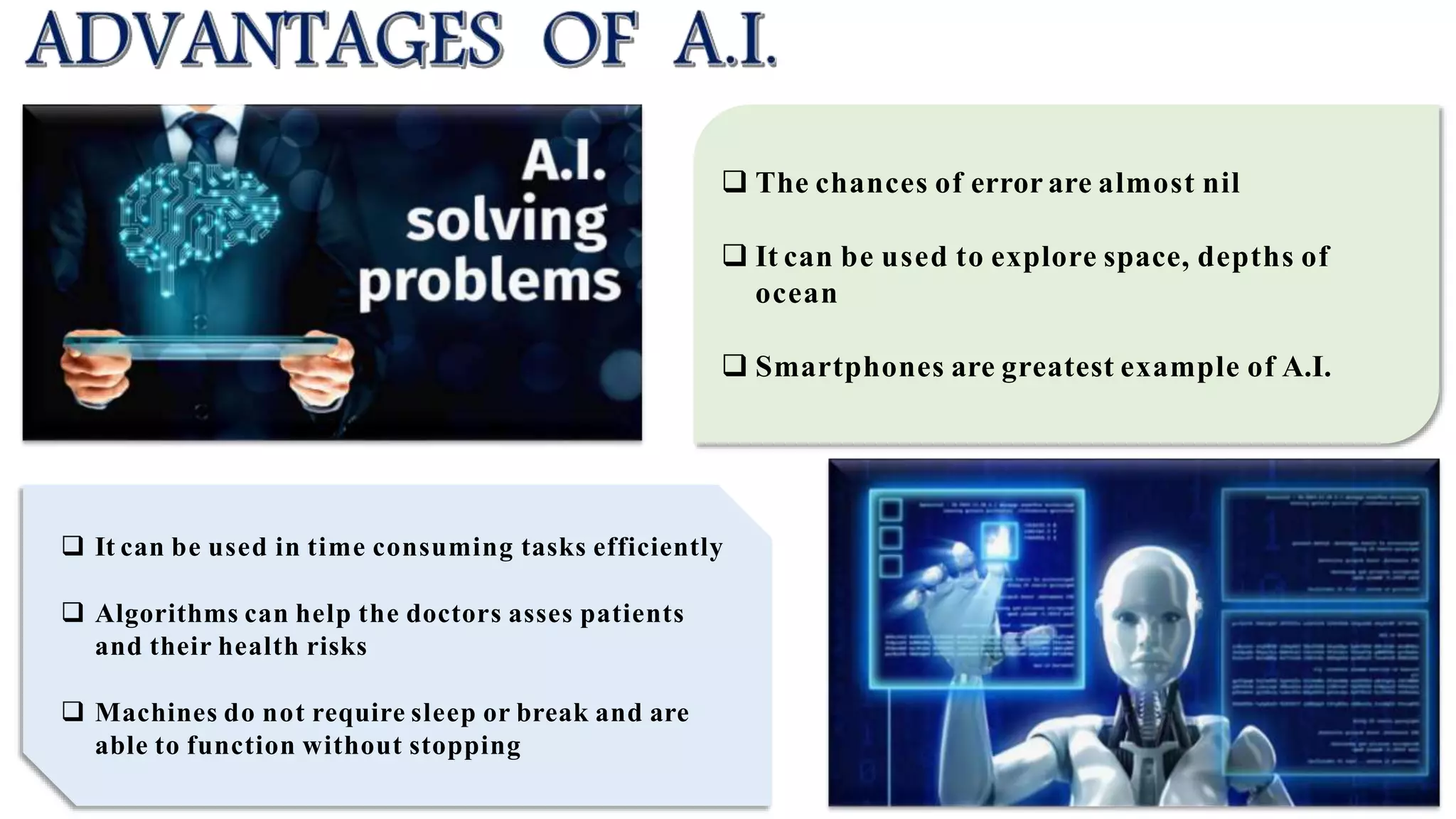
 The chances of error are almost nil
 It can be used to explore space, depths of
ocean
 Smartphones are greatest example of A.I.
 It can be used in time consuming tasks efficiently
 Algorithms can help the doctors asses patients
and their health risks
 Machines do not require sleep or break and are
able to function without stopping
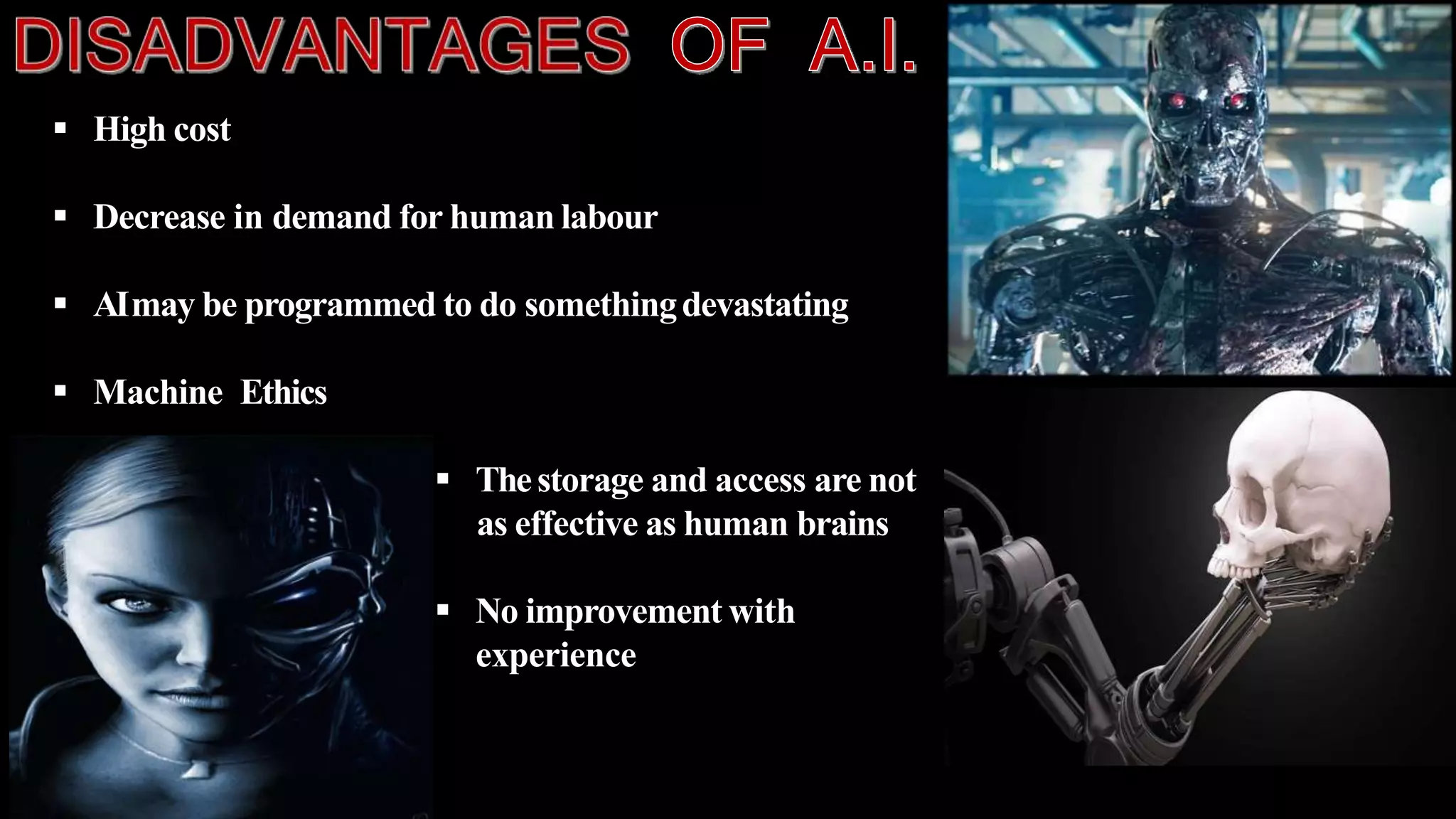
 High cost
 Decrease in demand for human labour
 AImay be programmed to do somethingdevastating
 Machine Ethics
 Thestorage and access are not
as effective as human brains
 No improvement with
experience
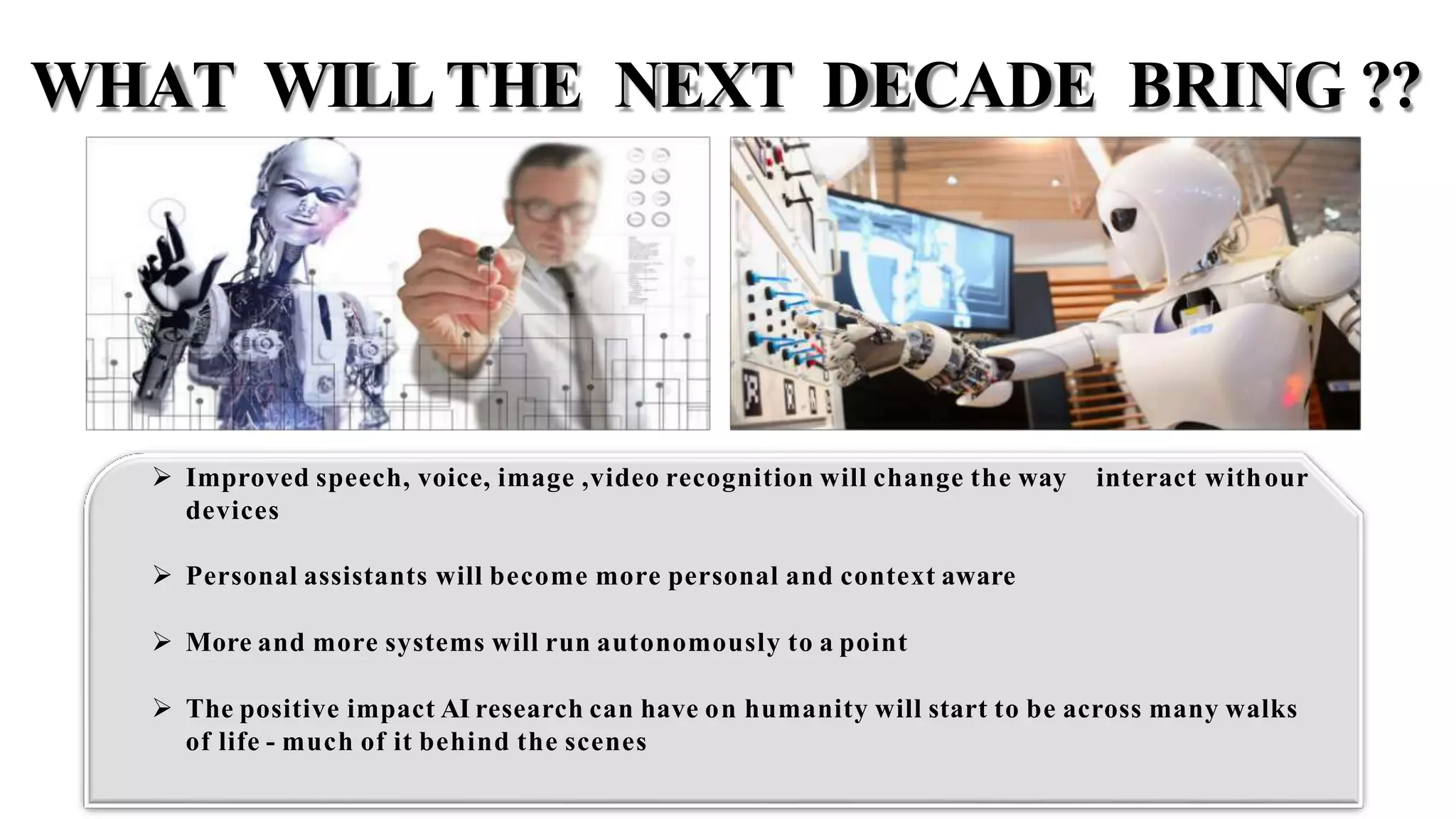
interact withour Improved speech, voice, image ,video recognition will change the way
devices
 Personal assistants will become more personal and context aware
 More and more systems will run autonomously to a point
 The positive impact AI research can have on humanity will start to be across many walks
of life - much of it behind the scenes
WHAT WILLTHE NEXT DECADE BRING ??
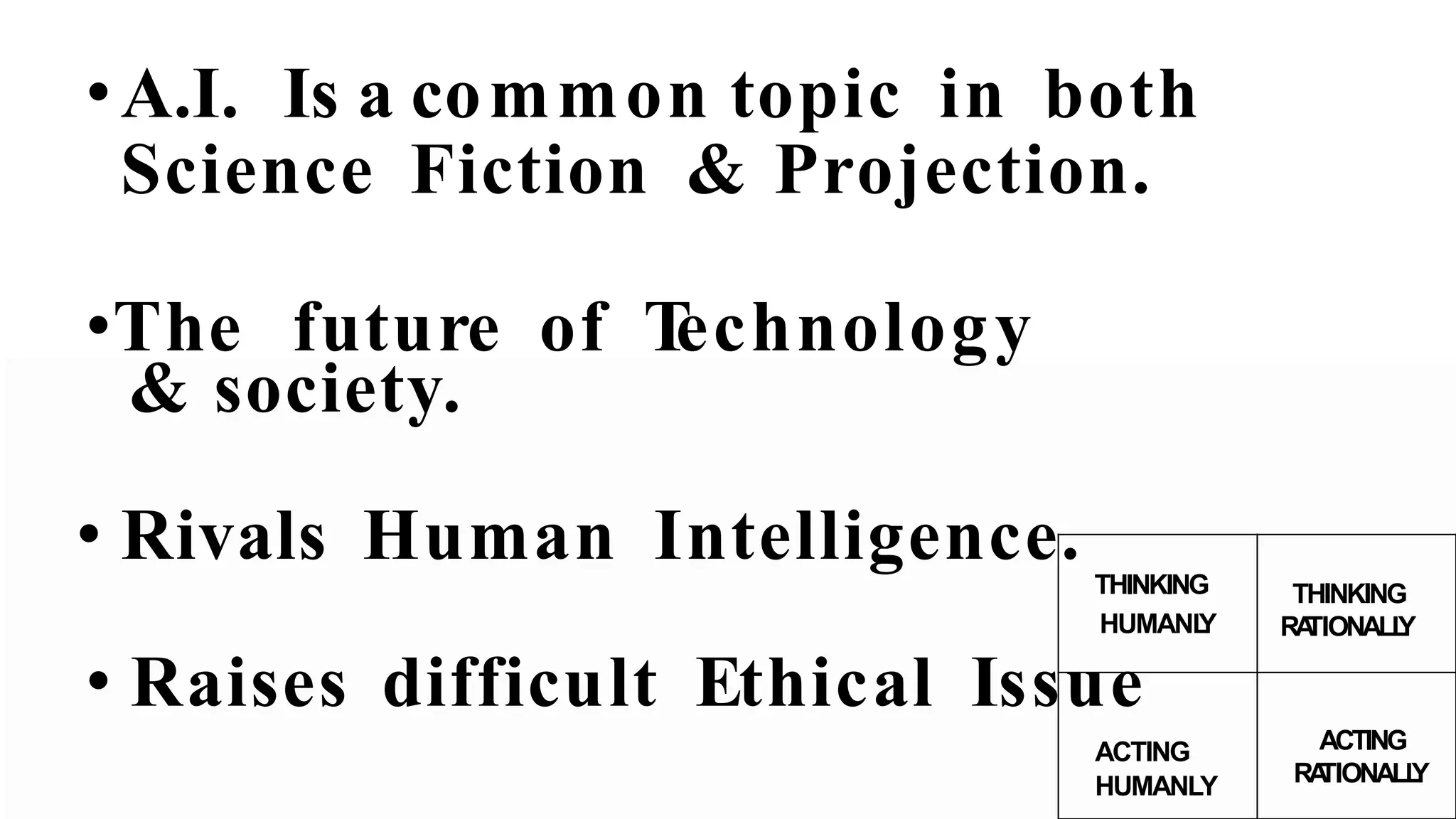
•A.I. Is a common topic in both
Science Fiction & Projection.
•The future of Technology
& society.
• Rivals Human Intelligence. THINKING
HUMANLY
THINKING
RATIONALLY
• Raises difficult Ethical Issue
ACTING
HUMANLY
ACTING
RATIONALLY
OBJECTIVES:
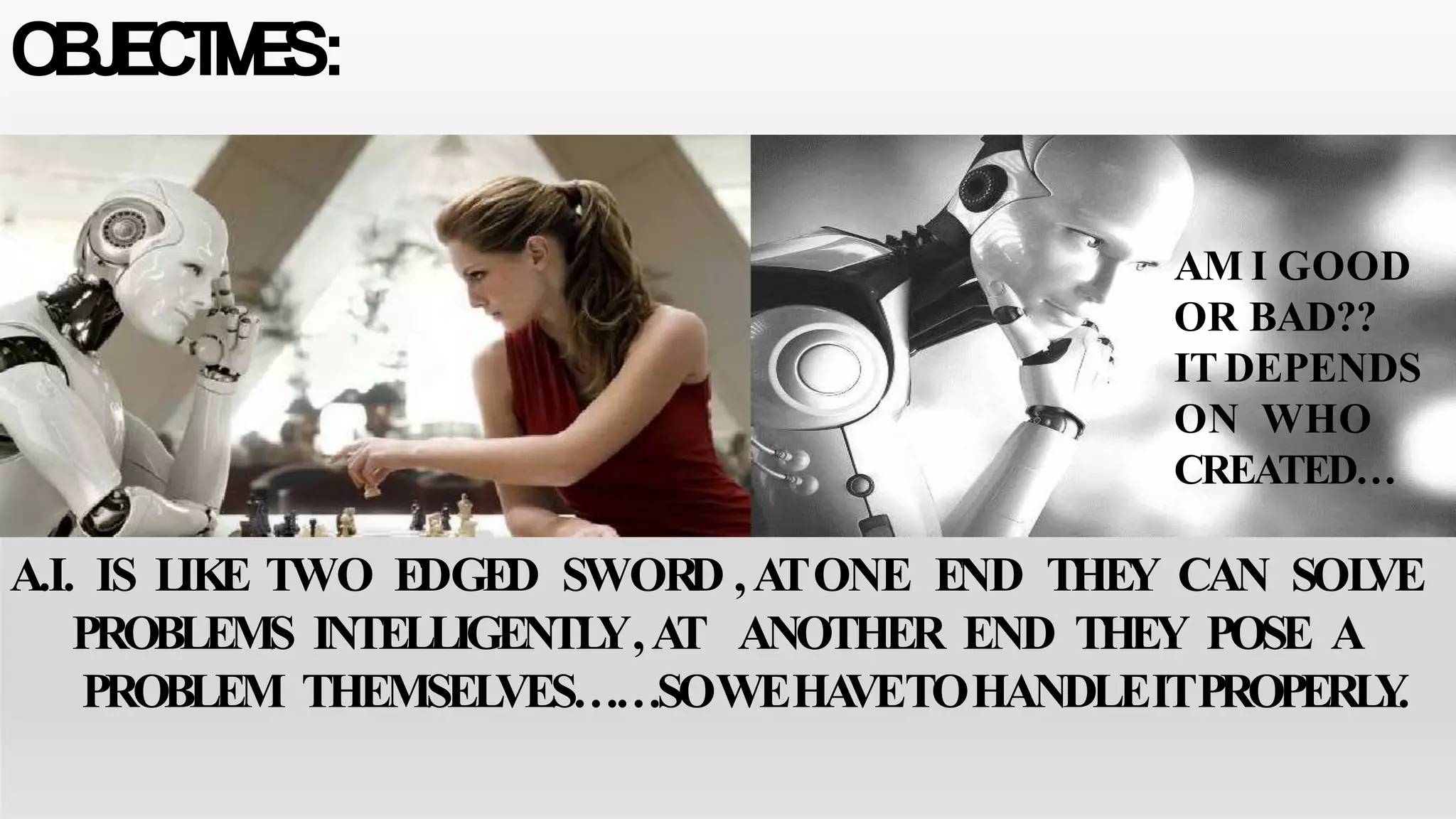
AM I GOOD
OR BAD??
ITDEPENDS
ON WHO
CREATED…
A.I. IS LIKE TWO EDGED SWORD ,ATONE END THEY CAN SOLVE
PROBLEMS INTELLIGENTLY,AT ANOTHER END THEY POSE A
PROBLEM THEMSELVES……SOWEHAVETOHANDLEITPROPERLY.
Artificial intelligence by p.k.

Artificial intelligence by p.k.

  • 1.
  • 2.
    CONTENTS • INTRODUCTION • HISTORY •CURRENTSTATUS • GOALS • APPLICATIONS • ADVANTAGES & DISADVANTAGES • FUTURE SCOPES • CONCLUSION
  • 4.
    ARTIFICIAL INTELLIGENCE ARTIFICIAL INTELLIGENCE Intelligence: “Thecapacity to learn and solve problems”  Artificial Intelligence: Artificial intelligence (AI) is the simulation of human intelligence by machines. • The ability to solve problems • The ability to act rationally • The ability to act like humans
  • 5.
  • 6.
    EARLY HISTORY OFA.I. 1950 : “CAN MACHINES THINK??????” 1956 : THE TERM “ARTIFICIALINTELLIGENCE” WAS FIRST INTRODUCED.
  • 7.
    CURRENT STATUS OFA.I. • Analyse Satellite Images to identify which areas have the highest poverty level • Gate allocation for plane while landing • Ticket price determination A.I. FOR GOOD AVIATION EDUCATION • Companies are creating robots to teach subjects
  • 8.
    • Solving avariety of problems of patients, hospitals & healthcare industry overall. • Using Avatars in place of patients. • Robots have become very common in many industries • Can do repetitive laborious tasks CURRENT STATUS OF A.I. HEALTHCARE HEAVY INDUSTRY FINANCE • Algorithmic Trading • Market analysis & data mining • Personal Finance • Portfolio management
  • 9.
    • To developalgorithms that human use. • Algorithms can require enormous computational resources and problem goes beyond a certain size • KNOWLEDGE REPRESENTATION : To build machine with the capability of making working assumption and common sense.
  • 10.
    • Planning : In classical planning problems, the agent can assume that it is the only system acting on the world  Multi-agent planning uses the cooperation and competition of many agents to achieve the given goal. • Learning :  Machine learning is the fundamental concept of AI search.  Unsupervised learning is the ability to find patterns in s stream ofinput  Supervised learning includes both classification and numerical regression
  • 11.
    :  Natural LanguageProcessinggives machines the ability to read and understand human language.  Common method of processing meaning from natural language is through semantic indexing. :  Machine perception is the ability to use input from sensors to deduce aspects of the world
  • 12.
    • MOTION &MANIPULATION :  Intelligence is required for robots to handle tasks such as object manipulation and navigation  Affective computing is the development of systems that can recognize, interpret, simulate human affects  Emotion and social skills are important to an intelligent agent to understand others and to make better decisions.
  • 13.
  • 14.
    • Search & Optimization •Logic • Probabilistic Methods • Neural Networks
  • 15.
  • 16.
     Competition &prizes Automotive  Healthcare  Finance &Economics  Video games
  • 18.
     The chancesof error are almost nil  It can be used to explore space, depths of ocean  Smartphones are greatest example of A.I.  It can be used in time consuming tasks efficiently  Algorithms can help the doctors asses patients and their health risks  Machines do not require sleep or break and are able to function without stopping
  • 20.
     High cost Decrease in demand for human labour  AImay be programmed to do somethingdevastating  Machine Ethics  Thestorage and access are not as effective as human brains  No improvement with experience
  • 22.
    interact withour Improvedspeech, voice, image ,video recognition will change the way devices  Personal assistants will become more personal and context aware  More and more systems will run autonomously to a point  The positive impact AI research can have on humanity will start to be across many walks of life - much of it behind the scenes WHAT WILLTHE NEXT DECADE BRING ??
  • 23.
    •A.I. Is acommon topic in both Science Fiction & Projection. •The future of Technology & society. • Rivals Human Intelligence. THINKING HUMANLY THINKING RATIONALLY • Raises difficult Ethical Issue ACTING HUMANLY ACTING RATIONALLY
  • 24.
    OBJECTIVES: AM I GOOD ORBAD?? ITDEPENDS ON WHO CREATED… A.I. IS LIKE TWO EDGED SWORD ,ATONE END THEY CAN SOLVE PROBLEMS INTELLIGENTLY,AT ANOTHER END THEY POSE A PROBLEM THEMSELVES……SOWEHAVETOHANDLEITPROPERLY.