Robust Object Recognition with Cortex-like Mechanisms (PAMI, 06) Presented by Ala Stolpnik T. Serre, L. Wolf, S. Bileschi, M. Riesenhuber, and T. Poggio
Introduction A general framework for the recognition of complex visual scenes The system follows the organization of visual cortex Texture and shape based object recognition
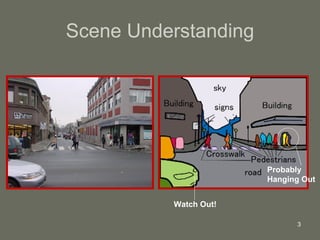
Scene Understanding Watch Out! Probably Hanging Out
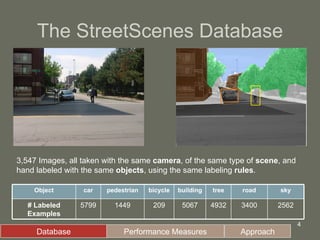
The StreetScenes Database 3,547 Images, all taken with the same  camera , of the same type of  scene , and hand labeled with the same  objects , using the same labeling  rules . Database Performance Measures Approach sky road tree building bicycle pedestrian car Object 2562 3400 4932 5067 209 1449 5799 # Labeled Examples
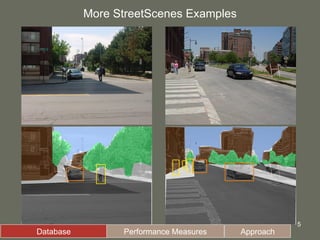
More StreetScenes Examples Database Performance Measures Approach
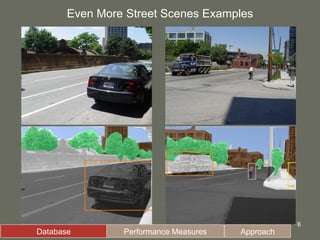
Even More Street Scenes Examples Database Performance Measures Approach
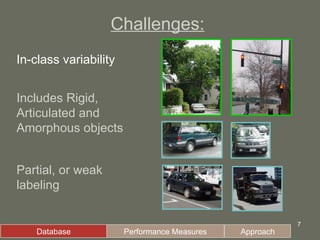
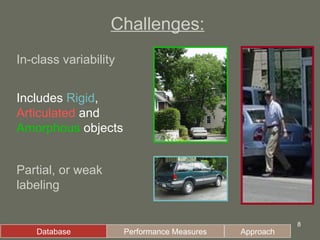
Challenges: In-class variability Partial, or weak labeling Includes Rigid, Articulated and Amorphous objects  Database Performance Measures Approach
Challenges: In-class variability Partial, or weak labeling Includes  Rigid ,  Articulated  and  Amorphous  objects   Database Performance Measures Approach
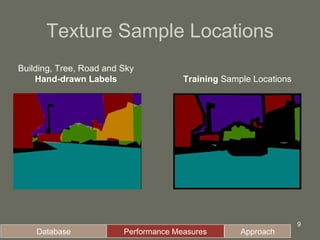
Texture Sample Locations Building, Tree, Road and Sky  Hand-drawn Labels Training  Sample   Locations Database Performance Measures Approach
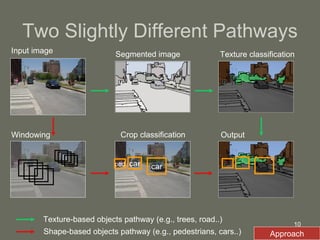
Input image Segmented image Texture classification Windowing Crop classification Output Texture-based objects pathway (e.g., trees, road..) Shape-based objects pathway (e.g., pedestrians, cars..) car car ped Approach Two Slightly Different Pathways
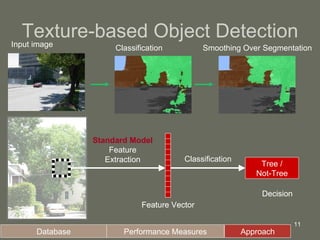
Texture-based Object Detection Input image Classification Smoothing Over Segmentation Tree / Not-Tree Standard Model  Feature Extraction Classification Database Performance Measures Approach Feature Vector Decision Feature Vector Decision
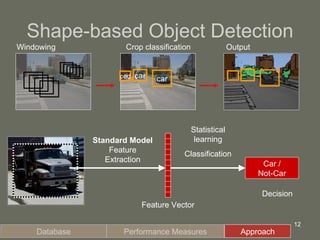
Shape-based Object Detection Windowing Crop classification Output car car ped Car / Not-Car Standard Model  Feature Extraction Statistical learning Classification Database Performance Measures Approach Feature Vector Decision
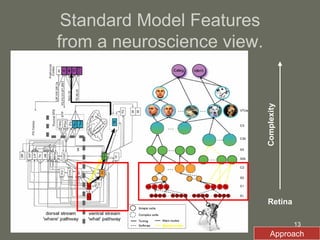
Standard Model Features from a neuroscience view. Retina Complexity Approach
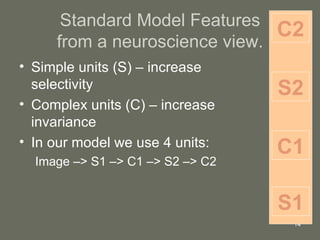
Standard Model Features from a neuroscience view. Simple units (S) – increase selectivity Complex units (C) – increase invariance In our model we use 4 units: Image –> S1 –> C1 –> S2 –> C2  C1 S2 C2 S1
Overview Introduction The model Results Approach
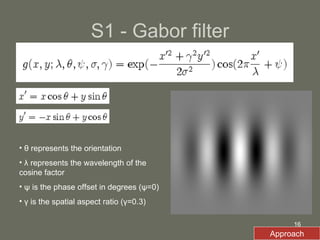
S1 - Gabor filter θ represents the orientation λ represents the wavelength of the cosine factor  ψ is the phase offset in degrees (ψ=0) γ is the spatial aspect ratio (γ=0.3) Approach
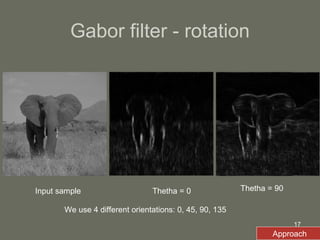
Gabor filter - rotation Input sample Thetha = 0 Thetha = 90 Approach We use 4 different orientations: 0, 45, 90, 135
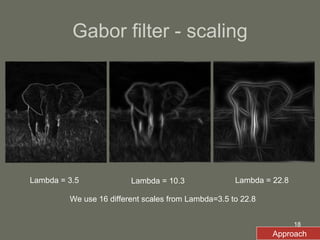
Gabor filter - scaling Lambda = 3.5 Lambda = 22.8 Lambda = 10.3 Approach We use 16 different scales from Lambda=3.5 to 22.8
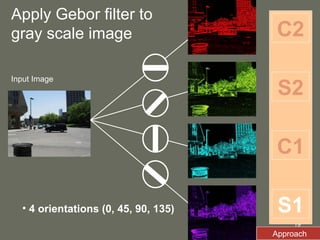
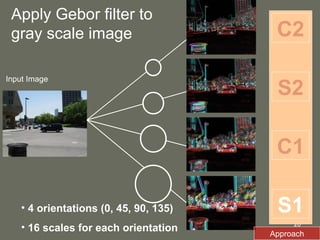
S1 Input Image 4 orientations (0, 45, 90, 135) C1 S2 C2 Approach Apply Gebor filter to gray scale image
Apply Gebor filter to gray scale image Input Image S1 C1 S2 C2 Approach 4 orientations (0, 45, 90, 135) 16 scales for each orientation
S1 S1 C1 S2 C2 Approach 4 orientations  16 scales for each orientation Total: 64 S1 units
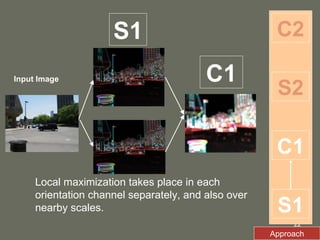
Input Image S1 C1 S1 C1 S2 C2 Local maximization takes place in each orientation channel separately, and also over nearby scales.  Approach
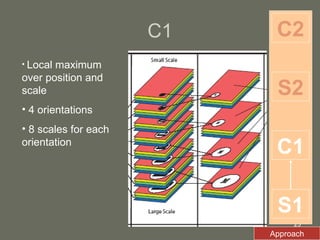
C1 S1 C1 S2 C2 Approach Local maximum over position and scale 4 orientations 8 scales for each orientation
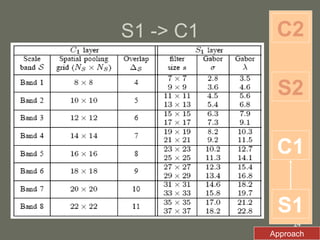
S1 -> C1 Approach S1 C1 S2 C2
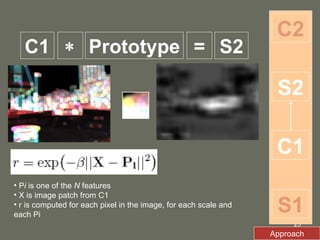
S1 C1 S2 C2 Approach P i  is one of   the  N  features X is image patch from C1 r is computed for each pixel in the image, for each scale and each Pi C1 S2 Prototype  =
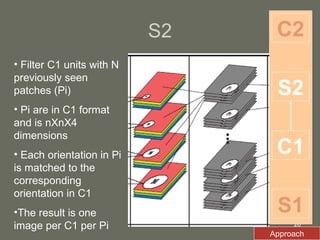
S2 Approach Filter C1 units with N previously seen patches (Pi) Pi are in C1 format and is nXnX4 dimensions Each orientation in Pi is matched to the corresponding orientation in C1 The result is one image per C1 per Pi S1 C1 S2 C2
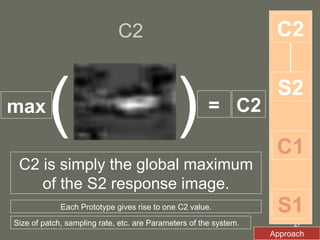
C2 C2 is simply the global maximum of the S2 response image. S1 C1 S2 C2 Each Prototype gives rise to one C2 value. C2 = max ( ) Size of patch, sampling rate, etc. are Parameters of the system. Approach
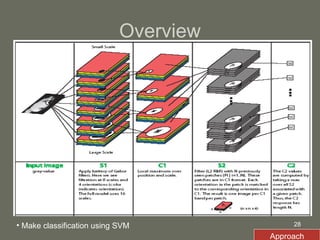
Overview Make classification using SVM Approach
The learning stage Where do we get the Pi from? Input: a collection of images (Task specific of general dictionary) Each Pi is from nXnX4 dimensions. Where n can be 4, 8, 12, or 16. Pi selection:  Select random image Convert the image to C1 Select nXn dimensional patch randomly from the C1 and this is our Pi Approach
Model overview At the learning stage compute N prototype templates (Pi) from training images. Object recognition: S1: apply 64 different Gabor filters to the image C1: maximize the output of the filters locally S2: measure “correlation” with Pi C2: maximization over entire image per Pi Approach
Overview Goals The model Results
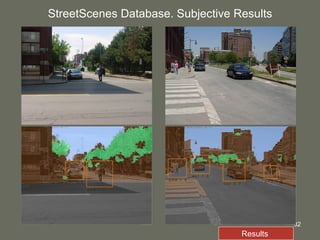
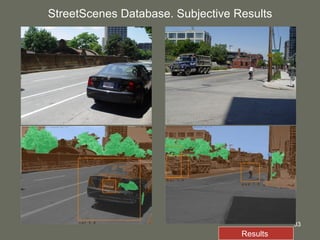
StreetScenes Database. Subjective Results Results
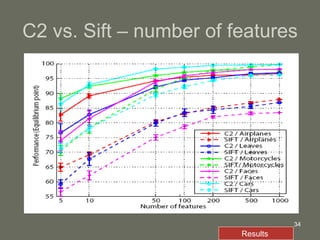
C2 vs. Sift – number of features Results
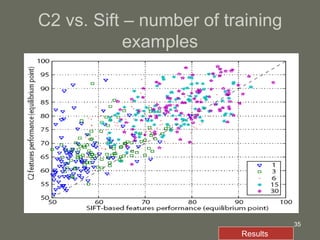
C2 vs. Sift – number of training examples Results
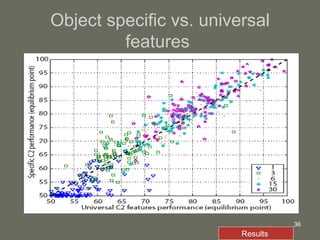
Object specific vs. universal features  Results
Conclusion A general framework for the recognition of complex visual scenes The system follows the organization of visual cortex Texture and shape based object recognition  Capability of learning from only a few training examples
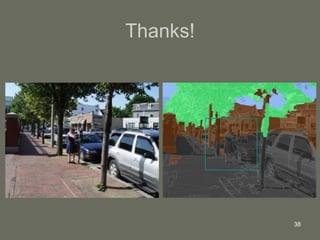
Thanks!

Ala Stolpnik's Standard Model talk

  • 1.
    Robust Object Recognitionwith Cortex-like Mechanisms (PAMI, 06) Presented by Ala Stolpnik T. Serre, L. Wolf, S. Bileschi, M. Riesenhuber, and T. Poggio
  • 2.
    Introduction A generalframework for the recognition of complex visual scenes The system follows the organization of visual cortex Texture and shape based object recognition
  • 3.
    Scene Understanding WatchOut! Probably Hanging Out
  • 4.
    The StreetScenes Database3,547 Images, all taken with the same camera , of the same type of scene , and hand labeled with the same objects , using the same labeling rules . Database Performance Measures Approach sky road tree building bicycle pedestrian car Object 2562 3400 4932 5067 209 1449 5799 # Labeled Examples
  • 5.
    More StreetScenes ExamplesDatabase Performance Measures Approach
  • 6.
    Even More StreetScenes Examples Database Performance Measures Approach
  • 7.
    Challenges: In-class variabilityPartial, or weak labeling Includes Rigid, Articulated and Amorphous objects Database Performance Measures Approach
  • 8.
    Challenges: In-class variabilityPartial, or weak labeling Includes Rigid , Articulated and Amorphous objects Database Performance Measures Approach
  • 9.
    Texture Sample LocationsBuilding, Tree, Road and Sky Hand-drawn Labels Training Sample Locations Database Performance Measures Approach
  • 10.
    Input image Segmentedimage Texture classification Windowing Crop classification Output Texture-based objects pathway (e.g., trees, road..) Shape-based objects pathway (e.g., pedestrians, cars..) car car ped Approach Two Slightly Different Pathways
  • 11.
    Texture-based Object DetectionInput image Classification Smoothing Over Segmentation Tree / Not-Tree Standard Model Feature Extraction Classification Database Performance Measures Approach Feature Vector Decision Feature Vector Decision
  • 12.
    Shape-based Object DetectionWindowing Crop classification Output car car ped Car / Not-Car Standard Model Feature Extraction Statistical learning Classification Database Performance Measures Approach Feature Vector Decision
  • 13.
    Standard Model Featuresfrom a neuroscience view. Retina Complexity Approach
  • 14.
    Standard Model Featuresfrom a neuroscience view. Simple units (S) – increase selectivity Complex units (C) – increase invariance In our model we use 4 units: Image –> S1 –> C1 –> S2 –> C2 C1 S2 C2 S1
  • 15.
    Overview Introduction Themodel Results Approach
  • 16.
    S1 - Gaborfilter θ represents the orientation λ represents the wavelength of the cosine factor ψ is the phase offset in degrees (ψ=0) γ is the spatial aspect ratio (γ=0.3) Approach
  • 17.
    Gabor filter -rotation Input sample Thetha = 0 Thetha = 90 Approach We use 4 different orientations: 0, 45, 90, 135
  • 18.
    Gabor filter -scaling Lambda = 3.5 Lambda = 22.8 Lambda = 10.3 Approach We use 16 different scales from Lambda=3.5 to 22.8
  • 19.
    S1 Input Image4 orientations (0, 45, 90, 135) C1 S2 C2 Approach Apply Gebor filter to gray scale image
  • 20.
    Apply Gebor filterto gray scale image Input Image S1 C1 S2 C2 Approach 4 orientations (0, 45, 90, 135) 16 scales for each orientation
  • 21.
    S1 S1 C1S2 C2 Approach 4 orientations 16 scales for each orientation Total: 64 S1 units
  • 22.
    Input Image S1C1 S1 C1 S2 C2 Local maximization takes place in each orientation channel separately, and also over nearby scales. Approach
  • 23.
    C1 S1 C1S2 C2 Approach Local maximum over position and scale 4 orientations 8 scales for each orientation
  • 24.
    S1 -> C1Approach S1 C1 S2 C2
  • 25.
    S1 C1 S2C2 Approach P i is one of the N features X is image patch from C1 r is computed for each pixel in the image, for each scale and each Pi C1 S2 Prototype  =
  • 26.
    S2 Approach FilterC1 units with N previously seen patches (Pi) Pi are in C1 format and is nXnX4 dimensions Each orientation in Pi is matched to the corresponding orientation in C1 The result is one image per C1 per Pi S1 C1 S2 C2
  • 27.
    C2 C2 issimply the global maximum of the S2 response image. S1 C1 S2 C2 Each Prototype gives rise to one C2 value. C2 = max ( ) Size of patch, sampling rate, etc. are Parameters of the system. Approach
  • 28.
    Overview Make classificationusing SVM Approach
  • 29.
    The learning stageWhere do we get the Pi from? Input: a collection of images (Task specific of general dictionary) Each Pi is from nXnX4 dimensions. Where n can be 4, 8, 12, or 16. Pi selection: Select random image Convert the image to C1 Select nXn dimensional patch randomly from the C1 and this is our Pi Approach
  • 30.
    Model overview Atthe learning stage compute N prototype templates (Pi) from training images. Object recognition: S1: apply 64 different Gabor filters to the image C1: maximize the output of the filters locally S2: measure “correlation” with Pi C2: maximization over entire image per Pi Approach
  • 31.
    Overview Goals Themodel Results
  • 32.
  • 33.
  • 34.
    C2 vs. Sift– number of features Results
  • 35.
    C2 vs. Sift– number of training examples Results
  • 36.
    Object specific vs.universal features Results
  • 37.
    Conclusion A generalframework for the recognition of complex visual scenes The system follows the organization of visual cortex Texture and shape based object recognition Capability of learning from only a few training examples
  • 38.

Editor's Notes

  • #2 אני אדבר על שיטה לזיהוי עצמים בתמונות . נתרכז במיוחד בזיהוי עצמים בסצנות של רחוב .