J. Janardhan et al. Int. Journal of Engineering Research and Applications www.ijera.com
ISSN : 2248-9622, Vol. 4, Issue 12( Part 6), December 2014, pp.253-258
www.ijera.com 253|P a g e
Radial Fatigue Analysis of An Alloy Wheel
J. Janardhan, V. Ravi Kumar, R. Lalitha Narayana
M.Tech Student, Department of Mechanical Engineering, A.S.R. College of Engineering, Tanuku
Assistant professor, Department of Mechanical Engineering, A.S.R. College of Engineering, Tanuku
Head of the Department, Department of Mechanical Engineering, A.S.R. College of Engineering, Tanuku
ABSTRACT:
Importance of wheel in the automobile is obvious. The vehicle (car) may be towed without the engine but at the
same time even that is also not possible without the wheels, the wheels along the tyre has to carry the vehicle
load, provide cushioning effect and cope with the steering control. The main requirements of an automobile
wheel are; it must be strong enough to perform the above functions. It should be balanced both statically as well
as dynamically. It should be lightest possible so that the unsprung weight is least.
The Wheel has to pass three types of tests before going into production, they are Cornering fatigue test,
Radial fatigue test and Impact test. In this thesis radial fatigue analysis is done to find the number of cycles at
which the wheel is going to fail. The 2D of the wheel was created in MDT, the drafting package and the same
was exported to ANSYS, the finite element package using IGES translator where the 3D model of the wheel is
created. The wheel is meshed using SOLID 45 element. A load of 2500N was applied on the hub area of the
wheel and a pressure of 0.207N/mm2 is applied on the outer surface of the rim. The pitch circle holes are
constrained in all degrees of freedom. The analysis is carried under these constraints and the results are taken to
carryout for further analysis i.e. fatigue module to find the life of the wheel.
Key words: Automobile wheel design, Static design, Dynamic design, Light design, Unsprung
weight, Radial fatigue test and Impact test
I. INTRODUCTION
The tyre works as a wheel only after it is
installed on the rim and is inflated. Therefore, the
tyre and wheel assembly influences the function and
the performance of the vehicle. The tyre is designed
and manufactured to suit a standard rim and once
installed on the correct rim the tyre will perform up
to its desired level. It is needless to say that the life
of the tyre will be shortened if it is installed on an
unsuitable rim. The rim is actually the name for the
cylindrical part where the tyre is installed. A wheel is
the name for the combination between the rim and
disc plate. Once the disc plate is installed inside the
cylinder this assembly becomes a wheel. Toyo Tyre
Talk at this time would like to introduce basic
technical knowledge about passenger vehicle rims.
The rim used for vehicles is provided depending on
each countries standard. This international standard,
similar to tyres, provides for a basic dimension for
the rim diameter, width, and the flange shape, etc.
and is common to every country in the world.
Recently the shape of the rim has settled to 5 degree
Drop Center Rim to provide for international
harmony.
Wheel is generally composed of rim and disc.
Rim is a part where the tyre is installed. Disc is a
part of the rim where it is fixed to the axle hub.
Offset is a distance between wheel mounting surface
where it is bolted to hub and the centerline of rim.
The flange is a part of rim, which holds the both
beads of the tyre. Bead seat comes in contact with
the bead face and is a part of rim, which holds the
tyre in a radial direction. Hump is bump what was
put on the bead seat for the bead to prevent the tyre
from sliding off the rim while the vehicle is moving.
Well is a part of rim with depth and width to
facilitate tyre mounting and removal from the rim.
First one is Aluminum Alloy Wheel is a metal
with features of excellent lightness, thermal
conductivity, corrosion resistance, characteristics of
casting, low temperature, machine processing and
recycling, etc. This metals main advantage is
reduced weight, high accuracy and design choices of
the wheel. This metal is useful for energy
conservation because it is possible to re-cycle
aluminum easily. Second one is Magnesium Alloy
Wheel is about 30% lighter than aluminum, and also,
excellent as for size stability and impact resistance.
However, its use is mainly restricted to racing, which
needs the features of lightness and high strength at
the expense of corrosion resistance and design
choice, etc. compared with aluminum. Recently, the
technology for casting and forging is improved, and
the corrosion resistance of magnesium is also
improving. This material is receiving special
attention due to the renewed interest in energy
RESEARCH ARTICLE OPEN ACCESS
J. Janardhan et al. Int. Journal of Engineering Research and Applications www.ijera.com
ISSN : 2248-9622, Vol. 4, Issue 12( Part 6), December 2014, pp.253-258
www.ijera.com 254|P a g e
conservation. Third one is Titanium Alloy Wheel is
an excellent metal for corrosion resistance and
strength (about 2.5 times) compared with aluminum,
but it is inferior due to machine processing,
designing and high cost. It is still in the development
stage although there is some use in the field of
racing. And final one is Composite Material Wheel ,
is different from the light alloy wheel, and it
(Generally, it is thermoplastic resin, which contains
the glass fiber reinforcement material) is developed
mainly for low weight. However, this wheel has
insufficient reliability against heat and for strength.
Development is continuing.
Objective of the project is the work involves in
finding the fatigue life of newly designed aluminum
alloy wheel due to static loads. The project mainly
involves in modeling of the wheel using MDT and
ANSYS, and the analysis is performed on the
modeled component using ANSYS. Analysis that is
performed typically includes static analysis.
II. EXPERIMENTAL SET UP OF AN
ALLOY WHEELS – RADIAL
FATIGUE TEST
1.1. SCOPE
This annex specifies a laboratory test procedure
to evaluate the fatigue test on an alloy wheel. It is
intended to for passenger car applications. With the
purpose of screening and/or quality control of the
wheel.
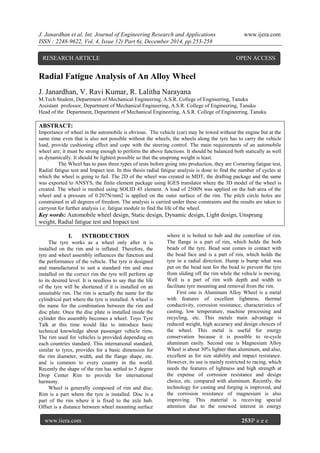
Fig. 1.1. Radial Fatigue Test Machine.
1.2. TEST PROCEDURE
Fig. 1.2 Model Equipment for Radial Fatigue
Test
The wheel with tyre is going to fix to the
machine equipment and it should be in contact to the
rotating drum the drum is going to revolve by the
motor by our required speed .so here the important
thing is we have to apply load on the tyre for it we
have to tie up a rope to the wheel and to the rotating
drum sideward block so that the load required has to
be set up by tightening the rope. In this way the
motor has to be run for our required speed and we
have to do this test continuously for two three hours
and by taking short durations or long time we can do
the experiment test by the way we have to note the
cycles . At last after so many days we are going to
get failure. By that we can estimate the life of the
alloy wheel. In this way it is time taking test
procedure, and we have to take correct procedure to
follow up.
III. FINITE ELEMENT ANALYSIS OF
WHEEL
The 2D of the wheel was created in MDT, the
drafting package and the same was exported to
ANSYS, the finite element package using IGES
translator where the 3D model of the wheel is
created.
2.1 Solid Model Of Wheel and :
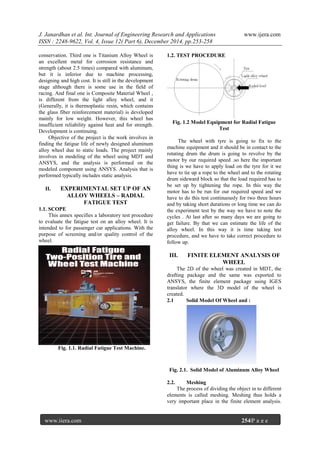
Fig. 2.1. Solid Model of Aluminum Alloy Wheel
2.2. Meshing
The process of dividing the object in to different
elements is called meshing. Meshing thus holds a
very important place in the finite element analysis.
J. Janardhan et al. Int. Journal of Engineering Research and Applications www.ijera.com
ISSN : 2248-9622, Vol. 4, Issue 12( Part 6), December 2014, pp.253-258
www.ijera.com 255|P a g e
An in-depth study of meshing assumes a very
important role.
The wheel is meshed using SOLID 45
element. The number of elements was found to be
9988 and the number of nodes was found to
be19903.
Fig. 2.2. Plot for meshed Model of Wheel by 3-D
4-Node
Tetrahedral Structural Solid with Rotations
(Solid45)
2.3. Boundary Conditions:
Fig. 2.3. Boundary conditions for model analysis
A pressure of 0.207N/mm2
is applied on the
outer surface of the rim. The pitch circle holes are
constrained in all degrees of freedom.
2.4. Loading conditions:
Here the load of 2500N is applied throughout the
inner surface of the hub diameter by taking one
middle node.
Fig. 2.4. Loading conditions for model analysis
2.5. Problem:
The problem stated here is to analyze the fatigue
failure of an alloy wheel. The load has to be
distributed on the hub diameter surface.
2.5.1. Material Properties of an alloy – A356.0-
T61 ; Permanent Mold Cast (Aluminum Alloy)
Subcategory: Aluminum Alloy; Nonferrous Metal;
Aluminum Casting Alloy: Aluminum A356.0 – T61;
UNS A13560; AAA356.0-T61;
Composition:
Component Wt% Component Wt%
Al 93 Mn Max 0.1
Cu Max 0.2 Si 6.5-7.5
Fe Max 0.2 Ti Max 0.2
Mg 0.25-
0.45
Zi Max 0.1
Table. 2.1. Aluminum Alloy Material Data
Yield strength of the material = 195N/mm2
Young’s modulus = 72400N/mm2
Density = 2.72e-9kgs2
/mm4
Poisson’s ratio = 0.33
2.5.2. Load given: Gross weight of the vehicle on
wheels;
619 + 5x70 + 50 = 1500kg.
619--------kreb weight of vehicle
5-----------No. Of Persons in car
70---------Weight of each person
50----------Overages added.
Load on each wheel: 1019/4=254.85kg.(2500N)
2.5.3. Pressure Load:
Consider 30 psi of air pressure load acting on
the outer surface of the wheel. Therefore
30 = 30x0.4535x9.81/(25.4) 2
= 0.207 N/mm2
2.6. Steps in doing a Fatigue Evaluation:
1. Enter POST1 and Resume Your Database
2. Establish the Size, Fatigue Material Properties,
and Locations
3. Define material fatigue properties.
4. Store Stresses and Assign Event Repetitions and
Scale Factors
5. Activate the Fatigue Calculations
IV. RESULTS AND DISCUSSIONS
3.1. Analysis Under Radial Load
J. Janardhan et al. Int. Journal of Engineering Research and Applications www.ijera.com
ISSN : 2248-9622, Vol. 4, Issue 12( Part 6), December 2014, pp.253-258
www.ijera.com 256|P a g e
The total weight of a car is balanced with vertical
reaction force from the road through the tyre. This
load constantly compresses the wheel radially. While
the car is running, the radial load becomes a cyclic
load with the rotation of the wheel. Hence, the
evaluation of wheel fatigue strength under radial
load is an important performance characteristic for
structural integrity.
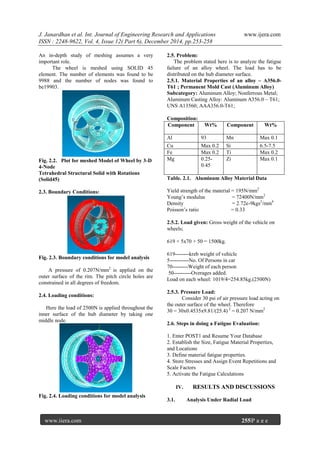
Total Deformation Analysis
Fig. 3.1. Total deformation under radial load.
3.2 Total deformation of engine side:
Fig. 3.2. Total deformation of engine side.
3.3. Maximum Shear Stress
Fig. 3.3. Maximum Shear Stress
3.4. Equivalent (von-Mises) Stress.
Fig. 3.4. Equivalent (von-mises) Stress.
3.5. Equivalent Alternating Stress
Fig. 3.5. Equivalent Alternating Stress.
3.6. Safety Factor:
Fig. 3.6. Safety Factor.
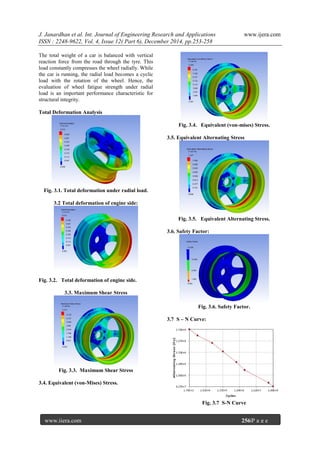
3.7 S – N Curve:
Fig. 3.7 S-N Curve
J. Janardhan et al. Int. Journal of Engineering Research and Applications www.ijera.com
ISSN : 2248-9622, Vol. 4, Issue 12( Part 6), December 2014, pp.253-258
www.ijera.com 257|P a g e
S.No. Cycles Alternating Stress (Pa)
1 17000 2.758e+008
2 50000 2.413e+008
3 34000 2.068e+008
4 1.4e+00
5
1.724e+008
5 8.e+005 1.379e+008
6 2.4e+00
6
1.172e+008
7 5.5e+00
7
8.963e+007
8 1.e+008 8.274e+007
Table. 3.1 S-N Curve
3.8 Fatigue Results:
Fig.3.8 Fatigue Results
3.9 Result:
Name Type Scale
Facto
r
Stress
Component
Infinite
Life
Fatigue
Tool
Fully
Reversed
1.0 Signed
Von-Mises
1.0x10⁹
Table 3.2. Fatigue result
V. CONCLUSIONS AND FUTURE
SCOPE
As in the case of an automobile wheel maximum
load is applied on the alloy wheel. Analysis of the
wheel plays an important role for the safety of the
passenger cars. This project deals with the fatigue
analysis of the wheel, as explained in the previous
chapters.
The 2D of the wheel was created in MDT, the
drafting package and the same was exported to
ANSYS, the finite element package using IGES
translator where the 3D model of the wheel is
created. The wheel is meshed using SOLID 45
element. A load of 2500N was applied on the hub
area of the wheel and a pressure of 0.207N/mm2 is
applied on the outer surface of the rim. The pitch
circle holes are constrained in all degrees of
freedom. The analysis is carried under these
constraints and the results are taken to carryout for
further analysis i.e fatigue module to find the life of
the wheel. Various number of cycles the analysis has
been done. Finally we found Equivalent (Von-Mises)
Stress we find 9.205x1e6 Pa maximum stress. And
the minimum stress is 0.041x1e6 Pa. and the
deformation is observed as the 0.515x1e-1 mm after
running the fatigue cycles we found that the infinite
life at 1.0x10⁹ cycles.
Same analysis can be performed with alternate
materials by applying load at different areas on the
wheel, to reduce the weight, which ultimately
reduces the overall cost, with increase in lifetime,
and we can find the failure by changing loads by
increasing or decreasing according to our
requirements of that particular wheels we also
change the models or design of the wheel and to test
for the fatigue and comparing with the two models
which will give the more life we can identify and we
can develop that model. And also the various tests
have to be done by other two tests such as cornering
test and impact test.
REFERENCES:
[1]. J.Stearns, P.C.Lam, and T.S.Srivastsans “An
analysis of Stress and Displacement in a
Rotating Rim subjected to Pressure and
Radial Loads.” Division of Advanced
Product and Process Technology. The
Goodyear Tyre and Rubber Company,
Akron, Ohio, U S A. April 14,2000.
[2]. Smithers Scientific Services, Inc.”Wheel
Test Center”Smithers Scientific Services,
Inc. 425 West Market Street, Akron, OH
44303-2099 U.S.A. 1997
[3]. Pottinger, M.G., Arnold, G.A., Marhall,
K.D.,[1976] “The effect of test speed and
surface curvature on cornering properties of
wheel”.
[4]. Ering Tonuk, Y.samin Unlusoy [2001] ,
“Prediction of Automobile tyre cornering
force characteristics by finite element
modeling and analysis”.
[5]. Wright,D.H., [1983] “Test Method for
Automotive Wheels, Institute of Mechanical
Engineering” Paper No.c278/83,in
Automobile Wheels and Tyres.
[6]. Cameron. Lonsdale and Francois. Demility.
[1999] “Wheel Rim Residual Stress
Measurement”.
[7]. Konishi,H.,Fujiware,A.,Katsura,T.,
Takeuchi,K.,and Nakata,M., 1996,”Impact
Strength of Aluminium alloy Wheel
(Influence of Disk and Rim Rigidity on the
J. Janardhan et al. Int. Journal of Engineering Research and Applications www.ijera.com
ISSN : 2248-9622, Vol. 4, Issue 12( Part 6), December 2014, pp.253-258
www.ijera.com 258|P a g e
JWL Impact Strength of Aluminium alloy
Wheel)”Nippon Kikai Gakkai
Ronbunshu,C.Hen,Vol.62,n 599,pg. 2884-
2890.
[8]. Mizoguchi, T., Nishimura, H., Nakata, K.,
and Kawakami, J., 1982, “Stress Analysis
and Fatigue Strength Evalution of Sheet
Fabricated 2-Piece Aluminium alloy Wheels
for Passenger Cars.”R&D,Reserch &
Development (Kobe Steel, Ltd),Vol.32,n
2,pg.25-28.
[9]. Konishi,H.,Fujiwara,A.,Katsura, T.,
Takeuchi,K.,and Nakata,M.,[1997],”Impact
Strength of Aluminium alloy Disk Wheel”
Nippon Kikai Gakkai
Ronbunshu,R&D,Reserch & Development
(Kobe Steel, Ltd), Vol 47, n 2,pp.25-28.
[10]. Fischer, G.; Grubisic, V.: Biaxial Wheel /
Hub Test Facility, Proceedings of the 4th
International User Meeting,September 21
st,1999 in Darmstadt LBF-Report No.TB-
219[2000].
[11]. Rupp, A., Grubisic, V.: Reliable and
Efficient Measurement of Suspension Loads
on Passenger-cars and Commercial Vehicles
International Conference and Exibition,
Ancona, 29.-30.6.1995.ATA
Orbassano[1995], s. 263-273.
[12]. Best Cast IT Ltd, “Reference Manuals” for
data on alloy.
[13]. Alfredsson, B. and Cadario, A., To appear
in: Int J Fatigue.
[14]. Chandawanich, N. and Sharpe, W. Jr., “An
Experimental Study of Fatigue Crack Growth
Initiation and Growth from Cold worked
Holes,” Engineering Fracture
Mechanics,Vol. 11, 1979, pp. 609-620.
[15]. Cathey, W. H. and Grandt, A. F., “Fracture
Mechanics Consideration of Residual
Stresses Introduced by Cold working
Fastener Holes,” Journal of Engineering
Materials and Technology, Vol. 102,
1980,pp. 85-91.
[16]. Fuchs, H.O. and Stephens, R.I. (1980) Metal
Fatigue in Structures. New York: John Wiley
and Sons.24.Gavin, H.P. (1986) “Spoked
Bicycle Wheels: A Comparative
Experimental and Finite Element Analysis of
Static and Dynamic Characteristics of
Bicycle Wheels with Variable Spoking
Patterns.” Undergraduate Leve, Howard L.
(1969) “Cumulative Damage Theories.” in
Metal Fatigue: Theory and Design. A.F.
[17]. Pippard, A.J.S., and Francis, W.E. (1931)
“The stresses in a radially-spoked wire wheel
under loads applied to the rim.”
Philosophical Magazine, 7(11), 233-285.
[18]. Pippard, A.J.S., and Francis, W.E. (1932)
“The stresses in a wire wheel under side
loads on the rim.”
[19]. Pippard, A.J.S., and White, M.J. (1932)
“The stresses in a wire wheel with non-radial
spokes under loads applied to the rim.”
Philosophical Mag., 7(14), 209-233.
[20]. Pope, Joseph Albert. (1959) Metal Fatigue.
London: Chapman and Hall.Price, D. and
Akers, A. (1985) “Stiffness Characteristics
of Bicycle Wheels.” Bike Tech. Emaus, PA:
[21]. Rice, Richard C. (1985) “Fatigue Data
Analysis.” in Metals Handbook. 9th Edition,
Vol. 8 (Mechanical Testing), Metals Park,
Ohio: American Society for Metals.

Radial Fatigue Analysis of An Alloy Wheel

  • 1.
    J. Janardhan etal. Int. Journal of Engineering Research and Applications www.ijera.com ISSN : 2248-9622, Vol. 4, Issue 12( Part 6), December 2014, pp.253-258 www.ijera.com 253|P a g e Radial Fatigue Analysis of An Alloy Wheel J. Janardhan, V. Ravi Kumar, R. Lalitha Narayana M.Tech Student, Department of Mechanical Engineering, A.S.R. College of Engineering, Tanuku Assistant professor, Department of Mechanical Engineering, A.S.R. College of Engineering, Tanuku Head of the Department, Department of Mechanical Engineering, A.S.R. College of Engineering, Tanuku ABSTRACT: Importance of wheel in the automobile is obvious. The vehicle (car) may be towed without the engine but at the same time even that is also not possible without the wheels, the wheels along the tyre has to carry the vehicle load, provide cushioning effect and cope with the steering control. The main requirements of an automobile wheel are; it must be strong enough to perform the above functions. It should be balanced both statically as well as dynamically. It should be lightest possible so that the unsprung weight is least. The Wheel has to pass three types of tests before going into production, they are Cornering fatigue test, Radial fatigue test and Impact test. In this thesis radial fatigue analysis is done to find the number of cycles at which the wheel is going to fail. The 2D of the wheel was created in MDT, the drafting package and the same was exported to ANSYS, the finite element package using IGES translator where the 3D model of the wheel is created. The wheel is meshed using SOLID 45 element. A load of 2500N was applied on the hub area of the wheel and a pressure of 0.207N/mm2 is applied on the outer surface of the rim. The pitch circle holes are constrained in all degrees of freedom. The analysis is carried under these constraints and the results are taken to carryout for further analysis i.e. fatigue module to find the life of the wheel. Key words: Automobile wheel design, Static design, Dynamic design, Light design, Unsprung weight, Radial fatigue test and Impact test I. INTRODUCTION The tyre works as a wheel only after it is installed on the rim and is inflated. Therefore, the tyre and wheel assembly influences the function and the performance of the vehicle. The tyre is designed and manufactured to suit a standard rim and once installed on the correct rim the tyre will perform up to its desired level. It is needless to say that the life of the tyre will be shortened if it is installed on an unsuitable rim. The rim is actually the name for the cylindrical part where the tyre is installed. A wheel is the name for the combination between the rim and disc plate. Once the disc plate is installed inside the cylinder this assembly becomes a wheel. Toyo Tyre Talk at this time would like to introduce basic technical knowledge about passenger vehicle rims. The rim used for vehicles is provided depending on each countries standard. This international standard, similar to tyres, provides for a basic dimension for the rim diameter, width, and the flange shape, etc. and is common to every country in the world. Recently the shape of the rim has settled to 5 degree Drop Center Rim to provide for international harmony. Wheel is generally composed of rim and disc. Rim is a part where the tyre is installed. Disc is a part of the rim where it is fixed to the axle hub. Offset is a distance between wheel mounting surface where it is bolted to hub and the centerline of rim. The flange is a part of rim, which holds the both beads of the tyre. Bead seat comes in contact with the bead face and is a part of rim, which holds the tyre in a radial direction. Hump is bump what was put on the bead seat for the bead to prevent the tyre from sliding off the rim while the vehicle is moving. Well is a part of rim with depth and width to facilitate tyre mounting and removal from the rim. First one is Aluminum Alloy Wheel is a metal with features of excellent lightness, thermal conductivity, corrosion resistance, characteristics of casting, low temperature, machine processing and recycling, etc. This metals main advantage is reduced weight, high accuracy and design choices of the wheel. This metal is useful for energy conservation because it is possible to re-cycle aluminum easily. Second one is Magnesium Alloy Wheel is about 30% lighter than aluminum, and also, excellent as for size stability and impact resistance. However, its use is mainly restricted to racing, which needs the features of lightness and high strength at the expense of corrosion resistance and design choice, etc. compared with aluminum. Recently, the technology for casting and forging is improved, and the corrosion resistance of magnesium is also improving. This material is receiving special attention due to the renewed interest in energy RESEARCH ARTICLE OPEN ACCESS
  • 2.
    J. Janardhan etal. Int. Journal of Engineering Research and Applications www.ijera.com ISSN : 2248-9622, Vol. 4, Issue 12( Part 6), December 2014, pp.253-258 www.ijera.com 254|P a g e conservation. Third one is Titanium Alloy Wheel is an excellent metal for corrosion resistance and strength (about 2.5 times) compared with aluminum, but it is inferior due to machine processing, designing and high cost. It is still in the development stage although there is some use in the field of racing. And final one is Composite Material Wheel , is different from the light alloy wheel, and it (Generally, it is thermoplastic resin, which contains the glass fiber reinforcement material) is developed mainly for low weight. However, this wheel has insufficient reliability against heat and for strength. Development is continuing. Objective of the project is the work involves in finding the fatigue life of newly designed aluminum alloy wheel due to static loads. The project mainly involves in modeling of the wheel using MDT and ANSYS, and the analysis is performed on the modeled component using ANSYS. Analysis that is performed typically includes static analysis. II. EXPERIMENTAL SET UP OF AN ALLOY WHEELS – RADIAL FATIGUE TEST 1.1. SCOPE This annex specifies a laboratory test procedure to evaluate the fatigue test on an alloy wheel. It is intended to for passenger car applications. With the purpose of screening and/or quality control of the wheel. Fig. 1.1. Radial Fatigue Test Machine. 1.2. TEST PROCEDURE Fig. 1.2 Model Equipment for Radial Fatigue Test The wheel with tyre is going to fix to the machine equipment and it should be in contact to the rotating drum the drum is going to revolve by the motor by our required speed .so here the important thing is we have to apply load on the tyre for it we have to tie up a rope to the wheel and to the rotating drum sideward block so that the load required has to be set up by tightening the rope. In this way the motor has to be run for our required speed and we have to do this test continuously for two three hours and by taking short durations or long time we can do the experiment test by the way we have to note the cycles . At last after so many days we are going to get failure. By that we can estimate the life of the alloy wheel. In this way it is time taking test procedure, and we have to take correct procedure to follow up. III. FINITE ELEMENT ANALYSIS OF WHEEL The 2D of the wheel was created in MDT, the drafting package and the same was exported to ANSYS, the finite element package using IGES translator where the 3D model of the wheel is created. 2.1 Solid Model Of Wheel and : Fig. 2.1. Solid Model of Aluminum Alloy Wheel 2.2. Meshing The process of dividing the object in to different elements is called meshing. Meshing thus holds a very important place in the finite element analysis.
  • 3.
    J. Janardhan etal. Int. Journal of Engineering Research and Applications www.ijera.com ISSN : 2248-9622, Vol. 4, Issue 12( Part 6), December 2014, pp.253-258 www.ijera.com 255|P a g e An in-depth study of meshing assumes a very important role. The wheel is meshed using SOLID 45 element. The number of elements was found to be 9988 and the number of nodes was found to be19903. Fig. 2.2. Plot for meshed Model of Wheel by 3-D 4-Node Tetrahedral Structural Solid with Rotations (Solid45) 2.3. Boundary Conditions: Fig. 2.3. Boundary conditions for model analysis A pressure of 0.207N/mm2 is applied on the outer surface of the rim. The pitch circle holes are constrained in all degrees of freedom. 2.4. Loading conditions: Here the load of 2500N is applied throughout the inner surface of the hub diameter by taking one middle node. Fig. 2.4. Loading conditions for model analysis 2.5. Problem: The problem stated here is to analyze the fatigue failure of an alloy wheel. The load has to be distributed on the hub diameter surface. 2.5.1. Material Properties of an alloy – A356.0- T61 ; Permanent Mold Cast (Aluminum Alloy) Subcategory: Aluminum Alloy; Nonferrous Metal; Aluminum Casting Alloy: Aluminum A356.0 – T61; UNS A13560; AAA356.0-T61; Composition: Component Wt% Component Wt% Al 93 Mn Max 0.1 Cu Max 0.2 Si 6.5-7.5 Fe Max 0.2 Ti Max 0.2 Mg 0.25- 0.45 Zi Max 0.1 Table. 2.1. Aluminum Alloy Material Data Yield strength of the material = 195N/mm2 Young’s modulus = 72400N/mm2 Density = 2.72e-9kgs2 /mm4 Poisson’s ratio = 0.33 2.5.2. Load given: Gross weight of the vehicle on wheels; 619 + 5x70 + 50 = 1500kg. 619--------kreb weight of vehicle 5-----------No. Of Persons in car 70---------Weight of each person 50----------Overages added. Load on each wheel: 1019/4=254.85kg.(2500N) 2.5.3. Pressure Load: Consider 30 psi of air pressure load acting on the outer surface of the wheel. Therefore 30 = 30x0.4535x9.81/(25.4) 2 = 0.207 N/mm2 2.6. Steps in doing a Fatigue Evaluation: 1. Enter POST1 and Resume Your Database 2. Establish the Size, Fatigue Material Properties, and Locations 3. Define material fatigue properties. 4. Store Stresses and Assign Event Repetitions and Scale Factors 5. Activate the Fatigue Calculations IV. RESULTS AND DISCUSSIONS 3.1. Analysis Under Radial Load
  • 4.
    J. Janardhan etal. Int. Journal of Engineering Research and Applications www.ijera.com ISSN : 2248-9622, Vol. 4, Issue 12( Part 6), December 2014, pp.253-258 www.ijera.com 256|P a g e The total weight of a car is balanced with vertical reaction force from the road through the tyre. This load constantly compresses the wheel radially. While the car is running, the radial load becomes a cyclic load with the rotation of the wheel. Hence, the evaluation of wheel fatigue strength under radial load is an important performance characteristic for structural integrity. Total Deformation Analysis Fig. 3.1. Total deformation under radial load. 3.2 Total deformation of engine side: Fig. 3.2. Total deformation of engine side. 3.3. Maximum Shear Stress Fig. 3.3. Maximum Shear Stress 3.4. Equivalent (von-Mises) Stress. Fig. 3.4. Equivalent (von-mises) Stress. 3.5. Equivalent Alternating Stress Fig. 3.5. Equivalent Alternating Stress. 3.6. Safety Factor: Fig. 3.6. Safety Factor. 3.7 S – N Curve: Fig. 3.7 S-N Curve
  • 5.
    J. Janardhan etal. Int. Journal of Engineering Research and Applications www.ijera.com ISSN : 2248-9622, Vol. 4, Issue 12( Part 6), December 2014, pp.253-258 www.ijera.com 257|P a g e S.No. Cycles Alternating Stress (Pa) 1 17000 2.758e+008 2 50000 2.413e+008 3 34000 2.068e+008 4 1.4e+00 5 1.724e+008 5 8.e+005 1.379e+008 6 2.4e+00 6 1.172e+008 7 5.5e+00 7 8.963e+007 8 1.e+008 8.274e+007 Table. 3.1 S-N Curve 3.8 Fatigue Results: Fig.3.8 Fatigue Results 3.9 Result: Name Type Scale Facto r Stress Component Infinite Life Fatigue Tool Fully Reversed 1.0 Signed Von-Mises 1.0x10⁹ Table 3.2. Fatigue result V. CONCLUSIONS AND FUTURE SCOPE As in the case of an automobile wheel maximum load is applied on the alloy wheel. Analysis of the wheel plays an important role for the safety of the passenger cars. This project deals with the fatigue analysis of the wheel, as explained in the previous chapters. The 2D of the wheel was created in MDT, the drafting package and the same was exported to ANSYS, the finite element package using IGES translator where the 3D model of the wheel is created. The wheel is meshed using SOLID 45 element. A load of 2500N was applied on the hub area of the wheel and a pressure of 0.207N/mm2 is applied on the outer surface of the rim. The pitch circle holes are constrained in all degrees of freedom. The analysis is carried under these constraints and the results are taken to carryout for further analysis i.e fatigue module to find the life of the wheel. Various number of cycles the analysis has been done. Finally we found Equivalent (Von-Mises) Stress we find 9.205x1e6 Pa maximum stress. And the minimum stress is 0.041x1e6 Pa. and the deformation is observed as the 0.515x1e-1 mm after running the fatigue cycles we found that the infinite life at 1.0x10⁹ cycles. Same analysis can be performed with alternate materials by applying load at different areas on the wheel, to reduce the weight, which ultimately reduces the overall cost, with increase in lifetime, and we can find the failure by changing loads by increasing or decreasing according to our requirements of that particular wheels we also change the models or design of the wheel and to test for the fatigue and comparing with the two models which will give the more life we can identify and we can develop that model. And also the various tests have to be done by other two tests such as cornering test and impact test. REFERENCES: [1]. J.Stearns, P.C.Lam, and T.S.Srivastsans “An analysis of Stress and Displacement in a Rotating Rim subjected to Pressure and Radial Loads.” Division of Advanced Product and Process Technology. The Goodyear Tyre and Rubber Company, Akron, Ohio, U S A. April 14,2000. [2]. Smithers Scientific Services, Inc.”Wheel Test Center”Smithers Scientific Services, Inc. 425 West Market Street, Akron, OH 44303-2099 U.S.A. 1997 [3]. Pottinger, M.G., Arnold, G.A., Marhall, K.D.,[1976] “The effect of test speed and surface curvature on cornering properties of wheel”. [4]. Ering Tonuk, Y.samin Unlusoy [2001] , “Prediction of Automobile tyre cornering force characteristics by finite element modeling and analysis”. [5]. Wright,D.H., [1983] “Test Method for Automotive Wheels, Institute of Mechanical Engineering” Paper No.c278/83,in Automobile Wheels and Tyres. [6]. Cameron. Lonsdale and Francois. Demility. [1999] “Wheel Rim Residual Stress Measurement”. [7]. Konishi,H.,Fujiware,A.,Katsura,T., Takeuchi,K.,and Nakata,M., 1996,”Impact Strength of Aluminium alloy Wheel (Influence of Disk and Rim Rigidity on the
  • 6.
    J. Janardhan etal. Int. Journal of Engineering Research and Applications www.ijera.com ISSN : 2248-9622, Vol. 4, Issue 12( Part 6), December 2014, pp.253-258 www.ijera.com 258|P a g e JWL Impact Strength of Aluminium alloy Wheel)”Nippon Kikai Gakkai Ronbunshu,C.Hen,Vol.62,n 599,pg. 2884- 2890. [8]. Mizoguchi, T., Nishimura, H., Nakata, K., and Kawakami, J., 1982, “Stress Analysis and Fatigue Strength Evalution of Sheet Fabricated 2-Piece Aluminium alloy Wheels for Passenger Cars.”R&D,Reserch & Development (Kobe Steel, Ltd),Vol.32,n 2,pg.25-28. [9]. Konishi,H.,Fujiwara,A.,Katsura, T., Takeuchi,K.,and Nakata,M.,[1997],”Impact Strength of Aluminium alloy Disk Wheel” Nippon Kikai Gakkai Ronbunshu,R&D,Reserch & Development (Kobe Steel, Ltd), Vol 47, n 2,pp.25-28. [10]. Fischer, G.; Grubisic, V.: Biaxial Wheel / Hub Test Facility, Proceedings of the 4th International User Meeting,September 21 st,1999 in Darmstadt LBF-Report No.TB- 219[2000]. [11]. Rupp, A., Grubisic, V.: Reliable and Efficient Measurement of Suspension Loads on Passenger-cars and Commercial Vehicles International Conference and Exibition, Ancona, 29.-30.6.1995.ATA Orbassano[1995], s. 263-273. [12]. Best Cast IT Ltd, “Reference Manuals” for data on alloy. [13]. Alfredsson, B. and Cadario, A., To appear in: Int J Fatigue. [14]. Chandawanich, N. and Sharpe, W. Jr., “An Experimental Study of Fatigue Crack Growth Initiation and Growth from Cold worked Holes,” Engineering Fracture Mechanics,Vol. 11, 1979, pp. 609-620. [15]. Cathey, W. H. and Grandt, A. F., “Fracture Mechanics Consideration of Residual Stresses Introduced by Cold working Fastener Holes,” Journal of Engineering Materials and Technology, Vol. 102, 1980,pp. 85-91. [16]. Fuchs, H.O. and Stephens, R.I. (1980) Metal Fatigue in Structures. New York: John Wiley and Sons.24.Gavin, H.P. (1986) “Spoked Bicycle Wheels: A Comparative Experimental and Finite Element Analysis of Static and Dynamic Characteristics of Bicycle Wheels with Variable Spoking Patterns.” Undergraduate Leve, Howard L. (1969) “Cumulative Damage Theories.” in Metal Fatigue: Theory and Design. A.F. [17]. Pippard, A.J.S., and Francis, W.E. (1931) “The stresses in a radially-spoked wire wheel under loads applied to the rim.” Philosophical Magazine, 7(11), 233-285. [18]. Pippard, A.J.S., and Francis, W.E. (1932) “The stresses in a wire wheel under side loads on the rim.” [19]. Pippard, A.J.S., and White, M.J. (1932) “The stresses in a wire wheel with non-radial spokes under loads applied to the rim.” Philosophical Mag., 7(14), 209-233. [20]. Pope, Joseph Albert. (1959) Metal Fatigue. London: Chapman and Hall.Price, D. and Akers, A. (1985) “Stiffness Characteristics of Bicycle Wheels.” Bike Tech. Emaus, PA: [21]. Rice, Richard C. (1985) “Fatigue Data Analysis.” in Metals Handbook. 9th Edition, Vol. 8 (Mechanical Testing), Metals Park, Ohio: American Society for Metals.