International Research Journal of Engineering and Technology (IRJET) e-ISSN: 2395-0056
Volume: 04 Issue: 07 | July -2017 www.irjet.net p-ISSN: 2395-0072
© 2017, IRJET | Impact Factor value: 5.181 | ISO 9001:2008 Certified Journal | Page 2723
Review Paper on Design and Analysis of Automotive Wheel Rim Using
Finite Element Analysis
Jitendra Shinde1, Sunil Kadam2, Samuvel Pandit3
1,3 Assistant professor, Department of Mechanical Engineering, BV Engineering College, R.K.Nagar, Kolhapur, India
2 Associate professor, Head of Department of Mechanical Engineering, BV Engineering College, Kolhapur, India
---------------------------------------------------------------------***---------------------------------------------------------------------
Abstract - This work involves the design and analysis of
automotive wheel rim using Ansys software .we have design
this wheel rim using Catia and imported into ansys software
for further analysis. In this work we are going to carry out the
radial load fatigue test on newly designed rim with material
and design optimization. Also validate the results
experimental results.
Key Words: Wheel rim, Design, Analysis, Optimization
1.INTRODUCTION
A wheel rim is a highly stressed component in an
automobile that is subjected to bending and torsional loads.
Because of the long life and high stresses, as well as the need
for weight reduction, material and manufacturing process
selection is important in rim design. There are competitions
among materials and manufacturing processes, due to cost
performance, and weight. This is a direct result of industry
demand for components that are lighter, to increase
efficiency, and cheaper to produce, while at the same time
maintaining fatigue strength and other functional
requirements.
In the fatigue life evaluation of aluminum wheel design, the
commonly accepted procedure for passenger car wheel
manufacturing is to pass two durability tests, namely the
radial fatigue test and cornering fatigue test .Since alloy
wheels are designed for variation in style and have more
complex shapes than regular steel wheels, it is difficult to
assess fatigue life by using analytical methods. The newly
designed wheel is tested in laboratory for its life through an
accelerated fatigue test.Basedonthesetest resultsthe wheel
design is further modified for high strength and less weight.
But stress analysis will not yield the optimum wheel design
described a probability based model forpredictionoffatigue
failure of automotive wheel rim. Aluminum alloys,
magnesium alloys and structural steel are the three
important materials by which rim of wheel is casted and
then manufactured. Fatigue life of all of these three
components gets varied. It is necessary to know the fatigue
life of each of these materials. By conducting design of
experiments best parametric design can be done. Also
thickness of the rim can be varied for eachofthesematerials.
It is stated that by varying the thickness level we can get
varied fatigue strength for different materials. It is
recommended to use optimum thickness which giveshigher
strength without compromising the fatigue life of the rim.
Weight reduction can cause high level of cost saving.
2. PROBLEM STATEMENT
The failureof rim wheel is due to crack initiatednearthehole
which further gets propagated throughout the rim which
leads to fatigue failure. In order to improve the Fatigue lifeof
rim, material optimization and design optimization is
necessary for which best material has to be selected by
conducting design of experiments to find parametric design
which gives higher fatigue life.
3. OBJECTIVE
1. To design the proposed automotive wheel rim.
2. To carry out stress and fatigue analysis of wheel by using
finite element method.
3. To study the effect of various materials on fatigue life of
the rim.
4. To optimize thickness of rim to reduce the material
consumption and improve life of component by using
advanced fatigue strain life approach.
5. To develop the experimental setup for proposed
automotive wheel rim.
6. To compare experimental and finite element analysis
results.
4. Methodology:
In this dissertation work it is proposed to study the effect of
various materials on fatigue life of the automotive wheel rim
by using finite element analysis and radial load testing.
Phase I – Literature Survey.
In this phase literaturesurvey of fatigue lifeanalysis,Design
optimization etc. will be carried.
Phase II – One of the method to find fatigue life of rim is by
conducting radial load test. This Phase includes fatigue
analysis of newly designed rim by finiteelementanalysisand
by radial Load test.
A) Experimental work:
We are going to carry out fatigue life analysis of rim by
radial load technique as follows.
International Research Journal of Engineering and Technology (IRJET) e-ISSN: 2395-0056
Volume: 04 Issue: 07 | July -2017 www.irjet.net p-ISSN: 2395-0072
© 2017, IRJET | Impact Factor value: 5.181 | ISO 9001:2008 Certified Journal | Page 2724
1.To carry out material optimization to reduce weight
and find fatigue life for each material.
2.To prepare the new automotive wheel rim by
suitable casting method.
3.Test the new rim on radial load by experimental
radial load fatigue test.
4.To find out fatigue life of new rim.
B) Finite element analysis :
1.To design automotive wheel rim which is now in
use.
2.To carry out stress and fatigue analysis of riminuse.
3.To carry out material optimization to reduce weight
and find fatigue life for each material.
4.To find out best thickness optimization for rim.
5.Modelling the new rim by catia and importing it into
ansys for further analysis
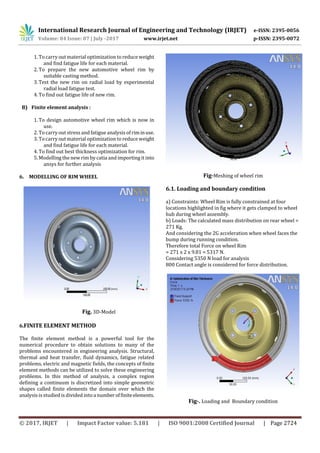
6. MODELLING OF RIM WHEEL
Fig. 3D-Model
6.FINITE ELEMENT METHOD
The finite element method is a powerful tool for the
numerical procedure to obtain solutions to many of the
problems encountered in engineering analysis. Structural,
thermal and heat transfer, fluid dynamics, fatigue related
problems, electric and magnetic fields, the concepts of finite
element methods can be utilized to solve these engineering
problems. In this method of analysis, a complex region
defining a continuum is discretized into simple geometric
shapes called finite elements the domain over which the
analysis isstudied is divided into a numberoffiniteelements.
Fig-Meshing of wheel rim
6.1. Loading and boundary condition
a) Constraints: Wheel Rim is fully constrained at four
locations highlighted in fig where it gets clamped to wheel
hub during wheel assembly.
b) Loads: The calculated mass distribution on rear wheel =
271 Kg.
And considering the 2G acceleration when wheel faces the
bump during running condition.
Therefore total Force on wheel Rim
= 271 x 2 x 9.81 = 5317 N.
Considering 5350 N load for analysis
800 Contact angle is considered for force distribution.
Fig-. Loading and Boundary condition
International Research Journal of Engineering and Technology (IRJET) e-ISSN: 2395-0056
Volume: 04 Issue: 07 | July -2017 www.irjet.net p-ISSN: 2395-0072
© 2017, IRJET | Impact Factor value: 5.181 | ISO 9001:2008 Certified Journal | Page 2725
7. RESULTS FOR ORIGINAL GEOMETRY
Fig-. Total Deformation
Fig. Equivalent Von mises stress
8. CONCLUSIONS
It is necessary to carry out experimental and finite element
analysis of wheel rim to avoid the failure of the rim by
improving the geometry and material optimization with the
help of design of experiment. Results are to be validate by
radial load test on wheel rim to check its fatigue life.
REFERENCES
[1] P. Ramamurthy Raju, B. Satyanarayana, K. Ramji, K.
Suresh Babu, "Evaluation of fatigue life of aluminum
alloys wheels under radial loads”, Engineering Failure
Analysis 14, pp.791–800,2007
[2] Y.H Kim, T.K.Ryou, H.J.Choi "An analysis of the forging
processes for 6061 aluminum-alloy wheels", journal of
material processing technology 123 (2002) 270-
276,2002.
[3] Sunil N. Yadav, N. S. Hanamapure,"Analyze the Effect of
Camber Angle on Fatigue Life ofWheel RimofPassenger
Car by Using Radial Fatigue Testing", International
Journal of Engineering Science and Innovative
Technology (IJESIT) Volume 2, Issue5,September2013.
[4] Mehmet Firat, Recep Kozan, Murat Ozsoy, O. Hamdi
Mete, “Numerical modeling and simulation of wheel
radial fatigue tests.” Engineering Failure Analysis 16,
pp.1533–1541, 2009.
[5] N.Satyanarayana,"fatigue analysis of aluminium alloy
wheel under radial load", International journal of
mechanical and industrial engineering(IJMIE),Vol-
2,Issue-1,2012.
[6] U.Kocabicak, M.Firat,"Numerical Analysis Wheel
Cornering Fatigue Tests", Engineering Failure Analysis
8(2001), 339-334, 2000.
[7] Vivek Asnani, Damon Delap, Colin Creager,"The
development of wheels for lunar roving vehicle",Journal
of terramechanics 46 (2009) 89-103,2009
[8] Ravi Lidoriya, Sanjay, Chaudhary and Anil Kumar
Mohopatra,"Design and Analysis of Aluminum Alloy
Wheel using PEEK Material", International Journal of
Mechanical Engineering and Research. ISSN No. 2249-
0019, Volume 3, Number 5 (2013), pp. 503-516, 2013.
[9] V.B.Bhandari,”Design of Machine Elements, Tata
McGraw Hill Publication, third edition.
BIOGRAPHIES
Mr. J.G.SHINDE
ME(CAD/CAM/CAE)
Assistant Professor
Bharati vidyapeeth’s college
engineering ,Kolhapur
Mr. S.J.KADAM
ME(CAD/CAM/CAE),Phdpursuing
Associate Professor
Bharati vidyapeeth’s college
engineering ,Kolhapur
Mr. S.V.Pandit
ME Mech-Production
Assistant Professor
Bharati vidyapeeth’s college
engineering ,Kolhapur

https://irjet.net/archives/V4/i7/IRJET-V4I7551.pdf

  • 1.
    International Research Journalof Engineering and Technology (IRJET) e-ISSN: 2395-0056 Volume: 04 Issue: 07 | July -2017 www.irjet.net p-ISSN: 2395-0072 © 2017, IRJET | Impact Factor value: 5.181 | ISO 9001:2008 Certified Journal | Page 2723 Review Paper on Design and Analysis of Automotive Wheel Rim Using Finite Element Analysis Jitendra Shinde1, Sunil Kadam2, Samuvel Pandit3 1,3 Assistant professor, Department of Mechanical Engineering, BV Engineering College, R.K.Nagar, Kolhapur, India 2 Associate professor, Head of Department of Mechanical Engineering, BV Engineering College, Kolhapur, India ---------------------------------------------------------------------***--------------------------------------------------------------------- Abstract - This work involves the design and analysis of automotive wheel rim using Ansys software .we have design this wheel rim using Catia and imported into ansys software for further analysis. In this work we are going to carry out the radial load fatigue test on newly designed rim with material and design optimization. Also validate the results experimental results. Key Words: Wheel rim, Design, Analysis, Optimization 1.INTRODUCTION A wheel rim is a highly stressed component in an automobile that is subjected to bending and torsional loads. Because of the long life and high stresses, as well as the need for weight reduction, material and manufacturing process selection is important in rim design. There are competitions among materials and manufacturing processes, due to cost performance, and weight. This is a direct result of industry demand for components that are lighter, to increase efficiency, and cheaper to produce, while at the same time maintaining fatigue strength and other functional requirements. In the fatigue life evaluation of aluminum wheel design, the commonly accepted procedure for passenger car wheel manufacturing is to pass two durability tests, namely the radial fatigue test and cornering fatigue test .Since alloy wheels are designed for variation in style and have more complex shapes than regular steel wheels, it is difficult to assess fatigue life by using analytical methods. The newly designed wheel is tested in laboratory for its life through an accelerated fatigue test.Basedonthesetest resultsthe wheel design is further modified for high strength and less weight. But stress analysis will not yield the optimum wheel design described a probability based model forpredictionoffatigue failure of automotive wheel rim. Aluminum alloys, magnesium alloys and structural steel are the three important materials by which rim of wheel is casted and then manufactured. Fatigue life of all of these three components gets varied. It is necessary to know the fatigue life of each of these materials. By conducting design of experiments best parametric design can be done. Also thickness of the rim can be varied for eachofthesematerials. It is stated that by varying the thickness level we can get varied fatigue strength for different materials. It is recommended to use optimum thickness which giveshigher strength without compromising the fatigue life of the rim. Weight reduction can cause high level of cost saving. 2. PROBLEM STATEMENT The failureof rim wheel is due to crack initiatednearthehole which further gets propagated throughout the rim which leads to fatigue failure. In order to improve the Fatigue lifeof rim, material optimization and design optimization is necessary for which best material has to be selected by conducting design of experiments to find parametric design which gives higher fatigue life. 3. OBJECTIVE 1. To design the proposed automotive wheel rim. 2. To carry out stress and fatigue analysis of wheel by using finite element method. 3. To study the effect of various materials on fatigue life of the rim. 4. To optimize thickness of rim to reduce the material consumption and improve life of component by using advanced fatigue strain life approach. 5. To develop the experimental setup for proposed automotive wheel rim. 6. To compare experimental and finite element analysis results. 4. Methodology: In this dissertation work it is proposed to study the effect of various materials on fatigue life of the automotive wheel rim by using finite element analysis and radial load testing. Phase I – Literature Survey. In this phase literaturesurvey of fatigue lifeanalysis,Design optimization etc. will be carried. Phase II – One of the method to find fatigue life of rim is by conducting radial load test. This Phase includes fatigue analysis of newly designed rim by finiteelementanalysisand by radial Load test. A) Experimental work: We are going to carry out fatigue life analysis of rim by radial load technique as follows.
  • 2.
    International Research Journalof Engineering and Technology (IRJET) e-ISSN: 2395-0056 Volume: 04 Issue: 07 | July -2017 www.irjet.net p-ISSN: 2395-0072 © 2017, IRJET | Impact Factor value: 5.181 | ISO 9001:2008 Certified Journal | Page 2724 1.To carry out material optimization to reduce weight and find fatigue life for each material. 2.To prepare the new automotive wheel rim by suitable casting method. 3.Test the new rim on radial load by experimental radial load fatigue test. 4.To find out fatigue life of new rim. B) Finite element analysis : 1.To design automotive wheel rim which is now in use. 2.To carry out stress and fatigue analysis of riminuse. 3.To carry out material optimization to reduce weight and find fatigue life for each material. 4.To find out best thickness optimization for rim. 5.Modelling the new rim by catia and importing it into ansys for further analysis 6. MODELLING OF RIM WHEEL Fig. 3D-Model 6.FINITE ELEMENT METHOD The finite element method is a powerful tool for the numerical procedure to obtain solutions to many of the problems encountered in engineering analysis. Structural, thermal and heat transfer, fluid dynamics, fatigue related problems, electric and magnetic fields, the concepts of finite element methods can be utilized to solve these engineering problems. In this method of analysis, a complex region defining a continuum is discretized into simple geometric shapes called finite elements the domain over which the analysis isstudied is divided into a numberoffiniteelements. Fig-Meshing of wheel rim 6.1. Loading and boundary condition a) Constraints: Wheel Rim is fully constrained at four locations highlighted in fig where it gets clamped to wheel hub during wheel assembly. b) Loads: The calculated mass distribution on rear wheel = 271 Kg. And considering the 2G acceleration when wheel faces the bump during running condition. Therefore total Force on wheel Rim = 271 x 2 x 9.81 = 5317 N. Considering 5350 N load for analysis 800 Contact angle is considered for force distribution. Fig-. Loading and Boundary condition
  • 3.
    International Research Journalof Engineering and Technology (IRJET) e-ISSN: 2395-0056 Volume: 04 Issue: 07 | July -2017 www.irjet.net p-ISSN: 2395-0072 © 2017, IRJET | Impact Factor value: 5.181 | ISO 9001:2008 Certified Journal | Page 2725 7. RESULTS FOR ORIGINAL GEOMETRY Fig-. Total Deformation Fig. Equivalent Von mises stress 8. CONCLUSIONS It is necessary to carry out experimental and finite element analysis of wheel rim to avoid the failure of the rim by improving the geometry and material optimization with the help of design of experiment. Results are to be validate by radial load test on wheel rim to check its fatigue life. REFERENCES [1] P. Ramamurthy Raju, B. Satyanarayana, K. Ramji, K. Suresh Babu, "Evaluation of fatigue life of aluminum alloys wheels under radial loads”, Engineering Failure Analysis 14, pp.791–800,2007 [2] Y.H Kim, T.K.Ryou, H.J.Choi "An analysis of the forging processes for 6061 aluminum-alloy wheels", journal of material processing technology 123 (2002) 270- 276,2002. [3] Sunil N. Yadav, N. S. Hanamapure,"Analyze the Effect of Camber Angle on Fatigue Life ofWheel RimofPassenger Car by Using Radial Fatigue Testing", International Journal of Engineering Science and Innovative Technology (IJESIT) Volume 2, Issue5,September2013. [4] Mehmet Firat, Recep Kozan, Murat Ozsoy, O. Hamdi Mete, “Numerical modeling and simulation of wheel radial fatigue tests.” Engineering Failure Analysis 16, pp.1533–1541, 2009. [5] N.Satyanarayana,"fatigue analysis of aluminium alloy wheel under radial load", International journal of mechanical and industrial engineering(IJMIE),Vol- 2,Issue-1,2012. [6] U.Kocabicak, M.Firat,"Numerical Analysis Wheel Cornering Fatigue Tests", Engineering Failure Analysis 8(2001), 339-334, 2000. [7] Vivek Asnani, Damon Delap, Colin Creager,"The development of wheels for lunar roving vehicle",Journal of terramechanics 46 (2009) 89-103,2009 [8] Ravi Lidoriya, Sanjay, Chaudhary and Anil Kumar Mohopatra,"Design and Analysis of Aluminum Alloy Wheel using PEEK Material", International Journal of Mechanical Engineering and Research. ISSN No. 2249- 0019, Volume 3, Number 5 (2013), pp. 503-516, 2013. [9] V.B.Bhandari,”Design of Machine Elements, Tata McGraw Hill Publication, third edition. BIOGRAPHIES Mr. J.G.SHINDE ME(CAD/CAM/CAE) Assistant Professor Bharati vidyapeeth’s college engineering ,Kolhapur Mr. S.J.KADAM ME(CAD/CAM/CAE),Phdpursuing Associate Professor Bharati vidyapeeth’s college engineering ,Kolhapur Mr. S.V.Pandit ME Mech-Production Assistant Professor Bharati vidyapeeth’s college engineering ,Kolhapur