Pharmacokinetics
&
Pharmacodynamics
PRESENTED BY:
Kiran Nayyar
M.Sc. Nursing 2nd Year
UCON, Faridkot
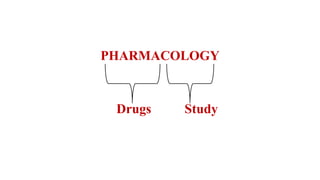
PHARMACOLOGY
Drugs Study
What is Pharmacology?
Pharmacology is a branch of science that deals with the study of drugs
and their actions on living systems - that is, the study of how drugs
work in the body (sometimes referred to as 'drug actions’).
Pharmacology has two major branches:
• Pharmacokinetics
• Pharmacodynamics
PHARMACOKINETICS
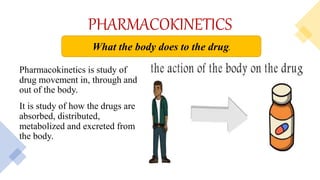
Pharmacokinetics is study of
drug movement in, through and
out of the body.
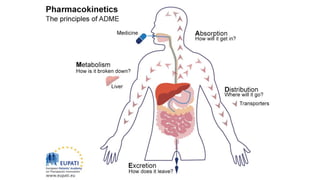
It is study of how the drugs are
absorbed, distributed,
metabolized and excreted from
the body.
What the body does to the drug.
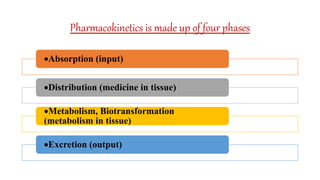
Pharmacokinetics is made up of four phases
Absorption (input)
Distribution (medicine in tissue)
Metabolism, Biotransformation
(metabolism in tissue)
Excretion (output)
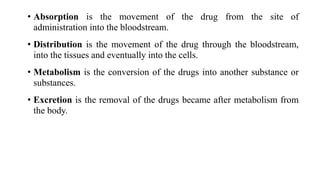
• Absorption is the movement of the drug from the site of
administration into the bloodstream.
• Distribution is the movement of the drug through the bloodstream,
into the tissues and eventually into the cells.
• Metabolism is the conversion of the drugs into another substance or
substances.
• Excretion is the removal of the drugs became after metabolism from
the body.
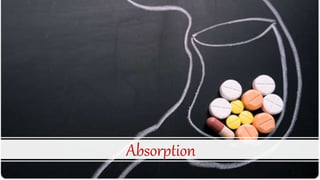
Absorption
Absorption is the movement of the drug from the site of administration into the
bloodstream.
Several variables affect the completeness and rate of the drugs absorption. The
completeness of absorption is the portion of the drug that is absorbed. Drugs given
orally may not be completely absorbed because of other drugs or food that the
patient is ingesting. The rate of absorption of drug depends on the route of
administration. The rate of absorption is also affected by the speed at which the
drugs dissolve, known as the rate of dissolution.
 Drugs that are administered orally generally take the longest to be absorbed
because they must be broken down into small particles before they can move into
the bloodstream. The presence of other drugs or food may also impair the rate of
oral drugs absorption.
 Drugs given parenterally are already dissolved and in a liquid form and
therefore are aborded more rapidly than drugs given orally.
 Drugs that are administered subcutaneously (SC) or intramuscularly (IM)are
absorbed into the small capillaries rapidly. IM absorption is somewhat more rapid
than SC absorption.
 Drugs that are administered IV are placed direly into the bloodstream and are
not technically absorbed although some sources refer to IV drugs as being
instantly absorbed.
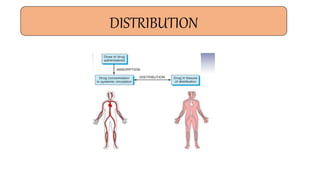
DISTRIBUTION
The distribution of a drug throughout the body depends on three factors:
Blood flow to the tissues
The drug’s ability to leave the blood
The drug’s ability to entre cells.
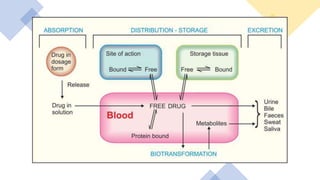
Most drugs are bound to some extent to proteins in the blood to be carried into
circulation. The protein–drug complex is relatively large and cannot enter into
capillaries and then into tissues to react. The drug must be freed from the protein’s
binding site at the tissues. Some drugs are tightly bound and are released very
slowly. These drugs have a very long duration of action because they are not free to
be broken down or excreted. Therefore, they are released very slowly into the
reactive tissue. Some drugs are loosely bound; they tend to act quickly and to be
excreted quickly. Some drugs compete with each other for protein binding sites,
altering effectiveness or causing toxicity when the two drugs are given together.
PROTEIN BINDING
The blood–brain barrier is a protective system of cellular activity that keeps many
things (e.g., foreign invaders, poisons) away from the CNS. Drugs that are highly
lipid soluble are more likely to pass through the blood–brain barrier and reach the
CNS. Drugs that are not lipid soluble are not able to pass the blood–brain barrier.
This is clinically significant in treating a brain infection with antibiotics. Almost all
antibiotics are not lipid soluble and cannot cross the blood–brain barrier. Effective
antibiotic treatment can occur only when the infection is severe enough to alter the
blood–brain barrier and allow antibiotics to cross. Although many drugs can cause
adverse CNS effects, these are often the result of indirect drug effects and not the
actual reaction of the drug with CNS tissue. For example, alterations in glucose
levels and electrolyte changes can interfere with nerve functioning and produce
CNS effects such as dizziness, confusion, or changes in thinking ability.
BLOOD–BRAIN BARRIER
Many drugs readily pass through the placenta and affect the developing fetus in
pregnant women. As stated earlier, it is best not to administer any drugs to pregnant
women because of the possible risk to the fetus. Drugs should be given only when
the benefit clearly outweighs any risk. Many other drugs are secreted into breast
milk and therefore have the potential to affect the neonate. Because of this
possibility, the nurse must always check the ability of a drug to pass into breast milk
when giving a drug to a breast-feeding mother.
PLACENTA AND BREAST MILK
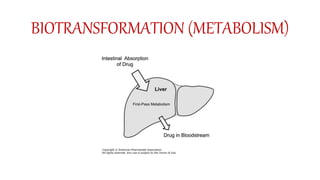
BIOTRANSFORMATION (METABOLISM)
The body is well prepared to deal with a myriad of foreign chemicals.
Enzymes in the liver, in many cells, in the lining of the GI tract, and
even circulating in the body detoxify foreign chemicals to protect the
fragile homeostasis that keeps the body functioning. Almost all of the
chemical reactions that the body uses to convert drugs and other
chemicals into nontoxic substances are based on a few processes that
work to make the chemical less active and more easily excreted from the
body. The liver is the most important site of drug metabolism, or
biotransformation, the process by which drugs are changed into new,
less active chemicals. Think of the liver as a sewage treatment plant.
Everything that is absorbed from the GI tract first enters the liver to be
“treated.” The liver detoxifies many chemicals and uses others to
produce needed enzymes and structures.
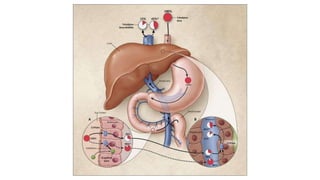
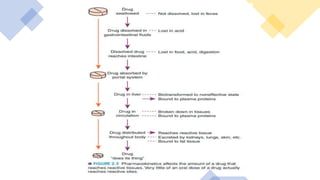
Drugs that are taken orally are usually absorbed from the small intestine directly into the portal
venous system (the blood vessels that flow through the liver on their way back to the heart). Aspirin
and alcohol are two drugs that are known to be absorbed from the lower end of the stomach. The
portal veins deliver these absorbed molecules into the liver, which immediately transforms most of
the chemicals delivered to it by a series of liver enzymes. These enzymes break the drug into
metabolites, some of which are active and cause effects in the body, and some of which are
deactivated and can be readily excreted from the body. As a result, a large percentage of the oral
dose is destroyed at this point and never reaches the tissues. This phenomenon is known as the
first-pass effect. The portion of the drug that gets through the first-pass effect is delivered to the
circulatory system for transport throughout the body Injected drugs and drugs absorbed from sites
other than the GI tract undergo a similar biotransformation when they pass through the liver. Because
some of the active drug already has had a chance to reach the reactive tissues before reaching the
liver, the injected drug is often more effective at a lower dose than the oral equivalent. Thus, the
recommended dose for oral drugs can be considerably higher than the recommended dose for
parenteral drugs, taking the first-pass effect into account.
FIRST-PASS EFFECT
The intracellular structures of the hepatic cells are lined with enzymes packed
together in what is called the hepatic microsomal system. Because orally
administered drugs enter the liver first, the enzyme systems immediately work on
the absorbed drug to biotransform it. As explained earlier, this first-pass effect is
responsible for neutralizing most of the drugs that are taken. Phase I
biotransformation involves oxidation, reduction, or hydrolysis of the drug via the
cytochrome P450 system of enzymes. These enzymes are found in most cells but are
especially abundant in the liver. Phase II biotransformation usually involves a
conjugation reaction that makes the drug more polar and more readily excreted by
the kidneys.
HEPATIC ENZYME
SYSTEM (P-450 SYSTEM)
The presence of a chemical that is metabolized by a particular enzyme
system often increases the activity of that enzyme system. This process
is referred to as enzyme induction. Only a few basic enzyme systems are
responsible for metabolizing most of the chemicals that pass through the
liver. Increased activity in an enzyme system speeds the metabolism of
the drug that caused the enzyme induction, as well as any other drug
that is metabolized via that same enzyme system. This explains why
some drugs cannot be taken together effectively: The presence of one
drug speeds the metabolism of others, preventing them from reaching
their therapeutic levels. Some drugs inhibit an enzyme system, making
it less effective. As a consequence, any drug that is metabolized by that
system will not be broken down for excretion, and the blood levels of
that drug will increase, often to toxic levels. These actions also explain
why liver disease is often a contraindication or a reason to use caution
when administering certain drugs. If the liver is not functioning
effectively, the drug will not be metabolized as it should be, and toxic
levels could develop rather quickly.
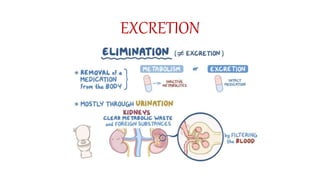
EXCRETION
Excretion is the removal of a drug from the body. The skin, saliva,
lungs, bile, and feces are some of the routes used to excrete drugs. The
kidneys, however, play the most important role in drug excretion.
Drugs that have been made water soluble in the liver are often readily
excreted from the kidney by glomerular filtration—the passage of water
and water-soluble components from the plasma into the renal tubule.
Other drugs are secreted or reabsorbed through the renal tubule by
active transport systems. The active transport systems that move the
drug into the tubule often do so by exchanging it for acid or bicarbonate
molecules. Therefore, the acidity of urine can play an important role in
drug excretion. This concept is important to remember when trying to
clear a drug rapidly from the system or trying to understand why a drug
is being given at the usual dose but is reaching toxic levels in the
system. One should always consider the patient’s kidney function and
urine acidity before administering a drug. Kidney dysfunction can lead
to toxic levels of a drug in the body because the drug cannot be
excreted.
The half-life of a drug is the time it takes for drug in the body to decrease to one half
of the peak level it previously achieved. For instance, if a patient takes 20 mg of a
drug with a half-life of 2 hours, 10 mg of the drug will remain 2 hours after
administration. Two hours later, 5 mg will be left (one half of the previous level); in
2 more hours, only 2.5 mg will remain. This information is important in determining
the appropriate timing for a drug dose or determining the duration of a drug’s effect
on the body.
HALF-LIFE
Determining the Impact of Half-Life on Drug Levels
A patient is taking a drug that has a half-life of 12 hours. You are trying to
determine when a 50-mg dose of the drug will be gone from the body:
 In 12 hours, half of the 50 mg (25 mg) would be in the body.
 In another 12 hours (24 hours), half of 25 mg (12.5 mg) would remain in the body.
 After 36 hours, half of 12.5 mg (6.25 mg) would remain.
 After 48 hours, half of 6.25 mg (3.125 mg) would remain.
 After 60 hours, half of 3.125 (1.56 mg) would remain.
 After 72 hours, half of 1.56 (0.78 mg) would remain.
 After 84 hours, half of 0.78 (0.39 mg) would remain.
 Twelve more hours (for a total of 96 hours) would reduce the drug amount to 0.195
mg.
 Finally, 12 more hours (108 hours) would reduce the amount of the drug in the body
to 0.097 mg, which would be quite negligible.
 Therefore, it would take 41⁄2 to 5 days to clear the drug from the body.
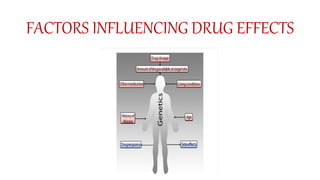
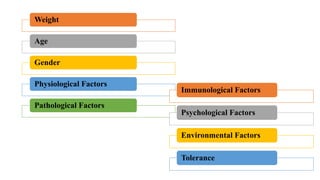
FACTORS INFLUENCING DRUG EFFECTS
Weight
Age
Gender
Physiological Factors
Pathological Factors
Immunological Factors
Psychological Factors
Environmental Factors
Tolerance
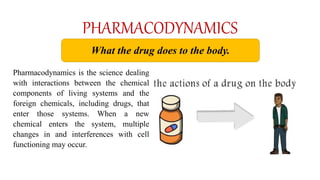
PHARMACODYNAMICS
Pharmacodynamics is the science dealing
with interactions between the chemical
components of living systems and the
foreign chemicals, including drugs, that
enter those systems. When a new
chemical enters the system, multiple
changes in and interferences with cell
functioning may occur.
What the drug does to the body.
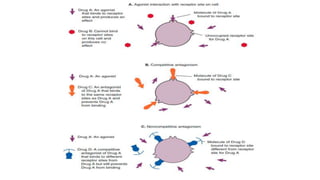
Many drugs are thought to act at specific areas on cell membranes called
receptor sites. The receptor sites react with certain chemicals to cause an
effect within the cell. In many situations, nearby enzymes break down
the reacting chemicals and open the receptor site for further stimulation.
To better understand this process, think of how a key works in a lock.
The specific chemical (the key) approaches a cell membrane and finds a
perfect fit (the lock) at a receptor site. The interaction between the
chemical and the receptor site affects enzyme systems within the cell.
RECEPTOR SITES
Drugs also can cause their effects by interfering with the enzyme systems that act as
catalysts for various chemical reactions. Enzyme systems work in a cascade fashion,
with one enzyme activating another, and then that enzyme activating another, until a
cellular reaction eventually occurs. If a single step in one of the many enzyme
systems is blocked, normal cell function is disrupted.
DRUG–ENZYME INTERACTIONS
Ideally, all chemotherapeutic agents would act only on enzyme systems that are
essential for the life of a pathogen or neoplastic cell and would not affect healthy
cells. The ability of a drug to attack only those systems found in foreign cells is
known as selective toxicity. Penicillin, an antibiotic used to treat bacterial infections,
has selective toxicity. It affects an enzyme system unique to bacteria, causing
bacterial cell death without disrupting normal human cell functioning.
Unfortunately, most other chemotherapeutic agents also destroy normal human cells,
causing many of the adverse effects associated with antipathogen and antineoplastic
chemotherapy. Cells that reproduce or are replaced rapidly (e.g., bone marrow cells,
gastrointestinal [GI] cells, hair follicles) are more easily affected by these agents.
Consequently, the goal of many chemotherapeutic regimens is to deliver a dose that
will be toxic to the invading cells yet cause the least amount of toxicity to the host.
SELECTIVE TOXICITY
SUMMARY
RECAPULIZATION
• What is pharmacology?
• What is pharmacokinetics?
• What is pharmacodynamics?
• What is half pass effect?
BIBLIOGRAPHY
 ‘Tripathi KD’ ‘Textbook of pharmacology’ published by JAYPEE
BROTHERS, Edition 7th Page No : 11-57.
 ‘Karch Amy M.’ ‘Focus on Nursing Pharmacology’ published by
Lippincott Williams, Edition 5th Page No: 17-31.
Pharmacokinetics and pharmacodynamics.pptx

Pharmacokinetics and pharmacodynamics.pptx

  • 1.
  • 2.
  • 3.
    What is Pharmacology? Pharmacologyis a branch of science that deals with the study of drugs and their actions on living systems - that is, the study of how drugs work in the body (sometimes referred to as 'drug actions’). Pharmacology has two major branches: • Pharmacokinetics • Pharmacodynamics
  • 4.
    PHARMACOKINETICS Pharmacokinetics is studyof drug movement in, through and out of the body. It is study of how the drugs are absorbed, distributed, metabolized and excreted from the body. What the body does to the drug.
  • 5.
    Pharmacokinetics is madeup of four phases Absorption (input) Distribution (medicine in tissue) Metabolism, Biotransformation (metabolism in tissue) Excretion (output)
  • 7.
    • Absorption isthe movement of the drug from the site of administration into the bloodstream. • Distribution is the movement of the drug through the bloodstream, into the tissues and eventually into the cells. • Metabolism is the conversion of the drugs into another substance or substances. • Excretion is the removal of the drugs became after metabolism from the body.
  • 9.
  • 10.
    Absorption is themovement of the drug from the site of administration into the bloodstream. Several variables affect the completeness and rate of the drugs absorption. The completeness of absorption is the portion of the drug that is absorbed. Drugs given orally may not be completely absorbed because of other drugs or food that the patient is ingesting. The rate of absorption of drug depends on the route of administration. The rate of absorption is also affected by the speed at which the drugs dissolve, known as the rate of dissolution.
  • 11.
     Drugs thatare administered orally generally take the longest to be absorbed because they must be broken down into small particles before they can move into the bloodstream. The presence of other drugs or food may also impair the rate of oral drugs absorption.  Drugs given parenterally are already dissolved and in a liquid form and therefore are aborded more rapidly than drugs given orally.  Drugs that are administered subcutaneously (SC) or intramuscularly (IM)are absorbed into the small capillaries rapidly. IM absorption is somewhat more rapid than SC absorption.  Drugs that are administered IV are placed direly into the bloodstream and are not technically absorbed although some sources refer to IV drugs as being instantly absorbed.
  • 12.
  • 13.
    The distribution ofa drug throughout the body depends on three factors: Blood flow to the tissues The drug’s ability to leave the blood The drug’s ability to entre cells.
  • 14.
    Most drugs arebound to some extent to proteins in the blood to be carried into circulation. The protein–drug complex is relatively large and cannot enter into capillaries and then into tissues to react. The drug must be freed from the protein’s binding site at the tissues. Some drugs are tightly bound and are released very slowly. These drugs have a very long duration of action because they are not free to be broken down or excreted. Therefore, they are released very slowly into the reactive tissue. Some drugs are loosely bound; they tend to act quickly and to be excreted quickly. Some drugs compete with each other for protein binding sites, altering effectiveness or causing toxicity when the two drugs are given together. PROTEIN BINDING
  • 15.
    The blood–brain barrieris a protective system of cellular activity that keeps many things (e.g., foreign invaders, poisons) away from the CNS. Drugs that are highly lipid soluble are more likely to pass through the blood–brain barrier and reach the CNS. Drugs that are not lipid soluble are not able to pass the blood–brain barrier. This is clinically significant in treating a brain infection with antibiotics. Almost all antibiotics are not lipid soluble and cannot cross the blood–brain barrier. Effective antibiotic treatment can occur only when the infection is severe enough to alter the blood–brain barrier and allow antibiotics to cross. Although many drugs can cause adverse CNS effects, these are often the result of indirect drug effects and not the actual reaction of the drug with CNS tissue. For example, alterations in glucose levels and electrolyte changes can interfere with nerve functioning and produce CNS effects such as dizziness, confusion, or changes in thinking ability. BLOOD–BRAIN BARRIER
  • 16.
    Many drugs readilypass through the placenta and affect the developing fetus in pregnant women. As stated earlier, it is best not to administer any drugs to pregnant women because of the possible risk to the fetus. Drugs should be given only when the benefit clearly outweighs any risk. Many other drugs are secreted into breast milk and therefore have the potential to affect the neonate. Because of this possibility, the nurse must always check the ability of a drug to pass into breast milk when giving a drug to a breast-feeding mother. PLACENTA AND BREAST MILK
  • 17.
  • 19.
    The body iswell prepared to deal with a myriad of foreign chemicals. Enzymes in the liver, in many cells, in the lining of the GI tract, and even circulating in the body detoxify foreign chemicals to protect the fragile homeostasis that keeps the body functioning. Almost all of the chemical reactions that the body uses to convert drugs and other chemicals into nontoxic substances are based on a few processes that work to make the chemical less active and more easily excreted from the body. The liver is the most important site of drug metabolism, or biotransformation, the process by which drugs are changed into new, less active chemicals. Think of the liver as a sewage treatment plant. Everything that is absorbed from the GI tract first enters the liver to be “treated.” The liver detoxifies many chemicals and uses others to produce needed enzymes and structures.
  • 20.
    Drugs that aretaken orally are usually absorbed from the small intestine directly into the portal venous system (the blood vessels that flow through the liver on their way back to the heart). Aspirin and alcohol are two drugs that are known to be absorbed from the lower end of the stomach. The portal veins deliver these absorbed molecules into the liver, which immediately transforms most of the chemicals delivered to it by a series of liver enzymes. These enzymes break the drug into metabolites, some of which are active and cause effects in the body, and some of which are deactivated and can be readily excreted from the body. As a result, a large percentage of the oral dose is destroyed at this point and never reaches the tissues. This phenomenon is known as the first-pass effect. The portion of the drug that gets through the first-pass effect is delivered to the circulatory system for transport throughout the body Injected drugs and drugs absorbed from sites other than the GI tract undergo a similar biotransformation when they pass through the liver. Because some of the active drug already has had a chance to reach the reactive tissues before reaching the liver, the injected drug is often more effective at a lower dose than the oral equivalent. Thus, the recommended dose for oral drugs can be considerably higher than the recommended dose for parenteral drugs, taking the first-pass effect into account. FIRST-PASS EFFECT
  • 21.
    The intracellular structuresof the hepatic cells are lined with enzymes packed together in what is called the hepatic microsomal system. Because orally administered drugs enter the liver first, the enzyme systems immediately work on the absorbed drug to biotransform it. As explained earlier, this first-pass effect is responsible for neutralizing most of the drugs that are taken. Phase I biotransformation involves oxidation, reduction, or hydrolysis of the drug via the cytochrome P450 system of enzymes. These enzymes are found in most cells but are especially abundant in the liver. Phase II biotransformation usually involves a conjugation reaction that makes the drug more polar and more readily excreted by the kidneys. HEPATIC ENZYME SYSTEM (P-450 SYSTEM)
  • 22.
    The presence ofa chemical that is metabolized by a particular enzyme system often increases the activity of that enzyme system. This process is referred to as enzyme induction. Only a few basic enzyme systems are responsible for metabolizing most of the chemicals that pass through the liver. Increased activity in an enzyme system speeds the metabolism of the drug that caused the enzyme induction, as well as any other drug that is metabolized via that same enzyme system. This explains why some drugs cannot be taken together effectively: The presence of one drug speeds the metabolism of others, preventing them from reaching their therapeutic levels. Some drugs inhibit an enzyme system, making it less effective. As a consequence, any drug that is metabolized by that system will not be broken down for excretion, and the blood levels of that drug will increase, often to toxic levels. These actions also explain why liver disease is often a contraindication or a reason to use caution when administering certain drugs. If the liver is not functioning effectively, the drug will not be metabolized as it should be, and toxic levels could develop rather quickly.
  • 23.
  • 24.
    Excretion is theremoval of a drug from the body. The skin, saliva, lungs, bile, and feces are some of the routes used to excrete drugs. The kidneys, however, play the most important role in drug excretion. Drugs that have been made water soluble in the liver are often readily excreted from the kidney by glomerular filtration—the passage of water and water-soluble components from the plasma into the renal tubule. Other drugs are secreted or reabsorbed through the renal tubule by active transport systems. The active transport systems that move the drug into the tubule often do so by exchanging it for acid or bicarbonate molecules. Therefore, the acidity of urine can play an important role in drug excretion. This concept is important to remember when trying to clear a drug rapidly from the system or trying to understand why a drug is being given at the usual dose but is reaching toxic levels in the system. One should always consider the patient’s kidney function and urine acidity before administering a drug. Kidney dysfunction can lead to toxic levels of a drug in the body because the drug cannot be excreted.
  • 26.
    The half-life ofa drug is the time it takes for drug in the body to decrease to one half of the peak level it previously achieved. For instance, if a patient takes 20 mg of a drug with a half-life of 2 hours, 10 mg of the drug will remain 2 hours after administration. Two hours later, 5 mg will be left (one half of the previous level); in 2 more hours, only 2.5 mg will remain. This information is important in determining the appropriate timing for a drug dose or determining the duration of a drug’s effect on the body. HALF-LIFE
  • 27.
    Determining the Impactof Half-Life on Drug Levels A patient is taking a drug that has a half-life of 12 hours. You are trying to determine when a 50-mg dose of the drug will be gone from the body:  In 12 hours, half of the 50 mg (25 mg) would be in the body.  In another 12 hours (24 hours), half of 25 mg (12.5 mg) would remain in the body.  After 36 hours, half of 12.5 mg (6.25 mg) would remain.  After 48 hours, half of 6.25 mg (3.125 mg) would remain.  After 60 hours, half of 3.125 (1.56 mg) would remain.  After 72 hours, half of 1.56 (0.78 mg) would remain.  After 84 hours, half of 0.78 (0.39 mg) would remain.  Twelve more hours (for a total of 96 hours) would reduce the drug amount to 0.195 mg.  Finally, 12 more hours (108 hours) would reduce the amount of the drug in the body to 0.097 mg, which would be quite negligible.  Therefore, it would take 41⁄2 to 5 days to clear the drug from the body.
  • 28.
  • 29.
    Weight Age Gender Physiological Factors Pathological Factors ImmunologicalFactors Psychological Factors Environmental Factors Tolerance
  • 30.
    PHARMACODYNAMICS Pharmacodynamics is thescience dealing with interactions between the chemical components of living systems and the foreign chemicals, including drugs, that enter those systems. When a new chemical enters the system, multiple changes in and interferences with cell functioning may occur. What the drug does to the body.
  • 31.
    Many drugs arethought to act at specific areas on cell membranes called receptor sites. The receptor sites react with certain chemicals to cause an effect within the cell. In many situations, nearby enzymes break down the reacting chemicals and open the receptor site for further stimulation. To better understand this process, think of how a key works in a lock. The specific chemical (the key) approaches a cell membrane and finds a perfect fit (the lock) at a receptor site. The interaction between the chemical and the receptor site affects enzyme systems within the cell. RECEPTOR SITES
  • 33.
    Drugs also cancause their effects by interfering with the enzyme systems that act as catalysts for various chemical reactions. Enzyme systems work in a cascade fashion, with one enzyme activating another, and then that enzyme activating another, until a cellular reaction eventually occurs. If a single step in one of the many enzyme systems is blocked, normal cell function is disrupted. DRUG–ENZYME INTERACTIONS
  • 34.
    Ideally, all chemotherapeuticagents would act only on enzyme systems that are essential for the life of a pathogen or neoplastic cell and would not affect healthy cells. The ability of a drug to attack only those systems found in foreign cells is known as selective toxicity. Penicillin, an antibiotic used to treat bacterial infections, has selective toxicity. It affects an enzyme system unique to bacteria, causing bacterial cell death without disrupting normal human cell functioning. Unfortunately, most other chemotherapeutic agents also destroy normal human cells, causing many of the adverse effects associated with antipathogen and antineoplastic chemotherapy. Cells that reproduce or are replaced rapidly (e.g., bone marrow cells, gastrointestinal [GI] cells, hair follicles) are more easily affected by these agents. Consequently, the goal of many chemotherapeutic regimens is to deliver a dose that will be toxic to the invading cells yet cause the least amount of toxicity to the host. SELECTIVE TOXICITY
  • 35.
  • 37.
    RECAPULIZATION • What ispharmacology? • What is pharmacokinetics? • What is pharmacodynamics? • What is half pass effect?
  • 38.
    BIBLIOGRAPHY  ‘Tripathi KD’‘Textbook of pharmacology’ published by JAYPEE BROTHERS, Edition 7th Page No : 11-57.  ‘Karch Amy M.’ ‘Focus on Nursing Pharmacology’ published by Lippincott Williams, Edition 5th Page No: 17-31.