LARYNGOSCOPE
PRESENTED BY:
GROUP#4
PARTICIPANTS:
Mohsin (leader) Bsat-f21-101
Hussain Bsat-f21-117
Ali Bsat-f21-093
Arslan Bsat-f21-388
Zain Bsat-f21-142
Hassaan Bsat-f21-099
Abeera Bsat-f21-134
Fatima Bsat-f21-151
Shirzma Bsat-f21-086
CONTRIBUTION:
500 PER PERSON
CONTENTS
▪ What is laryngoscope?
▪ Types of laryngoscope
▪ Laryngoscope used for
▪ Size of laryngoscope
▪ How laryngoscope inserted
▪ Complications of laryngoscope
WHAT IS LARYNGOSCOPE?
▪ A laryngoscopy (lair-in-GAHS-kuh-pee) is a test healthcare providers
perform to examine your larynx (voice box).
▪ They perform this test with a laryngoscope, a thin tube with lights,
lens and video cameras that help them to look closely at your larynx.
▪ Laryngoscopes may have tools your provider can use to remove tissue
from your larynx.
TYPES OF LARYNGOSCOPE:
▪ Laryngoscopes are designed for visualization of the vocal cords and
for placement of the ETT into the trachea under direct vision.
▪ The two main types are the curved Macintosh blade and the straight
blade (i.e., Miller with a curved tip and Wisconsin or Foregger with a
straight tip).
LARYNGOSCOPE USED FOR:
▪ Laryngoscopy can be used to treat some problems in the vocal cords
or throat.
▪ For example, long, thin instruments can be passed down the
laryngoscope to remove small growths (tumors or polyps) on the vocal
cords.
▪ A small laser on the end of a laryngoscope can also be used to burn
away abnormal areas.
SIZE OF LARYNGOSCOPE:
▪ LARYNGOSCOPE:
An endoscope for visually examining the interior of the larynx.
▪ Size:
The adult size, with a blade that is 2.5 cm wide, is suitable for children
older than 10 years. The pediatric version (newborn to age 2 years) has a
blade 1.3 cm wide that extends 0.6 cm beyond the fiberoptics. This blade
is recommended for use in neonates, infants, and smaller children.
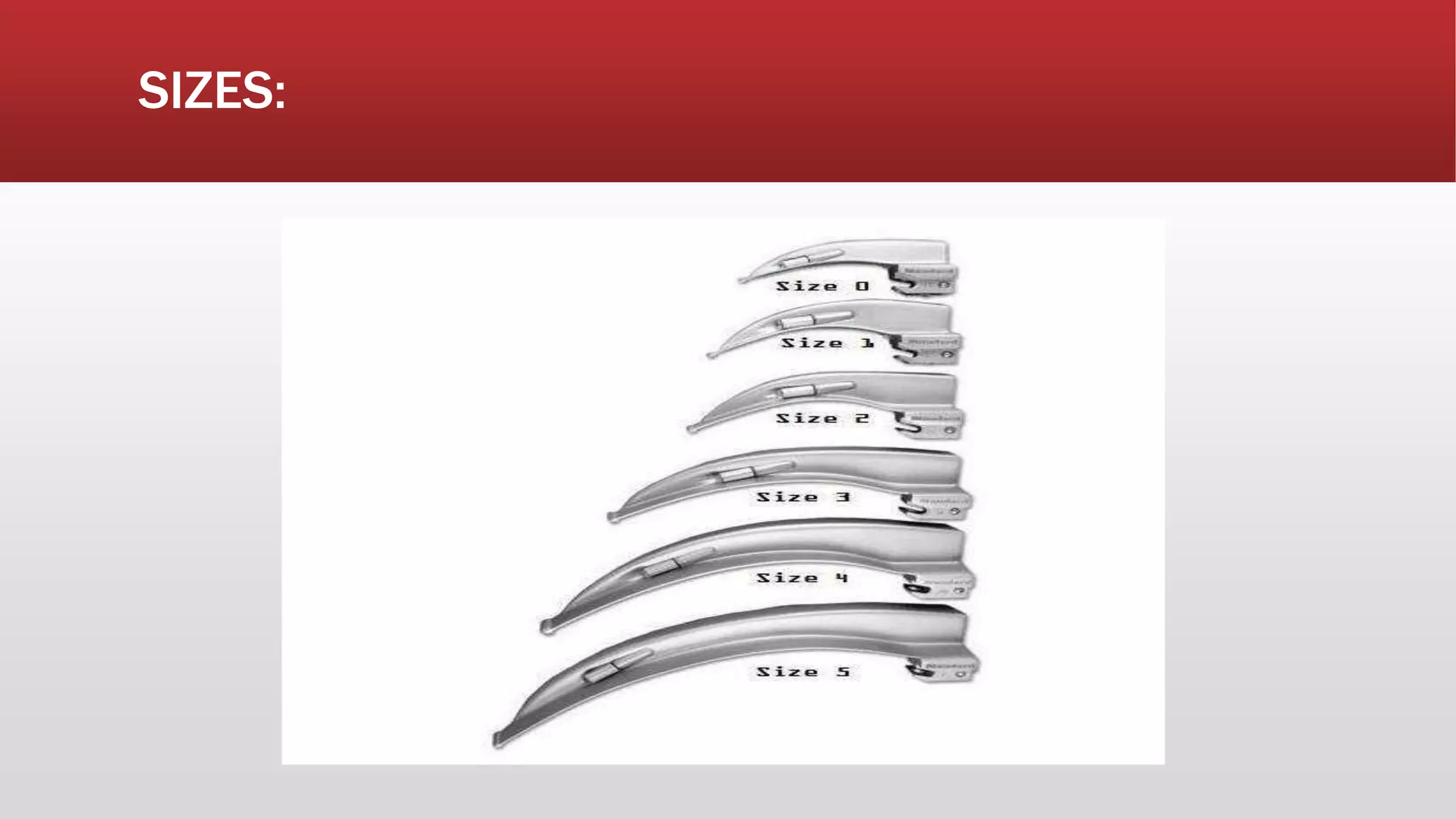
SIZES:
INSERT LARYNGOSCOPE:
▪ To the left, then the blade is smoothly advanced to the epiglottis. The
laryngoscope is then inserted in the right side of the mouth, and the
blade is then used to sweep the tongue.
COMPLICATIONS:
▪ Complications of laryngoscopy include:
▪ Inadequate ventilation
▪ Loss of airway
▪ Aspiration
▪ Hypertension (HTN),
▪ Dysrhythmias
▪ Eye trauma
▪ Dental trauma
▪ Laryngospasm
▪ Bronchospasm
▪ Perforation of the airway or esophagus
▪ Bleeding, Edema, and Airway obstruction.
LARYNGOSCOPE MODEL
TAKING HELP FROM:
HTTPS://WWW.YOUTUBE.COM/WATCH?V=ZJTFB7LGPIC
LARYNGOSCOPE  pp.pptx

LARYNGOSCOPE pp.pptx

  • 1.
  • 2.
    PARTICIPANTS: Mohsin (leader) Bsat-f21-101 HussainBsat-f21-117 Ali Bsat-f21-093 Arslan Bsat-f21-388 Zain Bsat-f21-142 Hassaan Bsat-f21-099 Abeera Bsat-f21-134 Fatima Bsat-f21-151 Shirzma Bsat-f21-086
  • 3.
  • 4.
    CONTENTS ▪ What islaryngoscope? ▪ Types of laryngoscope ▪ Laryngoscope used for ▪ Size of laryngoscope ▪ How laryngoscope inserted ▪ Complications of laryngoscope
  • 5.
    WHAT IS LARYNGOSCOPE? ▪A laryngoscopy (lair-in-GAHS-kuh-pee) is a test healthcare providers perform to examine your larynx (voice box). ▪ They perform this test with a laryngoscope, a thin tube with lights, lens and video cameras that help them to look closely at your larynx. ▪ Laryngoscopes may have tools your provider can use to remove tissue from your larynx.
  • 6.
    TYPES OF LARYNGOSCOPE: ▪Laryngoscopes are designed for visualization of the vocal cords and for placement of the ETT into the trachea under direct vision. ▪ The two main types are the curved Macintosh blade and the straight blade (i.e., Miller with a curved tip and Wisconsin or Foregger with a straight tip).
  • 7.
    LARYNGOSCOPE USED FOR: ▪Laryngoscopy can be used to treat some problems in the vocal cords or throat. ▪ For example, long, thin instruments can be passed down the laryngoscope to remove small growths (tumors or polyps) on the vocal cords. ▪ A small laser on the end of a laryngoscope can also be used to burn away abnormal areas.
  • 8.
    SIZE OF LARYNGOSCOPE: ▪LARYNGOSCOPE: An endoscope for visually examining the interior of the larynx. ▪ Size: The adult size, with a blade that is 2.5 cm wide, is suitable for children older than 10 years. The pediatric version (newborn to age 2 years) has a blade 1.3 cm wide that extends 0.6 cm beyond the fiberoptics. This blade is recommended for use in neonates, infants, and smaller children.
  • 9.
  • 10.
    INSERT LARYNGOSCOPE: ▪ Tothe left, then the blade is smoothly advanced to the epiglottis. The laryngoscope is then inserted in the right side of the mouth, and the blade is then used to sweep the tongue.
  • 11.
    COMPLICATIONS: ▪ Complications oflaryngoscopy include: ▪ Inadequate ventilation ▪ Loss of airway ▪ Aspiration ▪ Hypertension (HTN), ▪ Dysrhythmias ▪ Eye trauma ▪ Dental trauma ▪ Laryngospasm ▪ Bronchospasm ▪ Perforation of the airway or esophagus ▪ Bleeding, Edema, and Airway obstruction.
  • 12.
  • 13.