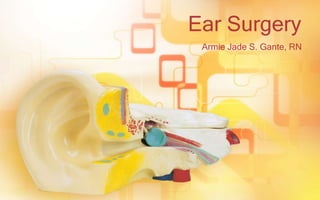

Ear Surgery
 Armie Jade S. Gante, RN
Ear surgery
• May involve the tympanic
  membrane, the middle ear cavity, the
  mastoid, or the inner ear

• It may be done for perforation of the
  eardrum, to facilitate drainage and
  remove diseased tissue in cases of
  infection, to relieve vertigo, or to treat
  hearing loss.
TYPES OF EAR SURGERY
Tympanoplasty
• Reconstruction of diseased or
  deformed middle ear components
Myringotomy
• creating a surgical opening into
  tympanic membrane (with knife or laser)
  for possible drainage tube insertion
• Type I (myringoplasty)

• Purpose:
  – To close perforation by placing a graft
    over it to create a closed middle ear
    to improve hearing and decrease risk
    of infection and cholesteatoma
• Perforation is closed using one of the
  following:
  – Fascia from temporalis muscle
  – Vein grafts from hand or forearm
  – Epithelium from auditory canal (eustachian
    tube)
• Type II to V

• Suitable replacement is used to
  maintain continuity of conduction sound
  pathway
  –   Polyethylene
  –   stainless steel wire
  –   Bone
  –   cartilage
• The necessity of a two-stage procedure
  is determined

  – First stage—eradication of all diseased
    tissues; area is cleaned out to achieve a dry,
    healed middle ear
  – Second stage—performed 2 to 3 months
    after first stage; reconstruction, using grafts.
Mastoidectomy
• Removal of mastoid process of
  temporal bone
  – Simple—performed through the ear
    with a tympanoplasty (closed
    approach)
  – Modified or radical—wide excision of
    the mastoid and diseased middle ear
    contents through an occipital incision
    (open)
Stapedectomy
• Removal of footplate of stapes and
  insertion of a graft or prosthesis
Labyrinthectomy
• Destruction of the labyrinth (inner ear)
  through the middle ear and aspiration of
  the endolabyrinth
Endolymphatic
decompression and shunt
• Release of pressure on the
  endolymphatic system in the labyrinth
  and creation of a shunt for fluid to the
  subarachnoid space or the mastoid
Cochlear implant
• Implantation of electronic device that
  bypasses cochlea and stimulates
  auditory nerve
Ear surgery

Ear surgery

  • 1.
    Ear Surgery ArmieJade S. Gante, RN
  • 2.
    Ear surgery • Mayinvolve the tympanic membrane, the middle ear cavity, the mastoid, or the inner ear • It may be done for perforation of the eardrum, to facilitate drainage and remove diseased tissue in cases of infection, to relieve vertigo, or to treat hearing loss.
  • 4.
    TYPES OF EARSURGERY
  • 5.
    Tympanoplasty • Reconstruction ofdiseased or deformed middle ear components
  • 6.
    Myringotomy • creating asurgical opening into tympanic membrane (with knife or laser) for possible drainage tube insertion
  • 7.
    • Type I(myringoplasty) • Purpose: – To close perforation by placing a graft over it to create a closed middle ear to improve hearing and decrease risk of infection and cholesteatoma
  • 8.
    • Perforation isclosed using one of the following: – Fascia from temporalis muscle – Vein grafts from hand or forearm – Epithelium from auditory canal (eustachian tube)
  • 9.
    • Type IIto V • Suitable replacement is used to maintain continuity of conduction sound pathway – Polyethylene – stainless steel wire – Bone – cartilage
  • 10.
    • The necessityof a two-stage procedure is determined – First stage—eradication of all diseased tissues; area is cleaned out to achieve a dry, healed middle ear – Second stage—performed 2 to 3 months after first stage; reconstruction, using grafts.
  • 11.
    Mastoidectomy • Removal ofmastoid process of temporal bone – Simple—performed through the ear with a tympanoplasty (closed approach) – Modified or radical—wide excision of the mastoid and diseased middle ear contents through an occipital incision (open)
  • 12.
    Stapedectomy • Removal offootplate of stapes and insertion of a graft or prosthesis
  • 13.
    Labyrinthectomy • Destruction ofthe labyrinth (inner ear) through the middle ear and aspiration of the endolabyrinth
  • 14.
    Endolymphatic decompression and shunt •Release of pressure on the endolymphatic system in the labyrinth and creation of a shunt for fluid to the subarachnoid space or the mastoid
  • 15.
    Cochlear implant • Implantationof electronic device that bypasses cochlea and stimulates auditory nerve