Presented by
Neelutpal Saha (222012)
Shan Lal (222021)
Mrinmoy Sarkar (222011)
Pankaj Srivastava (222014)
AGENDA

•Aviation Industry
•About IndiGo Airlines
•PEST analysis
•Porter’s 5 forces analysis
•SWOT and TOWS analysis
•Competitive Strategy
•STP
•Product Mix
•Market Leader Strategy
•Branding and Promotional Strategy
•The road ahead
•Recommendations
AVIATION INDUSTRY

Total domestic passengers carried by the scheduled domestic airlines between
January and May 2013 were 25.998 million, as against 25.808 million during the
corresponding period of previous year thereby registering a growth of 0.74 per
cent, revealed the statistics from Directorate General of Civil Aviation
No-frill carrier IndiGo lead in terms of market share with almost 30 per cent of
the pie, followed by Jet Airways-Jet Lite combine at 25.3 per cent, Air India
Domestic at 19.2 per cent, Spice Jet at 17.5 per cent, and Go Air at 8.3 per cent
for the month of July 2013.
The air transport (including air freight) in India has attracted foreign direct
investment (FDI) worth US$ 456.84 million from April 2000 to July 2013, as per
the data released by Department of Industrial Policy and Promotion
ABOUT INDIGO

Indigo is an Indian airline company headquartered at Gurgaon. It is a low cost
carrier and the largest airline in India with a market share of 30.3% as of September
2013. IndiGo is one of the fastest growing low cost carriers in the world. With its
fleet of 72 new Airbus A320 aircraft, the airline offers 447 daily flights connecting
to 35 destinations.
Indigo was set up in early 2006 by Rahul Bhatia of InterGlobe Enterprises and
Rakesh S Gangwal, a United States-based NRI. InterGlobe holds 51.12% stake in
IndiGo and 48% is held by Gangwal's Virginia based company Caelum Investments
On 17 August 2012, Indigo became the largest airline in India in terms of market
share (27%), In August 2013, the Centre for Asia Pacific Aviation ranked Indigo
amongst the 10 biggest low-cost carriers in the world.
MARKET SHARE

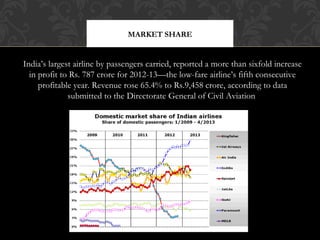
India’s largest airline by passengers carried, reported a more than sixfold increase
in profit to Rs. 787 crore for 2012-13—the low-fare airline’s fifth consecutive
profitable year. Revenue rose 65.4% to Rs.9,458 crore, according to data
submitted to the Directorate General of Civil Aviation
WHY IS THE MARKET LEADER?

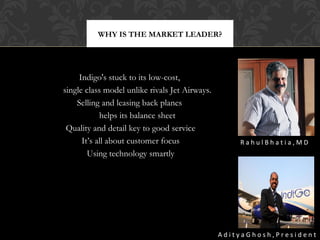
Indigo's stuck to its low-cost,
single class model unlike rivals Jet Airways.
Selling and leasing back planes
helps its balance sheet
Quality and detail key to good service
It’s all about customer focus
Using technology smartly

RahulBhatia,MD

AdityaGhosh,President
PEST ANALYSIS

This analysis is a framework or tool used by marketers to analyze and monitor
the macro environmental (external marketing environment) factors that have an
impact on an organization
Political:
Political:
Open Sky Policy/ Deregulation (+)
Low Entry Barriers (+)
FDI Limits (+)
FDI Limits (+)
49 % for airlines
49 % for airlines
100% for airports
100% for airports
Extensive airports development
planned
planned

Socio- Cultural:
Growing Middle Class (+)
Domestic Leisure Travel (+)
Foreign Tourist (+)
Status Symbol (+)
Security Issues & Terrorism (-)
CONTD

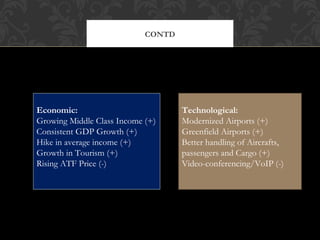
Economic:
Growing Middle Class Income (+)
Consistent GDP Growth (+)
Hike in average income (+)
Growth in Tourism (+)
Rising ATF Price (-)

Technological:
Modernized Airports (+)
Greenfield Airports (+)
Better handling of Aircrafts,
passengers and Cargo (+)
Video-conferencing/VoIP (-)
PORTER’S 5 FORCES ANALYSIS OF
AVIATION INDUSTRY

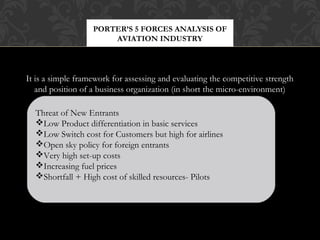
It is a simple framework for assessing and evaluating the competitive strength
and position of a business organization (in short the micro-environment)
Threat of New Entrants
Low Product differentiation in basic services
Low Switch cost for Customers but high for airlines
Open sky policy for foreign entrants
Very high set-up costs
Increasing fuel prices
Shortfall + High cost of skilled resources- Pilots
CONTD…

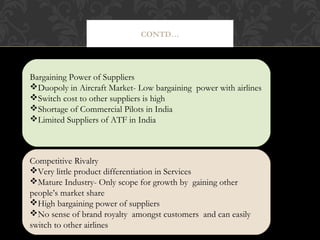
Bargaining Power of Suppliers
Duopoly in Aircraft Market- Low bargaining power with airlines
Switch cost to other suppliers is high
Shortage of Commercial Pilots in India
Limited Suppliers of ATF in India

Competitive Rivalry
Competitive Rivalry
Very little product differentiation in Services
Mature Industry- Only scope for growth by gaining other
people’s market share
High bargaining power of suppliers
No sense of brand royalty amongst customers and can easily
switch to other airlines
CONTD

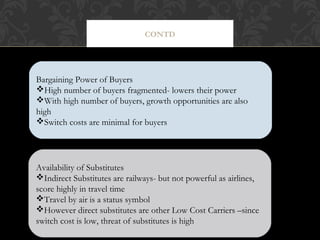
Bargaining Power of Buyers
High number of buyers fragmented- lowers their power
With high number of buyers, growth opportunities are also
high
high
Switch costs are minimal for buyers

Availability of Substitutes
Indirect Substitutes are railways- but not powerful as airlines,
score highly in travel time
Travel by air is aastatus symbol
Travel by air is status symbol
However direct substitutes are other Low Cost Carriers –since
switch cost is low, threat of substitutes is high
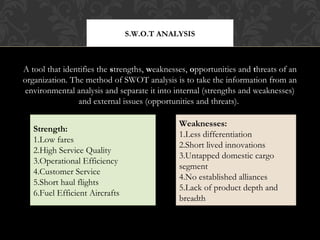
S.W.O.T ANALYSIS

A tool that identifies the strengths, weaknesses, opportunities and threats of an
organization. The method of SWOT analysis is to take the information from an
environmental analysis and separate it into internal (strengths and weaknesses)
and external issues (opportunities and threats).
Strength:
Strength:
1.Low fares
1.Low fares
2.High Service Quality
3.Operational Efficiency
4.Customer Service
4.Customer Service
5.Short haul flights
6.Fuel Efficient Aircrafts

Weaknesses:
Weaknesses:
1.Less differentiation
2.Short lived innovations
3.Untapped domestic cargo
segment
segment
4.No established alliances
5.Lack of product depth and
breadth
breadth
CONTD…

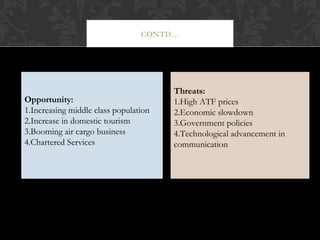
Opportunity:
Opportunity:
1.Increasing middle class population
2.Increase in domestic tourism
3.Booming air cargo business
4.Chartered Services

Threats:
Threats:
1.High ATF prices
1.High ATF prices
2.Economic slowdown
2.Economic slowdown
3.Government policies
4.Technological advancement in
communication
communication
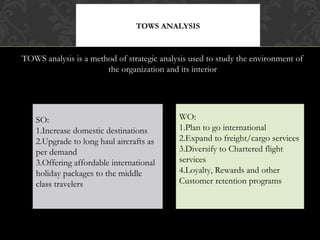
TOWS ANALYSIS

TOWS analysis is a method of strategic analysis used to study the environment of
the organization and its interior

SO:
SO:
1.Increase domestic destinations
2.Upgrade to long haul aircrafts as
per demand
per demand
3.Offering affordable international
holiday packages to the middle
class travelers
class travelers

WO:
WO:
1.Plan to go international
2.Expand to freight/cargo services
3.Diversify to Chartered flight
services
services
4.Loyalty, Rewards and other
Customer retention programs
CONTD

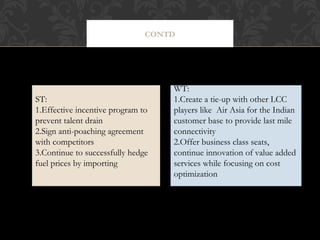
ST:
ST:
1.Effective incentive program to
prevent talent drain
2.Sign anti-poaching agreement
with competitors
with competitors
3.Continue to successfully hedge
fuel prices by importing

WT:
WT:
1.Create aatie-up with other LCC
1.Create tie-up with other LCC
players like Air Asia for the Indian
customer base to provide last mile
connectivity
connectivity
2.Offer business class seats,
continue innovation of value added
services while focusing on cost
optimization
optimization
SEGMENTATION, TARGET AND
POSITION

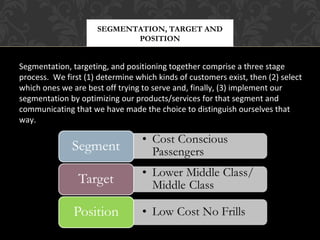
Segmentation, targeting, and positioning together comprise a three stage
process. We first (1) determine which kinds of customers exist, then (2) select
which ones we are best off trying to serve and, finally, (3) implement our
segmentation by optimizing our products/services for that segment and
communicating that we have made the choice to distinguish ourselves that
way.
PORTER’S SCA MODEL

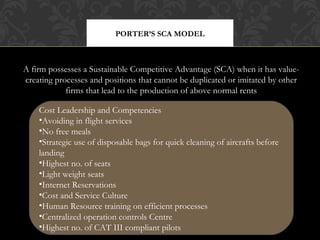
A firm possesses a Sustainable Competitive Advantage (SCA) when it has valuecreating processes and positions that cannot be duplicated or imitated by other
firms that lead to the production of above normal rents
Cost Leadership and Competencies
•Avoiding in flight services
•No free meals
•Strategic use of disposable bags for quick cleaning of aircrafts before
landing
•Highest no. of seats
•Light weight seats
•Internet Reservations
•Cost and Service Culture
•Human Resource training on efficient processes
•Centralized operation controls Centre
•Highest no. of CAT III compliant pilots
CONTD…

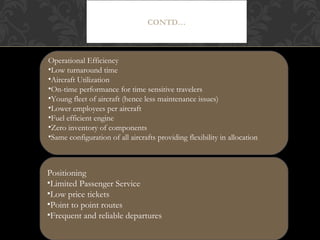
Operational Efficiency
•Low turnaround time
•Aircraft Utilization
•On-time performance for time sensitive travelers
•Young fleet of aircraft (hence less maintenance issues)
•Lower employees per aircraft
•Fuel efficient engine
•Zero inventory of components
•Same configuration of all aircrafts providing flexibility in allocation

Positioning
•Limited Passenger Service
•Low price tickets
•Point to point routes
•Frequent and reliable departures
PRODUCT MIX

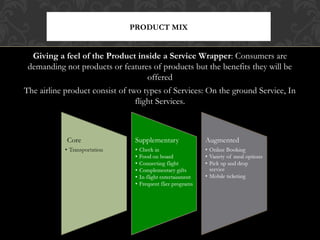
Giving a feel of the Product inside a Service Wrapper: Consumers are
demanding not products or features of products but the benefits they will be
offered
The airline product consist of two types of Services: On the ground Service, In
flight Services.
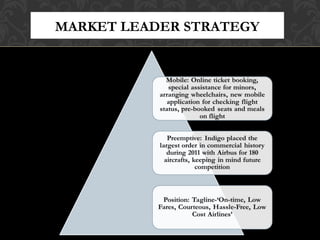
MARKET LEADER STRATEGY
BRANDING

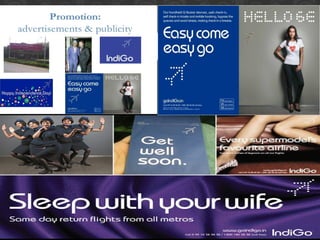
IndiGo’s media campaign has focused more on

customer service and

less on pricing where it is hard to be competitive, and the airline’s avantgarde branding has been a major differentiator.
IndiGo’s same-day return flights from major Indian cities, extra seat pitch (2
inches more than India’s industry standard) and new aircraft.
IndiGo’s check-in counters feature banners saying “India’s Coolest Airline” and
check-in queues have “Cut The Red Tape” signs.
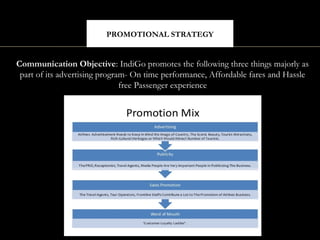
PROMOTIONAL STRATEGY

Communication Objective: IndiGo promotes the following three things majorly as
part of its advertising program- On time performance, Affordable fares and Hassle
free Passenger experience
CONTD…

Advertising Strategies:
Hoarding at airports with focus on Best on Time performance
Advertisement through social networking medium like Facebook, Twitter, etc.
Collaboration with multiplexes in major cities to promote the airline and its offers
Hoardings in multistoried buildings and offices
Ads in magazines targeting urban population
Sponsoring fashion shows, talent hunts, new year parties, etc.
Collaboration with consumer banks, credit card companies, hotels, ticketing
websites to promote special offers, discount, cashback etc.
Promoting in regional languages in respective sectors thus giving a local flavor
Sending special offers to frequent fliers through sms, email, etc.
THE ROAD AHEAD

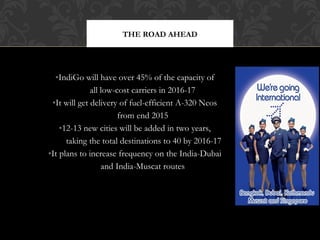
•IndiGo will have over 45% of the capacity of
all low-cost carriers in 2016-17
•It will get delivery of fuel-efficient A-320 Neos
from end 2015
•12-13 new cities will be added in two years,
taking the total destinations to 40 by 2016-17
•It plans to increase frequency on the India-Dubai
and India-Muscat routes
RECOMMENDATIONS

Building on strength
Meet the Global challenge and increase its footprint
Cost Control
Increase depth by venturing into cargo and chartered airlines
Continue being close to the customer by being consistent in their services and
comfort to customers
Come up with innovative offerings
Provide exciting and affordable travel packages
Increase tie-ups with hotels and banks
Differentiate themselves even more by improving media and communication
channels thus improving the overall communication plan
Continue to improve organizational development, which is a critical to airlines
THANK YOU 

Marketing case study on Indigo Airlines

  • 1.
    Presented by Neelutpal Saha(222012) Shan Lal (222021) Mrinmoy Sarkar (222011) Pankaj Srivastava (222014)
  • 2.
    AGENDA •Aviation Industry •About IndiGoAirlines •PEST analysis •Porter’s 5 forces analysis •SWOT and TOWS analysis •Competitive Strategy •STP •Product Mix •Market Leader Strategy •Branding and Promotional Strategy •The road ahead •Recommendations
  • 3.
    AVIATION INDUSTRY Total domesticpassengers carried by the scheduled domestic airlines between January and May 2013 were 25.998 million, as against 25.808 million during the corresponding period of previous year thereby registering a growth of 0.74 per cent, revealed the statistics from Directorate General of Civil Aviation No-frill carrier IndiGo lead in terms of market share with almost 30 per cent of the pie, followed by Jet Airways-Jet Lite combine at 25.3 per cent, Air India Domestic at 19.2 per cent, Spice Jet at 17.5 per cent, and Go Air at 8.3 per cent for the month of July 2013. The air transport (including air freight) in India has attracted foreign direct investment (FDI) worth US$ 456.84 million from April 2000 to July 2013, as per the data released by Department of Industrial Policy and Promotion
  • 4.
    ABOUT INDIGO Indigo isan Indian airline company headquartered at Gurgaon. It is a low cost carrier and the largest airline in India with a market share of 30.3% as of September 2013. IndiGo is one of the fastest growing low cost carriers in the world. With its fleet of 72 new Airbus A320 aircraft, the airline offers 447 daily flights connecting to 35 destinations. Indigo was set up in early 2006 by Rahul Bhatia of InterGlobe Enterprises and Rakesh S Gangwal, a United States-based NRI. InterGlobe holds 51.12% stake in IndiGo and 48% is held by Gangwal's Virginia based company Caelum Investments On 17 August 2012, Indigo became the largest airline in India in terms of market share (27%), In August 2013, the Centre for Asia Pacific Aviation ranked Indigo amongst the 10 biggest low-cost carriers in the world.
  • 5.
    MARKET SHARE India’s largestairline by passengers carried, reported a more than sixfold increase in profit to Rs. 787 crore for 2012-13—the low-fare airline’s fifth consecutive profitable year. Revenue rose 65.4% to Rs.9,458 crore, according to data submitted to the Directorate General of Civil Aviation
  • 6.
    WHY IS THEMARKET LEADER? Indigo's stuck to its low-cost, single class model unlike rivals Jet Airways. Selling and leasing back planes helps its balance sheet Quality and detail key to good service It’s all about customer focus Using technology smartly RahulBhatia,MD AdityaGhosh,President
  • 7.
    PEST ANALYSIS This analysisis a framework or tool used by marketers to analyze and monitor the macro environmental (external marketing environment) factors that have an impact on an organization Political: Political: Open Sky Policy/ Deregulation (+) Open Sky Policy/ Deregulation (+) Low Entry Barriers (+) Low Entry Barriers (+) FDI Limits (+) FDI Limits (+) 49 % for airlines 49 % for airlines 100% for airports 100% for airports Extensive airports development Extensive airports development planned planned Socio- Cultural: Growing Middle Class (+) Domestic Leisure Travel (+) Foreign Tourist (+) Status Symbol (+) Security Issues & Terrorism (-)
  • 8.
    CONTD Economic: Growing Middle ClassIncome (+) Consistent GDP Growth (+) Hike in average income (+) Growth in Tourism (+) Rising ATF Price (-) Technological: Modernized Airports (+) Greenfield Airports (+) Better handling of Aircrafts, passengers and Cargo (+) Video-conferencing/VoIP (-)
  • 9.
    PORTER’S 5 FORCESANALYSIS OF AVIATION INDUSTRY It is a simple framework for assessing and evaluating the competitive strength and position of a business organization (in short the micro-environment) Threat of New Entrants Threat of New Entrants Low Product differentiation in basic services Low Product differentiation in basic services Low Switch cost for Customers but high for airlines Low Switch cost for Customers but high for airlines Open sky policy for foreign entrants Open sky policy for foreign entrants Very high set-up costs Very high set-up costs Increasing fuel prices Increasing fuel prices Shortfall + High cost of skilled resources- Pilots Shortfall + High cost of skilled resources- Pilots
  • 10.
    CONTD… Bargaining Power ofSuppliers Bargaining Power of Suppliers Duopoly in Aircraft Market- Low bargaining power with airlines Duopoly in Aircraft Market- Low bargaining power with airlines Switch cost to other suppliers is high Switch cost to other suppliers is high Shortage of Commercial Pilots in India Shortage of Commercial Pilots in India Limited Suppliers of ATF in India Limited Suppliers of ATF in India Competitive Rivalry Competitive Rivalry Very little product differentiation in Services Very little product differentiation in Services Mature Industry- Only scope for growth by gaining other Mature Industry- Only scope for growth by gaining other people’s market share people’s market share High bargaining power of suppliers High bargaining power of suppliers No sense of brand royalty amongst customers and can easily No sense of brand royalty amongst customers and can easily switch to other airlines switch to other airlines
  • 11.
    CONTD Bargaining Power ofBuyers Bargaining Power of Buyers High number of buyers fragmented- lowers their power High number of buyers fragmented- lowers their power With high number of buyers, growth opportunities are also With high number of buyers, growth opportunities are also high high Switch costs are minimal for buyers Switch costs are minimal for buyers Availability of Substitutes Availability of Substitutes Indirect Substitutes are railways- but not powerful as airlines, Indirect Substitutes are railways- but not powerful as airlines, score highly in travel time score highly in travel time Travel by air is aastatus symbol Travel by air is status symbol However direct substitutes are other Low Cost Carriers –since However direct substitutes are other Low Cost Carriers –since switch cost is low, threat of substitutes is high switch cost is low, threat of substitutes is high
  • 12.
    S.W.O.T ANALYSIS A toolthat identifies the strengths, weaknesses, opportunities and threats of an organization. The method of SWOT analysis is to take the information from an environmental analysis and separate it into internal (strengths and weaknesses) and external issues (opportunities and threats). Strength: Strength: 1.Low fares 1.Low fares 2.High Service Quality 2.High Service Quality 3.Operational Efficiency 3.Operational Efficiency 4.Customer Service 4.Customer Service 5.Short haul flights 5.Short haul flights 6.Fuel Efficient Aircrafts 6.Fuel Efficient Aircrafts Weaknesses: Weaknesses: 1.Less differentiation 1.Less differentiation 2.Short lived innovations 2.Short lived innovations 3.Untapped domestic cargo 3.Untapped domestic cargo segment segment 4.No established alliances 4.No established alliances 5.Lack of product depth and 5.Lack of product depth and breadth breadth
  • 13.
    CONTD… Opportunity: Opportunity: 1.Increasing middle classpopulation 1.Increasing middle class population 2.Increase in domestic tourism 2.Increase in domestic tourism 3.Booming air cargo business 3.Booming air cargo business 4.Chartered Services 4.Chartered Services Threats: Threats: 1.High ATF prices 1.High ATF prices 2.Economic slowdown 2.Economic slowdown 3.Government policies 3.Government policies 4.Technological advancement in 4.Technological advancement in communication communication
  • 14.
    TOWS ANALYSIS TOWS analysisis a method of strategic analysis used to study the environment of the organization and its interior SO: SO: 1.Increase domestic destinations 1.Increase domestic destinations 2.Upgrade to long haul aircrafts as 2.Upgrade to long haul aircrafts as per demand per demand 3.Offering affordable international 3.Offering affordable international holiday packages to the middle holiday packages to the middle class travelers class travelers WO: WO: 1.Plan to go international 1.Plan to go international 2.Expand to freight/cargo services 2.Expand to freight/cargo services 3.Diversify to Chartered flight 3.Diversify to Chartered flight services services 4.Loyalty, Rewards and other 4.Loyalty, Rewards and other Customer retention programs Customer retention programs
  • 15.
    CONTD ST: ST: 1.Effective incentive programto 1.Effective incentive program to prevent talent drain prevent talent drain 2.Sign anti-poaching agreement 2.Sign anti-poaching agreement with competitors with competitors 3.Continue to successfully hedge 3.Continue to successfully hedge fuel prices by importing fuel prices by importing WT: WT: 1.Create aatie-up with other LCC 1.Create tie-up with other LCC players like Air Asia for the Indian players like Air Asia for the Indian customer base to provide last mile customer base to provide last mile connectivity connectivity 2.Offer business class seats, 2.Offer business class seats, continue innovation of value added continue innovation of value added services while focusing on cost services while focusing on cost optimization optimization
  • 16.
    SEGMENTATION, TARGET AND POSITION Segmentation,targeting, and positioning together comprise a three stage process. We first (1) determine which kinds of customers exist, then (2) select which ones we are best off trying to serve and, finally, (3) implement our segmentation by optimizing our products/services for that segment and communicating that we have made the choice to distinguish ourselves that way.
  • 17.
    PORTER’S SCA MODEL Afirm possesses a Sustainable Competitive Advantage (SCA) when it has valuecreating processes and positions that cannot be duplicated or imitated by other firms that lead to the production of above normal rents Cost Leadership and Competencies •Avoiding in flight services •No free meals •Strategic use of disposable bags for quick cleaning of aircrafts before landing •Highest no. of seats •Light weight seats •Internet Reservations •Cost and Service Culture •Human Resource training on efficient processes •Centralized operation controls Centre •Highest no. of CAT III compliant pilots
  • 18.
    CONTD… Operational Efficiency •Low turnaroundtime •Aircraft Utilization •On-time performance for time sensitive travelers •Young fleet of aircraft (hence less maintenance issues) •Lower employees per aircraft •Fuel efficient engine •Zero inventory of components •Same configuration of all aircrafts providing flexibility in allocation Positioning •Limited Passenger Service •Low price tickets •Point to point routes •Frequent and reliable departures
  • 19.
    PRODUCT MIX Giving afeel of the Product inside a Service Wrapper: Consumers are demanding not products or features of products but the benefits they will be offered The airline product consist of two types of Services: On the ground Service, In flight Services.
  • 20.
  • 21.
    BRANDING IndiGo’s media campaignhas focused more on customer service and less on pricing where it is hard to be competitive, and the airline’s avantgarde branding has been a major differentiator. IndiGo’s same-day return flights from major Indian cities, extra seat pitch (2 inches more than India’s industry standard) and new aircraft. IndiGo’s check-in counters feature banners saying “India’s Coolest Airline” and check-in queues have “Cut The Red Tape” signs.
  • 22.
    PROMOTIONAL STRATEGY Communication Objective:IndiGo promotes the following three things majorly as part of its advertising program- On time performance, Affordable fares and Hassle free Passenger experience
  • 23.
    CONTD… Advertising Strategies: Hoarding atairports with focus on Best on Time performance Advertisement through social networking medium like Facebook, Twitter, etc. Collaboration with multiplexes in major cities to promote the airline and its offers Hoardings in multistoried buildings and offices Ads in magazines targeting urban population Sponsoring fashion shows, talent hunts, new year parties, etc. Collaboration with consumer banks, credit card companies, hotels, ticketing websites to promote special offers, discount, cashback etc. Promoting in regional languages in respective sectors thus giving a local flavor Sending special offers to frequent fliers through sms, email, etc.
  • 25.
    THE ROAD AHEAD •IndiGowill have over 45% of the capacity of all low-cost carriers in 2016-17 •It will get delivery of fuel-efficient A-320 Neos from end 2015 •12-13 new cities will be added in two years, taking the total destinations to 40 by 2016-17 •It plans to increase frequency on the India-Dubai and India-Muscat routes
  • 26.
    RECOMMENDATIONS Building on strength Meetthe Global challenge and increase its footprint Cost Control Increase depth by venturing into cargo and chartered airlines Continue being close to the customer by being consistent in their services and comfort to customers Come up with innovative offerings Provide exciting and affordable travel packages Increase tie-ups with hotels and banks Differentiate themselves even more by improving media and communication channels thus improving the overall communication plan Continue to improve organizational development, which is a critical to airlines
  • 27.