




Review AE430 Aircraft Propulsion Systems Gustaaf Jacobs
Note Bring Anderson to exam for tables.
Goals Understand and analyze gas turbine engines: Turbojet Turbofan (turbojet + fanned propeller)! Ramjet
Analysis Analysis Energy control volume per engine component Pressure and temperature changes for ideal engine With efficiency definitions: pressure and temperature changes for non-ideal engine Control Volume over complete engine: Momentum balance=> thrust, propulsion efficiency Energy balance or thermo analysis: Brayton cycle: Thermal efficiency
Analysis Detailed component analysis Inlets Subsonic flow analysis in 1D Pressure recovery estimate Shock analysis in 1D inlet (converging-diverging) Estimate of losses External deceleration principles 2D shock external deceleration Oblique shock analysis Estimate spillage and losses
Analysis Combustor Qualitative idea of combustion physics Fuel-air ratio (stoichiometric) Flame speed Flame holding Quantitative: pressure loss with 1D channel flow analysis + heat addition=> not treated due to time restrictions Compressor/Turbine Estimate of pressure, temperature recovery with momentum and energy balance Velocity triangles analysis: first order estimate of compressor aerodynamics
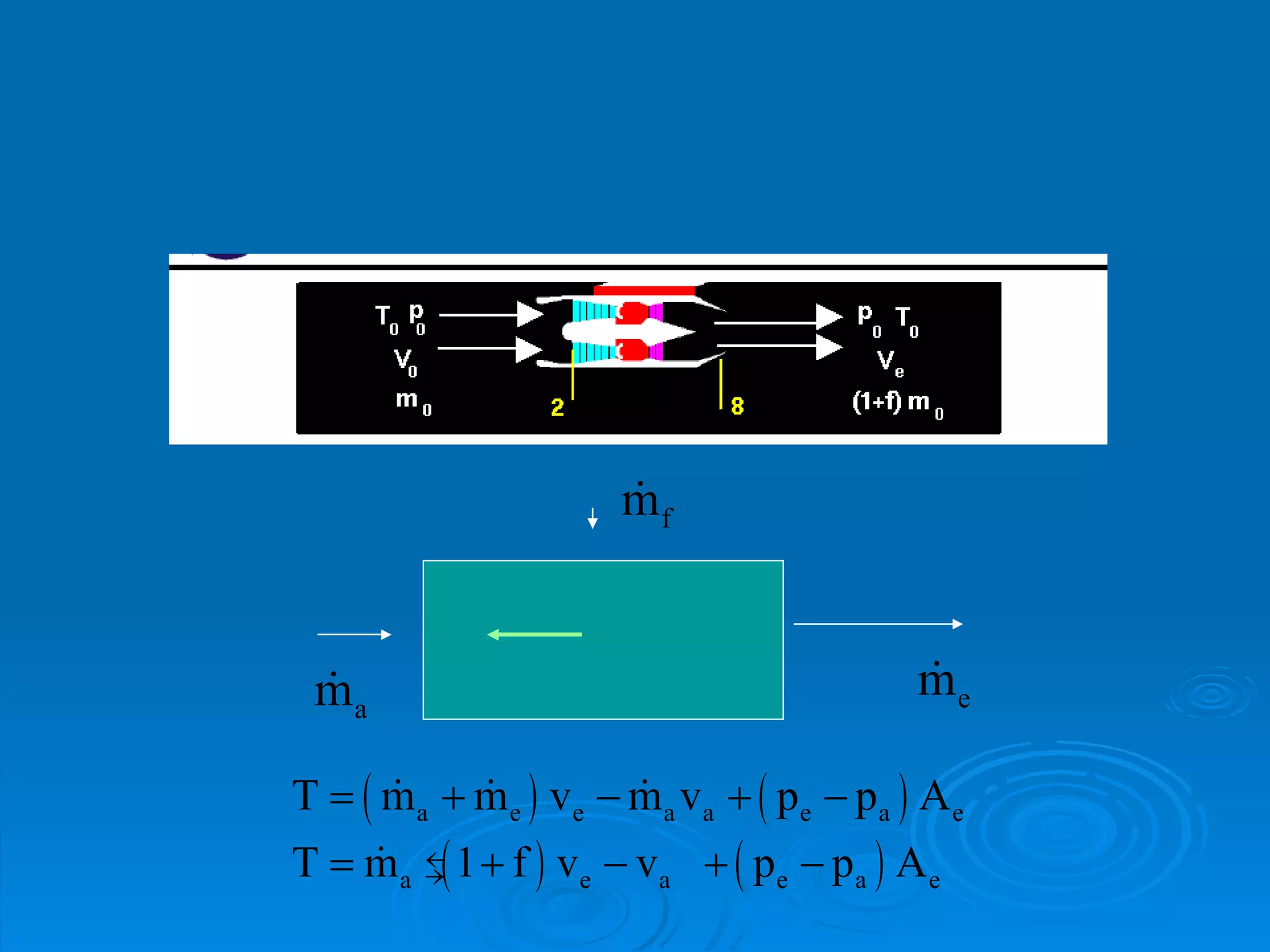
Control Volume Analysis:  Basic Idea T
Engine Performance Parameters Propulsion efficiency, ratio thrust power to add kinetic energy Thermal efficiency, ratio added kinetic energy to total energy consumption Total efficiency Thrust Specific Fuel Consumption
Thermodynamic cycles Diagram that looks at the change of state variables at various stage of the engine Ideal gas turbine: Brayton cycle Isentropic compression, constant p heat addition, constant p heat rejection First law of thermodynamics  analysis gives expression for  η th
Ideal Ramjet Analyze each stage using thermodynamic analysis with energy balance and isentropic relations to find: P, T, p 0 , T 0   v e , T/m a f
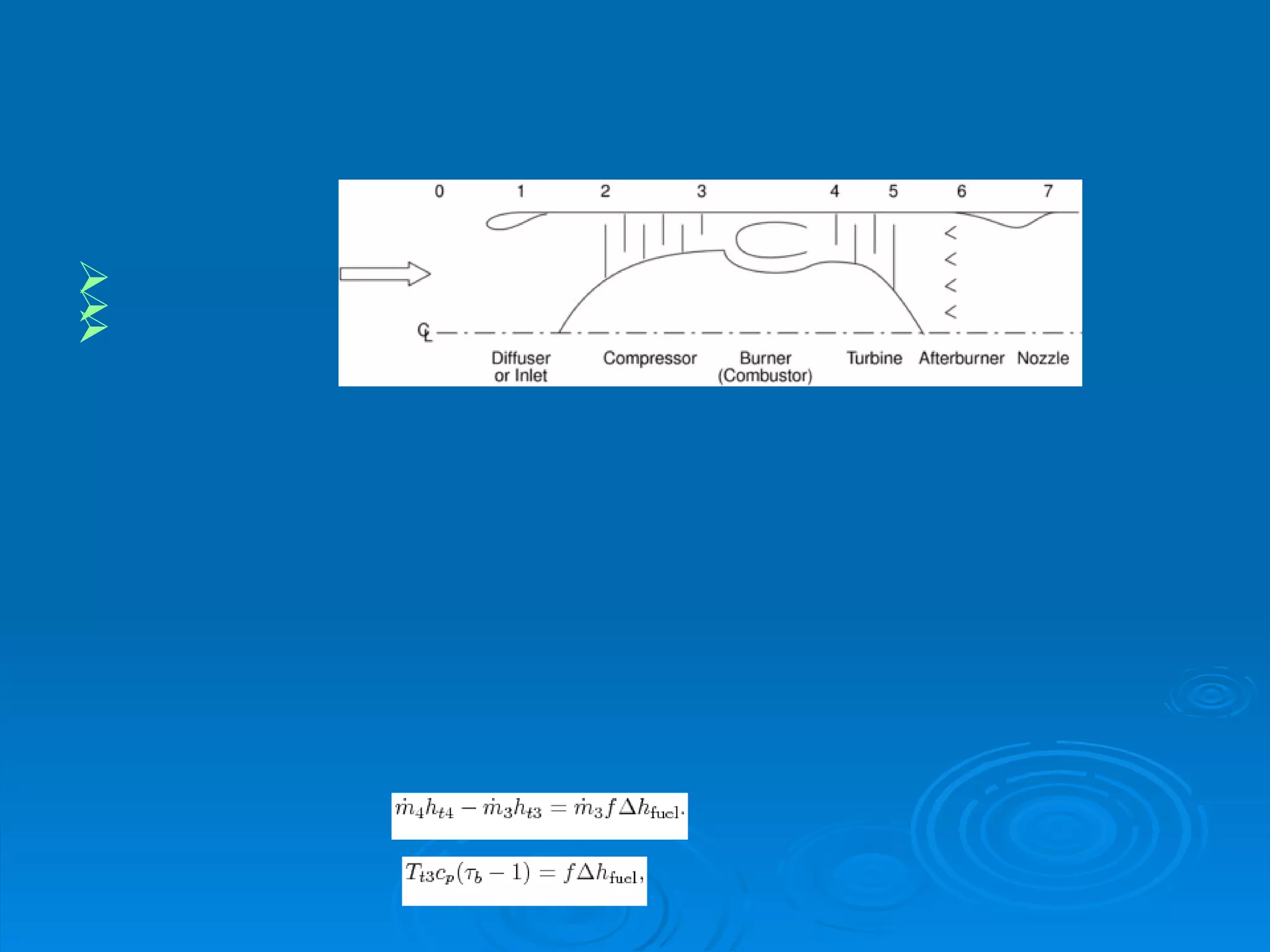
Ideal Ramjet p t,0 =p t,7 , p 0 =p 7  => M 0 =M 7 T 7  > T 0  since heat is added during combustion, so v 7 >v 0  => Thrust Fuel to air ratio, use  first law:
Non-isentropic compression and expansion: losses lead to lowered total pressure and temperature Define total pressure ratios before and after components to quantify the efficiency: r c , r n ,r d Non-ideal ramjet
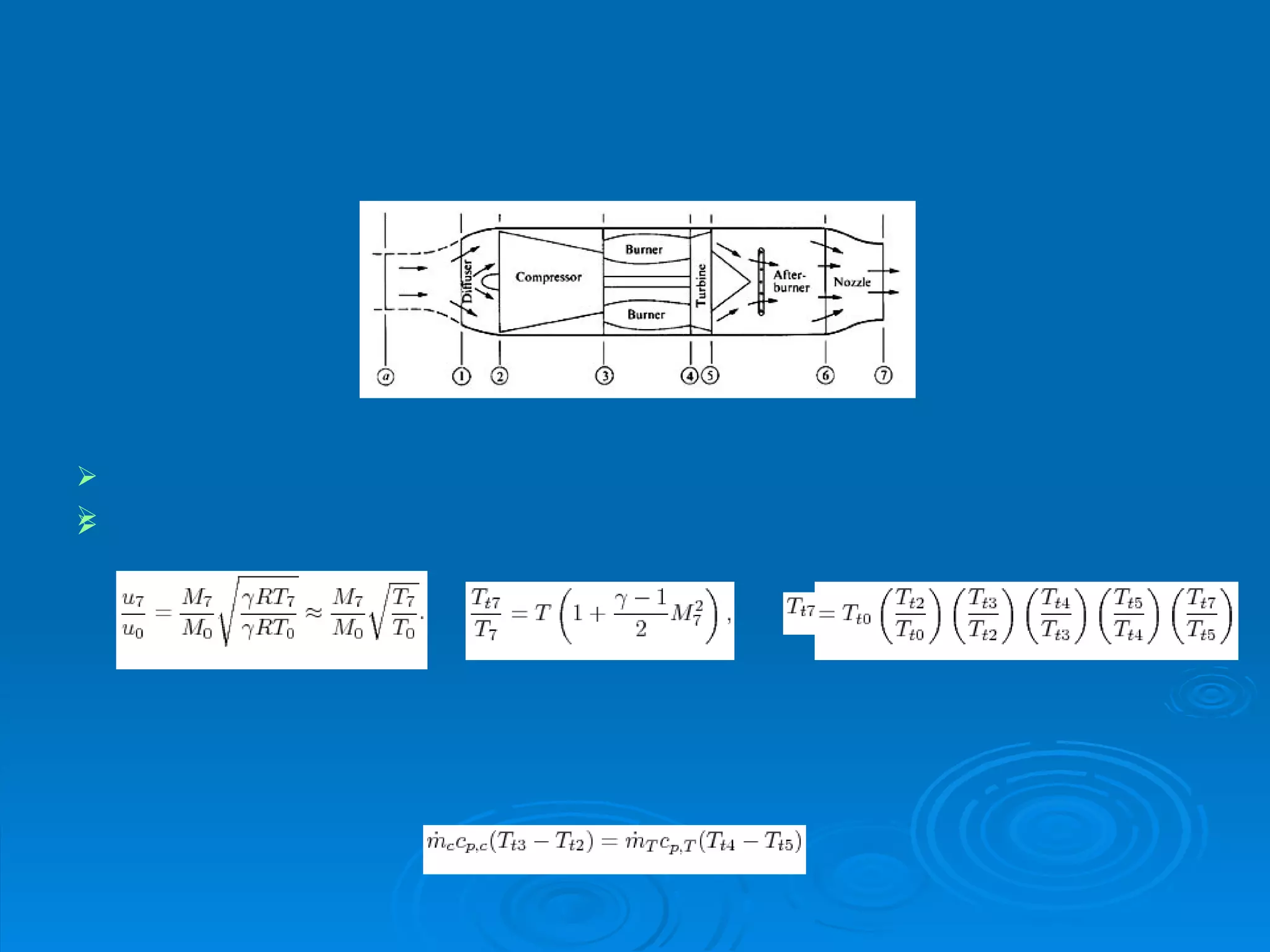
Major difference with ramjet p total  is not constant like in ramjet but increases and decrease in compressor and turbine. To find these ratios work from front to back through each stage Specific: compressor and turbine power are the same so (first law) Non-Ideal turbojet
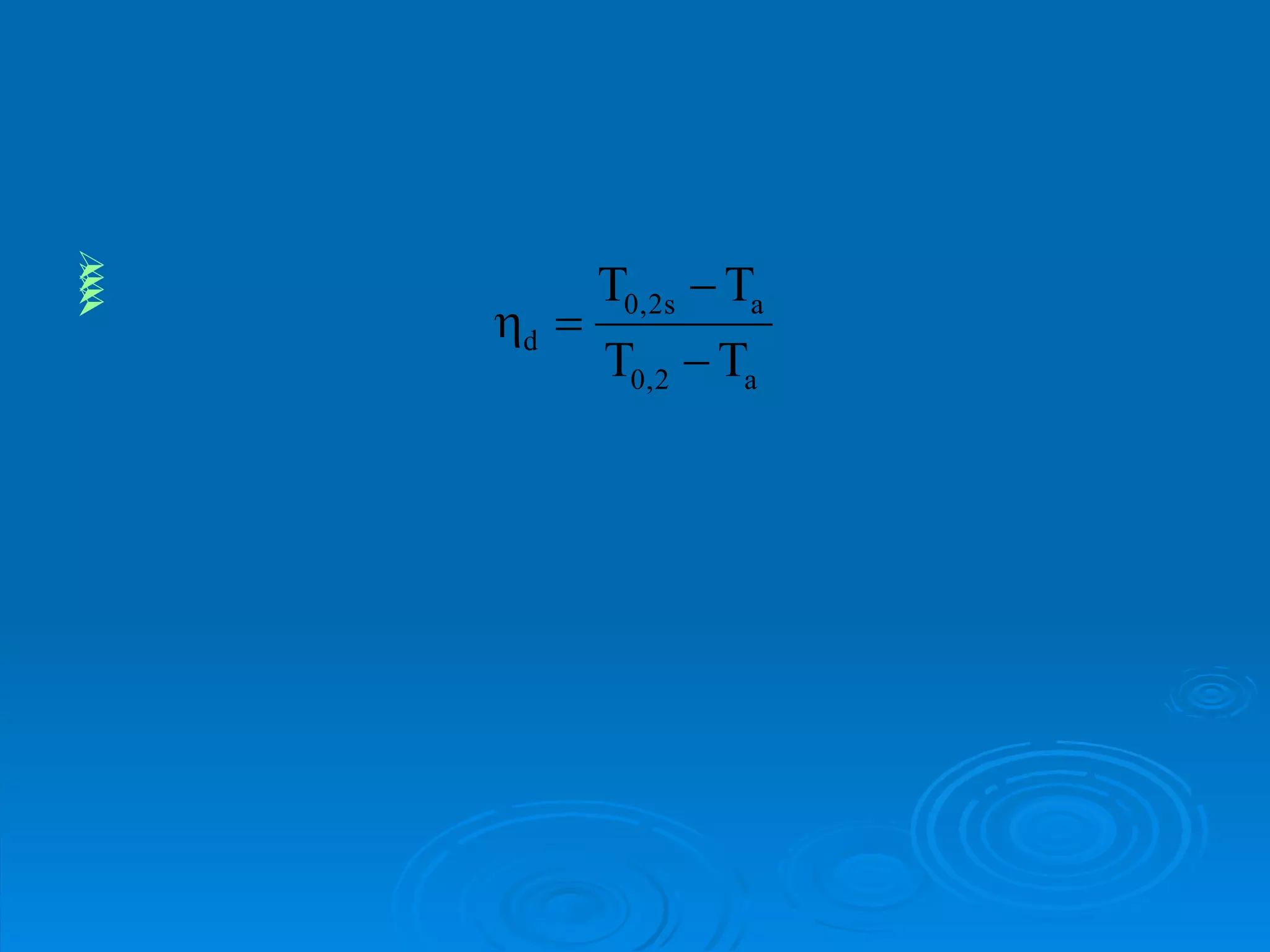
Definition of component efficiencies E.g. diffuser Relates actual total temperature increase to an isentropic temperature increase The isentropic temperature can be related to the total pressure using isentropic relations  The total pressure distribution is determined from front to back. Each stage has an effiiciency like this.
Turbofan Example on blackboard.
Detailed analysis of components
Intakes Convert kinetic energy to pressure Subsonic External acceleration or decelleration depends on intake design and speed of aircraft High speed: spillage. Low speed: stall. Diffuser design: prevent stall: use computational (XFOIL, MSES) and experimental validation to design
Supersonic intake 1D: converging-diverging nozzle Ideal: isentropic decelleration supersonic to throat, subsonic after throat Not possible in practice Shocks in nozzle Possible design: shock close to throat and M~1 at throat Need overspeeding to swallow shock in throat. Kantrowitz-Donaldson: design condition is shock swallowing condition.
Supersonic diffuser 2-D nozzle Use multiple oblique shocks to slow flow down with small losses in total pressure Use oblique shock analysis
Combustor + Compressor Discussed in last classes


Aircraft Propulsion Systems

  • 1.
    Review AE430 AircraftPropulsion Systems Gustaaf Jacobs
  • 2.
    Note Bring Andersonto exam for tables.
  • 3.
    Goals Understand andanalyze gas turbine engines: Turbojet Turbofan (turbojet + fanned propeller)! Ramjet
  • 4.
    Analysis Analysis Energycontrol volume per engine component Pressure and temperature changes for ideal engine With efficiency definitions: pressure and temperature changes for non-ideal engine Control Volume over complete engine: Momentum balance=> thrust, propulsion efficiency Energy balance or thermo analysis: Brayton cycle: Thermal efficiency
  • 5.
    Analysis Detailed componentanalysis Inlets Subsonic flow analysis in 1D Pressure recovery estimate Shock analysis in 1D inlet (converging-diverging) Estimate of losses External deceleration principles 2D shock external deceleration Oblique shock analysis Estimate spillage and losses
  • 6.
    Analysis Combustor Qualitativeidea of combustion physics Fuel-air ratio (stoichiometric) Flame speed Flame holding Quantitative: pressure loss with 1D channel flow analysis + heat addition=> not treated due to time restrictions Compressor/Turbine Estimate of pressure, temperature recovery with momentum and energy balance Velocity triangles analysis: first order estimate of compressor aerodynamics
  • 7.
  • 8.
    Engine Performance ParametersPropulsion efficiency, ratio thrust power to add kinetic energy Thermal efficiency, ratio added kinetic energy to total energy consumption Total efficiency Thrust Specific Fuel Consumption
  • 9.
    Thermodynamic cycles Diagramthat looks at the change of state variables at various stage of the engine Ideal gas turbine: Brayton cycle Isentropic compression, constant p heat addition, constant p heat rejection First law of thermodynamics analysis gives expression for η th
  • 10.
    Ideal Ramjet Analyzeeach stage using thermodynamic analysis with energy balance and isentropic relations to find: P, T, p 0 , T 0 v e , T/m a f
  • 11.
    Ideal Ramjet pt,0 =p t,7 , p 0 =p 7 => M 0 =M 7 T 7 > T 0 since heat is added during combustion, so v 7 >v 0 => Thrust Fuel to air ratio, use first law:
  • 12.
    Non-isentropic compression andexpansion: losses lead to lowered total pressure and temperature Define total pressure ratios before and after components to quantify the efficiency: r c , r n ,r d Non-ideal ramjet
  • 13.
    Major difference withramjet p total is not constant like in ramjet but increases and decrease in compressor and turbine. To find these ratios work from front to back through each stage Specific: compressor and turbine power are the same so (first law) Non-Ideal turbojet
  • 14.
    Definition of componentefficiencies E.g. diffuser Relates actual total temperature increase to an isentropic temperature increase The isentropic temperature can be related to the total pressure using isentropic relations The total pressure distribution is determined from front to back. Each stage has an effiiciency like this.
  • 15.
  • 16.
  • 17.
    Intakes Convert kineticenergy to pressure Subsonic External acceleration or decelleration depends on intake design and speed of aircraft High speed: spillage. Low speed: stall. Diffuser design: prevent stall: use computational (XFOIL, MSES) and experimental validation to design
  • 18.
    Supersonic intake 1D:converging-diverging nozzle Ideal: isentropic decelleration supersonic to throat, subsonic after throat Not possible in practice Shocks in nozzle Possible design: shock close to throat and M~1 at throat Need overspeeding to swallow shock in throat. Kantrowitz-Donaldson: design condition is shock swallowing condition.
  • 19.
    Supersonic diffuser 2-Dnozzle Use multiple oblique shocks to slow flow down with small losses in total pressure Use oblique shock analysis
  • 20.
    Combustor + CompressorDiscussed in last classes
  • 21.
  • 22.