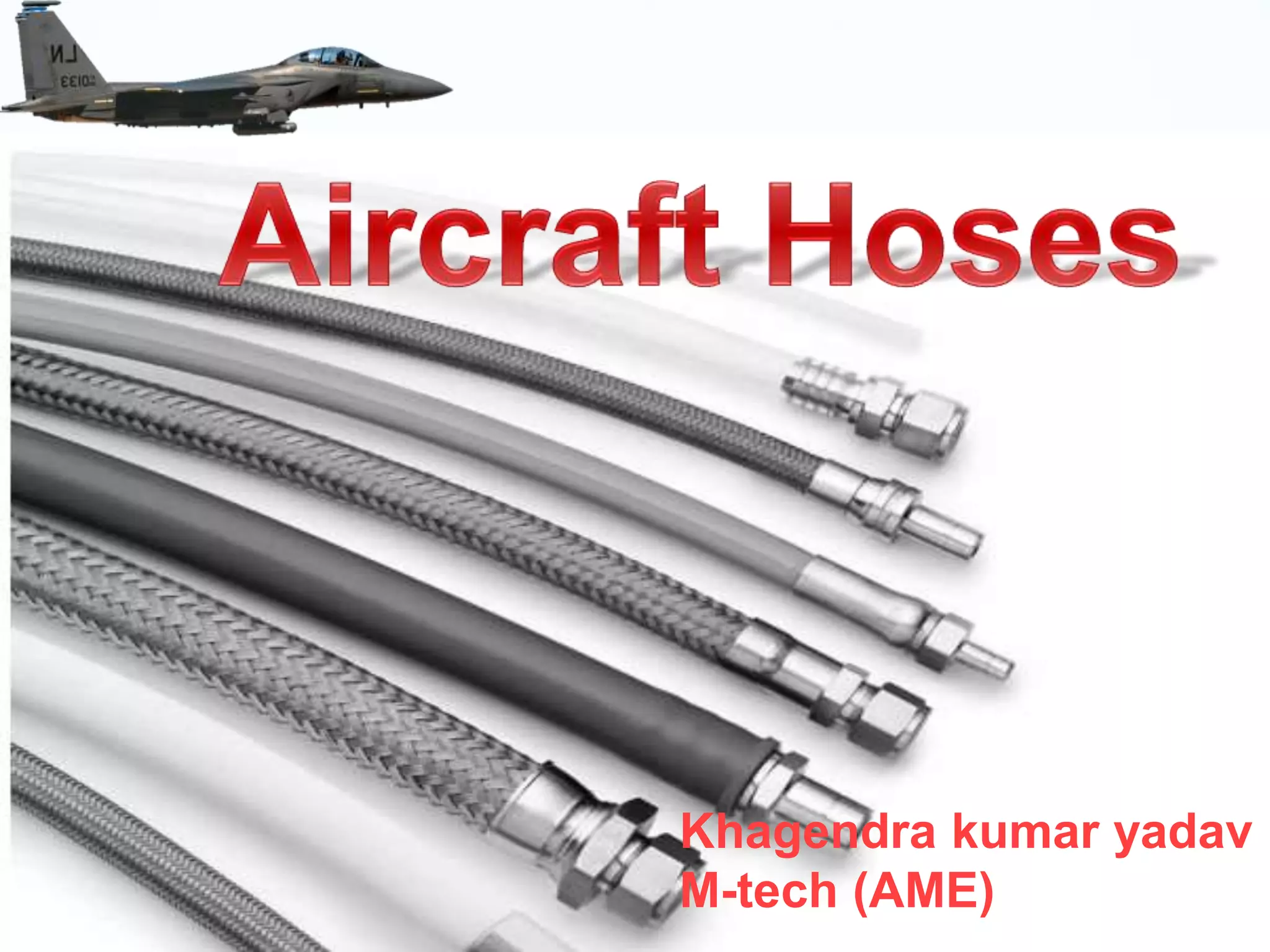
Khagendra kumar yadav
M-tech (AME)
content
 Hose-Introduction
 HOSES :SERVICE LIVES
 Hose Materials and Construction
 Hose Identification
 Storage of hose
 Hose installation
Hose
 A multiple-layered flexible conduit through which fluid is
conveyed from one point to another.
 Flexible hose is used in aircraft fluid systems to connect
moving parts with stationary parts in locations subject to
vibration or where a great amount of flexibility is needed. It
can also serve as a connector in metal tubing systems.
The hoses have been classified in two groups :
GROUP A : Fuel, Oil, pneumatic and hydraulic pressure
hoses.
GROUP B : All other hoses like hydraulic return line
and instruments hoses etc.
HOSES :SERVICE LIVES
 Shelf Life :
The total storage/shelf life of both types of hoses shall be
limited to 10 years from the cure date of manufacture.
During storage, periodic inspection should be carried out
once a year for signs of deterioration, weather cracks, signs
of corrosion on end fittings etc. and hose pressure tested to
1-1/2 times the working pressure every two years.
Before installation on aircraft pressure test should be
carried out at 1-1/2 times the working pressure.
 Service Life :
Group A hoses – max. 4 years extendable upto 6 years
Group B hoses – max. 6 year extendable upto 8 years
Hose Materials and Construction
 The two basic hose materials are synthetic rubber and
polytetrafluoroethylene (PTFE).
 To meet the requirements of strength, durability, and
workability, among other factors, synthetics are used in place
of pure rubber. Synthetic materials most commonly used in
the manufacture of flexible hose are Buna-N, neoprene, butyl,
ethylene propylene diene rubber (EPDM) and Teflon™.
 One material which is widely used for the manufacture of
hose for engine and hydraulic systems is
polytetrafluoroethylene (PTFE). This material is chemically
inert, is unaffected by the synthetic oils and fluids used in
aircraft systems, operates satisfactorily at high fluid and
ambient temperature and normally has an unlimited shelf life.
Low, Medium, and High Pressure Hoses
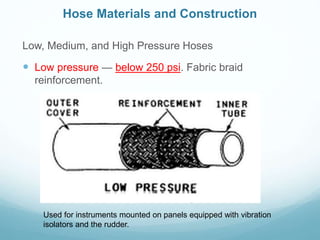
 Low pressure — below 250 psi. Fabric braid
reinforcement.
Hose Materials and Construction
Used for instruments mounted on panels equipped with vibration
isolators and the rudder.
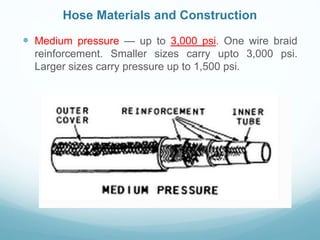
 Medium pressure — up to 3,000 psi. One wire braid
reinforcement. Smaller sizes carry upto 3,000 psi.
Larger sizes carry pressure up to 1,500 psi.
Hose Materials and Construction
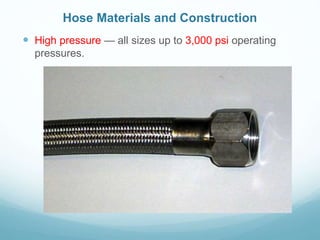
 High pressure — all sizes up to 3,000 psi operating
pressures.
Hose Materials and Construction
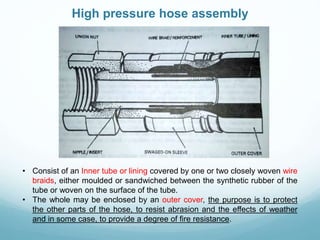
High pressure hose assembly
• Consist of an Inner tube or lining covered by one or two closely woven wire
braids, either moulded or sandwiched between the synthetic rubber of the
tube or woven on the surface of the tube.
• The whole may be enclosed by an outer cover, the purpose is to protect
the other parts of the hose, to resist abrasion and the effects of weather
and in some case, to provide a degree of fire resistance.
Hose Identification
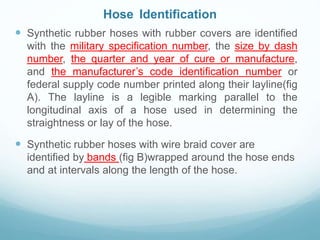
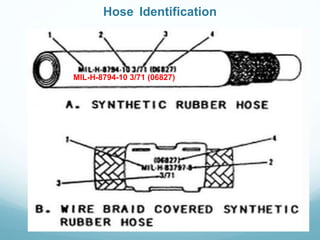
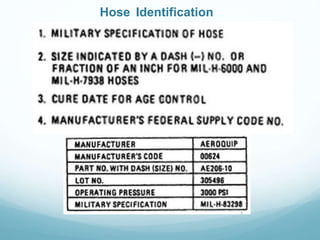
 Synthetic rubber hoses with rubber covers are identified
with the military specification number, the size by dash
number, the quarter and year of cure or manufacture,
and the manufacturer’s code identification number or
federal supply code number printed along their layline(fig
A). The layline is a legible marking parallel to the
longitudinal axis of a hose used in determining the
straightness or lay of the hose.
 Synthetic rubber hoses with wire braid cover are
identified by bands (fig B)wrapped around the hose ends
and at intervals along the length of the hose.
Hose Identification
MIL-H-8794-10 3/71 (06827)
Hose Identification
 Sizing
The size of a flexible hose is identified by the dash (-)number,
which is the ID of the hose expressed in 16ths of an inch. For
example, the ID of a -64 hose is 4 inches. For a few hose styles
this is the nominal and not the true ID.
 Cure Date
Synthetic rubber hoses will deteriorate from aging. A cure date is
used to ensure that they do not deteriorate beyond material and
performance specifications. The cure date is the quarter and year
the hose was manufactured. For example, 1/89 means the hose
was made during the first quarter (1 Jan to 31 Mar) of 1989. The
cure date limits the length of time a rubber hose can be stored, in
bulk or as an assembly, prior to being placed into service. The
storage or shelf life for rubber hose is 4 years. For the hose
manufactured in 1/89, the storage or shelf life will end on the 31st
of March 1993.
Hose Identification
Storage of hose
Aircraft hoses and hose assemblies should be stored uncoiled
and supported so as to release stresses.
 Temperature : The storage temperature should be between
50 deg. F and 70 deg. F and the distance between the
stored articles and the source of heat should be more than 3
feet.
 Humidity : The relative humidity in the store room should be
around 65 percent.
 Light : Rubber parts should not be exposed to strong light
e.g. direct rays of sun. The store rooms should be kept as
dark as practicable.
Hose installation
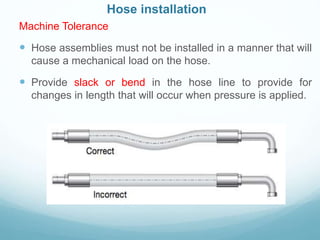
Machine Tolerance
 Hose assemblies must not be installed in a manner that will
cause a mechanical load on the hose.
 Provide slack or bend in the hose line to provide for
changes in length that will occur when pressure is applied.
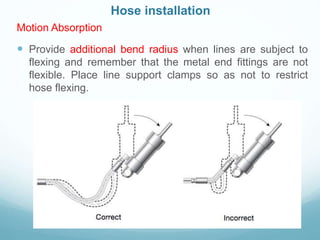
Motion Absorption
 Provide additional bend radius when lines are subject to
flexing and remember that the metal end fittings are not
flexible. Place line support clamps so as not to restrict
hose flexing.
Hose installation
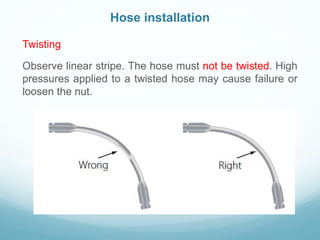
Twisting
Observe linear stripe. The hose must not be twisted. High
pressures applied to a twisted hose may cause failure or
loosen the nut.
Hose installation
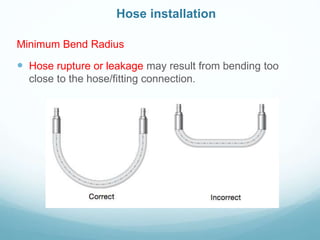
Minimum Bend Radius
 Hose rupture or leakage may result from bending too
close to the hose/fitting connection.
Hose installation
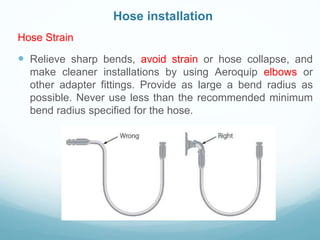
Hose Strain
 Relieve sharp bends, avoid strain or hose collapse, and
make cleaner installations by using Aeroquip elbows or
other adapter fittings. Provide as large a bend radius as
possible. Never use less than the recommended minimum
bend radius specified for the hose.
Hose installation
Aircraft hoses

Aircraft hoses

  • 1.
  • 2.
    content  Hose-Introduction  HOSES:SERVICE LIVES  Hose Materials and Construction  Hose Identification  Storage of hose  Hose installation
  • 3.
    Hose  A multiple-layeredflexible conduit through which fluid is conveyed from one point to another.  Flexible hose is used in aircraft fluid systems to connect moving parts with stationary parts in locations subject to vibration or where a great amount of flexibility is needed. It can also serve as a connector in metal tubing systems. The hoses have been classified in two groups : GROUP A : Fuel, Oil, pneumatic and hydraulic pressure hoses. GROUP B : All other hoses like hydraulic return line and instruments hoses etc.
  • 4.
    HOSES :SERVICE LIVES Shelf Life : The total storage/shelf life of both types of hoses shall be limited to 10 years from the cure date of manufacture. During storage, periodic inspection should be carried out once a year for signs of deterioration, weather cracks, signs of corrosion on end fittings etc. and hose pressure tested to 1-1/2 times the working pressure every two years. Before installation on aircraft pressure test should be carried out at 1-1/2 times the working pressure.  Service Life : Group A hoses – max. 4 years extendable upto 6 years Group B hoses – max. 6 year extendable upto 8 years
  • 5.
    Hose Materials andConstruction  The two basic hose materials are synthetic rubber and polytetrafluoroethylene (PTFE).  To meet the requirements of strength, durability, and workability, among other factors, synthetics are used in place of pure rubber. Synthetic materials most commonly used in the manufacture of flexible hose are Buna-N, neoprene, butyl, ethylene propylene diene rubber (EPDM) and Teflon™.  One material which is widely used for the manufacture of hose for engine and hydraulic systems is polytetrafluoroethylene (PTFE). This material is chemically inert, is unaffected by the synthetic oils and fluids used in aircraft systems, operates satisfactorily at high fluid and ambient temperature and normally has an unlimited shelf life.
  • 6.
    Low, Medium, andHigh Pressure Hoses  Low pressure — below 250 psi. Fabric braid reinforcement. Hose Materials and Construction Used for instruments mounted on panels equipped with vibration isolators and the rudder.
  • 7.
     Medium pressure— up to 3,000 psi. One wire braid reinforcement. Smaller sizes carry upto 3,000 psi. Larger sizes carry pressure up to 1,500 psi. Hose Materials and Construction
  • 8.
     High pressure— all sizes up to 3,000 psi operating pressures. Hose Materials and Construction
  • 9.
    High pressure hoseassembly • Consist of an Inner tube or lining covered by one or two closely woven wire braids, either moulded or sandwiched between the synthetic rubber of the tube or woven on the surface of the tube. • The whole may be enclosed by an outer cover, the purpose is to protect the other parts of the hose, to resist abrasion and the effects of weather and in some case, to provide a degree of fire resistance.
  • 10.
    Hose Identification  Syntheticrubber hoses with rubber covers are identified with the military specification number, the size by dash number, the quarter and year of cure or manufacture, and the manufacturer’s code identification number or federal supply code number printed along their layline(fig A). The layline is a legible marking parallel to the longitudinal axis of a hose used in determining the straightness or lay of the hose.  Synthetic rubber hoses with wire braid cover are identified by bands (fig B)wrapped around the hose ends and at intervals along the length of the hose.
  • 11.
  • 12.
  • 13.
     Sizing The sizeof a flexible hose is identified by the dash (-)number, which is the ID of the hose expressed in 16ths of an inch. For example, the ID of a -64 hose is 4 inches. For a few hose styles this is the nominal and not the true ID.  Cure Date Synthetic rubber hoses will deteriorate from aging. A cure date is used to ensure that they do not deteriorate beyond material and performance specifications. The cure date is the quarter and year the hose was manufactured. For example, 1/89 means the hose was made during the first quarter (1 Jan to 31 Mar) of 1989. The cure date limits the length of time a rubber hose can be stored, in bulk or as an assembly, prior to being placed into service. The storage or shelf life for rubber hose is 4 years. For the hose manufactured in 1/89, the storage or shelf life will end on the 31st of March 1993. Hose Identification
  • 14.
    Storage of hose Aircrafthoses and hose assemblies should be stored uncoiled and supported so as to release stresses.  Temperature : The storage temperature should be between 50 deg. F and 70 deg. F and the distance between the stored articles and the source of heat should be more than 3 feet.  Humidity : The relative humidity in the store room should be around 65 percent.  Light : Rubber parts should not be exposed to strong light e.g. direct rays of sun. The store rooms should be kept as dark as practicable.
  • 17.
    Hose installation Machine Tolerance Hose assemblies must not be installed in a manner that will cause a mechanical load on the hose.  Provide slack or bend in the hose line to provide for changes in length that will occur when pressure is applied.
  • 18.
    Motion Absorption  Provideadditional bend radius when lines are subject to flexing and remember that the metal end fittings are not flexible. Place line support clamps so as not to restrict hose flexing. Hose installation
  • 19.
    Twisting Observe linear stripe.The hose must not be twisted. High pressures applied to a twisted hose may cause failure or loosen the nut. Hose installation
  • 20.
    Minimum Bend Radius Hose rupture or leakage may result from bending too close to the hose/fitting connection. Hose installation
  • 21.
    Hose Strain  Relievesharp bends, avoid strain or hose collapse, and make cleaner installations by using Aeroquip elbows or other adapter fittings. Provide as large a bend radius as possible. Never use less than the recommended minimum bend radius specified for the hose. Hose installation