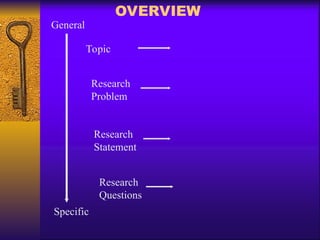
The process of clearly defining an issue or gap in knowledge that a study aims to address, forming the foundation for research direction, questions, and methodology.
DEFINITION
Research problemsare educational
issues or concerns studied by
researchers
In education, a problem is a concern to
educators that exists in educational
settings
3.
Ask yourself
Tohelp locate your research problem for your thesis, ask
yourself such questions as:
What was the issue/problem you want to study?
What is the concern being addressed “behind” this study?
Why do you want to undertake this study?
Why is this study important to the scholarly community?
4.
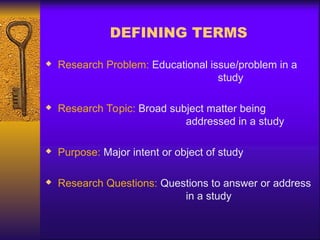
DEFINING TERMS
ResearchProblem: Educational issue/problem in a
study
Research Topic: Broad subject matter being
addressed in a study
Purpose: Major intent or object of study
Research Questions: Questions to answer or address
in a study
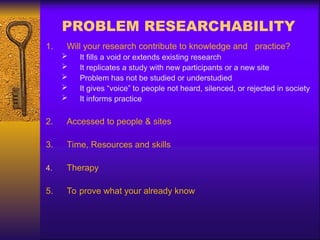
PROBLEM RESEARCHABILITY
1. Willyour research contribute to knowledge and practice?
It fills a void or extends existing research
It replicates a study with new participants or a new site
Problem has not be studied or understudied
It gives “voice” to people not heard, silenced, or rejected in society
It informs practice
2. Accessed to people & sites
3. Time, Resources and skills
4. Therapy
5. To prove what your already know
7.
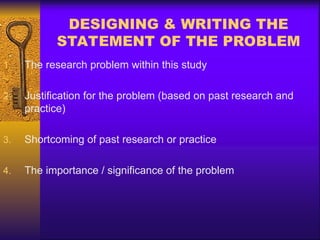
DESIGNING & WRITINGTHE
STATEMENT OF THE PROBLEM
1. The research problem within this study
2. Justification for the problem (based on past research and
practice)
3. Shortcoming of past research or practice
4. The importance / significance of the problem
8.
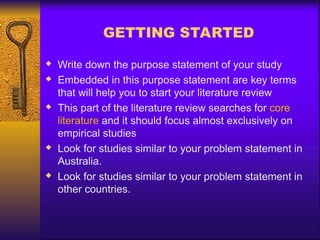
GETTING STARTED
Writedown the purpose statement of your study
Embedded in this purpose statement are key terms
that will help you to start your literature review
This part of the literature review searches for core
literature and it should focus almost exclusively on
empirical studies
Look for studies similar to your problem statement in
Australia.
Look for studies similar to your problem statement in
other countries.
WHERE TO START
1.Encyclopedia of educational research (Alkin, 1992) The
appendix ‘Doing library research in education’ is brilliant
2. Handbooks
International Handbooks of Educational Administration,
Educational Leadership, Lifelong Learning etc quickly
introduce you to the major players and research issues in
your study
3. Theses
Overseas – Dissertation abstracts, US computer disks
British Dissertation abstracts
Australia – Cunningham library, ACER, www.acer.edu.au
11.
4. Databases
ERIC (EducationalResources Information Centre)
www.accesseric.org. (world’s largest source of information – one
million abstracts)
Australian Education Index (AUSINET)
5. Current index to journals in education and resources in education:
locate through ERIC
6. Social Science Citation Index: CDROM
7. Online Journals (anbar)
8. Google (search engine)
12.
INITIAL ORGANISING THE
LITERATURE
Print out your research problem and research
purpose statement in font size 20pt & bold & adhere
to a place near your computer where your regularly
see. Do not be a dilettante . You need to get a
reasonably solid grasp of your proposed topic
relatively quickly in order to focus or flick.
Read, categorise, file
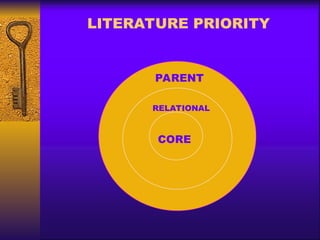
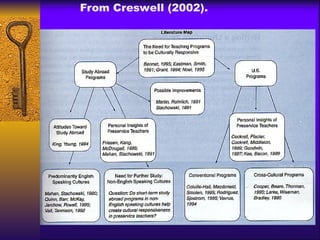
Construct a literature map (different from but a pre-
requisite to a conceptual framework)