AIDS (Acquired Immune Deficiency
Syndrome)
A disease of the human immune system caused by
the Human Immunodeficiency Virus (HIV). The
disease is a major health problem all around the
world, a disease outbreak that is not only present
over a large area but is actively spreading.
HIV is transmitted in many ways, such as:
sexual intercourse (including oral sex and anal sex);
contaminated blood transfusions and hypodermic
needles.
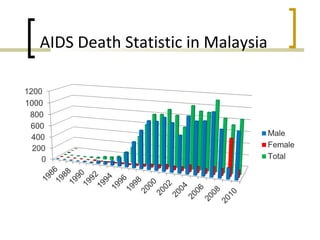
From the year 1986 till 2010, AIDS killed 12943
Malaysian, which included 11239 males and 1704
females.
AIDS Death Statistic in Malaysia
• Health burden
The prognosis for people with HIV has changed considerably since the first cases of AIDS were diagnosed
in the early 1980s. The use of Highly Active Antiretroviral Therapy (HAART) from the mid-1990s
onwards, has led to dramatic improvements in the prognosis of people with HIV. By the end of 2006,
HAART had become available in 51 out of the 53 countries in the WHO European region, but access
to treatment varies between countries (WHO, 2006f). People living with HIV who receive HAART
before the immune system is damaged, are drug-compliant and are able to tolerate the therapy, can
live a more or less normal life span. However, many HIV infected people do not know their HIV
status, and are in some cases too far advanced when finally diagnosed, to fully benefit from
treatment and care.
Late presentation is detrimental for both individual morbidity and mortality, and for public health
because people who are unaware of their HIV status can further spread the virus. Access to HIV
testing, treatment and care is fairly good in western and central Europe, but remains a challenge in
eastern Europe, in particular for intravenous drug users. In western Europe, migrant populations
face more difficulties in accessing testing and treatment services.
• Financial burden
HIV treatment is costly. The total cost comprises the costs of HAART, disease monitoring and
hospitalisation. The costs of first line therapy (per patient per year) tend to vary considerably across
Europe (estimates of average costs range between €600 and 14,000), depending on various factors
such as financial support by the Global Fund for AIDS, TB and Malaria (Mounier-Jack et al., 2008).
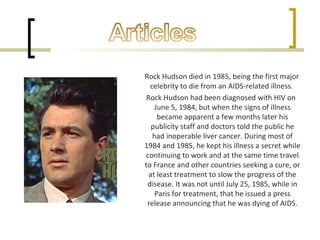
Rock Hudson died in 1985, being the first major
celebrity to die from an AIDS-related illness.
Rock Hudson had been diagnosed with HIV on
June 5, 1984, but when the signs of illness
became apparent a few months later his
publicity staff and doctors told the public he
had inoperable liver cancer. During most of
1984 and 1985, he kept his illness a secret while
continuing to work and at the same time travel
to France and other countries seeking a cure, or
at least treatment to slow the progress of the
disease. It was not until July 25, 1985, while in
Paris for treatment, that he issued a press
release announcing that he was dying of AIDS.
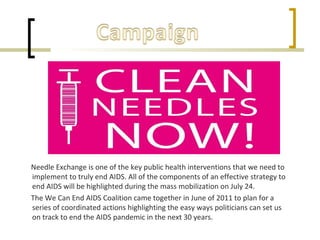
Needle Exchange is one of the key public health interventions that we need to
implement to truly end AIDS. All of the components of an effective strategy to
end AIDS will be highlighted during the mass mobilization on July 24.
The We Can End AIDS Coalition came together in June of 2011 to plan for a
series of coordinated actions highlighting the easy ways politicians can set us
on track to end the AIDS pandemic in the next 30 years.
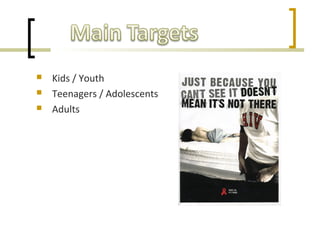
 Kids / Youth
 Teenagers / Adolescents
 Adults
This awareness video aims at empowering youth to practice sound sexual and
reproductive behavior, by increasing the knowledge of age specific matters on
these topics.
Creating an enabling environment for HIV / AIDS awareness targeting youth.
Strengthening the capacity of the districts in HIV / AIDS awareness programme
management, monitoring and supervision.
Training teachers, school guardians and special school “counselors” in HIV /
AIDS and life skills education.
Improving in-school adolescents and youth’s access to curriculum and extra-
curriculum HIV / AIDS information and education.
Increase the use of HIV / AIDS support services by adolescents and youth.
Disseminate information about the programme to national and international
stakeholders.

Aids awareness

  • 1.
    AIDS (Acquired ImmuneDeficiency Syndrome) A disease of the human immune system caused by the Human Immunodeficiency Virus (HIV). The disease is a major health problem all around the world, a disease outbreak that is not only present over a large area but is actively spreading. HIV is transmitted in many ways, such as: sexual intercourse (including oral sex and anal sex); contaminated blood transfusions and hypodermic needles. From the year 1986 till 2010, AIDS killed 12943 Malaysian, which included 11239 males and 1704 females.
  • 2.
  • 3.
    • Health burden Theprognosis for people with HIV has changed considerably since the first cases of AIDS were diagnosed in the early 1980s. The use of Highly Active Antiretroviral Therapy (HAART) from the mid-1990s onwards, has led to dramatic improvements in the prognosis of people with HIV. By the end of 2006, HAART had become available in 51 out of the 53 countries in the WHO European region, but access to treatment varies between countries (WHO, 2006f). People living with HIV who receive HAART before the immune system is damaged, are drug-compliant and are able to tolerate the therapy, can live a more or less normal life span. However, many HIV infected people do not know their HIV status, and are in some cases too far advanced when finally diagnosed, to fully benefit from treatment and care. Late presentation is detrimental for both individual morbidity and mortality, and for public health because people who are unaware of their HIV status can further spread the virus. Access to HIV testing, treatment and care is fairly good in western and central Europe, but remains a challenge in eastern Europe, in particular for intravenous drug users. In western Europe, migrant populations face more difficulties in accessing testing and treatment services. • Financial burden HIV treatment is costly. The total cost comprises the costs of HAART, disease monitoring and hospitalisation. The costs of first line therapy (per patient per year) tend to vary considerably across Europe (estimates of average costs range between €600 and 14,000), depending on various factors such as financial support by the Global Fund for AIDS, TB and Malaria (Mounier-Jack et al., 2008).
  • 5.
    Rock Hudson diedin 1985, being the first major celebrity to die from an AIDS-related illness. Rock Hudson had been diagnosed with HIV on June 5, 1984, but when the signs of illness became apparent a few months later his publicity staff and doctors told the public he had inoperable liver cancer. During most of 1984 and 1985, he kept his illness a secret while continuing to work and at the same time travel to France and other countries seeking a cure, or at least treatment to slow the progress of the disease. It was not until July 25, 1985, while in Paris for treatment, that he issued a press release announcing that he was dying of AIDS.
  • 6.
    Needle Exchange isone of the key public health interventions that we need to implement to truly end AIDS. All of the components of an effective strategy to end AIDS will be highlighted during the mass mobilization on July 24. The We Can End AIDS Coalition came together in June of 2011 to plan for a series of coordinated actions highlighting the easy ways politicians can set us on track to end the AIDS pandemic in the next 30 years.
  • 7.
     Kids /Youth  Teenagers / Adolescents  Adults
  • 8.
    This awareness videoaims at empowering youth to practice sound sexual and reproductive behavior, by increasing the knowledge of age specific matters on these topics. Creating an enabling environment for HIV / AIDS awareness targeting youth. Strengthening the capacity of the districts in HIV / AIDS awareness programme management, monitoring and supervision. Training teachers, school guardians and special school “counselors” in HIV / AIDS and life skills education. Improving in-school adolescents and youth’s access to curriculum and extra- curriculum HIV / AIDS information and education. Increase the use of HIV / AIDS support services by adolescents and youth. Disseminate information about the programme to national and international stakeholders.