



P a g e 1 | 20
SCHOOL OF ARCHITECTURE, BUILDING AND DESIGN
Bachelor of Quantity Surveying (Honours)
RESEARCH PROPOSAL
QSB 3933
Research Methodology
The role of Machinery in Construction Industry
STUDENT NAME: Yam Yih Hwan
STUDENT ID NO.: 0305861
SUPERVISOR: Ms Myzatul Aishah binti Kamarazaly
DATE OF SUBMISSION: 29th October 2015
P a g e 2 | 20
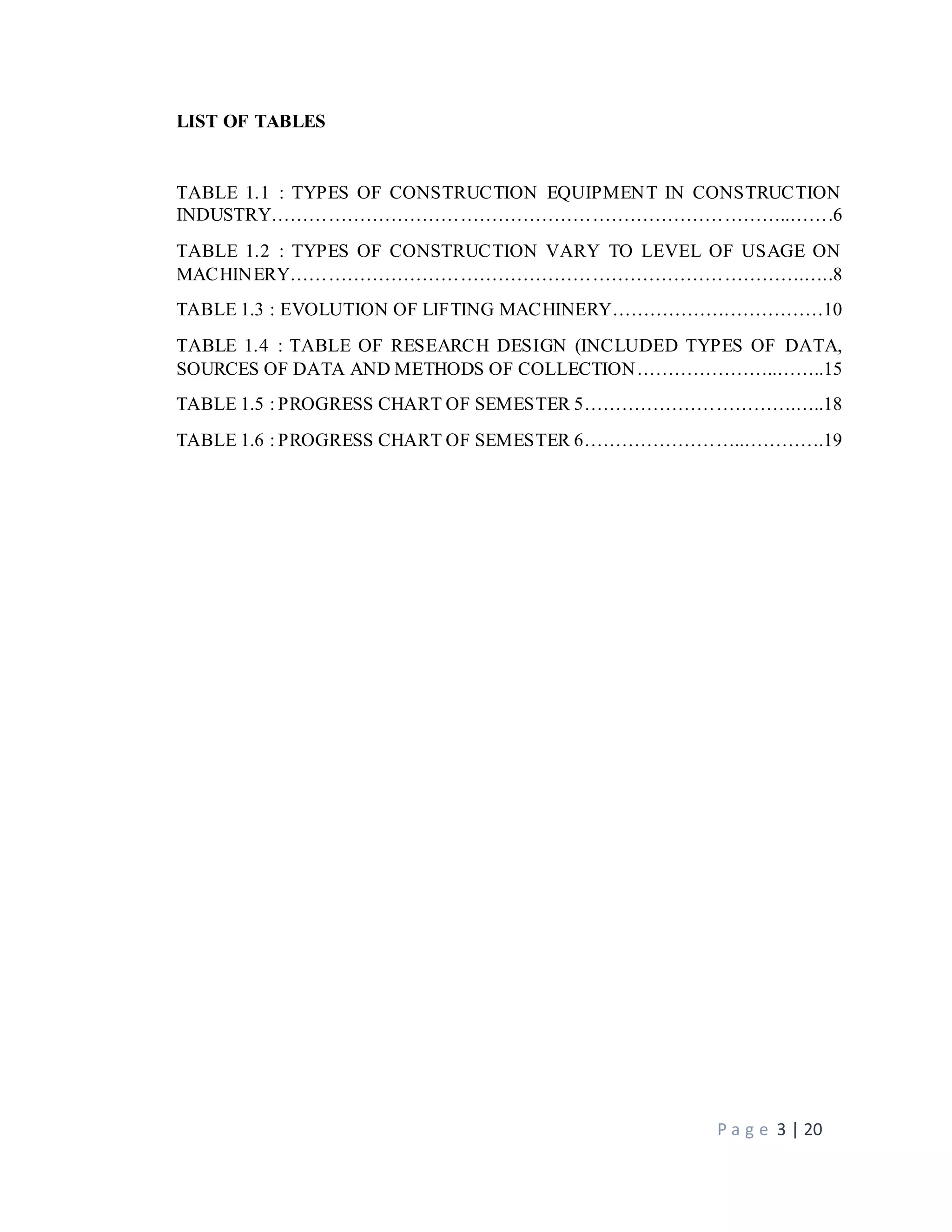
TABLE OF CONTENTS
LIST OF TABLES…………………………………………………….…………………3
CHAPTER 1 : INTRODUCTION………….…………………………………………….4
1.1 BACKGROUND OF THE STUDY…………………………………….4-10
1.2 NEED FOR STUDY…………………………...………………………..….11
1.3 PROBLEM STATEMENT………………………………………..…11-12
1.4 OBJECTIVES………………………………………………………….……13
1.5 SCOPE AND LIMITATIONS…………….……..…………………………13
1.6 RESEARCH DESIGN…………….…………………………….………14-15
1.7 IMPORTANCE OF RESEARCH FINDINGS……………..………………16
1.8 STRUCTURE OF THESIS………………………………….…..………16-17
1.9 RESEARCH PROGRAM CHART…………………………...…………18-19
REFERENCES……………………………………………………..……...……………20
P a g e 3 | 20
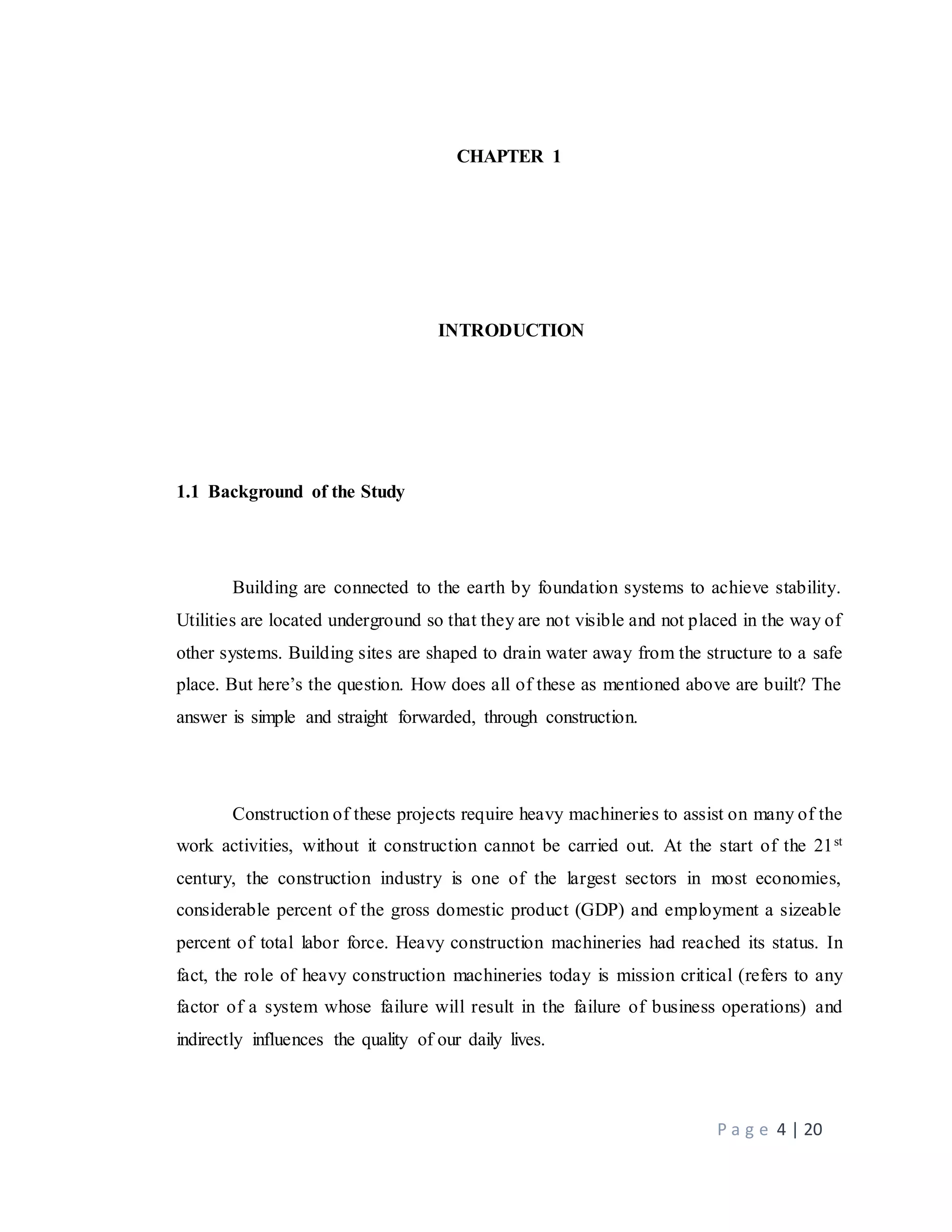
LIST OF TABLES
TABLE 1.1 : TYPES OF CONSTRUCTION EQUIPMENT IN CONSTRUCTION
INDUSTRY………………………………………………………………………..…….6
TABLE 1.2 : TYPES OF CONSTRUCTION VARY TO LEVEL OF USAGE ON
MACHINERY……………………………………………………………………….…..8
TABLE 1.3 : EVOLUTION OF LIFTING MACHINERY……………….……………10
TABLE 1.4 : TABLE OF RESEARCH DESIGN (INCLUDED TYPES OF DATA,
SOURCES OF DATA AND METHODS OF COLLECTION…………………..……..15
TABLE 1.5 : PROGRESS CHART OF SEMESTER 5…………………………….…..18
TABLE 1.6 : PROGRESS CHART OF SEMESTER 6……………………..………….19
P a g e 4 | 20
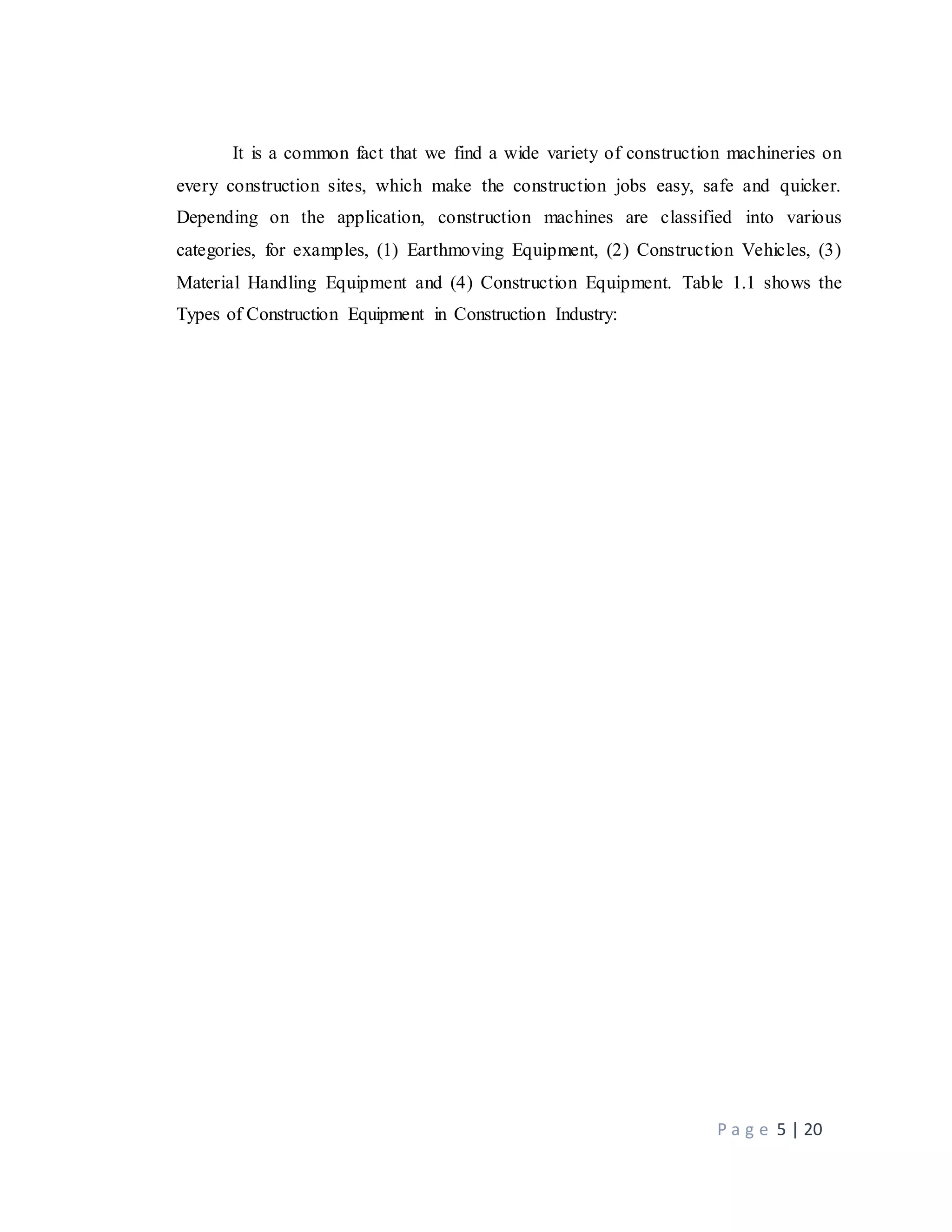
CHAPTER 1
INTRODUCTION
1.1 Background of the Study
Building are connected to the earth by foundation systems to achieve stability.
Utilities are located underground so that they are not visible and not placed in the way of
other systems. Building sites are shaped to drain water away from the structure to a safe
place. But here’s the question. How does all of these as mentioned above are built? The
answer is simple and straight forwarded, through construction.
Construction of these projects require heavy machineries to assist on many of the
work activities, without it construction cannot be carried out. At the start of the 21st
century, the construction industry is one of the largest sectors in most economies,
considerable percent of the gross domestic product (GDP) and employment a sizeable
percent of total labor force. Heavy construction machineries had reached its status. In
fact, the role of heavy construction machineries today is mission critical (refers to any
factor of a system whose failure will result in the failure of business operations) and
indirectly influences the quality of our daily lives.
P a g e 5 | 20
It is a common fact that we find a wide variety of construction machineries on
every construction sites, which make the construction jobs easy, safe and quicker.
Depending on the application, construction machines are classified into various
categories, for examples, (1) Earthmoving Equipment, (2) Construction Vehicles, (3)
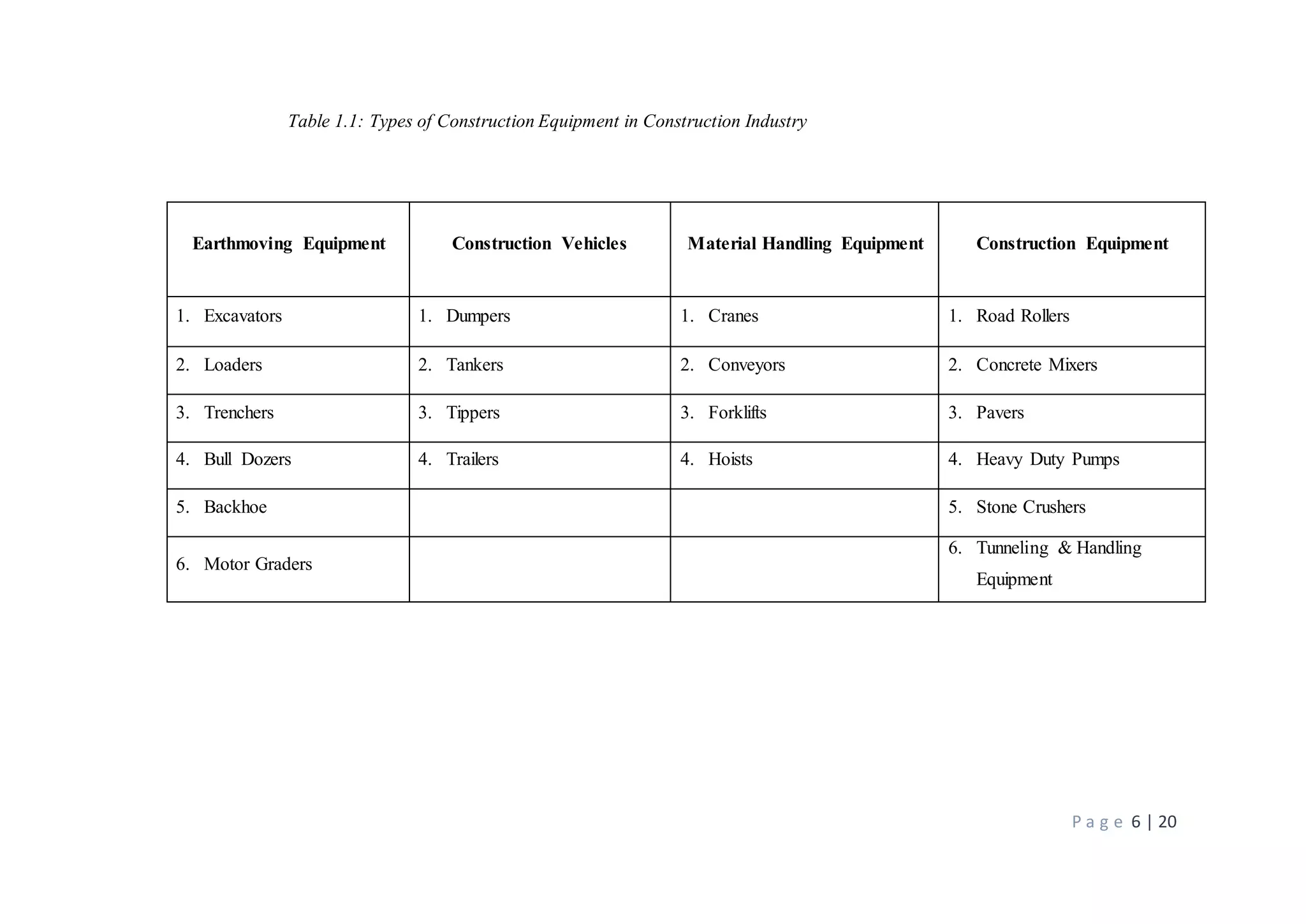
Material Handling Equipment and (4) Construction Equipment. Table 1.1 shows the
Types of Construction Equipment in Construction Industry:
P a g e 6 | 20
Table 1.1: Types of Construction Equipment in Construction Industry
Earthmoving Equipment Construction Vehicles Material Handling Equipment Construction Equipment
1. Excavators 1. Dumpers 1. Cranes 1. Road Rollers
2. Loaders 2. Tankers 2. Conveyors 2. Concrete Mixers
3. Trenchers 3. Tippers 3. Forklifts 3. Pavers
4. Bull Dozers 4. Trailers 4. Hoists 4. Heavy Duty Pumps
5. Backhoe 5. Stone Crushers
6. Motor Graders
6. Tunneling & Handling
Equipment
P a g e 7 | 20
Today contractors undertake many types of construction activities that require
different types, sizes, and groupings of machineries for earth moving, excavating,
and lifting. There is a piece of equipment for practically any work activity, large or
small. Construction machineries today is specifically designed by the manufacturer
to perform certain mechanical operations that accomplish a work activity. Working
capacity is a direct function of the size of the machine and the power required for the
operation, the greater the production capacity, and the greater the cost to own and
operate (Bloch and Geitner, 2012).
Heavy construction work typically requires high-capacity machineries. These
requirements are typically affected by the large amount of work to be done at a
specific amount of time to complete it (Bloch and Geitner, 2012). This work can
further be classified into whether the construction is vertical or horizontal. Vertical
construction typically requires less surface work, earth moving, and excavating and
more lifting work. On the other hand, horizontal construction typically requires more
surface work and limited lifting.
The dependency and need for heavy construction machineries had grown
with the size and complexity of construction projects (Bloch and Geitner, 2012). The
development of automated heavy construction equipment for earth moving,
excavating, and lifting occurred in the early centuries. Operating and mechanical
principles for most types of equipment are basically the same as when they are first
created. It should be noted that mechanical operations are typical for most basic
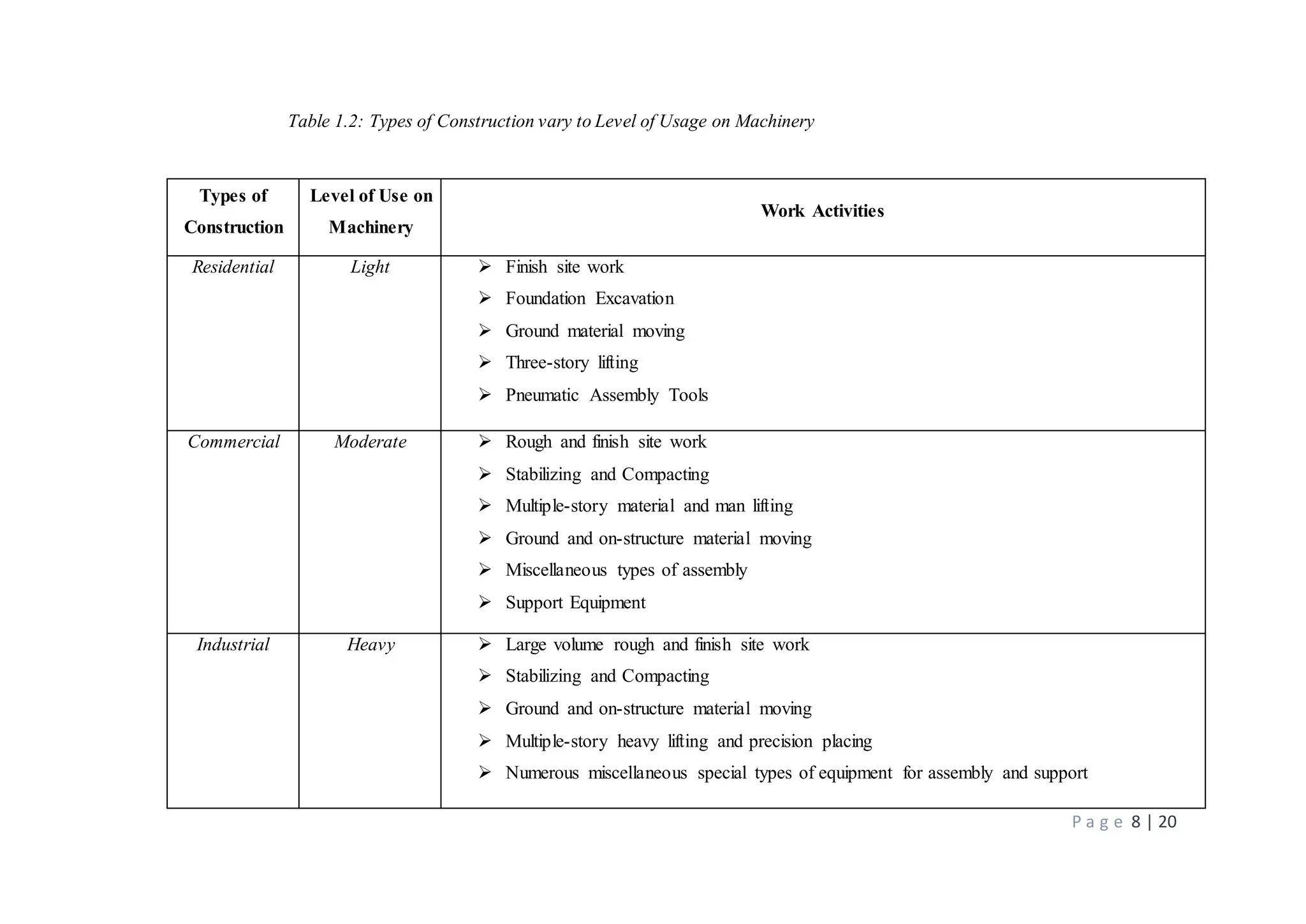
classifications of equipment. Table 1.2 shows Types of Construction vary to Level of
Usage on Machinery:
P a g e 8 | 20
Table 1.2: Types of Construction vary to Level of Usage on Machinery
Types of
Construction
Level of Use on
Machinery
Work Activities
Residential Light  Finish site work
 Foundation Excavation
 Ground material moving
 Three-story lifting
 Pneumatic Assembly Tools
Commercial Moderate  Rough and finish site work
 Stabilizing and Compacting
 Multiple-story material and man lifting
 Ground and on-structure material moving
 Miscellaneous types of assembly
 Support Equipment
Industrial Heavy  Large volume rough and finish site work
 Stabilizing and Compacting
 Ground and on-structure material moving
 Multiple-story heavy lifting and precision placing
 Numerous miscellaneous special types of equipment for assembly and support
P a g e 9 | 20
Development of tools started with humans. Hands and teeth were the first
tools. They were used to pick, dig, break, scrape and shape. They were used to make
other tools and shelter. Simple tools were eventually used to create a better living
environment. As the tools improves, the amount and speed with which construction
work could be done increased. Therefore the scale and complexity of construction
projects increased (Bloch and Geitner, 2012).
Today it is assumed that if machineries does not exist to perform its necessary
task, buildings are unlikely to be designed and constructed. Heavy construction
machinery manufacturers are very responsive to market needs and feedback from
users. Quite simply, design development of heavy construction equipment is driven
and evolves from the needs of the user market (Bloch and Geitner, 2012).
The cost of machinery for a particular construction project varies from 10-30%
of the total cost of project, depending upon the extent of mechanization (Danso,
2014). With the growing use of machineries, it has become necessary for
construction firms to be able to acquire wide range of modern equipment to ensure
timely completion of projects. The physical needs to perform construction work have
not changed very much. The work to be done changes based on the type of project,
but the activities that have to be performed are similar for all projects. Activities
include site work, the base or foundation, structure, and associated parts or
connections. It could be a building, highway, or dam.
Development and evolution of heavy construction equipment is predictable in
many ways. If we need bigger, we build bigger. If we need something new, we build
it. Tempered by economic reality, equipment will be refined with necessity driving
the design and development just as it has from the beginning (Bloch and Geitner,
2012). That is the past and the future for heavy construction equipment development.
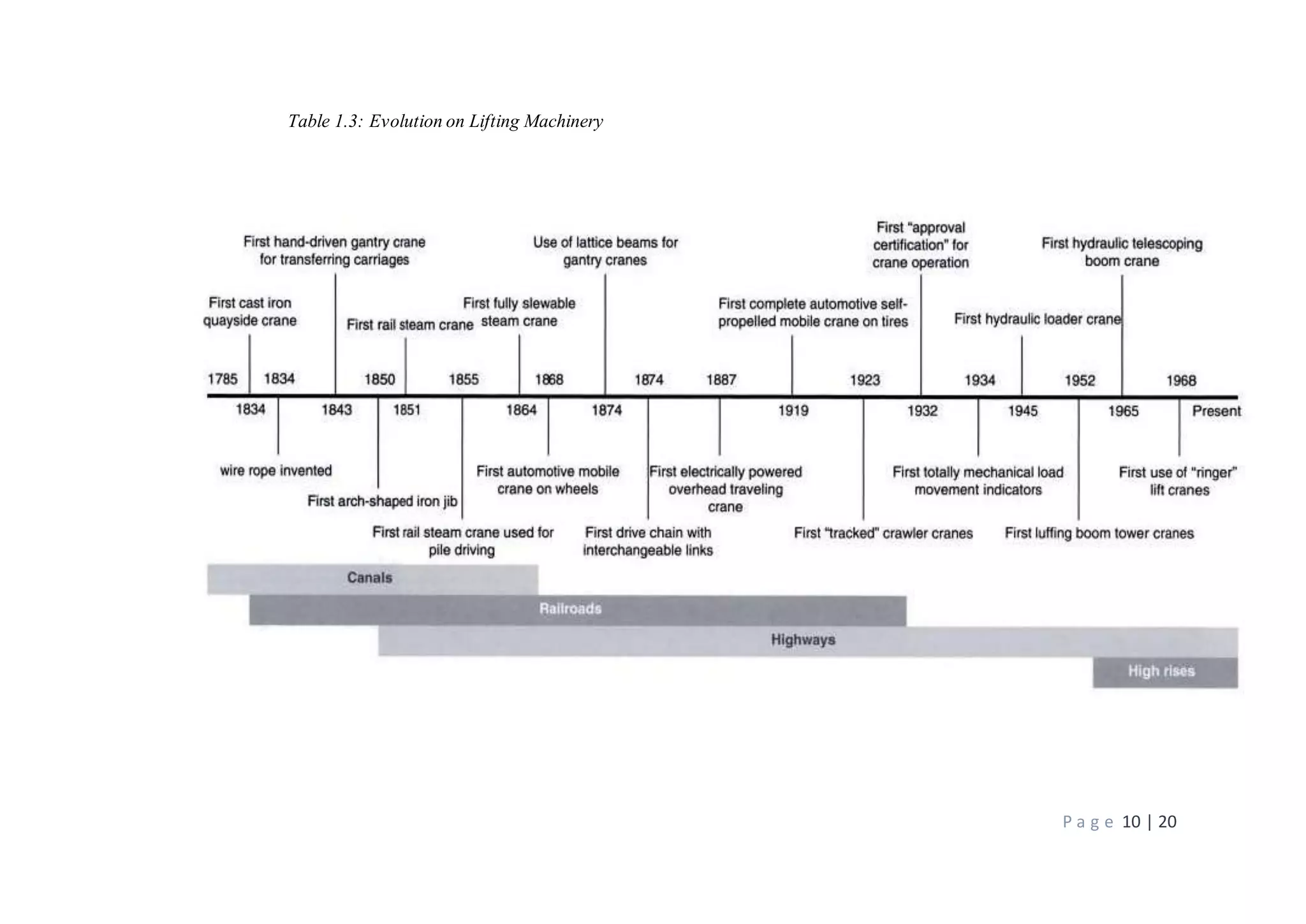
Table 1.3 shown an example of Evolution on Lifting Machinery:
P a g e 10 | 20
Table 1.3: Evolution on Lifting Machinery
P a g e 11 | 20
1.2 Needfor Study
What are the causes of machinery failures and the ways to prevent it? In its
simplest form, failure can be defined as any change in a machinery part or
component which causes it to be unable to perform its intended function
satisfactorily. Proper planning, selection, procurement, installation, operation,
maintenance and machinery replacement policy plays an important role in machinery
management to ensure successful completion of a project (Bloch and Geitner, 2012).
Classifications of failure causes are poor training, overrunning machine’s capability,
mechanical defects, and improper maintenance.
1.3 Problem Statement
Poor Training
Intensive training is essential for safe equipment operation. Users who do not
know how to use equipment properly are at high-risk. Pay close attention to training
manuals for devices like pneumatic rollers, power hammers, band saws and lathes.
Additionally, avoid using machinery that you have not been trained to use. This will
prevent you from making a grave error. Explain to your manager that you do not
know how to use the equipment, and ask for training instead (Friedmann, 2014). But
sometimes, as the construction site get larger, Contractors are hiring outside help to
operate the equipment without training them. As a result, those who end up driving
the machine lack the full understanding of how it works and what it is capable of
doing.
P a g e 12 | 20
Overrunning machine's capability
A lot of users tend to run machines to its maximum performance or at the
top of the engineering curve for which the machine was designed. Overrunning
the machine puts a strain on all the drives and makes breakdowns much more
likely to occur. In order to prevent this problem, users should find where a
machine's maximum performance level is and then reduce its usage to prevent it
from running it at maximum constantly (Wehrspann, 2015).
Mechanical Defects
Sometimes there is no human error involved in an injury, and it all boils
down to the machinery. Heavy machinery is known to malfunction, and the result
can be devastating for a user who is otherwise doing everything correctly (Friedmann,
2014). Reading the operator's manual is essentially important, because it tells
you how to set the machine and what parts to check before you take it into the
construction field. However, it is one step that many owners fail to do thoroughly.
The operator's manual also describes how to fix certain problems once they
happen so that owners can troubleshoot the problem themselves without having
to take more time to wait for a technician. However, many farmers may forget to
check the troubleshooting section, which can cost them even more time out of
the field.
Improper maintenance
It is important to perform a checkout on the machinery properly and on a
timely basis. Besides that, it is to do a general inspection of the machine at the
beginning of the day, like checking engine and transmission levels daily or
making sure the system is working perfectly. Taking shortcuts can lead to
downtime in the field.
P a g e 13 | 20
1.4 Objectives
Respectively, the study aims to achieve the following objectives.
1. To determine the roles of machinery in construction industry.
2. To identify the consequences of machinery in construction industry.
3. To notify the causes of machinery breakdowns and the ways to prevent it in
construction industry.
1.5 Scope and Limitations
The study will be limited to the views expressed by the Contractors using the
machineries on construction industry as well as the Suppliers which supply the
machineries to most of the construction. The focus will be on the roles of the
machinery in construction industry and the consequences with the usage of
machineries on construction site. Also, the causes of machinery breakdowns and the
ways to prevent it.
P a g e 14 | 20
1.6 ResearchDesign
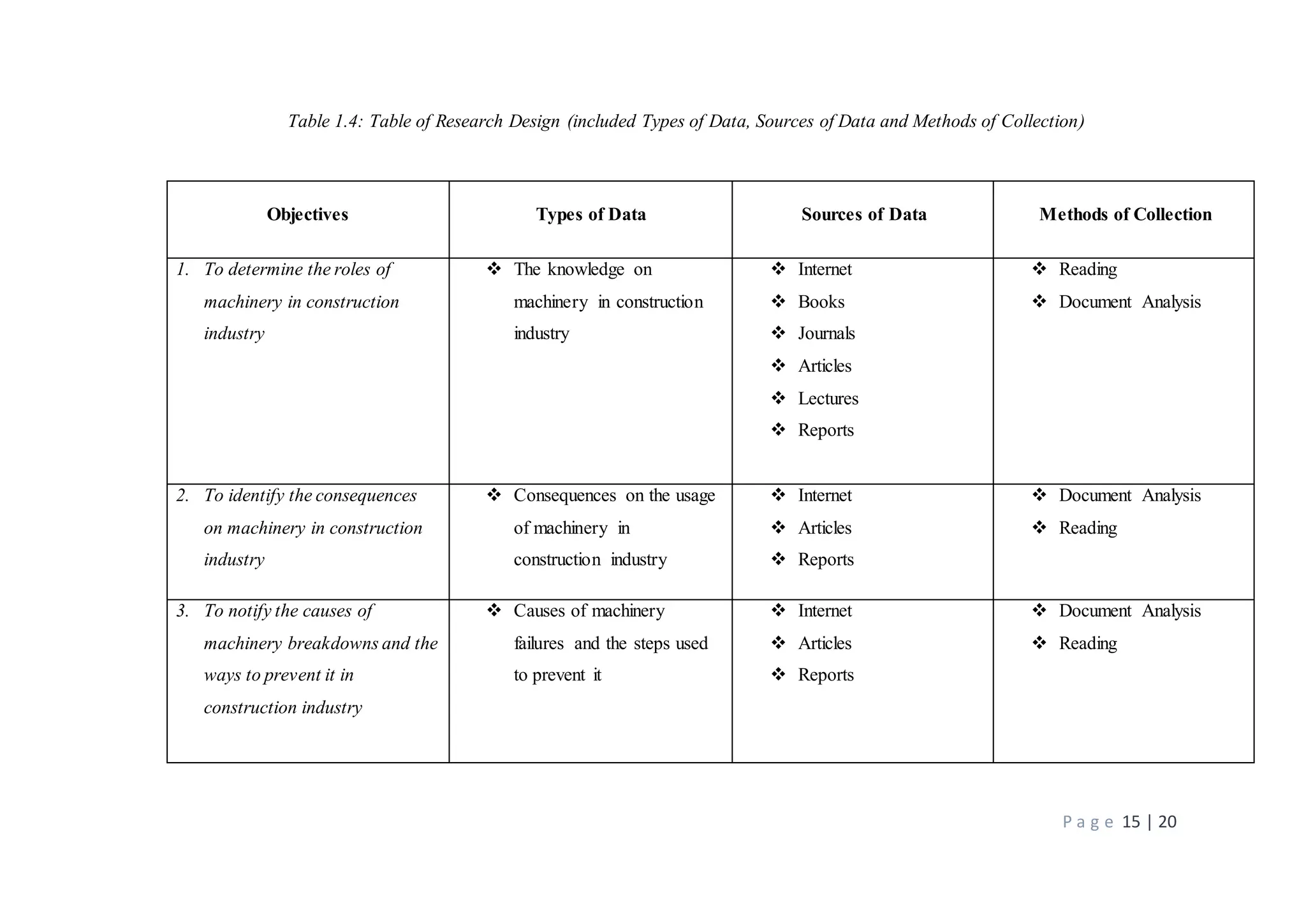
The research methodology for this dissertation will be conducted by using the
following approaches, as shown in Table 1.4:
 Literature Review
The literature review focuses mainly on the reviews of related literature,
which provided the responses and attention of the Contractors and Suppliers
in Kuala Lumpur.
 Questionnaires
Questionnaires will be distributed to the Contractors and Suppliers in Kuala
Lumpur.
 Interviews
Interviews will be conducted to strengthen and resolve some complication
arising from the questionnaire survey.
P a g e 15 | 20
Table 1.4: Table of Research Design (included Types of Data, Sources of Data and Methods of Collection)
Objectives Types of Data Sources of Data Methods of Collection
1. To determine the roles of
machinery in construction
industry
 The knowledge on
machinery in construction
industry
 Internet
 Books
 Journals
 Articles
 Lectures
 Reports
 Reading
 Document Analysis
2. To identify the consequences
on machinery in construction
industry
 Consequences on the usage
of machinery in
construction industry
 Internet
 Articles
 Reports
 Document Analysis
 Reading
3. To notify the causes of
machinery breakdowns and the
ways to prevent it in
construction industry
 Causes of machinery
failures and the steps used
to prevent it
 Internet
 Articles
 Reports
 Document Analysis
 Reading
P a g e 16 | 20
1.7 Importance of ResearchFindings
Basically, this paper highlights mainly on the roles of machinery in
construction industry, and a proportional of consequences with the usage of
machinery in construction site. Last but not least, it explained what are the common
causes of machinery failure and the ways to prevent it from happening in
construction industry.
1.8 Structure of Thesis
This thesis comprise five chapters:
Chapter 1:
 The introduction which stated the background and the need of study, problem
statement, objectives, scope and limitations and importance of research
findings.
Chapter 2:
 The reviews of related literature, the roles of machinery in construction
industry, what are the consequences of these machinery in construction
industry, and the causes and solutions to machinery in construction industry.
It concludes with a section of summarizing the perceptions gained from the
literature review.
P a g e 17 | 20
Chapter 3:
 The methodology that will be used in the study. The main points of the
methodology are the overall research strategy used, the procedure used to
carry out the case study, the instruments used to collect and gather data, and
the method that will be used in data analysis.
Chapter 4:
 Data will be obtained through case study, and will be analyzed and discussed.
The data that will be discussed containing all the nature, necessary materials
required and the construction process of the case study. The results of the
analysis will be discussed from related literature.
Chapter 5:
 The conclusions from the research findings as well as the recommendations
for further investigations.
P a g e 18 | 20
1.9 ResearchProgram Chart
Table 1.5: Progress Chart of Semester 5
Activity Week
1 2 3 4 5 6 7 8 9 10 11 Sembreak 13 14
Submission and Approval
of Research title
Submission of Research
Proposal
Submission of Literature
Review and Theoretical
Framework
Completed In Progress
P a g e 19 | 20
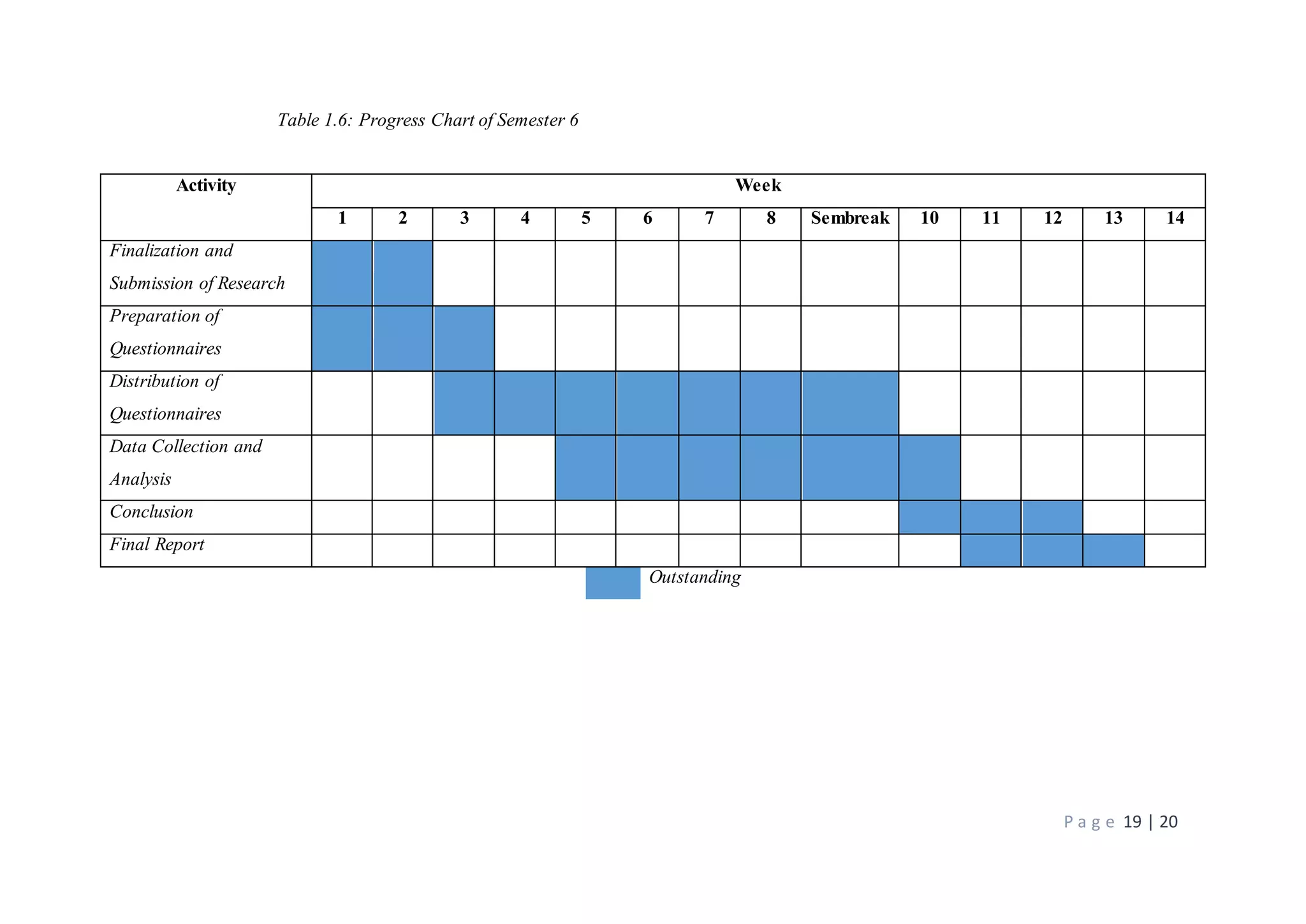
Table 1.6: Progress Chart of Semester 6
Activity Week
1 2 3 4 5 6 7 8 Sembreak 10 11 12 13 14
Finalization and
Submission of Research
Preparation of
Questionnaires
Distribution of
Questionnaires
Data Collection and
Analysis
Conclusion
Final Report
Outstanding
P a g e 20 | 20
References
1 Bloch, H. and Geitner, F. (2012). Machinery failure analysis and troubleshooting.
Oxford: Butterworth-Heinemann.
2 Gransberg, D., Popescu, C. and Ryan, R. (2006). Construction equipment
management for engineers, estimators, and owners. Boca Raton, FL: CRC
Taylor & Francis.
3 Friedmann, A. (2014). Causes Of Heavy Machinery | Construction Sites |
Disability. [online] Phillydisabilitylawyer.com. Available at:
http://phillydisabilitylawyer.com/causes-heavy-machinery-accidents/ [Accessed
28 Oct. 2015].
4 Wehrspann, J. (2015). 10 biggest causes of machinery breakdowns (and how to
prevent them). [online] Farmindustrynews.com. Available at:
http://farmindustrynews.com/planters/10-biggest-causes-machinery-breakdowns-
and-how-prevent-them [Accessed 28 Oct. 2015].
5 Hhilifting.com, (2015). Importance of Construction Industry in the Economy and
Use of Construction Equipments | HHI Lifting. [online] Available at:
http://www.hhilifting.com/importance-of-construction-industry-in-the-economy-
and-use-of-construction-equipments/ [Accessed 28 Oct. 2015].
6 Danso, H. (2014). Poor Workmanship and Lack of plant/Equipment Problems in
the Construction Industry, 2(3), pp.60-70.

Research Methodology:Introduction (Chapter 1)

  • 1.
    P a ge 1 | 20 SCHOOL OF ARCHITECTURE, BUILDING AND DESIGN Bachelor of Quantity Surveying (Honours) RESEARCH PROPOSAL QSB 3933 Research Methodology The role of Machinery in Construction Industry STUDENT NAME: Yam Yih Hwan STUDENT ID NO.: 0305861 SUPERVISOR: Ms Myzatul Aishah binti Kamarazaly DATE OF SUBMISSION: 29th October 2015
  • 2.
    P a ge 2 | 20 TABLE OF CONTENTS LIST OF TABLES…………………………………………………….…………………3 CHAPTER 1 : INTRODUCTION………….…………………………………………….4 1.1 BACKGROUND OF THE STUDY…………………………………….4-10 1.2 NEED FOR STUDY…………………………...………………………..….11 1.3 PROBLEM STATEMENT………………………………………..…11-12 1.4 OBJECTIVES………………………………………………………….……13 1.5 SCOPE AND LIMITATIONS…………….……..…………………………13 1.6 RESEARCH DESIGN…………….…………………………….………14-15 1.7 IMPORTANCE OF RESEARCH FINDINGS……………..………………16 1.8 STRUCTURE OF THESIS………………………………….…..………16-17 1.9 RESEARCH PROGRAM CHART…………………………...…………18-19 REFERENCES……………………………………………………..……...……………20
  • 3.
    P a ge 3 | 20 LIST OF TABLES TABLE 1.1 : TYPES OF CONSTRUCTION EQUIPMENT IN CONSTRUCTION INDUSTRY………………………………………………………………………..…….6 TABLE 1.2 : TYPES OF CONSTRUCTION VARY TO LEVEL OF USAGE ON MACHINERY……………………………………………………………………….…..8 TABLE 1.3 : EVOLUTION OF LIFTING MACHINERY……………….……………10 TABLE 1.4 : TABLE OF RESEARCH DESIGN (INCLUDED TYPES OF DATA, SOURCES OF DATA AND METHODS OF COLLECTION…………………..……..15 TABLE 1.5 : PROGRESS CHART OF SEMESTER 5…………………………….…..18 TABLE 1.6 : PROGRESS CHART OF SEMESTER 6……………………..………….19
  • 4.
    P a ge 4 | 20 CHAPTER 1 INTRODUCTION 1.1 Background of the Study Building are connected to the earth by foundation systems to achieve stability. Utilities are located underground so that they are not visible and not placed in the way of other systems. Building sites are shaped to drain water away from the structure to a safe place. But here’s the question. How does all of these as mentioned above are built? The answer is simple and straight forwarded, through construction. Construction of these projects require heavy machineries to assist on many of the work activities, without it construction cannot be carried out. At the start of the 21st century, the construction industry is one of the largest sectors in most economies, considerable percent of the gross domestic product (GDP) and employment a sizeable percent of total labor force. Heavy construction machineries had reached its status. In fact, the role of heavy construction machineries today is mission critical (refers to any factor of a system whose failure will result in the failure of business operations) and indirectly influences the quality of our daily lives.
  • 5.
    P a ge 5 | 20 It is a common fact that we find a wide variety of construction machineries on every construction sites, which make the construction jobs easy, safe and quicker. Depending on the application, construction machines are classified into various categories, for examples, (1) Earthmoving Equipment, (2) Construction Vehicles, (3) Material Handling Equipment and (4) Construction Equipment. Table 1.1 shows the Types of Construction Equipment in Construction Industry:
  • 6.
    P a ge 6 | 20 Table 1.1: Types of Construction Equipment in Construction Industry Earthmoving Equipment Construction Vehicles Material Handling Equipment Construction Equipment 1. Excavators 1. Dumpers 1. Cranes 1. Road Rollers 2. Loaders 2. Tankers 2. Conveyors 2. Concrete Mixers 3. Trenchers 3. Tippers 3. Forklifts 3. Pavers 4. Bull Dozers 4. Trailers 4. Hoists 4. Heavy Duty Pumps 5. Backhoe 5. Stone Crushers 6. Motor Graders 6. Tunneling & Handling Equipment
  • 7.
    P a ge 7 | 20 Today contractors undertake many types of construction activities that require different types, sizes, and groupings of machineries for earth moving, excavating, and lifting. There is a piece of equipment for practically any work activity, large or small. Construction machineries today is specifically designed by the manufacturer to perform certain mechanical operations that accomplish a work activity. Working capacity is a direct function of the size of the machine and the power required for the operation, the greater the production capacity, and the greater the cost to own and operate (Bloch and Geitner, 2012). Heavy construction work typically requires high-capacity machineries. These requirements are typically affected by the large amount of work to be done at a specific amount of time to complete it (Bloch and Geitner, 2012). This work can further be classified into whether the construction is vertical or horizontal. Vertical construction typically requires less surface work, earth moving, and excavating and more lifting work. On the other hand, horizontal construction typically requires more surface work and limited lifting. The dependency and need for heavy construction machineries had grown with the size and complexity of construction projects (Bloch and Geitner, 2012). The development of automated heavy construction equipment for earth moving, excavating, and lifting occurred in the early centuries. Operating and mechanical principles for most types of equipment are basically the same as when they are first created. It should be noted that mechanical operations are typical for most basic classifications of equipment. Table 1.2 shows Types of Construction vary to Level of Usage on Machinery:
  • 8.
    P a ge 8 | 20 Table 1.2: Types of Construction vary to Level of Usage on Machinery Types of Construction Level of Use on Machinery Work Activities Residential Light  Finish site work  Foundation Excavation  Ground material moving  Three-story lifting  Pneumatic Assembly Tools Commercial Moderate  Rough and finish site work  Stabilizing and Compacting  Multiple-story material and man lifting  Ground and on-structure material moving  Miscellaneous types of assembly  Support Equipment Industrial Heavy  Large volume rough and finish site work  Stabilizing and Compacting  Ground and on-structure material moving  Multiple-story heavy lifting and precision placing  Numerous miscellaneous special types of equipment for assembly and support
  • 9.
    P a ge 9 | 20 Development of tools started with humans. Hands and teeth were the first tools. They were used to pick, dig, break, scrape and shape. They were used to make other tools and shelter. Simple tools were eventually used to create a better living environment. As the tools improves, the amount and speed with which construction work could be done increased. Therefore the scale and complexity of construction projects increased (Bloch and Geitner, 2012). Today it is assumed that if machineries does not exist to perform its necessary task, buildings are unlikely to be designed and constructed. Heavy construction machinery manufacturers are very responsive to market needs and feedback from users. Quite simply, design development of heavy construction equipment is driven and evolves from the needs of the user market (Bloch and Geitner, 2012). The cost of machinery for a particular construction project varies from 10-30% of the total cost of project, depending upon the extent of mechanization (Danso, 2014). With the growing use of machineries, it has become necessary for construction firms to be able to acquire wide range of modern equipment to ensure timely completion of projects. The physical needs to perform construction work have not changed very much. The work to be done changes based on the type of project, but the activities that have to be performed are similar for all projects. Activities include site work, the base or foundation, structure, and associated parts or connections. It could be a building, highway, or dam. Development and evolution of heavy construction equipment is predictable in many ways. If we need bigger, we build bigger. If we need something new, we build it. Tempered by economic reality, equipment will be refined with necessity driving the design and development just as it has from the beginning (Bloch and Geitner, 2012). That is the past and the future for heavy construction equipment development. Table 1.3 shown an example of Evolution on Lifting Machinery:
  • 10.
    P a ge 10 | 20 Table 1.3: Evolution on Lifting Machinery
  • 11.
    P a ge 11 | 20 1.2 Needfor Study What are the causes of machinery failures and the ways to prevent it? In its simplest form, failure can be defined as any change in a machinery part or component which causes it to be unable to perform its intended function satisfactorily. Proper planning, selection, procurement, installation, operation, maintenance and machinery replacement policy plays an important role in machinery management to ensure successful completion of a project (Bloch and Geitner, 2012). Classifications of failure causes are poor training, overrunning machine’s capability, mechanical defects, and improper maintenance. 1.3 Problem Statement Poor Training Intensive training is essential for safe equipment operation. Users who do not know how to use equipment properly are at high-risk. Pay close attention to training manuals for devices like pneumatic rollers, power hammers, band saws and lathes. Additionally, avoid using machinery that you have not been trained to use. This will prevent you from making a grave error. Explain to your manager that you do not know how to use the equipment, and ask for training instead (Friedmann, 2014). But sometimes, as the construction site get larger, Contractors are hiring outside help to operate the equipment without training them. As a result, those who end up driving the machine lack the full understanding of how it works and what it is capable of doing.
  • 12.
    P a ge 12 | 20 Overrunning machine's capability A lot of users tend to run machines to its maximum performance or at the top of the engineering curve for which the machine was designed. Overrunning the machine puts a strain on all the drives and makes breakdowns much more likely to occur. In order to prevent this problem, users should find where a machine's maximum performance level is and then reduce its usage to prevent it from running it at maximum constantly (Wehrspann, 2015). Mechanical Defects Sometimes there is no human error involved in an injury, and it all boils down to the machinery. Heavy machinery is known to malfunction, and the result can be devastating for a user who is otherwise doing everything correctly (Friedmann, 2014). Reading the operator's manual is essentially important, because it tells you how to set the machine and what parts to check before you take it into the construction field. However, it is one step that many owners fail to do thoroughly. The operator's manual also describes how to fix certain problems once they happen so that owners can troubleshoot the problem themselves without having to take more time to wait for a technician. However, many farmers may forget to check the troubleshooting section, which can cost them even more time out of the field. Improper maintenance It is important to perform a checkout on the machinery properly and on a timely basis. Besides that, it is to do a general inspection of the machine at the beginning of the day, like checking engine and transmission levels daily or making sure the system is working perfectly. Taking shortcuts can lead to downtime in the field.
  • 13.
    P a ge 13 | 20 1.4 Objectives Respectively, the study aims to achieve the following objectives. 1. To determine the roles of machinery in construction industry. 2. To identify the consequences of machinery in construction industry. 3. To notify the causes of machinery breakdowns and the ways to prevent it in construction industry. 1.5 Scope and Limitations The study will be limited to the views expressed by the Contractors using the machineries on construction industry as well as the Suppliers which supply the machineries to most of the construction. The focus will be on the roles of the machinery in construction industry and the consequences with the usage of machineries on construction site. Also, the causes of machinery breakdowns and the ways to prevent it.
  • 14.
    P a ge 14 | 20 1.6 ResearchDesign The research methodology for this dissertation will be conducted by using the following approaches, as shown in Table 1.4:  Literature Review The literature review focuses mainly on the reviews of related literature, which provided the responses and attention of the Contractors and Suppliers in Kuala Lumpur.  Questionnaires Questionnaires will be distributed to the Contractors and Suppliers in Kuala Lumpur.  Interviews Interviews will be conducted to strengthen and resolve some complication arising from the questionnaire survey.
  • 15.
    P a ge 15 | 20 Table 1.4: Table of Research Design (included Types of Data, Sources of Data and Methods of Collection) Objectives Types of Data Sources of Data Methods of Collection 1. To determine the roles of machinery in construction industry  The knowledge on machinery in construction industry  Internet  Books  Journals  Articles  Lectures  Reports  Reading  Document Analysis 2. To identify the consequences on machinery in construction industry  Consequences on the usage of machinery in construction industry  Internet  Articles  Reports  Document Analysis  Reading 3. To notify the causes of machinery breakdowns and the ways to prevent it in construction industry  Causes of machinery failures and the steps used to prevent it  Internet  Articles  Reports  Document Analysis  Reading
  • 16.
    P a ge 16 | 20 1.7 Importance of ResearchFindings Basically, this paper highlights mainly on the roles of machinery in construction industry, and a proportional of consequences with the usage of machinery in construction site. Last but not least, it explained what are the common causes of machinery failure and the ways to prevent it from happening in construction industry. 1.8 Structure of Thesis This thesis comprise five chapters: Chapter 1:  The introduction which stated the background and the need of study, problem statement, objectives, scope and limitations and importance of research findings. Chapter 2:  The reviews of related literature, the roles of machinery in construction industry, what are the consequences of these machinery in construction industry, and the causes and solutions to machinery in construction industry. It concludes with a section of summarizing the perceptions gained from the literature review.
  • 17.
    P a ge 17 | 20 Chapter 3:  The methodology that will be used in the study. The main points of the methodology are the overall research strategy used, the procedure used to carry out the case study, the instruments used to collect and gather data, and the method that will be used in data analysis. Chapter 4:  Data will be obtained through case study, and will be analyzed and discussed. The data that will be discussed containing all the nature, necessary materials required and the construction process of the case study. The results of the analysis will be discussed from related literature. Chapter 5:  The conclusions from the research findings as well as the recommendations for further investigations.
  • 18.
    P a ge 18 | 20 1.9 ResearchProgram Chart Table 1.5: Progress Chart of Semester 5 Activity Week 1 2 3 4 5 6 7 8 9 10 11 Sembreak 13 14 Submission and Approval of Research title Submission of Research Proposal Submission of Literature Review and Theoretical Framework Completed In Progress
  • 19.
    P a ge 19 | 20 Table 1.6: Progress Chart of Semester 6 Activity Week 1 2 3 4 5 6 7 8 Sembreak 10 11 12 13 14 Finalization and Submission of Research Preparation of Questionnaires Distribution of Questionnaires Data Collection and Analysis Conclusion Final Report Outstanding
  • 20.
    P a ge 20 | 20 References 1 Bloch, H. and Geitner, F. (2012). Machinery failure analysis and troubleshooting. Oxford: Butterworth-Heinemann. 2 Gransberg, D., Popescu, C. and Ryan, R. (2006). Construction equipment management for engineers, estimators, and owners. Boca Raton, FL: CRC Taylor & Francis. 3 Friedmann, A. (2014). Causes Of Heavy Machinery | Construction Sites | Disability. [online] Phillydisabilitylawyer.com. Available at: http://phillydisabilitylawyer.com/causes-heavy-machinery-accidents/ [Accessed 28 Oct. 2015]. 4 Wehrspann, J. (2015). 10 biggest causes of machinery breakdowns (and how to prevent them). [online] Farmindustrynews.com. Available at: http://farmindustrynews.com/planters/10-biggest-causes-machinery-breakdowns- and-how-prevent-them [Accessed 28 Oct. 2015]. 5 Hhilifting.com, (2015). Importance of Construction Industry in the Economy and Use of Construction Equipments | HHI Lifting. [online] Available at: http://www.hhilifting.com/importance-of-construction-industry-in-the-economy- and-use-of-construction-equipments/ [Accessed 28 Oct. 2015]. 6 Danso, H. (2014). Poor Workmanship and Lack of plant/Equipment Problems in the Construction Industry, 2(3), pp.60-70.