09 AIDS epidemic update
UNAIDS/09.36E / JC1700E (English original, November 2009)
© Joint United Nations Programme on HIV/AIDS (UNAIDS) and World Health Organization (WHO) 2009.
All rights reserved. Publications produced by UNAIDS can be obtained from the UNAIDS Information
Production Unit. Requests for permission to reproduce or translate UNAIDS publications—whether for
sale or for noncommercial distribution—should also be addressed to the Information Production Unit at
the address below, or by fax, at +41 22 791 4835, or e-mail: publicationpermissions@unaids.org.
The designations employed and the presentation of the material in this publication do not imply the
expression of any opinion whatsoever on the part of UNAIDS concerning the legal status of any country,
territory, city or area or of its authorities, or concerning the delimitation of its frontiers or boundaries.
The mention of specific companies or of certain manufacturers’ products does not imply that they are
endorsed or recommended by UNAIDS in preference to others of a similar nature that are not men-
tioned. Errors and omissions excepted, the names of proprietary products are distinguished by initial
capital letters.
UNAIDS and WHO do not warrant that the information contained in this publication is complete and
correct and shall not be liable for any damages incurred as a result of its use.
All reasonable precautions have been taken by UNAIDS to verify the information contained in this
publication. However, the published material is being distributed without warranty of any kind, either
expressed or implied. The responsibility for the interpretation and use of the material lies with the
reader. In no event shall UNAIDS be liable for damages arising from its use.
UNAIDS
20 avenue Appia
CH-1211 Geneva 27
Switzerland
T (+41) 22 791 36 66
F (+41) 22 791 48 35
distribution@unaids.org
www.unaids.org
WHO Library Cataloguing-in-Publication Data
AIDS epidemic update : November 2009.
“UNAIDS/09.36E / JC1700E”.
1.HIV infections – epidemiology. 2.HIV infections – prevention and control. 3.Acquired
immunodeficiency syndrome – epidemiology. 4.Acquired immunodeficiency syndrome – prevention
and control. 5.Disease outbreaks. I.UNAIDS. II.World Health Organization.
ISBN 978 92 9173 832 8					 (NLM classification: WC 503.41)
AIDS epidemic update
December 2009
Sub-Saharan Africa
Asia
Eastern Europe and Central Asia
Caribbean
Latin America
North America and Western
and Central Europe
Middle east and North Africa
Oceania
Photo: UNAIDS, P. Virot
Photo: UNAIDS
Photo: UNAIDS, S. Drakborg
Photo: UNAIDS, C. Sattlberger
Photo: UNAIDS, P. Virot
Photo: UNAIDS
Contents
	
Introduction	 7
Sub-Saharan Africa	 21
Asia	 37
Eastern Europe and Central Asia	 48
Caribbean	 53
Latin America 	 57
North America and Western and Central Europe	 64
Middle east and North Africa	 70
Oceania	 75
MAPS	
BIBLIOGRAPHY	 85
Global estimates for adults and children, 2008	 81
Adults and children estimated to be living with HIV, 2008	 82
Estimated number of adults and children newly infected with HIV, 2008 	 83
Estimated adult and child deaths due to AIDS, 2008 	 84
Global summary of the AIDS epidemic
December 2008
Number of people living with HIV in 2008		 	
Total	 33.4 million [31.1 million–35.8 million]
Adults	 31.3 million [29.2 million–33.7 million]
Women	 15.7 million [14.2 million–17.2 million]
Children under 15 years	 2.1 million [1.2 million–2.9 million]
People newly infected with HIV in 2008		 	
Total	 2.7 million [2.4 million–3.0 million]
Adults	 2.3 million [2.0 million–2.5 million]
Children under 15 years	 430 000 [240 000–610 000]
AIDS-related deaths in 2008	
Total	 2.0 million [1.7 million–2.4 million]
Adults	 1.7 million [1.4 million–2.1 million]
Children under 15 years	 280 000 [150 000–410 000]
The ranges around the estimates in this table define the boundaries within which the actual numbers lie, based on
the best available information.
Introduction
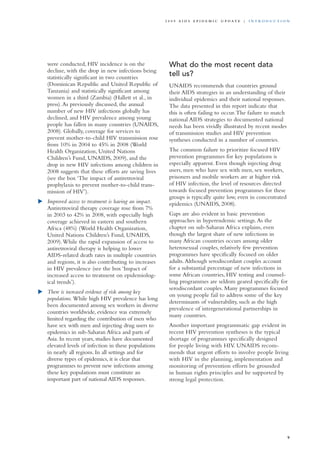
The number of people living with HIV worldwide continued to grow in 2008, reaching an estimated 33.4 million
[31.1 million–35.8 million].The total number of people living with the virus in 2008 was more than 20%
higher than the number in 2000, and the prevalence was roughly threefold higher than in 1990.
The continuing rise in the population of people
living with HIV reflects the combined effects of
continued high rates of new HIV infections and
the beneficial impact of antiretroviral therapy.As of
December 2008, approximately 4 million people in
low- and middle-income countries were receiving
antiretroviral therapy—a 10-fold increase over five
years (World Health Organization, United Nations
Children’s Fund, UNAIDS, 2009). In 2008, an
estimated 2.7 million [2.4 million–3.0 million]
Source: UNAIDS/WHO.
Number of people living with HIV Adult (15–49) HIV prevalence (%)
Number of people newly infected with HIV Number of adult and child deaths due to AIDS
1990 1993 1996 1999 2002 2005 2008
1990 1993 1996 1999 2002 2005 2008
1990 1993 1996 1999 2002 2005 2008
1990 1993 1996 1999 2002 2005 2008
0
10
20
30
40
Number(millions)
0
1
2
3
4
5
Number(millions)
0.0
0.3
0.6
0.9
1.2
0
1
2
3
4
5
Number(millions)
%
Global estimates 1990−2008
Estimate
High and low estimates
new HIV infections occurred. It is estimated that
2 million [1.7 million–2.4 million] deaths due
to AIDS-related illnesses occurred worldwide in
2008.
The latest epidemiological data indicate that glob-
ally the spread of HIV appears to have peaked in
1996, when 3.5 million [3.2 million–3.8 million]
new HIV infections occurred. In 2008, the
estimated number of new HIV infections was
approximately 30% lower than at the epidemic’s
peak 12 years earlier.Figure I
7
2 0 0 9 A I D S E p ide m i c u p da t e | i n t r o d u c t i o n
Consistent with the long interval between HIV
seroconversion and symptomatic disease, annual
HIV-related mortality appears to have peaked in
2004, when 2.2 million [1.9 million–2.6 million]
deaths occurred.The estimated number of AIDS-
related deaths in 2008 is roughly 10% lower than
in 2004.
An estimated 430 000 [240 000–610 000] new
HIV infections occurred among children under
the age of 15 in 2008. Most of these new
infections are believed to stem from transmission
in utero, during delivery or post-partum as a
result of breastfeeding.The number of children
newly infected with HIV in 2008 was roughly
18% lower than in 2001.
This report summarizes the latest data on the
epidemiology of HIV.The epidemiological
estimates in this report reflect continued
improvement in national HIV surveillance
systems and estimation methodology (see the
box ‘Deriving HIV estimates’). In 2007–2008,
national household surveys with anonymous
HIV testing components were conducted in
11 countries, including nine in sub-Saharan
Africa. Improvements in HIV surveillance and
information systems not only provide a clearer,
more reliable picture of the epidemic at the
global, regional and country levels but are
also helping national governments and other
stakeholders to tailor AIDS responses in order to
maximize the impact on public health.
The epidemic appears to have stabilized in most
regions, although prevalence continues to increase
in Eastern Europe and Central Asia and in other
parts of Asia due to a high rate of new HIV
infections. Sub-Saharan Africa remains the most
heavily affected region, accounting for 71% of
all new HIV infections in 2008.The resurgence
of the epidemic among men who have sex with
men in high-income countries is increasingly
well-documented. Differences are apparent in all
regions, with some national epidemics continuing
to expand even as the overall regional HIV
incidence stabilizes.
Key themes of the 2009 AIDS
epidemic update
This report is divided into separate chapters that
summarize epidemiological trends in individual
regions.While regional differences remain, several
themes are discernible:
	 AIDS continues to be a major global health priority.
Although important progress has been
achieved in preventing new HIV infections
and in lowering the annual number of AIDS-
related deaths, the number of people living
with HIV continues to increase.AIDS-related
illnesses remain one of the leading causes of
death globally and are projected to continue as
a significant global cause of premature
mortality in the coming decades (World
Health Organization, 2008).Although AIDS is
no longer a new syndrome, global solidarity in
the AIDS response will remain a necessity.
	 There is geographic variation between and within
countries and regions. Although this report
focuses considerable attention on national
trends, there are often large variations in HIV
prevalence and epidemiological patterns within
countries.The substantial diversity of national
epidemics underscores not only the need to
tailor prevention strategies to local needs but
also the importance of decentralizing AIDS
responses.
	 The epidemic is evolving. Epidemic patterns can
change over time.As the regional profiles in
this report highlight, national epidemics
throughout the world are experiencing impor-
tant transitions. In Eastern Europe and Central
Asia, epidemics that were once characterized
primarily by transmission among injecting
drug users are now increasingly characterized
by significant sexual transmission, while in
parts of Asia epidemics are becoming increas-
ingly characterized by significant transmission
among heterosexual couples.
	 There is evidence of successes in HIV prevention.
There is growing evidence of HIV prevention
successes in diverse settings. In five countries
where two recent national household surveys
8
i n t r o d u c t i o n | 2 0 0 9 A I D S E p ide m i c u p da t e
were conducted, HIV incidence is on the
decline, with the drop in new infections being
statistically significant in two countries
(Dominican Republic and United Republic of
Tanzania) and statistically significant among
women in a third (Zambia) (Hallett et al., in
press).As previously discussed, the annual
number of new HIV infections globally has
declined, and HIV prevalence among young
people has fallen in many countries (UNAIDS,
2008). Globally, coverage for services to
prevent mother-to-child HIV transmission rose
from 10% in 2004 to 45% in 2008 (World
Health Organization, United Nations
Children’s Fund, UNAIDS, 2009), and the
drop in new HIV infections among children in
2008 suggests that these efforts are saving lives
(see the box ‘The impact of antiretroviral
prophylaxis to prevent mother-to-child trans-
mission of HIV’).
	 Improved access to treatment is having an impact.
Antiretroviral therapy coverage rose from 7%
in 2003 to 42% in 2008, with especially high
coverage achieved in eastern and southern
Africa (48%) (World Health Organization,
United Nations Children’s Fund, UNAIDS,
2009).While the rapid expansion of access to
antiretroviral therapy is helping to lower
AIDS-related death rates in multiple countries
and regions, it is also contributing to increases
in HIV prevalence (see the box ‘Impact of
increased access to treatment on epidemiolog-
ical trends’).
	 There is increased evidence of risk among key
populations. While high HIV prevalence has long
been documented among sex workers in diverse
countries worldwide, evidence was extremely
limited regarding the contribution of men who
have sex with men and injecting drug users to
epidemics in sub-Saharan Africa and parts of
Asia. In recent years, studies have documented
elevated levels of infection in these populations
in nearly all regions. In all settings and for
diverse types of epidemics, it is clear that
programmes to prevent new infections among
these key populations must constitute an
important part of national AIDS responses.
What do the most recent data
tell us?
UNAIDS recommends that countries ground
their AIDS strategies in an understanding of their
individual epidemics and their national responses.
The data presented in this report indicate that
this is often failing to occur.The failure to match
national AIDS strategies to documented national
needs has been vividly illustrated by recent modes
of transmission studies and HIV prevention
syntheses conducted in a number of countries.
The common failure to prioritize focused HIV
prevention programmes for key populations is
especially apparent. Even though injecting drug
users, men who have sex with men, sex workers,
prisoners and mobile workers are at higher risk
of HIV infection, the level of resources directed
towards focused prevention programmes for these
groups is typically quite low, even in concentrated
epidemics (UNAIDS, 2008).
Gaps are also evident in basic prevention
approaches in hyperendemic settings.As the
chapter on sub-Saharan Africa explains, even
though the largest share of new infections in
many African countries occurs among older
heterosexual couples, relatively few prevention
programmes have specifically focused on older
adults.Although serodiscordant couples account
for a substantial percentage of new infections in
some African countries, HIV testing and counsel-
ling programmes are seldom geared specifically for
serodiscordant couples. Many programmes focused
on young people fail to address some of the key
determinants of vulnerability, such as the high
prevalence of intergenerational partnerships in
many countries.
Another important programmatic gap evident in
recent HIV prevention syntheses is the typical
shortage of programmes specifically designed
for people living with HIV. UNAIDS recom-
mends that urgent efforts to involve people living
with HIV in the planning, implementation and
monitoring of prevention efforts be grounded
in human rights principles and be supported by
strong legal protection.
9
2 0 0 9 A I D S E p ide m i c u p da t e | i n t r o d u c t i o n
Advancing the UNAIDS Outcome
Framework 2009–2011
In 2009, the UNAIDS Secretariat and Cosponsors
proposed—and the UNAIDS Programme
Coordinating Board endorsed—a set of specific
outcomes that the Joint Programme will aim to
catalyse support for in 2009–2011 (UNAIDS,
2009).While continuing to work towards compre-
hensive national responses to AIDS throughout the
world, the outcome framework sets out a limited
number of specific aims to guide future invest-
ments and to mobilize focused, concerted action.
The evidence summarized in this report under-
scores both the urgency of the priority outcomes
identified in the new UNAIDS framework and the
feasibility of achieving concrete progress in specific
areas.As the recent declines in HIV incidence in
multiple countries demonstrate, it is possible to
reduce sexual transmission of HIV. Likewise, the
increasing coverage of services to prevent mother-
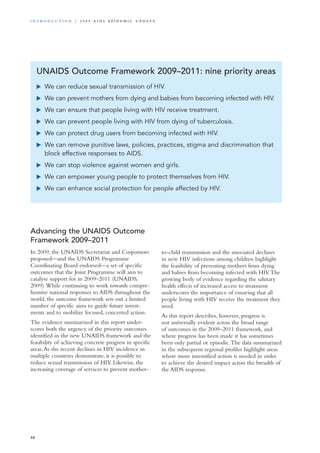
UNAIDS Outcome Framework 2009–2011: nine priority areas
	 We can reduce sexual transmission of HIV.
	 We can prevent mothers from dying and babies from becoming infected with HIV.
	 We can ensure that people living with HIV receive treatment.
	 We can prevent people living with HIV from dying of tuberculosis.
	 We can protect drug users from becoming infected with HIV.
	 We can remove punitive laws, policies, practices, stigma and discrimination that
block effective responses to AIDS.
	 We can stop violence against women and girls.
	 We can empower young people to protect themselves from HIV.
	 We can enhance social protection for people affected by HIV.
to-child transmission and the associated declines
in new HIV infections among children highlight
the feasibility of preventing mothers from dying
and babies from becoming infected with HIV.The
growing body of evidence regarding the salutary
health effects of increased access to treatment
underscores the importance of ensuring that all
people living with HIV receive the treatment they
need.
As this report describes, however, progress is
not universally evident across the broad range
of outcomes in the 2009–2011 framework, and
where progress has been made it has sometimes
been only partial or episodic.The data summarized
in the subsequent regional profiles highlight areas
where more intensified action is needed in order
to achieve the desired impact across the breadth of
the AIDS response.
10
i n t r o d u c t i o n | 2 0 0 9 A I D S E p ide m i c u p da t e
Adults and children
living with HIV
Adults and children
newly infected with HIV
Adult prevalence
(%)
Adult and child deaths
due to AIDS
22.4 million
[20.8 million–24.1 million]
1.9 million
[1.6 million–2.2 million]
5.2
[4.9–5.4]
1.4 million
[1.1 million–1.7 million]
19.7 million
[18.3 million–21.2 million]
2.3 million
[2.0 million–2.5 million]
5.8
[5.5–6.0]
1.4 million
[1.2 million–1.7 million]
310 000
[250 000–380 000]
35 000
[24 000–46 000]
0.2
[<0.2–0.3]
20 000
[15 000–25 000]
200 000
[150 000–250 000]
30 000
[23 000–40 000]
0.2
[0.1–0.2]
11 000
[7800–14 000]
3.8 million
[3.4 million–4.3 million]
280 000
[240 000–320 000]
0.3
[0.2–0.3]
270 000
[220 000–310 000]
4.0 million
[3.5 million–4.5 million]
310 000
[270 000–350 000]
0.3
[<0.3–0.4]
260 000
[210 000–320 000]
850 000
[700 000–1.0 million]
75 000
[58 000–88 000]
<0.1
[<0.1]
59 000
[46 000–71 000]
560 000
[480 000–650 000]
99 000
[75 000–120 000]
<0.1
[<0.1]
22 000
[18 000–27 000]
59 000
[51 000–68 000]
3900
[2900–5100]
0.3
[<0.3–0.4]
2000
[1100–3100]
36 000
[29 000–45 000]
5900
[4800–7300]
0.2
[<0.2–0.3]
<1000
[<500–1200]
2.0 million
[1.8 million–2.2 million]
170 000
[150 000–200 000]
0.6
[0.5–0.6]
77 000
[66 000–89 000]
1.6 million
[1.5 million–1.8 million]
150 000
[140 000–170 000]
0.5
[<0.5–0.6]
66 000
[56 000–77 000]
240 000
[220 000–260 000]
20 000
[16 000–24 000]
1.0
[0.9–1.1]
12 000
[9300–14 000]
220 000
[200 000–240 000]
21 000
[17 000–24 000]
1.1
[1.0–1.2]
20 000
[17 000–23 000]
1.5 million
[1.4 million–1.7 million]
110 000
[100 000–130 000]
0.7
[0.6–0.8]
87 000
[72 000–110 000]
900 000
[800 000–1.1 million]
280 000
[240 000–320 000]
0.5
[0.4–0.5]
26 000
[22 000–30 000]
850 000
[710 000–970 000]
30 000
[23 000–35 000]
0.3
[0.2–0.3]
13 000
[10 000–15 000]
660 000
[580 000–760 000]
40 000
[31 000–47 000]
7900
[6500–9700]
1.4 million
[1.2 million–1.6 million]
55 000
[36 000–61 000]
0.6
[0.5–0.7]
25 000
[20 000–31 000]
1.2 million
[1.1 million–1.4 million]
52 000
[42 000–60 000]
0.6
[0.5–0.7]
19 000
[16 000–23 000]
33.4 million
[31.1 million–35.8 million]
2.7 million
[2.4 million–3.0 million]
0.8
[<0.8–0.8]
2.0 million
[1.7 million–2.4 million]
29.0 million
[27.0 million–31.0 million]
3.2 million
[2.9 million–3.6 million]
0.8
[<0.8–0.8]
1.9 million
[1.6 million–2.2 million]
2008
2001
2008
Sub-Saharan Africa
Middle East and North Africa
South and South-East Asia
East Asia
2008
2001
2008
2001
2001
2008
2001
2008
Oceania
Latin America
2001
2008
2001
2008
Eastern Europe and Central Asia
Caribbean
2001
2008
2001
Western and Central Europe
North America
TOTAL
2001
2008
2001
2008
0.2
[<0.2–0.3]
Regional HIV and AIDS statistics, 2001 and 2008
11
2 0 0 9 A I D S E p ide m i c u p da t e | i n t r o d u c t i o n
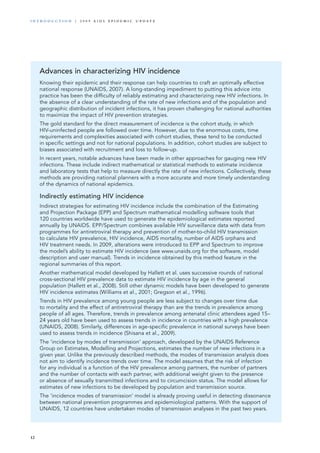
Advances in characterizing HIV incidence
Knowing their epidemic and their response can help countries to craft an optimally effective
national response (UNAIDS, 2007). A long-standing impediment to putting this advice into
practice has been the difficulty of reliably estimating and characterizing new HIV infections. In
the absence of a clear understanding of the rate of new infections and of the population and
geographic distribution of incident infections, it has proven challenging for national authorities
to maximize the impact of HIV prevention strategies.
The gold standard for the direct measurement of incidence is the cohort study, in which
HIV-uninfected people are followed over time. However, due to the enormous costs, time
requirements and complexities associated with cohort studies, these tend to be conducted
in specific settings and not for national populations. In addition, cohort studies are subject to
biases associated with recruitment and loss to follow-up.
In recent years, notable advances have been made in other approaches for gauging new HIV
infections. These include indirect mathematical or statistical methods to estimate incidence
and laboratory tests that help to measure directly the rate of new infections. Collectively, these
methods are providing national planners with a more accurate and more timely understanding
of the dynamics of national epidemics.
Indirectly estimating HIV incidence
Indirect strategies for estimating HIV incidence include the combination of the Estimating
and Projection Package (EPP) and Spectrum mathematical modelling software tools that
120 countries worldwide have used to generate the epidemiological estimates reported
annually by UNAIDS. EPP/Spectrum combines available HIV surveillance data with data from
programmes for antiretroviral therapy and prevention of mother-to-child HIV transmission
to calculate HIV prevalence, HIV incidence, AIDS mortality, number of AIDS orphans and
HIV treatment needs. In 2009, alterations were introduced to EPP and Spectrum to improve
the model’s ability to estimate HIV incidence (see www.unaids.org for the software, model
description and user manual). Trends in incidence obtained by this method feature in the
regional summaries of this report.
Another mathematical model developed by Hallett et al. uses successive rounds of national
cross-sectional HIV prevalence data to estimate HIV incidence by age in the general
population (Hallett et al., 2008). Still other dynamic models have been developed to generate
HIV incidence estimates (Williams et al., 2001; Gregson et al., 1996).
Trends in HIV prevalence among young people are less subject to changes over time due
to mortality and the effect of antiretroviral therapy than are the trends in prevalence among
people of all ages. Therefore, trends in prevalence among antenatal clinic attendees aged 15–
24 years old have been used to assess trends in incidence in countries with a high prevalence
(UNAIDS, 2008). Similarly, differences in age-specific prevalence in national surveys have been
used to assess trends in incidence (Shisana et al., 2009).
The ‘incidence by modes of transmission’ approach, developed by the UNAIDS Reference
Group on Estimates, Modelling and Projections, estimates the number of new infections in a
given year. Unlike the previously described methods, the modes of transmission analysis does
not aim to identify incidence trends over time. The model assumes that the risk of infection
for any individual is a function of the HIV prevalence among partners, the number of partners
and the number of contacts with each partner, with additional weight given to the presence
or absence of sexually transmitted infections and to circumcision status. The model allows for
estimates of new infections to be developed by population and transmission source.
The ‘incidence modes of transmission’ model is already proving useful in detecting dissonance
between national prevention programmes and epidemiological patterns. With the support of
UNAIDS, 12 countries have undertaken modes of transmission analyses in the past two years.
12
i n t r o d u c t i o n | 2 0 0 9 A I D S E p ide m i c u p da t e
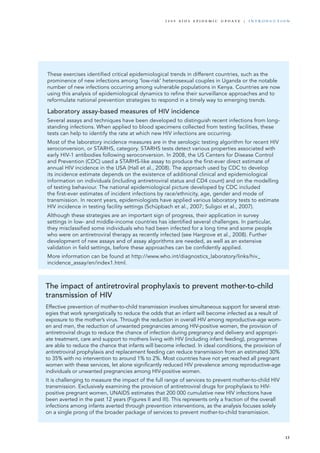
These exercises identified critical epidemiological trends in different countries, such as the
prominence of new infections among ‘low-risk’ heterosexual couples in Uganda or the notable
number of new infections occurring among vulnerable populations in Kenya. Countries are now
using this analysis of epidemiological dynamics to refine their surveillance approaches and to
reformulate national prevention strategies to respond in a timely way to emerging trends.
Laboratory assay-based measures of HIV incidence
Several assays and techniques have been developed to distinguish recent infections from long-
standing infections. When applied to blood specimens collected from testing facilities, these
tests can help to identify the rate at which new HIV infections are occurring.
Most of the laboratory incidence measures are in the serologic testing algorithm for recent HIV
seroconversion, or STARHS, category. STARHS tests detect various properties associated with
early HIV-1 antibodies following seroconversion. In 2008, the US Centers for Disease Control
and Prevention (CDC) used a STARHS-like assay to produce the first-ever direct estimate of
annual HIV incidence in the USA (Hall et al., 2008). The approach used by CDC to develop
its incidence estimate depends on the existence of additional clinical and epidemiological
information on individuals (including antiretroviral status and CD4 count) and on the modelling
of testing behaviour. The national epidemiological picture developed by CDC included
the first-ever estimates of incident infections by race/ethnicity, age, gender and mode of
transmission. In recent years, epidemiologists have applied various laboratory tests to estimate
HIV incidence in testing facility settings (Schüpbach et al., 2007; Suligoi et al., 2007).
Although these strategies are an important sign of progress, their application in survey
settings in low- and middle-income countries has identified several challenges. In particular,
they misclassified some individuals who had been infected for a long time and some people
who were on antiretroviral therapy as recently infected (see Hargrove et al., 2008). Further
development of new assays and of assay algorithms are needed, as well as an extensive
validation in field settings, before these approaches can be confidently applied.
More information can be found at http://www.who.int/diagnostics_laboratory/links/hiv_
incidence_assay/en/index1.html.
The impact of antiretroviral prophylaxis to prevent mother-to-child
transmission of HIV
Effective prevention of mother-to-child transmission involves simultaneous support for several strat-
egies that work synergistically to reduce the odds that an infant will become infected as a result of
exposure to the mother’s virus. Through the reduction in overall HIV among reproductive-age wom-
en and men, the reduction of unwanted pregnancies among HIV-positive women, the provision of
antiretroviral drugs to reduce the chance of infection during pregnancy and delivery and appropri-
ate treatment, care and support to mothers living with HIV (including infant feeding), programmes
are able to reduce the chance that infants will become infected. In ideal conditions, the provision of
antiretroviral prophylaxis and replacement feeding can reduce transmission from an estimated 30%
to 35% with no intervention to around 1% to 2%. Most countries have not yet reached all pregnant
women with these services, let alone significantly reduced HIV prevalence among reproductive-age
individuals or unwanted pregnancies among HIV-positive women.
It is challenging to measure the impact of the full range of services to prevent mother-to-child HIV
transmission. Exclusively examining the provision of antiretroviral drugs for prophylaxis to HIV-
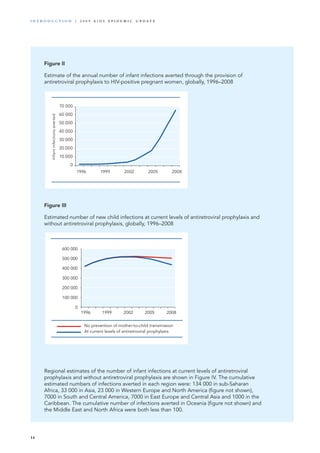
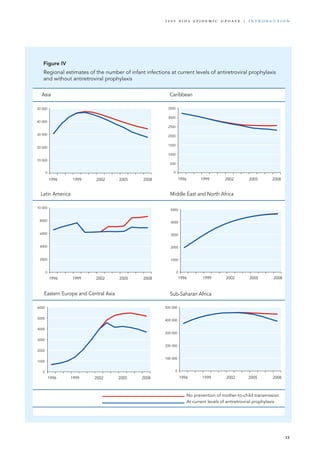
positive pregnant women, UNAIDS estimates that 200 000 cumulative new HIV infections have
been averted in the past 12 years (Figures II and III). This represents only a fraction of the overall
infections among infants averted through prevention interventions, as the analysis focuses solely
on a single prong of the broader package of services to prevent mother-to-child transmission.
13
2 0 0 9 A I D S E p ide m i c u p da t e | i n t r o d u c t i o n
Infantinfectionsaverted
0
10 000
20 000
30 000
40 000
50 000
60 000
70 000
1996 1999 2002 2005 2008
Figure II
Estimate of the annual number of infant infections averted through the provision of
antiretroviral prophylaxis to HIV-positive pregnant women, globally, 1996–2008
At current levels of antiretroviral prophylaxis
0
100 000
200 000
300 000
400 000
500 000
600 000
1996 1999 2002 2005 2008
No prevention of mother-to-child transmission
Figure III
Estimated number of new child infections at current levels of antiretroviral prophylaxis and
without antiretroviral prophylaxis, globally, 1996–2008
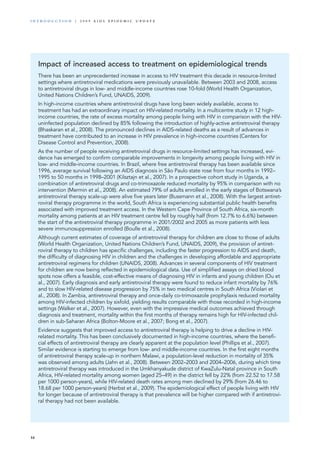
Regional estimates of the number of infant infections at current levels of antiretroviral
prophylaxis and without antiretroviral prophylaxis are shown in Figure IV. The cumulative
estimated numbers of infections averted in each region were: 134 000 in sub-Saharan
Africa, 33 000 in Asia, 23 000 in Western Europe and North America (figure not shown),
7000 in South and Central America, 7000 in East Europe and Central Asia and 1000 in the
Caribbean. The cumulative number of infections averted in Oceania (figure not shown) and
the Middle East and North Africa were both less than 100.
14
i n t r o d u c t i o n | 2 0 0 9 A I D S E p ide m i c u p da t e
0
10 000
20 000
30 000
40 000
50 000
1996 1999 2002 2005 2008
0
500
1000
1500
2000
2500
3000
3500
0
1000
2000
3000
4000
5000
6000
0
2000
4000
6000
8000
10 000
0
1000
2000
3000
4000
5000
0
100 000
200 000
300 000
400 000
500 000
1996 1999 2002 2005 2008
1996 1999 2002 2005 2008 1996 1999 2002 2005 2008
1996 1999 2002 2005 2008 1996 1999 2002 2005 2008
Asia Caribbean
Eastern Europe and Central Asia
Middle East and North Africa
Sub-Saharan Africa
Latin America
At current levels of antiretroviral prophylaxis
No prevention of mother-to-child transmission
Figure IV
Regional estimates of the number of infant infections at current levels of antiretroviral prophylaxis
and without antiretroviral prophylaxis
15
2 0 0 9 A I D S E p ide m i c u p da t e | i n t r o d u c t i o n
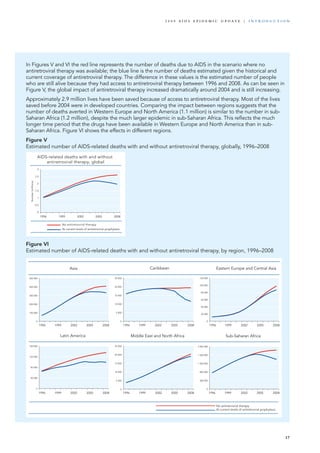
Impact of increased access to treatment on epidemiological trends
There has been an unprecedented increase in access to HIV treatment this decade in resource-limited
settings where antiretroviral medications were previously unavailable. Between 2003 and 2008, access
to antiretroviral drugs in low- and middle-income countries rose 10-fold (World Health Organization,
United Nations Children’s Fund, UNAIDS, 2009).
In high-income countries where antiretroviral drugs have long been widely available, access to
treatment has had an extraordinary impact on HIV-related mortality. In a multicentre study in 12 high-
income countries, the rate of excess mortality among people living with HIV in comparison with the HIV-
uninfected population declined by 85% following the introduction of highly-active antiretroviral therapy
(Bhaskaran et al., 2008). The pronounced declines in AIDS-related deaths as a result of advances in
treatment have contributed to an increase in HIV prevalence in high-income countries (Centers for
Disease Control and Prevention, 2008).
As the number of people receiving antiretroviral drugs in resource-limited settings has increased, evi-
dence has emerged to confirm comparable improvements in longevity among people living with HIV in
low- and middle-income countries. In Brazil, where free antiretroviral therapy has been available since
1996, average survival following an AIDS diagnosis in São Paulo state rose from four months in 1992–
1995 to 50 months in 1998–2001 (Kilsztajn et al., 2007). In a prospective cohort study in Uganda, a
combination of antiretroviral drugs and co-trimoxazole reduced mortality by 95% in comparison with no
intervention (Mermin et al., 2008). An estimated 79% of adults enrolled in the early stages of Botswana’s
antiretroviral therapy scale-up were alive five years later (Bussmann et al., 2008). With the largest antiret-
roviral therapy programme in the world, South Africa is experiencing substantial public health benefits
associated with improved treatment access. In the Western Cape Province of South Africa, six-month
mortality among patients at an HIV treatment centre fell by roughly half (from 12.7% to 6.6%) between
the start of the antiretroviral therapy programme in 2001/2002 and 2005 as more patients with less
severe immunosuppression enrolled (Boulle et al., 2008).
Although current estimates of coverage of antiretroviral therapy for children are close to those of adults
(World Health Organization, United Nations Children’s Fund, UNAIDS, 2009), the provision of antiret-
roviral therapy to children has specific challenges, including the faster progression to AIDS and death,
the difficulty of diagnosing HIV in children and the challenges in developing affordable and appropriate
antiretroviral regimens for children (UNAIDS, 2008). Advances in several components of HIV treatment
for children are now being reflected in epidemiological data. Use of simplified assays on dried blood
spots now offers a feasible, cost-effective means of diagnosing HIV in infants and young children (Ou et
al., 2007). Early diagnosis and early antiretroviral therapy were found to reduce infant mortality by 76%
and to slow HIV-related disease progression by 75% in two medical centres in South Africa (Violari et
al., 2008). In Zambia, antiretroviral therapy and once-daily co-trimoxazole prophylaxis reduced mortality
among HIV-infected children by sixfold, yielding results comparable with those recorded in high-income
settings (Walker et al., 2007). However, even with the impressive medical outcomes achieved through
diagnosis and treatment, mortality within the first months of therapy remains high for HIV-infected chil-
dren in sub-Saharan Africa (Bolton-Moore et al., 2007; Bong et al., 2007).
Evidence suggests that improved access to antiretroviral therapy is helping to drive a decline in HIV-
related mortality. This has been conclusively documented in high-income countries, where the benefi-
cial effects of antiretroviral therapy are clearly apparent at the population level (Phillips et al., 2007).
Similar evidence is starting to emerge from low- and middle-income countries. In the first eight months
of antiretroviral therapy scale-up in northern Malawi, a population-level reduction in mortality of 35%
was observed among adults (Jahn et al., 2008). Between 2002–2003 and 2004–2006, during which time
antiretroviral therapy was introduced in the Umkhanyakude district of KwaZulu-Natal province in South
Africa, HIV-related mortality among women (aged 25–49) in the district fell by 22% (from 22.52 to 17.58
per 1000 person-years), while HIV-related death rates among men declined by 29% (from 26.46 to
18.68 per 1000 person-years) (Herbst et al., 2009). The epidemiological effect of people living with HIV
for longer because of antiretroviral therapy is that prevalence will be higher compared with if antiretrovi-
ral therapy had not been available.
16
i n t r o d u c t i o n | 2 0 0 9 A I D S E p ide m i c u p da t e
In Figures V and VI the red line represents the number of deaths due to AIDS in the scenario where no
antiretroviral therapy was available; the blue line is the number of deaths estimated given the historical and
current coverage of antiretroviral therapy. The difference in these values is the estimated number of people
who are still alive because they had access to antiretroviral therapy between 1996 and 2008. As can be seen in
Figure V, the global impact of antiretroviral therapy increased dramatically around 2004 and is still increasing.
Approximately 2.9 million lives have been saved because of access to antiretroviral therapy. Most of the lives
saved before 2004 were in developed countries. Comparing the impact between regions suggests that the
number of deaths averted in Western Europe and North America (1.1 million) is similar to the number in sub-
Saharan Africa (1.2 million), despite the much larger epidemic in sub-Saharan Africa. This reflects the much
longer time period that the drugs have been available in Western Europe and North America than in sub-
Saharan Africa. Figure VI shows the effects in different regions.
Figure V
Estimated number of AIDS-related deaths with and without antiretroviral therapy, globally, 1996–2008
Figure VI
Estimated number of AIDS-related deaths with and without antiretroviral therapy, by region, 1996–2008
1996 1999 2002 2005 2008
Number(millions)
AIDS-related deaths with and without
antiretroviral therapy, global
0
0.5
1
1.5
2
2.5
3
No antiretroviral therapy
At current levels of antiretroviral prophylaxis
0
100 000
200 000
300 000
400 000
500 000
1996 1999 2002 2005 2008
0
5 000
10 000
15 000
20 000
25 000
1996 1999 2002 2005 2008
0
20 000
40 000
60 000
80 000
100 000
120 000
Asia Caribbean Eastern Europe and Central Asia
1996 1999 2002 2005 2008
0
40 000
80 000
120 000
160 000
Middle East and North Africa
0
5 000
10 000
15 000
20 000
25 000
Sub-Saharan Africa
0
400 000
800 000
1 200 000
1 600 000
2 000 000
1996 1999 2002 2005 2008
Latin America
1996 1999 2002 2005 2008 1996 1999 2002 2005 2008
No antiretroviral therapy
At current levels of antiretroviral prophylaxis
17
2 0 0 9 A I D S E p ide m i c u p da t e | i n t r o d u c t i o n
0
1 000 000
2 000 000
3 000 000
4 000 000
5 000 000
6 000 000
7 000 000
8 000 000
Western
Europe
and North
America
Sub-
Saharan
Africa
South and
Central
America
Asia Eastern
Europe
and
Central Asia
Caribbean Oceania Middle East
and North
Africa
7.2 million
2.3 million
1.4 million
590 000
73 000 40 000 49 000 7500
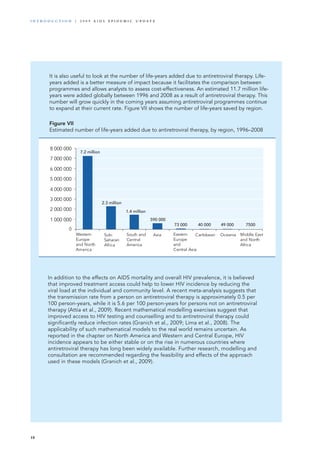
It is also useful to look at the number of life-years added due to antiretroviral therapy. Life-
years added is a better measure of impact because it facilitates the comparison between
programmes and allows analysts to assess cost-effectiveness. An estimated 11.7 million life-
years were added globally between 1996 and 2008 as a result of antiretroviral therapy. This
number will grow quickly in the coming years assuming antiretroviral programmes continue
to expand at their current rate. Figure VII shows the number of life-years saved by region.
Figure VII
Estimated number of life-years added due to antiretroviral therapy, by region, 1996–2008
In addition to the effects on AIDS mortality and overall HIV prevalence, it is believed
that improved treatment access could help to lower HIV incidence by reducing the
viral load at the individual and community level. A recent meta-analysis suggests that
the transmission rate from a person on antiretroviral therapy is approximately 0.5 per
100 person-years, while it is 5.6 per 100 person-years for persons not on antiretroviral
therapy (Attia et al., 2009). Recent mathematical modelling exercises suggest that
improved access to HIV testing and counselling and to antiretroviral therapy could
significantly reduce infection rates (Granich et al., 2009; Lima et al., 2008). The
applicability of such mathematical models to the real world remains uncertain. As
reported in the chapter on North America and Western and Central Europe, HIV
incidence appears to be either stable or on the rise in numerous countries where
antiretroviral therapy has long been widely available. Further research, modelling and
consultation are recommended regarding the feasibility and effects of the approach
used in these models (Granich et al., 2009).
18
i n t r o d u c t i o n | 2 0 0 9 A I D S E p ide m i c u p da t e
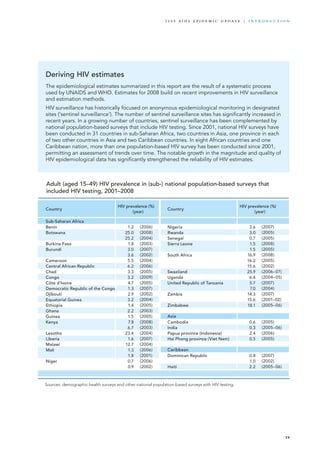
Deriving HIV estimates
The epidemiological estimates summarized in this report are the result of a systematic process
used by UNAIDS and WHO. Estimates for 2008 build on recent improvements in HIV surveillance
and estimation methods.
HIV surveillance has historically focused on anonymous epidemiological monitoring in designated
sites (‘sentinel surveillance’). The number of sentinel surveillance sites has significantly increased in
recent years. In a growing number of countries, sentinel surveillance has been complemented by
national population-based surveys that include HIV testing. Since 2001, national HIV surveys have
been conducted in 31 countries in sub-Saharan Africa, two countries in Asia, one province in each
of two other countries in Asia and two Caribbean countries. In eight African countries and one
Caribbean nation, more than one population-based HIV survey has been conducted since 2001,
permitting an assessment of trends over time. The notable growth in the magnitude and quality of
HIV epidemiological data has significantly strengthened the reliability of HIV estimates.
Country Country
Sub-Saharan Africa
Benin 1.2 (2006) Nigeria 3.6 (2007)
Botswana 25.0 (2008) Rwanda 3.0 (2005)
25.2 (2004) Senegal 0.7 (2005)
Burkina Faso 1.8 (2003) Sierra Leone 1.5 (2008)
Burundi 3.0 (2007) 1.5 (2005)
3.6 (2002) South Africa 16.9 (2008)
Cameroon 5.5 (2004) 16.2 (2005)
Central African Republic 6.2 (2006) 15.6 (2002)
Chad 3.3 (2005) Swaziland 25.9 (2006–07)
Congo 3.2 (2009) Uganda 6.4 (2004–05)
Côte d'Ivoire 4.7 (2005) United Republic of Tanzania 5.7 (2007)
Democratic Republic of the Congo 1.3 (2007) 7.0 (2004)
Djibouti 2.9 (2002) Zambia 14.3 (2007)
Equatorial Guinea 3.2 (2004) 15.6 (2001–02)
Ethiopia 1.4 (2005) Zimbabwe 18.1 (2005–06)
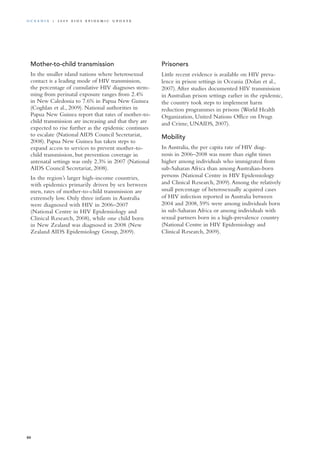
Ghana 2.2 (2003)
Guinea 1.5 (2005) Asia
Kenya 7.8 (2008) Cambodia 0.6 (2005)
6.7 (2003) India 0.3 (2005–06)
Lesotho 23.4 (2004) Papua province (Indonesia) 2.4 (2006)
Liberia 1.6 (2007) Hai Phong province (Viet Nam) 0.5 (2005)
Malawi 12.7 (2004)
Mali 1.3 (2006) Caribbean
1.8 (2001) Dominican Republic 0.8 (2007)
Niger 0.7 (2006) 1.0 (2002)
0.9 (2002) Haiti 2.2 (2005–06)
HIV prevalence (%)
(year)
HIV prevalence (%)
(year)
Adult (aged 15–49) HIV prevalence in (sub-) national population-based surveys that
included HIV testing, 2001–2008
Sources: demographic health surveys and other national population-based surveys with HIV testing.
19
2 0 0 9 A I D S E p ide m i c u p da t e | i n t r o d u c t i o n
UNAIDS and WHO use three tools to generate HIV estimates for countries and regions: the
Estimation and Projection Package (EPP), WORKBOOK and Spectrum.1
These models generate
estimates of HIV prevalence over time, the number of people living with HIV, new infections,
deaths due to AIDS, children orphaned by AIDS, and treatment needs. These models use data
from sentinel surveillance, surveys and special studies and are regularly updated on the basis of
the latest available research. An important new feature of EPP is that it now takes into account the
impact of treatment coverage on prevalence when estimating incidence. This incidence estimate
is then used by Spectrum to estimate the numbers of people living with HIV, new infections and
deaths. Incidence by age group is informed by age patterns of incidence derived from population-
based surveys (Hallett et al., 2008). In addition, EPP now allows for the prevalence trend to be
informed by multiple population-based surveys and a changing urban–rural ratio over time. As
previously reported, the availability of more representative data from national population-based
surveys led to a downward adjustment from previous estimates based solely on antenatal clinic
surveillance (UNAIDS, 2007). In addition, the models were also adjusted in 2007 to reflect more
reliable evidence on average survival time, in the absence of treatment, for people living with HIV
(UNAIDS, 2007).
1	
Additional information on these tools is available at http://www.unaids.org/en/knowldgeCentre/HIVData/Methodology/.
20
i n t r o d u c t i o n | 2 0 0 9 A I D S E p ide m i c u p da t e
SUB-SAHARAN AFRICA
Number of people living with HIV	 2008: 22.4 million 	 2001: 19.7 million
	 [20.8 million–24.1 million]	 [18.3 million–21.2 million]	
	
Number of new HIV infections	 2008: 1.9 million 	 2001: 2.3 million
	 [1.6 million–2.2 million]	 [2.0 million–2.5 million]		
	
Number of children newly infected	 2008: 390 000 	 2001: 460 000	
	 [210 000–570 000]	 [260 000–640 000]	 	
		
Number of AIDS-related deaths	 2008: 1.4 million	 2001: 1.4 million
	 [1.1 million–1.7 million]	 [1.2 million–1.7 million]
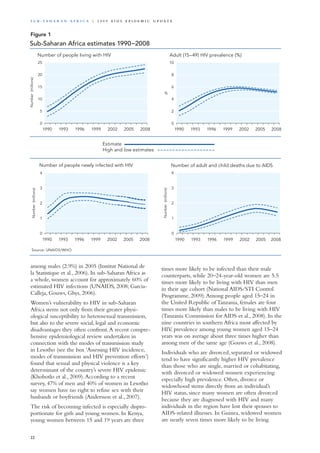
In 2008, an estimated 1.9 million [1.6 million–2.2 million] people living in sub-Saharan Africa became
newly infected with HIV, bringing the total number of people living with HIV to 22.4 million [20.8 million–
24.1 million].While the rate of new HIV infections in sub-Saharan Africa has slowly declined—with the
number of new infections in 2008 approximately 25% lower than at the epidemic’s peak in the region in
1995—the number of people living with HIV in sub-Saharan Africa slightly increased in 2008, in part due to
increased longevity stemming from improved access to HIV treatment. Adult (15–49) HIV prevalence declined
from 5.8% [5.5–6.0%] in 2001 to 5.2% [4.9–5.4%] in 2008.
In 2008, an estimated 1.4 million [1.1 million–1.7 million] AIDS-related deaths occurred in sub-Saharan
Africa.This number represents an 18% decline in annual HIV-related mortality in the region since 2004.
Regional overview
Sub-Saharan Africa remains the region most
heavily affected by HIV. In 2008, sub-Saharan
Africa accounted for 67% of HIV infections
worldwide, 68% of new HIV infections among
adults and 91% of new HIV infections among
children.The region also accounted for 72% of the
world’s AIDS-related deaths in 2008.
The epidemic continues to have an enormous
impact on households, communities, businesses,
public services and national economies in the
region. In Swaziland, average life expectancy
fell by half between 1990 and 2007, to 37 years
(United Nations Development Programme,
2008;Whiteside et al., 2006). In 2008, more than
14.1 million [11.5 million–17.1 million] children
in sub-Saharan Africa were estimated to have lost
one or both parents to AIDS.
Continuing disproportionate impact on
women and girls
Women and girls continue to be affected dispro-
portionately by HIV in sub-Saharan Africa. For
example, in Côte d’Ivoire, home to the most serious
epidemic in West Africa, HIV prevalence among
females (6.4%) was more than twice as high as
21
2 0 0 9 A I D S E p ide m i c u p da t e | S u b - S a h a r a n A f r i c a
among males (2.9%) in 2005 (Institut National de
la Statistique et al., 2006). In sub-Saharan Africa as
a whole, women account for approximately 60% of
estimated HIV infections (UNAIDS, 2008; Garcia-
Calleja, Gouws, Ghys, 2006).
Women’s vulnerability to HIV in sub-Saharan
Africa stems not only from their greater physi-
ological susceptibility to heterosexual transmission,
but also to the severe social, legal and economic
disadvantages they often confront.A recent compre-
hensive epidemiological review undertaken in
connection with the modes of transmission study
in Lesotho (see the box ‘Assessing HIV incidence,
modes of transmission and HIV prevention efforts’)
found that sexual and physical violence is a key
determinant of the country’s severe HIV epidemic
(Khobotlo et al., 2009).According to a recent
survey, 47% of men and 40% of women in Lesotho
say women have no right to refuse sex with their
husbands or boyfriends (Andersson et al., 2007).
The risk of becoming infected is especially dispro-
portionate for girls and young women. In Kenya,
young women between 15 and 19 years are three
times more likely to be infected than their male
counterparts, while 20–24-year-old women are 5.5
times more likely to be living with HIV than men
in their age cohort (National AIDS/STI Control
Programme, 2009).Among people aged 15–24 in
the United Republic of Tanzania, females are four
times more likely than males to be living with HIV
(Tanzania Commission for AIDS et al., 2008). In the
nine countries in southern Africa most affected by
HIV, prevalence among young women aged 15–24
years was on average about three times higher than
among men of the same age (Gouws et al., 2008).
Individuals who are divorced, separated or widowed
tend to have significantly higher HIV prevalence
than those who are single, married or cohabitating,
with divorced or widowed women experiencing
especially high prevalence. Often, divorce or
widowhood stems directly from an individual’s
HIV status, since many women are often divorced
because they are diagnosed with HIV and many
individuals in the region have lost their spouses to
AIDS-related illnesses. In Guinea, widowed women
are nearly seven times more likely to be living
Source: UNAIDS/WHO.
Number of people living with HIV Adult (15–49) HIV prevalence (%)
Number of people newly infected with HIV Number of adult and child deaths due to AIDS
1990 1993 1996 1999 2002 2005 2008
1990 1993 1996 1999 2002 2005 2008
1990 1993 1996 1999 2002 2005 2008
1990 1993 1996 1999 2002 2005 2008
0
5
10
15
20
25
Number(millions)
0
1
2
3
4
Number(millions)
0
2
4
6
8
10
%
0
1
2
3
4
Number(millions)
Sub-Saharan Africa estimates 1990−2008
Estimate
High and low estimates
Figure 1
22
S u b - S a h a r a n A f r i c a | 2 0 0 9 A I D S E p ide m i c u p da t e
with HIV than single women, while divorced or
separated women are more than three times more
likely to be infected than their single counterparts
(Direction Nationale de la Statistique & ORC
Macro, 2006). More than one in four (27%) of
widowed Tanzanians are living with HIV, compared
with 2% of those who have never been married
and 6% of those who are married or cohabiting
(National Bureau of Statistics & ORC Macro,
2005).Widowed individuals in Uganda are more
than six times more likely to be infected than those
who have never been married (Uganda Ministry of
Health & ORC Macro, 2006).
The relationship between marriage and risk of
HIV infection is often complex and may vary
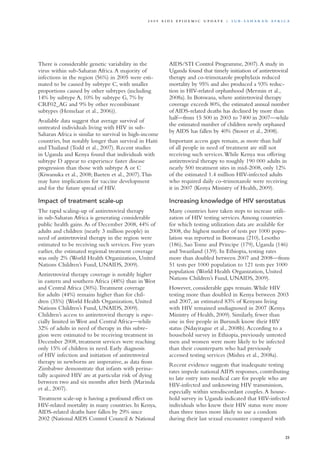
among settings and population groups (Figure 2).
A national study of uniformed personnel in
Burundi found that married men had HIV preva-
lence 2.7 times higher than reported for their
never-married counterparts (Ndayirague et al.,
2008a). However, never having been married is
not universally protective against HIV infection,
especially among women; in Lesotho, 24.2% of
never-married women who have had sex are living
with HIV (Khobotlo et al., 2009).
HIV prevalence generally tends to peak at a
younger age for women than for men (Gouws et
al., 2008).According to household surveys in 28
countries—all but five in sub-Saharan Africa—
peak HIV prevalence for women occurs between
the ages of 30 and 34, while men experience the
highest levels of HIV infection in their late 30s
and early 40s (Macro International, 2008).
The very young are often at extremely high risk
of infection through mother-to-child transmission.
In Swaziland, 5% of children between the ages of
2 and 4 were HIV-infected in 2006–2007 (Macro
International, 2008).
Impact across diverse populations
Consistent with the generalized nature of the
region’s epidemic, HIV affects all social and
economic groups in sub-Saharan Africa. In
Lesotho, women and men in every income, educa-
tion and migration strata had an HIV prevalence
of 15% or higher in 2004 (Khobotlo et al., 2009).
Surveys in different settings in sub-Saharan Africa
have detected a wide variation in the relationship
between HIV and income (Piot, Greener, Russell,
2007). In eight African countries where surveys
have been conducted (Burkina Faso, Cameroon,
Ghana, Kenya, Lesotho, Malawi, Uganda and the
United Republic of Tanzania), HIV prevalence
is higher among adults in the wealthiest quintile
than among those in the poorest quintile (Mishra
et al., 2007). In five of six West African countries
where survey data are available, women living
in the wealthiest households have higher HIV
prevalence than other socioeconomic groups
of women, but the relationship between wealth
and HIV is less clear for men in the subregion
(Lowndes et al., 2008).
As the epidemic has evolved in sub-Saharan
Africa, the relationship between HIV infection
and education has shifted, according to a recent
meta-analysis of 36 studies carried out in 11
countries between 1987 and 2003.While studies
prior to 1996 generally found either no associa-
tion between educational status and HIV risk or
found that the highest risk was among the most
educated, data collected after 1996 have tended to
find a lower risk among the most-educated people
(Hargreaves et al., 2008).
Assessing HIV incidence, modes of
transmission and HIV prevention efforts
The UNAIDS Secretariat and Cosponsors
collaborated in conducting modes of trans-
mission analyses and HIV epidemiology and
prevention syntheses in 12 countries in sub-
Saharan Africa in 2008–2009. These studies
used the UNAIDS Incidence Model de-
scribed in Gouws et al. (2006). Developed by
the UNAIDS Reference Group on Estimates,
Modelling and Projections, the process and
model use a variety of epidemiological data
sources in a country to estimate the distri-
bution of new HIV infections across various
subgroups of the population in a single year.
The model does not identify trends in HIV in-
cidence over time. The results should be in-
terpreted with caution as they are influenced
by a number of assumptions and sometimes
by uncertain input data. A particularly im-
portant feature of the model is its ability to
estimate the relative number of new infec-
tions by different modes of exposure.
Estimates of HIV incidence derived by the
UNAIDS model are coupled with an assess-
ment of HIV prevention spending and pro-
grammatic patterns. This approach enables
national decision-makers to identify any
mismatch between programmatic priorities
and epidemiological patterns and to iden-
tify programmatic or policy gaps in national
prevention efforts.
23
2 0 0 9 A I D S E p ide m i c u p da t e | S u b - S a h a r a n A f r i c a
HIV prevalence tends to be higher in urban
settings than in rural areas, with household surveys
conducted in the region between 2001 and 2005
indicating that the median urban/rural ratio of
HIV prevalence is 1.7:1.0 (Garcia-Calleja, Gouws,
Ghys, 2006). In the sub-Saharan African countries
where household surveys have been conducted,
HIV prevalence is higher in rural areas only in
Senegal (Macro International, 2008).The most
pronounced difference in HIV prevalence is in
Ethiopia, where urban dwellers are eight times
more likely to be HIV-infected than people living
in rural areas (Macro International, 2008).
Wide variation within subregional and
national epidemics
Within countries and subregions, wide variations
in HIV prevalence and epidemiological patterns
are frequently apparent. For example, in Kenya
there is a greater than 15-fold variation in HIV
prevalence among provinces, ranging from 0.8% in
North Eastern province to 14.9% in Nyanza prov-
ince (National AIDS/STI Control Programme,
2009), while the difference between the highest-
prevalence and lowest-prevalence region in the
United Republic of Tanzania is more than 16-fold
(Tanzania Commission for AIDS et al., 2008).
Although the Northwest and North Central
provinces of Uganda border each other, HIV
prevalence is nearly four times higher in the latter
(8.2% versus 2.3%) (Uganda Ministry of Health &
ORC Macro, 2006).
Adult HIV prevalence in Côte d’Ivoire (3.7%) is
more than twice as high as in Liberia (1.7%) or
Guinea (1.6%), even though these West African
countries share national borders (UNAIDS, 2008).
Within the relatively small nation of Benin, a more
than 12-fold variation in HIV prevalence among
pregnant women (ranging from 0.4% to 3.8%) has
been documented among the country’s depart-
ments (Bénin Ministère de la Santé, 2008).
Source: Lowndes et al. (2008).
Single Married/
cohabiting
Divorced/
separated/
widowed
16
14
12
10
8
6
4
2
0
16
14
12
10
8
6
4
2
0
16
14
12
10
8
6
4
2
0
Burkina Faso
Ghana
Niger
Benin
Guinea
Senegal
ôte d’Ivoire
Mali
Sierra Leone
%
%
%
2.2
1.6
6.3
0.8
2.8
0.5
1.3
7.2
10.6
0.2
1.2
2.3
4.6
6.1
1.3
3.6
11.0
1.1
2.9
6.2
6.7
0.3
2.3
3.3
Single Married/
cohabiting
Divorced/
separated/
widowed
Single Married/
cohabiting
Divorced/
separated
Widowed
Single Married/
cohabiting
Divorced/
separated
WidowedSingle Married/
cohabiting
Divorced/
separated/
widowed
Single Married/
cohabiting
Divorced/
separated
Widowed
Single Married/
cohabiting
Divorced/
separated
WidowedSingle Married/
cohabiting
Divorced/
separated
WidowedSingle Married/
cohabiting
Divorced/
separated
Widowed
too
few
cases
too
few
cases
too
few
cases
too
few
cases
too
few
cases
too
few
cases
too
few
cases
14.9
Female
Male
C
1.2 1.6
3.9
0.6
1.3
0.0 0.4
1.4 1.8
8.2
0.6 0.9
2.2
0.4 0.5
6.4
3.9
0.4
0.9
3.6
0.3
0.9
3.8
0.0
0.9
2.2 1.8 1.4
5.3
2.2
0.9
1.8
3.1
14.8
HIV prevalence by marital status and gender in the general populations
of nine West African countries
Figure 2
24
S u b - S a h a r a n A f r i c a | 2 0 0 9 A I D S E p ide m i c u p da t e
There is considerable genetic variability in the
virus within sub-Saharan Africa.A majority of
infections in the region (56%) in 2005 were esti-
mated to be caused by subtype C, with smaller
proportions caused by other subtypes (including
14% by subtype A, 10% by subtype G, 7% by
CRF02_AG and 9% by other recombinant
subtypes (Hemelaar et al., 2006)).
Available data suggest that average survival of
untreated individuals living with HIV in sub-
Saharan Africa is similar to survival in high-income
countries, but notably longer than survival in Haiti
and Thailand (Todd et al., 2007). Recent studies
in Uganda and Kenya found that individuals with
subtype D appear to experience faster disease
progression than those with subtype A or C
(Kiwanuka et al., 2008; Baeten et al., 2007).This
may have implications for vaccine development
and for the future spread of HIV.
Impact of treatment scale-up
The rapid scaling-up of antiretroviral therapy
in sub-Saharan Africa is generating considerable
public health gains.As of December 2008, 44% of
adults and children (nearly 3 million people) in
need of antiretroviral therapy in the region were
estimated to be receiving such services. Five years
earlier, the estimated regional treatment coverage
was only 2% (World Health Organization, United
Nations Children’s Fund, UNAIDS, 2009).
Antiretroviral therapy coverage is notably higher
in eastern and southern Africa (48%) than in West
and Central Africa (30%).Treatment coverage
for adults (44%) remains higher than for chil-
dren (35%) (World Health Organization, United
Nations Children’s Fund, UNAIDS, 2009).
Children’s access to antiretroviral therapy is espe-
cially limited in West and Central Africa—while
32% of adults in need of therapy in this subre-
gion were estimated to be receiving treatment in
December 2008, treatment services were reaching
only 15% of children in need. Early diagnosis
of HIV infection and initiation of antiretroviral
therapy in newborns are imperative, as data from
Zimbabwe demonstrate that infants with perina-
tally acquired HIV are at particular risk of dying
between two and six months after birth (Marinda
et al., 2007).
Treatment scale-up is having a profound effect on
HIV-related mortality in many countries. In Kenya,
AIDS-related deaths have fallen by 29% since
2002 (National AIDS Control Council & National
AIDS/STI Control Programme, 2007).A study in
Uganda found that timely initiation of antiretroviral
therapy and co-trimoxazole prophylaxis reduced
mortality by 95% and also produced a 93% reduc-
tion in HIV-related orphanhood (Mermin et al.,
2008a). In Botswana, where antiretroviral therapy
coverage exceeds 80%, the estimated annual number
of AIDS-related deaths has declined by more than
half—from 15 500 in 2003 to 7400 in 2007—while
the estimated number of children newly orphaned
by AIDS has fallen by 40% (Stover et al., 2008).
Important access gaps remain, as more than half
of all people in need of treatment are still not
receiving such services.While Kenya was offering
antiretroviral therapy to roughly 190 000 adults in
nearly 500 treatment sites in mid-2008, only 12%
of the estimated 1.4 million HIV-infected adults
who required daily co-trimoxazole were receiving
it in 2007 (Kenya Ministry of Health, 2009).
Increasing knowledge of HIV serostatus
Many countries have taken steps to increase utili-
zation of HIV testing services.Among countries
for which testing utilization data are available for
2008, the highest number of tests per 1000 popu-
lation was reported in Botswana (210), Lesotho
(186), Sao Tome and Principe (179), Uganda (146)
and Swaziland (139). In Ethiopia, testing rates
more than doubled between 2007 and 2008—from
51 tests per 1000 population to 121 tests per 1000
population (World Health Organization, United
Nations Children’s Fund, UNAIDS, 2009).
However, considerable gaps remain.While HIV
testing more than doubled in Kenya between 2003
and 2007, an estimated 83% of Kenyans living
with HIV remained undiagnosed in 2007 (Kenya
Ministry of Health, 2009). Similarly, fewer than
one in five people in Burundi know their HIV
status (Ndayirague et al., 2008b).According to a
household survey in Ethiopia, previously untested
men and women were more likely to be infected
than their counterparts who had previously
accessed testing services (Mishra et al., 2008a).
Recent evidence suggests that inadequate testing
rates impede national AIDS responses, contributing
to late entry into medical care for people who are
HIV-infected and unknowing HIV transmission,
especially within serodiscordant couples.A house-
hold survey in Uganda indicated that HIV-infected
individuals who knew their HIV status were more
than three times more likely to use a condom
during their last sexual encounter compared with
25
2 0 0 9 A I D S E p ide m i c u p da t e | S u b - S a h a r a n A f r i c a
those who did not know their status (Bunnell
et al., 2008). In rural Zimbabwe, women who
tested HIV-positive reported increased consistent
condom use with primary partners, although indi-
viduals testing negative reported an overall increase
in risky sexual behaviours (Sherr et al., 2007),
underscoring the need for intensified preven-
tion services to accompany initiatives to promote
knowledge of HIV serostatus.
Continuing urgent need to strengthen
HIV prevention
Even with the significant gains that have been
achieved through treatment scale-up, sub-Saharan
Africa’s epidemic continues to outpace the response.
Preserving the long-term viability of treatment
programmes and mitigating the epidemic’s impact
in the region requires immediate steps to elevate
the priority given to HIV prevention and to match
prevention strategies with actual needs.
In Swaziland, the country with the highest HIV
prevalence in the world, 17% of total expenditures
in 2008 supported HIV prevention programmes
(Mngadi et al., 2009). Between 2005 and 2007,
prevention spending declined by 43.2% in
Ghana (Bosu et al., 2009). Prevention spending
in Lesotho fell by 24% between 2005–2006 and
2007–2008 (Khobotlo et al., 2009). However, in
Uganda, prevention resources as a share of national
HIV-related spending rose from 13% in 2003–
2004 to 33.6% in 2006–2007 (Wabwire-Mangen
et al., 2009).
Prevention strategies often fail to address the key
drivers of national epidemics.While people over
the age of 25 are estimated to account for more
than two thirds of incident adult infections in
Swaziland, few prevention programmes specifi-
cally focus on people aged over 25 (Mngadi et
al., 2009). Likewise, while people in stable rela-
tionships are estimated to account for up to 62%
of new HIV infections in Lesotho, virtually no
programmes currently focus on adults, married
couples or people in long-term relationships
(Khobotlo et al., 2009).Although sex workers and
their clients, men who have sex with men and
injecting drug users together were estimated to
account for roughly one in three new HIV infec-
tions in Kenya in 2006, only minimal funding has
been provided for prevention initiatives focused on
these populations (Gelmon et al., 2009). In Ghana,
prevention programmes focused on sex workers,
men who have sex with men and injecting drug
users consumed 9% of all prevention spending
in 2007, even though these groups directly or
indirectly were estimated to account for at least
38% of new HIV infections in 2008 (Bosu et al.,
2009). In many countries where people in stable
relationships are responsible for a large proportion
of new HIV infections, couples testing and other
prevention services for serodiscordant couples have
received inadequate support (Gelmon et al., 2009).
State of HIV surveillance
Since 2001, household surveys that include a
component to assess HIV prevalence have been
conducted in 28 African countries, including nine
in 2007 and 2008.Although these surveys vary
considerably in quality (Garcia-Calleja, Gouws,
Ghys, 2006), they have provided more representa-
tive population-based estimates of HIV prevalence
than were possible with previous extrapolations
from sentinel surveillance of women attending
antenatal clinics.
An assessment of the quality of serosurveillance
in low- and middle-income countries between
2001 and 2007 (including sentinel surveillance and
national surveys) showed that among 44 coun-
tries that were assessed in this region, 24 had fully
functional surveillance systems (Lyerla, Gouws,
Garcia-Calleja, 2008).
Over the past two years, a series of syntheses of
epidemiological and programmatic data in 11
African countries has been undertaken. In addi-
tion to characterizing the modes of transmission
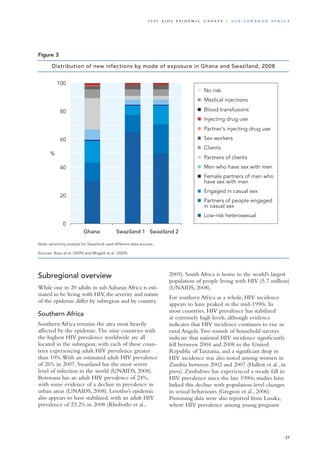
associated with incident HIV infections (Figure 3),
these analyses have also assessed national preven-
tion strategies.As a result of these efforts, national
decision-makers have obtained guidance on steps
to bring national strategies into greater alignment
with documented prevention needs.
Despite these improvements, substantial evidence
gaps remain, which hinders efforts to devise
evidence-informed AIDS strategies.While there
has been an important increase in HIV-related
research involving men who have sex with men
and injecting drug users in sub-Saharan Africa,
many countries lack reliable information on the
size, behaviours and HIV prevalence of these
populations (see Lowndes et al., 2008).
26
S u b - S a h a r a n A f r i c a | 2 0 0 9 A I D S E p ide m i c u p da t e
Subregional overview
While one in 20 adults in sub-Saharan Africa is esti-
mated to be living with HIV, the severity and nature
of the epidemic differ by subregion and by country.
Southern Africa
Southern Africa remains the area most heavily
affected by the epidemic.The nine countries with
the highest HIV prevalence worldwide are all
located in the subregion, with each of these coun-
tries experiencing adult HIV prevalence greater
than 10%.With an estimated adult HIV prevalence
of 26% in 2007, Swaziland has the most severe
level of infection in the world (UNAIDS, 2008).
Botswana has an adult HIV prevalence of 24%,
with some evidence of a decline in prevalence in
urban areas (UNAIDS, 2008). Lesotho’s epidemic
also appears to have stabilized, with an adult HIV
prevalence of 23.2% in 2008 (Khobotlo et al.,
2009). South Africa is home to the world’s largest
population of people living with HIV (5.7 million)
(UNAIDS, 2008).
For southern Africa as a whole, HIV incidence
appears to have peaked in the mid-1990s. In
most countries, HIV prevalence has stabilized
at extremely high levels, although evidence
indicates that HIV incidence continues to rise in
rural Angola.Two rounds of household surveys
indicate that national HIV incidence significantly
fell between 2004 and 2008 in the United
Republic of Tanzania, and a significant drop in
HIV incidence was also noted among women in
Zambia between 2002 and 2007 (Hallett et al., in
press). Zimbabwe has experienced a steady fall in
HIV prevalence since the late 1990s; studies have
linked this decline with population-level changes
in sexual behaviours (Gregson et al., 2006).
Promising data were also reported from Lusaka,
where HIV prevalence among young pregnant
Sources: Bosu et al. (2009) and Mngadi et al. (2009).
Note: sensitivity analysis for Swaziland used different data sources.
100
0
20
40
60
80
Ghana Swaziland 1 Swaziland 2
No risk
Medical injections
Blood transfusions
Injecting drug use
Partner’s injecting drug use
Sex workers
Clients
Partners of clients
Men who have sex with men
Female partners of men who
have sex with men
Engaged in casual sex
Partners of people engaged
in casual sex
Low-risk heterosexual
%
Distribution of new infections by mode of exposure in Ghana and Swaziland, 2008
Figure 3
27
2 0 0 9 A I D S E p ide m i c u p da t e | S u b - S a h a r a n A f r i c a
women (17 years or younger) declined from
12.1% in 2002 to 7.7% in 2006 (Stringer et al.,
2008). Likewise, the percentage of 20–24-year-old
antenatal clinic attendees who were HIV-infected
in Botswana fell from 38.7% in 2001 to 27.9% in
2007 (Botswana Ministry of Health, 2008).
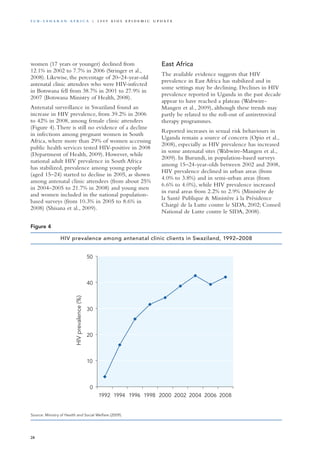
Antenatal surveillance in Swaziland found an
increase in HIV prevalence, from 39.2% in 2006
to 42% in 2008, among female clinic attendees
(Figure 4).There is still no evidence of a decline
in infections among pregnant women in South
Africa, where more than 29% of women accessing
public health services tested HIV-positive in 2008
(Department of Health, 2009). However, while
national adult HIV prevalence in South Africa
has stabilized, prevalence among young people
(aged 15–24) started to decline in 2005, as shown
among antenatal clinic attendees (from about 25%
in 2004–2005 to 21.7% in 2008) and young men
and women included in the national population-
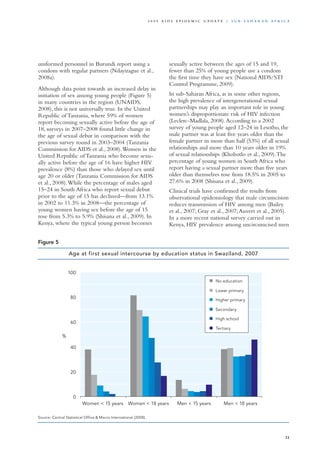
based surveys (from 10.3% in 2005 to 8.6% in
2008) (Shisana et al., 2009).
East Africa
The available evidence suggests that HIV
prevalence in East Africa has stabilized and in
some settings may be declining. Declines in HIV
prevalence reported in Uganda in the past decade
appear to have reached a plateau (Wabwire-
Mangen et al., 2009), although these trends may
partly be related to the roll-out of antiretroviral
therapy programmes.
Reported increases in sexual risk behaviours in
Uganda remain a source of concern (Opio et al.,
2008), especially as HIV prevalence has increased
in some antenatal sites (Wabwire-Mangen et al.,
2009). In Burundi, in population-based surveys
among 15–24-year-olds between 2002 and 2008,
HIV prevalence declined in urban areas (from
4.0% to 3.8%) and in semi-urban areas (from
6.6% to 4.0%), while HIV prevalence increased
in rural areas from 2.2% to 2.9% (Ministère de
la Santé Publique & Ministère à la Présidence
Chargé de la Lutte contre le SIDA, 2002; Conseil
National de Lutte contre le SIDA, 2008).
Source: Ministry of Health and Social Welfare (2009).
0
10
20
30
40
50
1992 1994 1996 1998 2000 2002 2004 2006 2008
HIVprevalence(%)
HIV prevalence among antenatal clinic clients in Swaziland, 1992–2008
Figure 4
28
S u b - S a h a r a n A f r i c a | 2 0 0 9 A I D S E p ide m i c u p da t e
According to a 2007 household survey in Kenya,
HIV prevalence has increased since 2003—
from 6.7% to 7.4% (although not statistically
significant)—reversing the decline reported in
previous studies. HIV prevalence among adults
aged 15–49 years in urban areas decreased from
10.0% in 2003 to 8.7% in 2007, while HIV prev-
alence in rural areas increased from 5.6% to 7.0%.
Interpretation of these findings remains chal-
lenging.An important factor in Kenya’s increasing
HIV prevalence is likely to be a decline in
HIV-related mortality stemming from rapid
treatment scale-up, although an increase in risky
sexual behaviour may also be playing a key role
in the apparent reversal of epidemiological trends,
especially among rural men.
West and Central Africa
Although HIV prevalence in West and Central
Africa is much lower than in southern Africa,
the subregion nevertheless is home to several
serious national epidemics.While adult HIV
prevalence is below 1% in three West African
countries (Cape Verde, Niger and Senegal),
nearly one in 25 adults (3.9%) in Côte d’Ivoire
and 1.9% of the general population in Ghana
are living with HIV (UNAIDS, 2008).A 2007
household survey found that HIV prevalence in
the Democratic Republic of the Congo (1.3%)
remains significantly lower than in several other
neighbouring countries (Ministère du Plan &
Macro International, 2008).
Some further favourable signs are apparent in
the subregion. Multiple household surveys have
detected declining HIV prevalence in Mali (from
1.7% in 2001 to 1.2% in 2006) and Niger (from
0.9% in 2002 to 0.7% in 2006). In Benin, the
percentage of antenatal clinic attendees who
tested HIV-positive fell by almost half between
2001 and 2007, from 4.1% to 2.1% (Bénin
Ministère de la Santé, 2008). Declines in HIV
prevalence among antenatal clinic attendees have
also been documented in Burkina Faso, Côte
d’Ivoire and Togo.While HIV prevalence in
the general population in Ghana has remained
stable, prevalence among 15–24-year-olds fell
from 3.2% in 2002 to 2.5% in 2006 (Bosu et al.,
2009). Other national epidemics also appear to
have stabilized, including in Sierra Leone, where
population-based surveys in 2005 and 2008 both
found an overall HIV prevalence of 1.5%.
Key regional dynamics
Heterosexual intercourse remains the primary
mode of HIV transmission in sub-Saharan Africa,
with extensive ongoing transmission to newborns
and breastfed babies. However, as the following
discussion indicates, recent evidence from epide-
miological studies to estimate the distribution
of new infections by mode of transmission in
East, southern and West Africa has shown that
epidemics in the region are much more varied
than previously understood, with notable new
infections occurring among men who have sex
with men and injecting drug users in some coun-
tries. Emerging evidence confirms elevated HIV
prevalence among sex workers, although the
contribution of sex work to new HIV infections
varies throughout the region.
Heterosexual transmission
Heterosexual exposure is the primary mode of
transmission in sub-Saharan Africa. In Swaziland,
transmission during heterosexual contact
(including sex within stable couples, casual sex and
sex work) is estimated to account for 94% of inci-
dent infections (Mngadi et al., 2009).
As epidemics in sub-Saharan Africa have matured,
models suggest that the proportion of new infec-
tions among people in stable, so-called ‘low-risk’,
partnerships is often high. In Lesotho, between
35% and 62% of incident HIV infections in 2008
occurred among people who had a single sexual
partner (Khobotlo et al., 2009). Heterosexual sex
within a union or regular partnership accounted
for an estimated 44% of incident HIV infections
in Kenya in 2006, while casual heterosexual sex
accounted for an additional 20% of new infec-
tions (Gelmon et al., 2009). In Uganda, people in
serodiscordant monogamous relationships were
estimated to account for 43% of incident infec-
tions in 2008 (Wabwire-Mangen et al., 2009).A
similar proportion of new infections (50–65%)
was estimated to occur among steady, long-term
heterosexual partners in Swaziland (Mngadi et al.,
2009). Low-risk heterosexual contact accounted
for the largest proportion (30%) of estimated
incident HIV infections in Ghana in 2008 (Bosu
et al., 2009), and individuals with only one sexual
partner are estimated to account for 27–53% of
new infections in Rwanda (Asiimwe, Koleros,
Chapman, 2009).
29
2 0 0 9 A I D S E p ide m i c u p da t e | S u b - S a h a r a n A f r i c a
The significant contribution of low-risk hetero-
sexual partnerships to epidemics in sub-Saharan
Africa has underscored the high prevalence in
many countries of serodiscordant partnerships.
Among married or cohabiting Kenyans who
were living with HIV in 2007, about 44% had a
partner who was not infected (Kenya Ministry of
Health, 2009).According to a household survey
in Swaziland in 2006–2007, one in six cohabiting
couples is serodiscordant (Central Statistical Office
& Macro International, 2008).
Mathematical models have examined the poten-
tial role of concurrent sexual partnerships in
facilitating the spread of HIV in sexual networks
(Morris & Kretzschmar, 2000). However, a recent
analysis of household survey data in 22 coun-
tries, including 18 in sub-Saharan Africa, found
no significant correlation between prevalence
of sexual concurrency and HIV prevalence at
the country or community level (Mishra &
Bignami-Van Assche, 2009). Given the severity
of national epidemics in sub-Saharan Africa and
the relative dearth of information on what might
be an important factor in the continued spread
of HIV, the UNAIDS Reference Group on
Estimates, Modelling and Projections convened
an expert consultation in April 2009 to identify a
research agenda on sexual concurrency and HIV.
In addition to recommending standardization
of definitions, terminology and methodological
approaches for measuring sexual concurrency,
meeting attendees recommended the routine
collection of pertinent data on sexual concurrency
and the initiation of focused research studies to
build the evidence base for an appropriate public
health response (Garnett, 2009).
As in many other parts of the world, the high
prevalence of regular non-marital partners among
married individuals (‘concurrency’) is tacitly
acknowledged and tolerated in some African
countries (Mngadi et al., 2009). In Lesotho, 24%
of adults have multiple sexual partners, often as
a result of extensive labour migration (Khobotlo
et al., 2009). In Swaziland, 17.9% of married or
cohabiting individuals surveyed in 2006–2007
reported having had two or more sexual partners in
the previous 12 months (Central Statistical Office
& Macro International, 2008). However, questions
in national surveys regarding multiple partners in
a given time period currently do not distinguish
between concurrent and serial partnerships.
The 2008 modes of transmission study and
epidemiological synthesis report in Swaziland
suggested that the percentage of men having
multiple partnerships may have fallen in response
to a public information campaign (Mngadi et
al., 2009). However, in Uganda, the proportion
of men (aged 15–49) reporting multiple sexual
partners increased from 24% in 2001 to 29% in
2005 (Opio et al., 2008). In 2008, 46% of new
HIV infections in Uganda were estimated to have
occurred among people with multiple sexual
partners and the partners of such individuals
(Wabwire-Mangen et al., 2009).
Surveys in countries such as Burundi and the
United Republic of Tanzania have found near-
universal knowledge about HIV (see Tanzania
Commission for AIDS et al., 2008; Ndayirague
et al., 2008b), although levels of comprehensive
knowledge about HIV transmission and its preven-
tion are often much lower.2
In most West African
countries, the number of women who have
comprehensive HIV-related knowledge is 10–20%
lower than the number of men reported to have
such knowledge (Lowndes et al., 2008). Surveys
in the United Republic of Tanzania indicate
that people with higher education and income
levels also have higher rates of comprehensive
HIV-related knowledge (Tanzania Commission for
AIDS et al., 2008).
Evidence suggests that HIV prevention
programmes may be having an impact on sexual
behaviours in some African countries. In southern
Africa, a trend towards safer sexual behaviour was
observed among both young men and young
women (15–24 years old) between 2000 and 2007
(Gouws et al., 2008). In South Africa, the propor-
tion of adults reporting condom use during the
most recent episode of sexual intercourse rose
from 31.3% in 2002 to 64.8% in 2008 (Shisana
et al., 2009). Nevertheless, condom use remains
low in many parts of sub-Saharan Africa. In
Burundi, only about one in five people report
using a condom during commercial sex episodes
(Ndayirague et al., 2008b), and only 12% of
2	
According to standard monitoring and evaluation indicators, including those used to assess progress in implementing the
2001 Declaration of Commitment on HIV/AIDS, comprehensive HIV knowledge involves not only accurate understanding of
the primary modes of HIV transmission and the effectiveness of proven sexual risk reduction methods, but also awareness of
the inaccuracy of common misconceptions about HIV (e.g. transmission via mosquito bites).
30
S u b - S a h a r a n A f r i c a | 2 0 0 9 A I D S E p ide m i c u p da t e
uniformed personnel in Burundi report using a
condom with regular partners (Ndayirague et al.,
2008a).
Although data point towards an increased delay in
initiation of sex among young people (Figure 5)
in many countries in the region (UNAIDS,
2008), this is not universally true. In the United
Republic of Tanzania, where 59% of women
report becoming sexually active before the age of
18, surveys in 2007–2008 found little change in
the age of sexual debut in comparison with the
previous survey round in 2003–2004 (Tanzania
Commission for AIDS et al., 2008).Women in the
United Republic of Tanzania who become sexu-
ally active before the age of 16 have higher HIV
prevalence (8%) than those who delayed sex until
age 20 or older (Tanzania Commission for AIDS
et al., 2008).While the percentage of males aged
15–24 in South Africa who report sexual debut
prior to the age of 15 has declined—from 13.1%
in 2002 to 11.3% in 2008—the percentage of
young women having sex before the age of 15
rose from 5.3% to 5.9% (Shisana et al., 2009). In
Kenya, where the typical young person becomes
sexually active between the ages of 15 and 19,
fewer than 25% of young people use a condom
the first time they have sex (National AIDS/STI
Control Programme, 2009).
In sub-Saharan Africa, as in some other regions,
the high prevalence of intergenerational sexual
partnerships may play an important role in young
women’s disproportionate risk of HIV infection
(Leclerc-Madlala, 2008).According to a 2002
survey of young people aged 12–24 in Lesotho, the
male partner was at least five years older than the
female partner in more than half (53%) of all sexual
relationships and more than 10 years older in 19%
of sexual relationships (Khobotlo et al., 2009).The
percentage of young women in South Africa who
report having a sexual partner more than five years
older than themselves rose from 18.5% in 2005 to
27.6% in 2008 (Shisana et al., 2009).
Clinical trials have confirmed the results from
observational epidemiology that male circumcision
reduces transmission of HIV among men (Bailey
et al., 2007; Gray et al., 2007;Auvert et al., 2005).
In a more recent national survey carried out in
Kenya, HIV prevalence among uncircumcised men
Source: Central Statistical Office & Macro International (2008).
0
20
40
60
80
100
Women < 15 years Women < 18 years Men < 15 years Men < 18 years
No education
Lower primary
Higher primary
Secondary
High school
Tertiary
%
Age at first sexual intercourse by education status in Swaziland, 2007
Figure 5
31
2 0 0 9 A I D S E p ide m i c u p da t e | S u b - S a h a r a n A f r i c a
in 2007 was found to be more than three times
higher (at 13.2%) than among men who were
circumcised (3.9%) (Kenya Ministry of Health,
2009).A 2008 analysis of available epidemio-
logical, behavioural and programmatic evidence
also concluded that the high prevalence of male
circumcision had helped to limit the epidemic’s
spread in West Africa (Lowndes et al., 2008).
Rates of circumcision vary considerably across and
within countries (Weiss et al., 2008). For example,
while more than 80% of Kenyan males (aged
15–64) outside the Nyanza province were circum-
cised in 2007 (Kenya Ministry of Health, 2009),
only 8% of men in Swaziland are circumcised
(Mngadi et al., 2009).
Several countries in the region have taken steps
to scale up medical male circumcision for HIV
prevention, including Botswana, Kenya and
Namibia (Forum for Collaborative HIV Research,
2009). For example, Botswana is integrating male
circumcision into its national surgery framework,
with the aim of reaching 80% of males aged 0–49
by 2013 (Forum for Collaborative Research, 2009).
As of March 2009, Swaziland had drafted a formal
male circumcision policy (Mngadi et al., 2009).
A recent analysis determined that the scale-up of
adult male circumcision in 14 African countries
would require considerable funding (an estimated
US$ 919 million over five years) and substantial
investments in human resources development, but
that scale-up would save costs in the long run
by altering the trajectory of national epidemics
(Auvert et al., 2008).
The benefits of male circumcision for the preven-
tion of HIV infection have also prompted
clinicians and policy-makers to examine strate-
gies for scaling up neonatal circumcision.A recent
study in South Africa concluded that painless
circumcision is feasible for nearly all newborns
if performed within the first week of birth
(Banleghbal, 2009).
Recent evidence confirms the long-established
role of untreated sexually transmitted infections
in accelerating the sexual transmission of HIV.
For example, according to the results of a
household survey in Uganda, individuals with
symptomatic herpes simplex virus type 2 infection
(HSV-2) are almost four times more likely than
those without HSV-2 to become infected with
HIV (Mermin et al., 2008b).These results are
consistent with an earlier systematic review of
19 studies that indicates that prevalent HSV-2
infection was associated with a threefold increased
risk of HIV acquisition among both men and
women in the general population (Freeman et
al., 2006).An epidemiological and economic
model applied to four diverse settings in East
and West Africa determined that more than half
of all new HIV infections could be attributed
to sexually transmitted infections (White et al.,
2008) and concluded that programmes for treating
curable sexually transmitted infections may be
cost-effective in populations with generalized
epidemics.A longitudinal study of women in
Uganda and Zimbabwe found that T. vaginalis
is strongly associated with HIV seroconversion
(Van der Pol et al., 2008). Surveys in the United
Republic of Tanzania detected an increase in
the rates of sexually transmitted infections or
genital discharges or sores, from 5% among
women and 6% among men in 2003–2004 to
6% and 7%, respectively, in 2007–2008 (Tanzania
Commission for AIDS et al., 2008). Despite the
consistently demonstrated association between
HSV-2 and HIV infection, evidence to date does
not support community-based HSV-2 suppression
as an effective HIV prevention strategy; in 2008,
results from a large multicountry study found
that acilclovir suppressive therapy did not reduce
HIV acquisition among HIV-negative, HSV-2-
seropositive men and women (Celum et al., 2008).
Heavy alcohol consumption is correlated with
increased sexual risk behaviours (Van Tieu &
Koblin, 2009). In Botswana, men who use alcohol
heavily were more than three times more likely to
have unprotected sex, to have sex with multiple
partners and to pay for sex. Similar patterns were
evident among women in Botswana, with heavy
alcohol users found to be 8.5 times more likely to
sell sex than other women. Researchers found a
strong dose–response relationship between alcohol
use and risky sexual behaviours, with problem or
heavy drinkers engaging in greater risk behaviours
than moderate drinkers (Weiser et al., 2006).
Sex work
HIV infection among sex workers and their
clients has long played an important role in the
heterosexual transmission of HIV in the region.
For sub-Saharan Africa as a whole, median
reported HIV prevalence among sex workers is
19%, with reported prevalence in this population
ranging from zero in the Comoros and Sierra
Leone to 49.4% in Guinea-Bissau (World Health
Organization, United Nations Children’s Fund,
32
S u b - S a h a r a n A f r i c a | 2 0 0 9 A I D S E p ide m i c u p da t e
UNAIDS, 2009). Seven African countries (Benin,
Burundi, Cameroon, Ghana, Guinea-Bissau, Mali
and Nigeria) report that more than 30% of all
sex workers are living with HIV (World Health
Organization, United Nations Children’s Fund,
UNAIDS, 2009). In Ghana, HIV prevalence
among female sex workers in Accra and Kumasi
is 8 to 20 times higher than among the general
population (Bosu et al., 2009). More than one
in four (25.5%) sex workers surveyed in Benin
in 2006 were HIV-positive (Bénin Ministère de
la Santé, 2008). More than one quarter of all sex
workers (26%) in Lesotho were reported to have
had a symptomatic sexually transmitted infection
in the previous year (Khobotlo et al., 2009).
Sex workers are not only a priority population
for HIV prevention programmes in their own
right—their clients have long been recognized
as a potential epidemiological bridge to other
populations. Extrapolating from the available data,
researchers concluded in 2008 that between 13%
and 29% of men in West Africa may have paid for
sex in the previous year (Lowndes et al., 2008).
As Africa’s epidemics have matured, the portion of
new infections attributable to sex work may have
declined (Lecler & Garenne, 2008). In Lesotho, a
hyperendemic country where the proportion of
sex workers is estimated to be small, the modes of
transmission model suggested that sex work was
the source of approximately 3% of new HIV infec-
tions in 2008 (Khobotlo et al., 2009).
Nevertheless, sex work continues to play a notable
role in many national epidemics. In Ghana, sex
workers, their clients and the sexual partners of
clients were estimated to account for 2.4%, 6.5%
and 23%, respectively, of all new HIV infections
in 2008 (Bosu et al., 2009). In 2006, the modes of
transmission exercise in Kenya suggested that sex
workers and their clients accounted for an estimated
14.1% of incident HIV infections (Gelmon et al.,
2009). Sex workers, their clients and the clients’
partners accounted for 10% of incident infections in
Uganda in 2008 (Wabwire-Mangen et al., 2009).A
modes of transmission study in Rwanda concluded
that sex workers accounted for 9–46% of new
infections in 2008, with the clients of sex workers
representing an additional 9–11% of incident infec-
tions (Asiimwe, Koleros, Chapman, 2009).
In Kenya, the per-act rate of HIV acquisition in
female sex workers fell fourfold between 1985 and
2005, with the fall in HIV risk predating the drop
in HIV prevalence reported in Kenya’s general
population in recent years (Kimani et al., 2008).As
the sharp reduction in HIV risk is consistent with
decreases in gonorrhoea prevalence, researchers
speculate that the reduced risk of acquiring HIV
may stem from improved prevention of sexually
transmitted infections, although condom use also
increased dramatically during this period (Kimani
et al., 2008).
The low social status of sex workers impedes
efforts to deliver HIV prevention services to this
population. Surveys in Lesotho indicate that sex
work is regarded as morally reprehensible, and the
country’s national AIDS policy explicitly notes
that the stigma associated with sex work deters sex
workers from seeking HIV testing or other health
services (Khobotlo et al., 2009).
Men who have sex with men
In recent years, an increase in research on
HIV-related risks among men who have sex
with men in sub-Saharan Africa has detected an
important, previously undocumented, component
of many national epidemics (Figure 6). In most
countries in which such serosurveys have been
conducted, researchers have identified HIV preva-
lence among men who have sex with men that is
substantially higher than among the general male
population (Smith et al., 2009).
In a study in Mombasa, Kenya, 43.0% of men who
have sex only with other men tested HIV-positive,
compared with 12.3% of men who reported
having sex with both men and women (Sander
et al., 2007). More than one in four (25.4%) men
who have sex with men surveyed in Lagos in 2007
tested HIV-positive (Federal Ministry of Health,
2007). In a 2008 study of 378 men who have sex
with men in Soweto, South Africa, researchers
found an overall HIV prevalence of 13.2%,
increasing to 33.9% among gay-identified men
(Lane et al., 2009). One third of men who have
sex with men surveyed in Cape Town, Durban and
Pretoria, South Africa, tested HIV-positive (Parry
et al., 2008).A cross-sectional anonymous survey
of 537 men who have sex with men in Malawi,
Namibia and Botswana found HIV prevalences of
21.4%, 12.4% and 19.7% among study participants
in the three countries, respectively. HIV prevalence
among study participants over the age of 30 was
twice as high as among all men who have sex with
men surveyed (Baral et al., 2009). In five urban
sites in Senegal, a low-prevalence country, 21.5%
33
2 0 0 9 A I D S E p ide m i c u p da t e | S u b - S a h a r a n A f r i c a
of men who have sex with men surveyed tested
HIV-positive (Wade et al., 2005).
A recent modes of transmission analysis indicates
that men who have sex with men may account
for as many as 20% of incident HIV infections
in Senegal (Lowndes et al., 2008). In Kenya, men
who have sex with men (including men in prison
settings) accounted for an estimated 15% of inci-
dent HIV infections nationwide in 2006 (Gelmon
et al., 2009). Similarly, a recent modelling exer-
cise concluded that men who have sex with men
accounted for an estimated 15% of new infections
in Rwanda (Asiimwe, Koleros, Chapman, 2009).
In Ghana, men who have sex with men showed
the highest HIV incidence (9.6%) of any popula-
tion and accounted for 7.2% of all new infections
in 2008 (Bosu et al., 2009). Reliable data on the
epidemic’s burden among men who have sex
with men are not available in many countries (see
Mngadi et al., 2009).
In studies in Botswana, Malawi and Namibia, lack
of consistent condom use with male partners was
significantly associated with HIV infection (Baral
et al., 2009).The same study also found that many
men apply petroleum-based lubricants when they
use a condom, which potentially contributes to
condom failure (Baral et al., 2009).
In a study of men who have sex with men in
Gauteng province in South Africa, the likelihood
of unprotected anal intercourse was significantly
associated with regular alcohol drinking (Lane
et al., 2008). Surveys in Cape Town, Durban and
Pretoria, South Africa, found that use of crack
cocaine, methamphetamine and other drugs to
facilitate sexual encounters is common among
men who have sex with men (Parry et al., 2008).
Although common in sub-Saharan Africa, homo-
sexual behaviour is highly stigmatized in the
region. More than 42% of men who have sex with
men surveyed in Botswana, Malawi and Namibia
reported experiencing at least one human rights
abuse, such as blackmail or denial of housing or
health care (Baral et al., 2009).
More than 30 countries in sub-Saharan Africa
have laws prohibiting same-sex activity between
consenting adults (Ottosson, 2009). Punishments
Source: Smith et al. (2009) and Baral (2009).
0
10
20
30
40
50
Botsw
ana
M
alaw
iN
am
ibia
South
Africa
Zam
bia
Kenya
United
Republic
ofTanzania
Uganda
C
ôte
d'Ivoire
G
hana
N
igeriaM
auritania
Senegal
Southern Africa
HIVprevalence(%)
East Africa West Africa
HIV prevalence among men who have sex with men in countries
in sub-Saharan Africa, 2000–2008
Figure 6
34
S u b - S a h a r a n A f r i c a | 2 0 0 9 A I D S E p ide m i c u p da t e
for violations of anti-sodomy laws are often severe,
with several countries authorizing the death
penalty and others providing for criminal penal-
ties in excess of 10 years imprisonment (Ottosson,
2009). In contrast with some other regions, no
trend towards the repeal of such laws is visible in
sub-Saharan Africa. In April 2009, Burundi enacted
the country’s first prohibition of consensual sexual
contact between members of the same sex.
Injecting drug use
Although less extensively studied than other key
populations, injecting drug users in sub-Saharan
Africa appear to be at high risk of HIV infection.
In the region as a whole, an estimated 221 000
injecting drug users are HIV-positive, representing
12.4% of all injecting drug users in the region
(Mathers et al., 2008). In Ghana, a modelling
exercise suggested that injecting drug users had
an estimated annual seroincidence rate of 4.0% in
2008 (Bosu et al., 2009). In 2007, 10% of injecting
drug users surveyed in the Kano region of Nigeria
tested HIV-positive (Federal Ministry of Health,
2007). In Nairobi, 36% of injecting drug users
surveyed tested HIV-positive (Odek-Ogunde et al.,
2004). Survey-based estimates of HIV prevalence
among injecting drug users in other African coun-
tries range from 12.4% in South Africa to 42.9%
in Kenya (Mathers et al., 2008).
The lack of reliable evidence on the size of
national populations of injecting drug users
inhibits the development of sound prevention
strategies (see Bosu et al., 2009). In Nigeria,
researchers found evidence of injecting drug use in
all regions of the country, but no indication of the
existence of specific HIV prevention and treatment
services for drug users (Adelakan & Lawal, 2006).
While studies have often found elevated levels of
HIV infection among communities of injecting
drug users in sub-Saharan Africa, this form of
transmission appears to be significantly outweighed
by sexual transmission with respect to prevalent
and incident infections. In Kenya, transmis-
sion during injecting drug use accounted for an
estimated 3.8% of new HIV infections in 2006
(Gelmon et al., 2009).
Mother-to-child transmission
As in the case of antiretroviral therapy, sub-
Saharan Africa has made remarkable strides in
expanding access to services to prevent mother-
to-child HIV transmission. In 2008, 45% of
HIV-infected pregnant women received anti-
retroviral drugs to prevent transmission to their
newborns, compared with 9% in 2004 (World
Health Organization, United Nations Children’s
Fund, UNAIDS, 2009). However, coverage is
much higher in eastern and southern Africa
(64%) than in West and Central Africa (27%)
(World Health Organization, United Nations
Children’s Fund, UNAIDS, 2009).
In 2008, an estimated 390 000 [210 000–570 000]
children were infected in sub-Saharan Africa.As
services to prevent mother-to-child transmission
have been brought to scale, the annual number of
new HIV infections among children has declined
fivefold in Botswana, from 4600 in 1999 to 890 in
2007 (Stover et al., 2008).There is also evidence
that mother-to-child transmission is contributing a
declining proportion of new infections in Lesotho
(Khobotlo et al., 2009).Although the vast majority
of infections in children are the result of mother-
to-child transmission, indications suggest that a
small proportion of infections in children under
the age of 15 could be the result of rape or other
sexual abuse (Khobotlo et al., 2009).
However, mother-to-child transmission continues
to account for a substantial, although decreasing,
portion of new HIV infections in many African
countries. In Swaziland, children were estimated
to account for nearly one in five (19%) new
HIV infections in 2008 (Mngadi et al., 2009).
Perinatally acquired infection accounted for
15% of new HIV infections in Uganda in 2008
(Wabwire-Mangen et al., 2009).
Inadequate knowledge about the availability of
prevention services in antenatal settings often
impedes their uptake. In the United Republic
of Tanzania, only 53% of women and 44% of
men reported awareness that medications and
other services are available to reduce the risk
of mother-to-child HIV transmission (Tanzania
Commission for AIDS et al., 2008).
HIV testing, counselling and prevention services
in antenatal settings offer an excellent oppor-
tunity not only to prevent newborns from
becoming infected but also to protect and
enhance the health of HIV-infected women. In
numerous countries in which testing data have
been reported, women are significantly more
likely than men to know their HIV serostatus,
in large measure due to the availability of testing
services in antenatal facilities.
35
2 0 0 9 A I D S E p ide m i c u p da t e | S u b - S a h a r a n A f r i c a
In 2007, a small study in rural Uganda found that
women living with HIV who become pregnant
experience a sharper decline in CD4 cells than
non-pregnant women, although no statistically
significant difference was detected between these
groups in mortality or AIDS diagnosis.The findings
led the research team to recommend that health-
care providers inform women who are infected
with HIV of the potential negative immunological
effect of pregnancy, offer women contraception
and prioritize pregnant women for antiretroviral
therapy if eligible (Van der Paal et al., 2007).
Migration
Although mobility is not itself a risk factor for
HIV, the circumstances associated with move-
ment increase vulnerability to HIV infection. In
the United Republic of Tanzania, women who
travelled away from home five or more times in
the previous 12 months were twice as likely to be
HIV-positive (12%) as those who did not travel
(Tanzania Commission for AIDS et al., 2008). In
rural KwaZulu-Natal province in South Africa, the
risk of becoming infected was found to increase
the closer an individual lived to a primary road
(Bärnighausen et al., 2008).
Consistent with earlier studies among long-
distance truck drivers and migrant mine workers
(who are more likely to engage in high-risk or
commercial sex), more recent evidence confirms
that work-related mobility often significantly
increases vulnerability to HIV infection. In
Lesotho, the separation of couples as a result of
labour migration could also be associated with
the high rate of multiple concurrent partnerships
(Khobotlo et al., 2009). Consistent with evidence
from earlier in the epidemic, recent studies suggest
that men in high-mobility occupations (such as
truck drivers) are more likely than other men to
purchase sex (Lowndes et al., 2008). Modelling
suggests that migration increases vulnerability to
HIV primarily by encouraging increased sexual
risk behaviour rather than by connecting areas of
high and low risk (Coffee, Lurie, Garnett, 2007).
Prisoners
Population-based rates of incarceration vary
substantially among countries in sub-Saharan
Africa (Dolan et al., 2007).Among 20 countries
for which HIV prevalence data on prison popula-
tions are available, eight report that at least 10%
of prisoners are HIV-infected either nationally or
in parts of the country (Dolan et al., 2007).
Medical injections
A small percentage of prevalent HIV infections
in sub-Saharan Africa is estimated to stem from
unsafe injections in medical settings. In an
analysis in 2004, it was estimated that unsafe
injections and the use of other contaminated skin
piercing instruments accounted for 2.5% of all
HIV infections in the region (Hauri,Armstrong,
Hutin, 2004). In an analysis of data from Kenya,
medical injections were estimated to be the
source of 0.6% of all HIV infections, with blood
transfusions accounting for an additional 0.2% of
infections (Gouws et al., 2006).
Analysing serobehavioural survey data from
Uganda from 2004–2005, researchers in 2008
concluded that receipt of multiple medical
injections was significantly associated with HIV
infection (Mishra et al, 2008b). In Uganda, men
and women who received five or more medical
injections in the previous year were significantly
more likely to be HIV-infected (10.8% and
11.4% HIV prevalence, respectively) than those
who received no injections (4.0% and 6.3%,
respectively). After accounting for other risk
factors and potential confounding factors,
men and women who received five or more
injections were found to be 2.35 times more
likely to be infected with HIV than those who
had no injections.
36
S u b - S a h a r a n A f r i c a | 2 0 0 9 A I D S E p ide m i c u p da t e
Asia
Asia, home to 60% of the world’s population, is
second only to sub-Saharan Africa in terms of the
number of people living with HIV. India accounts
for roughly half of Asia’s HIV prevalence.
With the exception of Thailand, every country in
Asia has an adult HIV prevalence of less than 1%.
However, owing to the region’s large population,
Asia’s comparatively low HIV prevalence translates
into a substantial portion of the global HIV burden.
Notwithstanding its comparatively low HIV
prevalence,Asia has not escaped the epidemic’s
harmful consequences.The economic conse-
quences of AIDS will force an additional 6 million
households in Asia into poverty by 2015 unless
national responses are significantly strengthened
(Commission on AIDS in Asia, 2008).
Substantial improvements in HIV surveillance
systems are evident in many countries. In China,
for example, the number of HIV surveillance sites
increased by roughly 20% between 2005 and 2007
(Wang et al., 2009). Likewise, the first national
population-based survey in Cambodia generated
strategic information on HIV prevalence and rele-
vant behaviours in the general population (Sopheab
et al., 2009). Particular strides have been made in
improving epidemiological and behavioural data
regarding the populations most heavily affected by
the epidemic. For example, Myanmar in 2007 began
In 2008, 4.7 million [3.8 million–5.5 million] people in Asia were living with HIV, including 350 000 [270 000–410 000]
who became newly infected last year.Asia’s epidemic peaked in the mid-1990s, and annual HIV incidence has subsequently
declined by more than half. Regionally, the epidemic has remained somewhat stable since 2000.
In 2008, an estimated 330 000 [260 000–400 000] AIDS-related deaths occurred in Asia.While the annual
number of AIDS-related deaths in South and South-East Asia in 2008 was approximately 12% lower than the
mortality peak in 2004, the rate of HIV-related mortality in East Asia continues to increase, with the number of
deaths in 2008 more than three times higher than in 2000.
Regional overview
Number of people living with HIV	 2008: 4.7 million 	 2001: 4.5 million
	 [3.8 million–5.5 million]	 [3.8 million–5.2 million]		
Number of new HIV infections	 2008: 350 000 	 2001: 400 000
	 [270 000–410 000]	 [310 000–480 000] 		
	
Number of children newly infected	 2008: 21 000	 2001: 33 000	
	 [13 000–29 000]	 [18 000–49 000]	 	
		
Number of AIDS-related deaths	 2008: 330 000	 2001: 280 000
	 [260 000–400 000 ]	 [230 000–340 000]
37
2 0 0 9 A I D S E p ide m i c u p da t e | A sia
including men who have sex with men in sentinel
surveillance activities. However, recent reviews have
emphasized the persistence of information gaps
regarding populations at higher risk in some parts of
Asia and the need to further strengthen HIV infor-
mation systems (Wang et al., 2009).
A wide variation in epidemiological patterns
between different Asian settings is apparent. For
example, while sexual transmission is driving the
epidemic throughout most of India, accounting
for nearly 90% of prevalence nationwide, trans-
mission during injecting drug use is the primary
transmission mode in the north-eastern part of the
country (National AIDS Control Organisation,
2008). In China, while the five highest-prevalence
provinces account for 53.4% of prevalence, the
five provinces with the lowest prevalence account
for less than 1% of total infections (Wang et al.,
2009). In the Papua province of Indonesia, where a
generalized epidemic similar to the one in neigh-
bouring Papua New Guinea has emerged, HIV
prevalence is 15 times higher than the national
average (National AIDS Commission, 2008).
An evolving epidemic
Asia’s epidemic has long been concentrated in
specific populations, namely injecting drug users,
sex workers and their clients, and men who have
sex with men. However, the epidemic in many
parts of Asia is steadily expanding into lower-risk
populations through transmission to the sexual
partners of those most at risk. In China, where the
epidemic was previously driven by transmission
during injecting drug use, heterosexual transmis-
sion has become the predominant mode of HIV
transmission (Wang et al., 2009).
While the regional epidemic appears to be
stable overall, HIV prevalence is increasing in
some parts of the region, such as Bangladesh
and Pakistan. Bangladesh has transitioned from a
low-level epidemic to a concentrated epidemic,
with especially elevated rates among injecting
drug users (Azim et al., 2008).A more prom-
ising picture has emerged in the heavily affected
Indian states of Andhra Pradesh, Karnataka,
Maharashtra and Tamil Nadu, where HIV preva-
Source: UNAIDS/WHO.
Number of people living with HIV Adult (15–49) HIV prevalence (%)
Number of people newly infected with HIV Number of adult and child deaths due to AIDS
1990 1993 1996 1999 2002 2005 2008
1990 1993 1996 1999 2002 2005 2008
Number(millions)
1990 1993 1996 1999 2002 2005 2008
1990 1993 1996 1999 2002 2005 2008
Number(millions)
Number(millions)
%
0
2
4
6
8
0.0
0.2
0.4
0.6
0.8
1.0
0.0
0.1
0.2
0.3
0.4
0.0
0.2
0.4
0.6
0.8
1.0
Asia estimates 1990−2008
Estimate
High and low estimates
Figure 7
38
A sia | 2 0 0 9 A I D S E p ide m i c u p da t e
lence among 15–24-year-old women attending
antenatal clinics declined by 54% between 2000
and 2007 (Figure 8) (Arora et al., 2008). Likewise,
a national population-based study in Cambodia
found an overall HIV prevalence of 0.6%,
confirming the long-term decline in HIV preva-
lence nationally (Sopheab et al., 2009).
Regionally, with the growth in transmission
among the low-risk heterosexual population,
vigilance is needed in order to prevent the
epidemic from entering a new period of growth.
The importance of sustained prevention efforts
in Asia was confirmed by a recent meta-analysis
of available data inViet Nam, which found that
many low-risk women may be at considerable
risk of HIV infection due to the high-risk sexual
and drug-using behaviours of their male partners
(Nguyen et al., 2008).
The proportion of women living with HIV in
the region rose from 19% in 2000 to 35% in
2008. In particular countries, the growth in HIV
infections among women has been especially
striking. In India, women accounted for an
estimated 39% of prevalence in 2007 (National
AIDS Control Organisation, 2008). During this
decade, women’s share of HIV cases in China
doubled (Lu et al., 2008).
Need for continued vigilance
Although Asia has produced some of the world’s
most noteworthy national prevention successes,
many national strategic plans fail to accord suffi-
cient priority to HIV prevention. In a region
where the heavy concentration of infections in
discrete populations offers an opportunity to radi-
cally curtail the epidemic’s expansion, the failure
of many national programmes to prioritize preven-
tion services for populations at higher risk is
especially worrisome (Commission on AIDS in
Asia, 2008).
Thailand provides a vivid illustration of both
the power of HIV prevention leadership and
the importance of sustaining a robust response
over time.With visionary leadership and imple-
mentation of evidence-informed public health
strategies in the 1990s,Thailand managed to
arrest an epidemic that threatened to spiral out of
control. However, after funding for basic preven-
tion services was slashed as a result of the Asian
economic crisis in the late 1990s, HIV incidence
subsequently increased. Having intensified national
Figure 8
Source: Arora et al. (2008).
Logarithmic trend line; test for trend by logistic regression, with age adjustment to the entire study population,
n = 202 254 for the south, n = 221 588 for the north.
0.0
0.5
1.0
1.5
2.0
2.5
2000 2001 2002 2003 2004 2005 2006 2007
Age-adjustedHIVprevalence(%)
Southern states
Northern states
Age-adjusted HIV prevalence among antenatal attendees aged 15–24
from 2000 to 2007 in high-prevalence southern states
(Andhra Pradesh, Karnataka, Maharashtra and Tamil Nadu) and northern states of India
39
2 0 0 9 A I D S E p ide m i c u p da t e | A sia
prevention efforts,Thailand has again succeeded
in reducing HIV incidence in recent years
(Punyacharoensin &Viwatwongkasem, 2009).
As the discussion below reveals, the region does
not lack models of courageous AIDS leadership.
Particularly noteworthy are the recent expansion
of HIV prevention services for traditionally
marginalized populations in several settings and
the steps taken in different countries to address
legal and social impediments to an effective
response. In China, national financial outlays for
HIV programmes overall rose more than threefold
between 2003 and 2006 (State Council AIDS
Working Committee Office & UN Theme Group
on AIDS, 2008).
Mixed success on treatment scale-up
The regional picture regarding treatment scale-up
is mixed.As of December 2008, 37% of those in
Asia needing antiretroviral therapy were receiving
it (World Health Organization, United Nations
Children’s Fund, UNAIDS, 2009), somewhat
below the global average (42%) for all low- and
middle-income countries.This represents a seven-
fold increase in treatment access in five years.
Improvement is needed in promoting widespread
knowledge of HIV sersostatus (Commission on
AIDS in Asia, 2008). For example, it is estimated
that fewer than one in three people living with
HIV in China have been diagnosed (Wang et al.,
2009).
Key regional dynamics
Asia’s epidemic is diverse, with different transmis-
sion routes predominating in different parts of
the region.While discrete populations—primarily
injecting drug users and sex workers and their
clients—have accounted for most HIV infections,
onward sexual transmission to the female part-
ners of drug users and the clients of sex workers
is becoming increasingly apparent. In addition, a
growing body of data has documented exception-
ally high transmission rates among men who have
sex with men and transgender people.
Sex work
According to national surveys, the percentage of
national populations that sell sex ranges from 0.2%
to 2.6% of the female population, depending on
the country (Vandepitte et al., 2006). (A survey
in two urban areas in China generated some-
what higher estimates, finding that sex workers
accounted for 3.4% to 3.6% of the total female
urban population (Zhang et al., 2007a).)
Although the total population of female sex workers
in the region is relatively small, the number of male
clients is much greater (Commission on AIDS in
Asia, 2008). In China alone, the number of male
clients of female sex workers may be as high as 37
million (Wang et al., 2009).
In many Asian countries, sex workers are at an
extremely high risk of infection (Figure 9). In
Myanmar, for example, more than 18% of female
sex workers are infected with HIV. In four states of
southern India, surveys found an HIV prevalence
of 14.5% among female sex workers (Ramesh et
al., 2008). Since condoms are not consistently used
during sex work, sex workers have an elevated risk
of becoming infected, which in turn can result in
subsequent transmission to their male clients. In
China, 60% of female sex workers do not consis-
tently use condoms with their clients (Wang et
al., 2009). Inadequate condom use during sex
work risks future HIV outbreaks in settings where
HIV prevalence is currently low; while a recent
survey of sex workers in the Hong Kong Special
Administrative Region found no cases of HIV
infection, more than half (50.7%) reported having
failed to use condoms consistently with their male
clients (Lau et al., 2007).
As in other regions, in Asia there is often consid-
erable overlap between the populations of sex
workers and injecting drug users (Bokhari et
al., 2007). In a study of injecting drug users in
Sichuan province in China, more than 40% of
females and 34% of males were engaged in sex
work (Gu et al., 2009).
The sex worker population is not homogenous,
and sex workers’ various modes of work and life
patterns may have an important effect on HIV
risk. In India, brothel-based female sex workers
are more likely than home-based sex workers to
be infected with HIV, and the risk is also greater
for sex workers who are not currently married
(Ramesh et al., 2008).
Male sex workers are also at high risk of infec-
tion. In Thailand, HIV prevalence among male
sex workers is more than twice as high as
among their female counterparts and is currently
trending upwards (National AIDS Prevention and
Alleviation Committee, 2008). In Indonesia, HIV
40
A sia | 2 0 0 9 A I D S E p ide m i c u p da t e
Source: Bokhari et al. (2007).
55
63
61
82
51
57
45
60
31
42
20
28
0 20 40 60 80 100
Hijras
Male sex
workers
Male clients of
female sex
workers
Female sex
workers
Has never heard of HIV or AIDS
Does not know that condoms
can prevent transmission of HIV
No perceived HIV risk
Per cent
Vulnerability to sexual HIV transmission in commercial sex in Karachi and Lahore, Pakistan
Figure 9
prevalence is nearly three times higher among
male sex workers (20.3%) than among female
sex workers (7.1%) (National AIDS Commission,
2008). In the Pakistani cities of Karachi and
Lahore, 4% of male sex workers are infected with
HIV (Bokhari et al., 2007). Sex work is common
among male transgender people (hijras) in South
Asia (Khan et al., 2008).
Stigma and discrimination against sex workers are
widespread. Buying or selling sex is widely crimi-
nalized in Asia, although the degree to which such
laws are enforced often varies. Moreover, when
laws are enforced, punishment is typically harsher
for the worker than for the client. In 2009,Taiwan,
China, began a process of legalizing sex work, due
at least in part to demands from sex workers for
equitable treatment.
There is abundant evidence in Asia that sound
prevention services focusing on sex workers
can generate substantial public health benefits.
Beginning with the implementation of the 100
Percent Condom Programme in brothels, HIV
prevalence among female sex workers in Thailand
fell from 33.2% in 1994 to 5.3% in 2007 (National
AIDS Prevention and Alleviation Committee, 2008).
The Avahan India AIDS Initiative—launched
by the Bill & Melinda Gates Foundation, with
ownership now being transitioned to the national
government—has dramatically expanded preven-
tion services for sex workers in states with a high
HIV prevalence (Figure 10). Due to the efforts
of the National AIDS Control Office,Avahan
and others, prevention services now reach more
than 80% of female sex workers in four heavily
affected states (Bill & Melinda Gates Foundation,
2008).As prevention services for sex workers have
been brought to scale in high-prevalence areas
of India, reported condom use during sex work
is increasing and the prevalence of curable sexu-
ally transmitted infections is on the decline (Bill
& Melinda Gates Foundation, 2008). Between
2003 and 2006, HIV prevalence among female
sex workers in India fell by more than half—
from 10.3% to 4.9% (National AIDS Control
Organisation, 2008). In Pune, India, female sex
workers’ risk of becoming infected with HIV
declined by more than 70% between 1993 and
2002, and similarly sharp declines in HIV inci-
dence were reported for male clients of sex
workers, primarily as a result of increased condom
use (Mehendale et al., 2007).
Sex-trafficked women comprise a subset of
the population of female sex workers in Asia.
According to global monitoring of human traf-
41
2 0 0 9 A I D S E p ide m i c u p da t e | A sia
ficking, East Asia is particularly prominent as a
source of women who are trafficked for sex work:
East Asian trafficking victims have been detected
in more than 20 countries worldwide (United
Nations Office on Drugs and Crime, 2009a).
Women and girls who have been trafficked to
India may be contributing to an expansion of
the epidemic in Nepal.A survey of 246 sex-
trafficked women and girls in Nepal determined
that 30% were HIV-positive, with HIV-infected
individuals more likely than their uninfected peers
to be infected with syphilis and/or hepatitis B
(Silverman et al., 2008).
Heterosexual transmission
Transmission among sex workers and their clients
is helping to drive a much broader epidemic of
heterosexually acquired HIV, resulting in extensive
transmission among individuals who engage in
low levels of risk behaviour.Acquisition of HIV
during heterosexual intercourse is now reported
as the dominant mode of transmission in China
(Wang et al., 2009), with the share of heterosexu-
ally acquired incident infections tripling between
2005 and 2007 (Lu et al., 2008). Likewise, in
Indonesia an epidemic that was originally confined
to injecting drug users is now becoming more
generalized through increased sexual transmission
(National AIDS Commission, 2008). Increasingly,
male members of populations at higher risk are
exposing their female sexual partners to HIV,
resulting in a steady rise in HIV prevalence among
low-risk heterosexual women. In Cambodia,
the age differential between spouses is positively
correlated with women’s increased risk of HIV
infection (Sopheab et al., 2009).With a diffuse
epidemic characterized by considerable hetero-
sexual transmission,Tanah Papua in Indonesia has
an HIV prevalence of 2.4% in the adult population
(aged 15–49) (Statistics Indonesia & Ministry of
Health, 2007).
Source: Avahan and State AIDS Control Society programme data (2008).
36% 26%38%
74%26%
61% 11%29%
58% 20%22%
26% 22%53%
26% 12%62%
49% 26%24%
36%64%
76% 5%19%
70% 14%15%
Injecting
drug users
Tamil Nadu*
21 000 est.
Maharashtra
27 000 est.
Andhra Pradesh
46 000 est.
Karnataka
26 000 est.
Tamil Nadu*
84 000 est.
Maharashtra
72 000 est.
Andhra Pradesh
115 000 est.
Karnataka
89 000 est.
Nagaland
28 000 est.
Manipur
35 000 est.
Female
sex workers
High risk—
men who have
sex with men
Per cent of mapped urban
key population covered**
Government of India and others Avahan Uncovered
36% 26%38%
74%26%
61% 11%29%
58% 20%22%
26% 22%53%
26% 12%62%
49% 26%24%
36%64%
76% 5%19%
70% 14%15%
Saturating prevention coverage through complementary programming.
Avahan has achieved a high coverage of target populations (routine programme monitoring data)
Percentages indicate intended coverage through establishment of services in specific geographic areas.
* Includes districts with no intended coverage.
** Mapping and size estimation quality varies by state.
Does not include rural areas
Figure 10
42
A sia | 2 0 0 9 A I D S E p ide m i c u p da t e
Source: Chen et al. (2007).
Comparison of the incidence of syphilis in China reported from 26 sentinel sites and
from the nationwide sexually transmitted disease surveillance system
0
5
10
15
20
25
30
35
1993 1994 1995 1996 1997 1998 1999 2000 2001 2002 2003 2004 2005
Reported incidence of total syphilis
from sentinel sites
Reported incidence of total syphilis
from the nationwide sexually transmitted
disease surveillance system
Incidence(per100000)
Figure 11
Rapid economic development in Asia has been
accompanied by significant changes in sexual
patterns. In China, studies indicate that syphilis
cases have risen dramatically since the early 1990s
(Figure 11) (Chen et al., 2007).Where such
evidence is available, behavioural surveys indicate
a trend towards earlier initiation of sexual activity
in most Asian countries (Wellings et al., 2006).
Whether such trends portend an eventual increase
in heterosexual HIV transmission remains unclear,
as roughly 95% of prevalent infections among
young people in Asia are among adolescents at
higher risk (Economic and Social Commission for
Asia and the Pacific, 2008).
The popularity of methamphetamine and other
amphetamine-type stimulants in East and South-
East Asia is cause for concern with respect to the
risk of sexual HIV transmission. Extensive research
in both high-income and developing countries
has correlated use of methamphetamine and other
amphetamine-type stimulants with sexual risk
behaviours and HIV infection (Van Tieu & Koblin,
2009). Up to 20 million people in East and South-
East Asia used amphetamine-type stimulants in
2007, with powerful methamphetamine serving as
the drug of choice in this class (United Nations
Office on Drugs and Crime, 2009b).
Injecting drug users
More than 4.5 million people in Asia are estimated
to inject drugs.With an estimated 2.4 million
drug injectors, China is estimated to have the
world’s largest population of injecting drug users
(Mathers et al., 2008), although the percentage of
the national population that injects drugs is higher
in some other countries.There are estimated to be
between 70 000 and 300 000 injecting drug users
in the Islamic Republic of Iran, while the esti-
mated number of injecting drug users in Pakistan
ranges from 54 000 to 870 000 (Iranian National
Center for Addiction Studies, 2008).
In part, the region’s comparatively heavy burden
of injecting drug use stems from the presence of
long-standing trafficking routes for illicit opium
(Lu et al., 2008). Opiates are the drug of choice
for 65% of Asia’s drug rehabilitation patients,
although drug use patterns vary greatly within
the region (United Nations Office on Drugs and
Crime, 2009b).
43
2 0 0 9 A I D S E p ide m i c u p da t e | A sia
Injecting drug users have some of the highest HIV
prevalence of any population in Asia. Regionally,
16% of injecting drug users are believed to be
HIV-infected (Mathers et al., 2008). However,
HIV prevalence among drug users is consider-
ably higher in many parts of Asia. In Thailand,
30–50% of injecting drug users are believed to
be living with HIV (National AIDS Prevention
and Alleviation Committee, 2008). More than
one in three injecting drug users in Myanmar
(37.5%) are HIV-infected, and nearly one in
four (23%) injecting drug users in urban settings
in Pakistan are HIV-positive (Bokhari et al.,
2007). More than half of injecting drug users
(52%) in Indonesia are living with HIV, with a
slightly higher prevalence among female injectors
(National AIDS Commission, 2008). In China,
estimated HIV prevalence among injecting drug
users ranges from 6.7% to 13.4% (Wang et al.,
2009). In one prefecture inYunnan province,
China, more than half (54%) of injectors are esti-
mated to be HIV-infected (Jia et al., 2008). HIV
prevalence among injecting drug users exceeds
10% in seven states in India, according to sentinel
surveillance undertaken in 2006 (National AIDS
Control Organisation & National Institute of
Health and Family Welfare, 2007). In a survey
of injecting drug users in Kabul, 36.6% of indi-
viduals surveyed exhibited antibodies to hepatitis
C and 6.5% were antibody-positive for hepatitis
B (Todd et al., 2007). In the Islamic Republic of
Iran, injecting drug use accounts for more than
two thirds (67.5%) of reported HIV cases (Iranian
National Center for Addiction Studies, 2008). In
Bangladesh, where very low levels of HIV were
reported in earlier surveys, a new round of serosur-
veillance in 2006 found that 7% of injecting drug
users surveyed were HIV-infected in Dhaka
(Azim et al., 2008).
Injecting drug users in Asia report high rates
of risk behaviour.Among injecting drug users
surveyed in Pakistan, two thirds reported sharing
needles during the previous week (Bokhari et
al., 2007). Surveys in China indicate that 40% of
injecting drug users share needles (Wang et al.,
2009).
Regional coverage for harm reduction
programmes is believed to be extremely low,
although definitive coverage estimates are not
currently available in most settings (Commission
on AIDS in Asia, 2008).The United Nations
Office on Drugs and Crime estimates that available
financial resources for harm reduction programmes
in Asia represent only about 10% of actual need
(Bergenstrom, 2009).
Several countries in the region have taken steps to
expand access to evidence-informed strategies to
prevent new infections among injecting drug users.
For example, Indonesia revised its national AIDS
strategy in 2007 to include harm reduction, and
the country’s supreme judicial court issued a ruling
that officially prioritized drug rehabilitation over
incarceration of drug users. UNAIDS regional
staff in Asia report that access to harm reduction
has also increased in other countries, including
Bangladesh, Malaysia andViet Nam.The Islamic
Republic of Iran has invested in drug substitution
programmes, overdose prevention and needle and
syringe programmes (Iranian National Center for
Addiction Studies, 2008).
China has launched a major push to expand
access to harm reduction programmes for drug
users (Sullivan & Wu, 2007).As of late 2007, more
than 88 000 drug users had enrolled in metha-
done maintenance treatment programmes, with
an annual retention rate of 64.5%, and nearly
50 000 drug users were participating in needle and
syringe programmes (State Council AIDS Working
Committee Office & UN Theme Group on
AIDS, 2008).While policy-makers in China were
convinced by public health evidence of the effec-
tiveness of harm reduction, a critical ingredient
for the rapid scaling-up of prevention services for
drug users has been increased acceptance of the
approach by public security personnel (Reid &
Aiken, 2009).
Where harm reduction measures have been imple-
mented, they have slowed the spread of infection.
For example, after harm reduction programmes
were introduced in south-western China, annual
HIV incidence among injecting drug users in the
area declined by nearly two thirds (Ruan et al.,
2007). In Manipur, India, HIV prevalence among
injecting drug users and reported needle sharing at
last injection fell by more than two thirds during
the seven years after implementation of harm
reduction programmes (Economic and Social
Commission for Asia and the Pacific, 2008).
Men who have sex with men
Men who have sex with men in Asia face nearly
one in five odds (18.7%) of being infected with
HIV (Baral et al., 2007). In a region where overall
HIV prevalence is low, high levels of infection
among men who have sex with men have been
44
A sia | 2 0 0 9 A I D S E p ide m i c u p da t e
Source: Ma et al. (2007).
0
2
4
6
8
10
12
14
2004 2005 2006
Prevalence(%)
HIV
Hepatitis B
Hepatitis C
Syphilis
Trends in HIV, hepatitis B, hepatitis C and syphilis in men who have sex with men
in Beijing in 2004, 2005 and 2006
Figure 12
reported in numerous locations—29.3% in
Myanmar in 2008 (National AIDS Programme,
2009), 30.7% in Bangkok (Chemnasiri et al.,
2008), 12.5% in Chongqing, China (Feng et al.,
2009), between 7.6% and 18.1% in a study of
over 4500 self-identified men who have sex with
men in southern India (Brahmam et al., 2008) and
between 4% and 32.8% in sentinel surveillance in
16 cities in India in 2006 (National AIDS Control
Organisation & National Institute of Health and
Family Welfare, 2007), 5.6% inVientiane (Sheridan
et al., 2009) and 5.2% nationally in Indonesia
(National AIDS Commission, 2008). In 2007, men
who have sex with men were estimated to account
for more than 12% of HIV incidence in China
(Wang et al., 2009).
Indications suggest that the epidemic among
men who have sex with men is expanding in
Asia. Surveillance indicates that the number of
cases in this population in China is increasing
(Wang et al., 2009; State Council AIDS Working
Committee Office & UN Theme Group on
AIDS, 2008). Periodic surveys of men who have
sex with men in Bangkok over the past several
years have likewise detected a steadily increasing
HIV prevalence (Chemnasiri et al., 2008). In the
Shandong province of China, HIV prevalence in
this population rose from 0.05% in 2007 to 3.1%
in 2008 (Ruan et al., 2009). Separate studies in
Chongqing, China, also detected a notable increase
in HIV prevalence among men who have sex with
men between 2006 and 2007 (Feng et al., 2009),
and annual surveys in Beijing in 2004, 2005 and
2006 identified a clear upward trend in prevalence
(Figure 12) (Ma et al., 2007).
Surveys indicate that a considerable proportion of
Asian men who have sex with men also have sex
with women (Sheridan et al., 2009). Recently, a
number of studies have focused on epidemiolog-
ical and behavioural differences between men who
have sex only with other men and those who have
sex with both men and women. In Bangkok, men
who have sex only with other men are more than
2.5 times more likely to be HIV-infected than
men who have sex with both men and women
(Li et al., 2009).While one study in Jinan, China,
found that unmarried men who have sex only
with other men were more than six times more
likely to be HIV-infected than married men with
both male and female partners (Ruan et al., 2009),
another survey in Chongqing, China, determined
45
2 0 0 9 A I D S E p ide m i c u p da t e | A sia
that married men who have sex with men were
more than twice as likely to be infected as their
non-married counterparts (Feng et al., 2009).
Many Asian men who have sex with men engage
in high rates of risk behaviour. Studies in China,
Thailand andViet Nam have found that many
men who have sex with men have multiple sex
partners (de Lind van Wijngaarden et al., 2009;
Ruan et al., 2009; Ruan et al., 2008). For example,
70% of men who have sex with men surveyed
in an urban area in China reported having more
than one sexual partner in the previous six months
(Wang et al., 2009). Reported condom use among
men who have sex with men is low (see Ma et al.,
2007; Mansergh et al., 2006). In a survey in the
Lao People’s Democratic Republic, for example,
fewer than one in four men who have sex with
men reported consistent condom use with non-
regular partners (Sheridan et al., 2009). Men who
have sex with men experience extremely elevated
rates of syphilis and other sexually transmitted
infections (Ruan et al., 2008).
A recent study in Bangkok found that the
percentage of men who have sex with men who
reported using drugs rose sixfold between 2003
and 2007—from 3.6% to 20.7%—and the propor-
tion who said that they used drugs during sex
increased from 0.8% to 6.3% (Chemnasiri et al.,
2008). In a survey of 541 men who have sex with
men in Beijing, having three or more alcoholic
drinks a week was significantly associated with
syphilis infection (Ruan et al., 2008).
Relatively few epidemiological and behavioural
studies have been conducted among male trans-
gender people (known as hijras in South Asia)
in the region. However, evidence indicates that
the epidemic is heavily affecting transgender
communities.The National AIDS Commission in
Indonesia estimates that HIV prevalence among
the transgender community (waria) ranges from
3% to 17% (National AIDS Commission, 2008).
Although a recent study in a city in Pakistan found
low HIV prevalence (1%) among hijras, 58% had
a sexually transmitted infection, with 38% having
multiple infections, and few used condoms (Khan
et al., 2008). In a survey of men who have sex
with men in Mumbai, India, men who had sex
with hijras had higher HIV prevalence than those
who did not (Hernandez et al., 2006). In a large
study in southern India, HIV prevalence among
hijras in 2006 was found to be 18.1% (Brahmam
et al., 2008).
Widespread stigma and discrimination associ-
ated with same-sex sexual orientation is common
in the region and is frequently life-threatening.
Seventeen per cent of men who have sex with
men surveyed inVientiane reported suicidal
ideation, which was the sole variable significantly
and independently associated with HIV infection
(Sheridan et al., 2009). Nearly half (45%) of hijras
surveyed in Pakistan said that they had experi-
enced discrimination on the basis of their sexual
orientation, and 40% had experienced physical
abuse or forced sex (Sheridan et al., 2009).
In many cases the social exclusion of men who
have sex with men is reinforced or institutional-
ized by national legal frameworks.At least 11
Asian countries have laws that prohibit sexual
activity between consenting adults of the same
sex (Ottosson, 2009). In response to a peti-
tion by gay rights groups, the Supreme Court of
Nepal decreed in 2008 that sexual and gender
minorities have full constitutional rights. In July
2009, the High Court in Delhi overturned the
country’s 150-year-old statute outlawing homo-
sexuality, finding that the law exposed the lesbian,
gay, bisexual and transgender community to
“harassment, exploitation, humiliation, cruel and
degrading treatment”.The Delhi High Court
also specifically determined that the sodomy law
impeded access to HIV services by men who have
sex with men.
In part due to such punitive legal frameworks, the
community-based infrastructure among men who
have sex with men has historically been poorly
developed throughout much of Asia. However, as
the recent achievements in Nepal and India make
clear, men who have sex with men and other
sexual minorities have made remarkable strides in
recent years in mobilizing their communities for
advocacy, social support and service delivery. In
part, this appears to stem from a rapidly developing
community consciousness in many parts of the
region. In the northern Chinese city of Harbin,
the percentage of men who have sex with men
who self-identify as homosexual rose from 58% in
2002 to 80% in 2006, and the proportion living
with a male partner increased from 12% to 41%
(Zhang et al., 2007b).
Prevention coverage for men who have sex with
men remains extremely low in Asia (Commission
on AIDS in Asia, 2008). However, recent expe-
rience demonstrates the feasibility of scaling
up prevention services for this population.The
46
A sia | 2 0 0 9 A I D S E p ide m i c u p da t e
Avahan India AIDS Initiative and government
officials report that near universal coverage for
HIV prevention services has been achieved for
men who have sex with men in Andhra Pradesh,
Karnataka and Maharashtra states in India (Bill &
Melinda Gates Foundation, 2008).
China has also launched a national effort to reach
men who have sex with men with HIV prevention
services, supporting and partnering with commu-
nity organizations. However, substantial additional
progress is required in order to address the preven-
tion needs of this population, as China estimated
that as of late 2007 it had achieved HIV prevention
coverage for about 8% of men who have sex with
men (State Council AIDS Working Committee
Office & UN Theme Group on AIDS, 2008).
Migrants
Nearly 50 million people in the Asia and Pacific
region are not living in their country of birth
(Economic and Social Commission for Asia and
the Pacific, 2008). However, the number of inter-
national migrants in Asia is vastly outweighed by
people who migrate internally. China’s so-called
‘floating population’—generated in large measure
by migration for work from rural to urban areas—
now approaches 150 million people (National
Population and Family Planning Commission of
China, 2008).
Although migration itself is not a risk factor for
HIV, the circumstances in which migration occurs
may increase vulnerability to infection. Studies in
China have found that rural-to-urban migrants
report frequent substance use and intoxication
(Chen et al., 2008) and elevated rates of sexually
transmitted infections (He et al., 2009; Chen
et al., 2007). In some parts of Asia, such as the
India–Nepal border, cross-border migration among
sexual and drug-using networks appears to be
contributing to a two-way flow of HIV (Nepal,
2007). Often excluded from basic health services
in the settings to which they have migrated
(Economic and Social Commission for Asia and
the Pacific, 2009), migrants are significantly more
likely than non-migrants to delay seeking medical
treatment for infectious diseases (Wang et al., 2008).
Many Asian countries fail to address the role
of mobility in their national AIDS frameworks,
although a number of countries, including
Bangladesh, India and Nepal, have implemented
HIV prevention initiatives for cross-border
migrants (Economic and Social Commission for
Asia and the Pacific, 2009). In response to the
potential impact of population migration on the
dynamics of the epidemic, China in 2006 launched
a national HIV education and communication
campaign focused on rural-to-urban migrants
(State Council AIDS Working Committee Office
& UN Theme Group on AIDS, 2008).
Mother-to-child transmission
An estimated 21 000 [13 000–29 000] children
under the age of 15 were newly infected with
HIV in Asia in 2008.To date, mother-to-child
transmission has been responsible for a relatively
modest share of new HIV infections in the region.
In 2007, perinatal transmission accounted for an
estimated 1.1% of incidence in China (Wang et al.,
2009).
As of December 2008, 25% of HIV-infected
pregnant women in the region received antiretro-
viral drugs for the prevention of mother-to-child
transmission (World Health Organization, United
Nations Children’s Fund, UNAIDS, 2009).While
this represents a significant improvement over
2004, when a regional prevention coverage of
8% was reported, regional prevention coverage in
antenatal settings in 2008 was less than the global
average (45%) for low- and middle-income coun-
tries.The number of new HIV infections among
children (0–14 years) remains relatively stable in
South and South-East Asia, although the rate of
mother-to-child transmission is still increasing in
East Asia.
Prisoners
Incarcerated populations in Asia appear to have
a substantially higher HIV prevalence than the
general population. In a region where national
HIV prevalence is relatively low, at least three
countries (Indonesia, Malaysia andViet Nam)
report that HIV prevalence in the prison popu-
lation exceeds 10%. However, HIV-related
information is not available for the prison systems
in all countries (Dolan et al., 2007).Access to
antiretroviral therapy or harm reduction services
is limited in most prison settings in the region
(Economic and Social Commission for Asia and
the Pacific, 2009).
47
2 0 0 9 A I D S E p ide m i c u p da t e | A sia
Number of people living with HIV	 2008: 1.5 million 	 2001: 900 000
	 [1.4 million–1.7 million]	 [800 000 – 1.1 million]		
Number of new HIV infections	 2008: 110 000 	 2001: 280 000
	 [100 000–130 000]	 [240 000–320 000]		
	
Number of children newly infected	 2008: 3700 	 2001: 3000 	
	 [1700–6000]	 [1600–4300]	 	 	
	
Number of AIDS-related deaths	 2008: 87 000	 2001: 26 000
	 [72 000–110 000]	 [22 000–30 000]
EASTERN EUROPE AND CENTRAL ASIA
Eastern Europe and Central Asia are considered together because of their physical proximity and their
common epidemiological characteristics. Epidemics in this region are primarily driven by transmission during
injecting drug use.
Regional overview
Eastern Europe and Central Asia is the only
region where HIV prevalence clearly remains
on the rise (Figure 14).An estimated 110 000
[100 000–130 000] people were newly infected
with HIV in 2008, bringing the number of people
living with HIV in Eastern Europe and Central
Asia to 1.5 million [1.4 million–1.7 million],
compared with 900 000 [800 000–1 000 000] in
2001, a 66% increase over that time period.
Ukraine and the Russian Federation are
experiencing especially severe and growing
national epidemics.With adult HIV prevalence
higher than 1.6%, Ukraine has the highest
inflection level reported in all of Europe
(Kruglov et al., 2008). Overall, estimated HIV
prevalence exceeds 1% of the adult population in
three countries in the region (UNAIDS, 2008).
Epidemiological surveillance efforts have
significantly improved in Eastern Europe and
Central Asia.These advances have enhanced the
reliability of epidemiological estimates in the
region and have expanded the evidence on which
to base national HIV strategies.
A number of countries in the region have
expanded access to antiretroviral therapy,
although treatment coverage remains relatively
low. By December 2008, 22% of adults in need
of antiretroviral therapy were receiving it—a
level less than half the global average for low-
and middle-income countries (42%).Available
evidence suggests that injecting drug users—the
population most at risk of HIV infection in
Eastern Europe and Central Asia—are often the
48
E as t e r n E u r o p e a n d Ce n t r a l A sia | 2 0 0 9 A I D S E p ide m i c u p da t e
least likely to receive antiretroviral therapy when
they are medically eligible (International Harm
Reduction Development Programme, 2008).
Key regional dynamics
Injecting drug use remains the primary route of
transmission in the region. In many countries,
drug users frequently engage in sex work, magni-
fying the risk of transmission.With increasing
transmission among the sexual partners of drug
users, many countries in the region are expe-
riencing a transition from an epidemic that is
heavily concentrated among drug users to one that
is increasingly characterized by significant sexual
transmission (Des Jarlais et al., 2009). In addition
to new infections associated with injecting drug
use and unprotected sex, key informants and scat-
tered media reports suggest that a notable number
of new infections may be occurring as a result of
unsafe injections in health-care settings.
Injecting drug users
Use of contaminated equipment during injecting
drug use was the source of 57% of newly diag-
nosed cases of HIV infection in Eastern Europe
in 2007 (van de Laar et al., 2008).An estimated
3.7 million people in the region currently inject
drugs, and roughly one in four are believed to be
HIV-infected (Mathers et al., 2008).
Exceptionally high HIV prevalence has been
reported in some countries. Between 38.5% and
50.3% of injecting drug users in Ukraine are
believed to be living with HIV (Kruglov et al.,
2008). In the Russian Federation, 37% of the
country’s 1.8 million injecting drug users are esti-
mated to be HIV-infected (Mathers et al., 2008).
Evidence indicates that young people account
for a considerable number of infections among
injecting drug users in the region. In a study
involving street youth (aged 15–19) in St.
Petersburg, Russian Federation, 37.4% of the
Source: UNAIDS/WHO.
Number of people living with HIV Adult (15–49) HIV prevalence (%)
Number of people newly infected with HIV Number of adult and child deaths due to AIDS
1990 1993 1996 1999 2002 2005 2008
1990 1993 1996 1999 2002 2005 2008
1990 1993 1996 1999 2002 2005 2008
1990 1993 1996 1999 2002 2005 2008
0.0
0.4
0.8
1.2
1.6
2.0
Number(millions)
0
100
200
300
400
Number(thousands)
0.0
0.2
0.4
0.6
0.8
1.0
%
0
100
200
300
400
Number(thousands)
Eastern Europe and Central Asia estimates 1990−2008
Estimate
High and low estimates
Figure 13
49
2 0 0 9 A I D S E p ide m i c u p da t e | E as t e r n E u r o p e a n d Ce n t r a l A sia
people surveyed were HIV-infected, with a
positive HIV status strongly and independently
associated with injecting drugs and sharing
needles (Kissin et al., 2007).
Use of contaminated injecting equipment during
drug use is an especially efficient means of HIV
transmission. In Eastern Europe and Central Asia,
this has sometimes resulted in an extremely rapid
spread of infection.Whereas HIV infection had
not been detected among injecting drug users in
Estonia only a decade ago, one recent survey found
that 72% of injecting drug users in the country are
now HIV-infected (Mathers et al., 2008).
Unsafe injecting practices frequently result in
transmission of blood-borne pathogens other
than HIV. Hepatitis C prevalence among
injecting drug users exceeds 25% in nearly all
European countries and reaches as high as 90%
(European Monitoring Centre for Drugs and
Drug Addiction, 2008). Coinfection with hepatic
diseases may increase the complexity of treatment
for people living with HIV and may contribute
to poorer medical outcomes (Treatment Action
Group, 2008).
A package of services collectively known as ‘harm
reduction’, which includes needle and syringe
programmes, drug treatment, including opioid
substitution therapy, antiretroviral therapy access
for drug users, and outreach to drug users and
their sexual partners, has proven effective in signifi-
cantly reducing the risk of HIV transmission via
injecting drug use (World Health Organization,
United Nations Office on Drugs and Crime,
UNAIDS, 2009). HIV prevention coverage for
injecting drug users remains low in the region.
However, scattered progress has been reported in
the region in expanding harm reduction services
(International Harm Reduction Development
Programme, 2008). For example, between 2005
and 2006 the number of sterile syringes distrib-
uted through harm reduction programmes per
injecting drug user doubled in Estonia, reaching
112 (European Monitoring Centre for Drugs and
Drug Addiction, 2008).
Heterosexual transmission
As most injecting drug users are sexually active—
often with non-injecting partners—the existence
of a major injection-driven epidemic has inevi-
Figure 14
Source: Van de Laar et al. (2008).
Note: data from the Russian Federation not included.
0
20
40
60
80
100
120
140
160
180
2000 2001 2002 2003 2004 2005 2006 2007
HIVcasespermillionpopulation
HIV cases per million population in the WHO Eastern Europe region
by year of notification, 2000–2007
50
E as t e r n E u r o p e a n d Ce n t r a l A sia | 2 0 0 9 A I D S E p ide m i c u p da t e
tably fuelled a growth in heterosexual acquisition
of HIV in Eastern Europe and Central Asia
(Des Jarlais et al., 2009; Burchell et al., 2008). In
Ukraine alone, the number of sexual partners of
injecting drug users nationally is estimated to be as
high as 552 500 (Kruglov et al., 2008).
In Eastern Europe, heterosexual transmission
was the source of 42% of newly diagnosed HIV
infections in 2007 (van de Laar et al., 2008).
According to a recent study in the Russian
Federation, having sex with an injecting drug
user increased the odds of acquiring HIV by 3.6
times (Burchell et al., 2008).
As the rate of heterosexual transmission has
increased, gender disparities in HIV prevalence are
narrowing. In Ukraine, women now represent 45%
of all adults living with HIV (Kruglov et al., 2008).
Sex workers
The common overlap between sex work and
injecting drug use further facilitates the spread
of HIV in the region. In the Russian Federation,
studies indicate that more than 30% of sex workers
have injected drugs (UNAIDS, 2008). In Ukraine,
available evidence indicates that HIV prevalence
among sex workers ranges from 13.6% to 31.0%
(Kruglov et al., 2008).
The stigma associated with sex work impedes
the delivery of effective prevention and treatment
services to this population. Frequently depicted in
the popular media as an epidemiological bridge
to the general population, sex workers in Eastern
Europe and Central Asia are often ostracized and
deterred from seeking appropriate services (Beyrer
& Pizer, 2007).
Men who have sex with men
Official surveillance figures suggest that trans-
mission among men who have sex with men is
responsible for a relatively small share of new
infections in Eastern Europe and Central Asia. In
2007, sex between men accounted for only 0.4%
of newly diagnosed infections in Eastern Europe
(van de Laar et al., 2008). However, informants in
the region fear that official statistics may signifi-
cantly understate the extent of infection in this
highly stigmatized population (UNAIDS, 2009).
Serosurveys throughout the region have detected
HIV prevalence among men who have sex with
men ranging from nil in Belarus, Kazakhstan,
Kyrgyzstan and Lithuania to 5.3% in Georgia
(Baral et al., 2007), 6% in the Russian Federation
(van Griensven et al., 2009) and between 10% and
23% in Ukraine (Kruglov et al., 2008).
Men who have sex with men not only consti-
tute a priority population itself for prevention
interventions but may also serve as an important
epidemiological bridge that facilitates further
expansion of the epidemic into new populations.
Extrapolating from behavioural surveys, researchers
estimate that the number of female sex partners of
men who have sex with men in Ukraine ranges
from 177 000 to 430 000 (Kruglov et al., 2008).
Social exclusion and discriminatory poli-
cies and practices hinder efforts to address the
epidemic among men who have sex with men.
Three Central Asian countries prohibit same-sex
activity between consenting adults (Ottosson,
2009). In Eastern Europe, at least six countries
have banned public events for the lesbian, gay
and bisexual community during the past decade
(International Lesbian and Gay Association, 2009).
However, three European countries had, as of
July 2009, enacted laws to prohibit employment
discrimination on the basis of sexual orientation
(International Lesbian and Gay Association, 2009).
Mother-to-child transmission
To date, mother-to-child transmission has played a
relatively small role in the epidemic’s expansion in
Eastern Europe and Central Asia. However, with
the rapid growth of sexual transmission, the risk
of transmission to newborns may increase.Among
previously untested pregnant women admitted
to maternity hospitals in St. Petersburg, Russian
Federation, 6.5% were found to be HIV-positive
(Kissin et al., 2008).
One of the signal achievements in the response to
AIDS in the region has been the high coverage
achieved of services to prevent mother-to-child
transmission. In December 2008, estimated
coverage for prevention of mother-to-child
transmission in Eastern Europe and Central Asia
exceeded 90% (World Health Organization,
United Nations Children’s Fund, UNAIDS, 2009).
Prisoners
Consistent with international patterns, HIV
prevalence in prison settings appears to be
significantly higher than in the unincarcerated
population in Eastern Europe and Central Asia.
51
2 0 0 9 A I D S E p ide m i c u p da t e | E as t e r n E u r o p e a n d Ce n t r a l A sia
Surveys in the general prison population found
HIV prevalence above 10% in several countries,
with other countries reporting elevated
infection levels among incarcerated injecting
drug users (Dolan et al., 2007). According to
expert informants in the region, many people
living with HIV move repeatedly in and out of
prison settings.
In Latvia, estimates suggest that prisoners
may comprise a third of the country’s total
population of people living with HIV (United
Nations Office on Drugs and Crime,World
Health Organization, UNAIDS, 2008). An
estimated 10 000 prisoners are living with HIV
in Ukraine (Kruglov et al., 2008).
In Lithuania, the Russian Federation and
Ukraine, studies have documented HIV transmis-
sion in prison settings (Dolan et al., 2007). In one
correctional setting in Lithuania, injecting drug
use was responsible for a large HIV outbreak,
with 299 prisoners becoming infected during a
four-month period (United Nations Office on
Drugs and Crime,World Health Organization,
UNAIDS, 2008).Although regional HIV preven-
tion coverage remains inadequate in prison
settings, several countries have successfully imple-
mented prison-based harm reduction programmes
(United Nations Office on Drugs and Crime,
World Health Organization, UNAIDS, 2008).
52
E as t e r n E u r o p e a n d Ce n t r a l A sia | 2 0 0 9 A I D S E p ide m i c u p da t e
CARIBBEAN
Regional overview
Although it accounts for a relatively small share of
the global epidemic—0.7% of people living with
HIV and 0.8% of new infections in 2008—the
Caribbean has been more heavily affected by
HIV than any region outside sub-Saharan Africa,
with the second highest level of adult HIV preva-
lence (1.0% [0.9–1.1%]).AIDS-related illnesses
were the fourth leading cause of death among
Caribbean women in 2004 and the fifth leading
cause of death among Caribbean men (Caribbean
Epidemiology Centre, 2007).
Although sharp declines in HIV incidence were
reported in some Caribbean countries earlier
this decade, the latest evidence suggests that the
regional rate of new HIV infections has stabilized.
An apparent exception to the stability of infec-
tion rates is in Cuba, where prevalence is low but
appears to be on the rise (de Arazoza et al., 2007).
As behavioural data in the region are sparse, it is
difficult to determine whether earlier declines in
new infections reflected the natural course of the
epidemic or the impact of HIV prevention efforts.
However, a recent review of epidemiological and
behavioural data in the Dominican Republic
concluded that the notable declines in HIV
prevalence reported in that country were likely to
be due to changes in sexual behaviour, including
increased condom use and partner reduction,
although the study also highlighted high levels of
HIV infection among men who have sex with
men (Halperin et al., 2009).
Additional efforts to improve HIV surveillance
in the Caribbean are urgently needed in order to
obtain a clearer picture of the epidemic and to
inform national strategic planning (Garcia-Calleja,
del Rio, Souteyrand, 2009).A considerable share
(17%) of AIDS cases reported in the Caribbean
have no assigned risk category; since many
cases are only officially reported long after the
diagnosed individual has died, it is often difficult
or impossible to carry out epidemiological
investigations (Figueroa, 2008).
National HIV burden varies considerably within
the region, ranging from an extremely low HIV
prevalence in Cuba to a 3% [1.9–4.2%] adult
HIV prevalence in the Bahamas (UNAIDS, 2008).
Number of people living with HIV	 2008: 240 000 	 2001: 220 000
	 [220 000–260 000]	 [200 000–240 000]		
Number of new HIV infections	 2008: 20 000 	 2001: 21 000
	 [16 000–24 000]	 [17 000–24 000] 		
	
Number of children newly infected	 2008: 2300	 2001: 2800	
	 [1400–3400]	 [1700–4000]	 	 	
	
Number of AIDS-related deaths	 2008: 12 000	 2001: 20 000
	 [9300–14 000]	 [17 000–23 000]
53
2 0 0 9 A I D S E p ide m i c u p da t e | Ca r i b b ea n
The Caribbean has a mixture of generalized and
concentrated epidemics.
Women account for approximately half of all infec-
tions in the Caribbean. HIV prevalence is especially
elevated among adolescent and young women, who
tend to have infection rates significantly higher
than males their own age (United States Agency for
International Development, 2008).
Substantial differences in HIV burden are apparent
within many Caribbean countries.There is a
nearly sevenfold variation in HIV prevalence
between the different regions of the Dominican
Republic (Pan American Health Organization,
2008), with HIV prevalence especially elevated in
the country’s former sugar plantations (bateyes)
(Centro de Estudios Sociales y Demográficos &
Measure DHS, 2007). In Haiti, HIV prevalence
among pregnant women in 2006–2007 ranged
from 0.75% in a sentinel antenatal site in the
western part of the country to 11.75% in one
urban setting (Gaillard & Eustache, 2007).
In part due to collaborative efforts to reduce
the price of medications, the Caribbean region
has made important strides towards increasing
access to HIV treatment.Whereas only 1 in
10 Caribbean residents in need of treatment
were receiving antiretroviral drugs in July 2004
(Pan American Health Organization, 2006), a
treatment coverage of 51% had been achieved
as of December 2008, a level higher than the
global average for low- and middle-income
countries (42%) (World Health Organization,
United Nations Children’s Fund, UNAIDS,
2009). Paediatric antiretroviral coverage in the
Caribbean (55%) was also higher in December
2008 than the global treatment coverage level for
children (38%).
Key regional dynamics
Heterosexual transmission, often tied to sex
work, is the primary source of HIV transmission,
although emerging evidence indicates that substan-
tial transmission is also occurring among men who
have sex with men.
Source: UNAIDS/WHO.
Number of people living with HIV Adult (15–49) HIV prevalence (%)
Number of people newly infected with HIV Number of adult and child deaths due to AIDS
1990 1993 1996 1999 2002 2005 2008
1990 1993 1996 1999 2002 2005 2008
1990 1993 1996 1999 2002 2005 2008
1990 1993 1996 1999 2002 2005 2008
0
100
200
300
400
Number(thousands)
0
20
40
60
80
Number(thousands)
0.0
0.5
1.0
1.5
2.0
0
20
40
60
80
Number(thousands)
%
Caribbean estimates 1990−2008
Estimate
High and low estimates
Figure 15
54
Ca r i b b ea n | 2 0 0 9 A I D S E p ide m i c u p da t e
Heterosexual transmission
The majority of AIDS cases reported in the
Caribbean involve heterosexually transmitted
infection (Figueroa, 2008).Although it has the
region’s highest HIV prevalence, Haiti has experi-
enced a notable decline in HIV prevalence since
the early 1990s; however, this long-term decline
has flattened in recent years (Gaillard & Eastache,
2007).According to a 2004 national behavioural
survey in Jamaica, nearly half (48%) of young men
(aged 15–24) and 15% of young women had more
than one sexual partner in the previous 12 months
(National HIV Program, 2008).
Although behavioural data throughout the region
are somewhat limited, there is evidence in the
Dominican Republic of important changes in
sexual behaviour. In particular, signs suggest that
the drop in HIV prevalence in that country
(Figure 16) may be related to increased condom
use and a reduction in multiple partnerships
among men (Halperin et al., 2009).
According to 2001 surveys, 2.0% of women in
Haiti and 1.8% of women in the Dominican
Republic were involved in sex work (Vandepitte et
al., 2006). Surveys throughout the Caribbean have
identified extremely high infection rates among
sex workers—27% in Guyana in 2005 (Presidential
Commission on HIV and AIDS, 2008) and 9% in
Jamaica in 2005 (National HIV Program, 2008).
Civil society monitoring indicates that a rela-
tively small share of external HIV financing in
the Caribbean has focused on programmes deliv-
ered by sex worker organizations (International
HIV/AIDS Alliance, 2009).Although women are
believed to account for the vast majority of sex
workers in the Caribbean, emerging evidence
suggests that male sex workers who sell their
services to tourists in the region may also face
considerable risks of acquiring HIV (Padilla, 2007).
Men who have sex with men
Although epidemiological studies involving men
who have sex with men are relatively rare in
the Caribbean, the few that exist suggest a high
burden of HIV infection in this population.A
2006 study in Trinidad and Tobago found that
20.4% of men who have sex with men surveyed
were HIV-infected (Baral et al., 2007), while a
0.0
0.5
1.0
1.5
2.0
2.5
1991 1992 1993 1994 1995 1996 1997 1998 1999 2000 2001 2002 2003 2004 2005 2006 2007
HIVprevalence(%)
Women in population-based survey
Pregnant women at La Altagracia
Hospital, Santo Domingo
Men in population-based survey
Source: Halperin et al. (2009).
HIV prevalence trends among young people (aged 15–24)
in the Dominican Republic, 1991–2007
Figure 16
55
2 0 0 9 A I D S E p ide m i c u p da t e | Ca r i b b ea n
subsequent study in Jamaica found HIV prevalence
of 31.8% (Figueroa et al., 2008). Sex between
men also appears to be driving an increase in HIV
prevalence in Cuba (de Arazoza et al., 2007).
Surveys of men who have sex with men in the
Dominican Republic found that 11% were living
with HIV and that only about half (54%) reported
using condoms consistently during anal intercourse
with another man (Toro-Alfonso, 2005).The
continuing high prevalence of males among people
living with HIV in the Dominican Republic, a
country previously believed to have an epidemic
overwhelmingly characterized by heterosexual
transmission, has led researchers to conclude that
sexual transmission between men may account
for a much larger share of infections than earlier
believed (Halperin et al., 2009).
As in many other parts of the world, the stigma
associated with homosexuality impedes HIV
prevention initiatives in the Caribbean focused
on men who have sex with men (Figueroa, 2008).
At least nine Caribbean countries criminalize
sexual conduct involving members of the same sex
(Ottosson, 2009).
Injecting drug use
Transmission during injecting drug use plays
a relatively modest role in the epidemic in the
Caribbean. However, a notable exception to this
pattern is Puerto Rico, where injecting drug use
represents the most common transmission route;
it accounted for 40% of HIV incidence among
males in 2006 and for 27% of new infections
among females (Centers for Disease Control
and Prevention, 2009). Puerto Rico, which is
a legal territory of the USA, had in 2006 an
HIV incidence rate twice as high as in the USA
as a whole (Centers for Disease Control and
Prevention, 2009).
Mother-to-child transmission
As of December 2008, 52% of HIV-infected preg-
nant women in the Caribbean were receiving
antiretroviral drugs for the prevention of mother-
to-child transmission (World Health Organization,
United Nations Children’s Fund, UNAIDS, 2009).
Regional prevention coverage in Caribbean ante-
natal settings exceeds the global average (45%)
and is an improvement over the regional coverage
in 2003 (22%). In response to the remaining
coverage gaps, United Nations stakeholders joined
with regional partners to launch the Caribbean
Initiative for the Elimination of theVertical
Transmission of HIV and Syphilis.
Prisons
Relatively little data exist on HIV prevalence
in general prison populations in the Caribbean.
From information available in three coun-
tries (Cuba, Jamaica and Trinidad and Tobago),
regional patterns are consistent with those seen
internationally, with HIV prevalence among pris-
oners (ranging from 4.9% in Trinidad and Tobago
to 25.8% in Cuba) substantially higher than in
the general population (Dolan et al., 2007).
56
Ca r i b b ea n | 2 0 0 9 A I D S E p ide m i c u p da t e
LATIN AMERICA
In 2008, an estimated 170 000 [150 000–200 000] new HIV infections occurred in the region, bringing the
number of people living with HIV to an estimated 2 million [1.8 million–2.2 million].
Regional overview
The latest epidemiological data suggest that the
epidemic in Latin America remains stable.With
a regional HIV prevalence of 0.6% [0.5–0.6%],
Latin America is primarily home to low-level and
concentrated epidemics.
Substantial new evidence on epidemiological
trends in the region, including the first ever
modes of transmission analysis for Peru and
numerous serosurveys among key populations in
Latin America, has been generated over the past
two years.As a general rule, however, surveil-
lance systems need to be strengthened in Latin
America in order to provide a stronger evidence
base for national planning (Garcia-Calleja, del Rio,
Souteyrand, 2009).
Due in large measure to the prominence in the
region’s epidemic of sexual transmission between
men, the number of HIV-infected men in Latin
America is substantially higher than the number
of women living with HIV. For example, in Peru
the number of male AIDS cases reported in 2008
was nearly three times higher than the number
among females, although this 3:1 differential repre-
sents a considerable decline from 1990, when the
male:female ratio of AIDS cases approached 12:1
(AlarcónVillaverde, 2009).
Concerns regarding commitment to HIV
prevention
Latin America offers examples of strong leadership
on HIV prevention. In particular, Brazil has been
noted for its early support for evidence-informed
HIV prevention, which analyses suggest helped
to mitigate the severity of the country’s epidemic
(Okie, 2006).
For the region as a whole, however, commitment
to evidence-informed HIV prevention has
been highly variable.According to one recent
analysis, prevention efforts have been hindered
Number of people living with HIV	 2008: 2 million 	 2001: 1.6 million
	 [1.8 million–2.2 million]	 [1.5 million–1.8 million]		
Number of new HIV infections	 2008: 170 000 	 2001: 150 000
	 [150 000–200 000]	 [140 000–170 000]		
	
Number of children newly infected	 2008: 6900	 2001: 6200	
	 [4200–9700]	 [3800–9100]	 	 	
	
Number of AIDS-related deaths	 2008: 77 000	 2001: 66 000
	 [66 000–89 000]	 [56 000–77 000]
57
2 0 0 9 A I D S E p ide m i c u p da t e | La t i n A m e r i c a
by insufficient attention to human rights and
sexual health and by inadequate monitoring and
evaluation (Cáceres & Mendoza, 2009). Even
though national epidemics in Latin America are
heavily concentrated among men who have sex
with men, injecting drug users and sex workers,
only a small fraction of HIV prevention spending
in the region supports prevention programmes
specifically focused on these populations
(UNAIDS, 2008). In recent years, however,
Mexico has taken steps to increase funding for
prevention services focused on men who have
sex with men (UNAIDS, 2008).
Above-average treatment coverage
Antiretroviral coverage in Latin America (at
54% in 2008) is above the global average, with
especially high coverage achieved in several
upper-middle-income countries (World Health
Organization, United Nations Children’s Fund,
UNAIDS, 2009). In general, treatment coverage is
higher in South America than in Central America
(UNAIDS, 2008).
Studies in various localities in Latin America
have correlated treatment scale-up with notable
declines in HIV-related mortality (Kilsztajn
et al., 2007).The most recent epidemiological
estimates confirm these site-specific findings. In
2008, 77 000 [66 000–89 000] AIDS-related deaths
in the region occurred—a 5% decline over the
HIV-related mortality estimated in 2004.
Consistent with the evolving state of the art of
HIV treatment, a growing number of people
living with HIV in Latin America are initiating
treatment earlier in the course of infection;
that is, they are starting treatment when their
CD4 count has fallen below 350 cells per cubic
millilitre rather than waiting until their CD4
count falls below 200. Earlier initiation of therapy
offers the possibility that medical outcomes in
the region may improve further still and that
reductions in the population-level viral load
may yield additional HIV prevention benefits. In
Argentina, nearly two thirds (65%) of men who
have sex with men surveyed in 2007 said that
Source: UNAIDS/WHO.
Number of people living with HIV Adult (15–49) HIV prevalence (%)
Number of people newly infected with HIV Number of adult and child deaths due to AIDS
1990 1993 1996 1999 2002 2005 2008
1990 1993 1996 1999 2002 2005 2008
1990 1993 1996 1999 2002 2005 2008
1990 1993 1996 1999 2002 2005 2008
0.0
0.5
1.0
1.5
2.0
2.5
Number(millions)
0
50
100
150
200
250
Number(thousands)
0.0
0.2
0.4
0.6
0.8
1.0
0
50
100
150
200
250
Number(thousands)
%
Latin America estimates 1990−2008
Estimate
High and low estimates
Figure 17
58
La t i n A m e r i c a | 2 0 0 9 A I D S E p ide m i c u p da t e
they had been tested for HIV in the previous 12
months (Barrón López, Libson, Hiller, 2008).
Key regional dynamics
Men who have sex with men account for the
largest share of infections in Latin America,
although there is a notable burden of infection
among injecting drug users, sex workers and the
clients of sex workers.The HIV burden appears
to be growing among women in Central America
and among indigenous populations and other
vulnerable groups (Bastos et al., 2008). Divergent
epidemiological patterns are evident across the
region, particularly with regard to the contribution
of injecting drug use to national epidemics.
Men who have sex with men
Epidemiologists estimate that men who have sex
with men in Latin America have a one in three
chance of becoming infected with HIV (Baral et
al., 2007). However, studies point towards substan-
tial variations in HIV prevalence among men who
have sex with men among Latin American coun-
tries (Cáceres et al., 2008).
Surveys have found HIV prevalence among men
who have sex with men ranging from 7.9% in
El Salvador to 25.6% in Mexico and prevalence
exceeding 10% in 12 out of 14 countries (Baral
et al., 2007). Surveys in four cities in Argentina
between 2006 and 2008 found that 11.8% of
men who have sex with men were HIV-infected
(Ministerio de Salud, 2009).A 2009 survey of
urban men who have sex with men in Costa Rica
determined that 11% of those surveyed were living
with HIV (Ministerio de Salud de Costa Rica,
2009).A modes of transmission analysis completed
in 2009 determined that men who have sex with
men account for 55% of HIV incidence in Peru
(AlarcónVillaverde, 2009) (Figure 18).
Source: Alarcón Villaverde (2009).
54.97%
15.97%
6.36%
6.30%
6.22%
5.54%
1.98%
1.33%
0.89%
0.23%
0.22%
0.0%
0.0%
0 10 20 30 40 50 60
Without risk
Blood transfusions
Partners (injecting drug users)
Medical injections
Female sex workers
Clients of female sex workers
Injecting drug users
Partners (casual heterosexual sex)
Female partners of men who have sex with men
Casual heterosexual sex
Partners of clients of female sex workers
Low-risk heterosexual
Men who have sex with men
%
Riskgroup
Distribution of HIV incidence by mode of exposure in Peru: estimate for 2010
Figure 18
59
2 0 0 9 A I D S E p ide m i c u p da t e | La t i n A m e r i c a
The rate of new HIV infections appears to be
exceptionally high among men who have sex
with men. Serosurveys in five Central American
countries detected an annual HIV incidence per
100 person-years of 5.1 among men who have
sex with men (Soto et al., 2007). Men who have
sex with men were 21.8 and 38 times more likely
than the general population to be infected in El
Salvador and Nicaragua, respectively (Soto et al.,
2007). In the Central American region, 39% of
men who have sex with men surveyed reported
that they do not consistently use condoms with
casual partners and only 29% reported having been
reached by HIV prevention programmes (Soto et
al., 2007).
The limited evidence suggests HIV prevention
programmes may be encouraging men who have
sex with men to adopt safer behaviours.Among
men who have sex with men in El Salvador,
condom use during the last episode of sexual
intercourse rose significantly between 2004 and
2007, from 70.5% to 82.1% (Population Services
International, 2008a). Similarly, men who have
sex with men in Argentina were found to have
increased condom use between 2004 and 2007
with both stable and casual partners (Barrón
López, Libson, Hiller, 2008).
Untreated sexual transmitted infections may be facil-
itating the spread of HIV among men who have sex
with men. In Peru, newly HIV-infected men who
have sex with men were roughly four times more
likely than their uninfected peers to have syphilis or
herpes simplex virus type 2 (HSV-2) (Sanchez et al.,
2009).According to sentinel surveillance in Central
America, HSV-2 and syphilis are associated with
HIV seropositivity (Soto et al., 2007).
As in other regions, the ‘men who have sex with
men’ label covers a wide array of groups with
varying sexual identities and socioeconomic status.
Many men who have sex with men in Latin
America do not identify themselves as homosexual.
In El Salvador, which has the highest documented
HIV prevalence among men who have sex with
men in Central America, 17% of men who have
sex with men identify themselves as heterosexual
(Soto et al., 2007). In urban settings in Peru, 6.5%
of men who said that they only assumed the active
role during anal intercourse with other men were
HIV-infected (Peinado et al., 2007).
Studies indicate that transgender people in Latin
America are often at an extremely high risk of
HIV infection (Cáceres & Mendoza, 2009). In
2006, 34% of transgender people surveyed in
Argentina were found to be HIV-infected (Sotelo,
Khoury, Muiños, 2006).While another study
in 2002–2006 found a somewhat lower HIV
prevalence among transgender people tested at
a local health facility in Argentina (27.6%), the
study confirmed that infection levels among the
transgender population are several times higher
than among other high-risk individuals who
sought testing services at the same facility (Toibaro
et al., 2008).A separate survey of transgender
people in Argentina in 2007 found that nearly
half (46%) reported having more than 200 sexual
partners in the previous six months (Barrón López,
Libson, Hiller, 2008).
Injecting drug users
An estimated 29% of the more than 2 million
Latin Americans who inject drugs are infected
with HIV (Mathers et al., 2008). Epidemics among
injecting drug users in Latin America tend to
be concentrated in the Southern Cone of South
America and in the northern part of Mexico,
along the USA border. (As described below in
the discussion on heterosexual transmission, there
is also substantial evidence of sexual transmission
among users of non-injecting drugs.)
A robust grassroots harm reduction movement
has long been present in Latin America (Bueno,
2007). Six countries in the region provide
various components of harm reduction,
although opioid substitution therapy is not
widely available (Cook, 2009).
Sex work
The percentage of the female population engaged
in sex work in Latin America varies from 0.2%
to 1.5% (Vandepitte et al., 2006). In Peru, 44% of
men report having had sex with a sex worker in
the past (Cáceres & Mendoza, 2009). Serosurveys
in Central America in recent years have detected
HIV prevalences among female sex workers of
4.3% in Guatemala and 3.2% in El Salvador (Soto
et al., 2007) (Figure 19).
A significant percentage of Central American sex
workers are infected with a sexually transmitted
infection, with especially high rates reported for
HSV-2 (85% HSV-2 seroprevalence among female
sex workers in five countries studied) (Soto et
al., 2007).While most public health attention has
60
La t i n A m e r i c a | 2 0 0 9 A I D S E p ide m i c u p da t e
focused on preventing HIV transmission among
female sex workers and their male clients, surveys
in Argentina indicate that HIV prevalence is signif-
icantly higher among male sex workers (22.8%)
than among female sex workers (1.8%) in that
country (Ministerio de Salud, 2009).
There is a frequent overlap between sex work
and drug use in the region (Strathdee & Magis-
Rodriguez, 2008). Cocaine injection and the
non-injection use of methamphetamine are inde-
pendently associated with HIV infection among
sex workers in Mexico (Patterson et al., 2008).
Emerging evidence suggests that HIV preven-
tion efforts may be having an impact among sex
workers in Latin America.A five-clinic survey of
female sex workers in Santiago, Chile, detected
no HIV infections; sex workers reported always
using condoms with clients (93.4%), although
consistent condom use with steady partners was
rare (9.9%) (Barrientos et al., 2007).A recent study
in Guatemala found that a multilevel interven-
tion focused on female sex workers resulted in a
more than fourfold decline in HIV incidence in
the population, as well as a significant increase in
consistent condom use (Sabidó et al., 2009). In
El Salvador, the rate of sex workers’ condom use
with non-paying partners increased nearly four-
fold between 2004 and 2007 (Population Services
International, 2008b).
As in other regions, surveys in Latin America
suggest that sex workers are more likely to use
condoms with clients than with casual or regular
partners.A 2008 survey of more than 460 sex
workers in Honduras found that while 96.7%
reported consistent condom use with clients,
frequency of condom use declined to 40.7% with
casual partners and to 10.6% with regular partners
(Secretaria de Salud Honduras, 2008) (Figure 20).
Heterosexual transmission
Although heterosexual transmission outside sex
work has thus far played a somewhat limited role
in Latin America’s epidemic, the risk of further
spread of infection is present. More than one in
five (22%) men who have sex with men surveyed
in five Central American countries reported having
sex with both men and women (Soto et al., 2007).
Surveys in Peru suggest that non-homosexually-
identified men who only assume the active role
during anal intercourse with other men may
Source: Soto et al. (2007).
0
5
10
15
20
25
El Salvador Guatemala Honduras Nicaragua Panama All countries
HIVseroprevalence(%)
n: 281 484 157 511 267 493 145 460 235 418 1085 2366
Men who have sex with men
Female sex workers
15.3
3.2
12.1
4.3
12.4
9.6
7.6
0.2
8.9
0.2
11.7
3.6
Estimated HIV-1 seroprevalence and 95% confidence interval for HIV among
men who have sex with men and female sex workers by country
Figure 19
61
2 0 0 9 A I D S E p ide m i c u p da t e | La t i n A m e r i c a
Source: Secretaria de Salud Honduras (2008).
10.6%
40.7%
96.7%
0
20
40
60
80
100
With clients
(n = 463)
With casual
partners
With regular
partners
Condom use
%
Condom use among female sex workers who attend VICITS (Vigilancia Centinela de ITS)
in Tegucigalpa, San Pedro Sula and La Ceiba, Honduras, in 2008
often expose their female sexual partners to HIV
(Peinado et al., 2007). In Peru, the female sexual
partners of men who have sex with men account
for an estimated 6% of HIV incidence (Alarcón
Villaverde, 2009).
As epidemics mature, the extent of heterosexual
HIV transmission often increases.According to
the 2009 modes of transmission study in Peru,
various forms of heterosexual transmission
account for 43% of new HIV infections in that
country, with 16% of all infections stemming
from so-called ‘low-risk’ sexual activity (Alarcón
Villaverde, 2009). In the Southern Cone of
South America, the early establishment of HIV
among networks of injecting drug users has
since given rise to increasing transmission among
low-income heterosexuals (Bastos et al., 2008).
In Argentina, a survey of 504 non-injecting
cocaine users found that 6.3% were HIV-infected,
with infection significantly associated with having
had a sexual partner who was either an injecting
drug user or known to be HIV-positive (Rossi
et al., 2008). More than 40% of HIV-infected
non-injecting cocaine users in Argentina were
reactive for antibodies to the hepatitis C virus
(Rossi et al., 2008).
Individuals with lower educational levels in Latin
America especially tend towards early initiation
of sexual activity, which potentially increases their
risk of HIV acquisition (Bozon, Gayet, Barrientos,
2009). In Bolivia (Plurinational State of), males
with post-secondary educational levels are nearly
three times more likely to use a condom during
sex with a non-cohabiting partner than their
counterparts with only a primary education
(Bolivian Ministry of Health, Macro International,
Measure DHS, 2008). In Honduras, surveys among
the ethnic minority Garífuna community found
low levels of condom use, elevated levels of HIV
infection (4.5%) and extremely high prevalence
(51%) of HSV-2 (Paz-Bailey et al., 2009).
Mother-to-child transmission
An estimated 6900 [4200‑9700] children under
the age of 15 were newly infected with HIV in
Latin America in 2008.As of December 2008,
Figure 20
62
La t i n A m e r i c a | 2 0 0 9 A I D S E p ide m i c u p da t e
54% of HIV-infected pregnant women in the
region were receiving antiretroviral drugs to
prevent transmission to their newborns, compared
with the global coverage of 45% (World Health
Organization, United Nations Children’s Fund,
UNAIDS, 2009); in 2004 the coverage was 23%.
Mobile populations
Cross-border migration between Mexico and
the USA may be having a considerable effect
on Mexico’s HIV epidemic. Male injecting
drug users in Tijuana who had been deported
from the USA were more than four times
more likely to be living with HIV than male
injecting non-deportees (Strathdee et al., 2008).
In the southern Mexican states of Michoacán
and Zacatecas, where significant numbers of
residents travel to the USA for work, more than
one in five AIDS cases are among individuals
who resided in the USA (Stathdee & Magis-
Rodriguez, 2008).Almost 50% of men who have
sex with men in Tijuana (Mexico) report having
male partners from the USA, while three quarters
of their peers in nearby San Diego (USA) report
having sex with Mexican men (Strathdee &
Magis-Rodriguez, 2008).A survey of more than
1500 Mexican individuals who had spent time
in the USA found that migrants had more sexual
partners and used more non-injecting drugs than
non-migrants, but migrants also reported higher
rates of condom use and HIV testing (Magis-
Rodriguez et al., 2009).
Prisoners
Documented HIV prevalence in the general prison
population exceeds 10% in at least two Latin
American countries (Argentina and Brazil) (Dolan
et al., 2007). In a survey of non-injecting cocaine
users in Argentina, HIV infection was significantly
associated with previous imprisonment (Rossi et
al., 2008). Harm reduction programmes are not
widely available in prison settings in Latin America
(Cook, 2009), although a number of countries
are considering the implementation of prevention
programmes in prisons.
63
2 0 0 9 A I D S E p ide m i c u p da t e | La t i n A m e r i c a
NORTH AMERICA AND WESTERN AND
CENTRAL EUROPE
In 2008, 75 000 [49 000–97 000] new HIV infections occurred in North America and Western and
Central Europe combined, bringing the total number of people living with HIV in these regions to
2.3 million [1.9 million–2.6 million].
Regional overview
Progress in reducing the number of new HIV
infections has stalled in high-income coun-
tries. Between 2000 and 2007, the rate of newly
reported cases of HIV infection in Europe nearly
doubled (van de Laar et al., 2008). In 2008, the
Centers for Disease Control and Prevention (USA)
estimated that annual HIV incidence has remained
relatively stable in the USA since the early 1990s,
although the annual number of new HIV infec-
tions in 2006 (56 300) was approximately 40%
greater than previously estimated (Hall et al.,
2008a). In Canada, official epidemiological esti-
mates suggest that annual HIV incidence may have
increased between 2002 and 2005 (Public Health
Agency of Canada, 2007).
Evolving epidemics
In North America and in Western and Central
Europe, national epidemics are concentrated
among key populations at higher risk, especially
men who have sex with men, injecting drug users
and immigrants.Within these regions, the rates
of new HIV infections appear to be highest in
the USA (Hall et al., 2008a) and Portugal (van de
Laar et al., 2008).
Although HIV incidence has either remained
relatively stable or increased slightly in high-
income countries in recent years, epidemiological
patterns have evolved considerably. In particular,
evidence indicates that the number of new HIV
infections among men who have sex with men
Number of people living with HIV	 2008: 2.3 million	 2001: 1.9 million
	 [1.9 million–2.6 million]	 [1.7 million–2.1 million]		
Number of new HIV infections	 2008: 75 000 	 2001: 93 000
	 [49 000–97 000]	 [76 000–110 000]		
	
Number of children newly infected	 2008: <500	 2001: <500	
	 [<200–<500]	 [<200–<500]	 	 	
	
Number of AIDS-related deaths	 2008: 38 000	 2001: 27 000
	 [27 000–61 000]	 [18 000–42 000]
64
N o r t h A m e r i c a a n d W es t e r n a n d Ce n t r a l E u r o p e | 2 0 0 9 A I D S E p ide m i c u p da t e
Source: UNAIDS/WHO.
Number of people living with HIV Adult (15–49) HIV prevalence (%)
1990 1993 1996 1999 2002 2005 2008 1990 1993 1996 1999 2002 2005 2008
0
1
2
3
Number(millions)
0.0
0.2
0.4
0.6
%
North America and Western and Central Europe estimates 1990−2008
Estimate
High and low estimates
has increased in the past decade, while rates of
new infections among injecting drug users have
fallen.
Racial and ethnic minorities are more heavily
affected by the epidemic than other populations
in many countries.Although African–Americans
represent 12% of the population of the USA,
they accounted for 46% of HIV prevalence
(Centers for Disease Control and Prevention,
2008a) and 45% of HIV incidence in 2006 (Hall
et al., 2008a).African–American males in the
USA have a lifetime risk of HIV seroconversion
that is 6.5 times higher than that for Caucasian
males, while African–American females are 19
times more likely than their Caucasian counter-
parts to become infected (Hall et al., 2008b). In
Canada, aboriginal people were seven times more
likely to receive an AIDS diagnosis in 2005 than
Caucasian people (Hall et al., 2009).
Men outnumber women in both HIV preva-
lence and incidence by more than 2:1 in North
America and in Western and Central Europe.
Males accounted for 73% of estimated new HIV
infections in the USA in 2006 (Centers for
Disease Control and Prevention, 2008b). HIV
incidence among women has remained relatively
stable since the early 1990s (Hall et al., 2008a).
Females account for 31% of new HIV diagnoses
in Europe (van de Laar et al., 2008) and for 24%
of new infections in Canada (Public Health
Agency of Canada, 2007).
Benefits of antiretroviral therapy
Epidemiological data in high-income countries
continue to reflect the extraordinary medical
benefits of antiretroviral therapy. In the USA, the
number of AIDS-related deaths in 2007 (14 581)
(Centers for Disease Control and Prevention,
2009) was 69% lower than in 1994 (47 100)
(Centers for Disease Control and Prevention,
1996). In Switzerland, the drop in AIDS-related
deaths has been even sharper, dropping from
more than 600 in 1995 to less than 50 in 2008
(Federal Office of Public Health, 2009) (Figure 22).
According to the multicountry CASCADE study
in Europe,Australia and Canada, mortality rates
among people living with HIV in the first five
years after infection now approach those in the
HIV-uninfected population, although excess
mortality among HIV-infected people increases
with the duration of infection (Bhaskaran et al.,
2008).
A modelling exercise tested against the available
epidemiological evidence tracked the steady rise
Figure 21
65
2 0 0 9 A I D S E p ide m i c u p da t e | N o r t h A m e r i c a a n d W es t e r n a n d Ce n t r a l E u r o p e
Source: Federal Office of Public Health (2009).
0
200
400
600
800
1000
1200
1995 1996 1997 1998 1999 2000 2001 2002 2003 2004 2005 2006 2007 2008
HIV Death with AIDS
AIDS cases Death without AIDS
Numberofpeople
Yearly number of new HIV and AIDS cases and related deaths in Switzerland, 1995–2008
in antiretroviral drug utilization in the United
Kingdom. More than a decade after antiretroviral
therapy was introduced in the country, 49% of
all people living with HIV were on antiretroviral
therapy, with no appreciable increase observed in
the number of patients with virologic failure or
resistance to the three original classes of antiret-
roviral drugs (Phillips et al., 2007).
The challenge of late diagnosis
Further progress in reducing HIV-related
mortality in high-income countries is likely to
require greater success in encouraging timely
diagnosis of HIV infection.An estimated 21%
of people living with HIV in the USA (Centers
for Disease Control and Prevention, 2008a),
and 27% in Canada (Public Health Agency of
Canada, 2007), are unaware of their HIV status.
In the United Kingdom, nearly one third (31%)
of people diagnosed with HIV in 2007 had fewer
than 200 CD4/mm3
within three months of their
diagnosis (Health Protection Agency, 2008a).
For Europe as a whole, the percentage of people
living with HIV who are diagnosed late in the
course of infection ranges from 15% to 38%
(Adler, Mounier-Jack, Coker, 2009). In the USA
in 2006, 36% of people diagnosed with HIV
received an AIDS diagnosis within 12 months
(Centers for Disease Control and Prevention,
2009), while 33% of an HIV-infected cohort in
France were classified as ‘late testers’ (Delpierre
et al., 2007). In France, the USA and the United
Kingdom, people with heterosexually acquired
HIV infection are most likely to be diagnosed
late in the course of infection (Delpierre et
al., 2007; Centers for Disease Control and
Prevention, 2009; Health Protection Agency,
2008), while in Switzerland being non-Caucasian
was associated with late diagnosis (Wolbers et al.,
2008).
Studies indicate that undiagnosed infection facili-
tates ongoing HIV transmission and increases
susceptibility to early mortality among people
living with HIV.The Centers for Disease Control
and Prevention estimates that people who are
unaware of their HIV-positive status are respon-
sible for up to 70% of new HIV infections in the
USA; individuals who are unaware of their HIV
infection are 3.5 times more likely to transmit
the virus to others than those who know about
their infection (Marks, Crepaz, Janssen, 2006).
In New York City, individuals who were diag-
nosed with AIDS within three months of testing
HIV-positive were more than twice as likely
to die within four months of their diagnosis as
patients with an earlier HIV diagnosis (Hanna et
al., 2008).
Many people diagnosed late in the course of
infection were never offered an HIV test prior
Figure 22
66
N o r t h A m e r i c a a n d W es t e r n a n d Ce n t r a l E u r o p e | 2 0 0 9 A I D S E p ide m i c u p da t e
to their diagnosis, notwithstanding their frequent
visits to health-care settings. Even though HIV
prevalence among African–American residents of
Washington, DC, may be as high as 5%, nearly
half (49%) of sexually active African–Americans
who saw a health-care provider in the previous
year were not offered an HIV test (Washington
DC Department of Health, George Washington
School of Public Health and Health Services,
2008).Among African–American and Hispanic
men who have sex with men surveyed at nine
gay pride events in the USA in 2004–2006, 74%
reported having visited a health facility but only
41% were offered an HIV test (Dowling et al.,
2007).
With the aim of increasing the percentage of
people who receive a timely diagnosis of HIV,
the Centers for Disease Control and Prevention
now recommends routine voluntary HIV testing
in all health-care settings unless the patient
expressly opts not to be tested (Centers for
Disease Control and Prevention, 2006). Several
other countries have taken steps to streamline the
process of informed consent in order to increase
testing uptake.
Key regional dynamics
Epidemics tend to be quite diverse in most
European and North American countries.A clear
trend towards increased transmission among men
who have sex with men is apparent in many
countries.
Men who have sex with men
Sex between men represents the dominant
mode of transmission in North America and
the European Union.A re-emergence of the
epidemic among men who have sex with men is
now clearly apparent in many high-income coun-
tries.While the rate of HIV notifications among
men who have sex with men in North America,
Western Europe and Australia fell by 5.2% in
1996–2000, it rose by an annual rate of 3.3%
between 2000 and 2005. In the USA, the rate
of new HIV infections among men who have
sex with men has steadily increased since the
early 1990s, rising by more than 50% between
1991–1993 and 2003–2006 (Hall et al., 2008a)
(Figure 23). HIV diagnoses among men who have
sex with men in the United Kingdom rose by
Source: Hall et al. (2008a).
Tick marks denote the beginning and end of a year. The model specified periods within which the number of HIV
infections was assumed to be approximately constant.
80 000
70 000
60 000
50 000
40 000
30 000
20 000
10 000
0
1977–
1979
1980–
1981
1982–
1983
1984–
1985
1986–
1987
1988–
1990
1991–
1993
1994–
1996
1997–
1999
2000–
2002
2003–
2006
Men who have sex with men
Injecting drug users
Men who have sex with men/
injecting drug users
Heterosexual
Period
Infections
Estimated new HIV infections by transmission category, extended backcalculation model,
50 US states and the District of Columbia, 1977–2006
Figure 23
67
2 0 0 9 A I D S E p ide m i c u p da t e | N o r t h A m e r i c a a n d W es t e r n a n d Ce n t r a l E u r o p e
74% between 2000 and 2007 (Health Protection
Agency, 2008b). In Europe overall, the number of
HIV reports among men who have sex with men
increased by 39% between 2003 and 2007 (van
de Laar et al., 2008). Similar trends have been
observed in Canada (Public Health Agency of
Canada, 2007).
The resurgence in HIV among men who have
sex with men in high-income countries is
tied to an increase in sexual risk behaviours.
In Denmark, the percentage of men who have
sex with men who engaged in unsafe sex (i.e.
unprotected anal sex with a partner of unknown
or different HIV serostatus) rose from 26–28%
in 2000–2002 to 33% in 2006 (Cowan & Haff,
2008). In several high-income countries, sharp
increases in diagnoses of sexually transmitted
infections other than HIV have been reported
among men who have sex with men (Health
Protection Agency, 2008b; Centers for Disease
Control and Prevention, 2008c).
Heterosexual transmission
The role of heterosexual transmission varies
notably among national epidemics in high-
income countries.While heterosexual HIV
transmission accounted for 29% of newly diag-
nosed cases of HIV infection in Western Europe,
it represented a majority (53%) of new HIV
diagnoses in Central Europe (van de Laar et al.,
2008). In the USA, the number of new hetero-
sexually acquired HIV infections levelled off in
the 1990s after increasing steeply in the 1980s;
in 2006, heterosexual transmission accounted for
slightly more than one in three new HIV infec-
tions (Hall et al., 2008a).
Injecting drug users
The role of injecting drug use in national
epidemics in Europe and North America has
dramatically declined over the course of the
epidemic.Although more than 30 000 injecting
drug users became infected annually with HIV
in 1984–1986 in the USA, fewer than 10 000
contracted HIV in 2006 (Hall et al., 2008a).
In 2007, injecting drug users accounted for 8%
and 13% of new HIV diagnoses in Western and
Central Europe, respectively (van de Laar et al.,
2008).
In countries that have invested heavily in harm
reduction programmes, reductions in drug-
related HIV transmission have been especially
pronounced. In Switzerland, where transmis-
sion during injecting drug use accounted for
a majority of HIV diagnoses in the late 1980s
(Federal Office of Public Health, 2008), this
mode of transmission accounted for only 4% of
new HIV infections in 2008 (Federal Office of
Public Health, 2009). Similarly, injecting drug
users accounted for 5% of new infections in the
Netherlands in 2007 (van den Broek et al., 2008).
The disproportionate risk of death experienced
by injecting drug users in some settings may also
help to explain the documented declines in HIV
prevalence among drug users.While accounting
for 20.9% of people with diagnosed HIV
infection in New York City in 2007, injecting
drug users accounted for 38.1% of all deaths
among HIV-diagnosed individuals (New York
City Department of Health and Mental Hygiene,
2008).
Mother-to-child transmission
Implementation of measures to prevent mother-
to-child HIV transmission has virtually eliminated
this source of infection in Europe. No new HIV
infections due to mother-to-child transmission
were reported in the Netherlands in 2007 (van
den Broek et al., 2008) or in Switzerland in 2008
(Federal Office of Public Health, 2008). In the
United Kingdom, perinatally exposed infants
accounted for 1.4% of new HIV infections in
2007 (Health Protection Agency, 2008a). For
Europe as a whole, the share of new HIV infec-
tions among newborns approaches nil (van de
Laar et al., 2008).
Similar, although somewhat more modest,
declines in HIV incidence among infants have
been reported in North America. In Canada, the
HIV infection rate among perinatally exposed
infants fell from 22% in 1997 to 3% in 2006
(Public Health Agency of Canada, 2007). In 25
states in the USA with longstanding HIV infec-
tion reporting systems, the number of annual
HIV diagnoses among infants dropped from
130 in 1995 to 64 in 2007 (Centers for Disease
Control and Prevention, 2009). In New York
City, the number of newly diagnosed infants
68
N o r t h A m e r i c a a n d W es t e r n a n d Ce n t r a l E u r o p e | 2 0 0 9 A I D S E p ide m i c u p da t e
fell from 370 in 1992 to 20 in 2005 (New York
City Department of Health and Mental Hygiene,
2007).
Prisoners
Evidence has long indicated that HIV preva-
lence among prisoners is higher than among the
general population.Whereas overall adult HIV
prevalence in the USA is 0.6% (UNAIDS, 2008),
1.6% of males and 2.4% of females incarcerated
in federal and state prison facilities in 2006 were
living with HIV (Maruschak, 2006). In prison
facilities in New York State, 12.2% of female
inmates and 6.0% of male inmates were living
with HIV in 2006 (Maruschak, 2006).
Mobility
People who acquired HIV infection in their
countries of origin before migrating to a high-
income country account for a considerable share
of the epidemic in Europe and North America.
Of the 4260 people who were newly diagnosed
with HIV in the United Kingdom in 2007
and who acquired the virus heterosexually, an
estimated 77% were believed to have become
infected outside the UK (Health Protection
Agency, 2008a). Individuals who were originally
from countries with a generalized epidemic
accounted for approximately 17% of new HIV
diagnoses in Europe in 2007 (van den Broek et
al., 2008).
69
2 0 0 9 A I D S E p ide m i c u p da t e | N o r t h A m e r i c a a n d W es t e r n a n d Ce n t r a l E u r o p e
In 2008, an estimated 35 000 [24 000–46 000] people in the Middle East and North Africa became infected
with HIV, and 20 000 [15 000–25 000] AIDS-related deaths occurred.The total number of people living with
HIV in the region at the end of 2008 was estimated to be 310 000 [250 000–380 000].
MIDDLE EAST AND NORTH AFRICA
Regional overview
An acute shortage of timely and reliable epide-
miological and behavioural data has long hindered
a clear understanding of HIV-related dynamics
and trends in the Middle East and North Africa.
Although several countries have taken steps
to improve HIV information systems, passive
reporting remains the primary mechanism for
obtaining evidence on epidemiological and behav-
ioural trends in the region (Shawky et al., 2009).
In the absence of strategic information about the
region, various theories about the status of the
epidemic in the Middle East and North Africa
have been put forward.While some have asserted
that cultural values in the region provide a sort of
‘immunity’ against HIV, others have asserted that
substantial HIV transmission is occurring but is
unrecorded.
A recent detailed review of available HIV-related
data demonstrates that neither ‘cultural immunity’
nor an out-of-control epidemic describes the situ-
ation with regard to HIV in the Middle East and
North Africa (Abu-Raddad et al., 2008).Although
no country in the region is likely to experience
an epidemic comparable with the most heavily
affected countries of sub-Saharan Africa, current
trends underscore the need for a substantial
strengthening of AIDS responses in the region.
The review highlights the urgent need to address
the pervasive weakness of ongoing monitoring
efforts in the region. Integrated biobehavioural
surveys should be conducted regularly among
priority populations and the results should be
monitored over time.These studies should be
complemented by research to estimate the size and
distribution of priority populations.
Number of people living with HIV	 2008: 310 000 	 2001: 200 000
	 [250 000–380 000]	 [150 000–250 000]		
Number of new HIV infections	 2008: 35 000	 2001: 30 000
	 [24 000–46 000]	 [23 000–40 000]		
	
Number of children newly infected	 2008: 4600 	 2001: 3800 	
	 [2300–7500]	 [1900–6400]	 	 	
	
Number of AIDS-related deaths	 2008: 20 000	 2001: 11 000
	 [15 000–25 000]	 [7800–14 000]
70
Midd l e E as t a n d N o r t h A f r i c a | 2 0 0 9 A I D S E p ide m i c u p da t e
In a region where people between the ages of 15
and 24 represent one fifth of the total population,
multicentre studies of vulnerable youth are needed
(Abu-Raddad et al., 2008). In Egypt, more than
95% of street children surveyed in 2006 reported
regularly engaging in sexual behaviour (Shawky et
al., 2009).
Egypt’s experience in improving HIV-related
information provides useful guidance on the value
of strengthening surveillance systems. By under-
taking biobehavioural studies of street children,
female sex workers, men who have sex with men
and injecting drug users (Figure 25), Egypt found
that 6.4% of high-risk males and 14.8% of high-
risk females were HIV-infected in 2006 (Shawky
et al., 2009).The survey also detected behavioural
patterns that indicate possible epidemiological
bridges between key groups and the general popu-
lation and generated critical evidence to inform
the development and implementation of public
health policies (Shawky et al., 2009).
Low but increasing HIV prevalence
Throughout most of the region HIV prevalence
remains low. Exceptions to this general rule are
evident in Djibouti and southern Sudan, where
HIV prevalence among pregnant women now
exceeds 1%. However, even in settings where
overall HIV prevalence is low, discrete popula-
tions are often heavily affected by the epidemic
(Abu-Raddad et al., 2008).
At least two broad epidemiological patterns are
contributing to the spread of HIV in countries
of the Middle East and North Africa. First, many
people in the region are contracting HIV while
living abroad, often exposing their sexual part-
ners to infection upon their return to their home
country.The second epidemic driver is transmis-
Source: UNAIDS/WHO.
Number of people living with HIV Adult (15–49) HIV prevalence (%)
Number of people newly infected with HIV Number of adult and child deaths due to AIDS
1990 1993 1996 1999 2002 2005 2008
1990 1993 1996 1999 2002 2005 2008
1990 1993 1996 1999 2002 2005 2008
1990 1993 1996 1999 2002 2005 2008
0
100
200
300
400
Number(thousands)
0
10
20
30
40
50
Number(thousands)
0.0
0.1
0.2
0.3
0.4
0
10
20
30
40
50
Number(thousands)
%
Middle East and North Africa estimates 1990−2008
Estimate
High and low estimates
Figure 24
71
2 0 0 9 A I D S E p ide m i c u p da t e | Midd l e E as t a n d N o r t h A f r i c a
sion within key populations, which may also
result in ongoing transmission to sexual partners.
Intensified prevention efforts are needed for the
female sexual partners of men who are exposed
to HIV during work abroad, drug use, sex with
another man or sex with a sex worker.A related
issue, although one that often manifests itself
outside the region, involves the large number
of South Asian men who are guest workers in
the Middle East and North Africa—anecdotal
information suggests that guest workers often
risk becoming infected through contact with sex
workers in the region, eventually returning home
to South Asia.
Stronger AIDS responses needed
In most parts of the region, the AIDS response
remains weak.With 14% of people in need of
treatment receiving antiretroviral drugs in 2008,
treatment coverage in the Middle East and North
Africa was less than half the global average for
low- and middle-income countries (World
Health Organization, United Nations Children’s
Fund, UNAIDS, 2009). Moreover, the pace of
service expansion is slower in the Middle East
and North Africa than in other regions.While
global antiretroviral coverage increased more than
fourfold between 2004 and 2008, a more modest
expansion was reported in North Africa and the
Middle East, with coverage rising from 11% to
14% in the same four-year period (World Health
Organization, United Nations Children’s Fund,
UNAIDS, 2009).
Some progress has been reported in promoting
knowledge of HIV serostatus, although the
number of people tested remains low. Between
2007 and 2008, the number of people receiving
HIV counselling and testing in Yemen increased
18-fold—from 121 to 2176 (World Health
Organization, United Nations Children’s Fund,
UNAIDS, 2009). In Morocco there was a 24-fold
rise in the number of people tested between
2001 and 2007—from 1500 to 35 458 (Morocco
Health Ministry, 2008).
Key regional dynamics
Epidemics in the Middle East and North Africa are
typically concentrated among injecting drug users,
men who have sex with men, and sex workers and
their clients. Exceptions to this general pattern are
Djibouti and southern Sudan, where transmission
is also occurring in the general population.
Figure 25
Source: Shawky et al. (2009).
At least once in 12 months prior to survey Last practice
9.2%
6.8%
11.8%
13.0%
12.0%
0
5
10
15
Street boys Street girls Male injecting
drug users
Female sex
workers
Men who have
sex with men
%
Percentage of condom use as reported by street children, male injecting drug users,
female sex workers and men who have sex with men in Egypt
72
Midd l e E as t a n d N o r t h A f r i c a | 2 0 0 9 A I D S E p ide m i c u p da t e
Injecting drug use
Nearly one million people are believed to inject
drugs in the Middle East and North Africa region,
which is a region that plays an important role
in the global drug trade (Abu-Raddad et al.,
2008). Elevated levels of HIV infection have been
detected in networks of drug users in several
countries, including mid-range prevalence esti-
mates among injecting drug users of 11.8% in
Oman, 6.5% in Morocco, 2.9% in Israel, 2.6% in
Egypt and 2.6% in Turkey (Mathers et al., 2008).
National HIV prevalence estimates for injecting
drug users tend to be somewhat lower than the
figures yielded by surveys in specific localities
(World Health Organization, United Nations
Children’s Fund, UNAIDS, 2009).
Data from the available surveys indicate that the
sharing of injecting equipment is common among
drug users in the region. In most countries in the
Middle East and North Africa, most injecting drug
users are infected with hepatitis C. Most injectors
are sexually active, but the level of HIV-related
knowledge is highly variable among drug users in
the region (Abu-Raddad et al., 2008).
Information on service coverage for harm reduc-
tion programmes for injecting drug users in
the region is limited.According to information
provided to WHO in 2009, at least two coun-
tries in the region (Morocco and Oman) offer
needle and syringe programmes, while Oman
also provides opioid substitution therapy (World
Health Organization, United Nations Children’s
Fund, UNAIDS, 2009). Most harm reduc-
tion programmes in the region are limited to
small pilot projects (Iranian National Center for
Addiction Studies, 2008). Morocco reports that
53% of injecting drug users surveyed reported
using sterile equipment the last time they injected,
although only 13% said they used a condom
during their most recent episode of sexual inter-
course (World Health Organization, United
Nations Children’s Fund, UNAIDS, 2009). Few
countries in the region have formally implemented
comprehensive harm reduction efforts.
Men who have sex with men
Although as common as in other regions, sexual
contact between men is highly stigmatized in
the Middle East and North Africa (Abu-Raddad
et al., 2008). Most countries in the region
criminalize same-sex activity between consenting
adults, either through formal statutes or through
the application of sharia laws that mandate death
by stoning for individuals who engage in sodomy
(Ottosson, 2009).
Epidemiological surveys of men who have sex
with men are relatively rare in the Middle East
and North Africa, although available evidence
suggests that this population is heavily affected by
the epidemic. In Sudan, 9.3% of men who clas-
sified themselves as receptive sexual partners of
other men were found to be HIV-infected, with
a somewhat lower prevalence (7.8%) reported
among ‘active’ men who have sex with men (van
Griensven et al., 2009). In Egypt, 6.3% of men
who have sex with men surveyed in 2006 were
living with HIV (Shawky et al., 2009). Using
diverse methodological approaches, Morocco esti-
mates that 4% of men who have sex with men are
HIV-infected, while Lebanon estimates an HIV
prevalence of 1% in this population (World Health
Organization, United Nations Children’s Fund,
UNAIDS, 2009).
Available evidence indicates that many men who
have sex with men in the Middle East and North
Africa also have sex with women (Abu-Raddad et
al., 2008). Only 15% of men who have sex with
men in Jordan reported using a condom during
their most recent episode of anal intercourse
with a male partner (World Health Organization,
United Nations Children’s Fund, UNAIDS, 2009).
According to surveys, a significant percentage of
men who have sex with men also inject drugs and
use non-injecting drugs (Abu-Raddad et al., 2008).
Forty-two per cent of men who have sex with
men in Egypt reported sexual relations with at
least one sex worker (Shawky et al., 2009).
Although there is evidence that some countries
in the region have awakened to the epidemic’s
inroads among men who have sex with men,
service coverage estimates for this population
are limited.According to reports to WHO, 13%
of men who have sex with men in Jordan are
currently reached by prevention services (World
Health Organization, United Nations Children’s
Fund, UNAIDS, 2009).
Sex work
Most studies in the Middle East and North Africa
have failed to detect high levels of HIV infec-
tion among female sex workers. However, surveys
of bar-based female sex workers in Djibouti
73
2 0 0 9 A I D S E p ide m i c u p da t e | Midd l e E as t a n d N o r t h A f r i c a
have found HIV prevalence rates as high as 26%,
while HIV prevalence among sex workers in
Yemen has ranged from 1.3% to 7% in multiple
studies (Abu-Raddad et al., 2008). In Egypt, 0.8%
of female sex workers surveyed in 2006 were
HIV-infected (Shawky et al., 2009). Using vari-
able monitoring approaches, national informants
in Algeria, Morocco andYemen estimate that,
respectively, 3.9%, 2.1% and 1.6% of their national
populations of female sex workers are infected with
HIV (World Health Organization, United Nations
Children’s Fund, UNAIDS, 2009).According to
limited data supplied by countries in 2009, the
percentage of sex workers who report having used
a condom during the most recent episode of inter-
course with a client ranged from 44.4% in Jordan
to 61.1% inYemen (World Health Organization,
United Nations Children’s Fund, UNAIDS, 2009).
Only limited evidence exists regarding HIV
transmission to sex workers’ male clients, who
may subsequently expose their wives or other
female sex partners to the virus. Some experts
have suggested that the near universal circumci-
sion of males in the region may slow the potential
secondary spread of infection from male clients
to their primary female partners (Abu-Raddad et
al., 2008). However, an earlier study of 410 people
living with HIV in Saudi Arabia found that 90% of
males with heterosexually acquired HIV became
infected as a result of intercourse with a female sex
worker (Abdulrahman, Halim,Al-Abdely, 2004).
Information on HIV prevention service coverage
for sex workers is not available from most coun-
tries in the region.
Mother-to-child transmission
In 2008, 4600 [2300–7500] children became
newly infected with HIV in the region. Prevention
coverage in antenatal settings remains virtually
non-existent in the region, with regional coverage
below 1% as of December 2008 (World Health
Organization, United Nations Children’s Fund,
UNAIDS, 2009).
Prisons
The limited evidence indicates that prisoners
experience significantly higher levels of HIV
infection than the general population in the
region. HIV prevalence among the general
prison population reportedly exceeds 10% in
Yemen, with elevated HIV prevalence reported
among drug-using prison inmates in the Islamic
Republic of Iran and the Libyan Arab Jamahiriya
(Dolan et al., 2007). In Morocco, HIV preva-
lence among prisoners fell by half between 2002
and 2007, from 1.2% to 0.6% (Morocco Health
Ministry, 2008).
Blood safety
Transmission resulting from blood transfusions,
organ transplants or renal dialysis accounts for a
considerable percentage of HIV prevalence in the
region. In Egypt, 6.2% of reported AIDS cases are
due to receipt of blood products, while 12% stem
from renal dialysis (Shawky et al., 2009). Blood
transfusions are reported to be the mode of trans-
mission for 6% of HIV prevalence in Lebanon
(Shawky et al., 2009). In Saudi Arabia, 12% of
people living with HIV contracted their infec-
tion through blood transfusions, while another
1.5% became infected due to an organ transplant
(Abdulrahman, Halim,Al-Abdely, 2004). Data
from Saudi Arabia suggest that the role of blood
transfusions as a source of HIV infection has
declined (Abdulrahman, Halim,Al-Abdely, 2004).
74
Midd l e E as t a n d N o r t h A f r i c a | 2 0 0 9 A I D S E p ide m i c u p da t e
OCEANIA
In 2008, 3900 [2900–5100] new HIV infections occurred in the Oceania region, bringing the total number of
people living with HIV to 59 000 [51 000–68 000].
Regional overview
There is generally a very low HIV prevalence in
Oceania compared with other regions. In the small
island nations that make up most of the countries
in the region, adult HIV prevalence tends to be
well below 0.1%. Likewise, with an estimated
HIV prevalence of 0.2%,Australia’s epidemic is
considerably less severe than those of any other
high-income country. National epidemics in
Oceania are overwhelmingly driven by sexual HIV
transmission, although the specific populations
most affected vary substantially within the region.
Infections on the rise in some countries
One notable exception to the preponderance
of low-level epidemics is Papua New Guinea,
which is experiencing an expanding, generalized
epidemic. Excluding the high-income countries
of Australia and New Zealand, Papua New
Guinea accounted for more than 99% of reported
HIV diagnoses in the region in 2007 (Coghlan
et al., 2009). Reversing the pattern typically seen,
HIV prevalence in Papua New Guinea is higher
in rural areas than in urban settings (National
AIDS Council Secretariat, 2008).The high
prevalence reported in the country’s rural areas
is comparable with epidemiological patterns in
the neighbouring Papua province of Indonesia.
Among the smaller island nations of the Pacific,
New Caledonia, Fiji, French Polynesia and Guam
account for the vast majority of HIV infections
in the region outside Papua New Guinea
(Coghlan et al., 2009) (Figure 27).
While most epidemics in the region appear to
be stable, new infections in Papua New Guinea
are on the rise. Reported HIV infections are also
increasing in Fiji, while the rate of new infections
appears to be declining in New Caledonia
(Coghlan et al., 2009). In Fiji, the number of new
HIV case reports in 2003–2006 was nearly 2.5
times greater than the number reported in 1999–
2002 (Coghlan et al., 2009).
Number of people living with HIV	 2008: 59 000 	 2001: 36 000
	 [51 000–68 000]	 [29 000–45 000]		
Number of new HIV infections	 2008: 3900 	 2001: 5900
	 [2900–5100]	 [4800–7300]		 	
Number of children newly infected	 2008: <500	 2001: <500	
	 [<500–<1000]	 [<200–<500]	 	 	
	
Number of AIDS-related deaths	 2008: 2000 	 2001: <1000
	 [1100–3100]	 [<500–1200]
75
2 0 0 9 A I D S E p ide m i c u p da t e | O c ea n ia
A slow, steady increase in new HIV diagnoses is
also apparent in Australia (Figure 28) and New
Zealand. Laboratory testing in Australia indicates
that the rate of recently acquired HIV infections
rose by roughly 50% between 1998 and 2007 in
several regions of the country (National Centre
in HIV Epidemiology and Clinical Research,
2008), although the number of new HIV diag-
noses nationwide fell modestly between 2006 and
2008 (from 308 to 281) (National Centre in HIV
Epidemiology and Clinical Research, 2009). In
New Zealand, the number of people diagnosed
through antibody testing in 2008 (184) was the
highest number ever reported in any single year
(New Zealand AIDS Epidemiology Group, 2009).
Monitoring of epidemiological trends in the region
is inhibited by the weakness of HIV surveillance
systems in many countries. In Papua New Guinea,
for example, nearly two out of three HIV infections
reported between 1987 and 2006 have not been
assigned a mode of transmission (National AIDS
Council Secretariat, 2008). In particular, existing
evidence does not permit definitive conclusions
regarding the impact of regional migration
on epidemiological trends, nor is it possible to
determine whether the epidemic in Papua New
Guinea is affecting neighbouring countries such as
the Solomon Islands (Coghlan et al., 2009).
Diverse epidemiological patterns
The gender distribution of new infections varies
considerably between the smaller island nations
in the region on the one hand and Australia
and New Zealand on the other. In Papua New
Guinea, males and females are equally likely
to become infected, with the risk of infection
growing among young women (Coghlan et al.,
2009; National AIDS Council Secretariat, 2008).
By contrast, males account for more than 80%
of new diagnoses in Australia and New Zealand
(New Zealand AIDS Epidemiology Group, 2009;
National Centre in HIV Epidemiology and
Clinical Research, 2008).
Source: UNAIDS/WHO.
Number of people living with HIV Adult (15–49) HIV prevalence (%)
Number of people newly infected with HIV Number of adult and child deaths due to AIDS
1990 1993 1996 1999 2002 2005 2008
1990 1993 1996 1999 2002 2005 2008
1990 1993 1996 1999 2002 2005 2008
1990 1993 1996 1999 2002 2005 2008
0
20
40
60
80
Number(thousands)
0
2
4
6
8
Number(thousands)
0.0
0.1
0.2
0.3
0.4
0
2
4
6
8
Number(thousands)
%
Oceania estimates 1990−2008
Estimate
High and low estimates
Figure 26
76
O c ea n ia | 2 0 0 9 A I D S E p ide m i c u p da t e
The age of those most likely to become infected
also differs substantially among countries.While
young women aged between 20 and 24 are most
likely to be diagnosed with HIV in Papua New
Guinea (National AIDS Council Secretariat, 2008)
(Figure 29), the common age group for new HIV
diagnoses among men who have sex with men in
New Zealand is 40–49 years (New Zealand AIDS
Epidemiology Group, 2009).
Treatment advances in many countries
Although antiretroviral therapy coverage estimates
are not routinely available throughout the region, a
number of countries appear to have made impor-
tant strides in expanding access to HIV treatment.
In Australia, 72% of a national cohort of people
living with HIV were receiving antiretroviral
medications in 2006 (Department of Health and
Ageing, 2008).Among HIV-positive males on
Source: the Secretariat of the Pacific Community and the Papua New Guinea Department of Health.
French Polynesia 1.1%
New Caledonia 1.2%
All others 0.8%
Guam 0.8%
Fiji 1.1%
Papua New Guinea 95.0%
Proportion of all HIV and AIDS cases in different Pacific island countries and territories,
1984–2007
Figure 27
Source: National Centre in HIV Epidemiology and Clinical Research (2009).
0
200
400
600
800
1000
1200
1999 2000 2001 2002 2003 2004 2005 2006 2007 2008
Numberofpeople
Annual newly diagnosed HIV infections in Australia, 1999–2008
Figure 28
77
2 0 0 9 A I D S E p ide m i c u p da t e | O c ea n ia
antiretroviral therapy in Australia in 2006, 85% had
undetectable viral loads (Department of Health
and Ageing, 2008).
Late diagnosis of HIV infection reduces the effec-
tiveness of HIV prevention efforts and complicates
treatment.While it was estimated that approxi-
mately 60 000 people were living with HIV
in Papua New Guinea in December 2007, the
cumulative number of people ever diagnosed
amounted to only 18 484 (National AIDS Council
Secretariat, 2008).To promote more widespread
knowledge of HIV serostatus, the Government
of Papua New Guinea introduced a policy of
provider-initiated HIV testing and counselling
in 2007. Between 2007 and 2008, the number
of people over the age of 15 who received HIV
testing and counselling in Papua New Guinea
rose approximately fourfold, from 26 932 to 107
615 (World Health Organization, United Nations
Children’s Fund, UNAIDS, 2009).
In Australia, the proportion of AIDS diagnoses
that occur around the time of HIV diagnosis rose
from 31% in 1997 to 56% in 2006 (Department of
Health and Ageing, 2008). Individuals with hetero-
sexually acquired HIV infection or who were born
in Asia are most likely to be diagnosed late in the
course of infection in Australia (McDonald et al.,
2007; Körner, 2007).
Key regional dynamics
Modes of transmission vary considerably within
the region. Heterosexual transmission predomi-
nates in the generalized epidemic of Papua New
Guinea, while men who have sex with men
appear to account for roughly half of the national
epidemics in many other smaller Pacific nations. In
the larger nations of Australia and New Zealand,
men who have sex with men is by far the largest
transmission category for both prevalence and
incidence.Transmission during injecting drug use
has made a relatively small contribution to the
epidemics in Oceania, in part due to the early
adoption of evidence-informed harm reduction
programmes in Australia and New Zealand.
Heterosexual transmission
Heterosexual acquisition accounts for nearly
95% of cumulative HIV diagnoses in Papua New
Guinea and for almost 88% in Fiji.The proportion
of heterosexually acquired cases is somewhat lower
in Melanesia countries other than Papua New
Guinea (59.4%) and in New Caledonia (36.3%)
(Coghlan et al., 2009).
The contribution of heterosexual HIV trans-
mission is significantly lower in the region’s
high-income countries. In Australia, heterosexual
contact was the transmission mode for 21%
Source: Papua New Guinea National AIDS Council and Department of Health.
0
500
1000
1500
2000
2500
3000
0−4
5−9
10−14
15−19
20−24
25−29
30−34
35−39
40−44
45−49
50−54
55−59
O
ver60Unknow
n
Male Female Sex not stated
Number
Age group
HIV infections detected in Papua New Guinea by age, 1987–2006
Figure 29
78
O c ea n ia | 2 0 0 9 A I D S E p ide m i c u p da t e
of new HIV diagnoses and for 9% of cases of
recently acquired HIV infection between 2003
and 2007 (National Centre in HIV Epidemiology
and Clinical Research, 2008). One in three new
HIV diagnoses in New Zealand in 2008 stemmed
from heterosexual contact (New Zealand AIDS
Epidemiology Group, 2009).
According to surveys in a number of countries,
young people exhibit levels of comprehensive
HIV knowledge that are below the global average
(Coghlan et al., 2009; UNAIDS, 2008), although
the vast majority of young people at higher risk
surveyed knew that condoms could protect against
sexual HIV transmission (Coghlan et al., 2009).
However, fewer than half of young people surveyed
in Papua New Guinea report using a condom
the last time they had sex with a non-commercial
partner (Coghlan et al., 2009). Surveys in several
Pacific nations indicate that a substantial minority of
young people become sexually active before the age
of 18, with roughly 40% of young people in Papua
New Guinea andVanuatu reporting more than one
sexual partner (Coghlan et al., 2009).
Surveys in diverse populations have consistently
found sexually transmitted infections to be
endemic in the Pacific islands. Studies in Papua
New Guinea have typically found a sexually trans-
mitted infection prevalence of 40–60% (Coghlan
et al., 2009).
The scarcity of recent HIV serosurveys among sex
workers in the region makes it difficult to quan-
tify the role of sex work in national epidemics.
Behavioural surveys in Papua New Guinea in
2006 found that 70% of truck drivers and 61% of
military personnel reported having paid a woman
for sex in the previous 12 months (National
AIDS Council Secretariat, 2008).Also in Papua
New Guinea, more than two thirds of female sex
workers surveyed in 2006 reported using condoms
with their last client, although less than half said
that they consistently used condoms (National
AIDS Council Secretariat, 2008).
Men who have sex with men
Sex between men is the primary driving force of
several national epidemics in the Pacific region.
In 2003–2007, men who have sex with men
made up 68% of newly diagnosed cases of HIV in
Australia and 86% of newly acquired HIV infec-
tions (National Centre in HIV Epidemiology
and Research, 2008). In New Zealand, men
who have sex with men represented 49% of new
cases diagnosed through antibody testing in 2008
(New Zealand AIDS Epidemiology Group, 2009).
Roughly two out of three cumulative diagnoses
in Guam are among men who have sex with men,
who also account for the largest share of HIV cases
in New Caledonia (37%) (Coghlan et al., 2009).
Consistent with trends in other high-income
countries,Australia and New Zealand have expe-
rienced an increase in HIV diagnoses in recent
years among men who have sex with men. In
New Zealand, for example, annual HIV diagnoses
among men who have sex with men rose by 89%
between 2000 and 2006 (New Zealand AIDS
Epidemiology Group, 2009).
Although existing evidence is not definitive, there
are signs that the recent growth in HIV diagnoses
among men who have sex with men in Australia
and New Zealand stems from increases in sexual
risk behaviours (Guy et al., 2007). In Australia,
syphilis rates more than doubled between 2004
and 2007, with men who have sex with men
accounting for most new cases (National Centre in
HIV Epidemiology and Clinical Research, 2008).
Injecting drug use
Transmission during injecting drug use is respon-
sible for a relatively modest share of new HIV
infections in the region—2% of newly acquired
infections in Australia between 2003 and 2007
(National Centre in HIV Epidemiology and
Clinical Research, 2008) and 1% of new HIV
diagnoses in New Zealand in 2008 (New Zealand
AIDS Epidemiology Group, 2009). Somewhat
higher figures are reported in the smaller Pacific
island nations, where injecting drug users represent
11.7% of cumulative HIV case reports in French
Polynesia and 5.7% in Melanesia (excluding Papua
New Guinea) (Coghlan et al., 2009). In both
Fiji and Papua New Guinea, injecting drug users
account for less than 1% of reported infections
(Coghlan et al., 2009).
Oceania is home to some of the world’s earliest
harm reduction programmes. Early in the
epidemic Australia and New Zealand invested in
diverse harm reduction services in order to avert
HIV transmission during drug use. New Zealand
began offering needle exchange services in 1987,
and now scores of community pharmacies partici-
pate in the programme (Sheridan et al., 2005).
79
2 0 0 9 A I D S E p ide m i c u p da t e | O c ea n ia
Mother-to-child transmission
In the smaller island nations where heterosexual
contact is a leading mode of HIV transmission,
the percentage of cumulative HIV diagnoses stem-
ming from perinatal exposure ranges from 2.4%
in New Caledonia to 7.6% in Papua New Guinea
(Coghlan et al., 2009). National authorities in
Papua New Guinea report that rates of mother-to-
child transmission are increasing and that they are
expected to rise further as the epidemic continues
to escalate (National AIDS Council Secretariat,
2008). Papua New Guinea has taken steps to
expand access to services to prevent mother-to-
child transmission, but prevention coverage in
antenatal settings was only 2.3% in 2007 (National
AIDS Council Secretariat, 2008).
In the region’s larger high-income countries,
with epidemics primarily driven by sex between
men, rates of mother-to-child transmission are
extremely low. Only three infants in Australia
were diagnosed with HIV in 2006–2007
(National Centre in HIV Epidemiology and
Clinical Research, 2008), while one child born
in New Zealand was diagnosed in 2008 (New
Zealand AIDS Epidemiology Group, 2009).
Prisoners
Little recent evidence is available on HIV preva-
lence in prison settings in Oceania (Dolan et al.,
2007).After studies documented HIV transmission
in Australian prison settings earlier in the epidemic,
the country took steps to implement harm
reduction programmes in prisons (World Health
Organization, United Nations Office on Drugs
and Crime, UNAIDS, 2007).
Mobility
In Australia, the per capita rate of HIV diag-
nosis in 2006–2008 was more than eight times
higher among individuals who immigrated from
sub-Saharan Africa than among Australian-born
persons (National Centre in HIV Epidemiology
and Clinical Research, 2009).Among the relatively
small percentage of heterosexually acquired cases
of HIV infection reported in Australia between
2004 and 2008, 59% were among individuals born
in sub-Saharan Africa or among individuals with
sexual partners born in a high-prevalence country
(National Centre in HIV Epidemiology and
Clinical Research, 2009).
80
O c ea n ia | 2 0 0 9 A I D S E p ide m i c u p da t e
81
2 0 0 9 A I D S E p ide m i c u p da t e | Ma p s
Global estimates for adults and children, 2008
People living with HIV 	 33.4 million [31.1–35.8 million]
New HIV infections in 2008 	 2.7 million [2.4–3.0 million]
Deaths due to AIDS in 2008 	 2.0 million [1.7–2.4 million]
The ranges around the estimates in this table define the boundaries within which the actual numbers lie, based
on the best available information.
82
Ma p s | 2 0 0 9 A I D S E p ide m i c u p da t e
Adults and children estimated to be living
with HIV, 2008
Total: 33.4 million (31.1–35.8 million)
Sub-Saharan
Africa
22.4 million
[20.8–24.1 million]
Latin America
2.0 million
[1.8–2.2 million]
Caribbean
240 000
[220 000–260 000]
North America
1.4 million
[1.2–1.6 million]
Middle East
and North Africa
310 000
[250 000–380 000]
Western and
Central Europe
850 000
[710 000–970 000]
Oceania
59 000
[51 000–68 000]
East Asia
850 000
[700 000–1.0 million]
South and
South-East Asia
3.8 million
[3.4–4.3 million]
Eastern Europe
and Central Asia
1.5 million
[1.4–1.7 million]
83
2 0 0 9 A I D S E p ide m i c u p da t e | Ma p s
Sub-Saharan
Africa
1.9 million
[1.6–2.2 million]
Latin America
170 000
[150 000–200 000]
Caribbean
20 000
[16 000–24 000]
North America
55 000
[36 000–61 000]
Middle East
and North Africa
35 000
[24 000–46 000]
Western and
Central Europe
30 000
[23 000–35 000]
Oceania
3900
[2900–5100]
East Asia
75 000
[58 000–88 000]
South and
South-East Asia
280 000
[240 000–320 000]
Eastern Europe
and Central Asia
110 000
[100 000–130 000]
Total: 2.7 million (2.4–3.0 million)
Estimated number of adults and children
newly infected with HIV, 2008
84
Ma p s | 2 0 0 9 A I D S E p ide m i c u p da t e
Sub-Saharan
Africa
1.4 million
[1.1–1.7 million]
Latin America
77 000
[66 000–89 000]
Caribbean
12 000
[9300–14 000]
North America
25 000
[20 000–31 000]
Middle East
and North Africa
20 000
[15 000–25 000]
Western and
Central Europe
13 000
[10 000–15 000]
Oceania
2000
[1100–3100]
East Asia
59 000
[46 000–71 000]
South and
South-East Asia
270 000
[220 000–310 000]
Eastern Europe
and Central Asia
87 000
[72 000–110 000]
Estimated adult and child deaths due to AIDS,
2008
Total: 2.0 million (1.7–2.4 million)
INTRODUCTION
Attia S et al. (2009). Sexual transmission of HIV according to viral load and antiretroviral therapy: systematic
review and meta-analysis. AIDS, 23:1397–1404.
Bhaskaran K et al. (2008). Changes in the risk of death after HIV seroconversion compared with mortality in
the general population. Journal of the American Medical Association, 300(1):51–59.
Bolton-Moore C et al. (2007). Clinical outcomes and CD4 cell response in children receiving antiretroviral
therapy at primary health care facilities in Zambia. Journal of the American Medical Association, 298(16):1888–1899.
Bong C et al. (2007). Risk factors for early mortality in children on adult fixed-dose combination antiretroviral
therapy in a central hospital in Malawi. AIDS, 21:1805–1810.
Boulle A et al. (2008).Antiretroviral therapy and early mortality in South Africa. Bulletin of the World Health
Organization, 86:678–687.
Bussmann H et al. (2008). Five-year outcomes of initial patients treated in Botswana’s national antiretroviral
treatment program. AIDS, 22(17):2303–2311.
Centers for Disease Control and Prevention (2008). HIV prevalence estimates—United States, 2006. Morbidity
and Mortality Weekly Report, 57(39):1073–1076.
Granich RM et al. (2009). Universal voluntary HIV testing with immediate antiretroviral therapy as a strategy
for elimination of HIV transmission: a mathematical model. Lancet, 373:48–57.
Hall HI et al. (2008). Estimation of HIV incidence in the United States. Journal of the American Medical
Association, 300(5):520–529.
Hallett T et al. (2008). Estimating incidence from prevalence in generalised HIV epidemics: methods and valida-
tion. PLoS Medicine, 5(4):e80.
Hallett TB et al. (in press). Estimates of HIV incidence from household-based prevalence surveys in sub-Saharan
Africa. AIDS.
Hargrove JW et al. (2008). Improved HIV-1 incidence estimates using the BED capture enzyme immunoassay.
AIDS, 22:511–518.
Herbst AJ et al. (2009).Adult mortality and antiretroviral treatment roll-out in rural KwaZulu-Natal, South
Africa. Bulletin of the World Health Organization, 87:754–762.
Jahn A et al. (2008). Population-level effect of HIV on adult mortality and early evidence of reversal after intro-
duction of antiretroviral therapy in Malawi. Lancet, 371:1603–1611.
Kilsztajn S et al. (2007). Improvement in survival among symptomatic AIDS patients by exposure category in
Sao Paulo. Journal of Acquired Immune Deficiency Syndromes, 45(3):342–347.
LimaVD et al. (2008). Expanded access to highly active antiretroviral therapy: a potentially powerful strategy to
curb the growth of the HIV epidemic. Journal of Infectious Diseases, 198:59–67.
Mermin J et al. (2008). Mortality in HIV-infected Ugandan adults receiving antiretroviral treatment and survival
of their HIV-uninfected children: a prospective cohort study. Lancet, 371:752–759.
Musicco M et al. (1994).Antiretroviral treatment of men infected with human immunodeficiency virus type 1
reduces the incidence of heterosexual transmission. Archives of Internal Medicine, 154(17):1971–1976.
Bibliography
85
2 0 0 9 A I D S E p ide m i c u p da t e | Bi b l i o g r a p h y
Ou C et al. (2007). Identification of HIV-1 infected infants and young children using real-time RT PCR and
dried blood spots from Uganda and Cameroon. Journal of Virological Methods, 144:109–144.
Phillips AN et al. (2007). HIV in the UK 1980–2006: reconstruction using a model of HIV infection and the
effect of antiretroviral therapy. HIV Medicine, 8:536–546.
Schüpbach J et al. (2007).Assessment of recent HIV-1 infection by a line immunoassay for HIV-1/2 confirma-
tion. PLoS Medicine, 4:e343.
Shisana O et al. (2009). South African national HIV prevalence, incidence, behaviour and communications survey 2008: a
turning tide among teenagers? Cape Town, South Africa, HSRC Press.
Suligoi B et al. (2007). Detection of recent HIV infections in African individuals infected by HIV-1 non-B
subtypes using HIV antibody avidity. Journal of Clinical Virology, 41:288–292.
UNAIDS (2009). Joint action for results: UNAIDS outcome framework 2009–2011. Geneva, UNAIDS.
UNAIDS (2007). Practical guidelines for intensifying HIV prevention. Geneva, UNAIDS.
UNAIDS (2008). Report on the global AIDS epidemic. Geneva, UNAIDS.
Violari A et al. (2008). Early antiretroviral therapy and mortality among HIV-infected infants. New England
Journal of Medicine, 359:2233–2244.
Walker AS et al. (2007).The impact of daily cotrimoxazole prophylaxis and antiretroviral therapy on mortality
and hospital admissions in HIV-infected Zambian children. Clinical Infectious Diseases, 44:1361–1367.
Williams B et al. (2001). Estimating HIV incidence rates from age prevalence data in epidemic situations.
Statistics in Medicine, 20(13):2003–2016.
World Health Organization (2008). World health statistics 2008. Geneva,World Health Organization.
World Health Organization, United Nations Children’s Fund, UNAIDS (2009). Towards universal access: scaling up
priority HIV/AIDS interventions in the health sector. Geneva,World Health Organization.
Violari A et al. (2008). Early antiretroviral therapy and mortality among HIV-infected infants. New England
Journal of Medicine, 359:2233–2244.
Walker AS et al. (2007).The impact of daily cotrimoxazole prophylaxis and antiretroviral therapy on mortality
and hospital admissions in HIV-infected Zambian children. Clinical Infectious Diseases, 44:1361–1367.
World Health Organization, United Nations Children’s Fund, UNAIDS (2009). Towards universal access: scaling up
priority HIV/AIDS interventions in the health sector. Geneva,World Health Organization.
Sub-saharan Africa
Adelekan ML, Lawal RA (2006). Drug use and HIV infection in Nigeria: a review of recent findings. African
Journal of Drug & Alcohol Studies, 5(2):118–129.
Andersson N et al. (2007). Risk factors for domestic physical violence: national cross-sectional household
surveys in eight southern African countries. BMC Women’s Health, DOI:10.1186/1472-6874-7-11.
Asiimwe A, Koleros A, Chapman J (2009). Understanding the dynamics of the HIV epidemic in Rwanda: modeling
the expected distribution of new HIV infections by exposure group. Kigali, National AIDS Control Commission,
MEASURE Evaluation.
Auvert B et al. (2008). Estimating the resources needed and savings anticipated from roll-out of adult male
circumcision in sub-Saharan Africa. PLoS ONE, 3(8):e2679.
Auvert B et al. (2005). Randomized, controlled intervention trial of male circumcision for reduction of HIV
infection risk: the ANRS 1265 trial. PLoS Medicine, 2:e298.
Bailey RC et al. (2007). Male circumcision for HIV prevention in young men in Kisumu, Kenya: a randomised
controlled trial. Lancet, 369:643–656.
86
Bi b l i o g r a p h y | 2 0 0 9 A I D S E p ide m i c u p da t e
Baeten JM et al. (2007). HIV-1 subtype D infection is associated with faster disease progression than subtype A
in spite of similar plasma HIV-1 loads. Journal of Infectious Diseases, 195:1177–1180.
Banleghbal B (2009). Optimal time for neonatal circumcision: an observation-based study. Journal of Pediatric
Urology, 5:356–362.
Baral S et al. (2009). HIV prevalence, risks for HIV infection, and human rights among men who have sex with
men (MSM) in Malawi, Namibia, and Botswana. PLoS ONE, 4(3):e4997.
Bärnighausen T et al. (2008). High HIV incidence in a community with high HIV prevalence in South Africa:
findings from a prospective population-based study. AIDS, 22:139–144.
Bénin Ministère de la Santé (2008). Rapport de surveillance de l’infection par le VIH et de la syphilis au Bénin—annee
2007. Porto-Novo, Ministère de la Santé.
Bosu WK et al. (2009). Modes of HIV transmission in West Africa: analysis of the distribution of new HIV infections in
Ghana and recommendations for prevention.
Botswana Ministry of Health (2008). 2007 Botswana ANC second generation HIV/AIDS sentinel surveillance tech-
nical report. Gaborone, Government of Botswana.
Bunnell R et al. (2008). HIV transmission risk behavior among HIV-infected adults in Uganda: results of a
nationally representative survey. AIDS, 22:617–624.
Celum C et al. (2008). Effect of acilclovir on HIV-1 acquisition in herpes simplex virus 2 seropositive women
and men who have sex with men: a randomised, double-blind, placebo-controlled trial. Lancet, 371:2109–2119.
Central Statistical Office, Macro International (2008). Swaziland demographic and health survey 2006–2007.
Mbabane, Central Statistical Office, Macro International.
Coffee M, Lurie MN, Garnett GP (2007). Modelling the impact of migration on the HIV epidemic in South
Africa. AIDS, 21:343–350.
Conseil National de Lutte contre le SIDA (2008). Enquete combinee de surveillance des comportmements face au VIH/
SIDA/IST et d’estimation de la sereporevalence du VIH/SIDA au Burundi. Bujumbura, Conseil National de Lutte
contre le SIDA.
Department of Health (2009). 2008 national antenatal sentinel HIV and syphilis prevalence survey, South Africa.
Pretoria, Department of Health.
Direction Nationale de la Statistique, ORC Macro (2006). Enquête démographique et de santé, Guinée, 2005.
Calverton, USA, Direction Nationale de la Statistique, ORC Macro.
Dolan K et al. (2007). HIV in prison in low-income and middle-income countries. Lancet Infectious Diseases, 7:32–41.
Federal Ministry of Health (2007). HIV/STI integrated biological and behavioral surveillance survey (IBBSS) 2007.
Abuja, Federal Republic of Nigeria.
Freeman EE (2006). Herpes simplex virus 2 infection increases HIV acquisition in men and women: systematic
review and meta-analysis of longitudinal studies. AIDS, 20(1):73–83.
Forum for Collaborative HIV Research (2009). Evaluation of impact of adult male circumcision programs on HIV
incidence and prevalence: current research, gaps in knowledge and recommendations for additional research. Washington, DC,
George Washington University.
Garcia-Calleja JM, Gouws E, Ghys PD (2006). National population based HIV prevalence surveys in sub-Saharan
Africa: results and implications for HIV and AIDS estimates. SexuallyTransmitted Infections, 82 (Supp. 3):iii64–iii70.
Garnett G (2009). Consultation on concurrent sexual partnerships: recommendations from a meeting of the UNAIDS
Reference Group on Estimates, Modelling and Projections held in Nairobi, Kenya,April 20–21st 2009. UNAIDS
Reference Group on Estimates, Modelling and Projections.
Gelmon L et al. (2009). Kenya: HIV prevention response and modes of transmission analysis. Nairobi, Kenya National
AIDS Control Council.
Gray RH et al. (2007). Male circumcision for HIV prevention in men in Rakai, Uganda: a randomised trial.
Lancet, 369:657–666.
Gregson S et al. (2006). HIV decline associated with behavior change in eastern Zimbabwe. Science, 311:664–666.
87
2 0 0 9 A I D S E p ide m i c u p da t e | Bi b l i o g r a p h y
Gouws E et al. (2006). Short term estimates of adult HIV incidence by mode of transmission: Kenya and
Thailand as examples. Sexually Transmitted Infections, 82 (Supp. 3):iii51–iii55.
Gouws E et al. (2008).The epidemiology of HIV infection among young people aged 15–24 years in southern
Africa. AIDS, 22 (Supp. 4):S5–S16.
Hallett TB et al. (in press). Estimates of HIV incidence from household-based prevalence surveys in sub-Saharan
Africa. AIDS.
Hargreaves JR et al. (2008). Systematic review exploring time trends in the association between educational
attainment and risk of HIV infection in sub-Saharan Africa. AIDS, 22:403–414.
Hauri AM,Armstrong GL, HutinYJ (2004).The global burden of disease attributable to contaminated injec-
tions given in health care settings. International Journal of STDs and AIDS, 15(1):7–16.
Hemelaar J et al. (2006). Global and regional distribution of HIV-1 genetic subtypes and recombinants in 2004.
AIDS, 20:W13–W23.
Institut National de la Statistique et al. (2006) Enquête sur les indicateurs du sida, Côte d’Ivoire 2005. Calverton,
USA, Macro International.
Kenya Ministry of Health (2009). Kenya AIDS indicator survey 2007. Nairobi, Kenya Ministry of Health.
Khobotlo M et al. (2009). Lesotho: HIV prevention response and modes of transmission analysis. Maseru, Lesotho
National AIDS Commission.
Kimani J et al. (2008). Reduced rates of HIV acquisition during unprotected sex by Kenyan female sex workers
predating population declines in HIV prevalence. AIDS, 22:131–137.
Kiwanuka N et al. (2008). Effect of human immunodeficiency type 1 (HIV-1) subtype on disease progression in
persons from Rakai, Uganda, with incident HIV-1 infection. Journal of Infectious Diseases, DOI:10.1086/527416.
Lane T et al. (2009). High HIV prevalence among men who have sex with men in Soweto, South Africa: results
from the Soweto men’s study. AIDS and Behavior, DOI:10.1007/s10461-009-9598-y.
Lane T et al. (2008).Alcohol and sexual risk behavior among men who have sex with men in South African
township communities. AIDS and Behavior, 12 (Supp. 1):78–85.
Leclerc PM, Garenne M (2008). Commercial sex and HIV transmission in mature epidemics: a study of five
African countries. International Journal of STD & AIDS, 19:660–664.
Leclerc-Madlala S (2008).Age-disparate and intergenerational sex in southern Africa: the dynamics of hypervul-
nerability. AIDS, 22:S17–S22.
Lowndes CM et al. (2008). West Africa HIV/AIDS epidemiology and response synthesis: implications for prevention.
Washington, DC, World Bank.
Lyerla R, Gouws E, Garcia-Calleja JM (2008).The quality of sero-surveillance in low- and middle-income
countries: status and trends through 2007. Sexually Transmitted Infections, 84 (Supp. 1): i85–i91.
Macro International (2008). HIV prevalence estimates from the demographic and health surveys. Calverton, USA,
Macro International.
Marinda E et al. (2007). Child mortality according to maternal and infant HIV status in Zimbabwe. Pediatric
Infectious Disease Journal, 26(6):519–526.
Mathers BM et al. (2008). Global epidemiology of injecting drug use and HIV among people who inject drugs:
a systematic review. Lancet, 372:1733–1745.
Mermin J et al. (2008a). Mortality in HIV-infected Ugandan adults receiving antiretroviral treatment and
survival of their HIV-uninfected children: a prospective cohort study. Lancet, 371:752–759.
Mermin J et al. (2008b). Risk factors for recent HIV infection in Uganda. Journal of the American Medical
Association, 300(5):540–549.
Ministère de la Santé Publique, Ministère à la Présidence Chargé de la Lutte contre le SIDA. (2002). Enquete
nationale de seroprevalence de l’infection par le VIH au Burundi. Bujumbura, Ministère de la Santé Publique and
Ministère à la Présidence Chargé de la Lutte contre le SIDA.
88
Bi b l i o g r a p h y | 2 0 0 9 A I D S E p ide m i c u p da t e
Ministère du Plan, Macro International (2008). Enquête démographique et de santé, République Démocratique du
Congo 2007. Calverton, USA, Ministère du Plan, Macro International.
Ministry of Health and Social Welfare (2009). Report of the 11th round of the Swaziland HIV sentinel surveillance.
Final report 2008. Swaziland Ministry of Health and Social Welfare.
MishraV, Bignami-Van Assche S (2009). Concurrent sexual partnerships and HIV infection: evidence from national
population-based surveys. DHS Working Papers No. 62. Calverton, USA, Macro International.
MishraVR et al. (2007). HIV infection does not disproportionately affect the poorer in sub-Saharan Africa.
AIDS, 21 (Supp. 7):S17–S28.
MishraV et al. (2008a). Evaluating HIV seroprevalence estimates from Ethiopia: further analysis of the 2005 Ethiopia
demographic and health survey. Calverton, USA, Macro International.
MishraV et al. (2008b). The association between medical injections and prevalent HIV infection: evidence from a national
sero-survey in Uganda. Calverton, USA, Macro International.
Morris M, Kretzchmar M (2000).A microsimulation study of the effect of concurrent partnerships on the
spread of HIV in Uganda. Mathematical Population Studies, 8(2):109.
Mngadi S et al. (2009) Swaziland: HIV prevention response and modes of transmission analysis. Mbabane, National
Emergency Response Council on HIV/AIDS.
National AIDS/STI Control Programme (2009). 2007 Kenya AIDS indicator survey: final report. Nairobi, National
AIDS/STI Control Programme.
National AIDS Control Council, National AIDS/STI Control Programme. Sentinel surveillance of HIV and AIDS
in Kenya 2006. Nairobi, National AIDS Control Council, National AIDS/STI Control Programme.
National Bureau of Statistics, ORC Macro (2005). Tanzania demographic and health survey 2004–5. Dar es Salaam,
National Bureau of Statistics, ORC Macro.
Ndayirague A et al. (2008a). Enquete combinee de surveillance des comportements face au VIH/SIDA/IST et
d’estimation de la seroprevalence du VIH/SIDA au Burundi: rapport provisoire chez les hommes en tenue. Bujumbura,
Conseil National de Lutte contre le SIDA.
Ndayirague A et al. (2008b). Enquete combinee de surveillance des comportements face au VIH/SIDA/IST et
d’estimation de la seroprevalence du VIH/SIDA au Burundi. Bujumbura, Conseil National de Lutte contre le SIDA.
Odek-Ogunde M et al. (2004). Seroprevalence of HIV, HBC and HCV in injecting drug users in Nairobi,
Kenya:World Health Organization drug injecting study phase II findings. XV International Conference on
AIDS, Bangkok.Abstract WePeC6001.
Opio A et al. (2008).Trends in HIV-related behaviors and knowledge in Uganda, 1989–2005: evidence of a
shift toward more risk-taking behaviors. Journal of Acquired Immune Deficiency Syndromes, 49:320–326.
Ottosson D (2009). State-sponsored homophobia: a world survey of laws prohibiting same sex activity between consenting
adults. Brussels, International Lesbian, Gay, Bisexual,Trans and Intersex Association.
Parry C et al. (2008). Rapid assessment of drug-related HIV risk among men who have sex with men in three
South African cities. Drug and Alcohol Dependence, 95(1):45–53.
Piot P, Greener R, Russell S (2007). Squaring the circle:AIDS, poverty, and human development. PLoS
Medicine, 4(10):e314.
Sander EJ et al. (2007). HIV-1 infection in high risk men who have sex with men in Mobasa, Kenya. AIDS,
21:2513–2520.
Sherr L et al. (2007).Voluntary counselling and testing: uptake, impact on sexual behaviour, and HIV incidence
in a rural Zimbabwean cohort. AIDS, 21:851–860.
Shisana O et al. (2009). South African national HIV prevalence, incidence, behaviour and communications survey 2008: a
turning tide among teenagers? Cape Town, South Africa, HSRC Press.
Smith AD et al. (2009). Men who have sex with men and HIV/AIDS in sub-Saharan Africa. Lancet,
DOI:10.1016/S0140-6736(09)61118-1.
Stover J et al. (2008). Estimated HIV trends and program effects in Botswana. PLoS ONE, 3(11):e3729.
89
2 0 0 9 A I D S E p ide m i c u p da t e | Bi b l i o g r a p h y
Stringer EM et al. (2008). Declining HIV prevalence among young pregnant women in Lusaka, Zambia.
Bulletin of the World Health Organization, 86:697–702.
Tanzania Commission for AIDS et al. (2008). Tanzania HIV/AIDS and malaria indicator survey 2007–2008. Dar
es Salaam,Tanzania Commission for AIDS.
Todd J et al. (2007).Time from HIV seroconversion to death: a collaborative analysis of eight studies in six low
and middle-income countries before highly active antiretroviral therapy. AIDS (Supp. 6):S55–S63.
Uganda Ministry of Health, ORC Macro (2006). Uganda HIV/AIDS sero-behavioural survey 2004–2005.
Calverton, USA, Uganda Ministry of Health, Macro International.
UNAIDS (2008). Report on the global AIDS epidemic. Geneva, UNAIDS.
United Nations Development Programme (2008). Human development report 2007–2008. NewYork, United
Nations Development Programme.
Van der Paal L et al. (2007). Effect of pregnancy on HIV disease progression and survival among women in
rural Uganda. Tropical Medicine and International Health, 12(8):920–928.
Van der Pol B et al. (2008). Trichomonas vaginalis infection and human immunodeficiency virus acquisition in
African women. Journal of Infectious Diseases, 197:548–554.
Van Tieu H, Koblin BA (2009). HIV, alcohol and noninjection drug use. Current Opinion in HIV and AIDS,
4:314–318.
Wabwire-Mangen F et al. (2009). Uganda: HIV modes of transmission and prevention response analysis. Kampala,
Uganda National AIDS Commission.
Wade AS et al. (2005). HIV infection and sexually transmitted infections among men who have sex with men
in Senegal. AIDS, 19:2133–2140.
Weiser SD et al. (2006).A population-based study on alcohol and high-risk sexual behaviors in Botswana. PLoS
Medicine, 3(10):e392.
Weiss HA et al. (2008). Male circumcision for HIV prevention: from evidence to action? AIDS, 22:567–574.
White RG et al. (2008).Treating curable sexually transmitted infections to prevent HIV in Africa: still an effec-
tive control strategy? Journal of Acquired Immune Deficiency Syndromes, 47(3):346–353.
Whiteside A et al. (2006). The socio-economic impact of HIV/AIDS in Swaziland. Durban, South Africa, Health
Economics and HIV/AIDS Research Division.
World Health Organization, United Nations Children’s Fund, UNAIDS (2009). Towards universal access: scaling up
priority HIV/AIDS interventions in the health sector. Progress report 2009. Geneva,World Health Organization.
ASIA
Arora P et al. (2008).Trends in HIV incidence in India from 2000 to 2007. Lancet, 372(9635):289–290.
Azim T et al. (2008). Bangladesh moves from being a low-prevalence nation for HIV to one with a concen-
trated epidemic in injecting drug users. International Journal of STD & AIDS, 19:327–331.
Baral S et al. (2007). Elevated risk for HIV infection among men who have sex with men in low- and middle-
income countries 2000–2006: a systematic review. PLoS Medicine, 4(12):e339.
Bergenstrom A (2009). Estimating resource needs and gaps for harm reduction in Asia. Presentation at the 20th
IHRA International Conference, Bangkok.
Bill & Melinda Gates Foundation (2008). Avahan—the India AIDS initiative: the business of HIV prevention at scale.
New Delhi, Bill & Melinda Gates Foundation.
Bokhari A et al. (2007). HIV risk in Karachi and Lahore, Pakistan: an emerging epidemic in injecting and
commercial sex networks. International Journal of STD & AIDS, 18(7):486–492.
Brahmam GNV et al. (2008). Sexual practices, HIV and sexually transmitted infections among self-identified
men who have sex with men in four high HIV prevalence states in India. AIDS, 22 (Supp. 5):S45–S57.
90
Bi b l i o g r a p h y | 2 0 0 9 A I D S E p ide m i c u p da t e
Dolan K et al. (2007). HIV in prison in low-income and middle-income countries. Lancet Infectious Diseases,
7:32–41.
Chemnasiri T et al. (2008).Trends in HIV prevalence and risk behavior among men who have sex with men
(MSM) in Bangkok,Thailand, 2003 to 2007. XVII International AIDS Conference, Mexico City.Abstract
CDC0235.
Chen X et al. (2008). Substance use among rural-to-urban migrants in China: a moderation effect model anal-
ysis. Substance Use & Misuse, 43(1):105–124.
Chen ZQ et al. (2007). Syphilis in China: results of a national surveillance programme. Lancet, 369(9556):132–138.
Commission on AIDS in Asia (2008). Redefining AIDS in Asia: crafting an effective response. New Delhi, Oxford
University Press.
de Lind van Wijngaarden JW et al. (2009).The epidemiology of human immunodeficiency virus infec-
tion, sexually transmitted infections, and associated risk behaviors among men who have sex with men in
the Mekong subregion and China: implications for policy and programming. Sexually Transmitted Diseases,
36(12):1–6.
Economic and Social Commission for Asia and the Pacific (2008). Statistical yearbook for Asia and the Pacific.
Bangkok, Economic and Social Commission for Asia and the Pacific.
Economic and Social Commission for Asia and the Pacific (2009). HIV and AIDS in Asia and the Pacific: a review
of progress towards universal access. Bangkok, Economic and Social Commission for Asia and the Pacific.
Feng L et al. (2009). High HIV prevalence detected in 2006 and 2007 among men who have sex with men in
China’s largest municipality: an alarming epidemic in Chongqing, China. Journal of Acquired Immune Deficiency
Syndromes, 52(1):79–85.
Gu J et al. (2009). Prevalence of needle sharing, commercial sex behaviors and associated factors in Chinese
male and female injecting drug user populations. AIDS Care, 21(1):31–41.
He N et al. (2009). Herpes simplex virus-2 infection in male rural migrants in Shanghai, China. International
Journal of STD & AIDS, 20(2):112–114.
Hernandez AL et al. (2006) Sexual behavior among men who have sex with women, men and hijras in
Mumbai, India—multiple sexual risks. AIDS and Behavior, 10 (Supp. 1):5–16.
Iranian National Center for Addiction Studies (2008). Assessment of situation and response to drug use and its harms
in the Middle East and North Africa—year 2008. Tehran,Tehran University of Medical Sciences.
JiaY et al. (2008). Estimates of HIV prevalence in a highly endemic area of China: Dehong prefecture,Yunnan
province. International Journal of Epidemiology, DOI:10.1093/ije/dyn196.
Khan AA et al. (2008). Correlates and prevalence of HIV and sexually transmitted infections among hijras (male
transgenders) in Pakistan. International Journal of STD & AIDS, 19:817–820.
Lau JTF et al. (2007). Prevalence of HIV and factors associated with risk behaviours among Chinese female sex
workers in Hong Kong. AIDS Care, 19(6):721–732.
Li A et al. (2009). Sexual behavior and risk factors for HIV infection among homosexual and bisexual men in
Thailand. AIDS and Behavior, 13(2):318–327.
Lu L et al. (2008).The changing face of HIV in China. Nature, 455:609–611.
Ma X et al (2007).Trends in prevalence of HIV, syphilis, hepatitis C, hepatitis B, and sexual risk behavior among
men who have sex with men: results of 3 consecutive respondent-driven sampling surveys in Beijing, 2004
through 2006. Journal of Acquired Immune Deficiency Syndromes, 45(5):581–587.
Mansergh G et al. (2006). Inconsistent condom use with steady and casual partners and associated factors
among sexually-active men who have sex with men in Bangkok,Thailand. AIDS and Behavior, 10(6):743–751.
Mathers BM et al. (2008). Global epidemiology of injecting drug use and HIV among people who inject drugs:
a systematic review. Lancet, 372:1733–1745.
Mehendale SM et al. (2007). Declining HIV incidence among patients attending sexually transmitted infection
clinics in Pune, India. Journal of Acquired Immune Deficiency Syndromes, 45(5):564–569.
91
2 0 0 9 A I D S E p ide m i c u p da t e | Bi b l i o g r a p h y
National AIDS Commission (2008). Country report on the follow-up to the Declaration of Commitment on HIV/
AIDS. Available at http://data.unaids.org/pub/Report/2008/indonesia_2008_country_progress_report_en.pdf
(accessed 3 August 2009).
National AIDS Control Organisation (2008). UNGASS country progress report 2008: India. New Delhi, Ministry
of Health and Family Welfare.
National AIDS Control Organisation, National Institute of Health & Family Welfare (2007). Annual HIV
sentinel surveillance: country report, 2006. New Delhi, National Institute of Health and Family Welfare, National
AIDS Control Organisation.
National AIDS Prevention and Alleviation Committee (2008). UNGASS country progress report—Thailand.
Nonthaburi,Thailand, Ministry of Public Health.
National AIDS Programme (2009). Report of the HIV sentinel sero-surveilance survey 2008—Myanmar. Government
of Myanmar.
National Institute of Medical Statistics, National AIDS Control Organisation (2008). Technical report: India HIV
estimates—2006. New Delhi, National Institute of Medical Statistics, National AIDS Control Organisation.
National Population and Family Planning Commission of China (2008). Nine trends of changes of China’s floating
population since the adoption of the reform and opening-up policy. Available at http://www.npfpc.gov/cn/en/publica-
tions/pdetail.aspx?publicationsid=090511101706328092 (accessed 31 July 2009).
Nepal B (2007). Population mobility and spread of HIV across the Indo–Nepal border. Journal of Health,
Population and Nutrition, 25(3):267–277.
Nguyen TA et al. (2008).A hidden HIV epidemic among women inVietnam. BMC Public Health,
DOI:10.1186/1471-2458-8-37.
Ottosson D (2009). State-sponsored homophobia: a world survey of laws prohibiting same sex activity between consenting
adults. Brussels, International Lesbian, Gay, Bisexual,Trans and Intersex Association.
Punyacharoensin N,Viwatwongkasem C (2009).Trends in three decades of HIV/AIDS epidemic in Thailand by
nonparametric backcalculation method. AIDS, 23(9):1143–1152.
Ramesh BM et al (2008). Determinants of HIV prevalence among female sex workers in four south Indian
states: analysis of cross-sectional surveys in twenty-three districts. AIDS, 22 (Supp. 5):S35–S44.
Reid G,Aitken C (2009).Advocacy for harm reduction in China: a new era dawns. International Journal of Drug
Policy, 20(4):365–370.
RuanY et al.(2008).Risk factors for syphilis and prevalence of HIV,hepatitis B and C among men who have sex with
men in Beijing,China:implications for HIV prevention.AIDS and Behavior, DOI:10.1007/s10461-008-9503-0.
RuanY et al. (2007). Incidence of HIV, hepatitis C and hepatitis B viruses among injection drug users in south-
western China: a 3-year follow-up study. AIDS, 21:S39–S46.
Ruan S et al. (2009). Rising HIV prevalence among married and unmarried men who have sex with men: Jinan,
China. AIDS and Behavior, DOI:10.10007/s10461-009-9567-5.
Sheridan S et al. (2009). HIV prevalence and risk behaviour among men who have sex with men inVientiane
Capital, Lao People’s Democratic Republic, 2007. AIDS, 23(3):409–414.
Silverman JG et al. (2008). Syphilis and hepatitis B co-infection among HIV-infected, sex-trafficked women and
girls in Nepal. Emerging Infectious Diseases, 14(6):932–934.
Sopheab H et al. (2009). Distribution of HIV in Cambodia: findings from the first national population survey.
AIDS, 23(11):1389–1395.
State Council AIDS Working Committee Office, UN Theme Group on AIDS (2008). UNGASS country progress
report—PR China. Available at http://data.unaids.org/pub/Report/2008/china_2008_country_progress_report_
en.pdf (accessed 3 August 2009).
Statistics Indonesia, Ministry of Health (2007). Risk behavior and HIV prevalence inTanah Papua 2006. Jakarta,
Statistics India, Ministry of Health.
Sullivan SG,Wu Z (2007). Rapid scale up of harm reduction in China. International Journal of Drug Policy,
18(2):118–128.
92
Bi b l i o g r a p h y | 2 0 0 9 A I D S E p ide m i c u p da t e
Todd CS et al. (2007). HIV, hepatitis C, and hepatitis B infections and associated risk behavior in injection drug
users, Kabul,Afghanistan. Emerging Infectious Diseases, 13(9):1327–1331.
United Nations Office on Drugs and Crime (2009a). Global report on trafficking in persons. Vienna, United Nations
Office on Drugs and Crime.
United Nations Office on Drugs and Crime (2009b). World drug report.Vienna, United Nations Office on Drugs
and Crime.
Vandepitte J et al. (2006). Estimates of the number of female sex workers in different regions of the world. Sexu-
allyTransmitted Infections, 82 (Supp.3):iii18–iii25.
VanTieu H, Koblin BA (2009). HIV, alcohol and non-injection drug use. Current Opinions in HIV and AIDS,
4:314–318.
Wang L et al. (2009).The 2007 estimates for people at risk for and living with HIV in China: progress and chal-
lenges. Journal of Acquired Immune Deficiency Syndromes, 50:414–418.
WangY (2008).Treatment seeking for symptoms suggestive of TB: comparison between migrants and permanent
urban residents in Chongquing, China. Tropical Medicine & International Health, 13(7):927–933.
Wellings K et al. (2006). Sexual behaviour in context: a global perspective. Lancet, 368:1706–1728.
World Health Organization, United Nations Children’s Fund, UNAIDS (2009). Towards universal access: scaling up
priority HIV/AIDS interventions in the health sector. Progress report 2009. Geneva,World Health Organization.
Zhang D et al. (2007a). Estimating the population of female sex workers in two Chinese cities on the basis of the
HIV/AIDS behavioral surveillance approach combined with a multiplier method. SexuallyTransmitted Infections,
83:228–231.
Zhang D et al. (2007b). Changes in HIV prevalence and sexual behavior among men who have sex with men in
a northern Chinese city: 2002–2006. Journal of Infection, DOI:10.1016/j.jinf.2007.06.015.
Eastern Europe and Central Asia
Baral S et al. (2007). Elevated risk for HIV infection among men who have sex with men in low- and middle-
income countries 2000–2006: a systematic review. PLoS Medicine, 4(12):e339.
Burchell AN et al. (2008). Characterization of an emerging heterosexual HIV epidemic in Russia. Sexually
Transmitted Diseases, 35(9):807–813.
Beyrer C, Pizer H (2007). Public health & human rights: evidence-based approaches. Baltimore, USA, Johns Hopkins
University Press.
Des Jarlais DC et al. (2009). HIV among injecting drug users: current epidemiology, biologic markers, respon-
dent-driven sampling, and supervised-injection facilities. Current Opinions in HIV and AIDS, 4:308–313.
Dolan K et al. (2007). HIV in prison in low-income and middle-income countries. Lancet Infectious Diseases,
7:32–41.
European Monitoring Centre for Drugs and Drug Addiction (2008). Annual report 2008: the state of the drugs
problem in Europe. Lisbon, European Monitoring Centre for Drugs and Drug Addiction.
International Harm Reduction Development Programme (2008). Harm reduction developments 2008: countries
with injection-driven epidemics. NewYork, Open Society Institute.
International Lesbian and Gay Association (2009). Rainbow Europe: legal situation for lesbian, gay and bisexual people
in Europe.Available at http://www.ilga-europe.org/europe/news/ilga_europe_prints_maps_on_legal_situation_
for_lgb_people_in_europe (accessed 28 July 2009).
Kissin DM et al. (2008). Rapid HIV testing and prevention of perinatal HIV transmission in high-risk mater-
nity hospitals in St. Petersburg, Russia. American Journal of Obstetrics and Gynecology, 198(2):183.e1–183.e7.
Kissin DM et al. (2007). HIV seroprevalence in street youth, St. Petersburg. AIDS, 21(17):2333–2340.
KruglovYV et al. (2008).The most severe HIV epidemic in Europe: Ukraine’s national HIV prevalence esti-
mates for 2007. Sexually Transmitted Infections, 84:i37–i41.
93
2 0 0 9 A I D S E p ide m i c u p da t e | Bi b l i o g r a p h y
Mathers BM et al. (2008). Global epidemiology of injecting drug use and HIV among people who inject drugs:
a systematic review. Lancet, 372:1733–1745.
Ottosson D (2009). State-sponsored homophobia: a world survey of laws prohibiting same sex activity between consenting
adults. Brussels, International Lesbian, Gay, Bisexual,Trans and Intersex Association.
Treatment Action Group (2008). Guide to hepatitis C for people living with HIV: testing, coinfection, treatment and
support. NewYork,Treatment Action Group.
UNAIDS (2008). Report on the global AIDS epidemic. Geneva, UNAIDS.
UNAIDS (2009). Hidden HIV epidemic amongst MSM in Eastern Europe and Central Asia.Available at http://
www.unaids.org/en/KnowledgeCentre/Resources/FeatureStories/archive/2009/20090126_MSMUkraine.asp
(accessed 24 July 2009).
United Nations Office on Drugs and Crime,World Health Organization, UNAIDS (2008). A toolkit for policy-
makers, programme managers, prison officers and health care providers in prison settings.Vienna, United Nations Office
on Drugs and Crime.
van de Laar MJ et al. (2008). HIV/AIDS surveillance in Europe: update 2007. Eurosurveillance, 13(50):pii=19066.
Van Griensven F et al. (2009).The global epidemic of HIV infection among men who have sex with men.
Current Opinions in HIV and AIDS, 4:300–307.
World Health Organization, United Nations Children’s Fund, UNAIDS (2009). Towards universal access: scaling up
priority HIV/AIDS interventions in the health sector. Progress report 2009. Geneva,World Health Organization.
World Health Organization, United Nations Office on Drugs and Crime, UNAIDS (2009). Technical guide for
countries to set targets for universal access to HIV prevention, treatment and care for injecting drug users. Geneva,World
Health Organization.
Caribbean
Baral S et al. (2007). Elevated risk for HIV infection among men who have sex with men in low- and middle-
income countries 2000–2006: a systematic review. PLoS Medicine, 4(12):e339.
Caribbean Epidemiology Centre (2007). CAREC annual report 2007. Port of Spain, Caribbean Epidemiology
Centre.
Centers for Disease Control and Prevention (2009). Incidence and diagnoses of HIV infection—Puerto Rico,
2006. Morbidity and Mortality Weekly Report, 58(21):589–591.
Centro de Estudios Sociales y Demográficos, Measure DHS (2007). República Demonicana: encuesta demográfica y
de salud 2007 (ENDESA 2007): resultados básicos. Santo Domingo, Centro de Estudios Sociales y Demográficos.
de Arazoza H et al. (2007).The HIV/AIDS epidemic in Cuba: description and tentative explanation of its low
HIV prevalence. BMC Infectious Diseases, 7:130.
Dolan K et al. (2007). HIV in prison in low-income and middle-income countries. Lancet Infectious Diseases,
7:32–41.
Figueroa C et al. (2008). High HIV prevalence among hard to reach gay men in Jamaica is associated with high
social vulnerability. XVII International AIDS Conference, 3–8 August 2008. Mexico City.Abstract MOPE0400.
Figueroa JP (2008).The HIV epidemic in the Caribbean: meeting the challenges of achieving universal access
to prevention, treatment and care. West Indian Medical Journal, 57(3):195–203.
Gaillard EM, Eustache L (2007). Estimation de la séroprevalence du VIH en Haïti en 2007 selon le milieu de resi-
dence urbain et rural pour chacun des 10 départments. Washington, DC, United States Agency for International
Development.
Garcia-Calleja JM, del Rio C, SouteyrandY (2009). HIV infection in the Americas: improving strategic infor-
mation to improve response. Journal of Acquired Immune Deficiency Syndromes, 51:S1–S3.
94
Bi b l i o g r a p h y | 2 0 0 9 A I D S E p ide m i c u p da t e
Halperin DT et al. (2009). Understanding the HIV epidemic in the Dominican Republic: a prevention success
story in the Caribbean? Journal of Acquired Immune Deficiency Syndromes, 51:S52–S59.
International HIV/AIDS Alliance (2009). Report on access to Global Fund resources by HIV/AIDS key populations
in Latin America and the Caribbean. Hove, United Kingdom, International HIV/AIDS Alliance.
National HIV Program (2008). Country progress report to the Secretary General of the United Nations on the United
Nations General Assembly Special Session. Jamaica, Ministry of Health.
Ottosson D (2009). State-sponsored homophobia: a world survey of laws prohibiting same sex activity between consenting
adults. Brussels, International Lesbian, Gay, Bisexual,Trans and Intersex Association.
Padilla M (2007). Caribbean pleasure industry: tourism, sexuality, and AIDS in the Dominican Republic. Chicago,
University of Chicago Press.
Pan American Health Organization (2008). Evaluación de la respuesta del sistema nacional de salud al VIH en la
República Dominicana.Washington, DC, Pan American Health Organization.
Pan American Health Organization (2006). Toward universal access to HIV prevention, care and treatment: 3 by 5
report for the Americas.Washington, DC, Pan American Health Organization.
Presidential Commission on HIV and AIDS (2008). UNGASS country progress report. Guyana.Available at
http://data.unaids.org/pub/Report/2008/guyana_2008_country_progress_report_en.pdf.
Toro-Alfonso JV (2005). Proyecto Delta: identificacion y descripcion de conocimiento, actitudes, creencias, y comportamientos
de riesgo para la transmission del VIH en poblacion de homosexuals y hombre que tienen sexo con hombres en la Republica
Dominicana. Final Report, Poyecto CONECTA, USAID (cited in Cácares CF et al. (2008). Epidemiology of
male same-sex behaviour and associated sexual health indicators in low- and middle-income countries: 2003–
2007 estimates. Sexually Transmitted Infections, 84 (Supp. 1):i49–i56).
UNAIDS (2008). Report on the global AIDS epidemic. Geneva, UNAIDS.
World Health Organization, United Nations Children’s Fund, UNAIDS (2009). Towards universal access: scaling up
priority HIV/AIDS interventions in the health sector. Progress report 2009. Geneva,World Health Organization.
United States Agency for International Development (2008). Jamaica: HIV/AIDS profile. Available at http://
www.usaid.gov/our_work/global_health/aids/Countries/lac/jamaica_profile.pdf (accessed 22 July 2009).
Vandepitte J et al. (2006). Estimates of the number of female sex workers in different regions of the world.
Sexually Transmitted Infections, 82:iii18–iii25.
Latin America
AlarcónVillaverde JO (2009). Modos de transmisión del VIH en América Latina: resultados de la aplicación del modelo.
Washington, DC, Pan American Health Organization.
Baral S et al. (2007). Elevated risk for HIV infection among men who have sex with men in low- and middle-
income countries 2000–2006: a systematic review. PLoS Medicine, 4(12):e339.
Barrientos JE et al. (2007). HIV prevalence,AIDS knowledge, and condom use among female sex workers in
Santiago, Chile. Cadernos de Saúde Pública, 23(8):1777–1784.
Barrón López S, Libson M, Hiller R (2008). Estudio social en hombres que tienen sexo con hombres (HSH) relevami-
ento 2007. University of Buenos Aires.
Bastos FI et al. (2008).AIDS in Latin America: assessing the current status of the epidemic and the ongoing
response. International Journal of Epidemiology, 37(4):729–737.
Bolivian Ministry of Health, Macro International, Measure DHS (2008). Encuesta nacional de demografía y salud
2008. La Paz, Bolivian Ministry of Health.
95
2 0 0 9 A I D S E p ide m i c u p da t e | Bi b l i o g r a p h y
Bozon M, Gayet C, Barrientos J (2009).A life course approach to patterns and trends in modern Latin
American sexual behavior. Journal of Acquired Immune Deficiency Syndromes, 51:S4–S12.
Bueno R (2007).The Latin American harm reduction network (RELARD): successes and challenges.
International Journal of Drug Policy, 18:145–147.
Cáceres CF et al. (2008). Epidemiology of male same-sex behaviour and associated sexual health indicators in
low- and middle-income countries: 2003–2007 estimates. Sexually Transmitted Infections, 84 (Supp. 1):i49–i56.
Cáceres CF, Mendoza W (2009).The national response to the HIV/AIDS epidemic in Peru: accomplishments
and gaps—a review. Journal of Acquired Immune Deficiency Syndromes, 51:S60–S66.
Cook C (2009). Harm reduction policy and practice worldwide: an overview of national support for harm reduction in
policy and practice. International Harm Reduction Association.Available at http://www.ihra.net/Assets/1556/1/
HarmReductionPoliciesandPractiveWorldwide5.pdf (accessed 30 July 2009).
Dolan K et al. (2007). HIV in prison in low-income and middle-income countries. Lancet Infectious Diseases,
7:32–41.
Garcia-Calleja JM, del Rio C, SouteyrandY (2009). HIV infection in the Americas: improving strategic infor-
mation to improve response. Journal of Acquired Immune Deficiency Syndromes, 51:S1–S3.
Kilsztajn S et al. (2007). Improvement in survival among symptomatic AIDS patients by exposure category in
Sao Paulo. Journal of Acquired Immune Deficiency Syndromes, 45(3):342–347.
Magis-Rodriguez C et al. (2009). Going north: Mexican migrants and their vulnerability to HIV. Journal of
Acquired Immune Deficiency Syndromes, 51:S21–S25.
Mathers BM et al. (2008). Global epidemiology of injecting drug use and HIV among people who inject drugs:
a systematic review. Lancet, 372:1733–1745.
Ministerio de Salud (2009). Base de datos y referencias para una estraegia basada en evidencia—respuesta estratégica actu-
alizada al VIH y el SIDA de Argentina: hacia el acceso universal a la prevención, tratamiento, atención, tratamiento, atención
ye apoloyo: periodo 2008–2011. Buenos Aires, Ministerio de Salud.
Ministerio de Salud de Costa Rica (2009). Estuido de seroprevalencia del virus de immunodeficiencia humana, sifilis y
comportamiento en hombres que tienen sexo con hombres en la gran areas metropolitana de Costa Rica. Informe oficial
preliminar. San Jose, Ministerio de Salud de Costa Rica.
Okie S (2006). Fighting HIV—lessons from Brazil. New England Journal of Medicine, 354:1977–1981.
Patterson TL et al. (2008). Prevalence and correlates of HIV infection among female sex workers in 2
Mexico–US border cities. Journal of Infectious Diseases, 197:728–732.
Paz-Bailey G et al. (2009). High rates of STD and sexual risk behaviors among Garífunas in Honduras. Acquired
Immune Deficiency Syndromes, 51:S26–S34.
Peinado J et al. (2007). Role versatility among men who have sex with men in urban Peru. Journal of Sex
Research, 44(3):233–239.
Population Services International (2008a). Estudio TRaC de VIH/SIDA entre hombres que tienen sexo con hombres
en San Salvador, Sonsonate, Santa Ana, San Miguel y La Paz. Guatemala City, Population Services International.
Population Services International (2008b). Estudio TRaC de VIH/SIDA entre trabajadoras sexuales femeninas en San
Salvador, Santa Ana, San Miguel, Sonsonate y San Vicente. Guatemala City, Population Services International.
Rossi D et al. (2008). Multiple infections and associated risk factors among non-injecting cocaine users in
Argentina. Cadernos de Saúde Pública, 24(5):965–974.
Sabidó M et al. (2009).The UALE project: decline in the incidence of HIV and sexually transmitted infec-
tions and increase in the use of condoms among sex workers in Guatemala. Journal of Acquired Immune Deficiency
Syndromes, 51:S35–S41.
Sanchez J et al. (2009). High HIV and ulcerative transmitted infection incidence estimates among men who
have sex with men in Peru: awaiting an effective preventive intervention. Journal of Acquired Immune Deficiency
Syndromes, 51:S47–S51.
Secretaria de Salud Honduras (2008). Base de datos VICITS Honduras. Tegucigalpa, Secretaria de Salud Honduras.
96
Bi b l i o g r a p h y | 2 0 0 9 A I D S E p ide m i c u p da t e
Sotelo JA, Khoury MC, Muiños R (2006). Estudio sobre seroprevalencia de VIH en personas trans su asociación a prác-
ticas de riesgo. Argentina Health Ministry.
Soto RJ et al. (2007). Sentinel surveillance of sexually transmitted infections/HIV and risk behaviors in
vulnerable populations in 5 Central American countries. Journal of Acquired Immune Deficiency Syndromes,
46(1):101–111.
Strathdee SA et al. (2008). Differential effects of migration and deportation on HIV infection among male and
female injection drug users in Tijuana, Mexico. PLoS ONE, 3(7):e2690.
Strathdee SA, Magis-Rodriguez C (2008). Mexico’s evolving HIV epidemic. Journal of the American Medical
Association, 300(5):571–573.
Toibaro JJ et al. (2008). Infecciones de transmission sexual en personas transgenero y otras identidades sexuales.
Medicina, 69:327–330.
UNAIDS (2008). Report on the global AIDS epidemic. Geneva, UNAIDS.
Vandepitte J et al. (2006). Estimates of the number of female sex workers in different regions of the world.
Sexually Transmitted Infections, 82:iii18–iii25.
World Health Organization, United Nations Children’s Fund, UNAIDS (2009). Towards universal access: scaling up
priority HIV/AIDS interventions in the health sector. Progress report 2009. Geneva,World Health Organization.
NORTH AMERICA AND WESTERN AND CENTRAL EUROPE
Adler A, Mounier-Jack S, Coker RJ (2009). Late diagnosis of HIV in Europe: definitional and public health
challenges. AIDS Care, 21(3):284–293.
Bhaskaran K et al. (2008). Changes in the risk of death after HIV seroconversion compared with mortality in
the general population. Journal of the American Medical Association, 300(1):51–59.
Centers for Disease Control and Prevention (2009). HIV/AIDS surveillance report, 2007. Vol. 19.Atlanta, USA,
Centers for Disease Control and Prevention.
Centers for Disease Control and Prevention (2008a). HIV prevalence estimates—United States, 2006. Morbidity
and Mortality Weekly Report, 57(39):1073–1076.
Centers for Disease Control and Prevention (2008b). Estimates of new HIV infections in the United States. Available
at http://www.cdc.gov/hiv/topics/surveillance/resources/factsheets/incidence.htm (accessed 16 July 2009).
Centers for Disease Control and Prevention (2008c). Sexually transmitted disease surveillance 2007. Atlanta, USA,
Centers for Disease Control and Prevention.
Centers for Disease Control and Prevention (2006). Revised recommendations for HIV testing of adults,
adolescents and pregnant women in health-care settings. Morbidity and Mortality Weekly Report, 55(RR-14).
Centers for Disease Control and Prevention (1996). HIV/AIDS surveillance report. Vol. 8(2).Atlanta, USA,
Centers for Disease Control and Prevention.
Cowan SA, Haff J (2008). HIV and risk behaviour among men who have sex with men in Denmark—the 2006
sex life survey. Eurosurveillance, 13(48):pii=19050.
Delpierre C et al. (2007). Correlates of late HIV diagnosis: implications for testing policy. International Journal of
STD & AIDS, 18:312–317.
Dowling T et al. (2007). Rapid HIV testing among racial/ethnic minority men at gay pride events—nine U.S.
cities, 2004–2006. Morbidity and Mortality Weekly Report, 56(24):602–604.
Federal Office of Public Health (2009). Factsheet on HIV and AIDS in Switzerland 2008.
Federal Office of Public Health (2008). HIV and AIDS in Switzerland.Available at http://www.bag.admin.ch/
hiv_aids/01033/01143/01498/index.html?lang=en&bild=19460 (accessed on 21 August 2009).
Hall HI et al. (2009). Epidemiology of HIV in the United States and Canada: current status and ongoing chal-
lenges. Journal of Acquired Immune Deficiency Syndromes, 51:S13–S20.
97
2 0 0 9 A I D S E p ide m i c u p da t e | Bi b l i o g r a p h y
Hall HI et al. (2008a). Estimation of HIV incidence in the United States. Journal of the American Medical
Association, 300(5):520–529.
Hall HI et al. (2008b). Estimating the lifetime risk of a diagnosis of the HIV infection in 33 states, 2004–2005.
Journal of Acquired Immune Deficiency Syndromes, 49(3):294–297.
Hanna DB et al. (2008). Concurrent HIV/AIDS diagnosis increases the risk of short-term HIV-related death
among persons newly diagnosed with AIDS, 2002–2005. AIDS Patient Care and STDs, 22(1):17–28.
Health Protection Agency (2008a). HIV in the United Kingdom: 2008 report. London, Health Protection Agency.
Health Protection Agency (2008b). Sexually transmitted infections and men who have sex with men in the UK: 2008
report. London, Health Protection Agency.
Marks G, Crepaz N, Janssen RS (2006). Estimating sexual transmission of HIV from persons aware and unaware
that they are infected with the virus in the USA. AIDS, 20(10):1447–1450.
Maruschak LM (2006). HIV in prisons, 2006. Washington, DC, Department of Justice.
NewYork City Department of Health and Mental Hygiene (2008). NewYork City HIV/AIDS annual surveillance
statistics. NewYork, NewYork City Department of Health and Mental Hygiene.
NewYork City Department of Health and Mental Hygiene (2007). Pediatric & adolescent HIV/AIDS surveillance
update. NewYork, NewYork City Department of Health and Mental Hygiene.
Phillips AN et al. (2007). HIV in the UK 1980–2006: reconstruction using a model of HIV infection and the
effect of antiretroviral therapy. HIV Medicine, 8:536–546.
Public Health Agency of Canada (2007). HIV/AIDS epi updates, November 2007. Ottawa, Public Health Agency
of Canada.
UNAIDS (2008). Report on the global AIDS epidemic. Geneva, UNAIDS.
van de Laar MJ et al. (2008). HIV/AIDS surveillance in Europe: update 2007. Eurosurveillance, 13(50):pii=19066.
van den Broek IVF et al. (2008). Sexually transmitted infections, including HIV, in the Netherlands in 2007. Bilthoven,
Netherlands, National Institute for Public Health and the Environment.
Washington DC Department of Public Health, George Washington University School of Public Health and
Health Services (2008). District of Columbia HIV/AIDS behavioral surveillance summary and technical reports 2008.
Wolbers M et al. (2008). Delayed diagnosis of HIV infection and late initiation of antiretroviral therapy in the
Swiss HIV cohort study. HIV Medicine, 9(6):397–405.
MIDDLE EAST AND NORTH AFRICA
Abdulrahman AA, Halim MA,Al-Abdely HM (2004). Mode of transmission of HIV-1 in Saudi Arabia. AIDS,
18(10):1478–1480.
Abu-Raddad L et al. (2008). Characterizing the HIV/AIDS epidemic in the Middle East and North Africa: evidence
on levels, distribution and trends—time for strategic action. Middle East and North Africa HIV/AIDS Epidemiology
Synthesis Project.
Dolan K et al. (2007). HIV in prison in low-income and middle-income countries. Lancet Infectious Diseases,
7:32–41.
Iranian National Center for Addiction Studies (2008). Assessment of situation and response to drug use and its harms
in the Middle East and North Africa—year 2008. Tehran,Tehran University of Medical Sciences.
Mathers BM et al. (2008). Global epidemiology of injecting drug use and HIV among people who inject drugs:
a systematic review. Lancet, 372:1733–1745.
Morocco Health Ministry (2008). Rapport national 2008: mise en oeuvre de la declaration d’engagement sur le
VIH/sida.
Ottosson D (2009). State-sponsored homophobia: a world survey of laws prohibiting same sex activity between consenting
adults. Brussels, International Lesbian, Gay, Bisexual,Trans and Intersex Association.
98
Bi b l i o g r a p h y | 2 0 0 9 A I D S E p ide m i c u p da t e
Shawky W et al. (2009). HIV surveillance and epidemic profile in the Middle East and North Africa. Journal of
Acquired Immune Deficiency Syndromes, 51:S83–S95.
van Griensven F et al. (2009).The global epidemic of HIV infection among men who have sex with men.
Current Opinion in HIV and AIDS, 4:300–307.
World Health Organization, United Nations Children’s Fund, UNAIDS (2009). Towards universal access: scaling up
priority HIV/AIDS interventions in the health sector. Progress report 2009. Geneva, World Health Organization.
OCEANIA
Coghlan B et al. (2009). HIV in the Pacific: 1984–2007. Melbourne,Australia, Burnet Institute.
Department of Health and Ageing (2008). Australia—UNGASS country progress report. Canberra, Department of
Health and Ageing.
Dolan K et al. (2007). HIV in prison in low-income and middle-income countries. Lancet Infectious Diseases,
7:32–41.
Guy RJ et al. (2007). HIV diagnoses in Australia: diverging epidemics within a low-prevalence country.
Australian Health Review, 187(8):437–440.
Körner N (2007). Late HIV diagnosis of people from culturally and linguistically diverse backgrounds in
Sydney: the role of culture and community. AIDS Care, 19(2):168–178.
McDonald AM et al. (2007). Late HIV presentation among AIDS cases in Australia, 1992–2001. Australian and
New Zealand Journal of Public Health, 27(6):608–613.
National AIDS Council Secretariat (2008). UNGASS 2008 country progress report. Port Moresby, National AIDS
Council Secretariat.Available at http://data.unaids.org/pub/Report/2008/papua_new_guinea_2008_country_
progress_report_en.pdf (accessed 10 August 2009).
National Centre in HIV Epidemiology and Clinical Research (2009). HIV/AIDS, viral hepatitis and sexually trans-
missible infections in Australia.Annual surveillance report 2009. Sydney,Australia, University of New South Wales.
National Centre in HIV Epidemiology and Clinical Research (2008). HIV/AIDS, viral hepatitis and sexually trans-
missible infections in Australia.Annual surveillance report 2008. Sydney,Australia, University of New South Wales.
New Zealand AIDS Epidemiology Group (2009). AIDS—New Zealand. Dunedin, New Zealand, University
of Otago.
Sheridan J et al. (2005). Pharmacy-based needle exchange in New Zealand: a review of services. Harm Reduction
Journal, 2:10 DOI:10.1186/1477-7517-2-10.
UNAIDS (2008). Report on the global AIDS epidemic. Geneva, UNAIDS.
World Health Organization, United Nations Children’s Fund, UNAIDS (2009). Towards universal access: scaling up
priority HIV/AIDS interventions in the health sector. Progress report 2009. Geneva,World Health Organization.
World Health Organization, United Nations Office on Drugs and Crime, UNAIDS (2007). Interventions to
address HIV in prisons: needle and syringe programmes and decontamination strategies. Evidence for Action Technical
Papers. Geneva,World Health Organization.
99
2 0 0 9 A I D S E p ide m i c u p da t e | Bi b l i o g r a p h y
The annual AIDS epidemic update reports on
the latest developments in the global AIDS
epidemic. With maps and regional summaries,
the 2009 edition provides the most recent
estimates of the epidemic’s scope and human
toll and explores new trends in the epidemic’s
evolution.
UNAIDS
20 AVENUE APPIA
CH-1211 GENEVA 27
SWITZERLAND
T (+41) 22 791 36 66
F (+41) 22 791 48 35
www.unaids.org

2009 aids epidemic update

  • 1.
  • 2.
    UNAIDS/09.36E / JC1700E(English original, November 2009) © Joint United Nations Programme on HIV/AIDS (UNAIDS) and World Health Organization (WHO) 2009. All rights reserved. Publications produced by UNAIDS can be obtained from the UNAIDS Information Production Unit. Requests for permission to reproduce or translate UNAIDS publications—whether for sale or for noncommercial distribution—should also be addressed to the Information Production Unit at the address below, or by fax, at +41 22 791 4835, or e-mail: publicationpermissions@unaids.org. The designations employed and the presentation of the material in this publication do not imply the expression of any opinion whatsoever on the part of UNAIDS concerning the legal status of any country, territory, city or area or of its authorities, or concerning the delimitation of its frontiers or boundaries. The mention of specific companies or of certain manufacturers’ products does not imply that they are endorsed or recommended by UNAIDS in preference to others of a similar nature that are not men- tioned. Errors and omissions excepted, the names of proprietary products are distinguished by initial capital letters. UNAIDS and WHO do not warrant that the information contained in this publication is complete and correct and shall not be liable for any damages incurred as a result of its use. All reasonable precautions have been taken by UNAIDS to verify the information contained in this publication. However, the published material is being distributed without warranty of any kind, either expressed or implied. The responsibility for the interpretation and use of the material lies with the reader. In no event shall UNAIDS be liable for damages arising from its use. UNAIDS 20 avenue Appia CH-1211 Geneva 27 Switzerland T (+41) 22 791 36 66 F (+41) 22 791 48 35 distribution@unaids.org www.unaids.org WHO Library Cataloguing-in-Publication Data AIDS epidemic update : November 2009. “UNAIDS/09.36E / JC1700E”. 1.HIV infections – epidemiology. 2.HIV infections – prevention and control. 3.Acquired immunodeficiency syndrome – epidemiology. 4.Acquired immunodeficiency syndrome – prevention and control. 5.Disease outbreaks. I.UNAIDS. II.World Health Organization. ISBN 978 92 9173 832 8 (NLM classification: WC 503.41)
  • 3.
  • 4.
    Sub-Saharan Africa Asia Eastern Europeand Central Asia Caribbean Latin America North America and Western and Central Europe Middle east and North Africa Oceania Photo: UNAIDS, P. Virot Photo: UNAIDS Photo: UNAIDS, S. Drakborg Photo: UNAIDS, C. Sattlberger Photo: UNAIDS, P. Virot Photo: UNAIDS, P. Virot Photo: UNAIDS, P. Virot Photo: UNAIDS
  • 5.
    Contents Introduction 7 Sub-Saharan Africa 21 Asia 37 Eastern Europe and Central Asia 48 Caribbean 53 Latin America 57 North America and Western and Central Europe 64 Middle east and North Africa 70 Oceania 75 MAPS BIBLIOGRAPHY 85 Global estimates for adults and children, 2008 81 Adults and children estimated to be living with HIV, 2008 82 Estimated number of adults and children newly infected with HIV, 2008 83 Estimated adult and child deaths due to AIDS, 2008 84
  • 6.
    Global summary ofthe AIDS epidemic December 2008 Number of people living with HIV in 2008 Total 33.4 million [31.1 million–35.8 million] Adults 31.3 million [29.2 million–33.7 million] Women 15.7 million [14.2 million–17.2 million] Children under 15 years 2.1 million [1.2 million–2.9 million] People newly infected with HIV in 2008 Total 2.7 million [2.4 million–3.0 million] Adults 2.3 million [2.0 million–2.5 million] Children under 15 years 430 000 [240 000–610 000] AIDS-related deaths in 2008 Total 2.0 million [1.7 million–2.4 million] Adults 1.7 million [1.4 million–2.1 million] Children under 15 years 280 000 [150 000–410 000] The ranges around the estimates in this table define the boundaries within which the actual numbers lie, based on the best available information.
  • 7.
    Introduction The number ofpeople living with HIV worldwide continued to grow in 2008, reaching an estimated 33.4 million [31.1 million–35.8 million].The total number of people living with the virus in 2008 was more than 20% higher than the number in 2000, and the prevalence was roughly threefold higher than in 1990. The continuing rise in the population of people living with HIV reflects the combined effects of continued high rates of new HIV infections and the beneficial impact of antiretroviral therapy.As of December 2008, approximately 4 million people in low- and middle-income countries were receiving antiretroviral therapy—a 10-fold increase over five years (World Health Organization, United Nations Children’s Fund, UNAIDS, 2009). In 2008, an estimated 2.7 million [2.4 million–3.0 million] Source: UNAIDS/WHO. Number of people living with HIV Adult (15–49) HIV prevalence (%) Number of people newly infected with HIV Number of adult and child deaths due to AIDS 1990 1993 1996 1999 2002 2005 2008 1990 1993 1996 1999 2002 2005 2008 1990 1993 1996 1999 2002 2005 2008 1990 1993 1996 1999 2002 2005 2008 0 10 20 30 40 Number(millions) 0 1 2 3 4 5 Number(millions) 0.0 0.3 0.6 0.9 1.2 0 1 2 3 4 5 Number(millions) % Global estimates 1990−2008 Estimate High and low estimates new HIV infections occurred. It is estimated that 2 million [1.7 million–2.4 million] deaths due to AIDS-related illnesses occurred worldwide in 2008. The latest epidemiological data indicate that glob- ally the spread of HIV appears to have peaked in 1996, when 3.5 million [3.2 million–3.8 million] new HIV infections occurred. In 2008, the estimated number of new HIV infections was approximately 30% lower than at the epidemic’s peak 12 years earlier.Figure I 7 2 0 0 9 A I D S E p ide m i c u p da t e | i n t r o d u c t i o n
  • 8.
    Consistent with thelong interval between HIV seroconversion and symptomatic disease, annual HIV-related mortality appears to have peaked in 2004, when 2.2 million [1.9 million–2.6 million] deaths occurred.The estimated number of AIDS- related deaths in 2008 is roughly 10% lower than in 2004. An estimated 430 000 [240 000–610 000] new HIV infections occurred among children under the age of 15 in 2008. Most of these new infections are believed to stem from transmission in utero, during delivery or post-partum as a result of breastfeeding.The number of children newly infected with HIV in 2008 was roughly 18% lower than in 2001. This report summarizes the latest data on the epidemiology of HIV.The epidemiological estimates in this report reflect continued improvement in national HIV surveillance systems and estimation methodology (see the box ‘Deriving HIV estimates’). In 2007–2008, national household surveys with anonymous HIV testing components were conducted in 11 countries, including nine in sub-Saharan Africa. Improvements in HIV surveillance and information systems not only provide a clearer, more reliable picture of the epidemic at the global, regional and country levels but are also helping national governments and other stakeholders to tailor AIDS responses in order to maximize the impact on public health. The epidemic appears to have stabilized in most regions, although prevalence continues to increase in Eastern Europe and Central Asia and in other parts of Asia due to a high rate of new HIV infections. Sub-Saharan Africa remains the most heavily affected region, accounting for 71% of all new HIV infections in 2008.The resurgence of the epidemic among men who have sex with men in high-income countries is increasingly well-documented. Differences are apparent in all regions, with some national epidemics continuing to expand even as the overall regional HIV incidence stabilizes. Key themes of the 2009 AIDS epidemic update This report is divided into separate chapters that summarize epidemiological trends in individual regions.While regional differences remain, several themes are discernible: AIDS continues to be a major global health priority. Although important progress has been achieved in preventing new HIV infections and in lowering the annual number of AIDS- related deaths, the number of people living with HIV continues to increase.AIDS-related illnesses remain one of the leading causes of death globally and are projected to continue as a significant global cause of premature mortality in the coming decades (World Health Organization, 2008).Although AIDS is no longer a new syndrome, global solidarity in the AIDS response will remain a necessity. There is geographic variation between and within countries and regions. Although this report focuses considerable attention on national trends, there are often large variations in HIV prevalence and epidemiological patterns within countries.The substantial diversity of national epidemics underscores not only the need to tailor prevention strategies to local needs but also the importance of decentralizing AIDS responses. The epidemic is evolving. Epidemic patterns can change over time.As the regional profiles in this report highlight, national epidemics throughout the world are experiencing impor- tant transitions. In Eastern Europe and Central Asia, epidemics that were once characterized primarily by transmission among injecting drug users are now increasingly characterized by significant sexual transmission, while in parts of Asia epidemics are becoming increas- ingly characterized by significant transmission among heterosexual couples. There is evidence of successes in HIV prevention. There is growing evidence of HIV prevention successes in diverse settings. In five countries where two recent national household surveys 8 i n t r o d u c t i o n | 2 0 0 9 A I D S E p ide m i c u p da t e
  • 9.
    were conducted, HIVincidence is on the decline, with the drop in new infections being statistically significant in two countries (Dominican Republic and United Republic of Tanzania) and statistically significant among women in a third (Zambia) (Hallett et al., in press).As previously discussed, the annual number of new HIV infections globally has declined, and HIV prevalence among young people has fallen in many countries (UNAIDS, 2008). Globally, coverage for services to prevent mother-to-child HIV transmission rose from 10% in 2004 to 45% in 2008 (World Health Organization, United Nations Children’s Fund, UNAIDS, 2009), and the drop in new HIV infections among children in 2008 suggests that these efforts are saving lives (see the box ‘The impact of antiretroviral prophylaxis to prevent mother-to-child trans- mission of HIV’). Improved access to treatment is having an impact. Antiretroviral therapy coverage rose from 7% in 2003 to 42% in 2008, with especially high coverage achieved in eastern and southern Africa (48%) (World Health Organization, United Nations Children’s Fund, UNAIDS, 2009).While the rapid expansion of access to antiretroviral therapy is helping to lower AIDS-related death rates in multiple countries and regions, it is also contributing to increases in HIV prevalence (see the box ‘Impact of increased access to treatment on epidemiolog- ical trends’). There is increased evidence of risk among key populations. While high HIV prevalence has long been documented among sex workers in diverse countries worldwide, evidence was extremely limited regarding the contribution of men who have sex with men and injecting drug users to epidemics in sub-Saharan Africa and parts of Asia. In recent years, studies have documented elevated levels of infection in these populations in nearly all regions. In all settings and for diverse types of epidemics, it is clear that programmes to prevent new infections among these key populations must constitute an important part of national AIDS responses. What do the most recent data tell us? UNAIDS recommends that countries ground their AIDS strategies in an understanding of their individual epidemics and their national responses. The data presented in this report indicate that this is often failing to occur.The failure to match national AIDS strategies to documented national needs has been vividly illustrated by recent modes of transmission studies and HIV prevention syntheses conducted in a number of countries. The common failure to prioritize focused HIV prevention programmes for key populations is especially apparent. Even though injecting drug users, men who have sex with men, sex workers, prisoners and mobile workers are at higher risk of HIV infection, the level of resources directed towards focused prevention programmes for these groups is typically quite low, even in concentrated epidemics (UNAIDS, 2008). Gaps are also evident in basic prevention approaches in hyperendemic settings.As the chapter on sub-Saharan Africa explains, even though the largest share of new infections in many African countries occurs among older heterosexual couples, relatively few prevention programmes have specifically focused on older adults.Although serodiscordant couples account for a substantial percentage of new infections in some African countries, HIV testing and counsel- ling programmes are seldom geared specifically for serodiscordant couples. Many programmes focused on young people fail to address some of the key determinants of vulnerability, such as the high prevalence of intergenerational partnerships in many countries. Another important programmatic gap evident in recent HIV prevention syntheses is the typical shortage of programmes specifically designed for people living with HIV. UNAIDS recom- mends that urgent efforts to involve people living with HIV in the planning, implementation and monitoring of prevention efforts be grounded in human rights principles and be supported by strong legal protection. 9 2 0 0 9 A I D S E p ide m i c u p da t e | i n t r o d u c t i o n
  • 10.
    Advancing the UNAIDSOutcome Framework 2009–2011 In 2009, the UNAIDS Secretariat and Cosponsors proposed—and the UNAIDS Programme Coordinating Board endorsed—a set of specific outcomes that the Joint Programme will aim to catalyse support for in 2009–2011 (UNAIDS, 2009).While continuing to work towards compre- hensive national responses to AIDS throughout the world, the outcome framework sets out a limited number of specific aims to guide future invest- ments and to mobilize focused, concerted action. The evidence summarized in this report under- scores both the urgency of the priority outcomes identified in the new UNAIDS framework and the feasibility of achieving concrete progress in specific areas.As the recent declines in HIV incidence in multiple countries demonstrate, it is possible to reduce sexual transmission of HIV. Likewise, the increasing coverage of services to prevent mother- UNAIDS Outcome Framework 2009–2011: nine priority areas We can reduce sexual transmission of HIV. We can prevent mothers from dying and babies from becoming infected with HIV. We can ensure that people living with HIV receive treatment. We can prevent people living with HIV from dying of tuberculosis. We can protect drug users from becoming infected with HIV. We can remove punitive laws, policies, practices, stigma and discrimination that block effective responses to AIDS. We can stop violence against women and girls. We can empower young people to protect themselves from HIV. We can enhance social protection for people affected by HIV. to-child transmission and the associated declines in new HIV infections among children highlight the feasibility of preventing mothers from dying and babies from becoming infected with HIV.The growing body of evidence regarding the salutary health effects of increased access to treatment underscores the importance of ensuring that all people living with HIV receive the treatment they need. As this report describes, however, progress is not universally evident across the broad range of outcomes in the 2009–2011 framework, and where progress has been made it has sometimes been only partial or episodic.The data summarized in the subsequent regional profiles highlight areas where more intensified action is needed in order to achieve the desired impact across the breadth of the AIDS response. 10 i n t r o d u c t i o n | 2 0 0 9 A I D S E p ide m i c u p da t e
  • 11.
    Adults and children livingwith HIV Adults and children newly infected with HIV Adult prevalence (%) Adult and child deaths due to AIDS 22.4 million [20.8 million–24.1 million] 1.9 million [1.6 million–2.2 million] 5.2 [4.9–5.4] 1.4 million [1.1 million–1.7 million] 19.7 million [18.3 million–21.2 million] 2.3 million [2.0 million–2.5 million] 5.8 [5.5–6.0] 1.4 million [1.2 million–1.7 million] 310 000 [250 000–380 000] 35 000 [24 000–46 000] 0.2 [<0.2–0.3] 20 000 [15 000–25 000] 200 000 [150 000–250 000] 30 000 [23 000–40 000] 0.2 [0.1–0.2] 11 000 [7800–14 000] 3.8 million [3.4 million–4.3 million] 280 000 [240 000–320 000] 0.3 [0.2–0.3] 270 000 [220 000–310 000] 4.0 million [3.5 million–4.5 million] 310 000 [270 000–350 000] 0.3 [<0.3–0.4] 260 000 [210 000–320 000] 850 000 [700 000–1.0 million] 75 000 [58 000–88 000] <0.1 [<0.1] 59 000 [46 000–71 000] 560 000 [480 000–650 000] 99 000 [75 000–120 000] <0.1 [<0.1] 22 000 [18 000–27 000] 59 000 [51 000–68 000] 3900 [2900–5100] 0.3 [<0.3–0.4] 2000 [1100–3100] 36 000 [29 000–45 000] 5900 [4800–7300] 0.2 [<0.2–0.3] <1000 [<500–1200] 2.0 million [1.8 million–2.2 million] 170 000 [150 000–200 000] 0.6 [0.5–0.6] 77 000 [66 000–89 000] 1.6 million [1.5 million–1.8 million] 150 000 [140 000–170 000] 0.5 [<0.5–0.6] 66 000 [56 000–77 000] 240 000 [220 000–260 000] 20 000 [16 000–24 000] 1.0 [0.9–1.1] 12 000 [9300–14 000] 220 000 [200 000–240 000] 21 000 [17 000–24 000] 1.1 [1.0–1.2] 20 000 [17 000–23 000] 1.5 million [1.4 million–1.7 million] 110 000 [100 000–130 000] 0.7 [0.6–0.8] 87 000 [72 000–110 000] 900 000 [800 000–1.1 million] 280 000 [240 000–320 000] 0.5 [0.4–0.5] 26 000 [22 000–30 000] 850 000 [710 000–970 000] 30 000 [23 000–35 000] 0.3 [0.2–0.3] 13 000 [10 000–15 000] 660 000 [580 000–760 000] 40 000 [31 000–47 000] 7900 [6500–9700] 1.4 million [1.2 million–1.6 million] 55 000 [36 000–61 000] 0.6 [0.5–0.7] 25 000 [20 000–31 000] 1.2 million [1.1 million–1.4 million] 52 000 [42 000–60 000] 0.6 [0.5–0.7] 19 000 [16 000–23 000] 33.4 million [31.1 million–35.8 million] 2.7 million [2.4 million–3.0 million] 0.8 [<0.8–0.8] 2.0 million [1.7 million–2.4 million] 29.0 million [27.0 million–31.0 million] 3.2 million [2.9 million–3.6 million] 0.8 [<0.8–0.8] 1.9 million [1.6 million–2.2 million] 2008 2001 2008 Sub-Saharan Africa Middle East and North Africa South and South-East Asia East Asia 2008 2001 2008 2001 2001 2008 2001 2008 Oceania Latin America 2001 2008 2001 2008 Eastern Europe and Central Asia Caribbean 2001 2008 2001 Western and Central Europe North America TOTAL 2001 2008 2001 2008 0.2 [<0.2–0.3] Regional HIV and AIDS statistics, 2001 and 2008 11 2 0 0 9 A I D S E p ide m i c u p da t e | i n t r o d u c t i o n
  • 12.
    Advances in characterizingHIV incidence Knowing their epidemic and their response can help countries to craft an optimally effective national response (UNAIDS, 2007). A long-standing impediment to putting this advice into practice has been the difficulty of reliably estimating and characterizing new HIV infections. In the absence of a clear understanding of the rate of new infections and of the population and geographic distribution of incident infections, it has proven challenging for national authorities to maximize the impact of HIV prevention strategies. The gold standard for the direct measurement of incidence is the cohort study, in which HIV-uninfected people are followed over time. However, due to the enormous costs, time requirements and complexities associated with cohort studies, these tend to be conducted in specific settings and not for national populations. In addition, cohort studies are subject to biases associated with recruitment and loss to follow-up. In recent years, notable advances have been made in other approaches for gauging new HIV infections. These include indirect mathematical or statistical methods to estimate incidence and laboratory tests that help to measure directly the rate of new infections. Collectively, these methods are providing national planners with a more accurate and more timely understanding of the dynamics of national epidemics. Indirectly estimating HIV incidence Indirect strategies for estimating HIV incidence include the combination of the Estimating and Projection Package (EPP) and Spectrum mathematical modelling software tools that 120 countries worldwide have used to generate the epidemiological estimates reported annually by UNAIDS. EPP/Spectrum combines available HIV surveillance data with data from programmes for antiretroviral therapy and prevention of mother-to-child HIV transmission to calculate HIV prevalence, HIV incidence, AIDS mortality, number of AIDS orphans and HIV treatment needs. In 2009, alterations were introduced to EPP and Spectrum to improve the model’s ability to estimate HIV incidence (see www.unaids.org for the software, model description and user manual). Trends in incidence obtained by this method feature in the regional summaries of this report. Another mathematical model developed by Hallett et al. uses successive rounds of national cross-sectional HIV prevalence data to estimate HIV incidence by age in the general population (Hallett et al., 2008). Still other dynamic models have been developed to generate HIV incidence estimates (Williams et al., 2001; Gregson et al., 1996). Trends in HIV prevalence among young people are less subject to changes over time due to mortality and the effect of antiretroviral therapy than are the trends in prevalence among people of all ages. Therefore, trends in prevalence among antenatal clinic attendees aged 15– 24 years old have been used to assess trends in incidence in countries with a high prevalence (UNAIDS, 2008). Similarly, differences in age-specific prevalence in national surveys have been used to assess trends in incidence (Shisana et al., 2009). The ‘incidence by modes of transmission’ approach, developed by the UNAIDS Reference Group on Estimates, Modelling and Projections, estimates the number of new infections in a given year. Unlike the previously described methods, the modes of transmission analysis does not aim to identify incidence trends over time. The model assumes that the risk of infection for any individual is a function of the HIV prevalence among partners, the number of partners and the number of contacts with each partner, with additional weight given to the presence or absence of sexually transmitted infections and to circumcision status. The model allows for estimates of new infections to be developed by population and transmission source. The ‘incidence modes of transmission’ model is already proving useful in detecting dissonance between national prevention programmes and epidemiological patterns. With the support of UNAIDS, 12 countries have undertaken modes of transmission analyses in the past two years. 12 i n t r o d u c t i o n | 2 0 0 9 A I D S E p ide m i c u p da t e
  • 13.
    These exercises identifiedcritical epidemiological trends in different countries, such as the prominence of new infections among ‘low-risk’ heterosexual couples in Uganda or the notable number of new infections occurring among vulnerable populations in Kenya. Countries are now using this analysis of epidemiological dynamics to refine their surveillance approaches and to reformulate national prevention strategies to respond in a timely way to emerging trends. Laboratory assay-based measures of HIV incidence Several assays and techniques have been developed to distinguish recent infections from long- standing infections. When applied to blood specimens collected from testing facilities, these tests can help to identify the rate at which new HIV infections are occurring. Most of the laboratory incidence measures are in the serologic testing algorithm for recent HIV seroconversion, or STARHS, category. STARHS tests detect various properties associated with early HIV-1 antibodies following seroconversion. In 2008, the US Centers for Disease Control and Prevention (CDC) used a STARHS-like assay to produce the first-ever direct estimate of annual HIV incidence in the USA (Hall et al., 2008). The approach used by CDC to develop its incidence estimate depends on the existence of additional clinical and epidemiological information on individuals (including antiretroviral status and CD4 count) and on the modelling of testing behaviour. The national epidemiological picture developed by CDC included the first-ever estimates of incident infections by race/ethnicity, age, gender and mode of transmission. In recent years, epidemiologists have applied various laboratory tests to estimate HIV incidence in testing facility settings (Schüpbach et al., 2007; Suligoi et al., 2007). Although these strategies are an important sign of progress, their application in survey settings in low- and middle-income countries has identified several challenges. In particular, they misclassified some individuals who had been infected for a long time and some people who were on antiretroviral therapy as recently infected (see Hargrove et al., 2008). Further development of new assays and of assay algorithms are needed, as well as an extensive validation in field settings, before these approaches can be confidently applied. More information can be found at http://www.who.int/diagnostics_laboratory/links/hiv_ incidence_assay/en/index1.html. The impact of antiretroviral prophylaxis to prevent mother-to-child transmission of HIV Effective prevention of mother-to-child transmission involves simultaneous support for several strat- egies that work synergistically to reduce the odds that an infant will become infected as a result of exposure to the mother’s virus. Through the reduction in overall HIV among reproductive-age wom- en and men, the reduction of unwanted pregnancies among HIV-positive women, the provision of antiretroviral drugs to reduce the chance of infection during pregnancy and delivery and appropri- ate treatment, care and support to mothers living with HIV (including infant feeding), programmes are able to reduce the chance that infants will become infected. In ideal conditions, the provision of antiretroviral prophylaxis and replacement feeding can reduce transmission from an estimated 30% to 35% with no intervention to around 1% to 2%. Most countries have not yet reached all pregnant women with these services, let alone significantly reduced HIV prevalence among reproductive-age individuals or unwanted pregnancies among HIV-positive women. It is challenging to measure the impact of the full range of services to prevent mother-to-child HIV transmission. Exclusively examining the provision of antiretroviral drugs for prophylaxis to HIV- positive pregnant women, UNAIDS estimates that 200 000 cumulative new HIV infections have been averted in the past 12 years (Figures II and III). This represents only a fraction of the overall infections among infants averted through prevention interventions, as the analysis focuses solely on a single prong of the broader package of services to prevent mother-to-child transmission. 13 2 0 0 9 A I D S E p ide m i c u p da t e | i n t r o d u c t i o n
  • 14.
    Infantinfectionsaverted 0 10 000 20 000 30000 40 000 50 000 60 000 70 000 1996 1999 2002 2005 2008 Figure II Estimate of the annual number of infant infections averted through the provision of antiretroviral prophylaxis to HIV-positive pregnant women, globally, 1996–2008 At current levels of antiretroviral prophylaxis 0 100 000 200 000 300 000 400 000 500 000 600 000 1996 1999 2002 2005 2008 No prevention of mother-to-child transmission Figure III Estimated number of new child infections at current levels of antiretroviral prophylaxis and without antiretroviral prophylaxis, globally, 1996–2008 Regional estimates of the number of infant infections at current levels of antiretroviral prophylaxis and without antiretroviral prophylaxis are shown in Figure IV. The cumulative estimated numbers of infections averted in each region were: 134 000 in sub-Saharan Africa, 33 000 in Asia, 23 000 in Western Europe and North America (figure not shown), 7000 in South and Central America, 7000 in East Europe and Central Asia and 1000 in the Caribbean. The cumulative number of infections averted in Oceania (figure not shown) and the Middle East and North Africa were both less than 100. 14 i n t r o d u c t i o n | 2 0 0 9 A I D S E p ide m i c u p da t e
  • 15.
    0 10 000 20 000 30000 40 000 50 000 1996 1999 2002 2005 2008 0 500 1000 1500 2000 2500 3000 3500 0 1000 2000 3000 4000 5000 6000 0 2000 4000 6000 8000 10 000 0 1000 2000 3000 4000 5000 0 100 000 200 000 300 000 400 000 500 000 1996 1999 2002 2005 2008 1996 1999 2002 2005 2008 1996 1999 2002 2005 2008 1996 1999 2002 2005 2008 1996 1999 2002 2005 2008 Asia Caribbean Eastern Europe and Central Asia Middle East and North Africa Sub-Saharan Africa Latin America At current levels of antiretroviral prophylaxis No prevention of mother-to-child transmission Figure IV Regional estimates of the number of infant infections at current levels of antiretroviral prophylaxis and without antiretroviral prophylaxis 15 2 0 0 9 A I D S E p ide m i c u p da t e | i n t r o d u c t i o n
  • 16.
    Impact of increasedaccess to treatment on epidemiological trends There has been an unprecedented increase in access to HIV treatment this decade in resource-limited settings where antiretroviral medications were previously unavailable. Between 2003 and 2008, access to antiretroviral drugs in low- and middle-income countries rose 10-fold (World Health Organization, United Nations Children’s Fund, UNAIDS, 2009). In high-income countries where antiretroviral drugs have long been widely available, access to treatment has had an extraordinary impact on HIV-related mortality. In a multicentre study in 12 high- income countries, the rate of excess mortality among people living with HIV in comparison with the HIV- uninfected population declined by 85% following the introduction of highly-active antiretroviral therapy (Bhaskaran et al., 2008). The pronounced declines in AIDS-related deaths as a result of advances in treatment have contributed to an increase in HIV prevalence in high-income countries (Centers for Disease Control and Prevention, 2008). As the number of people receiving antiretroviral drugs in resource-limited settings has increased, evi- dence has emerged to confirm comparable improvements in longevity among people living with HIV in low- and middle-income countries. In Brazil, where free antiretroviral therapy has been available since 1996, average survival following an AIDS diagnosis in São Paulo state rose from four months in 1992– 1995 to 50 months in 1998–2001 (Kilsztajn et al., 2007). In a prospective cohort study in Uganda, a combination of antiretroviral drugs and co-trimoxazole reduced mortality by 95% in comparison with no intervention (Mermin et al., 2008). An estimated 79% of adults enrolled in the early stages of Botswana’s antiretroviral therapy scale-up were alive five years later (Bussmann et al., 2008). With the largest antiret- roviral therapy programme in the world, South Africa is experiencing substantial public health benefits associated with improved treatment access. In the Western Cape Province of South Africa, six-month mortality among patients at an HIV treatment centre fell by roughly half (from 12.7% to 6.6%) between the start of the antiretroviral therapy programme in 2001/2002 and 2005 as more patients with less severe immunosuppression enrolled (Boulle et al., 2008). Although current estimates of coverage of antiretroviral therapy for children are close to those of adults (World Health Organization, United Nations Children’s Fund, UNAIDS, 2009), the provision of antiret- roviral therapy to children has specific challenges, including the faster progression to AIDS and death, the difficulty of diagnosing HIV in children and the challenges in developing affordable and appropriate antiretroviral regimens for children (UNAIDS, 2008). Advances in several components of HIV treatment for children are now being reflected in epidemiological data. Use of simplified assays on dried blood spots now offers a feasible, cost-effective means of diagnosing HIV in infants and young children (Ou et al., 2007). Early diagnosis and early antiretroviral therapy were found to reduce infant mortality by 76% and to slow HIV-related disease progression by 75% in two medical centres in South Africa (Violari et al., 2008). In Zambia, antiretroviral therapy and once-daily co-trimoxazole prophylaxis reduced mortality among HIV-infected children by sixfold, yielding results comparable with those recorded in high-income settings (Walker et al., 2007). However, even with the impressive medical outcomes achieved through diagnosis and treatment, mortality within the first months of therapy remains high for HIV-infected chil- dren in sub-Saharan Africa (Bolton-Moore et al., 2007; Bong et al., 2007). Evidence suggests that improved access to antiretroviral therapy is helping to drive a decline in HIV- related mortality. This has been conclusively documented in high-income countries, where the benefi- cial effects of antiretroviral therapy are clearly apparent at the population level (Phillips et al., 2007). Similar evidence is starting to emerge from low- and middle-income countries. In the first eight months of antiretroviral therapy scale-up in northern Malawi, a population-level reduction in mortality of 35% was observed among adults (Jahn et al., 2008). Between 2002–2003 and 2004–2006, during which time antiretroviral therapy was introduced in the Umkhanyakude district of KwaZulu-Natal province in South Africa, HIV-related mortality among women (aged 25–49) in the district fell by 22% (from 22.52 to 17.58 per 1000 person-years), while HIV-related death rates among men declined by 29% (from 26.46 to 18.68 per 1000 person-years) (Herbst et al., 2009). The epidemiological effect of people living with HIV for longer because of antiretroviral therapy is that prevalence will be higher compared with if antiretrovi- ral therapy had not been available. 16 i n t r o d u c t i o n | 2 0 0 9 A I D S E p ide m i c u p da t e
  • 17.
    In Figures Vand VI the red line represents the number of deaths due to AIDS in the scenario where no antiretroviral therapy was available; the blue line is the number of deaths estimated given the historical and current coverage of antiretroviral therapy. The difference in these values is the estimated number of people who are still alive because they had access to antiretroviral therapy between 1996 and 2008. As can be seen in Figure V, the global impact of antiretroviral therapy increased dramatically around 2004 and is still increasing. Approximately 2.9 million lives have been saved because of access to antiretroviral therapy. Most of the lives saved before 2004 were in developed countries. Comparing the impact between regions suggests that the number of deaths averted in Western Europe and North America (1.1 million) is similar to the number in sub- Saharan Africa (1.2 million), despite the much larger epidemic in sub-Saharan Africa. This reflects the much longer time period that the drugs have been available in Western Europe and North America than in sub- Saharan Africa. Figure VI shows the effects in different regions. Figure V Estimated number of AIDS-related deaths with and without antiretroviral therapy, globally, 1996–2008 Figure VI Estimated number of AIDS-related deaths with and without antiretroviral therapy, by region, 1996–2008 1996 1999 2002 2005 2008 Number(millions) AIDS-related deaths with and without antiretroviral therapy, global 0 0.5 1 1.5 2 2.5 3 No antiretroviral therapy At current levels of antiretroviral prophylaxis 0 100 000 200 000 300 000 400 000 500 000 1996 1999 2002 2005 2008 0 5 000 10 000 15 000 20 000 25 000 1996 1999 2002 2005 2008 0 20 000 40 000 60 000 80 000 100 000 120 000 Asia Caribbean Eastern Europe and Central Asia 1996 1999 2002 2005 2008 0 40 000 80 000 120 000 160 000 Middle East and North Africa 0 5 000 10 000 15 000 20 000 25 000 Sub-Saharan Africa 0 400 000 800 000 1 200 000 1 600 000 2 000 000 1996 1999 2002 2005 2008 Latin America 1996 1999 2002 2005 2008 1996 1999 2002 2005 2008 No antiretroviral therapy At current levels of antiretroviral prophylaxis 17 2 0 0 9 A I D S E p ide m i c u p da t e | i n t r o d u c t i o n
  • 18.
    0 1 000 000 2000 000 3 000 000 4 000 000 5 000 000 6 000 000 7 000 000 8 000 000 Western Europe and North America Sub- Saharan Africa South and Central America Asia Eastern Europe and Central Asia Caribbean Oceania Middle East and North Africa 7.2 million 2.3 million 1.4 million 590 000 73 000 40 000 49 000 7500 It is also useful to look at the number of life-years added due to antiretroviral therapy. Life- years added is a better measure of impact because it facilitates the comparison between programmes and allows analysts to assess cost-effectiveness. An estimated 11.7 million life- years were added globally between 1996 and 2008 as a result of antiretroviral therapy. This number will grow quickly in the coming years assuming antiretroviral programmes continue to expand at their current rate. Figure VII shows the number of life-years saved by region. Figure VII Estimated number of life-years added due to antiretroviral therapy, by region, 1996–2008 In addition to the effects on AIDS mortality and overall HIV prevalence, it is believed that improved treatment access could help to lower HIV incidence by reducing the viral load at the individual and community level. A recent meta-analysis suggests that the transmission rate from a person on antiretroviral therapy is approximately 0.5 per 100 person-years, while it is 5.6 per 100 person-years for persons not on antiretroviral therapy (Attia et al., 2009). Recent mathematical modelling exercises suggest that improved access to HIV testing and counselling and to antiretroviral therapy could significantly reduce infection rates (Granich et al., 2009; Lima et al., 2008). The applicability of such mathematical models to the real world remains uncertain. As reported in the chapter on North America and Western and Central Europe, HIV incidence appears to be either stable or on the rise in numerous countries where antiretroviral therapy has long been widely available. Further research, modelling and consultation are recommended regarding the feasibility and effects of the approach used in these models (Granich et al., 2009). 18 i n t r o d u c t i o n | 2 0 0 9 A I D S E p ide m i c u p da t e
  • 19.
    Deriving HIV estimates Theepidemiological estimates summarized in this report are the result of a systematic process used by UNAIDS and WHO. Estimates for 2008 build on recent improvements in HIV surveillance and estimation methods. HIV surveillance has historically focused on anonymous epidemiological monitoring in designated sites (‘sentinel surveillance’). The number of sentinel surveillance sites has significantly increased in recent years. In a growing number of countries, sentinel surveillance has been complemented by national population-based surveys that include HIV testing. Since 2001, national HIV surveys have been conducted in 31 countries in sub-Saharan Africa, two countries in Asia, one province in each of two other countries in Asia and two Caribbean countries. In eight African countries and one Caribbean nation, more than one population-based HIV survey has been conducted since 2001, permitting an assessment of trends over time. The notable growth in the magnitude and quality of HIV epidemiological data has significantly strengthened the reliability of HIV estimates. Country Country Sub-Saharan Africa Benin 1.2 (2006) Nigeria 3.6 (2007) Botswana 25.0 (2008) Rwanda 3.0 (2005) 25.2 (2004) Senegal 0.7 (2005) Burkina Faso 1.8 (2003) Sierra Leone 1.5 (2008) Burundi 3.0 (2007) 1.5 (2005) 3.6 (2002) South Africa 16.9 (2008) Cameroon 5.5 (2004) 16.2 (2005) Central African Republic 6.2 (2006) 15.6 (2002) Chad 3.3 (2005) Swaziland 25.9 (2006–07) Congo 3.2 (2009) Uganda 6.4 (2004–05) Côte d'Ivoire 4.7 (2005) United Republic of Tanzania 5.7 (2007) Democratic Republic of the Congo 1.3 (2007) 7.0 (2004) Djibouti 2.9 (2002) Zambia 14.3 (2007) Equatorial Guinea 3.2 (2004) 15.6 (2001–02) Ethiopia 1.4 (2005) Zimbabwe 18.1 (2005–06) Ghana 2.2 (2003) Guinea 1.5 (2005) Asia Kenya 7.8 (2008) Cambodia 0.6 (2005) 6.7 (2003) India 0.3 (2005–06) Lesotho 23.4 (2004) Papua province (Indonesia) 2.4 (2006) Liberia 1.6 (2007) Hai Phong province (Viet Nam) 0.5 (2005) Malawi 12.7 (2004) Mali 1.3 (2006) Caribbean 1.8 (2001) Dominican Republic 0.8 (2007) Niger 0.7 (2006) 1.0 (2002) 0.9 (2002) Haiti 2.2 (2005–06) HIV prevalence (%) (year) HIV prevalence (%) (year) Adult (aged 15–49) HIV prevalence in (sub-) national population-based surveys that included HIV testing, 2001–2008 Sources: demographic health surveys and other national population-based surveys with HIV testing. 19 2 0 0 9 A I D S E p ide m i c u p da t e | i n t r o d u c t i o n
  • 20.
    UNAIDS and WHOuse three tools to generate HIV estimates for countries and regions: the Estimation and Projection Package (EPP), WORKBOOK and Spectrum.1 These models generate estimates of HIV prevalence over time, the number of people living with HIV, new infections, deaths due to AIDS, children orphaned by AIDS, and treatment needs. These models use data from sentinel surveillance, surveys and special studies and are regularly updated on the basis of the latest available research. An important new feature of EPP is that it now takes into account the impact of treatment coverage on prevalence when estimating incidence. This incidence estimate is then used by Spectrum to estimate the numbers of people living with HIV, new infections and deaths. Incidence by age group is informed by age patterns of incidence derived from population- based surveys (Hallett et al., 2008). In addition, EPP now allows for the prevalence trend to be informed by multiple population-based surveys and a changing urban–rural ratio over time. As previously reported, the availability of more representative data from national population-based surveys led to a downward adjustment from previous estimates based solely on antenatal clinic surveillance (UNAIDS, 2007). In addition, the models were also adjusted in 2007 to reflect more reliable evidence on average survival time, in the absence of treatment, for people living with HIV (UNAIDS, 2007). 1 Additional information on these tools is available at http://www.unaids.org/en/knowldgeCentre/HIVData/Methodology/. 20 i n t r o d u c t i o n | 2 0 0 9 A I D S E p ide m i c u p da t e
  • 21.
    SUB-SAHARAN AFRICA Number ofpeople living with HIV 2008: 22.4 million 2001: 19.7 million [20.8 million–24.1 million] [18.3 million–21.2 million] Number of new HIV infections 2008: 1.9 million 2001: 2.3 million [1.6 million–2.2 million] [2.0 million–2.5 million] Number of children newly infected 2008: 390 000 2001: 460 000 [210 000–570 000] [260 000–640 000] Number of AIDS-related deaths 2008: 1.4 million 2001: 1.4 million [1.1 million–1.7 million] [1.2 million–1.7 million] In 2008, an estimated 1.9 million [1.6 million–2.2 million] people living in sub-Saharan Africa became newly infected with HIV, bringing the total number of people living with HIV to 22.4 million [20.8 million– 24.1 million].While the rate of new HIV infections in sub-Saharan Africa has slowly declined—with the number of new infections in 2008 approximately 25% lower than at the epidemic’s peak in the region in 1995—the number of people living with HIV in sub-Saharan Africa slightly increased in 2008, in part due to increased longevity stemming from improved access to HIV treatment. Adult (15–49) HIV prevalence declined from 5.8% [5.5–6.0%] in 2001 to 5.2% [4.9–5.4%] in 2008. In 2008, an estimated 1.4 million [1.1 million–1.7 million] AIDS-related deaths occurred in sub-Saharan Africa.This number represents an 18% decline in annual HIV-related mortality in the region since 2004. Regional overview Sub-Saharan Africa remains the region most heavily affected by HIV. In 2008, sub-Saharan Africa accounted for 67% of HIV infections worldwide, 68% of new HIV infections among adults and 91% of new HIV infections among children.The region also accounted for 72% of the world’s AIDS-related deaths in 2008. The epidemic continues to have an enormous impact on households, communities, businesses, public services and national economies in the region. In Swaziland, average life expectancy fell by half between 1990 and 2007, to 37 years (United Nations Development Programme, 2008;Whiteside et al., 2006). In 2008, more than 14.1 million [11.5 million–17.1 million] children in sub-Saharan Africa were estimated to have lost one or both parents to AIDS. Continuing disproportionate impact on women and girls Women and girls continue to be affected dispro- portionately by HIV in sub-Saharan Africa. For example, in Côte d’Ivoire, home to the most serious epidemic in West Africa, HIV prevalence among females (6.4%) was more than twice as high as 21 2 0 0 9 A I D S E p ide m i c u p da t e | S u b - S a h a r a n A f r i c a
  • 22.
    among males (2.9%)in 2005 (Institut National de la Statistique et al., 2006). In sub-Saharan Africa as a whole, women account for approximately 60% of estimated HIV infections (UNAIDS, 2008; Garcia- Calleja, Gouws, Ghys, 2006). Women’s vulnerability to HIV in sub-Saharan Africa stems not only from their greater physi- ological susceptibility to heterosexual transmission, but also to the severe social, legal and economic disadvantages they often confront.A recent compre- hensive epidemiological review undertaken in connection with the modes of transmission study in Lesotho (see the box ‘Assessing HIV incidence, modes of transmission and HIV prevention efforts’) found that sexual and physical violence is a key determinant of the country’s severe HIV epidemic (Khobotlo et al., 2009).According to a recent survey, 47% of men and 40% of women in Lesotho say women have no right to refuse sex with their husbands or boyfriends (Andersson et al., 2007). The risk of becoming infected is especially dispro- portionate for girls and young women. In Kenya, young women between 15 and 19 years are three times more likely to be infected than their male counterparts, while 20–24-year-old women are 5.5 times more likely to be living with HIV than men in their age cohort (National AIDS/STI Control Programme, 2009).Among people aged 15–24 in the United Republic of Tanzania, females are four times more likely than males to be living with HIV (Tanzania Commission for AIDS et al., 2008). In the nine countries in southern Africa most affected by HIV, prevalence among young women aged 15–24 years was on average about three times higher than among men of the same age (Gouws et al., 2008). Individuals who are divorced, separated or widowed tend to have significantly higher HIV prevalence than those who are single, married or cohabitating, with divorced or widowed women experiencing especially high prevalence. Often, divorce or widowhood stems directly from an individual’s HIV status, since many women are often divorced because they are diagnosed with HIV and many individuals in the region have lost their spouses to AIDS-related illnesses. In Guinea, widowed women are nearly seven times more likely to be living Source: UNAIDS/WHO. Number of people living with HIV Adult (15–49) HIV prevalence (%) Number of people newly infected with HIV Number of adult and child deaths due to AIDS 1990 1993 1996 1999 2002 2005 2008 1990 1993 1996 1999 2002 2005 2008 1990 1993 1996 1999 2002 2005 2008 1990 1993 1996 1999 2002 2005 2008 0 5 10 15 20 25 Number(millions) 0 1 2 3 4 Number(millions) 0 2 4 6 8 10 % 0 1 2 3 4 Number(millions) Sub-Saharan Africa estimates 1990−2008 Estimate High and low estimates Figure 1 22 S u b - S a h a r a n A f r i c a | 2 0 0 9 A I D S E p ide m i c u p da t e
  • 23.
    with HIV thansingle women, while divorced or separated women are more than three times more likely to be infected than their single counterparts (Direction Nationale de la Statistique & ORC Macro, 2006). More than one in four (27%) of widowed Tanzanians are living with HIV, compared with 2% of those who have never been married and 6% of those who are married or cohabiting (National Bureau of Statistics & ORC Macro, 2005).Widowed individuals in Uganda are more than six times more likely to be infected than those who have never been married (Uganda Ministry of Health & ORC Macro, 2006). The relationship between marriage and risk of HIV infection is often complex and may vary among settings and population groups (Figure 2). A national study of uniformed personnel in Burundi found that married men had HIV preva- lence 2.7 times higher than reported for their never-married counterparts (Ndayirague et al., 2008a). However, never having been married is not universally protective against HIV infection, especially among women; in Lesotho, 24.2% of never-married women who have had sex are living with HIV (Khobotlo et al., 2009). HIV prevalence generally tends to peak at a younger age for women than for men (Gouws et al., 2008).According to household surveys in 28 countries—all but five in sub-Saharan Africa— peak HIV prevalence for women occurs between the ages of 30 and 34, while men experience the highest levels of HIV infection in their late 30s and early 40s (Macro International, 2008). The very young are often at extremely high risk of infection through mother-to-child transmission. In Swaziland, 5% of children between the ages of 2 and 4 were HIV-infected in 2006–2007 (Macro International, 2008). Impact across diverse populations Consistent with the generalized nature of the region’s epidemic, HIV affects all social and economic groups in sub-Saharan Africa. In Lesotho, women and men in every income, educa- tion and migration strata had an HIV prevalence of 15% or higher in 2004 (Khobotlo et al., 2009). Surveys in different settings in sub-Saharan Africa have detected a wide variation in the relationship between HIV and income (Piot, Greener, Russell, 2007). In eight African countries where surveys have been conducted (Burkina Faso, Cameroon, Ghana, Kenya, Lesotho, Malawi, Uganda and the United Republic of Tanzania), HIV prevalence is higher among adults in the wealthiest quintile than among those in the poorest quintile (Mishra et al., 2007). In five of six West African countries where survey data are available, women living in the wealthiest households have higher HIV prevalence than other socioeconomic groups of women, but the relationship between wealth and HIV is less clear for men in the subregion (Lowndes et al., 2008). As the epidemic has evolved in sub-Saharan Africa, the relationship between HIV infection and education has shifted, according to a recent meta-analysis of 36 studies carried out in 11 countries between 1987 and 2003.While studies prior to 1996 generally found either no associa- tion between educational status and HIV risk or found that the highest risk was among the most educated, data collected after 1996 have tended to find a lower risk among the most-educated people (Hargreaves et al., 2008). Assessing HIV incidence, modes of transmission and HIV prevention efforts The UNAIDS Secretariat and Cosponsors collaborated in conducting modes of trans- mission analyses and HIV epidemiology and prevention syntheses in 12 countries in sub- Saharan Africa in 2008–2009. These studies used the UNAIDS Incidence Model de- scribed in Gouws et al. (2006). Developed by the UNAIDS Reference Group on Estimates, Modelling and Projections, the process and model use a variety of epidemiological data sources in a country to estimate the distri- bution of new HIV infections across various subgroups of the population in a single year. The model does not identify trends in HIV in- cidence over time. The results should be in- terpreted with caution as they are influenced by a number of assumptions and sometimes by uncertain input data. A particularly im- portant feature of the model is its ability to estimate the relative number of new infec- tions by different modes of exposure. Estimates of HIV incidence derived by the UNAIDS model are coupled with an assess- ment of HIV prevention spending and pro- grammatic patterns. This approach enables national decision-makers to identify any mismatch between programmatic priorities and epidemiological patterns and to iden- tify programmatic or policy gaps in national prevention efforts. 23 2 0 0 9 A I D S E p ide m i c u p da t e | S u b - S a h a r a n A f r i c a
  • 24.
    HIV prevalence tendsto be higher in urban settings than in rural areas, with household surveys conducted in the region between 2001 and 2005 indicating that the median urban/rural ratio of HIV prevalence is 1.7:1.0 (Garcia-Calleja, Gouws, Ghys, 2006). In the sub-Saharan African countries where household surveys have been conducted, HIV prevalence is higher in rural areas only in Senegal (Macro International, 2008).The most pronounced difference in HIV prevalence is in Ethiopia, where urban dwellers are eight times more likely to be HIV-infected than people living in rural areas (Macro International, 2008). Wide variation within subregional and national epidemics Within countries and subregions, wide variations in HIV prevalence and epidemiological patterns are frequently apparent. For example, in Kenya there is a greater than 15-fold variation in HIV prevalence among provinces, ranging from 0.8% in North Eastern province to 14.9% in Nyanza prov- ince (National AIDS/STI Control Programme, 2009), while the difference between the highest- prevalence and lowest-prevalence region in the United Republic of Tanzania is more than 16-fold (Tanzania Commission for AIDS et al., 2008). Although the Northwest and North Central provinces of Uganda border each other, HIV prevalence is nearly four times higher in the latter (8.2% versus 2.3%) (Uganda Ministry of Health & ORC Macro, 2006). Adult HIV prevalence in Côte d’Ivoire (3.7%) is more than twice as high as in Liberia (1.7%) or Guinea (1.6%), even though these West African countries share national borders (UNAIDS, 2008). Within the relatively small nation of Benin, a more than 12-fold variation in HIV prevalence among pregnant women (ranging from 0.4% to 3.8%) has been documented among the country’s depart- ments (Bénin Ministère de la Santé, 2008). Source: Lowndes et al. (2008). Single Married/ cohabiting Divorced/ separated/ widowed 16 14 12 10 8 6 4 2 0 16 14 12 10 8 6 4 2 0 16 14 12 10 8 6 4 2 0 Burkina Faso Ghana Niger Benin Guinea Senegal ôte d’Ivoire Mali Sierra Leone % % % 2.2 1.6 6.3 0.8 2.8 0.5 1.3 7.2 10.6 0.2 1.2 2.3 4.6 6.1 1.3 3.6 11.0 1.1 2.9 6.2 6.7 0.3 2.3 3.3 Single Married/ cohabiting Divorced/ separated/ widowed Single Married/ cohabiting Divorced/ separated Widowed Single Married/ cohabiting Divorced/ separated WidowedSingle Married/ cohabiting Divorced/ separated/ widowed Single Married/ cohabiting Divorced/ separated Widowed Single Married/ cohabiting Divorced/ separated WidowedSingle Married/ cohabiting Divorced/ separated WidowedSingle Married/ cohabiting Divorced/ separated Widowed too few cases too few cases too few cases too few cases too few cases too few cases too few cases 14.9 Female Male C 1.2 1.6 3.9 0.6 1.3 0.0 0.4 1.4 1.8 8.2 0.6 0.9 2.2 0.4 0.5 6.4 3.9 0.4 0.9 3.6 0.3 0.9 3.8 0.0 0.9 2.2 1.8 1.4 5.3 2.2 0.9 1.8 3.1 14.8 HIV prevalence by marital status and gender in the general populations of nine West African countries Figure 2 24 S u b - S a h a r a n A f r i c a | 2 0 0 9 A I D S E p ide m i c u p da t e
  • 25.
    There is considerablegenetic variability in the virus within sub-Saharan Africa.A majority of infections in the region (56%) in 2005 were esti- mated to be caused by subtype C, with smaller proportions caused by other subtypes (including 14% by subtype A, 10% by subtype G, 7% by CRF02_AG and 9% by other recombinant subtypes (Hemelaar et al., 2006)). Available data suggest that average survival of untreated individuals living with HIV in sub- Saharan Africa is similar to survival in high-income countries, but notably longer than survival in Haiti and Thailand (Todd et al., 2007). Recent studies in Uganda and Kenya found that individuals with subtype D appear to experience faster disease progression than those with subtype A or C (Kiwanuka et al., 2008; Baeten et al., 2007).This may have implications for vaccine development and for the future spread of HIV. Impact of treatment scale-up The rapid scaling-up of antiretroviral therapy in sub-Saharan Africa is generating considerable public health gains.As of December 2008, 44% of adults and children (nearly 3 million people) in need of antiretroviral therapy in the region were estimated to be receiving such services. Five years earlier, the estimated regional treatment coverage was only 2% (World Health Organization, United Nations Children’s Fund, UNAIDS, 2009). Antiretroviral therapy coverage is notably higher in eastern and southern Africa (48%) than in West and Central Africa (30%).Treatment coverage for adults (44%) remains higher than for chil- dren (35%) (World Health Organization, United Nations Children’s Fund, UNAIDS, 2009). Children’s access to antiretroviral therapy is espe- cially limited in West and Central Africa—while 32% of adults in need of therapy in this subre- gion were estimated to be receiving treatment in December 2008, treatment services were reaching only 15% of children in need. Early diagnosis of HIV infection and initiation of antiretroviral therapy in newborns are imperative, as data from Zimbabwe demonstrate that infants with perina- tally acquired HIV are at particular risk of dying between two and six months after birth (Marinda et al., 2007). Treatment scale-up is having a profound effect on HIV-related mortality in many countries. In Kenya, AIDS-related deaths have fallen by 29% since 2002 (National AIDS Control Council & National AIDS/STI Control Programme, 2007).A study in Uganda found that timely initiation of antiretroviral therapy and co-trimoxazole prophylaxis reduced mortality by 95% and also produced a 93% reduc- tion in HIV-related orphanhood (Mermin et al., 2008a). In Botswana, where antiretroviral therapy coverage exceeds 80%, the estimated annual number of AIDS-related deaths has declined by more than half—from 15 500 in 2003 to 7400 in 2007—while the estimated number of children newly orphaned by AIDS has fallen by 40% (Stover et al., 2008). Important access gaps remain, as more than half of all people in need of treatment are still not receiving such services.While Kenya was offering antiretroviral therapy to roughly 190 000 adults in nearly 500 treatment sites in mid-2008, only 12% of the estimated 1.4 million HIV-infected adults who required daily co-trimoxazole were receiving it in 2007 (Kenya Ministry of Health, 2009). Increasing knowledge of HIV serostatus Many countries have taken steps to increase utili- zation of HIV testing services.Among countries for which testing utilization data are available for 2008, the highest number of tests per 1000 popu- lation was reported in Botswana (210), Lesotho (186), Sao Tome and Principe (179), Uganda (146) and Swaziland (139). In Ethiopia, testing rates more than doubled between 2007 and 2008—from 51 tests per 1000 population to 121 tests per 1000 population (World Health Organization, United Nations Children’s Fund, UNAIDS, 2009). However, considerable gaps remain.While HIV testing more than doubled in Kenya between 2003 and 2007, an estimated 83% of Kenyans living with HIV remained undiagnosed in 2007 (Kenya Ministry of Health, 2009). Similarly, fewer than one in five people in Burundi know their HIV status (Ndayirague et al., 2008b).According to a household survey in Ethiopia, previously untested men and women were more likely to be infected than their counterparts who had previously accessed testing services (Mishra et al., 2008a). Recent evidence suggests that inadequate testing rates impede national AIDS responses, contributing to late entry into medical care for people who are HIV-infected and unknowing HIV transmission, especially within serodiscordant couples.A house- hold survey in Uganda indicated that HIV-infected individuals who knew their HIV status were more than three times more likely to use a condom during their last sexual encounter compared with 25 2 0 0 9 A I D S E p ide m i c u p da t e | S u b - S a h a r a n A f r i c a
  • 26.
    those who didnot know their status (Bunnell et al., 2008). In rural Zimbabwe, women who tested HIV-positive reported increased consistent condom use with primary partners, although indi- viduals testing negative reported an overall increase in risky sexual behaviours (Sherr et al., 2007), underscoring the need for intensified preven- tion services to accompany initiatives to promote knowledge of HIV serostatus. Continuing urgent need to strengthen HIV prevention Even with the significant gains that have been achieved through treatment scale-up, sub-Saharan Africa’s epidemic continues to outpace the response. Preserving the long-term viability of treatment programmes and mitigating the epidemic’s impact in the region requires immediate steps to elevate the priority given to HIV prevention and to match prevention strategies with actual needs. In Swaziland, the country with the highest HIV prevalence in the world, 17% of total expenditures in 2008 supported HIV prevention programmes (Mngadi et al., 2009). Between 2005 and 2007, prevention spending declined by 43.2% in Ghana (Bosu et al., 2009). Prevention spending in Lesotho fell by 24% between 2005–2006 and 2007–2008 (Khobotlo et al., 2009). However, in Uganda, prevention resources as a share of national HIV-related spending rose from 13% in 2003– 2004 to 33.6% in 2006–2007 (Wabwire-Mangen et al., 2009). Prevention strategies often fail to address the key drivers of national epidemics.While people over the age of 25 are estimated to account for more than two thirds of incident adult infections in Swaziland, few prevention programmes specifi- cally focus on people aged over 25 (Mngadi et al., 2009). Likewise, while people in stable rela- tionships are estimated to account for up to 62% of new HIV infections in Lesotho, virtually no programmes currently focus on adults, married couples or people in long-term relationships (Khobotlo et al., 2009).Although sex workers and their clients, men who have sex with men and injecting drug users together were estimated to account for roughly one in three new HIV infec- tions in Kenya in 2006, only minimal funding has been provided for prevention initiatives focused on these populations (Gelmon et al., 2009). In Ghana, prevention programmes focused on sex workers, men who have sex with men and injecting drug users consumed 9% of all prevention spending in 2007, even though these groups directly or indirectly were estimated to account for at least 38% of new HIV infections in 2008 (Bosu et al., 2009). In many countries where people in stable relationships are responsible for a large proportion of new HIV infections, couples testing and other prevention services for serodiscordant couples have received inadequate support (Gelmon et al., 2009). State of HIV surveillance Since 2001, household surveys that include a component to assess HIV prevalence have been conducted in 28 African countries, including nine in 2007 and 2008.Although these surveys vary considerably in quality (Garcia-Calleja, Gouws, Ghys, 2006), they have provided more representa- tive population-based estimates of HIV prevalence than were possible with previous extrapolations from sentinel surveillance of women attending antenatal clinics. An assessment of the quality of serosurveillance in low- and middle-income countries between 2001 and 2007 (including sentinel surveillance and national surveys) showed that among 44 coun- tries that were assessed in this region, 24 had fully functional surveillance systems (Lyerla, Gouws, Garcia-Calleja, 2008). Over the past two years, a series of syntheses of epidemiological and programmatic data in 11 African countries has been undertaken. In addi- tion to characterizing the modes of transmission associated with incident HIV infections (Figure 3), these analyses have also assessed national preven- tion strategies.As a result of these efforts, national decision-makers have obtained guidance on steps to bring national strategies into greater alignment with documented prevention needs. Despite these improvements, substantial evidence gaps remain, which hinders efforts to devise evidence-informed AIDS strategies.While there has been an important increase in HIV-related research involving men who have sex with men and injecting drug users in sub-Saharan Africa, many countries lack reliable information on the size, behaviours and HIV prevalence of these populations (see Lowndes et al., 2008). 26 S u b - S a h a r a n A f r i c a | 2 0 0 9 A I D S E p ide m i c u p da t e
  • 27.
    Subregional overview While onein 20 adults in sub-Saharan Africa is esti- mated to be living with HIV, the severity and nature of the epidemic differ by subregion and by country. Southern Africa Southern Africa remains the area most heavily affected by the epidemic.The nine countries with the highest HIV prevalence worldwide are all located in the subregion, with each of these coun- tries experiencing adult HIV prevalence greater than 10%.With an estimated adult HIV prevalence of 26% in 2007, Swaziland has the most severe level of infection in the world (UNAIDS, 2008). Botswana has an adult HIV prevalence of 24%, with some evidence of a decline in prevalence in urban areas (UNAIDS, 2008). Lesotho’s epidemic also appears to have stabilized, with an adult HIV prevalence of 23.2% in 2008 (Khobotlo et al., 2009). South Africa is home to the world’s largest population of people living with HIV (5.7 million) (UNAIDS, 2008). For southern Africa as a whole, HIV incidence appears to have peaked in the mid-1990s. In most countries, HIV prevalence has stabilized at extremely high levels, although evidence indicates that HIV incidence continues to rise in rural Angola.Two rounds of household surveys indicate that national HIV incidence significantly fell between 2004 and 2008 in the United Republic of Tanzania, and a significant drop in HIV incidence was also noted among women in Zambia between 2002 and 2007 (Hallett et al., in press). Zimbabwe has experienced a steady fall in HIV prevalence since the late 1990s; studies have linked this decline with population-level changes in sexual behaviours (Gregson et al., 2006). Promising data were also reported from Lusaka, where HIV prevalence among young pregnant Sources: Bosu et al. (2009) and Mngadi et al. (2009). Note: sensitivity analysis for Swaziland used different data sources. 100 0 20 40 60 80 Ghana Swaziland 1 Swaziland 2 No risk Medical injections Blood transfusions Injecting drug use Partner’s injecting drug use Sex workers Clients Partners of clients Men who have sex with men Female partners of men who have sex with men Engaged in casual sex Partners of people engaged in casual sex Low-risk heterosexual % Distribution of new infections by mode of exposure in Ghana and Swaziland, 2008 Figure 3 27 2 0 0 9 A I D S E p ide m i c u p da t e | S u b - S a h a r a n A f r i c a
  • 28.
    women (17 years oryounger) declined from 12.1% in 2002 to 7.7% in 2006 (Stringer et al., 2008). Likewise, the percentage of 20–24-year-old antenatal clinic attendees who were HIV-infected in Botswana fell from 38.7% in 2001 to 27.9% in 2007 (Botswana Ministry of Health, 2008). Antenatal surveillance in Swaziland found an increase in HIV prevalence, from 39.2% in 2006 to 42% in 2008, among female clinic attendees (Figure 4).There is still no evidence of a decline in infections among pregnant women in South Africa, where more than 29% of women accessing public health services tested HIV-positive in 2008 (Department of Health, 2009). However, while national adult HIV prevalence in South Africa has stabilized, prevalence among young people (aged 15–24) started to decline in 2005, as shown among antenatal clinic attendees (from about 25% in 2004–2005 to 21.7% in 2008) and young men and women included in the national population- based surveys (from 10.3% in 2005 to 8.6% in 2008) (Shisana et al., 2009). East Africa The available evidence suggests that HIV prevalence in East Africa has stabilized and in some settings may be declining. Declines in HIV prevalence reported in Uganda in the past decade appear to have reached a plateau (Wabwire- Mangen et al., 2009), although these trends may partly be related to the roll-out of antiretroviral therapy programmes. Reported increases in sexual risk behaviours in Uganda remain a source of concern (Opio et al., 2008), especially as HIV prevalence has increased in some antenatal sites (Wabwire-Mangen et al., 2009). In Burundi, in population-based surveys among 15–24-year-olds between 2002 and 2008, HIV prevalence declined in urban areas (from 4.0% to 3.8%) and in semi-urban areas (from 6.6% to 4.0%), while HIV prevalence increased in rural areas from 2.2% to 2.9% (Ministère de la Santé Publique & Ministère à la Présidence Chargé de la Lutte contre le SIDA, 2002; Conseil National de Lutte contre le SIDA, 2008). Source: Ministry of Health and Social Welfare (2009). 0 10 20 30 40 50 1992 1994 1996 1998 2000 2002 2004 2006 2008 HIVprevalence(%) HIV prevalence among antenatal clinic clients in Swaziland, 1992–2008 Figure 4 28 S u b - S a h a r a n A f r i c a | 2 0 0 9 A I D S E p ide m i c u p da t e
  • 29.
    According to a2007 household survey in Kenya, HIV prevalence has increased since 2003— from 6.7% to 7.4% (although not statistically significant)—reversing the decline reported in previous studies. HIV prevalence among adults aged 15–49 years in urban areas decreased from 10.0% in 2003 to 8.7% in 2007, while HIV prev- alence in rural areas increased from 5.6% to 7.0%. Interpretation of these findings remains chal- lenging.An important factor in Kenya’s increasing HIV prevalence is likely to be a decline in HIV-related mortality stemming from rapid treatment scale-up, although an increase in risky sexual behaviour may also be playing a key role in the apparent reversal of epidemiological trends, especially among rural men. West and Central Africa Although HIV prevalence in West and Central Africa is much lower than in southern Africa, the subregion nevertheless is home to several serious national epidemics.While adult HIV prevalence is below 1% in three West African countries (Cape Verde, Niger and Senegal), nearly one in 25 adults (3.9%) in Côte d’Ivoire and 1.9% of the general population in Ghana are living with HIV (UNAIDS, 2008).A 2007 household survey found that HIV prevalence in the Democratic Republic of the Congo (1.3%) remains significantly lower than in several other neighbouring countries (Ministère du Plan & Macro International, 2008). Some further favourable signs are apparent in the subregion. Multiple household surveys have detected declining HIV prevalence in Mali (from 1.7% in 2001 to 1.2% in 2006) and Niger (from 0.9% in 2002 to 0.7% in 2006). In Benin, the percentage of antenatal clinic attendees who tested HIV-positive fell by almost half between 2001 and 2007, from 4.1% to 2.1% (Bénin Ministère de la Santé, 2008). Declines in HIV prevalence among antenatal clinic attendees have also been documented in Burkina Faso, Côte d’Ivoire and Togo.While HIV prevalence in the general population in Ghana has remained stable, prevalence among 15–24-year-olds fell from 3.2% in 2002 to 2.5% in 2006 (Bosu et al., 2009). Other national epidemics also appear to have stabilized, including in Sierra Leone, where population-based surveys in 2005 and 2008 both found an overall HIV prevalence of 1.5%. Key regional dynamics Heterosexual intercourse remains the primary mode of HIV transmission in sub-Saharan Africa, with extensive ongoing transmission to newborns and breastfed babies. However, as the following discussion indicates, recent evidence from epide- miological studies to estimate the distribution of new infections by mode of transmission in East, southern and West Africa has shown that epidemics in the region are much more varied than previously understood, with notable new infections occurring among men who have sex with men and injecting drug users in some coun- tries. Emerging evidence confirms elevated HIV prevalence among sex workers, although the contribution of sex work to new HIV infections varies throughout the region. Heterosexual transmission Heterosexual exposure is the primary mode of transmission in sub-Saharan Africa. In Swaziland, transmission during heterosexual contact (including sex within stable couples, casual sex and sex work) is estimated to account for 94% of inci- dent infections (Mngadi et al., 2009). As epidemics in sub-Saharan Africa have matured, models suggest that the proportion of new infec- tions among people in stable, so-called ‘low-risk’, partnerships is often high. In Lesotho, between 35% and 62% of incident HIV infections in 2008 occurred among people who had a single sexual partner (Khobotlo et al., 2009). Heterosexual sex within a union or regular partnership accounted for an estimated 44% of incident HIV infections in Kenya in 2006, while casual heterosexual sex accounted for an additional 20% of new infec- tions (Gelmon et al., 2009). In Uganda, people in serodiscordant monogamous relationships were estimated to account for 43% of incident infec- tions in 2008 (Wabwire-Mangen et al., 2009).A similar proportion of new infections (50–65%) was estimated to occur among steady, long-term heterosexual partners in Swaziland (Mngadi et al., 2009). Low-risk heterosexual contact accounted for the largest proportion (30%) of estimated incident HIV infections in Ghana in 2008 (Bosu et al., 2009), and individuals with only one sexual partner are estimated to account for 27–53% of new infections in Rwanda (Asiimwe, Koleros, Chapman, 2009). 29 2 0 0 9 A I D S E p ide m i c u p da t e | S u b - S a h a r a n A f r i c a
  • 30.
    The significant contributionof low-risk hetero- sexual partnerships to epidemics in sub-Saharan Africa has underscored the high prevalence in many countries of serodiscordant partnerships. Among married or cohabiting Kenyans who were living with HIV in 2007, about 44% had a partner who was not infected (Kenya Ministry of Health, 2009).According to a household survey in Swaziland in 2006–2007, one in six cohabiting couples is serodiscordant (Central Statistical Office & Macro International, 2008). Mathematical models have examined the poten- tial role of concurrent sexual partnerships in facilitating the spread of HIV in sexual networks (Morris & Kretzschmar, 2000). However, a recent analysis of household survey data in 22 coun- tries, including 18 in sub-Saharan Africa, found no significant correlation between prevalence of sexual concurrency and HIV prevalence at the country or community level (Mishra & Bignami-Van Assche, 2009). Given the severity of national epidemics in sub-Saharan Africa and the relative dearth of information on what might be an important factor in the continued spread of HIV, the UNAIDS Reference Group on Estimates, Modelling and Projections convened an expert consultation in April 2009 to identify a research agenda on sexual concurrency and HIV. In addition to recommending standardization of definitions, terminology and methodological approaches for measuring sexual concurrency, meeting attendees recommended the routine collection of pertinent data on sexual concurrency and the initiation of focused research studies to build the evidence base for an appropriate public health response (Garnett, 2009). As in many other parts of the world, the high prevalence of regular non-marital partners among married individuals (‘concurrency’) is tacitly acknowledged and tolerated in some African countries (Mngadi et al., 2009). In Lesotho, 24% of adults have multiple sexual partners, often as a result of extensive labour migration (Khobotlo et al., 2009). In Swaziland, 17.9% of married or cohabiting individuals surveyed in 2006–2007 reported having had two or more sexual partners in the previous 12 months (Central Statistical Office & Macro International, 2008). However, questions in national surveys regarding multiple partners in a given time period currently do not distinguish between concurrent and serial partnerships. The 2008 modes of transmission study and epidemiological synthesis report in Swaziland suggested that the percentage of men having multiple partnerships may have fallen in response to a public information campaign (Mngadi et al., 2009). However, in Uganda, the proportion of men (aged 15–49) reporting multiple sexual partners increased from 24% in 2001 to 29% in 2005 (Opio et al., 2008). In 2008, 46% of new HIV infections in Uganda were estimated to have occurred among people with multiple sexual partners and the partners of such individuals (Wabwire-Mangen et al., 2009). Surveys in countries such as Burundi and the United Republic of Tanzania have found near- universal knowledge about HIV (see Tanzania Commission for AIDS et al., 2008; Ndayirague et al., 2008b), although levels of comprehensive knowledge about HIV transmission and its preven- tion are often much lower.2 In most West African countries, the number of women who have comprehensive HIV-related knowledge is 10–20% lower than the number of men reported to have such knowledge (Lowndes et al., 2008). Surveys in the United Republic of Tanzania indicate that people with higher education and income levels also have higher rates of comprehensive HIV-related knowledge (Tanzania Commission for AIDS et al., 2008). Evidence suggests that HIV prevention programmes may be having an impact on sexual behaviours in some African countries. In southern Africa, a trend towards safer sexual behaviour was observed among both young men and young women (15–24 years old) between 2000 and 2007 (Gouws et al., 2008). In South Africa, the propor- tion of adults reporting condom use during the most recent episode of sexual intercourse rose from 31.3% in 2002 to 64.8% in 2008 (Shisana et al., 2009). Nevertheless, condom use remains low in many parts of sub-Saharan Africa. In Burundi, only about one in five people report using a condom during commercial sex episodes (Ndayirague et al., 2008b), and only 12% of 2 According to standard monitoring and evaluation indicators, including those used to assess progress in implementing the 2001 Declaration of Commitment on HIV/AIDS, comprehensive HIV knowledge involves not only accurate understanding of the primary modes of HIV transmission and the effectiveness of proven sexual risk reduction methods, but also awareness of the inaccuracy of common misconceptions about HIV (e.g. transmission via mosquito bites). 30 S u b - S a h a r a n A f r i c a | 2 0 0 9 A I D S E p ide m i c u p da t e
  • 31.
    uniformed personnel inBurundi report using a condom with regular partners (Ndayirague et al., 2008a). Although data point towards an increased delay in initiation of sex among young people (Figure 5) in many countries in the region (UNAIDS, 2008), this is not universally true. In the United Republic of Tanzania, where 59% of women report becoming sexually active before the age of 18, surveys in 2007–2008 found little change in the age of sexual debut in comparison with the previous survey round in 2003–2004 (Tanzania Commission for AIDS et al., 2008).Women in the United Republic of Tanzania who become sexu- ally active before the age of 16 have higher HIV prevalence (8%) than those who delayed sex until age 20 or older (Tanzania Commission for AIDS et al., 2008).While the percentage of males aged 15–24 in South Africa who report sexual debut prior to the age of 15 has declined—from 13.1% in 2002 to 11.3% in 2008—the percentage of young women having sex before the age of 15 rose from 5.3% to 5.9% (Shisana et al., 2009). In Kenya, where the typical young person becomes sexually active between the ages of 15 and 19, fewer than 25% of young people use a condom the first time they have sex (National AIDS/STI Control Programme, 2009). In sub-Saharan Africa, as in some other regions, the high prevalence of intergenerational sexual partnerships may play an important role in young women’s disproportionate risk of HIV infection (Leclerc-Madlala, 2008).According to a 2002 survey of young people aged 12–24 in Lesotho, the male partner was at least five years older than the female partner in more than half (53%) of all sexual relationships and more than 10 years older in 19% of sexual relationships (Khobotlo et al., 2009).The percentage of young women in South Africa who report having a sexual partner more than five years older than themselves rose from 18.5% in 2005 to 27.6% in 2008 (Shisana et al., 2009). Clinical trials have confirmed the results from observational epidemiology that male circumcision reduces transmission of HIV among men (Bailey et al., 2007; Gray et al., 2007;Auvert et al., 2005). In a more recent national survey carried out in Kenya, HIV prevalence among uncircumcised men Source: Central Statistical Office & Macro International (2008). 0 20 40 60 80 100 Women < 15 years Women < 18 years Men < 15 years Men < 18 years No education Lower primary Higher primary Secondary High school Tertiary % Age at first sexual intercourse by education status in Swaziland, 2007 Figure 5 31 2 0 0 9 A I D S E p ide m i c u p da t e | S u b - S a h a r a n A f r i c a
  • 32.
    in 2007 wasfound to be more than three times higher (at 13.2%) than among men who were circumcised (3.9%) (Kenya Ministry of Health, 2009).A 2008 analysis of available epidemio- logical, behavioural and programmatic evidence also concluded that the high prevalence of male circumcision had helped to limit the epidemic’s spread in West Africa (Lowndes et al., 2008). Rates of circumcision vary considerably across and within countries (Weiss et al., 2008). For example, while more than 80% of Kenyan males (aged 15–64) outside the Nyanza province were circum- cised in 2007 (Kenya Ministry of Health, 2009), only 8% of men in Swaziland are circumcised (Mngadi et al., 2009). Several countries in the region have taken steps to scale up medical male circumcision for HIV prevention, including Botswana, Kenya and Namibia (Forum for Collaborative HIV Research, 2009). For example, Botswana is integrating male circumcision into its national surgery framework, with the aim of reaching 80% of males aged 0–49 by 2013 (Forum for Collaborative Research, 2009). As of March 2009, Swaziland had drafted a formal male circumcision policy (Mngadi et al., 2009). A recent analysis determined that the scale-up of adult male circumcision in 14 African countries would require considerable funding (an estimated US$ 919 million over five years) and substantial investments in human resources development, but that scale-up would save costs in the long run by altering the trajectory of national epidemics (Auvert et al., 2008). The benefits of male circumcision for the preven- tion of HIV infection have also prompted clinicians and policy-makers to examine strate- gies for scaling up neonatal circumcision.A recent study in South Africa concluded that painless circumcision is feasible for nearly all newborns if performed within the first week of birth (Banleghbal, 2009). Recent evidence confirms the long-established role of untreated sexually transmitted infections in accelerating the sexual transmission of HIV. For example, according to the results of a household survey in Uganda, individuals with symptomatic herpes simplex virus type 2 infection (HSV-2) are almost four times more likely than those without HSV-2 to become infected with HIV (Mermin et al., 2008b).These results are consistent with an earlier systematic review of 19 studies that indicates that prevalent HSV-2 infection was associated with a threefold increased risk of HIV acquisition among both men and women in the general population (Freeman et al., 2006).An epidemiological and economic model applied to four diverse settings in East and West Africa determined that more than half of all new HIV infections could be attributed to sexually transmitted infections (White et al., 2008) and concluded that programmes for treating curable sexually transmitted infections may be cost-effective in populations with generalized epidemics.A longitudinal study of women in Uganda and Zimbabwe found that T. vaginalis is strongly associated with HIV seroconversion (Van der Pol et al., 2008). Surveys in the United Republic of Tanzania detected an increase in the rates of sexually transmitted infections or genital discharges or sores, from 5% among women and 6% among men in 2003–2004 to 6% and 7%, respectively, in 2007–2008 (Tanzania Commission for AIDS et al., 2008). Despite the consistently demonstrated association between HSV-2 and HIV infection, evidence to date does not support community-based HSV-2 suppression as an effective HIV prevention strategy; in 2008, results from a large multicountry study found that acilclovir suppressive therapy did not reduce HIV acquisition among HIV-negative, HSV-2- seropositive men and women (Celum et al., 2008). Heavy alcohol consumption is correlated with increased sexual risk behaviours (Van Tieu & Koblin, 2009). In Botswana, men who use alcohol heavily were more than three times more likely to have unprotected sex, to have sex with multiple partners and to pay for sex. Similar patterns were evident among women in Botswana, with heavy alcohol users found to be 8.5 times more likely to sell sex than other women. Researchers found a strong dose–response relationship between alcohol use and risky sexual behaviours, with problem or heavy drinkers engaging in greater risk behaviours than moderate drinkers (Weiser et al., 2006). Sex work HIV infection among sex workers and their clients has long played an important role in the heterosexual transmission of HIV in the region. For sub-Saharan Africa as a whole, median reported HIV prevalence among sex workers is 19%, with reported prevalence in this population ranging from zero in the Comoros and Sierra Leone to 49.4% in Guinea-Bissau (World Health Organization, United Nations Children’s Fund, 32 S u b - S a h a r a n A f r i c a | 2 0 0 9 A I D S E p ide m i c u p da t e
  • 33.
    UNAIDS, 2009). SevenAfrican countries (Benin, Burundi, Cameroon, Ghana, Guinea-Bissau, Mali and Nigeria) report that more than 30% of all sex workers are living with HIV (World Health Organization, United Nations Children’s Fund, UNAIDS, 2009). In Ghana, HIV prevalence among female sex workers in Accra and Kumasi is 8 to 20 times higher than among the general population (Bosu et al., 2009). More than one in four (25.5%) sex workers surveyed in Benin in 2006 were HIV-positive (Bénin Ministère de la Santé, 2008). More than one quarter of all sex workers (26%) in Lesotho were reported to have had a symptomatic sexually transmitted infection in the previous year (Khobotlo et al., 2009). Sex workers are not only a priority population for HIV prevention programmes in their own right—their clients have long been recognized as a potential epidemiological bridge to other populations. Extrapolating from the available data, researchers concluded in 2008 that between 13% and 29% of men in West Africa may have paid for sex in the previous year (Lowndes et al., 2008). As Africa’s epidemics have matured, the portion of new infections attributable to sex work may have declined (Lecler & Garenne, 2008). In Lesotho, a hyperendemic country where the proportion of sex workers is estimated to be small, the modes of transmission model suggested that sex work was the source of approximately 3% of new HIV infec- tions in 2008 (Khobotlo et al., 2009). Nevertheless, sex work continues to play a notable role in many national epidemics. In Ghana, sex workers, their clients and the sexual partners of clients were estimated to account for 2.4%, 6.5% and 23%, respectively, of all new HIV infections in 2008 (Bosu et al., 2009). In 2006, the modes of transmission exercise in Kenya suggested that sex workers and their clients accounted for an estimated 14.1% of incident HIV infections (Gelmon et al., 2009). Sex workers, their clients and the clients’ partners accounted for 10% of incident infections in Uganda in 2008 (Wabwire-Mangen et al., 2009).A modes of transmission study in Rwanda concluded that sex workers accounted for 9–46% of new infections in 2008, with the clients of sex workers representing an additional 9–11% of incident infec- tions (Asiimwe, Koleros, Chapman, 2009). In Kenya, the per-act rate of HIV acquisition in female sex workers fell fourfold between 1985 and 2005, with the fall in HIV risk predating the drop in HIV prevalence reported in Kenya’s general population in recent years (Kimani et al., 2008).As the sharp reduction in HIV risk is consistent with decreases in gonorrhoea prevalence, researchers speculate that the reduced risk of acquiring HIV may stem from improved prevention of sexually transmitted infections, although condom use also increased dramatically during this period (Kimani et al., 2008). The low social status of sex workers impedes efforts to deliver HIV prevention services to this population. Surveys in Lesotho indicate that sex work is regarded as morally reprehensible, and the country’s national AIDS policy explicitly notes that the stigma associated with sex work deters sex workers from seeking HIV testing or other health services (Khobotlo et al., 2009). Men who have sex with men In recent years, an increase in research on HIV-related risks among men who have sex with men in sub-Saharan Africa has detected an important, previously undocumented, component of many national epidemics (Figure 6). In most countries in which such serosurveys have been conducted, researchers have identified HIV preva- lence among men who have sex with men that is substantially higher than among the general male population (Smith et al., 2009). In a study in Mombasa, Kenya, 43.0% of men who have sex only with other men tested HIV-positive, compared with 12.3% of men who reported having sex with both men and women (Sander et al., 2007). More than one in four (25.4%) men who have sex with men surveyed in Lagos in 2007 tested HIV-positive (Federal Ministry of Health, 2007). In a 2008 study of 378 men who have sex with men in Soweto, South Africa, researchers found an overall HIV prevalence of 13.2%, increasing to 33.9% among gay-identified men (Lane et al., 2009). One third of men who have sex with men surveyed in Cape Town, Durban and Pretoria, South Africa, tested HIV-positive (Parry et al., 2008).A cross-sectional anonymous survey of 537 men who have sex with men in Malawi, Namibia and Botswana found HIV prevalences of 21.4%, 12.4% and 19.7% among study participants in the three countries, respectively. HIV prevalence among study participants over the age of 30 was twice as high as among all men who have sex with men surveyed (Baral et al., 2009). In five urban sites in Senegal, a low-prevalence country, 21.5% 33 2 0 0 9 A I D S E p ide m i c u p da t e | S u b - S a h a r a n A f r i c a
  • 34.
    of men whohave sex with men surveyed tested HIV-positive (Wade et al., 2005). A recent modes of transmission analysis indicates that men who have sex with men may account for as many as 20% of incident HIV infections in Senegal (Lowndes et al., 2008). In Kenya, men who have sex with men (including men in prison settings) accounted for an estimated 15% of inci- dent HIV infections nationwide in 2006 (Gelmon et al., 2009). Similarly, a recent modelling exer- cise concluded that men who have sex with men accounted for an estimated 15% of new infections in Rwanda (Asiimwe, Koleros, Chapman, 2009). In Ghana, men who have sex with men showed the highest HIV incidence (9.6%) of any popula- tion and accounted for 7.2% of all new infections in 2008 (Bosu et al., 2009). Reliable data on the epidemic’s burden among men who have sex with men are not available in many countries (see Mngadi et al., 2009). In studies in Botswana, Malawi and Namibia, lack of consistent condom use with male partners was significantly associated with HIV infection (Baral et al., 2009).The same study also found that many men apply petroleum-based lubricants when they use a condom, which potentially contributes to condom failure (Baral et al., 2009). In a study of men who have sex with men in Gauteng province in South Africa, the likelihood of unprotected anal intercourse was significantly associated with regular alcohol drinking (Lane et al., 2008). Surveys in Cape Town, Durban and Pretoria, South Africa, found that use of crack cocaine, methamphetamine and other drugs to facilitate sexual encounters is common among men who have sex with men (Parry et al., 2008). Although common in sub-Saharan Africa, homo- sexual behaviour is highly stigmatized in the region. More than 42% of men who have sex with men surveyed in Botswana, Malawi and Namibia reported experiencing at least one human rights abuse, such as blackmail or denial of housing or health care (Baral et al., 2009). More than 30 countries in sub-Saharan Africa have laws prohibiting same-sex activity between consenting adults (Ottosson, 2009). Punishments Source: Smith et al. (2009) and Baral (2009). 0 10 20 30 40 50 Botsw ana M alaw iN am ibia South Africa Zam bia Kenya United Republic ofTanzania Uganda C ôte d'Ivoire G hana N igeriaM auritania Senegal Southern Africa HIVprevalence(%) East Africa West Africa HIV prevalence among men who have sex with men in countries in sub-Saharan Africa, 2000–2008 Figure 6 34 S u b - S a h a r a n A f r i c a | 2 0 0 9 A I D S E p ide m i c u p da t e
  • 35.
    for violations ofanti-sodomy laws are often severe, with several countries authorizing the death penalty and others providing for criminal penal- ties in excess of 10 years imprisonment (Ottosson, 2009). In contrast with some other regions, no trend towards the repeal of such laws is visible in sub-Saharan Africa. In April 2009, Burundi enacted the country’s first prohibition of consensual sexual contact between members of the same sex. Injecting drug use Although less extensively studied than other key populations, injecting drug users in sub-Saharan Africa appear to be at high risk of HIV infection. In the region as a whole, an estimated 221 000 injecting drug users are HIV-positive, representing 12.4% of all injecting drug users in the region (Mathers et al., 2008). In Ghana, a modelling exercise suggested that injecting drug users had an estimated annual seroincidence rate of 4.0% in 2008 (Bosu et al., 2009). In 2007, 10% of injecting drug users surveyed in the Kano region of Nigeria tested HIV-positive (Federal Ministry of Health, 2007). In Nairobi, 36% of injecting drug users surveyed tested HIV-positive (Odek-Ogunde et al., 2004). Survey-based estimates of HIV prevalence among injecting drug users in other African coun- tries range from 12.4% in South Africa to 42.9% in Kenya (Mathers et al., 2008). The lack of reliable evidence on the size of national populations of injecting drug users inhibits the development of sound prevention strategies (see Bosu et al., 2009). In Nigeria, researchers found evidence of injecting drug use in all regions of the country, but no indication of the existence of specific HIV prevention and treatment services for drug users (Adelakan & Lawal, 2006). While studies have often found elevated levels of HIV infection among communities of injecting drug users in sub-Saharan Africa, this form of transmission appears to be significantly outweighed by sexual transmission with respect to prevalent and incident infections. In Kenya, transmis- sion during injecting drug use accounted for an estimated 3.8% of new HIV infections in 2006 (Gelmon et al., 2009). Mother-to-child transmission As in the case of antiretroviral therapy, sub- Saharan Africa has made remarkable strides in expanding access to services to prevent mother- to-child HIV transmission. In 2008, 45% of HIV-infected pregnant women received anti- retroviral drugs to prevent transmission to their newborns, compared with 9% in 2004 (World Health Organization, United Nations Children’s Fund, UNAIDS, 2009). However, coverage is much higher in eastern and southern Africa (64%) than in West and Central Africa (27%) (World Health Organization, United Nations Children’s Fund, UNAIDS, 2009). In 2008, an estimated 390 000 [210 000–570 000] children were infected in sub-Saharan Africa.As services to prevent mother-to-child transmission have been brought to scale, the annual number of new HIV infections among children has declined fivefold in Botswana, from 4600 in 1999 to 890 in 2007 (Stover et al., 2008).There is also evidence that mother-to-child transmission is contributing a declining proportion of new infections in Lesotho (Khobotlo et al., 2009).Although the vast majority of infections in children are the result of mother- to-child transmission, indications suggest that a small proportion of infections in children under the age of 15 could be the result of rape or other sexual abuse (Khobotlo et al., 2009). However, mother-to-child transmission continues to account for a substantial, although decreasing, portion of new HIV infections in many African countries. In Swaziland, children were estimated to account for nearly one in five (19%) new HIV infections in 2008 (Mngadi et al., 2009). Perinatally acquired infection accounted for 15% of new HIV infections in Uganda in 2008 (Wabwire-Mangen et al., 2009). Inadequate knowledge about the availability of prevention services in antenatal settings often impedes their uptake. In the United Republic of Tanzania, only 53% of women and 44% of men reported awareness that medications and other services are available to reduce the risk of mother-to-child HIV transmission (Tanzania Commission for AIDS et al., 2008). HIV testing, counselling and prevention services in antenatal settings offer an excellent oppor- tunity not only to prevent newborns from becoming infected but also to protect and enhance the health of HIV-infected women. In numerous countries in which testing data have been reported, women are significantly more likely than men to know their HIV serostatus, in large measure due to the availability of testing services in antenatal facilities. 35 2 0 0 9 A I D S E p ide m i c u p da t e | S u b - S a h a r a n A f r i c a
  • 36.
    In 2007, asmall study in rural Uganda found that women living with HIV who become pregnant experience a sharper decline in CD4 cells than non-pregnant women, although no statistically significant difference was detected between these groups in mortality or AIDS diagnosis.The findings led the research team to recommend that health- care providers inform women who are infected with HIV of the potential negative immunological effect of pregnancy, offer women contraception and prioritize pregnant women for antiretroviral therapy if eligible (Van der Paal et al., 2007). Migration Although mobility is not itself a risk factor for HIV, the circumstances associated with move- ment increase vulnerability to HIV infection. In the United Republic of Tanzania, women who travelled away from home five or more times in the previous 12 months were twice as likely to be HIV-positive (12%) as those who did not travel (Tanzania Commission for AIDS et al., 2008). In rural KwaZulu-Natal province in South Africa, the risk of becoming infected was found to increase the closer an individual lived to a primary road (Bärnighausen et al., 2008). Consistent with earlier studies among long- distance truck drivers and migrant mine workers (who are more likely to engage in high-risk or commercial sex), more recent evidence confirms that work-related mobility often significantly increases vulnerability to HIV infection. In Lesotho, the separation of couples as a result of labour migration could also be associated with the high rate of multiple concurrent partnerships (Khobotlo et al., 2009). Consistent with evidence from earlier in the epidemic, recent studies suggest that men in high-mobility occupations (such as truck drivers) are more likely than other men to purchase sex (Lowndes et al., 2008). Modelling suggests that migration increases vulnerability to HIV primarily by encouraging increased sexual risk behaviour rather than by connecting areas of high and low risk (Coffee, Lurie, Garnett, 2007). Prisoners Population-based rates of incarceration vary substantially among countries in sub-Saharan Africa (Dolan et al., 2007).Among 20 countries for which HIV prevalence data on prison popula- tions are available, eight report that at least 10% of prisoners are HIV-infected either nationally or in parts of the country (Dolan et al., 2007). Medical injections A small percentage of prevalent HIV infections in sub-Saharan Africa is estimated to stem from unsafe injections in medical settings. In an analysis in 2004, it was estimated that unsafe injections and the use of other contaminated skin piercing instruments accounted for 2.5% of all HIV infections in the region (Hauri,Armstrong, Hutin, 2004). In an analysis of data from Kenya, medical injections were estimated to be the source of 0.6% of all HIV infections, with blood transfusions accounting for an additional 0.2% of infections (Gouws et al., 2006). Analysing serobehavioural survey data from Uganda from 2004–2005, researchers in 2008 concluded that receipt of multiple medical injections was significantly associated with HIV infection (Mishra et al, 2008b). In Uganda, men and women who received five or more medical injections in the previous year were significantly more likely to be HIV-infected (10.8% and 11.4% HIV prevalence, respectively) than those who received no injections (4.0% and 6.3%, respectively). After accounting for other risk factors and potential confounding factors, men and women who received five or more injections were found to be 2.35 times more likely to be infected with HIV than those who had no injections. 36 S u b - S a h a r a n A f r i c a | 2 0 0 9 A I D S E p ide m i c u p da t e
  • 37.
    Asia Asia, home to60% of the world’s population, is second only to sub-Saharan Africa in terms of the number of people living with HIV. India accounts for roughly half of Asia’s HIV prevalence. With the exception of Thailand, every country in Asia has an adult HIV prevalence of less than 1%. However, owing to the region’s large population, Asia’s comparatively low HIV prevalence translates into a substantial portion of the global HIV burden. Notwithstanding its comparatively low HIV prevalence,Asia has not escaped the epidemic’s harmful consequences.The economic conse- quences of AIDS will force an additional 6 million households in Asia into poverty by 2015 unless national responses are significantly strengthened (Commission on AIDS in Asia, 2008). Substantial improvements in HIV surveillance systems are evident in many countries. In China, for example, the number of HIV surveillance sites increased by roughly 20% between 2005 and 2007 (Wang et al., 2009). Likewise, the first national population-based survey in Cambodia generated strategic information on HIV prevalence and rele- vant behaviours in the general population (Sopheab et al., 2009). Particular strides have been made in improving epidemiological and behavioural data regarding the populations most heavily affected by the epidemic. For example, Myanmar in 2007 began In 2008, 4.7 million [3.8 million–5.5 million] people in Asia were living with HIV, including 350 000 [270 000–410 000] who became newly infected last year.Asia’s epidemic peaked in the mid-1990s, and annual HIV incidence has subsequently declined by more than half. Regionally, the epidemic has remained somewhat stable since 2000. In 2008, an estimated 330 000 [260 000–400 000] AIDS-related deaths occurred in Asia.While the annual number of AIDS-related deaths in South and South-East Asia in 2008 was approximately 12% lower than the mortality peak in 2004, the rate of HIV-related mortality in East Asia continues to increase, with the number of deaths in 2008 more than three times higher than in 2000. Regional overview Number of people living with HIV 2008: 4.7 million 2001: 4.5 million [3.8 million–5.5 million] [3.8 million–5.2 million] Number of new HIV infections 2008: 350 000 2001: 400 000 [270 000–410 000] [310 000–480 000] Number of children newly infected 2008: 21 000 2001: 33 000 [13 000–29 000] [18 000–49 000] Number of AIDS-related deaths 2008: 330 000 2001: 280 000 [260 000–400 000 ] [230 000–340 000] 37 2 0 0 9 A I D S E p ide m i c u p da t e | A sia
  • 38.
    including men whohave sex with men in sentinel surveillance activities. However, recent reviews have emphasized the persistence of information gaps regarding populations at higher risk in some parts of Asia and the need to further strengthen HIV infor- mation systems (Wang et al., 2009). A wide variation in epidemiological patterns between different Asian settings is apparent. For example, while sexual transmission is driving the epidemic throughout most of India, accounting for nearly 90% of prevalence nationwide, trans- mission during injecting drug use is the primary transmission mode in the north-eastern part of the country (National AIDS Control Organisation, 2008). In China, while the five highest-prevalence provinces account for 53.4% of prevalence, the five provinces with the lowest prevalence account for less than 1% of total infections (Wang et al., 2009). In the Papua province of Indonesia, where a generalized epidemic similar to the one in neigh- bouring Papua New Guinea has emerged, HIV prevalence is 15 times higher than the national average (National AIDS Commission, 2008). An evolving epidemic Asia’s epidemic has long been concentrated in specific populations, namely injecting drug users, sex workers and their clients, and men who have sex with men. However, the epidemic in many parts of Asia is steadily expanding into lower-risk populations through transmission to the sexual partners of those most at risk. In China, where the epidemic was previously driven by transmission during injecting drug use, heterosexual transmis- sion has become the predominant mode of HIV transmission (Wang et al., 2009). While the regional epidemic appears to be stable overall, HIV prevalence is increasing in some parts of the region, such as Bangladesh and Pakistan. Bangladesh has transitioned from a low-level epidemic to a concentrated epidemic, with especially elevated rates among injecting drug users (Azim et al., 2008).A more prom- ising picture has emerged in the heavily affected Indian states of Andhra Pradesh, Karnataka, Maharashtra and Tamil Nadu, where HIV preva- Source: UNAIDS/WHO. Number of people living with HIV Adult (15–49) HIV prevalence (%) Number of people newly infected with HIV Number of adult and child deaths due to AIDS 1990 1993 1996 1999 2002 2005 2008 1990 1993 1996 1999 2002 2005 2008 Number(millions) 1990 1993 1996 1999 2002 2005 2008 1990 1993 1996 1999 2002 2005 2008 Number(millions) Number(millions) % 0 2 4 6 8 0.0 0.2 0.4 0.6 0.8 1.0 0.0 0.1 0.2 0.3 0.4 0.0 0.2 0.4 0.6 0.8 1.0 Asia estimates 1990−2008 Estimate High and low estimates Figure 7 38 A sia | 2 0 0 9 A I D S E p ide m i c u p da t e
  • 39.
    lence among 15–24-year-oldwomen attending antenatal clinics declined by 54% between 2000 and 2007 (Figure 8) (Arora et al., 2008). Likewise, a national population-based study in Cambodia found an overall HIV prevalence of 0.6%, confirming the long-term decline in HIV preva- lence nationally (Sopheab et al., 2009). Regionally, with the growth in transmission among the low-risk heterosexual population, vigilance is needed in order to prevent the epidemic from entering a new period of growth. The importance of sustained prevention efforts in Asia was confirmed by a recent meta-analysis of available data inViet Nam, which found that many low-risk women may be at considerable risk of HIV infection due to the high-risk sexual and drug-using behaviours of their male partners (Nguyen et al., 2008). The proportion of women living with HIV in the region rose from 19% in 2000 to 35% in 2008. In particular countries, the growth in HIV infections among women has been especially striking. In India, women accounted for an estimated 39% of prevalence in 2007 (National AIDS Control Organisation, 2008). During this decade, women’s share of HIV cases in China doubled (Lu et al., 2008). Need for continued vigilance Although Asia has produced some of the world’s most noteworthy national prevention successes, many national strategic plans fail to accord suffi- cient priority to HIV prevention. In a region where the heavy concentration of infections in discrete populations offers an opportunity to radi- cally curtail the epidemic’s expansion, the failure of many national programmes to prioritize preven- tion services for populations at higher risk is especially worrisome (Commission on AIDS in Asia, 2008). Thailand provides a vivid illustration of both the power of HIV prevention leadership and the importance of sustaining a robust response over time.With visionary leadership and imple- mentation of evidence-informed public health strategies in the 1990s,Thailand managed to arrest an epidemic that threatened to spiral out of control. However, after funding for basic preven- tion services was slashed as a result of the Asian economic crisis in the late 1990s, HIV incidence subsequently increased. Having intensified national Figure 8 Source: Arora et al. (2008). Logarithmic trend line; test for trend by logistic regression, with age adjustment to the entire study population, n = 202 254 for the south, n = 221 588 for the north. 0.0 0.5 1.0 1.5 2.0 2.5 2000 2001 2002 2003 2004 2005 2006 2007 Age-adjustedHIVprevalence(%) Southern states Northern states Age-adjusted HIV prevalence among antenatal attendees aged 15–24 from 2000 to 2007 in high-prevalence southern states (Andhra Pradesh, Karnataka, Maharashtra and Tamil Nadu) and northern states of India 39 2 0 0 9 A I D S E p ide m i c u p da t e | A sia
  • 40.
    prevention efforts,Thailand hasagain succeeded in reducing HIV incidence in recent years (Punyacharoensin &Viwatwongkasem, 2009). As the discussion below reveals, the region does not lack models of courageous AIDS leadership. Particularly noteworthy are the recent expansion of HIV prevention services for traditionally marginalized populations in several settings and the steps taken in different countries to address legal and social impediments to an effective response. In China, national financial outlays for HIV programmes overall rose more than threefold between 2003 and 2006 (State Council AIDS Working Committee Office & UN Theme Group on AIDS, 2008). Mixed success on treatment scale-up The regional picture regarding treatment scale-up is mixed.As of December 2008, 37% of those in Asia needing antiretroviral therapy were receiving it (World Health Organization, United Nations Children’s Fund, UNAIDS, 2009), somewhat below the global average (42%) for all low- and middle-income countries.This represents a seven- fold increase in treatment access in five years. Improvement is needed in promoting widespread knowledge of HIV sersostatus (Commission on AIDS in Asia, 2008). For example, it is estimated that fewer than one in three people living with HIV in China have been diagnosed (Wang et al., 2009). Key regional dynamics Asia’s epidemic is diverse, with different transmis- sion routes predominating in different parts of the region.While discrete populations—primarily injecting drug users and sex workers and their clients—have accounted for most HIV infections, onward sexual transmission to the female part- ners of drug users and the clients of sex workers is becoming increasingly apparent. In addition, a growing body of data has documented exception- ally high transmission rates among men who have sex with men and transgender people. Sex work According to national surveys, the percentage of national populations that sell sex ranges from 0.2% to 2.6% of the female population, depending on the country (Vandepitte et al., 2006). (A survey in two urban areas in China generated some- what higher estimates, finding that sex workers accounted for 3.4% to 3.6% of the total female urban population (Zhang et al., 2007a).) Although the total population of female sex workers in the region is relatively small, the number of male clients is much greater (Commission on AIDS in Asia, 2008). In China alone, the number of male clients of female sex workers may be as high as 37 million (Wang et al., 2009). In many Asian countries, sex workers are at an extremely high risk of infection (Figure 9). In Myanmar, for example, more than 18% of female sex workers are infected with HIV. In four states of southern India, surveys found an HIV prevalence of 14.5% among female sex workers (Ramesh et al., 2008). Since condoms are not consistently used during sex work, sex workers have an elevated risk of becoming infected, which in turn can result in subsequent transmission to their male clients. In China, 60% of female sex workers do not consis- tently use condoms with their clients (Wang et al., 2009). Inadequate condom use during sex work risks future HIV outbreaks in settings where HIV prevalence is currently low; while a recent survey of sex workers in the Hong Kong Special Administrative Region found no cases of HIV infection, more than half (50.7%) reported having failed to use condoms consistently with their male clients (Lau et al., 2007). As in other regions, in Asia there is often consid- erable overlap between the populations of sex workers and injecting drug users (Bokhari et al., 2007). In a study of injecting drug users in Sichuan province in China, more than 40% of females and 34% of males were engaged in sex work (Gu et al., 2009). The sex worker population is not homogenous, and sex workers’ various modes of work and life patterns may have an important effect on HIV risk. In India, brothel-based female sex workers are more likely than home-based sex workers to be infected with HIV, and the risk is also greater for sex workers who are not currently married (Ramesh et al., 2008). Male sex workers are also at high risk of infec- tion. In Thailand, HIV prevalence among male sex workers is more than twice as high as among their female counterparts and is currently trending upwards (National AIDS Prevention and Alleviation Committee, 2008). In Indonesia, HIV 40 A sia | 2 0 0 9 A I D S E p ide m i c u p da t e
  • 41.
    Source: Bokhari etal. (2007). 55 63 61 82 51 57 45 60 31 42 20 28 0 20 40 60 80 100 Hijras Male sex workers Male clients of female sex workers Female sex workers Has never heard of HIV or AIDS Does not know that condoms can prevent transmission of HIV No perceived HIV risk Per cent Vulnerability to sexual HIV transmission in commercial sex in Karachi and Lahore, Pakistan Figure 9 prevalence is nearly three times higher among male sex workers (20.3%) than among female sex workers (7.1%) (National AIDS Commission, 2008). In the Pakistani cities of Karachi and Lahore, 4% of male sex workers are infected with HIV (Bokhari et al., 2007). Sex work is common among male transgender people (hijras) in South Asia (Khan et al., 2008). Stigma and discrimination against sex workers are widespread. Buying or selling sex is widely crimi- nalized in Asia, although the degree to which such laws are enforced often varies. Moreover, when laws are enforced, punishment is typically harsher for the worker than for the client. In 2009,Taiwan, China, began a process of legalizing sex work, due at least in part to demands from sex workers for equitable treatment. There is abundant evidence in Asia that sound prevention services focusing on sex workers can generate substantial public health benefits. Beginning with the implementation of the 100 Percent Condom Programme in brothels, HIV prevalence among female sex workers in Thailand fell from 33.2% in 1994 to 5.3% in 2007 (National AIDS Prevention and Alleviation Committee, 2008). The Avahan India AIDS Initiative—launched by the Bill & Melinda Gates Foundation, with ownership now being transitioned to the national government—has dramatically expanded preven- tion services for sex workers in states with a high HIV prevalence (Figure 10). Due to the efforts of the National AIDS Control Office,Avahan and others, prevention services now reach more than 80% of female sex workers in four heavily affected states (Bill & Melinda Gates Foundation, 2008).As prevention services for sex workers have been brought to scale in high-prevalence areas of India, reported condom use during sex work is increasing and the prevalence of curable sexu- ally transmitted infections is on the decline (Bill & Melinda Gates Foundation, 2008). Between 2003 and 2006, HIV prevalence among female sex workers in India fell by more than half— from 10.3% to 4.9% (National AIDS Control Organisation, 2008). In Pune, India, female sex workers’ risk of becoming infected with HIV declined by more than 70% between 1993 and 2002, and similarly sharp declines in HIV inci- dence were reported for male clients of sex workers, primarily as a result of increased condom use (Mehendale et al., 2007). Sex-trafficked women comprise a subset of the population of female sex workers in Asia. According to global monitoring of human traf- 41 2 0 0 9 A I D S E p ide m i c u p da t e | A sia
  • 42.
    ficking, East Asiais particularly prominent as a source of women who are trafficked for sex work: East Asian trafficking victims have been detected in more than 20 countries worldwide (United Nations Office on Drugs and Crime, 2009a). Women and girls who have been trafficked to India may be contributing to an expansion of the epidemic in Nepal.A survey of 246 sex- trafficked women and girls in Nepal determined that 30% were HIV-positive, with HIV-infected individuals more likely than their uninfected peers to be infected with syphilis and/or hepatitis B (Silverman et al., 2008). Heterosexual transmission Transmission among sex workers and their clients is helping to drive a much broader epidemic of heterosexually acquired HIV, resulting in extensive transmission among individuals who engage in low levels of risk behaviour.Acquisition of HIV during heterosexual intercourse is now reported as the dominant mode of transmission in China (Wang et al., 2009), with the share of heterosexu- ally acquired incident infections tripling between 2005 and 2007 (Lu et al., 2008). Likewise, in Indonesia an epidemic that was originally confined to injecting drug users is now becoming more generalized through increased sexual transmission (National AIDS Commission, 2008). Increasingly, male members of populations at higher risk are exposing their female sexual partners to HIV, resulting in a steady rise in HIV prevalence among low-risk heterosexual women. In Cambodia, the age differential between spouses is positively correlated with women’s increased risk of HIV infection (Sopheab et al., 2009).With a diffuse epidemic characterized by considerable hetero- sexual transmission,Tanah Papua in Indonesia has an HIV prevalence of 2.4% in the adult population (aged 15–49) (Statistics Indonesia & Ministry of Health, 2007). Source: Avahan and State AIDS Control Society programme data (2008). 36% 26%38% 74%26% 61% 11%29% 58% 20%22% 26% 22%53% 26% 12%62% 49% 26%24% 36%64% 76% 5%19% 70% 14%15% Injecting drug users Tamil Nadu* 21 000 est. Maharashtra 27 000 est. Andhra Pradesh 46 000 est. Karnataka 26 000 est. Tamil Nadu* 84 000 est. Maharashtra 72 000 est. Andhra Pradesh 115 000 est. Karnataka 89 000 est. Nagaland 28 000 est. Manipur 35 000 est. Female sex workers High risk— men who have sex with men Per cent of mapped urban key population covered** Government of India and others Avahan Uncovered 36% 26%38% 74%26% 61% 11%29% 58% 20%22% 26% 22%53% 26% 12%62% 49% 26%24% 36%64% 76% 5%19% 70% 14%15% Saturating prevention coverage through complementary programming. Avahan has achieved a high coverage of target populations (routine programme monitoring data) Percentages indicate intended coverage through establishment of services in specific geographic areas. * Includes districts with no intended coverage. ** Mapping and size estimation quality varies by state. Does not include rural areas Figure 10 42 A sia | 2 0 0 9 A I D S E p ide m i c u p da t e
  • 43.
    Source: Chen etal. (2007). Comparison of the incidence of syphilis in China reported from 26 sentinel sites and from the nationwide sexually transmitted disease surveillance system 0 5 10 15 20 25 30 35 1993 1994 1995 1996 1997 1998 1999 2000 2001 2002 2003 2004 2005 Reported incidence of total syphilis from sentinel sites Reported incidence of total syphilis from the nationwide sexually transmitted disease surveillance system Incidence(per100000) Figure 11 Rapid economic development in Asia has been accompanied by significant changes in sexual patterns. In China, studies indicate that syphilis cases have risen dramatically since the early 1990s (Figure 11) (Chen et al., 2007).Where such evidence is available, behavioural surveys indicate a trend towards earlier initiation of sexual activity in most Asian countries (Wellings et al., 2006). Whether such trends portend an eventual increase in heterosexual HIV transmission remains unclear, as roughly 95% of prevalent infections among young people in Asia are among adolescents at higher risk (Economic and Social Commission for Asia and the Pacific, 2008). The popularity of methamphetamine and other amphetamine-type stimulants in East and South- East Asia is cause for concern with respect to the risk of sexual HIV transmission. Extensive research in both high-income and developing countries has correlated use of methamphetamine and other amphetamine-type stimulants with sexual risk behaviours and HIV infection (Van Tieu & Koblin, 2009). Up to 20 million people in East and South- East Asia used amphetamine-type stimulants in 2007, with powerful methamphetamine serving as the drug of choice in this class (United Nations Office on Drugs and Crime, 2009b). Injecting drug users More than 4.5 million people in Asia are estimated to inject drugs.With an estimated 2.4 million drug injectors, China is estimated to have the world’s largest population of injecting drug users (Mathers et al., 2008), although the percentage of the national population that injects drugs is higher in some other countries.There are estimated to be between 70 000 and 300 000 injecting drug users in the Islamic Republic of Iran, while the esti- mated number of injecting drug users in Pakistan ranges from 54 000 to 870 000 (Iranian National Center for Addiction Studies, 2008). In part, the region’s comparatively heavy burden of injecting drug use stems from the presence of long-standing trafficking routes for illicit opium (Lu et al., 2008). Opiates are the drug of choice for 65% of Asia’s drug rehabilitation patients, although drug use patterns vary greatly within the region (United Nations Office on Drugs and Crime, 2009b). 43 2 0 0 9 A I D S E p ide m i c u p da t e | A sia
  • 44.
    Injecting drug usershave some of the highest HIV prevalence of any population in Asia. Regionally, 16% of injecting drug users are believed to be HIV-infected (Mathers et al., 2008). However, HIV prevalence among drug users is consider- ably higher in many parts of Asia. In Thailand, 30–50% of injecting drug users are believed to be living with HIV (National AIDS Prevention and Alleviation Committee, 2008). More than one in three injecting drug users in Myanmar (37.5%) are HIV-infected, and nearly one in four (23%) injecting drug users in urban settings in Pakistan are HIV-positive (Bokhari et al., 2007). More than half of injecting drug users (52%) in Indonesia are living with HIV, with a slightly higher prevalence among female injectors (National AIDS Commission, 2008). In China, estimated HIV prevalence among injecting drug users ranges from 6.7% to 13.4% (Wang et al., 2009). In one prefecture inYunnan province, China, more than half (54%) of injectors are esti- mated to be HIV-infected (Jia et al., 2008). HIV prevalence among injecting drug users exceeds 10% in seven states in India, according to sentinel surveillance undertaken in 2006 (National AIDS Control Organisation & National Institute of Health and Family Welfare, 2007). In a survey of injecting drug users in Kabul, 36.6% of indi- viduals surveyed exhibited antibodies to hepatitis C and 6.5% were antibody-positive for hepatitis B (Todd et al., 2007). In the Islamic Republic of Iran, injecting drug use accounts for more than two thirds (67.5%) of reported HIV cases (Iranian National Center for Addiction Studies, 2008). In Bangladesh, where very low levels of HIV were reported in earlier surveys, a new round of serosur- veillance in 2006 found that 7% of injecting drug users surveyed were HIV-infected in Dhaka (Azim et al., 2008). Injecting drug users in Asia report high rates of risk behaviour.Among injecting drug users surveyed in Pakistan, two thirds reported sharing needles during the previous week (Bokhari et al., 2007). Surveys in China indicate that 40% of injecting drug users share needles (Wang et al., 2009). Regional coverage for harm reduction programmes is believed to be extremely low, although definitive coverage estimates are not currently available in most settings (Commission on AIDS in Asia, 2008).The United Nations Office on Drugs and Crime estimates that available financial resources for harm reduction programmes in Asia represent only about 10% of actual need (Bergenstrom, 2009). Several countries in the region have taken steps to expand access to evidence-informed strategies to prevent new infections among injecting drug users. For example, Indonesia revised its national AIDS strategy in 2007 to include harm reduction, and the country’s supreme judicial court issued a ruling that officially prioritized drug rehabilitation over incarceration of drug users. UNAIDS regional staff in Asia report that access to harm reduction has also increased in other countries, including Bangladesh, Malaysia andViet Nam.The Islamic Republic of Iran has invested in drug substitution programmes, overdose prevention and needle and syringe programmes (Iranian National Center for Addiction Studies, 2008). China has launched a major push to expand access to harm reduction programmes for drug users (Sullivan & Wu, 2007).As of late 2007, more than 88 000 drug users had enrolled in metha- done maintenance treatment programmes, with an annual retention rate of 64.5%, and nearly 50 000 drug users were participating in needle and syringe programmes (State Council AIDS Working Committee Office & UN Theme Group on AIDS, 2008).While policy-makers in China were convinced by public health evidence of the effec- tiveness of harm reduction, a critical ingredient for the rapid scaling-up of prevention services for drug users has been increased acceptance of the approach by public security personnel (Reid & Aiken, 2009). Where harm reduction measures have been imple- mented, they have slowed the spread of infection. For example, after harm reduction programmes were introduced in south-western China, annual HIV incidence among injecting drug users in the area declined by nearly two thirds (Ruan et al., 2007). In Manipur, India, HIV prevalence among injecting drug users and reported needle sharing at last injection fell by more than two thirds during the seven years after implementation of harm reduction programmes (Economic and Social Commission for Asia and the Pacific, 2008). Men who have sex with men Men who have sex with men in Asia face nearly one in five odds (18.7%) of being infected with HIV (Baral et al., 2007). In a region where overall HIV prevalence is low, high levels of infection among men who have sex with men have been 44 A sia | 2 0 0 9 A I D S E p ide m i c u p da t e
  • 45.
    Source: Ma etal. (2007). 0 2 4 6 8 10 12 14 2004 2005 2006 Prevalence(%) HIV Hepatitis B Hepatitis C Syphilis Trends in HIV, hepatitis B, hepatitis C and syphilis in men who have sex with men in Beijing in 2004, 2005 and 2006 Figure 12 reported in numerous locations—29.3% in Myanmar in 2008 (National AIDS Programme, 2009), 30.7% in Bangkok (Chemnasiri et al., 2008), 12.5% in Chongqing, China (Feng et al., 2009), between 7.6% and 18.1% in a study of over 4500 self-identified men who have sex with men in southern India (Brahmam et al., 2008) and between 4% and 32.8% in sentinel surveillance in 16 cities in India in 2006 (National AIDS Control Organisation & National Institute of Health and Family Welfare, 2007), 5.6% inVientiane (Sheridan et al., 2009) and 5.2% nationally in Indonesia (National AIDS Commission, 2008). In 2007, men who have sex with men were estimated to account for more than 12% of HIV incidence in China (Wang et al., 2009). Indications suggest that the epidemic among men who have sex with men is expanding in Asia. Surveillance indicates that the number of cases in this population in China is increasing (Wang et al., 2009; State Council AIDS Working Committee Office & UN Theme Group on AIDS, 2008). Periodic surveys of men who have sex with men in Bangkok over the past several years have likewise detected a steadily increasing HIV prevalence (Chemnasiri et al., 2008). In the Shandong province of China, HIV prevalence in this population rose from 0.05% in 2007 to 3.1% in 2008 (Ruan et al., 2009). Separate studies in Chongqing, China, also detected a notable increase in HIV prevalence among men who have sex with men between 2006 and 2007 (Feng et al., 2009), and annual surveys in Beijing in 2004, 2005 and 2006 identified a clear upward trend in prevalence (Figure 12) (Ma et al., 2007). Surveys indicate that a considerable proportion of Asian men who have sex with men also have sex with women (Sheridan et al., 2009). Recently, a number of studies have focused on epidemiolog- ical and behavioural differences between men who have sex only with other men and those who have sex with both men and women. In Bangkok, men who have sex only with other men are more than 2.5 times more likely to be HIV-infected than men who have sex with both men and women (Li et al., 2009).While one study in Jinan, China, found that unmarried men who have sex only with other men were more than six times more likely to be HIV-infected than married men with both male and female partners (Ruan et al., 2009), another survey in Chongqing, China, determined 45 2 0 0 9 A I D S E p ide m i c u p da t e | A sia
  • 46.
    that married menwho have sex with men were more than twice as likely to be infected as their non-married counterparts (Feng et al., 2009). Many Asian men who have sex with men engage in high rates of risk behaviour. Studies in China, Thailand andViet Nam have found that many men who have sex with men have multiple sex partners (de Lind van Wijngaarden et al., 2009; Ruan et al., 2009; Ruan et al., 2008). For example, 70% of men who have sex with men surveyed in an urban area in China reported having more than one sexual partner in the previous six months (Wang et al., 2009). Reported condom use among men who have sex with men is low (see Ma et al., 2007; Mansergh et al., 2006). In a survey in the Lao People’s Democratic Republic, for example, fewer than one in four men who have sex with men reported consistent condom use with non- regular partners (Sheridan et al., 2009). Men who have sex with men experience extremely elevated rates of syphilis and other sexually transmitted infections (Ruan et al., 2008). A recent study in Bangkok found that the percentage of men who have sex with men who reported using drugs rose sixfold between 2003 and 2007—from 3.6% to 20.7%—and the propor- tion who said that they used drugs during sex increased from 0.8% to 6.3% (Chemnasiri et al., 2008). In a survey of 541 men who have sex with men in Beijing, having three or more alcoholic drinks a week was significantly associated with syphilis infection (Ruan et al., 2008). Relatively few epidemiological and behavioural studies have been conducted among male trans- gender people (known as hijras in South Asia) in the region. However, evidence indicates that the epidemic is heavily affecting transgender communities.The National AIDS Commission in Indonesia estimates that HIV prevalence among the transgender community (waria) ranges from 3% to 17% (National AIDS Commission, 2008). Although a recent study in a city in Pakistan found low HIV prevalence (1%) among hijras, 58% had a sexually transmitted infection, with 38% having multiple infections, and few used condoms (Khan et al., 2008). In a survey of men who have sex with men in Mumbai, India, men who had sex with hijras had higher HIV prevalence than those who did not (Hernandez et al., 2006). In a large study in southern India, HIV prevalence among hijras in 2006 was found to be 18.1% (Brahmam et al., 2008). Widespread stigma and discrimination associ- ated with same-sex sexual orientation is common in the region and is frequently life-threatening. Seventeen per cent of men who have sex with men surveyed inVientiane reported suicidal ideation, which was the sole variable significantly and independently associated with HIV infection (Sheridan et al., 2009). Nearly half (45%) of hijras surveyed in Pakistan said that they had experi- enced discrimination on the basis of their sexual orientation, and 40% had experienced physical abuse or forced sex (Sheridan et al., 2009). In many cases the social exclusion of men who have sex with men is reinforced or institutional- ized by national legal frameworks.At least 11 Asian countries have laws that prohibit sexual activity between consenting adults of the same sex (Ottosson, 2009). In response to a peti- tion by gay rights groups, the Supreme Court of Nepal decreed in 2008 that sexual and gender minorities have full constitutional rights. In July 2009, the High Court in Delhi overturned the country’s 150-year-old statute outlawing homo- sexuality, finding that the law exposed the lesbian, gay, bisexual and transgender community to “harassment, exploitation, humiliation, cruel and degrading treatment”.The Delhi High Court also specifically determined that the sodomy law impeded access to HIV services by men who have sex with men. In part due to such punitive legal frameworks, the community-based infrastructure among men who have sex with men has historically been poorly developed throughout much of Asia. However, as the recent achievements in Nepal and India make clear, men who have sex with men and other sexual minorities have made remarkable strides in recent years in mobilizing their communities for advocacy, social support and service delivery. In part, this appears to stem from a rapidly developing community consciousness in many parts of the region. In the northern Chinese city of Harbin, the percentage of men who have sex with men who self-identify as homosexual rose from 58% in 2002 to 80% in 2006, and the proportion living with a male partner increased from 12% to 41% (Zhang et al., 2007b). Prevention coverage for men who have sex with men remains extremely low in Asia (Commission on AIDS in Asia, 2008). However, recent expe- rience demonstrates the feasibility of scaling up prevention services for this population.The 46 A sia | 2 0 0 9 A I D S E p ide m i c u p da t e
  • 47.
    Avahan India AIDSInitiative and government officials report that near universal coverage for HIV prevention services has been achieved for men who have sex with men in Andhra Pradesh, Karnataka and Maharashtra states in India (Bill & Melinda Gates Foundation, 2008). China has also launched a national effort to reach men who have sex with men with HIV prevention services, supporting and partnering with commu- nity organizations. However, substantial additional progress is required in order to address the preven- tion needs of this population, as China estimated that as of late 2007 it had achieved HIV prevention coverage for about 8% of men who have sex with men (State Council AIDS Working Committee Office & UN Theme Group on AIDS, 2008). Migrants Nearly 50 million people in the Asia and Pacific region are not living in their country of birth (Economic and Social Commission for Asia and the Pacific, 2008). However, the number of inter- national migrants in Asia is vastly outweighed by people who migrate internally. China’s so-called ‘floating population’—generated in large measure by migration for work from rural to urban areas— now approaches 150 million people (National Population and Family Planning Commission of China, 2008). Although migration itself is not a risk factor for HIV, the circumstances in which migration occurs may increase vulnerability to infection. Studies in China have found that rural-to-urban migrants report frequent substance use and intoxication (Chen et al., 2008) and elevated rates of sexually transmitted infections (He et al., 2009; Chen et al., 2007). In some parts of Asia, such as the India–Nepal border, cross-border migration among sexual and drug-using networks appears to be contributing to a two-way flow of HIV (Nepal, 2007). Often excluded from basic health services in the settings to which they have migrated (Economic and Social Commission for Asia and the Pacific, 2009), migrants are significantly more likely than non-migrants to delay seeking medical treatment for infectious diseases (Wang et al., 2008). Many Asian countries fail to address the role of mobility in their national AIDS frameworks, although a number of countries, including Bangladesh, India and Nepal, have implemented HIV prevention initiatives for cross-border migrants (Economic and Social Commission for Asia and the Pacific, 2009). In response to the potential impact of population migration on the dynamics of the epidemic, China in 2006 launched a national HIV education and communication campaign focused on rural-to-urban migrants (State Council AIDS Working Committee Office & UN Theme Group on AIDS, 2008). Mother-to-child transmission An estimated 21 000 [13 000–29 000] children under the age of 15 were newly infected with HIV in Asia in 2008.To date, mother-to-child transmission has been responsible for a relatively modest share of new HIV infections in the region. In 2007, perinatal transmission accounted for an estimated 1.1% of incidence in China (Wang et al., 2009). As of December 2008, 25% of HIV-infected pregnant women in the region received antiretro- viral drugs for the prevention of mother-to-child transmission (World Health Organization, United Nations Children’s Fund, UNAIDS, 2009).While this represents a significant improvement over 2004, when a regional prevention coverage of 8% was reported, regional prevention coverage in antenatal settings in 2008 was less than the global average (45%) for low- and middle-income coun- tries.The number of new HIV infections among children (0–14 years) remains relatively stable in South and South-East Asia, although the rate of mother-to-child transmission is still increasing in East Asia. Prisoners Incarcerated populations in Asia appear to have a substantially higher HIV prevalence than the general population. In a region where national HIV prevalence is relatively low, at least three countries (Indonesia, Malaysia andViet Nam) report that HIV prevalence in the prison popu- lation exceeds 10%. However, HIV-related information is not available for the prison systems in all countries (Dolan et al., 2007).Access to antiretroviral therapy or harm reduction services is limited in most prison settings in the region (Economic and Social Commission for Asia and the Pacific, 2009). 47 2 0 0 9 A I D S E p ide m i c u p da t e | A sia
  • 48.
    Number of peopleliving with HIV 2008: 1.5 million 2001: 900 000 [1.4 million–1.7 million] [800 000 – 1.1 million] Number of new HIV infections 2008: 110 000 2001: 280 000 [100 000–130 000] [240 000–320 000] Number of children newly infected 2008: 3700 2001: 3000 [1700–6000] [1600–4300] Number of AIDS-related deaths 2008: 87 000 2001: 26 000 [72 000–110 000] [22 000–30 000] EASTERN EUROPE AND CENTRAL ASIA Eastern Europe and Central Asia are considered together because of their physical proximity and their common epidemiological characteristics. Epidemics in this region are primarily driven by transmission during injecting drug use. Regional overview Eastern Europe and Central Asia is the only region where HIV prevalence clearly remains on the rise (Figure 14).An estimated 110 000 [100 000–130 000] people were newly infected with HIV in 2008, bringing the number of people living with HIV in Eastern Europe and Central Asia to 1.5 million [1.4 million–1.7 million], compared with 900 000 [800 000–1 000 000] in 2001, a 66% increase over that time period. Ukraine and the Russian Federation are experiencing especially severe and growing national epidemics.With adult HIV prevalence higher than 1.6%, Ukraine has the highest inflection level reported in all of Europe (Kruglov et al., 2008). Overall, estimated HIV prevalence exceeds 1% of the adult population in three countries in the region (UNAIDS, 2008). Epidemiological surveillance efforts have significantly improved in Eastern Europe and Central Asia.These advances have enhanced the reliability of epidemiological estimates in the region and have expanded the evidence on which to base national HIV strategies. A number of countries in the region have expanded access to antiretroviral therapy, although treatment coverage remains relatively low. By December 2008, 22% of adults in need of antiretroviral therapy were receiving it—a level less than half the global average for low- and middle-income countries (42%).Available evidence suggests that injecting drug users—the population most at risk of HIV infection in Eastern Europe and Central Asia—are often the 48 E as t e r n E u r o p e a n d Ce n t r a l A sia | 2 0 0 9 A I D S E p ide m i c u p da t e
  • 49.
    least likely toreceive antiretroviral therapy when they are medically eligible (International Harm Reduction Development Programme, 2008). Key regional dynamics Injecting drug use remains the primary route of transmission in the region. In many countries, drug users frequently engage in sex work, magni- fying the risk of transmission.With increasing transmission among the sexual partners of drug users, many countries in the region are expe- riencing a transition from an epidemic that is heavily concentrated among drug users to one that is increasingly characterized by significant sexual transmission (Des Jarlais et al., 2009). In addition to new infections associated with injecting drug use and unprotected sex, key informants and scat- tered media reports suggest that a notable number of new infections may be occurring as a result of unsafe injections in health-care settings. Injecting drug users Use of contaminated equipment during injecting drug use was the source of 57% of newly diag- nosed cases of HIV infection in Eastern Europe in 2007 (van de Laar et al., 2008).An estimated 3.7 million people in the region currently inject drugs, and roughly one in four are believed to be HIV-infected (Mathers et al., 2008). Exceptionally high HIV prevalence has been reported in some countries. Between 38.5% and 50.3% of injecting drug users in Ukraine are believed to be living with HIV (Kruglov et al., 2008). In the Russian Federation, 37% of the country’s 1.8 million injecting drug users are esti- mated to be HIV-infected (Mathers et al., 2008). Evidence indicates that young people account for a considerable number of infections among injecting drug users in the region. In a study involving street youth (aged 15–19) in St. Petersburg, Russian Federation, 37.4% of the Source: UNAIDS/WHO. Number of people living with HIV Adult (15–49) HIV prevalence (%) Number of people newly infected with HIV Number of adult and child deaths due to AIDS 1990 1993 1996 1999 2002 2005 2008 1990 1993 1996 1999 2002 2005 2008 1990 1993 1996 1999 2002 2005 2008 1990 1993 1996 1999 2002 2005 2008 0.0 0.4 0.8 1.2 1.6 2.0 Number(millions) 0 100 200 300 400 Number(thousands) 0.0 0.2 0.4 0.6 0.8 1.0 % 0 100 200 300 400 Number(thousands) Eastern Europe and Central Asia estimates 1990−2008 Estimate High and low estimates Figure 13 49 2 0 0 9 A I D S E p ide m i c u p da t e | E as t e r n E u r o p e a n d Ce n t r a l A sia
  • 50.
    people surveyed wereHIV-infected, with a positive HIV status strongly and independently associated with injecting drugs and sharing needles (Kissin et al., 2007). Use of contaminated injecting equipment during drug use is an especially efficient means of HIV transmission. In Eastern Europe and Central Asia, this has sometimes resulted in an extremely rapid spread of infection.Whereas HIV infection had not been detected among injecting drug users in Estonia only a decade ago, one recent survey found that 72% of injecting drug users in the country are now HIV-infected (Mathers et al., 2008). Unsafe injecting practices frequently result in transmission of blood-borne pathogens other than HIV. Hepatitis C prevalence among injecting drug users exceeds 25% in nearly all European countries and reaches as high as 90% (European Monitoring Centre for Drugs and Drug Addiction, 2008). Coinfection with hepatic diseases may increase the complexity of treatment for people living with HIV and may contribute to poorer medical outcomes (Treatment Action Group, 2008). A package of services collectively known as ‘harm reduction’, which includes needle and syringe programmes, drug treatment, including opioid substitution therapy, antiretroviral therapy access for drug users, and outreach to drug users and their sexual partners, has proven effective in signifi- cantly reducing the risk of HIV transmission via injecting drug use (World Health Organization, United Nations Office on Drugs and Crime, UNAIDS, 2009). HIV prevention coverage for injecting drug users remains low in the region. However, scattered progress has been reported in the region in expanding harm reduction services (International Harm Reduction Development Programme, 2008). For example, between 2005 and 2006 the number of sterile syringes distrib- uted through harm reduction programmes per injecting drug user doubled in Estonia, reaching 112 (European Monitoring Centre for Drugs and Drug Addiction, 2008). Heterosexual transmission As most injecting drug users are sexually active— often with non-injecting partners—the existence of a major injection-driven epidemic has inevi- Figure 14 Source: Van de Laar et al. (2008). Note: data from the Russian Federation not included. 0 20 40 60 80 100 120 140 160 180 2000 2001 2002 2003 2004 2005 2006 2007 HIVcasespermillionpopulation HIV cases per million population in the WHO Eastern Europe region by year of notification, 2000–2007 50 E as t e r n E u r o p e a n d Ce n t r a l A sia | 2 0 0 9 A I D S E p ide m i c u p da t e
  • 51.
    tably fuelled agrowth in heterosexual acquisition of HIV in Eastern Europe and Central Asia (Des Jarlais et al., 2009; Burchell et al., 2008). In Ukraine alone, the number of sexual partners of injecting drug users nationally is estimated to be as high as 552 500 (Kruglov et al., 2008). In Eastern Europe, heterosexual transmission was the source of 42% of newly diagnosed HIV infections in 2007 (van de Laar et al., 2008). According to a recent study in the Russian Federation, having sex with an injecting drug user increased the odds of acquiring HIV by 3.6 times (Burchell et al., 2008). As the rate of heterosexual transmission has increased, gender disparities in HIV prevalence are narrowing. In Ukraine, women now represent 45% of all adults living with HIV (Kruglov et al., 2008). Sex workers The common overlap between sex work and injecting drug use further facilitates the spread of HIV in the region. In the Russian Federation, studies indicate that more than 30% of sex workers have injected drugs (UNAIDS, 2008). In Ukraine, available evidence indicates that HIV prevalence among sex workers ranges from 13.6% to 31.0% (Kruglov et al., 2008). The stigma associated with sex work impedes the delivery of effective prevention and treatment services to this population. Frequently depicted in the popular media as an epidemiological bridge to the general population, sex workers in Eastern Europe and Central Asia are often ostracized and deterred from seeking appropriate services (Beyrer & Pizer, 2007). Men who have sex with men Official surveillance figures suggest that trans- mission among men who have sex with men is responsible for a relatively small share of new infections in Eastern Europe and Central Asia. In 2007, sex between men accounted for only 0.4% of newly diagnosed infections in Eastern Europe (van de Laar et al., 2008). However, informants in the region fear that official statistics may signifi- cantly understate the extent of infection in this highly stigmatized population (UNAIDS, 2009). Serosurveys throughout the region have detected HIV prevalence among men who have sex with men ranging from nil in Belarus, Kazakhstan, Kyrgyzstan and Lithuania to 5.3% in Georgia (Baral et al., 2007), 6% in the Russian Federation (van Griensven et al., 2009) and between 10% and 23% in Ukraine (Kruglov et al., 2008). Men who have sex with men not only consti- tute a priority population itself for prevention interventions but may also serve as an important epidemiological bridge that facilitates further expansion of the epidemic into new populations. Extrapolating from behavioural surveys, researchers estimate that the number of female sex partners of men who have sex with men in Ukraine ranges from 177 000 to 430 000 (Kruglov et al., 2008). Social exclusion and discriminatory poli- cies and practices hinder efforts to address the epidemic among men who have sex with men. Three Central Asian countries prohibit same-sex activity between consenting adults (Ottosson, 2009). In Eastern Europe, at least six countries have banned public events for the lesbian, gay and bisexual community during the past decade (International Lesbian and Gay Association, 2009). However, three European countries had, as of July 2009, enacted laws to prohibit employment discrimination on the basis of sexual orientation (International Lesbian and Gay Association, 2009). Mother-to-child transmission To date, mother-to-child transmission has played a relatively small role in the epidemic’s expansion in Eastern Europe and Central Asia. However, with the rapid growth of sexual transmission, the risk of transmission to newborns may increase.Among previously untested pregnant women admitted to maternity hospitals in St. Petersburg, Russian Federation, 6.5% were found to be HIV-positive (Kissin et al., 2008). One of the signal achievements in the response to AIDS in the region has been the high coverage achieved of services to prevent mother-to-child transmission. In December 2008, estimated coverage for prevention of mother-to-child transmission in Eastern Europe and Central Asia exceeded 90% (World Health Organization, United Nations Children’s Fund, UNAIDS, 2009). Prisoners Consistent with international patterns, HIV prevalence in prison settings appears to be significantly higher than in the unincarcerated population in Eastern Europe and Central Asia. 51 2 0 0 9 A I D S E p ide m i c u p da t e | E as t e r n E u r o p e a n d Ce n t r a l A sia
  • 52.
    Surveys in thegeneral prison population found HIV prevalence above 10% in several countries, with other countries reporting elevated infection levels among incarcerated injecting drug users (Dolan et al., 2007). According to expert informants in the region, many people living with HIV move repeatedly in and out of prison settings. In Latvia, estimates suggest that prisoners may comprise a third of the country’s total population of people living with HIV (United Nations Office on Drugs and Crime,World Health Organization, UNAIDS, 2008). An estimated 10 000 prisoners are living with HIV in Ukraine (Kruglov et al., 2008). In Lithuania, the Russian Federation and Ukraine, studies have documented HIV transmis- sion in prison settings (Dolan et al., 2007). In one correctional setting in Lithuania, injecting drug use was responsible for a large HIV outbreak, with 299 prisoners becoming infected during a four-month period (United Nations Office on Drugs and Crime,World Health Organization, UNAIDS, 2008).Although regional HIV preven- tion coverage remains inadequate in prison settings, several countries have successfully imple- mented prison-based harm reduction programmes (United Nations Office on Drugs and Crime, World Health Organization, UNAIDS, 2008). 52 E as t e r n E u r o p e a n d Ce n t r a l A sia | 2 0 0 9 A I D S E p ide m i c u p da t e
  • 53.
    CARIBBEAN Regional overview Although itaccounts for a relatively small share of the global epidemic—0.7% of people living with HIV and 0.8% of new infections in 2008—the Caribbean has been more heavily affected by HIV than any region outside sub-Saharan Africa, with the second highest level of adult HIV preva- lence (1.0% [0.9–1.1%]).AIDS-related illnesses were the fourth leading cause of death among Caribbean women in 2004 and the fifth leading cause of death among Caribbean men (Caribbean Epidemiology Centre, 2007). Although sharp declines in HIV incidence were reported in some Caribbean countries earlier this decade, the latest evidence suggests that the regional rate of new HIV infections has stabilized. An apparent exception to the stability of infec- tion rates is in Cuba, where prevalence is low but appears to be on the rise (de Arazoza et al., 2007). As behavioural data in the region are sparse, it is difficult to determine whether earlier declines in new infections reflected the natural course of the epidemic or the impact of HIV prevention efforts. However, a recent review of epidemiological and behavioural data in the Dominican Republic concluded that the notable declines in HIV prevalence reported in that country were likely to be due to changes in sexual behaviour, including increased condom use and partner reduction, although the study also highlighted high levels of HIV infection among men who have sex with men (Halperin et al., 2009). Additional efforts to improve HIV surveillance in the Caribbean are urgently needed in order to obtain a clearer picture of the epidemic and to inform national strategic planning (Garcia-Calleja, del Rio, Souteyrand, 2009).A considerable share (17%) of AIDS cases reported in the Caribbean have no assigned risk category; since many cases are only officially reported long after the diagnosed individual has died, it is often difficult or impossible to carry out epidemiological investigations (Figueroa, 2008). National HIV burden varies considerably within the region, ranging from an extremely low HIV prevalence in Cuba to a 3% [1.9–4.2%] adult HIV prevalence in the Bahamas (UNAIDS, 2008). Number of people living with HIV 2008: 240 000 2001: 220 000 [220 000–260 000] [200 000–240 000] Number of new HIV infections 2008: 20 000 2001: 21 000 [16 000–24 000] [17 000–24 000] Number of children newly infected 2008: 2300 2001: 2800 [1400–3400] [1700–4000] Number of AIDS-related deaths 2008: 12 000 2001: 20 000 [9300–14 000] [17 000–23 000] 53 2 0 0 9 A I D S E p ide m i c u p da t e | Ca r i b b ea n
  • 54.
    The Caribbean hasa mixture of generalized and concentrated epidemics. Women account for approximately half of all infec- tions in the Caribbean. HIV prevalence is especially elevated among adolescent and young women, who tend to have infection rates significantly higher than males their own age (United States Agency for International Development, 2008). Substantial differences in HIV burden are apparent within many Caribbean countries.There is a nearly sevenfold variation in HIV prevalence between the different regions of the Dominican Republic (Pan American Health Organization, 2008), with HIV prevalence especially elevated in the country’s former sugar plantations (bateyes) (Centro de Estudios Sociales y Demográficos & Measure DHS, 2007). In Haiti, HIV prevalence among pregnant women in 2006–2007 ranged from 0.75% in a sentinel antenatal site in the western part of the country to 11.75% in one urban setting (Gaillard & Eustache, 2007). In part due to collaborative efforts to reduce the price of medications, the Caribbean region has made important strides towards increasing access to HIV treatment.Whereas only 1 in 10 Caribbean residents in need of treatment were receiving antiretroviral drugs in July 2004 (Pan American Health Organization, 2006), a treatment coverage of 51% had been achieved as of December 2008, a level higher than the global average for low- and middle-income countries (42%) (World Health Organization, United Nations Children’s Fund, UNAIDS, 2009). Paediatric antiretroviral coverage in the Caribbean (55%) was also higher in December 2008 than the global treatment coverage level for children (38%). Key regional dynamics Heterosexual transmission, often tied to sex work, is the primary source of HIV transmission, although emerging evidence indicates that substan- tial transmission is also occurring among men who have sex with men. Source: UNAIDS/WHO. Number of people living with HIV Adult (15–49) HIV prevalence (%) Number of people newly infected with HIV Number of adult and child deaths due to AIDS 1990 1993 1996 1999 2002 2005 2008 1990 1993 1996 1999 2002 2005 2008 1990 1993 1996 1999 2002 2005 2008 1990 1993 1996 1999 2002 2005 2008 0 100 200 300 400 Number(thousands) 0 20 40 60 80 Number(thousands) 0.0 0.5 1.0 1.5 2.0 0 20 40 60 80 Number(thousands) % Caribbean estimates 1990−2008 Estimate High and low estimates Figure 15 54 Ca r i b b ea n | 2 0 0 9 A I D S E p ide m i c u p da t e
  • 55.
    Heterosexual transmission The majorityof AIDS cases reported in the Caribbean involve heterosexually transmitted infection (Figueroa, 2008).Although it has the region’s highest HIV prevalence, Haiti has experi- enced a notable decline in HIV prevalence since the early 1990s; however, this long-term decline has flattened in recent years (Gaillard & Eastache, 2007).According to a 2004 national behavioural survey in Jamaica, nearly half (48%) of young men (aged 15–24) and 15% of young women had more than one sexual partner in the previous 12 months (National HIV Program, 2008). Although behavioural data throughout the region are somewhat limited, there is evidence in the Dominican Republic of important changes in sexual behaviour. In particular, signs suggest that the drop in HIV prevalence in that country (Figure 16) may be related to increased condom use and a reduction in multiple partnerships among men (Halperin et al., 2009). According to 2001 surveys, 2.0% of women in Haiti and 1.8% of women in the Dominican Republic were involved in sex work (Vandepitte et al., 2006). Surveys throughout the Caribbean have identified extremely high infection rates among sex workers—27% in Guyana in 2005 (Presidential Commission on HIV and AIDS, 2008) and 9% in Jamaica in 2005 (National HIV Program, 2008). Civil society monitoring indicates that a rela- tively small share of external HIV financing in the Caribbean has focused on programmes deliv- ered by sex worker organizations (International HIV/AIDS Alliance, 2009).Although women are believed to account for the vast majority of sex workers in the Caribbean, emerging evidence suggests that male sex workers who sell their services to tourists in the region may also face considerable risks of acquiring HIV (Padilla, 2007). Men who have sex with men Although epidemiological studies involving men who have sex with men are relatively rare in the Caribbean, the few that exist suggest a high burden of HIV infection in this population.A 2006 study in Trinidad and Tobago found that 20.4% of men who have sex with men surveyed were HIV-infected (Baral et al., 2007), while a 0.0 0.5 1.0 1.5 2.0 2.5 1991 1992 1993 1994 1995 1996 1997 1998 1999 2000 2001 2002 2003 2004 2005 2006 2007 HIVprevalence(%) Women in population-based survey Pregnant women at La Altagracia Hospital, Santo Domingo Men in population-based survey Source: Halperin et al. (2009). HIV prevalence trends among young people (aged 15–24) in the Dominican Republic, 1991–2007 Figure 16 55 2 0 0 9 A I D S E p ide m i c u p da t e | Ca r i b b ea n
  • 56.
    subsequent study inJamaica found HIV prevalence of 31.8% (Figueroa et al., 2008). Sex between men also appears to be driving an increase in HIV prevalence in Cuba (de Arazoza et al., 2007). Surveys of men who have sex with men in the Dominican Republic found that 11% were living with HIV and that only about half (54%) reported using condoms consistently during anal intercourse with another man (Toro-Alfonso, 2005).The continuing high prevalence of males among people living with HIV in the Dominican Republic, a country previously believed to have an epidemic overwhelmingly characterized by heterosexual transmission, has led researchers to conclude that sexual transmission between men may account for a much larger share of infections than earlier believed (Halperin et al., 2009). As in many other parts of the world, the stigma associated with homosexuality impedes HIV prevention initiatives in the Caribbean focused on men who have sex with men (Figueroa, 2008). At least nine Caribbean countries criminalize sexual conduct involving members of the same sex (Ottosson, 2009). Injecting drug use Transmission during injecting drug use plays a relatively modest role in the epidemic in the Caribbean. However, a notable exception to this pattern is Puerto Rico, where injecting drug use represents the most common transmission route; it accounted for 40% of HIV incidence among males in 2006 and for 27% of new infections among females (Centers for Disease Control and Prevention, 2009). Puerto Rico, which is a legal territory of the USA, had in 2006 an HIV incidence rate twice as high as in the USA as a whole (Centers for Disease Control and Prevention, 2009). Mother-to-child transmission As of December 2008, 52% of HIV-infected preg- nant women in the Caribbean were receiving antiretroviral drugs for the prevention of mother- to-child transmission (World Health Organization, United Nations Children’s Fund, UNAIDS, 2009). Regional prevention coverage in Caribbean ante- natal settings exceeds the global average (45%) and is an improvement over the regional coverage in 2003 (22%). In response to the remaining coverage gaps, United Nations stakeholders joined with regional partners to launch the Caribbean Initiative for the Elimination of theVertical Transmission of HIV and Syphilis. Prisons Relatively little data exist on HIV prevalence in general prison populations in the Caribbean. From information available in three coun- tries (Cuba, Jamaica and Trinidad and Tobago), regional patterns are consistent with those seen internationally, with HIV prevalence among pris- oners (ranging from 4.9% in Trinidad and Tobago to 25.8% in Cuba) substantially higher than in the general population (Dolan et al., 2007). 56 Ca r i b b ea n | 2 0 0 9 A I D S E p ide m i c u p da t e
  • 57.
    LATIN AMERICA In 2008,an estimated 170 000 [150 000–200 000] new HIV infections occurred in the region, bringing the number of people living with HIV to an estimated 2 million [1.8 million–2.2 million]. Regional overview The latest epidemiological data suggest that the epidemic in Latin America remains stable.With a regional HIV prevalence of 0.6% [0.5–0.6%], Latin America is primarily home to low-level and concentrated epidemics. Substantial new evidence on epidemiological trends in the region, including the first ever modes of transmission analysis for Peru and numerous serosurveys among key populations in Latin America, has been generated over the past two years.As a general rule, however, surveil- lance systems need to be strengthened in Latin America in order to provide a stronger evidence base for national planning (Garcia-Calleja, del Rio, Souteyrand, 2009). Due in large measure to the prominence in the region’s epidemic of sexual transmission between men, the number of HIV-infected men in Latin America is substantially higher than the number of women living with HIV. For example, in Peru the number of male AIDS cases reported in 2008 was nearly three times higher than the number among females, although this 3:1 differential repre- sents a considerable decline from 1990, when the male:female ratio of AIDS cases approached 12:1 (AlarcónVillaverde, 2009). Concerns regarding commitment to HIV prevention Latin America offers examples of strong leadership on HIV prevention. In particular, Brazil has been noted for its early support for evidence-informed HIV prevention, which analyses suggest helped to mitigate the severity of the country’s epidemic (Okie, 2006). For the region as a whole, however, commitment to evidence-informed HIV prevention has been highly variable.According to one recent analysis, prevention efforts have been hindered Number of people living with HIV 2008: 2 million 2001: 1.6 million [1.8 million–2.2 million] [1.5 million–1.8 million] Number of new HIV infections 2008: 170 000 2001: 150 000 [150 000–200 000] [140 000–170 000] Number of children newly infected 2008: 6900 2001: 6200 [4200–9700] [3800–9100] Number of AIDS-related deaths 2008: 77 000 2001: 66 000 [66 000–89 000] [56 000–77 000] 57 2 0 0 9 A I D S E p ide m i c u p da t e | La t i n A m e r i c a
  • 58.
    by insufficient attentionto human rights and sexual health and by inadequate monitoring and evaluation (Cáceres & Mendoza, 2009). Even though national epidemics in Latin America are heavily concentrated among men who have sex with men, injecting drug users and sex workers, only a small fraction of HIV prevention spending in the region supports prevention programmes specifically focused on these populations (UNAIDS, 2008). In recent years, however, Mexico has taken steps to increase funding for prevention services focused on men who have sex with men (UNAIDS, 2008). Above-average treatment coverage Antiretroviral coverage in Latin America (at 54% in 2008) is above the global average, with especially high coverage achieved in several upper-middle-income countries (World Health Organization, United Nations Children’s Fund, UNAIDS, 2009). In general, treatment coverage is higher in South America than in Central America (UNAIDS, 2008). Studies in various localities in Latin America have correlated treatment scale-up with notable declines in HIV-related mortality (Kilsztajn et al., 2007).The most recent epidemiological estimates confirm these site-specific findings. In 2008, 77 000 [66 000–89 000] AIDS-related deaths in the region occurred—a 5% decline over the HIV-related mortality estimated in 2004. Consistent with the evolving state of the art of HIV treatment, a growing number of people living with HIV in Latin America are initiating treatment earlier in the course of infection; that is, they are starting treatment when their CD4 count has fallen below 350 cells per cubic millilitre rather than waiting until their CD4 count falls below 200. Earlier initiation of therapy offers the possibility that medical outcomes in the region may improve further still and that reductions in the population-level viral load may yield additional HIV prevention benefits. In Argentina, nearly two thirds (65%) of men who have sex with men surveyed in 2007 said that Source: UNAIDS/WHO. Number of people living with HIV Adult (15–49) HIV prevalence (%) Number of people newly infected with HIV Number of adult and child deaths due to AIDS 1990 1993 1996 1999 2002 2005 2008 1990 1993 1996 1999 2002 2005 2008 1990 1993 1996 1999 2002 2005 2008 1990 1993 1996 1999 2002 2005 2008 0.0 0.5 1.0 1.5 2.0 2.5 Number(millions) 0 50 100 150 200 250 Number(thousands) 0.0 0.2 0.4 0.6 0.8 1.0 0 50 100 150 200 250 Number(thousands) % Latin America estimates 1990−2008 Estimate High and low estimates Figure 17 58 La t i n A m e r i c a | 2 0 0 9 A I D S E p ide m i c u p da t e
  • 59.
    they had beentested for HIV in the previous 12 months (Barrón López, Libson, Hiller, 2008). Key regional dynamics Men who have sex with men account for the largest share of infections in Latin America, although there is a notable burden of infection among injecting drug users, sex workers and the clients of sex workers.The HIV burden appears to be growing among women in Central America and among indigenous populations and other vulnerable groups (Bastos et al., 2008). Divergent epidemiological patterns are evident across the region, particularly with regard to the contribution of injecting drug use to national epidemics. Men who have sex with men Epidemiologists estimate that men who have sex with men in Latin America have a one in three chance of becoming infected with HIV (Baral et al., 2007). However, studies point towards substan- tial variations in HIV prevalence among men who have sex with men among Latin American coun- tries (Cáceres et al., 2008). Surveys have found HIV prevalence among men who have sex with men ranging from 7.9% in El Salvador to 25.6% in Mexico and prevalence exceeding 10% in 12 out of 14 countries (Baral et al., 2007). Surveys in four cities in Argentina between 2006 and 2008 found that 11.8% of men who have sex with men were HIV-infected (Ministerio de Salud, 2009).A 2009 survey of urban men who have sex with men in Costa Rica determined that 11% of those surveyed were living with HIV (Ministerio de Salud de Costa Rica, 2009).A modes of transmission analysis completed in 2009 determined that men who have sex with men account for 55% of HIV incidence in Peru (AlarcónVillaverde, 2009) (Figure 18). Source: Alarcón Villaverde (2009). 54.97% 15.97% 6.36% 6.30% 6.22% 5.54% 1.98% 1.33% 0.89% 0.23% 0.22% 0.0% 0.0% 0 10 20 30 40 50 60 Without risk Blood transfusions Partners (injecting drug users) Medical injections Female sex workers Clients of female sex workers Injecting drug users Partners (casual heterosexual sex) Female partners of men who have sex with men Casual heterosexual sex Partners of clients of female sex workers Low-risk heterosexual Men who have sex with men % Riskgroup Distribution of HIV incidence by mode of exposure in Peru: estimate for 2010 Figure 18 59 2 0 0 9 A I D S E p ide m i c u p da t e | La t i n A m e r i c a
  • 60.
    The rate ofnew HIV infections appears to be exceptionally high among men who have sex with men. Serosurveys in five Central American countries detected an annual HIV incidence per 100 person-years of 5.1 among men who have sex with men (Soto et al., 2007). Men who have sex with men were 21.8 and 38 times more likely than the general population to be infected in El Salvador and Nicaragua, respectively (Soto et al., 2007). In the Central American region, 39% of men who have sex with men surveyed reported that they do not consistently use condoms with casual partners and only 29% reported having been reached by HIV prevention programmes (Soto et al., 2007). The limited evidence suggests HIV prevention programmes may be encouraging men who have sex with men to adopt safer behaviours.Among men who have sex with men in El Salvador, condom use during the last episode of sexual intercourse rose significantly between 2004 and 2007, from 70.5% to 82.1% (Population Services International, 2008a). Similarly, men who have sex with men in Argentina were found to have increased condom use between 2004 and 2007 with both stable and casual partners (Barrón López, Libson, Hiller, 2008). Untreated sexual transmitted infections may be facil- itating the spread of HIV among men who have sex with men. In Peru, newly HIV-infected men who have sex with men were roughly four times more likely than their uninfected peers to have syphilis or herpes simplex virus type 2 (HSV-2) (Sanchez et al., 2009).According to sentinel surveillance in Central America, HSV-2 and syphilis are associated with HIV seropositivity (Soto et al., 2007). As in other regions, the ‘men who have sex with men’ label covers a wide array of groups with varying sexual identities and socioeconomic status. Many men who have sex with men in Latin America do not identify themselves as homosexual. In El Salvador, which has the highest documented HIV prevalence among men who have sex with men in Central America, 17% of men who have sex with men identify themselves as heterosexual (Soto et al., 2007). In urban settings in Peru, 6.5% of men who said that they only assumed the active role during anal intercourse with other men were HIV-infected (Peinado et al., 2007). Studies indicate that transgender people in Latin America are often at an extremely high risk of HIV infection (Cáceres & Mendoza, 2009). In 2006, 34% of transgender people surveyed in Argentina were found to be HIV-infected (Sotelo, Khoury, Muiños, 2006).While another study in 2002–2006 found a somewhat lower HIV prevalence among transgender people tested at a local health facility in Argentina (27.6%), the study confirmed that infection levels among the transgender population are several times higher than among other high-risk individuals who sought testing services at the same facility (Toibaro et al., 2008).A separate survey of transgender people in Argentina in 2007 found that nearly half (46%) reported having more than 200 sexual partners in the previous six months (Barrón López, Libson, Hiller, 2008). Injecting drug users An estimated 29% of the more than 2 million Latin Americans who inject drugs are infected with HIV (Mathers et al., 2008). Epidemics among injecting drug users in Latin America tend to be concentrated in the Southern Cone of South America and in the northern part of Mexico, along the USA border. (As described below in the discussion on heterosexual transmission, there is also substantial evidence of sexual transmission among users of non-injecting drugs.) A robust grassroots harm reduction movement has long been present in Latin America (Bueno, 2007). Six countries in the region provide various components of harm reduction, although opioid substitution therapy is not widely available (Cook, 2009). Sex work The percentage of the female population engaged in sex work in Latin America varies from 0.2% to 1.5% (Vandepitte et al., 2006). In Peru, 44% of men report having had sex with a sex worker in the past (Cáceres & Mendoza, 2009). Serosurveys in Central America in recent years have detected HIV prevalences among female sex workers of 4.3% in Guatemala and 3.2% in El Salvador (Soto et al., 2007) (Figure 19). A significant percentage of Central American sex workers are infected with a sexually transmitted infection, with especially high rates reported for HSV-2 (85% HSV-2 seroprevalence among female sex workers in five countries studied) (Soto et al., 2007).While most public health attention has 60 La t i n A m e r i c a | 2 0 0 9 A I D S E p ide m i c u p da t e
  • 61.
    focused on preventingHIV transmission among female sex workers and their male clients, surveys in Argentina indicate that HIV prevalence is signif- icantly higher among male sex workers (22.8%) than among female sex workers (1.8%) in that country (Ministerio de Salud, 2009). There is a frequent overlap between sex work and drug use in the region (Strathdee & Magis- Rodriguez, 2008). Cocaine injection and the non-injection use of methamphetamine are inde- pendently associated with HIV infection among sex workers in Mexico (Patterson et al., 2008). Emerging evidence suggests that HIV preven- tion efforts may be having an impact among sex workers in Latin America.A five-clinic survey of female sex workers in Santiago, Chile, detected no HIV infections; sex workers reported always using condoms with clients (93.4%), although consistent condom use with steady partners was rare (9.9%) (Barrientos et al., 2007).A recent study in Guatemala found that a multilevel interven- tion focused on female sex workers resulted in a more than fourfold decline in HIV incidence in the population, as well as a significant increase in consistent condom use (Sabidó et al., 2009). In El Salvador, the rate of sex workers’ condom use with non-paying partners increased nearly four- fold between 2004 and 2007 (Population Services International, 2008b). As in other regions, surveys in Latin America suggest that sex workers are more likely to use condoms with clients than with casual or regular partners.A 2008 survey of more than 460 sex workers in Honduras found that while 96.7% reported consistent condom use with clients, frequency of condom use declined to 40.7% with casual partners and to 10.6% with regular partners (Secretaria de Salud Honduras, 2008) (Figure 20). Heterosexual transmission Although heterosexual transmission outside sex work has thus far played a somewhat limited role in Latin America’s epidemic, the risk of further spread of infection is present. More than one in five (22%) men who have sex with men surveyed in five Central American countries reported having sex with both men and women (Soto et al., 2007). Surveys in Peru suggest that non-homosexually- identified men who only assume the active role during anal intercourse with other men may Source: Soto et al. (2007). 0 5 10 15 20 25 El Salvador Guatemala Honduras Nicaragua Panama All countries HIVseroprevalence(%) n: 281 484 157 511 267 493 145 460 235 418 1085 2366 Men who have sex with men Female sex workers 15.3 3.2 12.1 4.3 12.4 9.6 7.6 0.2 8.9 0.2 11.7 3.6 Estimated HIV-1 seroprevalence and 95% confidence interval for HIV among men who have sex with men and female sex workers by country Figure 19 61 2 0 0 9 A I D S E p ide m i c u p da t e | La t i n A m e r i c a
  • 62.
    Source: Secretaria deSalud Honduras (2008). 10.6% 40.7% 96.7% 0 20 40 60 80 100 With clients (n = 463) With casual partners With regular partners Condom use % Condom use among female sex workers who attend VICITS (Vigilancia Centinela de ITS) in Tegucigalpa, San Pedro Sula and La Ceiba, Honduras, in 2008 often expose their female sexual partners to HIV (Peinado et al., 2007). In Peru, the female sexual partners of men who have sex with men account for an estimated 6% of HIV incidence (Alarcón Villaverde, 2009). As epidemics mature, the extent of heterosexual HIV transmission often increases.According to the 2009 modes of transmission study in Peru, various forms of heterosexual transmission account for 43% of new HIV infections in that country, with 16% of all infections stemming from so-called ‘low-risk’ sexual activity (Alarcón Villaverde, 2009). In the Southern Cone of South America, the early establishment of HIV among networks of injecting drug users has since given rise to increasing transmission among low-income heterosexuals (Bastos et al., 2008). In Argentina, a survey of 504 non-injecting cocaine users found that 6.3% were HIV-infected, with infection significantly associated with having had a sexual partner who was either an injecting drug user or known to be HIV-positive (Rossi et al., 2008). More than 40% of HIV-infected non-injecting cocaine users in Argentina were reactive for antibodies to the hepatitis C virus (Rossi et al., 2008). Individuals with lower educational levels in Latin America especially tend towards early initiation of sexual activity, which potentially increases their risk of HIV acquisition (Bozon, Gayet, Barrientos, 2009). In Bolivia (Plurinational State of), males with post-secondary educational levels are nearly three times more likely to use a condom during sex with a non-cohabiting partner than their counterparts with only a primary education (Bolivian Ministry of Health, Macro International, Measure DHS, 2008). In Honduras, surveys among the ethnic minority Garífuna community found low levels of condom use, elevated levels of HIV infection (4.5%) and extremely high prevalence (51%) of HSV-2 (Paz-Bailey et al., 2009). Mother-to-child transmission An estimated 6900 [4200‑9700] children under the age of 15 were newly infected with HIV in Latin America in 2008.As of December 2008, Figure 20 62 La t i n A m e r i c a | 2 0 0 9 A I D S E p ide m i c u p da t e
  • 63.
    54% of HIV-infectedpregnant women in the region were receiving antiretroviral drugs to prevent transmission to their newborns, compared with the global coverage of 45% (World Health Organization, United Nations Children’s Fund, UNAIDS, 2009); in 2004 the coverage was 23%. Mobile populations Cross-border migration between Mexico and the USA may be having a considerable effect on Mexico’s HIV epidemic. Male injecting drug users in Tijuana who had been deported from the USA were more than four times more likely to be living with HIV than male injecting non-deportees (Strathdee et al., 2008). In the southern Mexican states of Michoacán and Zacatecas, where significant numbers of residents travel to the USA for work, more than one in five AIDS cases are among individuals who resided in the USA (Stathdee & Magis- Rodriguez, 2008).Almost 50% of men who have sex with men in Tijuana (Mexico) report having male partners from the USA, while three quarters of their peers in nearby San Diego (USA) report having sex with Mexican men (Strathdee & Magis-Rodriguez, 2008).A survey of more than 1500 Mexican individuals who had spent time in the USA found that migrants had more sexual partners and used more non-injecting drugs than non-migrants, but migrants also reported higher rates of condom use and HIV testing (Magis- Rodriguez et al., 2009). Prisoners Documented HIV prevalence in the general prison population exceeds 10% in at least two Latin American countries (Argentina and Brazil) (Dolan et al., 2007). In a survey of non-injecting cocaine users in Argentina, HIV infection was significantly associated with previous imprisonment (Rossi et al., 2008). Harm reduction programmes are not widely available in prison settings in Latin America (Cook, 2009), although a number of countries are considering the implementation of prevention programmes in prisons. 63 2 0 0 9 A I D S E p ide m i c u p da t e | La t i n A m e r i c a
  • 64.
    NORTH AMERICA ANDWESTERN AND CENTRAL EUROPE In 2008, 75 000 [49 000–97 000] new HIV infections occurred in North America and Western and Central Europe combined, bringing the total number of people living with HIV in these regions to 2.3 million [1.9 million–2.6 million]. Regional overview Progress in reducing the number of new HIV infections has stalled in high-income coun- tries. Between 2000 and 2007, the rate of newly reported cases of HIV infection in Europe nearly doubled (van de Laar et al., 2008). In 2008, the Centers for Disease Control and Prevention (USA) estimated that annual HIV incidence has remained relatively stable in the USA since the early 1990s, although the annual number of new HIV infec- tions in 2006 (56 300) was approximately 40% greater than previously estimated (Hall et al., 2008a). In Canada, official epidemiological esti- mates suggest that annual HIV incidence may have increased between 2002 and 2005 (Public Health Agency of Canada, 2007). Evolving epidemics In North America and in Western and Central Europe, national epidemics are concentrated among key populations at higher risk, especially men who have sex with men, injecting drug users and immigrants.Within these regions, the rates of new HIV infections appear to be highest in the USA (Hall et al., 2008a) and Portugal (van de Laar et al., 2008). Although HIV incidence has either remained relatively stable or increased slightly in high- income countries in recent years, epidemiological patterns have evolved considerably. In particular, evidence indicates that the number of new HIV infections among men who have sex with men Number of people living with HIV 2008: 2.3 million 2001: 1.9 million [1.9 million–2.6 million] [1.7 million–2.1 million] Number of new HIV infections 2008: 75 000 2001: 93 000 [49 000–97 000] [76 000–110 000] Number of children newly infected 2008: <500 2001: <500 [<200–<500] [<200–<500] Number of AIDS-related deaths 2008: 38 000 2001: 27 000 [27 000–61 000] [18 000–42 000] 64 N o r t h A m e r i c a a n d W es t e r n a n d Ce n t r a l E u r o p e | 2 0 0 9 A I D S E p ide m i c u p da t e
  • 65.
    Source: UNAIDS/WHO. Number ofpeople living with HIV Adult (15–49) HIV prevalence (%) 1990 1993 1996 1999 2002 2005 2008 1990 1993 1996 1999 2002 2005 2008 0 1 2 3 Number(millions) 0.0 0.2 0.4 0.6 % North America and Western and Central Europe estimates 1990−2008 Estimate High and low estimates has increased in the past decade, while rates of new infections among injecting drug users have fallen. Racial and ethnic minorities are more heavily affected by the epidemic than other populations in many countries.Although African–Americans represent 12% of the population of the USA, they accounted for 46% of HIV prevalence (Centers for Disease Control and Prevention, 2008a) and 45% of HIV incidence in 2006 (Hall et al., 2008a).African–American males in the USA have a lifetime risk of HIV seroconversion that is 6.5 times higher than that for Caucasian males, while African–American females are 19 times more likely than their Caucasian counter- parts to become infected (Hall et al., 2008b). In Canada, aboriginal people were seven times more likely to receive an AIDS diagnosis in 2005 than Caucasian people (Hall et al., 2009). Men outnumber women in both HIV preva- lence and incidence by more than 2:1 in North America and in Western and Central Europe. Males accounted for 73% of estimated new HIV infections in the USA in 2006 (Centers for Disease Control and Prevention, 2008b). HIV incidence among women has remained relatively stable since the early 1990s (Hall et al., 2008a). Females account for 31% of new HIV diagnoses in Europe (van de Laar et al., 2008) and for 24% of new infections in Canada (Public Health Agency of Canada, 2007). Benefits of antiretroviral therapy Epidemiological data in high-income countries continue to reflect the extraordinary medical benefits of antiretroviral therapy. In the USA, the number of AIDS-related deaths in 2007 (14 581) (Centers for Disease Control and Prevention, 2009) was 69% lower than in 1994 (47 100) (Centers for Disease Control and Prevention, 1996). In Switzerland, the drop in AIDS-related deaths has been even sharper, dropping from more than 600 in 1995 to less than 50 in 2008 (Federal Office of Public Health, 2009) (Figure 22). According to the multicountry CASCADE study in Europe,Australia and Canada, mortality rates among people living with HIV in the first five years after infection now approach those in the HIV-uninfected population, although excess mortality among HIV-infected people increases with the duration of infection (Bhaskaran et al., 2008). A modelling exercise tested against the available epidemiological evidence tracked the steady rise Figure 21 65 2 0 0 9 A I D S E p ide m i c u p da t e | N o r t h A m e r i c a a n d W es t e r n a n d Ce n t r a l E u r o p e
  • 66.
    Source: Federal Officeof Public Health (2009). 0 200 400 600 800 1000 1200 1995 1996 1997 1998 1999 2000 2001 2002 2003 2004 2005 2006 2007 2008 HIV Death with AIDS AIDS cases Death without AIDS Numberofpeople Yearly number of new HIV and AIDS cases and related deaths in Switzerland, 1995–2008 in antiretroviral drug utilization in the United Kingdom. More than a decade after antiretroviral therapy was introduced in the country, 49% of all people living with HIV were on antiretroviral therapy, with no appreciable increase observed in the number of patients with virologic failure or resistance to the three original classes of antiret- roviral drugs (Phillips et al., 2007). The challenge of late diagnosis Further progress in reducing HIV-related mortality in high-income countries is likely to require greater success in encouraging timely diagnosis of HIV infection.An estimated 21% of people living with HIV in the USA (Centers for Disease Control and Prevention, 2008a), and 27% in Canada (Public Health Agency of Canada, 2007), are unaware of their HIV status. In the United Kingdom, nearly one third (31%) of people diagnosed with HIV in 2007 had fewer than 200 CD4/mm3 within three months of their diagnosis (Health Protection Agency, 2008a). For Europe as a whole, the percentage of people living with HIV who are diagnosed late in the course of infection ranges from 15% to 38% (Adler, Mounier-Jack, Coker, 2009). In the USA in 2006, 36% of people diagnosed with HIV received an AIDS diagnosis within 12 months (Centers for Disease Control and Prevention, 2009), while 33% of an HIV-infected cohort in France were classified as ‘late testers’ (Delpierre et al., 2007). In France, the USA and the United Kingdom, people with heterosexually acquired HIV infection are most likely to be diagnosed late in the course of infection (Delpierre et al., 2007; Centers for Disease Control and Prevention, 2009; Health Protection Agency, 2008), while in Switzerland being non-Caucasian was associated with late diagnosis (Wolbers et al., 2008). Studies indicate that undiagnosed infection facili- tates ongoing HIV transmission and increases susceptibility to early mortality among people living with HIV.The Centers for Disease Control and Prevention estimates that people who are unaware of their HIV-positive status are respon- sible for up to 70% of new HIV infections in the USA; individuals who are unaware of their HIV infection are 3.5 times more likely to transmit the virus to others than those who know about their infection (Marks, Crepaz, Janssen, 2006). In New York City, individuals who were diag- nosed with AIDS within three months of testing HIV-positive were more than twice as likely to die within four months of their diagnosis as patients with an earlier HIV diagnosis (Hanna et al., 2008). Many people diagnosed late in the course of infection were never offered an HIV test prior Figure 22 66 N o r t h A m e r i c a a n d W es t e r n a n d Ce n t r a l E u r o p e | 2 0 0 9 A I D S E p ide m i c u p da t e
  • 67.
    to their diagnosis,notwithstanding their frequent visits to health-care settings. Even though HIV prevalence among African–American residents of Washington, DC, may be as high as 5%, nearly half (49%) of sexually active African–Americans who saw a health-care provider in the previous year were not offered an HIV test (Washington DC Department of Health, George Washington School of Public Health and Health Services, 2008).Among African–American and Hispanic men who have sex with men surveyed at nine gay pride events in the USA in 2004–2006, 74% reported having visited a health facility but only 41% were offered an HIV test (Dowling et al., 2007). With the aim of increasing the percentage of people who receive a timely diagnosis of HIV, the Centers for Disease Control and Prevention now recommends routine voluntary HIV testing in all health-care settings unless the patient expressly opts not to be tested (Centers for Disease Control and Prevention, 2006). Several other countries have taken steps to streamline the process of informed consent in order to increase testing uptake. Key regional dynamics Epidemics tend to be quite diverse in most European and North American countries.A clear trend towards increased transmission among men who have sex with men is apparent in many countries. Men who have sex with men Sex between men represents the dominant mode of transmission in North America and the European Union.A re-emergence of the epidemic among men who have sex with men is now clearly apparent in many high-income coun- tries.While the rate of HIV notifications among men who have sex with men in North America, Western Europe and Australia fell by 5.2% in 1996–2000, it rose by an annual rate of 3.3% between 2000 and 2005. In the USA, the rate of new HIV infections among men who have sex with men has steadily increased since the early 1990s, rising by more than 50% between 1991–1993 and 2003–2006 (Hall et al., 2008a) (Figure 23). HIV diagnoses among men who have sex with men in the United Kingdom rose by Source: Hall et al. (2008a). Tick marks denote the beginning and end of a year. The model specified periods within which the number of HIV infections was assumed to be approximately constant. 80 000 70 000 60 000 50 000 40 000 30 000 20 000 10 000 0 1977– 1979 1980– 1981 1982– 1983 1984– 1985 1986– 1987 1988– 1990 1991– 1993 1994– 1996 1997– 1999 2000– 2002 2003– 2006 Men who have sex with men Injecting drug users Men who have sex with men/ injecting drug users Heterosexual Period Infections Estimated new HIV infections by transmission category, extended backcalculation model, 50 US states and the District of Columbia, 1977–2006 Figure 23 67 2 0 0 9 A I D S E p ide m i c u p da t e | N o r t h A m e r i c a a n d W es t e r n a n d Ce n t r a l E u r o p e
  • 68.
    74% between 2000and 2007 (Health Protection Agency, 2008b). In Europe overall, the number of HIV reports among men who have sex with men increased by 39% between 2003 and 2007 (van de Laar et al., 2008). Similar trends have been observed in Canada (Public Health Agency of Canada, 2007). The resurgence in HIV among men who have sex with men in high-income countries is tied to an increase in sexual risk behaviours. In Denmark, the percentage of men who have sex with men who engaged in unsafe sex (i.e. unprotected anal sex with a partner of unknown or different HIV serostatus) rose from 26–28% in 2000–2002 to 33% in 2006 (Cowan & Haff, 2008). In several high-income countries, sharp increases in diagnoses of sexually transmitted infections other than HIV have been reported among men who have sex with men (Health Protection Agency, 2008b; Centers for Disease Control and Prevention, 2008c). Heterosexual transmission The role of heterosexual transmission varies notably among national epidemics in high- income countries.While heterosexual HIV transmission accounted for 29% of newly diag- nosed cases of HIV infection in Western Europe, it represented a majority (53%) of new HIV diagnoses in Central Europe (van de Laar et al., 2008). In the USA, the number of new hetero- sexually acquired HIV infections levelled off in the 1990s after increasing steeply in the 1980s; in 2006, heterosexual transmission accounted for slightly more than one in three new HIV infec- tions (Hall et al., 2008a). Injecting drug users The role of injecting drug use in national epidemics in Europe and North America has dramatically declined over the course of the epidemic.Although more than 30 000 injecting drug users became infected annually with HIV in 1984–1986 in the USA, fewer than 10 000 contracted HIV in 2006 (Hall et al., 2008a). In 2007, injecting drug users accounted for 8% and 13% of new HIV diagnoses in Western and Central Europe, respectively (van de Laar et al., 2008). In countries that have invested heavily in harm reduction programmes, reductions in drug- related HIV transmission have been especially pronounced. In Switzerland, where transmis- sion during injecting drug use accounted for a majority of HIV diagnoses in the late 1980s (Federal Office of Public Health, 2008), this mode of transmission accounted for only 4% of new HIV infections in 2008 (Federal Office of Public Health, 2009). Similarly, injecting drug users accounted for 5% of new infections in the Netherlands in 2007 (van den Broek et al., 2008). The disproportionate risk of death experienced by injecting drug users in some settings may also help to explain the documented declines in HIV prevalence among drug users.While accounting for 20.9% of people with diagnosed HIV infection in New York City in 2007, injecting drug users accounted for 38.1% of all deaths among HIV-diagnosed individuals (New York City Department of Health and Mental Hygiene, 2008). Mother-to-child transmission Implementation of measures to prevent mother- to-child HIV transmission has virtually eliminated this source of infection in Europe. No new HIV infections due to mother-to-child transmission were reported in the Netherlands in 2007 (van den Broek et al., 2008) or in Switzerland in 2008 (Federal Office of Public Health, 2008). In the United Kingdom, perinatally exposed infants accounted for 1.4% of new HIV infections in 2007 (Health Protection Agency, 2008a). For Europe as a whole, the share of new HIV infec- tions among newborns approaches nil (van de Laar et al., 2008). Similar, although somewhat more modest, declines in HIV incidence among infants have been reported in North America. In Canada, the HIV infection rate among perinatally exposed infants fell from 22% in 1997 to 3% in 2006 (Public Health Agency of Canada, 2007). In 25 states in the USA with longstanding HIV infec- tion reporting systems, the number of annual HIV diagnoses among infants dropped from 130 in 1995 to 64 in 2007 (Centers for Disease Control and Prevention, 2009). In New York City, the number of newly diagnosed infants 68 N o r t h A m e r i c a a n d W es t e r n a n d Ce n t r a l E u r o p e | 2 0 0 9 A I D S E p ide m i c u p da t e
  • 69.
    fell from 370in 1992 to 20 in 2005 (New York City Department of Health and Mental Hygiene, 2007). Prisoners Evidence has long indicated that HIV preva- lence among prisoners is higher than among the general population.Whereas overall adult HIV prevalence in the USA is 0.6% (UNAIDS, 2008), 1.6% of males and 2.4% of females incarcerated in federal and state prison facilities in 2006 were living with HIV (Maruschak, 2006). In prison facilities in New York State, 12.2% of female inmates and 6.0% of male inmates were living with HIV in 2006 (Maruschak, 2006). Mobility People who acquired HIV infection in their countries of origin before migrating to a high- income country account for a considerable share of the epidemic in Europe and North America. Of the 4260 people who were newly diagnosed with HIV in the United Kingdom in 2007 and who acquired the virus heterosexually, an estimated 77% were believed to have become infected outside the UK (Health Protection Agency, 2008a). Individuals who were originally from countries with a generalized epidemic accounted for approximately 17% of new HIV diagnoses in Europe in 2007 (van den Broek et al., 2008). 69 2 0 0 9 A I D S E p ide m i c u p da t e | N o r t h A m e r i c a a n d W es t e r n a n d Ce n t r a l E u r o p e
  • 70.
    In 2008, anestimated 35 000 [24 000–46 000] people in the Middle East and North Africa became infected with HIV, and 20 000 [15 000–25 000] AIDS-related deaths occurred.The total number of people living with HIV in the region at the end of 2008 was estimated to be 310 000 [250 000–380 000]. MIDDLE EAST AND NORTH AFRICA Regional overview An acute shortage of timely and reliable epide- miological and behavioural data has long hindered a clear understanding of HIV-related dynamics and trends in the Middle East and North Africa. Although several countries have taken steps to improve HIV information systems, passive reporting remains the primary mechanism for obtaining evidence on epidemiological and behav- ioural trends in the region (Shawky et al., 2009). In the absence of strategic information about the region, various theories about the status of the epidemic in the Middle East and North Africa have been put forward.While some have asserted that cultural values in the region provide a sort of ‘immunity’ against HIV, others have asserted that substantial HIV transmission is occurring but is unrecorded. A recent detailed review of available HIV-related data demonstrates that neither ‘cultural immunity’ nor an out-of-control epidemic describes the situ- ation with regard to HIV in the Middle East and North Africa (Abu-Raddad et al., 2008).Although no country in the region is likely to experience an epidemic comparable with the most heavily affected countries of sub-Saharan Africa, current trends underscore the need for a substantial strengthening of AIDS responses in the region. The review highlights the urgent need to address the pervasive weakness of ongoing monitoring efforts in the region. Integrated biobehavioural surveys should be conducted regularly among priority populations and the results should be monitored over time.These studies should be complemented by research to estimate the size and distribution of priority populations. Number of people living with HIV 2008: 310 000 2001: 200 000 [250 000–380 000] [150 000–250 000] Number of new HIV infections 2008: 35 000 2001: 30 000 [24 000–46 000] [23 000–40 000] Number of children newly infected 2008: 4600 2001: 3800 [2300–7500] [1900–6400] Number of AIDS-related deaths 2008: 20 000 2001: 11 000 [15 000–25 000] [7800–14 000] 70 Midd l e E as t a n d N o r t h A f r i c a | 2 0 0 9 A I D S E p ide m i c u p da t e
  • 71.
    In a regionwhere people between the ages of 15 and 24 represent one fifth of the total population, multicentre studies of vulnerable youth are needed (Abu-Raddad et al., 2008). In Egypt, more than 95% of street children surveyed in 2006 reported regularly engaging in sexual behaviour (Shawky et al., 2009). Egypt’s experience in improving HIV-related information provides useful guidance on the value of strengthening surveillance systems. By under- taking biobehavioural studies of street children, female sex workers, men who have sex with men and injecting drug users (Figure 25), Egypt found that 6.4% of high-risk males and 14.8% of high- risk females were HIV-infected in 2006 (Shawky et al., 2009).The survey also detected behavioural patterns that indicate possible epidemiological bridges between key groups and the general popu- lation and generated critical evidence to inform the development and implementation of public health policies (Shawky et al., 2009). Low but increasing HIV prevalence Throughout most of the region HIV prevalence remains low. Exceptions to this general rule are evident in Djibouti and southern Sudan, where HIV prevalence among pregnant women now exceeds 1%. However, even in settings where overall HIV prevalence is low, discrete popula- tions are often heavily affected by the epidemic (Abu-Raddad et al., 2008). At least two broad epidemiological patterns are contributing to the spread of HIV in countries of the Middle East and North Africa. First, many people in the region are contracting HIV while living abroad, often exposing their sexual part- ners to infection upon their return to their home country.The second epidemic driver is transmis- Source: UNAIDS/WHO. Number of people living with HIV Adult (15–49) HIV prevalence (%) Number of people newly infected with HIV Number of adult and child deaths due to AIDS 1990 1993 1996 1999 2002 2005 2008 1990 1993 1996 1999 2002 2005 2008 1990 1993 1996 1999 2002 2005 2008 1990 1993 1996 1999 2002 2005 2008 0 100 200 300 400 Number(thousands) 0 10 20 30 40 50 Number(thousands) 0.0 0.1 0.2 0.3 0.4 0 10 20 30 40 50 Number(thousands) % Middle East and North Africa estimates 1990−2008 Estimate High and low estimates Figure 24 71 2 0 0 9 A I D S E p ide m i c u p da t e | Midd l e E as t a n d N o r t h A f r i c a
  • 72.
    sion within keypopulations, which may also result in ongoing transmission to sexual partners. Intensified prevention efforts are needed for the female sexual partners of men who are exposed to HIV during work abroad, drug use, sex with another man or sex with a sex worker.A related issue, although one that often manifests itself outside the region, involves the large number of South Asian men who are guest workers in the Middle East and North Africa—anecdotal information suggests that guest workers often risk becoming infected through contact with sex workers in the region, eventually returning home to South Asia. Stronger AIDS responses needed In most parts of the region, the AIDS response remains weak.With 14% of people in need of treatment receiving antiretroviral drugs in 2008, treatment coverage in the Middle East and North Africa was less than half the global average for low- and middle-income countries (World Health Organization, United Nations Children’s Fund, UNAIDS, 2009). Moreover, the pace of service expansion is slower in the Middle East and North Africa than in other regions.While global antiretroviral coverage increased more than fourfold between 2004 and 2008, a more modest expansion was reported in North Africa and the Middle East, with coverage rising from 11% to 14% in the same four-year period (World Health Organization, United Nations Children’s Fund, UNAIDS, 2009). Some progress has been reported in promoting knowledge of HIV serostatus, although the number of people tested remains low. Between 2007 and 2008, the number of people receiving HIV counselling and testing in Yemen increased 18-fold—from 121 to 2176 (World Health Organization, United Nations Children’s Fund, UNAIDS, 2009). In Morocco there was a 24-fold rise in the number of people tested between 2001 and 2007—from 1500 to 35 458 (Morocco Health Ministry, 2008). Key regional dynamics Epidemics in the Middle East and North Africa are typically concentrated among injecting drug users, men who have sex with men, and sex workers and their clients. Exceptions to this general pattern are Djibouti and southern Sudan, where transmission is also occurring in the general population. Figure 25 Source: Shawky et al. (2009). At least once in 12 months prior to survey Last practice 9.2% 6.8% 11.8% 13.0% 12.0% 0 5 10 15 Street boys Street girls Male injecting drug users Female sex workers Men who have sex with men % Percentage of condom use as reported by street children, male injecting drug users, female sex workers and men who have sex with men in Egypt 72 Midd l e E as t a n d N o r t h A f r i c a | 2 0 0 9 A I D S E p ide m i c u p da t e
  • 73.
    Injecting drug use Nearlyone million people are believed to inject drugs in the Middle East and North Africa region, which is a region that plays an important role in the global drug trade (Abu-Raddad et al., 2008). Elevated levels of HIV infection have been detected in networks of drug users in several countries, including mid-range prevalence esti- mates among injecting drug users of 11.8% in Oman, 6.5% in Morocco, 2.9% in Israel, 2.6% in Egypt and 2.6% in Turkey (Mathers et al., 2008). National HIV prevalence estimates for injecting drug users tend to be somewhat lower than the figures yielded by surveys in specific localities (World Health Organization, United Nations Children’s Fund, UNAIDS, 2009). Data from the available surveys indicate that the sharing of injecting equipment is common among drug users in the region. In most countries in the Middle East and North Africa, most injecting drug users are infected with hepatitis C. Most injectors are sexually active, but the level of HIV-related knowledge is highly variable among drug users in the region (Abu-Raddad et al., 2008). Information on service coverage for harm reduc- tion programmes for injecting drug users in the region is limited.According to information provided to WHO in 2009, at least two coun- tries in the region (Morocco and Oman) offer needle and syringe programmes, while Oman also provides opioid substitution therapy (World Health Organization, United Nations Children’s Fund, UNAIDS, 2009). Most harm reduc- tion programmes in the region are limited to small pilot projects (Iranian National Center for Addiction Studies, 2008). Morocco reports that 53% of injecting drug users surveyed reported using sterile equipment the last time they injected, although only 13% said they used a condom during their most recent episode of sexual inter- course (World Health Organization, United Nations Children’s Fund, UNAIDS, 2009). Few countries in the region have formally implemented comprehensive harm reduction efforts. Men who have sex with men Although as common as in other regions, sexual contact between men is highly stigmatized in the Middle East and North Africa (Abu-Raddad et al., 2008). Most countries in the region criminalize same-sex activity between consenting adults, either through formal statutes or through the application of sharia laws that mandate death by stoning for individuals who engage in sodomy (Ottosson, 2009). Epidemiological surveys of men who have sex with men are relatively rare in the Middle East and North Africa, although available evidence suggests that this population is heavily affected by the epidemic. In Sudan, 9.3% of men who clas- sified themselves as receptive sexual partners of other men were found to be HIV-infected, with a somewhat lower prevalence (7.8%) reported among ‘active’ men who have sex with men (van Griensven et al., 2009). In Egypt, 6.3% of men who have sex with men surveyed in 2006 were living with HIV (Shawky et al., 2009). Using diverse methodological approaches, Morocco esti- mates that 4% of men who have sex with men are HIV-infected, while Lebanon estimates an HIV prevalence of 1% in this population (World Health Organization, United Nations Children’s Fund, UNAIDS, 2009). Available evidence indicates that many men who have sex with men in the Middle East and North Africa also have sex with women (Abu-Raddad et al., 2008). Only 15% of men who have sex with men in Jordan reported using a condom during their most recent episode of anal intercourse with a male partner (World Health Organization, United Nations Children’s Fund, UNAIDS, 2009). According to surveys, a significant percentage of men who have sex with men also inject drugs and use non-injecting drugs (Abu-Raddad et al., 2008). Forty-two per cent of men who have sex with men in Egypt reported sexual relations with at least one sex worker (Shawky et al., 2009). Although there is evidence that some countries in the region have awakened to the epidemic’s inroads among men who have sex with men, service coverage estimates for this population are limited.According to reports to WHO, 13% of men who have sex with men in Jordan are currently reached by prevention services (World Health Organization, United Nations Children’s Fund, UNAIDS, 2009). Sex work Most studies in the Middle East and North Africa have failed to detect high levels of HIV infec- tion among female sex workers. However, surveys of bar-based female sex workers in Djibouti 73 2 0 0 9 A I D S E p ide m i c u p da t e | Midd l e E as t a n d N o r t h A f r i c a
  • 74.
    have found HIVprevalence rates as high as 26%, while HIV prevalence among sex workers in Yemen has ranged from 1.3% to 7% in multiple studies (Abu-Raddad et al., 2008). In Egypt, 0.8% of female sex workers surveyed in 2006 were HIV-infected (Shawky et al., 2009). Using vari- able monitoring approaches, national informants in Algeria, Morocco andYemen estimate that, respectively, 3.9%, 2.1% and 1.6% of their national populations of female sex workers are infected with HIV (World Health Organization, United Nations Children’s Fund, UNAIDS, 2009).According to limited data supplied by countries in 2009, the percentage of sex workers who report having used a condom during the most recent episode of inter- course with a client ranged from 44.4% in Jordan to 61.1% inYemen (World Health Organization, United Nations Children’s Fund, UNAIDS, 2009). Only limited evidence exists regarding HIV transmission to sex workers’ male clients, who may subsequently expose their wives or other female sex partners to the virus. Some experts have suggested that the near universal circumci- sion of males in the region may slow the potential secondary spread of infection from male clients to their primary female partners (Abu-Raddad et al., 2008). However, an earlier study of 410 people living with HIV in Saudi Arabia found that 90% of males with heterosexually acquired HIV became infected as a result of intercourse with a female sex worker (Abdulrahman, Halim,Al-Abdely, 2004). Information on HIV prevention service coverage for sex workers is not available from most coun- tries in the region. Mother-to-child transmission In 2008, 4600 [2300–7500] children became newly infected with HIV in the region. Prevention coverage in antenatal settings remains virtually non-existent in the region, with regional coverage below 1% as of December 2008 (World Health Organization, United Nations Children’s Fund, UNAIDS, 2009). Prisons The limited evidence indicates that prisoners experience significantly higher levels of HIV infection than the general population in the region. HIV prevalence among the general prison population reportedly exceeds 10% in Yemen, with elevated HIV prevalence reported among drug-using prison inmates in the Islamic Republic of Iran and the Libyan Arab Jamahiriya (Dolan et al., 2007). In Morocco, HIV preva- lence among prisoners fell by half between 2002 and 2007, from 1.2% to 0.6% (Morocco Health Ministry, 2008). Blood safety Transmission resulting from blood transfusions, organ transplants or renal dialysis accounts for a considerable percentage of HIV prevalence in the region. In Egypt, 6.2% of reported AIDS cases are due to receipt of blood products, while 12% stem from renal dialysis (Shawky et al., 2009). Blood transfusions are reported to be the mode of trans- mission for 6% of HIV prevalence in Lebanon (Shawky et al., 2009). In Saudi Arabia, 12% of people living with HIV contracted their infec- tion through blood transfusions, while another 1.5% became infected due to an organ transplant (Abdulrahman, Halim,Al-Abdely, 2004). Data from Saudi Arabia suggest that the role of blood transfusions as a source of HIV infection has declined (Abdulrahman, Halim,Al-Abdely, 2004). 74 Midd l e E as t a n d N o r t h A f r i c a | 2 0 0 9 A I D S E p ide m i c u p da t e
  • 75.
    OCEANIA In 2008, 3900[2900–5100] new HIV infections occurred in the Oceania region, bringing the total number of people living with HIV to 59 000 [51 000–68 000]. Regional overview There is generally a very low HIV prevalence in Oceania compared with other regions. In the small island nations that make up most of the countries in the region, adult HIV prevalence tends to be well below 0.1%. Likewise, with an estimated HIV prevalence of 0.2%,Australia’s epidemic is considerably less severe than those of any other high-income country. National epidemics in Oceania are overwhelmingly driven by sexual HIV transmission, although the specific populations most affected vary substantially within the region. Infections on the rise in some countries One notable exception to the preponderance of low-level epidemics is Papua New Guinea, which is experiencing an expanding, generalized epidemic. Excluding the high-income countries of Australia and New Zealand, Papua New Guinea accounted for more than 99% of reported HIV diagnoses in the region in 2007 (Coghlan et al., 2009). Reversing the pattern typically seen, HIV prevalence in Papua New Guinea is higher in rural areas than in urban settings (National AIDS Council Secretariat, 2008).The high prevalence reported in the country’s rural areas is comparable with epidemiological patterns in the neighbouring Papua province of Indonesia. Among the smaller island nations of the Pacific, New Caledonia, Fiji, French Polynesia and Guam account for the vast majority of HIV infections in the region outside Papua New Guinea (Coghlan et al., 2009) (Figure 27). While most epidemics in the region appear to be stable, new infections in Papua New Guinea are on the rise. Reported HIV infections are also increasing in Fiji, while the rate of new infections appears to be declining in New Caledonia (Coghlan et al., 2009). In Fiji, the number of new HIV case reports in 2003–2006 was nearly 2.5 times greater than the number reported in 1999– 2002 (Coghlan et al., 2009). Number of people living with HIV 2008: 59 000 2001: 36 000 [51 000–68 000] [29 000–45 000] Number of new HIV infections 2008: 3900 2001: 5900 [2900–5100] [4800–7300] Number of children newly infected 2008: <500 2001: <500 [<500–<1000] [<200–<500] Number of AIDS-related deaths 2008: 2000 2001: <1000 [1100–3100] [<500–1200] 75 2 0 0 9 A I D S E p ide m i c u p da t e | O c ea n ia
  • 76.
    A slow, steadyincrease in new HIV diagnoses is also apparent in Australia (Figure 28) and New Zealand. Laboratory testing in Australia indicates that the rate of recently acquired HIV infections rose by roughly 50% between 1998 and 2007 in several regions of the country (National Centre in HIV Epidemiology and Clinical Research, 2008), although the number of new HIV diag- noses nationwide fell modestly between 2006 and 2008 (from 308 to 281) (National Centre in HIV Epidemiology and Clinical Research, 2009). In New Zealand, the number of people diagnosed through antibody testing in 2008 (184) was the highest number ever reported in any single year (New Zealand AIDS Epidemiology Group, 2009). Monitoring of epidemiological trends in the region is inhibited by the weakness of HIV surveillance systems in many countries. In Papua New Guinea, for example, nearly two out of three HIV infections reported between 1987 and 2006 have not been assigned a mode of transmission (National AIDS Council Secretariat, 2008). In particular, existing evidence does not permit definitive conclusions regarding the impact of regional migration on epidemiological trends, nor is it possible to determine whether the epidemic in Papua New Guinea is affecting neighbouring countries such as the Solomon Islands (Coghlan et al., 2009). Diverse epidemiological patterns The gender distribution of new infections varies considerably between the smaller island nations in the region on the one hand and Australia and New Zealand on the other. In Papua New Guinea, males and females are equally likely to become infected, with the risk of infection growing among young women (Coghlan et al., 2009; National AIDS Council Secretariat, 2008). By contrast, males account for more than 80% of new diagnoses in Australia and New Zealand (New Zealand AIDS Epidemiology Group, 2009; National Centre in HIV Epidemiology and Clinical Research, 2008). Source: UNAIDS/WHO. Number of people living with HIV Adult (15–49) HIV prevalence (%) Number of people newly infected with HIV Number of adult and child deaths due to AIDS 1990 1993 1996 1999 2002 2005 2008 1990 1993 1996 1999 2002 2005 2008 1990 1993 1996 1999 2002 2005 2008 1990 1993 1996 1999 2002 2005 2008 0 20 40 60 80 Number(thousands) 0 2 4 6 8 Number(thousands) 0.0 0.1 0.2 0.3 0.4 0 2 4 6 8 Number(thousands) % Oceania estimates 1990−2008 Estimate High and low estimates Figure 26 76 O c ea n ia | 2 0 0 9 A I D S E p ide m i c u p da t e
  • 77.
    The age ofthose most likely to become infected also differs substantially among countries.While young women aged between 20 and 24 are most likely to be diagnosed with HIV in Papua New Guinea (National AIDS Council Secretariat, 2008) (Figure 29), the common age group for new HIV diagnoses among men who have sex with men in New Zealand is 40–49 years (New Zealand AIDS Epidemiology Group, 2009). Treatment advances in many countries Although antiretroviral therapy coverage estimates are not routinely available throughout the region, a number of countries appear to have made impor- tant strides in expanding access to HIV treatment. In Australia, 72% of a national cohort of people living with HIV were receiving antiretroviral medications in 2006 (Department of Health and Ageing, 2008).Among HIV-positive males on Source: the Secretariat of the Pacific Community and the Papua New Guinea Department of Health. French Polynesia 1.1% New Caledonia 1.2% All others 0.8% Guam 0.8% Fiji 1.1% Papua New Guinea 95.0% Proportion of all HIV and AIDS cases in different Pacific island countries and territories, 1984–2007 Figure 27 Source: National Centre in HIV Epidemiology and Clinical Research (2009). 0 200 400 600 800 1000 1200 1999 2000 2001 2002 2003 2004 2005 2006 2007 2008 Numberofpeople Annual newly diagnosed HIV infections in Australia, 1999–2008 Figure 28 77 2 0 0 9 A I D S E p ide m i c u p da t e | O c ea n ia
  • 78.
    antiretroviral therapy inAustralia in 2006, 85% had undetectable viral loads (Department of Health and Ageing, 2008). Late diagnosis of HIV infection reduces the effec- tiveness of HIV prevention efforts and complicates treatment.While it was estimated that approxi- mately 60 000 people were living with HIV in Papua New Guinea in December 2007, the cumulative number of people ever diagnosed amounted to only 18 484 (National AIDS Council Secretariat, 2008).To promote more widespread knowledge of HIV serostatus, the Government of Papua New Guinea introduced a policy of provider-initiated HIV testing and counselling in 2007. Between 2007 and 2008, the number of people over the age of 15 who received HIV testing and counselling in Papua New Guinea rose approximately fourfold, from 26 932 to 107 615 (World Health Organization, United Nations Children’s Fund, UNAIDS, 2009). In Australia, the proportion of AIDS diagnoses that occur around the time of HIV diagnosis rose from 31% in 1997 to 56% in 2006 (Department of Health and Ageing, 2008). Individuals with hetero- sexually acquired HIV infection or who were born in Asia are most likely to be diagnosed late in the course of infection in Australia (McDonald et al., 2007; Körner, 2007). Key regional dynamics Modes of transmission vary considerably within the region. Heterosexual transmission predomi- nates in the generalized epidemic of Papua New Guinea, while men who have sex with men appear to account for roughly half of the national epidemics in many other smaller Pacific nations. In the larger nations of Australia and New Zealand, men who have sex with men is by far the largest transmission category for both prevalence and incidence.Transmission during injecting drug use has made a relatively small contribution to the epidemics in Oceania, in part due to the early adoption of evidence-informed harm reduction programmes in Australia and New Zealand. Heterosexual transmission Heterosexual acquisition accounts for nearly 95% of cumulative HIV diagnoses in Papua New Guinea and for almost 88% in Fiji.The proportion of heterosexually acquired cases is somewhat lower in Melanesia countries other than Papua New Guinea (59.4%) and in New Caledonia (36.3%) (Coghlan et al., 2009). The contribution of heterosexual HIV trans- mission is significantly lower in the region’s high-income countries. In Australia, heterosexual contact was the transmission mode for 21% Source: Papua New Guinea National AIDS Council and Department of Health. 0 500 1000 1500 2000 2500 3000 0−4 5−9 10−14 15−19 20−24 25−29 30−34 35−39 40−44 45−49 50−54 55−59 O ver60Unknow n Male Female Sex not stated Number Age group HIV infections detected in Papua New Guinea by age, 1987–2006 Figure 29 78 O c ea n ia | 2 0 0 9 A I D S E p ide m i c u p da t e
  • 79.
    of new HIVdiagnoses and for 9% of cases of recently acquired HIV infection between 2003 and 2007 (National Centre in HIV Epidemiology and Clinical Research, 2008). One in three new HIV diagnoses in New Zealand in 2008 stemmed from heterosexual contact (New Zealand AIDS Epidemiology Group, 2009). According to surveys in a number of countries, young people exhibit levels of comprehensive HIV knowledge that are below the global average (Coghlan et al., 2009; UNAIDS, 2008), although the vast majority of young people at higher risk surveyed knew that condoms could protect against sexual HIV transmission (Coghlan et al., 2009). However, fewer than half of young people surveyed in Papua New Guinea report using a condom the last time they had sex with a non-commercial partner (Coghlan et al., 2009). Surveys in several Pacific nations indicate that a substantial minority of young people become sexually active before the age of 18, with roughly 40% of young people in Papua New Guinea andVanuatu reporting more than one sexual partner (Coghlan et al., 2009). Surveys in diverse populations have consistently found sexually transmitted infections to be endemic in the Pacific islands. Studies in Papua New Guinea have typically found a sexually trans- mitted infection prevalence of 40–60% (Coghlan et al., 2009). The scarcity of recent HIV serosurveys among sex workers in the region makes it difficult to quan- tify the role of sex work in national epidemics. Behavioural surveys in Papua New Guinea in 2006 found that 70% of truck drivers and 61% of military personnel reported having paid a woman for sex in the previous 12 months (National AIDS Council Secretariat, 2008).Also in Papua New Guinea, more than two thirds of female sex workers surveyed in 2006 reported using condoms with their last client, although less than half said that they consistently used condoms (National AIDS Council Secretariat, 2008). Men who have sex with men Sex between men is the primary driving force of several national epidemics in the Pacific region. In 2003–2007, men who have sex with men made up 68% of newly diagnosed cases of HIV in Australia and 86% of newly acquired HIV infec- tions (National Centre in HIV Epidemiology and Research, 2008). In New Zealand, men who have sex with men represented 49% of new cases diagnosed through antibody testing in 2008 (New Zealand AIDS Epidemiology Group, 2009). Roughly two out of three cumulative diagnoses in Guam are among men who have sex with men, who also account for the largest share of HIV cases in New Caledonia (37%) (Coghlan et al., 2009). Consistent with trends in other high-income countries,Australia and New Zealand have expe- rienced an increase in HIV diagnoses in recent years among men who have sex with men. In New Zealand, for example, annual HIV diagnoses among men who have sex with men rose by 89% between 2000 and 2006 (New Zealand AIDS Epidemiology Group, 2009). Although existing evidence is not definitive, there are signs that the recent growth in HIV diagnoses among men who have sex with men in Australia and New Zealand stems from increases in sexual risk behaviours (Guy et al., 2007). In Australia, syphilis rates more than doubled between 2004 and 2007, with men who have sex with men accounting for most new cases (National Centre in HIV Epidemiology and Clinical Research, 2008). Injecting drug use Transmission during injecting drug use is respon- sible for a relatively modest share of new HIV infections in the region—2% of newly acquired infections in Australia between 2003 and 2007 (National Centre in HIV Epidemiology and Clinical Research, 2008) and 1% of new HIV diagnoses in New Zealand in 2008 (New Zealand AIDS Epidemiology Group, 2009). Somewhat higher figures are reported in the smaller Pacific island nations, where injecting drug users represent 11.7% of cumulative HIV case reports in French Polynesia and 5.7% in Melanesia (excluding Papua New Guinea) (Coghlan et al., 2009). In both Fiji and Papua New Guinea, injecting drug users account for less than 1% of reported infections (Coghlan et al., 2009). Oceania is home to some of the world’s earliest harm reduction programmes. Early in the epidemic Australia and New Zealand invested in diverse harm reduction services in order to avert HIV transmission during drug use. New Zealand began offering needle exchange services in 1987, and now scores of community pharmacies partici- pate in the programme (Sheridan et al., 2005). 79 2 0 0 9 A I D S E p ide m i c u p da t e | O c ea n ia
  • 80.
    Mother-to-child transmission In thesmaller island nations where heterosexual contact is a leading mode of HIV transmission, the percentage of cumulative HIV diagnoses stem- ming from perinatal exposure ranges from 2.4% in New Caledonia to 7.6% in Papua New Guinea (Coghlan et al., 2009). National authorities in Papua New Guinea report that rates of mother-to- child transmission are increasing and that they are expected to rise further as the epidemic continues to escalate (National AIDS Council Secretariat, 2008). Papua New Guinea has taken steps to expand access to services to prevent mother-to- child transmission, but prevention coverage in antenatal settings was only 2.3% in 2007 (National AIDS Council Secretariat, 2008). In the region’s larger high-income countries, with epidemics primarily driven by sex between men, rates of mother-to-child transmission are extremely low. Only three infants in Australia were diagnosed with HIV in 2006–2007 (National Centre in HIV Epidemiology and Clinical Research, 2008), while one child born in New Zealand was diagnosed in 2008 (New Zealand AIDS Epidemiology Group, 2009). Prisoners Little recent evidence is available on HIV preva- lence in prison settings in Oceania (Dolan et al., 2007).After studies documented HIV transmission in Australian prison settings earlier in the epidemic, the country took steps to implement harm reduction programmes in prisons (World Health Organization, United Nations Office on Drugs and Crime, UNAIDS, 2007). Mobility In Australia, the per capita rate of HIV diag- nosis in 2006–2008 was more than eight times higher among individuals who immigrated from sub-Saharan Africa than among Australian-born persons (National Centre in HIV Epidemiology and Clinical Research, 2009).Among the relatively small percentage of heterosexually acquired cases of HIV infection reported in Australia between 2004 and 2008, 59% were among individuals born in sub-Saharan Africa or among individuals with sexual partners born in a high-prevalence country (National Centre in HIV Epidemiology and Clinical Research, 2009). 80 O c ea n ia | 2 0 0 9 A I D S E p ide m i c u p da t e
  • 81.
    81 2 0 09 A I D S E p ide m i c u p da t e | Ma p s Global estimates for adults and children, 2008 People living with HIV 33.4 million [31.1–35.8 million] New HIV infections in 2008 2.7 million [2.4–3.0 million] Deaths due to AIDS in 2008 2.0 million [1.7–2.4 million] The ranges around the estimates in this table define the boundaries within which the actual numbers lie, based on the best available information.
  • 82.
    82 Ma p s| 2 0 0 9 A I D S E p ide m i c u p da t e Adults and children estimated to be living with HIV, 2008 Total: 33.4 million (31.1–35.8 million) Sub-Saharan Africa 22.4 million [20.8–24.1 million] Latin America 2.0 million [1.8–2.2 million] Caribbean 240 000 [220 000–260 000] North America 1.4 million [1.2–1.6 million] Middle East and North Africa 310 000 [250 000–380 000] Western and Central Europe 850 000 [710 000–970 000] Oceania 59 000 [51 000–68 000] East Asia 850 000 [700 000–1.0 million] South and South-East Asia 3.8 million [3.4–4.3 million] Eastern Europe and Central Asia 1.5 million [1.4–1.7 million]
  • 83.
    83 2 0 09 A I D S E p ide m i c u p da t e | Ma p s Sub-Saharan Africa 1.9 million [1.6–2.2 million] Latin America 170 000 [150 000–200 000] Caribbean 20 000 [16 000–24 000] North America 55 000 [36 000–61 000] Middle East and North Africa 35 000 [24 000–46 000] Western and Central Europe 30 000 [23 000–35 000] Oceania 3900 [2900–5100] East Asia 75 000 [58 000–88 000] South and South-East Asia 280 000 [240 000–320 000] Eastern Europe and Central Asia 110 000 [100 000–130 000] Total: 2.7 million (2.4–3.0 million) Estimated number of adults and children newly infected with HIV, 2008
  • 84.
    84 Ma p s| 2 0 0 9 A I D S E p ide m i c u p da t e Sub-Saharan Africa 1.4 million [1.1–1.7 million] Latin America 77 000 [66 000–89 000] Caribbean 12 000 [9300–14 000] North America 25 000 [20 000–31 000] Middle East and North Africa 20 000 [15 000–25 000] Western and Central Europe 13 000 [10 000–15 000] Oceania 2000 [1100–3100] East Asia 59 000 [46 000–71 000] South and South-East Asia 270 000 [220 000–310 000] Eastern Europe and Central Asia 87 000 [72 000–110 000] Estimated adult and child deaths due to AIDS, 2008 Total: 2.0 million (1.7–2.4 million)
  • 85.
    INTRODUCTION Attia S etal. (2009). Sexual transmission of HIV according to viral load and antiretroviral therapy: systematic review and meta-analysis. AIDS, 23:1397–1404. Bhaskaran K et al. (2008). Changes in the risk of death after HIV seroconversion compared with mortality in the general population. Journal of the American Medical Association, 300(1):51–59. Bolton-Moore C et al. (2007). Clinical outcomes and CD4 cell response in children receiving antiretroviral therapy at primary health care facilities in Zambia. Journal of the American Medical Association, 298(16):1888–1899. Bong C et al. (2007). Risk factors for early mortality in children on adult fixed-dose combination antiretroviral therapy in a central hospital in Malawi. AIDS, 21:1805–1810. Boulle A et al. (2008).Antiretroviral therapy and early mortality in South Africa. Bulletin of the World Health Organization, 86:678–687. Bussmann H et al. (2008). Five-year outcomes of initial patients treated in Botswana’s national antiretroviral treatment program. AIDS, 22(17):2303–2311. Centers for Disease Control and Prevention (2008). HIV prevalence estimates—United States, 2006. Morbidity and Mortality Weekly Report, 57(39):1073–1076. Granich RM et al. (2009). Universal voluntary HIV testing with immediate antiretroviral therapy as a strategy for elimination of HIV transmission: a mathematical model. Lancet, 373:48–57. Hall HI et al. (2008). Estimation of HIV incidence in the United States. Journal of the American Medical Association, 300(5):520–529. Hallett T et al. (2008). Estimating incidence from prevalence in generalised HIV epidemics: methods and valida- tion. PLoS Medicine, 5(4):e80. Hallett TB et al. (in press). Estimates of HIV incidence from household-based prevalence surveys in sub-Saharan Africa. AIDS. Hargrove JW et al. (2008). Improved HIV-1 incidence estimates using the BED capture enzyme immunoassay. AIDS, 22:511–518. Herbst AJ et al. (2009).Adult mortality and antiretroviral treatment roll-out in rural KwaZulu-Natal, South Africa. Bulletin of the World Health Organization, 87:754–762. Jahn A et al. (2008). Population-level effect of HIV on adult mortality and early evidence of reversal after intro- duction of antiretroviral therapy in Malawi. Lancet, 371:1603–1611. Kilsztajn S et al. (2007). Improvement in survival among symptomatic AIDS patients by exposure category in Sao Paulo. Journal of Acquired Immune Deficiency Syndromes, 45(3):342–347. LimaVD et al. (2008). Expanded access to highly active antiretroviral therapy: a potentially powerful strategy to curb the growth of the HIV epidemic. Journal of Infectious Diseases, 198:59–67. Mermin J et al. (2008). Mortality in HIV-infected Ugandan adults receiving antiretroviral treatment and survival of their HIV-uninfected children: a prospective cohort study. Lancet, 371:752–759. Musicco M et al. (1994).Antiretroviral treatment of men infected with human immunodeficiency virus type 1 reduces the incidence of heterosexual transmission. Archives of Internal Medicine, 154(17):1971–1976. Bibliography 85 2 0 0 9 A I D S E p ide m i c u p da t e | Bi b l i o g r a p h y
  • 86.
    Ou C etal. (2007). Identification of HIV-1 infected infants and young children using real-time RT PCR and dried blood spots from Uganda and Cameroon. Journal of Virological Methods, 144:109–144. Phillips AN et al. (2007). HIV in the UK 1980–2006: reconstruction using a model of HIV infection and the effect of antiretroviral therapy. HIV Medicine, 8:536–546. Schüpbach J et al. (2007).Assessment of recent HIV-1 infection by a line immunoassay for HIV-1/2 confirma- tion. PLoS Medicine, 4:e343. Shisana O et al. (2009). South African national HIV prevalence, incidence, behaviour and communications survey 2008: a turning tide among teenagers? Cape Town, South Africa, HSRC Press. Suligoi B et al. (2007). Detection of recent HIV infections in African individuals infected by HIV-1 non-B subtypes using HIV antibody avidity. Journal of Clinical Virology, 41:288–292. UNAIDS (2009). Joint action for results: UNAIDS outcome framework 2009–2011. Geneva, UNAIDS. UNAIDS (2007). Practical guidelines for intensifying HIV prevention. Geneva, UNAIDS. UNAIDS (2008). Report on the global AIDS epidemic. Geneva, UNAIDS. Violari A et al. (2008). Early antiretroviral therapy and mortality among HIV-infected infants. New England Journal of Medicine, 359:2233–2244. Walker AS et al. (2007).The impact of daily cotrimoxazole prophylaxis and antiretroviral therapy on mortality and hospital admissions in HIV-infected Zambian children. Clinical Infectious Diseases, 44:1361–1367. Williams B et al. (2001). Estimating HIV incidence rates from age prevalence data in epidemic situations. Statistics in Medicine, 20(13):2003–2016. World Health Organization (2008). World health statistics 2008. Geneva,World Health Organization. World Health Organization, United Nations Children’s Fund, UNAIDS (2009). Towards universal access: scaling up priority HIV/AIDS interventions in the health sector. Geneva,World Health Organization. Violari A et al. (2008). Early antiretroviral therapy and mortality among HIV-infected infants. New England Journal of Medicine, 359:2233–2244. Walker AS et al. (2007).The impact of daily cotrimoxazole prophylaxis and antiretroviral therapy on mortality and hospital admissions in HIV-infected Zambian children. Clinical Infectious Diseases, 44:1361–1367. World Health Organization, United Nations Children’s Fund, UNAIDS (2009). Towards universal access: scaling up priority HIV/AIDS interventions in the health sector. Geneva,World Health Organization. Sub-saharan Africa Adelekan ML, Lawal RA (2006). Drug use and HIV infection in Nigeria: a review of recent findings. African Journal of Drug & Alcohol Studies, 5(2):118–129. Andersson N et al. (2007). Risk factors for domestic physical violence: national cross-sectional household surveys in eight southern African countries. BMC Women’s Health, DOI:10.1186/1472-6874-7-11. Asiimwe A, Koleros A, Chapman J (2009). Understanding the dynamics of the HIV epidemic in Rwanda: modeling the expected distribution of new HIV infections by exposure group. Kigali, National AIDS Control Commission, MEASURE Evaluation. Auvert B et al. (2008). Estimating the resources needed and savings anticipated from roll-out of adult male circumcision in sub-Saharan Africa. PLoS ONE, 3(8):e2679. Auvert B et al. (2005). Randomized, controlled intervention trial of male circumcision for reduction of HIV infection risk: the ANRS 1265 trial. PLoS Medicine, 2:e298. Bailey RC et al. (2007). Male circumcision for HIV prevention in young men in Kisumu, Kenya: a randomised controlled trial. Lancet, 369:643–656. 86 Bi b l i o g r a p h y | 2 0 0 9 A I D S E p ide m i c u p da t e
  • 87.
    Baeten JM etal. (2007). HIV-1 subtype D infection is associated with faster disease progression than subtype A in spite of similar plasma HIV-1 loads. Journal of Infectious Diseases, 195:1177–1180. Banleghbal B (2009). Optimal time for neonatal circumcision: an observation-based study. Journal of Pediatric Urology, 5:356–362. Baral S et al. (2009). HIV prevalence, risks for HIV infection, and human rights among men who have sex with men (MSM) in Malawi, Namibia, and Botswana. PLoS ONE, 4(3):e4997. Bärnighausen T et al. (2008). High HIV incidence in a community with high HIV prevalence in South Africa: findings from a prospective population-based study. AIDS, 22:139–144. Bénin Ministère de la Santé (2008). Rapport de surveillance de l’infection par le VIH et de la syphilis au Bénin—annee 2007. Porto-Novo, Ministère de la Santé. Bosu WK et al. (2009). Modes of HIV transmission in West Africa: analysis of the distribution of new HIV infections in Ghana and recommendations for prevention. Botswana Ministry of Health (2008). 2007 Botswana ANC second generation HIV/AIDS sentinel surveillance tech- nical report. Gaborone, Government of Botswana. Bunnell R et al. (2008). HIV transmission risk behavior among HIV-infected adults in Uganda: results of a nationally representative survey. AIDS, 22:617–624. Celum C et al. (2008). Effect of acilclovir on HIV-1 acquisition in herpes simplex virus 2 seropositive women and men who have sex with men: a randomised, double-blind, placebo-controlled trial. Lancet, 371:2109–2119. Central Statistical Office, Macro International (2008). Swaziland demographic and health survey 2006–2007. Mbabane, Central Statistical Office, Macro International. Coffee M, Lurie MN, Garnett GP (2007). Modelling the impact of migration on the HIV epidemic in South Africa. AIDS, 21:343–350. Conseil National de Lutte contre le SIDA (2008). Enquete combinee de surveillance des comportmements face au VIH/ SIDA/IST et d’estimation de la sereporevalence du VIH/SIDA au Burundi. Bujumbura, Conseil National de Lutte contre le SIDA. Department of Health (2009). 2008 national antenatal sentinel HIV and syphilis prevalence survey, South Africa. Pretoria, Department of Health. Direction Nationale de la Statistique, ORC Macro (2006). Enquête démographique et de santé, Guinée, 2005. Calverton, USA, Direction Nationale de la Statistique, ORC Macro. Dolan K et al. (2007). HIV in prison in low-income and middle-income countries. Lancet Infectious Diseases, 7:32–41. Federal Ministry of Health (2007). HIV/STI integrated biological and behavioral surveillance survey (IBBSS) 2007. Abuja, Federal Republic of Nigeria. Freeman EE (2006). Herpes simplex virus 2 infection increases HIV acquisition in men and women: systematic review and meta-analysis of longitudinal studies. AIDS, 20(1):73–83. Forum for Collaborative HIV Research (2009). Evaluation of impact of adult male circumcision programs on HIV incidence and prevalence: current research, gaps in knowledge and recommendations for additional research. Washington, DC, George Washington University. Garcia-Calleja JM, Gouws E, Ghys PD (2006). National population based HIV prevalence surveys in sub-Saharan Africa: results and implications for HIV and AIDS estimates. SexuallyTransmitted Infections, 82 (Supp. 3):iii64–iii70. Garnett G (2009). Consultation on concurrent sexual partnerships: recommendations from a meeting of the UNAIDS Reference Group on Estimates, Modelling and Projections held in Nairobi, Kenya,April 20–21st 2009. UNAIDS Reference Group on Estimates, Modelling and Projections. Gelmon L et al. (2009). Kenya: HIV prevention response and modes of transmission analysis. Nairobi, Kenya National AIDS Control Council. Gray RH et al. (2007). Male circumcision for HIV prevention in men in Rakai, Uganda: a randomised trial. Lancet, 369:657–666. Gregson S et al. (2006). HIV decline associated with behavior change in eastern Zimbabwe. Science, 311:664–666. 87 2 0 0 9 A I D S E p ide m i c u p da t e | Bi b l i o g r a p h y
  • 88.
    Gouws E etal. (2006). Short term estimates of adult HIV incidence by mode of transmission: Kenya and Thailand as examples. Sexually Transmitted Infections, 82 (Supp. 3):iii51–iii55. Gouws E et al. (2008).The epidemiology of HIV infection among young people aged 15–24 years in southern Africa. AIDS, 22 (Supp. 4):S5–S16. Hallett TB et al. (in press). Estimates of HIV incidence from household-based prevalence surveys in sub-Saharan Africa. AIDS. Hargreaves JR et al. (2008). Systematic review exploring time trends in the association between educational attainment and risk of HIV infection in sub-Saharan Africa. AIDS, 22:403–414. Hauri AM,Armstrong GL, HutinYJ (2004).The global burden of disease attributable to contaminated injec- tions given in health care settings. International Journal of STDs and AIDS, 15(1):7–16. Hemelaar J et al. (2006). Global and regional distribution of HIV-1 genetic subtypes and recombinants in 2004. AIDS, 20:W13–W23. Institut National de la Statistique et al. (2006) Enquête sur les indicateurs du sida, Côte d’Ivoire 2005. Calverton, USA, Macro International. Kenya Ministry of Health (2009). Kenya AIDS indicator survey 2007. Nairobi, Kenya Ministry of Health. Khobotlo M et al. (2009). Lesotho: HIV prevention response and modes of transmission analysis. Maseru, Lesotho National AIDS Commission. Kimani J et al. (2008). Reduced rates of HIV acquisition during unprotected sex by Kenyan female sex workers predating population declines in HIV prevalence. AIDS, 22:131–137. Kiwanuka N et al. (2008). Effect of human immunodeficiency type 1 (HIV-1) subtype on disease progression in persons from Rakai, Uganda, with incident HIV-1 infection. Journal of Infectious Diseases, DOI:10.1086/527416. Lane T et al. (2009). High HIV prevalence among men who have sex with men in Soweto, South Africa: results from the Soweto men’s study. AIDS and Behavior, DOI:10.1007/s10461-009-9598-y. Lane T et al. (2008).Alcohol and sexual risk behavior among men who have sex with men in South African township communities. AIDS and Behavior, 12 (Supp. 1):78–85. Leclerc PM, Garenne M (2008). Commercial sex and HIV transmission in mature epidemics: a study of five African countries. International Journal of STD & AIDS, 19:660–664. Leclerc-Madlala S (2008).Age-disparate and intergenerational sex in southern Africa: the dynamics of hypervul- nerability. AIDS, 22:S17–S22. Lowndes CM et al. (2008). West Africa HIV/AIDS epidemiology and response synthesis: implications for prevention. Washington, DC, World Bank. Lyerla R, Gouws E, Garcia-Calleja JM (2008).The quality of sero-surveillance in low- and middle-income countries: status and trends through 2007. Sexually Transmitted Infections, 84 (Supp. 1): i85–i91. Macro International (2008). HIV prevalence estimates from the demographic and health surveys. Calverton, USA, Macro International. Marinda E et al. (2007). Child mortality according to maternal and infant HIV status in Zimbabwe. Pediatric Infectious Disease Journal, 26(6):519–526. Mathers BM et al. (2008). Global epidemiology of injecting drug use and HIV among people who inject drugs: a systematic review. Lancet, 372:1733–1745. Mermin J et al. (2008a). Mortality in HIV-infected Ugandan adults receiving antiretroviral treatment and survival of their HIV-uninfected children: a prospective cohort study. Lancet, 371:752–759. Mermin J et al. (2008b). Risk factors for recent HIV infection in Uganda. Journal of the American Medical Association, 300(5):540–549. Ministère de la Santé Publique, Ministère à la Présidence Chargé de la Lutte contre le SIDA. (2002). Enquete nationale de seroprevalence de l’infection par le VIH au Burundi. Bujumbura, Ministère de la Santé Publique and Ministère à la Présidence Chargé de la Lutte contre le SIDA. 88 Bi b l i o g r a p h y | 2 0 0 9 A I D S E p ide m i c u p da t e
  • 89.
    Ministère du Plan,Macro International (2008). Enquête démographique et de santé, République Démocratique du Congo 2007. Calverton, USA, Ministère du Plan, Macro International. Ministry of Health and Social Welfare (2009). Report of the 11th round of the Swaziland HIV sentinel surveillance. Final report 2008. Swaziland Ministry of Health and Social Welfare. MishraV, Bignami-Van Assche S (2009). Concurrent sexual partnerships and HIV infection: evidence from national population-based surveys. DHS Working Papers No. 62. Calverton, USA, Macro International. MishraVR et al. (2007). HIV infection does not disproportionately affect the poorer in sub-Saharan Africa. AIDS, 21 (Supp. 7):S17–S28. MishraV et al. (2008a). Evaluating HIV seroprevalence estimates from Ethiopia: further analysis of the 2005 Ethiopia demographic and health survey. Calverton, USA, Macro International. MishraV et al. (2008b). The association between medical injections and prevalent HIV infection: evidence from a national sero-survey in Uganda. Calverton, USA, Macro International. Morris M, Kretzchmar M (2000).A microsimulation study of the effect of concurrent partnerships on the spread of HIV in Uganda. Mathematical Population Studies, 8(2):109. Mngadi S et al. (2009) Swaziland: HIV prevention response and modes of transmission analysis. Mbabane, National Emergency Response Council on HIV/AIDS. National AIDS/STI Control Programme (2009). 2007 Kenya AIDS indicator survey: final report. Nairobi, National AIDS/STI Control Programme. National AIDS Control Council, National AIDS/STI Control Programme. Sentinel surveillance of HIV and AIDS in Kenya 2006. Nairobi, National AIDS Control Council, National AIDS/STI Control Programme. National Bureau of Statistics, ORC Macro (2005). Tanzania demographic and health survey 2004–5. Dar es Salaam, National Bureau of Statistics, ORC Macro. Ndayirague A et al. (2008a). Enquete combinee de surveillance des comportements face au VIH/SIDA/IST et d’estimation de la seroprevalence du VIH/SIDA au Burundi: rapport provisoire chez les hommes en tenue. Bujumbura, Conseil National de Lutte contre le SIDA. Ndayirague A et al. (2008b). Enquete combinee de surveillance des comportements face au VIH/SIDA/IST et d’estimation de la seroprevalence du VIH/SIDA au Burundi. Bujumbura, Conseil National de Lutte contre le SIDA. Odek-Ogunde M et al. (2004). Seroprevalence of HIV, HBC and HCV in injecting drug users in Nairobi, Kenya:World Health Organization drug injecting study phase II findings. XV International Conference on AIDS, Bangkok.Abstract WePeC6001. Opio A et al. (2008).Trends in HIV-related behaviors and knowledge in Uganda, 1989–2005: evidence of a shift toward more risk-taking behaviors. Journal of Acquired Immune Deficiency Syndromes, 49:320–326. Ottosson D (2009). State-sponsored homophobia: a world survey of laws prohibiting same sex activity between consenting adults. Brussels, International Lesbian, Gay, Bisexual,Trans and Intersex Association. Parry C et al. (2008). Rapid assessment of drug-related HIV risk among men who have sex with men in three South African cities. Drug and Alcohol Dependence, 95(1):45–53. Piot P, Greener R, Russell S (2007). Squaring the circle:AIDS, poverty, and human development. PLoS Medicine, 4(10):e314. Sander EJ et al. (2007). HIV-1 infection in high risk men who have sex with men in Mobasa, Kenya. AIDS, 21:2513–2520. Sherr L et al. (2007).Voluntary counselling and testing: uptake, impact on sexual behaviour, and HIV incidence in a rural Zimbabwean cohort. AIDS, 21:851–860. Shisana O et al. (2009). South African national HIV prevalence, incidence, behaviour and communications survey 2008: a turning tide among teenagers? Cape Town, South Africa, HSRC Press. Smith AD et al. (2009). Men who have sex with men and HIV/AIDS in sub-Saharan Africa. Lancet, DOI:10.1016/S0140-6736(09)61118-1. Stover J et al. (2008). Estimated HIV trends and program effects in Botswana. PLoS ONE, 3(11):e3729. 89 2 0 0 9 A I D S E p ide m i c u p da t e | Bi b l i o g r a p h y
  • 90.
    Stringer EM etal. (2008). Declining HIV prevalence among young pregnant women in Lusaka, Zambia. Bulletin of the World Health Organization, 86:697–702. Tanzania Commission for AIDS et al. (2008). Tanzania HIV/AIDS and malaria indicator survey 2007–2008. Dar es Salaam,Tanzania Commission for AIDS. Todd J et al. (2007).Time from HIV seroconversion to death: a collaborative analysis of eight studies in six low and middle-income countries before highly active antiretroviral therapy. AIDS (Supp. 6):S55–S63. Uganda Ministry of Health, ORC Macro (2006). Uganda HIV/AIDS sero-behavioural survey 2004–2005. Calverton, USA, Uganda Ministry of Health, Macro International. UNAIDS (2008). Report on the global AIDS epidemic. Geneva, UNAIDS. United Nations Development Programme (2008). Human development report 2007–2008. NewYork, United Nations Development Programme. Van der Paal L et al. (2007). Effect of pregnancy on HIV disease progression and survival among women in rural Uganda. Tropical Medicine and International Health, 12(8):920–928. Van der Pol B et al. (2008). Trichomonas vaginalis infection and human immunodeficiency virus acquisition in African women. Journal of Infectious Diseases, 197:548–554. Van Tieu H, Koblin BA (2009). HIV, alcohol and noninjection drug use. Current Opinion in HIV and AIDS, 4:314–318. Wabwire-Mangen F et al. (2009). Uganda: HIV modes of transmission and prevention response analysis. Kampala, Uganda National AIDS Commission. Wade AS et al. (2005). HIV infection and sexually transmitted infections among men who have sex with men in Senegal. AIDS, 19:2133–2140. Weiser SD et al. (2006).A population-based study on alcohol and high-risk sexual behaviors in Botswana. PLoS Medicine, 3(10):e392. Weiss HA et al. (2008). Male circumcision for HIV prevention: from evidence to action? AIDS, 22:567–574. White RG et al. (2008).Treating curable sexually transmitted infections to prevent HIV in Africa: still an effec- tive control strategy? Journal of Acquired Immune Deficiency Syndromes, 47(3):346–353. Whiteside A et al. (2006). The socio-economic impact of HIV/AIDS in Swaziland. Durban, South Africa, Health Economics and HIV/AIDS Research Division. World Health Organization, United Nations Children’s Fund, UNAIDS (2009). Towards universal access: scaling up priority HIV/AIDS interventions in the health sector. Progress report 2009. Geneva,World Health Organization. ASIA Arora P et al. (2008).Trends in HIV incidence in India from 2000 to 2007. Lancet, 372(9635):289–290. Azim T et al. (2008). Bangladesh moves from being a low-prevalence nation for HIV to one with a concen- trated epidemic in injecting drug users. International Journal of STD & AIDS, 19:327–331. Baral S et al. (2007). Elevated risk for HIV infection among men who have sex with men in low- and middle- income countries 2000–2006: a systematic review. PLoS Medicine, 4(12):e339. Bergenstrom A (2009). Estimating resource needs and gaps for harm reduction in Asia. Presentation at the 20th IHRA International Conference, Bangkok. Bill & Melinda Gates Foundation (2008). Avahan—the India AIDS initiative: the business of HIV prevention at scale. New Delhi, Bill & Melinda Gates Foundation. Bokhari A et al. (2007). HIV risk in Karachi and Lahore, Pakistan: an emerging epidemic in injecting and commercial sex networks. International Journal of STD & AIDS, 18(7):486–492. Brahmam GNV et al. (2008). Sexual practices, HIV and sexually transmitted infections among self-identified men who have sex with men in four high HIV prevalence states in India. AIDS, 22 (Supp. 5):S45–S57. 90 Bi b l i o g r a p h y | 2 0 0 9 A I D S E p ide m i c u p da t e
  • 91.
    Dolan K etal. (2007). HIV in prison in low-income and middle-income countries. Lancet Infectious Diseases, 7:32–41. Chemnasiri T et al. (2008).Trends in HIV prevalence and risk behavior among men who have sex with men (MSM) in Bangkok,Thailand, 2003 to 2007. XVII International AIDS Conference, Mexico City.Abstract CDC0235. Chen X et al. (2008). Substance use among rural-to-urban migrants in China: a moderation effect model anal- ysis. Substance Use & Misuse, 43(1):105–124. Chen ZQ et al. (2007). Syphilis in China: results of a national surveillance programme. Lancet, 369(9556):132–138. Commission on AIDS in Asia (2008). Redefining AIDS in Asia: crafting an effective response. New Delhi, Oxford University Press. de Lind van Wijngaarden JW et al. (2009).The epidemiology of human immunodeficiency virus infec- tion, sexually transmitted infections, and associated risk behaviors among men who have sex with men in the Mekong subregion and China: implications for policy and programming. Sexually Transmitted Diseases, 36(12):1–6. Economic and Social Commission for Asia and the Pacific (2008). Statistical yearbook for Asia and the Pacific. Bangkok, Economic and Social Commission for Asia and the Pacific. Economic and Social Commission for Asia and the Pacific (2009). HIV and AIDS in Asia and the Pacific: a review of progress towards universal access. Bangkok, Economic and Social Commission for Asia and the Pacific. Feng L et al. (2009). High HIV prevalence detected in 2006 and 2007 among men who have sex with men in China’s largest municipality: an alarming epidemic in Chongqing, China. Journal of Acquired Immune Deficiency Syndromes, 52(1):79–85. Gu J et al. (2009). Prevalence of needle sharing, commercial sex behaviors and associated factors in Chinese male and female injecting drug user populations. AIDS Care, 21(1):31–41. He N et al. (2009). Herpes simplex virus-2 infection in male rural migrants in Shanghai, China. International Journal of STD & AIDS, 20(2):112–114. Hernandez AL et al. (2006) Sexual behavior among men who have sex with women, men and hijras in Mumbai, India—multiple sexual risks. AIDS and Behavior, 10 (Supp. 1):5–16. Iranian National Center for Addiction Studies (2008). Assessment of situation and response to drug use and its harms in the Middle East and North Africa—year 2008. Tehran,Tehran University of Medical Sciences. JiaY et al. (2008). Estimates of HIV prevalence in a highly endemic area of China: Dehong prefecture,Yunnan province. International Journal of Epidemiology, DOI:10.1093/ije/dyn196. Khan AA et al. (2008). Correlates and prevalence of HIV and sexually transmitted infections among hijras (male transgenders) in Pakistan. International Journal of STD & AIDS, 19:817–820. Lau JTF et al. (2007). Prevalence of HIV and factors associated with risk behaviours among Chinese female sex workers in Hong Kong. AIDS Care, 19(6):721–732. Li A et al. (2009). Sexual behavior and risk factors for HIV infection among homosexual and bisexual men in Thailand. AIDS and Behavior, 13(2):318–327. Lu L et al. (2008).The changing face of HIV in China. Nature, 455:609–611. Ma X et al (2007).Trends in prevalence of HIV, syphilis, hepatitis C, hepatitis B, and sexual risk behavior among men who have sex with men: results of 3 consecutive respondent-driven sampling surveys in Beijing, 2004 through 2006. Journal of Acquired Immune Deficiency Syndromes, 45(5):581–587. Mansergh G et al. (2006). Inconsistent condom use with steady and casual partners and associated factors among sexually-active men who have sex with men in Bangkok,Thailand. AIDS and Behavior, 10(6):743–751. Mathers BM et al. (2008). Global epidemiology of injecting drug use and HIV among people who inject drugs: a systematic review. Lancet, 372:1733–1745. Mehendale SM et al. (2007). Declining HIV incidence among patients attending sexually transmitted infection clinics in Pune, India. Journal of Acquired Immune Deficiency Syndromes, 45(5):564–569. 91 2 0 0 9 A I D S E p ide m i c u p da t e | Bi b l i o g r a p h y
  • 92.
    National AIDS Commission(2008). Country report on the follow-up to the Declaration of Commitment on HIV/ AIDS. Available at http://data.unaids.org/pub/Report/2008/indonesia_2008_country_progress_report_en.pdf (accessed 3 August 2009). National AIDS Control Organisation (2008). UNGASS country progress report 2008: India. New Delhi, Ministry of Health and Family Welfare. National AIDS Control Organisation, National Institute of Health & Family Welfare (2007). Annual HIV sentinel surveillance: country report, 2006. New Delhi, National Institute of Health and Family Welfare, National AIDS Control Organisation. National AIDS Prevention and Alleviation Committee (2008). UNGASS country progress report—Thailand. Nonthaburi,Thailand, Ministry of Public Health. National AIDS Programme (2009). Report of the HIV sentinel sero-surveilance survey 2008—Myanmar. Government of Myanmar. National Institute of Medical Statistics, National AIDS Control Organisation (2008). Technical report: India HIV estimates—2006. New Delhi, National Institute of Medical Statistics, National AIDS Control Organisation. National Population and Family Planning Commission of China (2008). Nine trends of changes of China’s floating population since the adoption of the reform and opening-up policy. Available at http://www.npfpc.gov/cn/en/publica- tions/pdetail.aspx?publicationsid=090511101706328092 (accessed 31 July 2009). Nepal B (2007). Population mobility and spread of HIV across the Indo–Nepal border. Journal of Health, Population and Nutrition, 25(3):267–277. Nguyen TA et al. (2008).A hidden HIV epidemic among women inVietnam. BMC Public Health, DOI:10.1186/1471-2458-8-37. Ottosson D (2009). State-sponsored homophobia: a world survey of laws prohibiting same sex activity between consenting adults. Brussels, International Lesbian, Gay, Bisexual,Trans and Intersex Association. Punyacharoensin N,Viwatwongkasem C (2009).Trends in three decades of HIV/AIDS epidemic in Thailand by nonparametric backcalculation method. AIDS, 23(9):1143–1152. Ramesh BM et al (2008). Determinants of HIV prevalence among female sex workers in four south Indian states: analysis of cross-sectional surveys in twenty-three districts. AIDS, 22 (Supp. 5):S35–S44. Reid G,Aitken C (2009).Advocacy for harm reduction in China: a new era dawns. International Journal of Drug Policy, 20(4):365–370. RuanY et al.(2008).Risk factors for syphilis and prevalence of HIV,hepatitis B and C among men who have sex with men in Beijing,China:implications for HIV prevention.AIDS and Behavior, DOI:10.1007/s10461-008-9503-0. RuanY et al. (2007). Incidence of HIV, hepatitis C and hepatitis B viruses among injection drug users in south- western China: a 3-year follow-up study. AIDS, 21:S39–S46. Ruan S et al. (2009). Rising HIV prevalence among married and unmarried men who have sex with men: Jinan, China. AIDS and Behavior, DOI:10.10007/s10461-009-9567-5. Sheridan S et al. (2009). HIV prevalence and risk behaviour among men who have sex with men inVientiane Capital, Lao People’s Democratic Republic, 2007. AIDS, 23(3):409–414. Silverman JG et al. (2008). Syphilis and hepatitis B co-infection among HIV-infected, sex-trafficked women and girls in Nepal. Emerging Infectious Diseases, 14(6):932–934. Sopheab H et al. (2009). Distribution of HIV in Cambodia: findings from the first national population survey. AIDS, 23(11):1389–1395. State Council AIDS Working Committee Office, UN Theme Group on AIDS (2008). UNGASS country progress report—PR China. Available at http://data.unaids.org/pub/Report/2008/china_2008_country_progress_report_ en.pdf (accessed 3 August 2009). Statistics Indonesia, Ministry of Health (2007). Risk behavior and HIV prevalence inTanah Papua 2006. Jakarta, Statistics India, Ministry of Health. Sullivan SG,Wu Z (2007). Rapid scale up of harm reduction in China. International Journal of Drug Policy, 18(2):118–128. 92 Bi b l i o g r a p h y | 2 0 0 9 A I D S E p ide m i c u p da t e
  • 93.
    Todd CS etal. (2007). HIV, hepatitis C, and hepatitis B infections and associated risk behavior in injection drug users, Kabul,Afghanistan. Emerging Infectious Diseases, 13(9):1327–1331. United Nations Office on Drugs and Crime (2009a). Global report on trafficking in persons. Vienna, United Nations Office on Drugs and Crime. United Nations Office on Drugs and Crime (2009b). World drug report.Vienna, United Nations Office on Drugs and Crime. Vandepitte J et al. (2006). Estimates of the number of female sex workers in different regions of the world. Sexu- allyTransmitted Infections, 82 (Supp.3):iii18–iii25. VanTieu H, Koblin BA (2009). HIV, alcohol and non-injection drug use. Current Opinions in HIV and AIDS, 4:314–318. Wang L et al. (2009).The 2007 estimates for people at risk for and living with HIV in China: progress and chal- lenges. Journal of Acquired Immune Deficiency Syndromes, 50:414–418. WangY (2008).Treatment seeking for symptoms suggestive of TB: comparison between migrants and permanent urban residents in Chongquing, China. Tropical Medicine & International Health, 13(7):927–933. Wellings K et al. (2006). Sexual behaviour in context: a global perspective. Lancet, 368:1706–1728. World Health Organization, United Nations Children’s Fund, UNAIDS (2009). Towards universal access: scaling up priority HIV/AIDS interventions in the health sector. Progress report 2009. Geneva,World Health Organization. Zhang D et al. (2007a). Estimating the population of female sex workers in two Chinese cities on the basis of the HIV/AIDS behavioral surveillance approach combined with a multiplier method. SexuallyTransmitted Infections, 83:228–231. Zhang D et al. (2007b). Changes in HIV prevalence and sexual behavior among men who have sex with men in a northern Chinese city: 2002–2006. Journal of Infection, DOI:10.1016/j.jinf.2007.06.015. Eastern Europe and Central Asia Baral S et al. (2007). Elevated risk for HIV infection among men who have sex with men in low- and middle- income countries 2000–2006: a systematic review. PLoS Medicine, 4(12):e339. Burchell AN et al. (2008). Characterization of an emerging heterosexual HIV epidemic in Russia. Sexually Transmitted Diseases, 35(9):807–813. Beyrer C, Pizer H (2007). Public health & human rights: evidence-based approaches. Baltimore, USA, Johns Hopkins University Press. Des Jarlais DC et al. (2009). HIV among injecting drug users: current epidemiology, biologic markers, respon- dent-driven sampling, and supervised-injection facilities. Current Opinions in HIV and AIDS, 4:308–313. Dolan K et al. (2007). HIV in prison in low-income and middle-income countries. Lancet Infectious Diseases, 7:32–41. European Monitoring Centre for Drugs and Drug Addiction (2008). Annual report 2008: the state of the drugs problem in Europe. Lisbon, European Monitoring Centre for Drugs and Drug Addiction. International Harm Reduction Development Programme (2008). Harm reduction developments 2008: countries with injection-driven epidemics. NewYork, Open Society Institute. International Lesbian and Gay Association (2009). Rainbow Europe: legal situation for lesbian, gay and bisexual people in Europe.Available at http://www.ilga-europe.org/europe/news/ilga_europe_prints_maps_on_legal_situation_ for_lgb_people_in_europe (accessed 28 July 2009). Kissin DM et al. (2008). Rapid HIV testing and prevention of perinatal HIV transmission in high-risk mater- nity hospitals in St. Petersburg, Russia. American Journal of Obstetrics and Gynecology, 198(2):183.e1–183.e7. Kissin DM et al. (2007). HIV seroprevalence in street youth, St. Petersburg. AIDS, 21(17):2333–2340. KruglovYV et al. (2008).The most severe HIV epidemic in Europe: Ukraine’s national HIV prevalence esti- mates for 2007. Sexually Transmitted Infections, 84:i37–i41. 93 2 0 0 9 A I D S E p ide m i c u p da t e | Bi b l i o g r a p h y
  • 94.
    Mathers BM etal. (2008). Global epidemiology of injecting drug use and HIV among people who inject drugs: a systematic review. Lancet, 372:1733–1745. Ottosson D (2009). State-sponsored homophobia: a world survey of laws prohibiting same sex activity between consenting adults. Brussels, International Lesbian, Gay, Bisexual,Trans and Intersex Association. Treatment Action Group (2008). Guide to hepatitis C for people living with HIV: testing, coinfection, treatment and support. NewYork,Treatment Action Group. UNAIDS (2008). Report on the global AIDS epidemic. Geneva, UNAIDS. UNAIDS (2009). Hidden HIV epidemic amongst MSM in Eastern Europe and Central Asia.Available at http:// www.unaids.org/en/KnowledgeCentre/Resources/FeatureStories/archive/2009/20090126_MSMUkraine.asp (accessed 24 July 2009). United Nations Office on Drugs and Crime,World Health Organization, UNAIDS (2008). A toolkit for policy- makers, programme managers, prison officers and health care providers in prison settings.Vienna, United Nations Office on Drugs and Crime. van de Laar MJ et al. (2008). HIV/AIDS surveillance in Europe: update 2007. Eurosurveillance, 13(50):pii=19066. Van Griensven F et al. (2009).The global epidemic of HIV infection among men who have sex with men. Current Opinions in HIV and AIDS, 4:300–307. World Health Organization, United Nations Children’s Fund, UNAIDS (2009). Towards universal access: scaling up priority HIV/AIDS interventions in the health sector. Progress report 2009. Geneva,World Health Organization. World Health Organization, United Nations Office on Drugs and Crime, UNAIDS (2009). Technical guide for countries to set targets for universal access to HIV prevention, treatment and care for injecting drug users. Geneva,World Health Organization. Caribbean Baral S et al. (2007). Elevated risk for HIV infection among men who have sex with men in low- and middle- income countries 2000–2006: a systematic review. PLoS Medicine, 4(12):e339. Caribbean Epidemiology Centre (2007). CAREC annual report 2007. Port of Spain, Caribbean Epidemiology Centre. Centers for Disease Control and Prevention (2009). Incidence and diagnoses of HIV infection—Puerto Rico, 2006. Morbidity and Mortality Weekly Report, 58(21):589–591. Centro de Estudios Sociales y Demográficos, Measure DHS (2007). República Demonicana: encuesta demográfica y de salud 2007 (ENDESA 2007): resultados básicos. Santo Domingo, Centro de Estudios Sociales y Demográficos. de Arazoza H et al. (2007).The HIV/AIDS epidemic in Cuba: description and tentative explanation of its low HIV prevalence. BMC Infectious Diseases, 7:130. Dolan K et al. (2007). HIV in prison in low-income and middle-income countries. Lancet Infectious Diseases, 7:32–41. Figueroa C et al. (2008). High HIV prevalence among hard to reach gay men in Jamaica is associated with high social vulnerability. XVII International AIDS Conference, 3–8 August 2008. Mexico City.Abstract MOPE0400. Figueroa JP (2008).The HIV epidemic in the Caribbean: meeting the challenges of achieving universal access to prevention, treatment and care. West Indian Medical Journal, 57(3):195–203. Gaillard EM, Eustache L (2007). Estimation de la séroprevalence du VIH en Haïti en 2007 selon le milieu de resi- dence urbain et rural pour chacun des 10 départments. Washington, DC, United States Agency for International Development. Garcia-Calleja JM, del Rio C, SouteyrandY (2009). HIV infection in the Americas: improving strategic infor- mation to improve response. Journal of Acquired Immune Deficiency Syndromes, 51:S1–S3. 94 Bi b l i o g r a p h y | 2 0 0 9 A I D S E p ide m i c u p da t e
  • 95.
    Halperin DT etal. (2009). Understanding the HIV epidemic in the Dominican Republic: a prevention success story in the Caribbean? Journal of Acquired Immune Deficiency Syndromes, 51:S52–S59. International HIV/AIDS Alliance (2009). Report on access to Global Fund resources by HIV/AIDS key populations in Latin America and the Caribbean. Hove, United Kingdom, International HIV/AIDS Alliance. National HIV Program (2008). Country progress report to the Secretary General of the United Nations on the United Nations General Assembly Special Session. Jamaica, Ministry of Health. Ottosson D (2009). State-sponsored homophobia: a world survey of laws prohibiting same sex activity between consenting adults. Brussels, International Lesbian, Gay, Bisexual,Trans and Intersex Association. Padilla M (2007). Caribbean pleasure industry: tourism, sexuality, and AIDS in the Dominican Republic. Chicago, University of Chicago Press. Pan American Health Organization (2008). Evaluación de la respuesta del sistema nacional de salud al VIH en la República Dominicana.Washington, DC, Pan American Health Organization. Pan American Health Organization (2006). Toward universal access to HIV prevention, care and treatment: 3 by 5 report for the Americas.Washington, DC, Pan American Health Organization. Presidential Commission on HIV and AIDS (2008). UNGASS country progress report. Guyana.Available at http://data.unaids.org/pub/Report/2008/guyana_2008_country_progress_report_en.pdf. Toro-Alfonso JV (2005). Proyecto Delta: identificacion y descripcion de conocimiento, actitudes, creencias, y comportamientos de riesgo para la transmission del VIH en poblacion de homosexuals y hombre que tienen sexo con hombres en la Republica Dominicana. Final Report, Poyecto CONECTA, USAID (cited in Cácares CF et al. (2008). Epidemiology of male same-sex behaviour and associated sexual health indicators in low- and middle-income countries: 2003– 2007 estimates. Sexually Transmitted Infections, 84 (Supp. 1):i49–i56). UNAIDS (2008). Report on the global AIDS epidemic. Geneva, UNAIDS. World Health Organization, United Nations Children’s Fund, UNAIDS (2009). Towards universal access: scaling up priority HIV/AIDS interventions in the health sector. Progress report 2009. Geneva,World Health Organization. United States Agency for International Development (2008). Jamaica: HIV/AIDS profile. Available at http:// www.usaid.gov/our_work/global_health/aids/Countries/lac/jamaica_profile.pdf (accessed 22 July 2009). Vandepitte J et al. (2006). Estimates of the number of female sex workers in different regions of the world. Sexually Transmitted Infections, 82:iii18–iii25. Latin America AlarcónVillaverde JO (2009). Modos de transmisión del VIH en América Latina: resultados de la aplicación del modelo. Washington, DC, Pan American Health Organization. Baral S et al. (2007). Elevated risk for HIV infection among men who have sex with men in low- and middle- income countries 2000–2006: a systematic review. PLoS Medicine, 4(12):e339. Barrientos JE et al. (2007). HIV prevalence,AIDS knowledge, and condom use among female sex workers in Santiago, Chile. Cadernos de Saúde Pública, 23(8):1777–1784. Barrón López S, Libson M, Hiller R (2008). Estudio social en hombres que tienen sexo con hombres (HSH) relevami- ento 2007. University of Buenos Aires. Bastos FI et al. (2008).AIDS in Latin America: assessing the current status of the epidemic and the ongoing response. International Journal of Epidemiology, 37(4):729–737. Bolivian Ministry of Health, Macro International, Measure DHS (2008). Encuesta nacional de demografía y salud 2008. La Paz, Bolivian Ministry of Health. 95 2 0 0 9 A I D S E p ide m i c u p da t e | Bi b l i o g r a p h y
  • 96.
    Bozon M, GayetC, Barrientos J (2009).A life course approach to patterns and trends in modern Latin American sexual behavior. Journal of Acquired Immune Deficiency Syndromes, 51:S4–S12. Bueno R (2007).The Latin American harm reduction network (RELARD): successes and challenges. International Journal of Drug Policy, 18:145–147. Cáceres CF et al. (2008). Epidemiology of male same-sex behaviour and associated sexual health indicators in low- and middle-income countries: 2003–2007 estimates. Sexually Transmitted Infections, 84 (Supp. 1):i49–i56. Cáceres CF, Mendoza W (2009).The national response to the HIV/AIDS epidemic in Peru: accomplishments and gaps—a review. Journal of Acquired Immune Deficiency Syndromes, 51:S60–S66. Cook C (2009). Harm reduction policy and practice worldwide: an overview of national support for harm reduction in policy and practice. International Harm Reduction Association.Available at http://www.ihra.net/Assets/1556/1/ HarmReductionPoliciesandPractiveWorldwide5.pdf (accessed 30 July 2009). Dolan K et al. (2007). HIV in prison in low-income and middle-income countries. Lancet Infectious Diseases, 7:32–41. Garcia-Calleja JM, del Rio C, SouteyrandY (2009). HIV infection in the Americas: improving strategic infor- mation to improve response. Journal of Acquired Immune Deficiency Syndromes, 51:S1–S3. Kilsztajn S et al. (2007). Improvement in survival among symptomatic AIDS patients by exposure category in Sao Paulo. Journal of Acquired Immune Deficiency Syndromes, 45(3):342–347. Magis-Rodriguez C et al. (2009). Going north: Mexican migrants and their vulnerability to HIV. Journal of Acquired Immune Deficiency Syndromes, 51:S21–S25. Mathers BM et al. (2008). Global epidemiology of injecting drug use and HIV among people who inject drugs: a systematic review. Lancet, 372:1733–1745. Ministerio de Salud (2009). Base de datos y referencias para una estraegia basada en evidencia—respuesta estratégica actu- alizada al VIH y el SIDA de Argentina: hacia el acceso universal a la prevención, tratamiento, atención, tratamiento, atención ye apoloyo: periodo 2008–2011. Buenos Aires, Ministerio de Salud. Ministerio de Salud de Costa Rica (2009). Estuido de seroprevalencia del virus de immunodeficiencia humana, sifilis y comportamiento en hombres que tienen sexo con hombres en la gran areas metropolitana de Costa Rica. Informe oficial preliminar. San Jose, Ministerio de Salud de Costa Rica. Okie S (2006). Fighting HIV—lessons from Brazil. New England Journal of Medicine, 354:1977–1981. Patterson TL et al. (2008). Prevalence and correlates of HIV infection among female sex workers in 2 Mexico–US border cities. Journal of Infectious Diseases, 197:728–732. Paz-Bailey G et al. (2009). High rates of STD and sexual risk behaviors among Garífunas in Honduras. Acquired Immune Deficiency Syndromes, 51:S26–S34. Peinado J et al. (2007). Role versatility among men who have sex with men in urban Peru. Journal of Sex Research, 44(3):233–239. Population Services International (2008a). Estudio TRaC de VIH/SIDA entre hombres que tienen sexo con hombres en San Salvador, Sonsonate, Santa Ana, San Miguel y La Paz. Guatemala City, Population Services International. Population Services International (2008b). Estudio TRaC de VIH/SIDA entre trabajadoras sexuales femeninas en San Salvador, Santa Ana, San Miguel, Sonsonate y San Vicente. Guatemala City, Population Services International. Rossi D et al. (2008). Multiple infections and associated risk factors among non-injecting cocaine users in Argentina. Cadernos de Saúde Pública, 24(5):965–974. Sabidó M et al. (2009).The UALE project: decline in the incidence of HIV and sexually transmitted infec- tions and increase in the use of condoms among sex workers in Guatemala. Journal of Acquired Immune Deficiency Syndromes, 51:S35–S41. Sanchez J et al. (2009). High HIV and ulcerative transmitted infection incidence estimates among men who have sex with men in Peru: awaiting an effective preventive intervention. Journal of Acquired Immune Deficiency Syndromes, 51:S47–S51. Secretaria de Salud Honduras (2008). Base de datos VICITS Honduras. Tegucigalpa, Secretaria de Salud Honduras. 96 Bi b l i o g r a p h y | 2 0 0 9 A I D S E p ide m i c u p da t e
  • 97.
    Sotelo JA, KhouryMC, Muiños R (2006). Estudio sobre seroprevalencia de VIH en personas trans su asociación a prác- ticas de riesgo. Argentina Health Ministry. Soto RJ et al. (2007). Sentinel surveillance of sexually transmitted infections/HIV and risk behaviors in vulnerable populations in 5 Central American countries. Journal of Acquired Immune Deficiency Syndromes, 46(1):101–111. Strathdee SA et al. (2008). Differential effects of migration and deportation on HIV infection among male and female injection drug users in Tijuana, Mexico. PLoS ONE, 3(7):e2690. Strathdee SA, Magis-Rodriguez C (2008). Mexico’s evolving HIV epidemic. Journal of the American Medical Association, 300(5):571–573. Toibaro JJ et al. (2008). Infecciones de transmission sexual en personas transgenero y otras identidades sexuales. Medicina, 69:327–330. UNAIDS (2008). Report on the global AIDS epidemic. Geneva, UNAIDS. Vandepitte J et al. (2006). Estimates of the number of female sex workers in different regions of the world. Sexually Transmitted Infections, 82:iii18–iii25. World Health Organization, United Nations Children’s Fund, UNAIDS (2009). Towards universal access: scaling up priority HIV/AIDS interventions in the health sector. Progress report 2009. Geneva,World Health Organization. NORTH AMERICA AND WESTERN AND CENTRAL EUROPE Adler A, Mounier-Jack S, Coker RJ (2009). Late diagnosis of HIV in Europe: definitional and public health challenges. AIDS Care, 21(3):284–293. Bhaskaran K et al. (2008). Changes in the risk of death after HIV seroconversion compared with mortality in the general population. Journal of the American Medical Association, 300(1):51–59. Centers for Disease Control and Prevention (2009). HIV/AIDS surveillance report, 2007. Vol. 19.Atlanta, USA, Centers for Disease Control and Prevention. Centers for Disease Control and Prevention (2008a). HIV prevalence estimates—United States, 2006. Morbidity and Mortality Weekly Report, 57(39):1073–1076. Centers for Disease Control and Prevention (2008b). Estimates of new HIV infections in the United States. Available at http://www.cdc.gov/hiv/topics/surveillance/resources/factsheets/incidence.htm (accessed 16 July 2009). Centers for Disease Control and Prevention (2008c). Sexually transmitted disease surveillance 2007. Atlanta, USA, Centers for Disease Control and Prevention. Centers for Disease Control and Prevention (2006). Revised recommendations for HIV testing of adults, adolescents and pregnant women in health-care settings. Morbidity and Mortality Weekly Report, 55(RR-14). Centers for Disease Control and Prevention (1996). HIV/AIDS surveillance report. Vol. 8(2).Atlanta, USA, Centers for Disease Control and Prevention. Cowan SA, Haff J (2008). HIV and risk behaviour among men who have sex with men in Denmark—the 2006 sex life survey. Eurosurveillance, 13(48):pii=19050. Delpierre C et al. (2007). Correlates of late HIV diagnosis: implications for testing policy. International Journal of STD & AIDS, 18:312–317. Dowling T et al. (2007). Rapid HIV testing among racial/ethnic minority men at gay pride events—nine U.S. cities, 2004–2006. Morbidity and Mortality Weekly Report, 56(24):602–604. Federal Office of Public Health (2009). Factsheet on HIV and AIDS in Switzerland 2008. Federal Office of Public Health (2008). HIV and AIDS in Switzerland.Available at http://www.bag.admin.ch/ hiv_aids/01033/01143/01498/index.html?lang=en&bild=19460 (accessed on 21 August 2009). Hall HI et al. (2009). Epidemiology of HIV in the United States and Canada: current status and ongoing chal- lenges. Journal of Acquired Immune Deficiency Syndromes, 51:S13–S20. 97 2 0 0 9 A I D S E p ide m i c u p da t e | Bi b l i o g r a p h y
  • 98.
    Hall HI etal. (2008a). Estimation of HIV incidence in the United States. Journal of the American Medical Association, 300(5):520–529. Hall HI et al. (2008b). Estimating the lifetime risk of a diagnosis of the HIV infection in 33 states, 2004–2005. Journal of Acquired Immune Deficiency Syndromes, 49(3):294–297. Hanna DB et al. (2008). Concurrent HIV/AIDS diagnosis increases the risk of short-term HIV-related death among persons newly diagnosed with AIDS, 2002–2005. AIDS Patient Care and STDs, 22(1):17–28. Health Protection Agency (2008a). HIV in the United Kingdom: 2008 report. London, Health Protection Agency. Health Protection Agency (2008b). Sexually transmitted infections and men who have sex with men in the UK: 2008 report. London, Health Protection Agency. Marks G, Crepaz N, Janssen RS (2006). Estimating sexual transmission of HIV from persons aware and unaware that they are infected with the virus in the USA. AIDS, 20(10):1447–1450. Maruschak LM (2006). HIV in prisons, 2006. Washington, DC, Department of Justice. NewYork City Department of Health and Mental Hygiene (2008). NewYork City HIV/AIDS annual surveillance statistics. NewYork, NewYork City Department of Health and Mental Hygiene. NewYork City Department of Health and Mental Hygiene (2007). Pediatric & adolescent HIV/AIDS surveillance update. NewYork, NewYork City Department of Health and Mental Hygiene. Phillips AN et al. (2007). HIV in the UK 1980–2006: reconstruction using a model of HIV infection and the effect of antiretroviral therapy. HIV Medicine, 8:536–546. Public Health Agency of Canada (2007). HIV/AIDS epi updates, November 2007. Ottawa, Public Health Agency of Canada. UNAIDS (2008). Report on the global AIDS epidemic. Geneva, UNAIDS. van de Laar MJ et al. (2008). HIV/AIDS surveillance in Europe: update 2007. Eurosurveillance, 13(50):pii=19066. van den Broek IVF et al. (2008). Sexually transmitted infections, including HIV, in the Netherlands in 2007. Bilthoven, Netherlands, National Institute for Public Health and the Environment. Washington DC Department of Public Health, George Washington University School of Public Health and Health Services (2008). District of Columbia HIV/AIDS behavioral surveillance summary and technical reports 2008. Wolbers M et al. (2008). Delayed diagnosis of HIV infection and late initiation of antiretroviral therapy in the Swiss HIV cohort study. HIV Medicine, 9(6):397–405. MIDDLE EAST AND NORTH AFRICA Abdulrahman AA, Halim MA,Al-Abdely HM (2004). Mode of transmission of HIV-1 in Saudi Arabia. AIDS, 18(10):1478–1480. Abu-Raddad L et al. (2008). Characterizing the HIV/AIDS epidemic in the Middle East and North Africa: evidence on levels, distribution and trends—time for strategic action. Middle East and North Africa HIV/AIDS Epidemiology Synthesis Project. Dolan K et al. (2007). HIV in prison in low-income and middle-income countries. Lancet Infectious Diseases, 7:32–41. Iranian National Center for Addiction Studies (2008). Assessment of situation and response to drug use and its harms in the Middle East and North Africa—year 2008. Tehran,Tehran University of Medical Sciences. Mathers BM et al. (2008). Global epidemiology of injecting drug use and HIV among people who inject drugs: a systematic review. Lancet, 372:1733–1745. Morocco Health Ministry (2008). Rapport national 2008: mise en oeuvre de la declaration d’engagement sur le VIH/sida. Ottosson D (2009). State-sponsored homophobia: a world survey of laws prohibiting same sex activity between consenting adults. Brussels, International Lesbian, Gay, Bisexual,Trans and Intersex Association. 98 Bi b l i o g r a p h y | 2 0 0 9 A I D S E p ide m i c u p da t e
  • 99.
    Shawky W etal. (2009). HIV surveillance and epidemic profile in the Middle East and North Africa. Journal of Acquired Immune Deficiency Syndromes, 51:S83–S95. van Griensven F et al. (2009).The global epidemic of HIV infection among men who have sex with men. Current Opinion in HIV and AIDS, 4:300–307. World Health Organization, United Nations Children’s Fund, UNAIDS (2009). Towards universal access: scaling up priority HIV/AIDS interventions in the health sector. Progress report 2009. Geneva, World Health Organization. OCEANIA Coghlan B et al. (2009). HIV in the Pacific: 1984–2007. Melbourne,Australia, Burnet Institute. Department of Health and Ageing (2008). Australia—UNGASS country progress report. Canberra, Department of Health and Ageing. Dolan K et al. (2007). HIV in prison in low-income and middle-income countries. Lancet Infectious Diseases, 7:32–41. Guy RJ et al. (2007). HIV diagnoses in Australia: diverging epidemics within a low-prevalence country. Australian Health Review, 187(8):437–440. Körner N (2007). Late HIV diagnosis of people from culturally and linguistically diverse backgrounds in Sydney: the role of culture and community. AIDS Care, 19(2):168–178. McDonald AM et al. (2007). Late HIV presentation among AIDS cases in Australia, 1992–2001. Australian and New Zealand Journal of Public Health, 27(6):608–613. National AIDS Council Secretariat (2008). UNGASS 2008 country progress report. Port Moresby, National AIDS Council Secretariat.Available at http://data.unaids.org/pub/Report/2008/papua_new_guinea_2008_country_ progress_report_en.pdf (accessed 10 August 2009). National Centre in HIV Epidemiology and Clinical Research (2009). HIV/AIDS, viral hepatitis and sexually trans- missible infections in Australia.Annual surveillance report 2009. Sydney,Australia, University of New South Wales. National Centre in HIV Epidemiology and Clinical Research (2008). HIV/AIDS, viral hepatitis and sexually trans- missible infections in Australia.Annual surveillance report 2008. Sydney,Australia, University of New South Wales. New Zealand AIDS Epidemiology Group (2009). AIDS—New Zealand. Dunedin, New Zealand, University of Otago. Sheridan J et al. (2005). Pharmacy-based needle exchange in New Zealand: a review of services. Harm Reduction Journal, 2:10 DOI:10.1186/1477-7517-2-10. UNAIDS (2008). Report on the global AIDS epidemic. Geneva, UNAIDS. World Health Organization, United Nations Children’s Fund, UNAIDS (2009). Towards universal access: scaling up priority HIV/AIDS interventions in the health sector. Progress report 2009. Geneva,World Health Organization. World Health Organization, United Nations Office on Drugs and Crime, UNAIDS (2007). Interventions to address HIV in prisons: needle and syringe programmes and decontamination strategies. Evidence for Action Technical Papers. Geneva,World Health Organization. 99 2 0 0 9 A I D S E p ide m i c u p da t e | Bi b l i o g r a p h y
  • 100.
    The annual AIDSepidemic update reports on the latest developments in the global AIDS epidemic. With maps and regional summaries, the 2009 edition provides the most recent estimates of the epidemic’s scope and human toll and explores new trends in the epidemic’s evolution. UNAIDS 20 AVENUE APPIA CH-1211 GENEVA 27 SWITZERLAND T (+41) 22 791 36 66 F (+41) 22 791 48 35 www.unaids.org