International Research Journal of Engineering and Technology (IRJET) e-ISSN: 2395-0056
Volume: 09 Issue: 06 | June 2022 www.irjet.net p-ISSN: 2395-0072
© 2022, IRJET | Impact Factor value: 7.529 | ISO 9001:2008 Certified Journal | Page 1756
REAL-TIME OBJECT DETECTION USING OPEN COMPUTER VISION
Mahalakshmi Rajabattula1, Dr. G. Babu Rao2
1Student, Department Of Computer Science, Visakhapatnam, Andhra Pradesh, India.
2Assitant Professor, Department Of Computer Science, Visakhapatnam, Andhra Pradesh, India
--------------------------------------------------------------------***-----------------------------------------------------------------------------
Abstract- Real-time object detection and tracking is a broad, exciting, yet inconclusive and difficult topic of computer vision.
Researchers are constantly devising more efficient and competitive algorithms as a result of their expanding use in
surveillance, tracking systems utilized in security, and many other applications. However, issues such as tracking in a dynamic
environment, the expensive calculation to match the real-time speed, and multi-camera multi-object tracking make this work
extremely difficult. Through several methodologies have been created, we have reviewed several well-known and basic
techniques of object tracking and identification in this literature review. Ultimately, we've studied their general usage and
results
Keywords: Numpy, OpenCV, SVM, CNN.
1. INTRODUCTION
Object recognition is the activity of recognizing things in videos and images. Autonomous vehicles could use this computer
vision technique to classify and detect objects in real-time. An autonomous vehicle is a vehicle that really can sense and
react to its environment in order to navigate without the help or involvement of a human. Object detection and recognition
are deemed one of the most important tasks since they aid the vehicle with identifying objects and predicting their
development trends. As an outcome, high-accuracy object detection methods are needed. Though there are various
machine learning and deep learning algorithms for object detection and recognition, such as the Support Vector Machine
(SVM), Convolutional Neural Networks (CNNs), Regional Convolutional Neural Networks (R-CNNs), and the You Only Look
Once (YOLO) model, it is crucial to choose the correct algorithm for autonomous driving because this requires real-time
object detection and recognition. Since algorithms cannot spot objects in photos as fast as humans can, it is crucial that the
algorithms be accurate, and that the objects be identified in real-time, so that vehicle controllers can solve objective
functions at a rate of at least once per second.
2. METHODOLOGY
Numpy:
NumPy is a Python library that allows the user to interact with arrays.It also provides various functions for working using
matrices, Fourier transforms, and linear algebra. Travis Oliphant created NumPy in 2005. It is an opensource project that
you might be free to be using. Numerical Python (NumPy) is a programming language that is used to solve problems
numerically.
OpenCV:
Since OpenCV is created in C++ and it has a C++ interface just like its primary interface, it has a less extensive but still large
older C interface. The C++ service mode all of the exciting developments and algorithms. Python, Java, and
MATLAB/OCTAVE everyone has bindings. The online documentation provides the API for these interfaces. Wrappers for
just a range of languages have been implemented to support wider usage. OpenCV.js, a JavaScript binding for a subset of
OpenCV functions, is introduced in version 3.4 for use on web platforms.
YOLO:
YOLO is a real-time object detection algorithm that uses neural networks. Along with its accuracy and force, this algorithm
is indeed very popular. It has been used to recognize traffic signals, persons, toll booths, and animals in various
applications. This article explains how the YOLO algorithm for object detection works and introduces it to readers. It also
highlights some more of the real-world applications of technology.
International Research Journal of Engineering and Technology (IRJET) e-ISSN: 2395-0056
Volume: 09 Issue: 06 | June 2022 www.irjet.net p-ISSN: 2395-0072
© 2022, IRJET | Impact Factor value: 7.529 | ISO 9001:2008 Certified Journal | Page 1757
3. PROPOSED SYSTEM
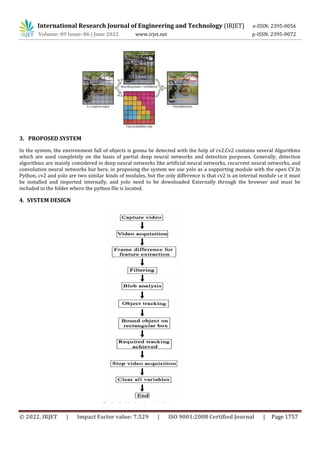
In the system, the environment full of objects is gonna be detected with the help of cv2.Cv2 contains several Algorithms
which are used completely on the basis of partial deep neural networks and detection purposes. Generally, detection
algorithms are mainly considered in deep neural networks like artificial neural networks, recurrent neural networks, and
convolution neural networks but here, in proposing the system we use yolo as a supporting module with the open CV.In
Python, cv2 and yolo are two similar kinds of modules, but the only difference is that cv2 is an internal module i.e it must
be installed and imported internally, and yolo need to be downloaded Externally through the browser and must be
included in the folder where the python file is located.
4. SYSTEM DESIGN
International Research Journal of Engineering and Technology (IRJET) e-ISSN: 2395-0056
Volume: 09 Issue: 06 | June 2022 www.irjet.net p-ISSN: 2395-0072
© 2022, IRJET | Impact Factor value: 7.529 | ISO 9001:2008 Certified Journal | Page 1758
5. RESULTS
International Research Journal of Engineering and Technology (IRJET) e-ISSN: 2395-0056
Volume: 09 Issue: 06 | June 2022 www.irjet.net p-ISSN: 2395-0072
© 2022, IRJET | Impact Factor value: 7.529 | ISO 9001:2008 Certified Journal | Page 1759
6. CONCLUSIONS
The performance of these algorithms on the detection and recognition of three construction vehicles at a scaled site is
analyzed in this thesis report. This chapter includes the results of the study, along with answers to the research questions,
concluding remarks, and future work.Many of the models in this article relating to object recognition, such as R-CNN, YOLO
SSD, and many others, are reviewed and compared in this paper. The limits of each technique were then discussed. This
proposed paradigm prioritizes accuracy over speed. When images involve small items, the earlier models are useless.
Effective recognition for tiny items in images is necessary.
7. REFERENCES
[1] Volvo Excavation Site, R. Philippe, 2020. https://www.korestudios.com/portfolio/volvoconstruction-equipment/
[2] Exemplar Construction Site, AHK, 2018.http://urbantoronto.ca/news/2018/04/ torontoslargest-construction-site-
well-spadina-front/
[3] V. G. Maltarollo, K. M. Honório, and A. B. F. da Silva, "Applications of artificial neural networks in chemical problems,"
Artificial neural networks-architectures and applications, vol. 3, no. 2, pp. 203–223, 2013.
[4] Supervised Learning, Tutorials Point, 2020.
http://www.tutorialspoint.com/artificial neural network/artificial neural network supervised learning.htm
[5] Deep Learning the Beautiful Mind, B. Frank, 2016. www.mindwise-groningen.nl/deep-learning-thebeautiful-mind/
(available online).

REAL-TIME OBJECT DETECTION USING OPEN COMPUTER VISION

  • 1.
    International Research Journalof Engineering and Technology (IRJET) e-ISSN: 2395-0056 Volume: 09 Issue: 06 | June 2022 www.irjet.net p-ISSN: 2395-0072 © 2022, IRJET | Impact Factor value: 7.529 | ISO 9001:2008 Certified Journal | Page 1756 REAL-TIME OBJECT DETECTION USING OPEN COMPUTER VISION Mahalakshmi Rajabattula1, Dr. G. Babu Rao2 1Student, Department Of Computer Science, Visakhapatnam, Andhra Pradesh, India. 2Assitant Professor, Department Of Computer Science, Visakhapatnam, Andhra Pradesh, India --------------------------------------------------------------------***----------------------------------------------------------------------------- Abstract- Real-time object detection and tracking is a broad, exciting, yet inconclusive and difficult topic of computer vision. Researchers are constantly devising more efficient and competitive algorithms as a result of their expanding use in surveillance, tracking systems utilized in security, and many other applications. However, issues such as tracking in a dynamic environment, the expensive calculation to match the real-time speed, and multi-camera multi-object tracking make this work extremely difficult. Through several methodologies have been created, we have reviewed several well-known and basic techniques of object tracking and identification in this literature review. Ultimately, we've studied their general usage and results Keywords: Numpy, OpenCV, SVM, CNN. 1. INTRODUCTION Object recognition is the activity of recognizing things in videos and images. Autonomous vehicles could use this computer vision technique to classify and detect objects in real-time. An autonomous vehicle is a vehicle that really can sense and react to its environment in order to navigate without the help or involvement of a human. Object detection and recognition are deemed one of the most important tasks since they aid the vehicle with identifying objects and predicting their development trends. As an outcome, high-accuracy object detection methods are needed. Though there are various machine learning and deep learning algorithms for object detection and recognition, such as the Support Vector Machine (SVM), Convolutional Neural Networks (CNNs), Regional Convolutional Neural Networks (R-CNNs), and the You Only Look Once (YOLO) model, it is crucial to choose the correct algorithm for autonomous driving because this requires real-time object detection and recognition. Since algorithms cannot spot objects in photos as fast as humans can, it is crucial that the algorithms be accurate, and that the objects be identified in real-time, so that vehicle controllers can solve objective functions at a rate of at least once per second. 2. METHODOLOGY Numpy: NumPy is a Python library that allows the user to interact with arrays.It also provides various functions for working using matrices, Fourier transforms, and linear algebra. Travis Oliphant created NumPy in 2005. It is an opensource project that you might be free to be using. Numerical Python (NumPy) is a programming language that is used to solve problems numerically. OpenCV: Since OpenCV is created in C++ and it has a C++ interface just like its primary interface, it has a less extensive but still large older C interface. The C++ service mode all of the exciting developments and algorithms. Python, Java, and MATLAB/OCTAVE everyone has bindings. The online documentation provides the API for these interfaces. Wrappers for just a range of languages have been implemented to support wider usage. OpenCV.js, a JavaScript binding for a subset of OpenCV functions, is introduced in version 3.4 for use on web platforms. YOLO: YOLO is a real-time object detection algorithm that uses neural networks. Along with its accuracy and force, this algorithm is indeed very popular. It has been used to recognize traffic signals, persons, toll booths, and animals in various applications. This article explains how the YOLO algorithm for object detection works and introduces it to readers. It also highlights some more of the real-world applications of technology.
  • 2.
    International Research Journalof Engineering and Technology (IRJET) e-ISSN: 2395-0056 Volume: 09 Issue: 06 | June 2022 www.irjet.net p-ISSN: 2395-0072 © 2022, IRJET | Impact Factor value: 7.529 | ISO 9001:2008 Certified Journal | Page 1757 3. PROPOSED SYSTEM In the system, the environment full of objects is gonna be detected with the help of cv2.Cv2 contains several Algorithms which are used completely on the basis of partial deep neural networks and detection purposes. Generally, detection algorithms are mainly considered in deep neural networks like artificial neural networks, recurrent neural networks, and convolution neural networks but here, in proposing the system we use yolo as a supporting module with the open CV.In Python, cv2 and yolo are two similar kinds of modules, but the only difference is that cv2 is an internal module i.e it must be installed and imported internally, and yolo need to be downloaded Externally through the browser and must be included in the folder where the python file is located. 4. SYSTEM DESIGN
  • 3.
    International Research Journalof Engineering and Technology (IRJET) e-ISSN: 2395-0056 Volume: 09 Issue: 06 | June 2022 www.irjet.net p-ISSN: 2395-0072 © 2022, IRJET | Impact Factor value: 7.529 | ISO 9001:2008 Certified Journal | Page 1758 5. RESULTS
  • 4.
    International Research Journalof Engineering and Technology (IRJET) e-ISSN: 2395-0056 Volume: 09 Issue: 06 | June 2022 www.irjet.net p-ISSN: 2395-0072 © 2022, IRJET | Impact Factor value: 7.529 | ISO 9001:2008 Certified Journal | Page 1759 6. CONCLUSIONS The performance of these algorithms on the detection and recognition of three construction vehicles at a scaled site is analyzed in this thesis report. This chapter includes the results of the study, along with answers to the research questions, concluding remarks, and future work.Many of the models in this article relating to object recognition, such as R-CNN, YOLO SSD, and many others, are reviewed and compared in this paper. The limits of each technique were then discussed. This proposed paradigm prioritizes accuracy over speed. When images involve small items, the earlier models are useless. Effective recognition for tiny items in images is necessary. 7. REFERENCES [1] Volvo Excavation Site, R. Philippe, 2020. https://www.korestudios.com/portfolio/volvoconstruction-equipment/ [2] Exemplar Construction Site, AHK, 2018.http://urbantoronto.ca/news/2018/04/ torontoslargest-construction-site- well-spadina-front/ [3] V. G. Maltarollo, K. M. Honório, and A. B. F. da Silva, "Applications of artificial neural networks in chemical problems," Artificial neural networks-architectures and applications, vol. 3, no. 2, pp. 203–223, 2013. [4] Supervised Learning, Tutorials Point, 2020. http://www.tutorialspoint.com/artificial neural network/artificial neural network supervised learning.htm [5] Deep Learning the Beautiful Mind, B. Frank, 2016. www.mindwise-groningen.nl/deep-learning-thebeautiful-mind/ (available online).