
UNIVERSITY OF MINES AND TECHNOLOGY, TARKWA UMaT
ARTIFICIAL INTELLIGENCE IN
GEOSCIENCE
GEOLOGICAL ENGINEERING DEPARTMENT
ARTIFICIAL INTELLIGENCE IN GEOLOGY(GL276)
CONTENT
 Introduction
 The difference between AI and Machine Learning
 Application of AI in Geoscience
 Limitations of AI in Geoscience
 Future perspective
 Conclusion
 References
2
INTRODUCTION
 Artificial intelligence is a branch of computer science
dealing with the reproduction of human-level
intelligence, self-awareness, knowledge, conscience,
thought in computer programs.
 Artificial intelligence (AI) is one of the fastest growing
disciplines in modern technology.
 AI has found numerous applications in the various
sciences including Geoscience
3
4
THE DIFFERENCE BETWEEN AI AND ML
 AI is as explained in the introductory slide
 Machine learning on the other hand is a subset of AI.
 Machine learning (ML) is the process of using
mathematical models of data to help a computer learn
without direct instruction.
 Good examples of AI are Siri, Google Assistant and
Amazon Alexa.
 Examples of ML are Google search engines, Twitter
sentiment analysis and stock prediction.
5
APPLICATIONS OF AI IN GEOSCIENCE
 AI and ML have become very useful many areas of
Geoscience mainly because of their capability to
interpret humongous data collected by various sensors.
 AI is applicable in the following fields of geoscience and
more:
 Petrophysics/Formation elevation
 Geography, Geodesy/Topography
 Geology/Geophysics
 Remote sensing and photogeology.
6
APPLICATIONS OF AI IN GEOSCIENCE
 AI is used to build predictive models of soil behavior
based on data from laboratory tests and field
measurements
 It is applied in the analysis of geological data to help
geologists understand the deposit model, formation
process; and discover the metallogenic rule and assist
mineral exploration and development.
7
LIMITATIONS OF AI IN GEOSCIENCE
 AI has proven to be ubiquitous in the field of geoscience
however a few limitations of AI in the discipline include
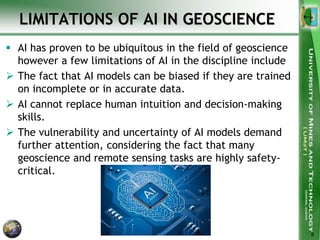
 The fact that AI models can be biased if they are trained
on incomplete or in accurate data.
 AI cannot replace human intuition and decision-making
skills.
 The vulnerability and uncertainty of AI models demand
further attention, considering the fact that many
geoscience and remote sensing tasks are highly safety-
critical.
8
FUTURE PERSPECTIVE OF AI
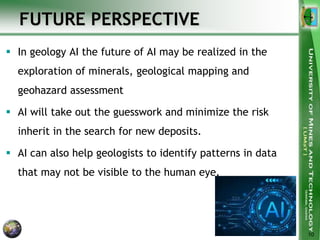
 In general AI have the following potentials:
 AI will transform the scientific method
 It will become a pillar of foreign policy
 AI will enable next generation consumer experiences
 Addressing the climate crisis will require AI
 AI will enable truly personalized medicine
9
FUTURE PERSPECTIVE
 In geology AI the future of AI may be realized in the
exploration of minerals, geological mapping and
geohazard assessment
 AI will take out the guesswork and minimize the risk
inherit in the search for new deposits.
 AI can also help geologists to identify patterns in data
that may not be visible to the human eye.
10
CONCLUSION
 In conclusion, AI has the potential to help geosciences
move from qualitative to quantitative analysis. AI-
enabled technologies such as image processing, smart
sensors, and intelligent inversion are being tested by
researchers in a wide variety of geosciencces domains.
11
CONCLUSION cont’d
 A novel approach to representing geosystem dynamics
via a recurrent neural network within deep learning
architectures has been proposed. The physics-aware AI
system exhibits robust transferability and good
intelligence for inferring unobserved processes in runoff
modeling
12
REFERENCES
 https://www.sciencedaily.com
 https://www.ai.engineering.columia.edu
 https://www.sciencedirect.com
THANK YOU
13

AI IN GEOLOGY.ppt

  • 1.
    UNIVERSITY OF MINESAND TECHNOLOGY, TARKWA UMaT ARTIFICIAL INTELLIGENCE IN GEOSCIENCE GEOLOGICAL ENGINEERING DEPARTMENT ARTIFICIAL INTELLIGENCE IN GEOLOGY(GL276)
  • 2.
    CONTENT  Introduction  Thedifference between AI and Machine Learning  Application of AI in Geoscience  Limitations of AI in Geoscience  Future perspective  Conclusion  References 2
  • 3.
    INTRODUCTION  Artificial intelligenceis a branch of computer science dealing with the reproduction of human-level intelligence, self-awareness, knowledge, conscience, thought in computer programs.  Artificial intelligence (AI) is one of the fastest growing disciplines in modern technology.  AI has found numerous applications in the various sciences including Geoscience 3
  • 4.
  • 5.
    THE DIFFERENCE BETWEENAI AND ML  AI is as explained in the introductory slide  Machine learning on the other hand is a subset of AI.  Machine learning (ML) is the process of using mathematical models of data to help a computer learn without direct instruction.  Good examples of AI are Siri, Google Assistant and Amazon Alexa.  Examples of ML are Google search engines, Twitter sentiment analysis and stock prediction. 5
  • 6.
    APPLICATIONS OF AIIN GEOSCIENCE  AI and ML have become very useful many areas of Geoscience mainly because of their capability to interpret humongous data collected by various sensors.  AI is applicable in the following fields of geoscience and more:  Petrophysics/Formation elevation  Geography, Geodesy/Topography  Geology/Geophysics  Remote sensing and photogeology. 6
  • 7.
    APPLICATIONS OF AIIN GEOSCIENCE  AI is used to build predictive models of soil behavior based on data from laboratory tests and field measurements  It is applied in the analysis of geological data to help geologists understand the deposit model, formation process; and discover the metallogenic rule and assist mineral exploration and development. 7
  • 8.
    LIMITATIONS OF AIIN GEOSCIENCE  AI has proven to be ubiquitous in the field of geoscience however a few limitations of AI in the discipline include  The fact that AI models can be biased if they are trained on incomplete or in accurate data.  AI cannot replace human intuition and decision-making skills.  The vulnerability and uncertainty of AI models demand further attention, considering the fact that many geoscience and remote sensing tasks are highly safety- critical. 8
  • 9.
    FUTURE PERSPECTIVE OFAI  In general AI have the following potentials:  AI will transform the scientific method  It will become a pillar of foreign policy  AI will enable next generation consumer experiences  Addressing the climate crisis will require AI  AI will enable truly personalized medicine 9
  • 10.
    FUTURE PERSPECTIVE  Ingeology AI the future of AI may be realized in the exploration of minerals, geological mapping and geohazard assessment  AI will take out the guesswork and minimize the risk inherit in the search for new deposits.  AI can also help geologists to identify patterns in data that may not be visible to the human eye. 10
  • 11.
    CONCLUSION  In conclusion,AI has the potential to help geosciences move from qualitative to quantitative analysis. AI- enabled technologies such as image processing, smart sensors, and intelligent inversion are being tested by researchers in a wide variety of geosciencces domains. 11
  • 12.
    CONCLUSION cont’d  Anovel approach to representing geosystem dynamics via a recurrent neural network within deep learning architectures has been proposed. The physics-aware AI system exhibits robust transferability and good intelligence for inferring unobserved processes in runoff modeling 12
  • 13.