An Artificial Intelligence-driven Approach to Mineral Exploration in Botswana
An Artificial Intelligence-driven Approach to Mineral Exploration in Botswana.
African Exploration Showcase
Geological Society of South Africa
Johannesburg
13 November 2025
An Artificial Intelligence-driven Approach to Mineral Exploration in Botswana
1.
An Artificial Intelligence-drivenApproach to
Mineral Exploration in Botswana
James AH Campbell
Managing Director, Botswana Diamonds plc
African Exploration Showcase
Geological Society of South Africa
Johannesburg
13 November 2025
2.
African Exploration Showcase2025
2
AES, GSSA 2025
An Artificial Intelligence-driven Approach to Mineral Exploration in Botswana
AGENDA
⧫ Global demand: exploration crisis
⧫ AI foundations: remote sensing, geophysics, data fusion
⧫ Company landscape & case studies
⧫ Cost/time benefits: juniors vs majors
⧫ BOD strategy: dataset & AI-screened targets
⧫ Polymetallic & kimberlite examples
⧫ AI vs traditional methods: future of AI
Marsfontein blow pit and dumps when active
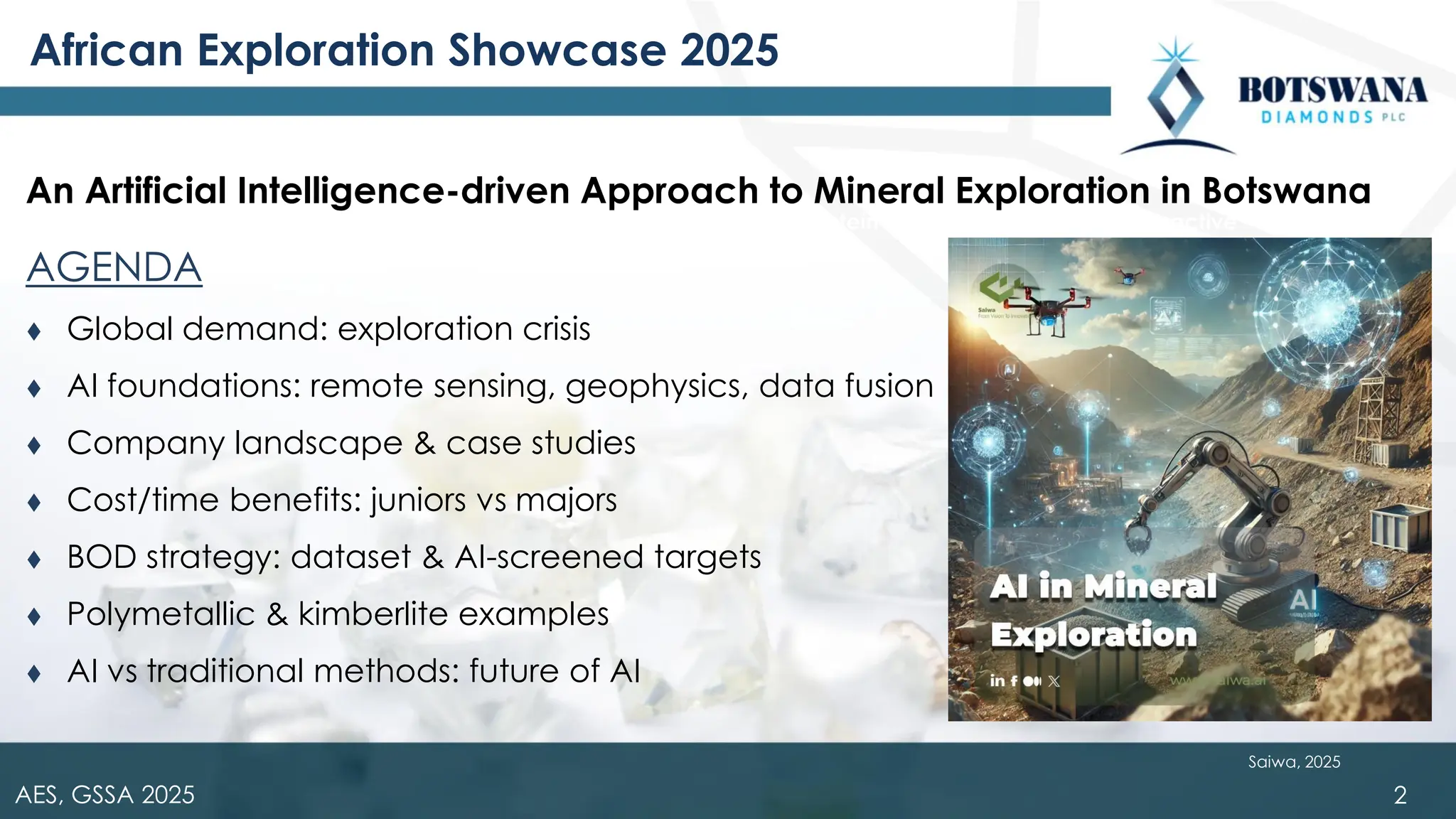
Saiwa, 2025
Global Demand forCritical Minerals
⧫ The energy transition is accelerating demand for
copper, lithium, cobalt, nickel, graphite and rare
earths used in batteries, renewables and grid
storage.
⧫ Authoritative outlooks indicate lithium demand
may rise more than fivefold by 2040, with nickel,
cobalt and rare earths at least doubling over the
same period.
⧫ Botswana is well placed geologically with highly
prospective Cu–Ni–Co and PGM terranes that
complement its world-class diamond endowment.
⧫ Absent discoveries, supply gaps of ~30–40% for
key minerals such as copper and lithium are
forecast by the mid-2030s, sharpening the
exploration imperative.
4
AES, GSSA 2025
Deloitte, 2024
5.
Exploration Crisis: RisingCosts, Fewer Discoveries
⧫ Global discovery rates have fallen significantly
since 2010 despite higher spend; greenfield success
is commonly cited at ~0.02% (≈1 in 5,000 drillholes).
⧫ Shallow, outcropping deposits are largely
exhausted; deeper targets under cover require new
geoscience and computational approaches.
⧫ Escalating drill and logistics costs erode ROI and
suppress risk capital, particularly for juniors,
prolonging the 'orphan period' between
campaigns.
⧫ These structural headwinds motivate systematic,
data-driven targeting to raise hit rates and
compress cycles.
5
AES, GSSA 2025
Bond, 2025
6.
Juniors vs Majorsin Discovery
⧫ Historically, >60% of commercial
discoveries are credited to junior explorers
who specialise in high-risk front-end work.
⧫ Majors increasingly replace reserves by
acquiring advanced projects rather than
leading greenfield search in frontier terrains.
⧫ Tighter capital markets and higher failure
rates (>90% for juniors) impede the venture
pipeline that majors ultimately rely upon.
⧫ If the Junior is correctly incubated, the
failure rate is considerably lower.
⧫ AI-enabled prospectivity can lower
technical risk for juniors, improving
financing potential and partnership options.
6
AES, GSSA 2025
Visualcapitalist, 2024
Artificial Intelligence inMineral Exploration
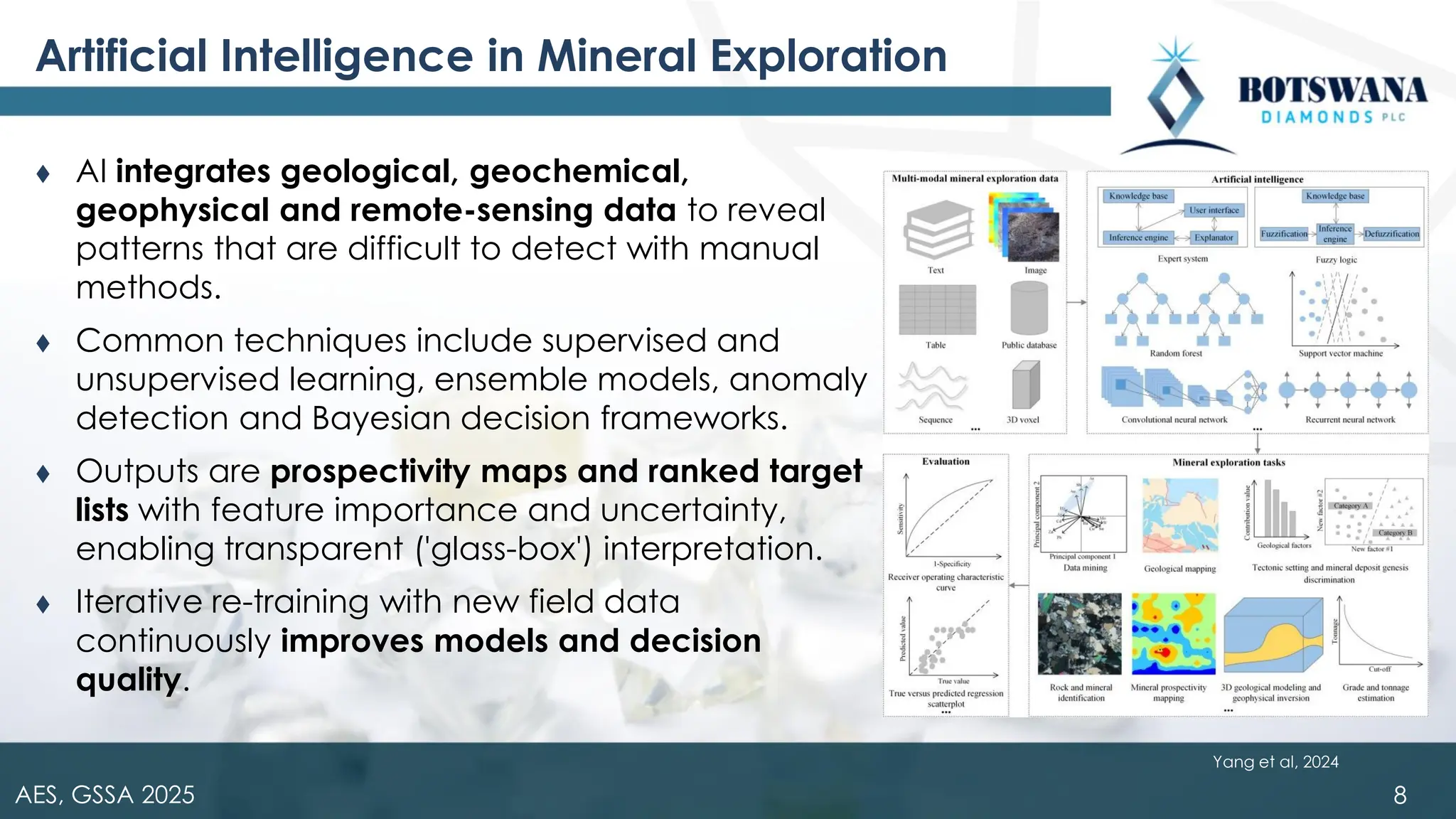
⧫ AI integrates geological, geochemical,
geophysical and remote-sensing data to reveal
patterns that are difficult to detect with manual
methods.
⧫ Common techniques include supervised and
unsupervised learning, ensemble models, anomaly
detection and Bayesian decision frameworks.
⧫ Outputs are prospectivity maps and ranked target
lists with feature importance and uncertainty,
enabling transparent ('glass-box') interpretation.
⧫ Iterative re-training with new field data
continuously improves models and decision
quality.
8
AES, GSSA 2025
Yang et al, 2024
9.
Remote Sensing andGeophysical AI
⧫ Multispectral/hyperspectral satellites and
UAVs map alteration, structure and regolith;
AI automates pixel-to-mineral information
extraction.
⧫ Machine Learning assisted inversion and
clustering of gravity, magnetics, and EM
improve depth estimates and structure/host
recognition under cover.
⧫ Joint inversion and data fusion reduce
ambiguity by consistent geophysical
application across multiple datasets
simultaneously.
⧫ These methods rapidly screen large areas to
funnel scarce field budgets to the most
prospective areas.
9
AES, GSSA 2025
Javan et al, 2024
10.
Data Fusion andProspectivity Modelling
⧫ Knowledge-driven rules (deposit models,
expert features) are combined with
data-driven learning to compute pixel-level
prospectivity.
⧫ Feature engineering captures litho-structural
context (e.g., contacts, dilational jogs, dyke
swarms, basin architecture) across scales.
⧫ Ensembles (e.g., random forests, gradient
boosting, deep nets) output class
probabilities with uncertainty for ranked
targeting.
⧫ Model governance includes cross-validation,
blind tests and sensitivity analysis to avoid
over-fitting and spurious correlations.
10
AES, GSSA 2025
Bell Geospace, 2024
Select Companies ApplyingAI
⧫ KoBold Metals applies decision theoretical
targeting ('Intelligent Prospector') to
accelerate discovery of Cu–Ni–Co–Li deposits.
⧫ Earth AI integrates in-house data science with
nimble drilling capability, reporting materially
higher drill-hit ratios than historical norms.
⧫ Planetary AI (Xplore) couples knowledge
models with Machine Learning for transparent
prospectivity at local-to-country scales.
⧫ Other players (e.g., GoldSpot, Mira) specialise
in hyperspectral/geophysical Machine
Learning and integrated targeting for clients.
12
AES, GSSA 2025
Mining Doc, 2024
13.
Case Study: KoBoldMetals (Zambia Copper)
⧫ Applied Machine Learning and decision
analytics to legacy and new data, delineating
the Mingomba orebody reported as Zambia’s
most significant copper discovery in a century.
⧫ Rapid drill confirmation (~1 year) contrasts with
typical multi-year campaigns in covered
terranes.
⧫ Portfolio scale and continuous model updates
allow fast redeployment of learning across
districts.
⧫ Illustrates how algorithmic triage can prioritise
scarce drilling for maximum information gain.
⧫ Funded by Gates/Bezos with $500M capital.
13
AES, GSSA 2025
KoBold, 2024
14.
Case Study: EarthAI (Australia)
⧫ Reports ~75% drill-hole success on
AI-generated targets versus sub-1%
historical norms for greenfields in similar
terrains.
⧫ Combines satellite analytics, geological
Machine Learning and rapid drilling to
close the loop between prediction and
testing.
⧫ Cost reductions of up to ~80% are cited
through tighter drill focusing and fewer
abandoned campaigns.
⧫ Shows the value of owning both the data
/ Machine Learning pipeline and fast
execution capability.
14
AES, GSSA 2025
Mining.com, 2025
15.
Planetary AI 'Xplore’(Botswana)
⧫ Combines 57+ deposit models with Machine
Learning to compute prospectivity at multiple
scales ('glass-box' interpretability).
⧫ Semantic methods capture geological context
(e.g. proximity to structures, host lithologies,
permissive facies).
⧫ Delivers ranked target maps with quantified
uncertainty, feature importance and
recommended subsequent data acquisition to
reduce risk, powered by Machine Learning for
adaptive targeting and evidence-based
prioritisation.
⧫ Configured for governments and explorers;
supports area selection, licensing and JV
screening.
15
AES, GSSA 2025
PlanetaryAI, 2025
16.
AI Cost andTime Benefits
⧫ AI narrows search space early, focusing drilling
on high-probability targets and lifting drill-hit
ratios from sub-1% to orders-of-magnitude
higher in some reports.
⧫ Exploration cycles compress (planning → test
→ learn) through automated data prep, rapid
modelling and adaptive survey design (4x
faster).
⧫ Claims of up to ~80% reduction in discovery
cost reflect fewer false positives and better
sequencing of work programs.
⧫ At industry scale, modelling suggests
multi-hundred-billion dollar annual savings by
the mid-2030s if broadly adopted.
16
AES, GSSA 2025
CleanTech, 2025
17.
Differential Impact
Juniors
⧫ Juniorscan leverage AI to process large
legacy datasets, lifting target quality
without adding fixed headcount.
⧫ Higher-confidence targets improve
access to risk capital and strategic
partners, shortening the 'orphan period'.
⧫ Transparent, explainable outputs support
investment committees and JV
negotiations.
⧫ AI-ready data rooms become a
competitive asset when farming out or
transacting licences.
17
AES, GSSA 2025
Majors
⧫ Majors can apply AI at portfolio scale to
rank districts, optimise capital allocation
and integrate brownfields with greenfields.
⧫ Standardised data governance and
Machine Learning pipelines enable
comparability across business units and
countries.
⧫ Decision analytics frameworks quantify
trade-offs between resource replacement,
optionality and ESG constraints.
⧫ AI also improves brownfields targeting,
extending mine life and smoothing reserve
replacement profiles.
Botswana Diamonds plc(BOD): Strategy Overview
⧫ BOD’s strategy is to exploit a proprietary,
comprehensive Botswana dataset accumulated
over ~20 years and to apply AI for rapid
prospectivity screening.
⧫ Partnership with Planetary AI enables
country-scale analysis before license applications,
improving ground selection quality.
⧫ Focus spans polymetallics (Cu-Ni-Co-Zn-Pb-Ag,
PGEs) and diamonds, reflecting Botswana’s
metallogenic diversity.
⧫ Objective is to secure high-potential ground,
develop drill-ready targets and form value
accretive JVs.
19
AES, GSSA 2025
Botswana Geoscience Institute, 2024
20.
BOD Legacy Dataset:Scale & Composition
⧫ ~225,000 km² of spatial coverage and ~383 GB of data
comprising:
⧫ ~375,000 line km airborne geophysics,
⧫ 606 ground geophysical surveys,
⧫ ~358,000 soil sample results and
⧫ ~32,000 drill logs.
⧫ Datasets were standardised, georeferenced and fused for
AI ingestion to ensure apples-to-apples comparisons across
tiles.
⧫ Coverage extends across Ngamiland, SE Botswana and
other permissive belts, including kimberlite fields and
mafic-ultramafic terranes.
⧫ This scale permits consistent, unbiased target ranking from
license to province.
20
AES, GSSA 2025
Botswana Geoscience Institute, 2020
21.
BOD License Applications:AI-Screened Results
⧫ First AI pass generated applications over
~7,500 km²: 11 polymetallic and 3 kimberlite
targets meeting de-risking criteria.
⧫ Selection emphasised permissive geology,
multi-commodity potential and adjacency to
undercapitalised neighbours.
⧫ AI ranking guides phased ground acquisition and
JV approaches to stitch contiguous trends where
appropriate.
⧫ Field programs prioritise drill-ready targets while
acquiring missing datasets to lift model
confidence.
21
AES, GSSA 2025
22.
BOD’s Competitive Advantage
FivePillar approach
⧫ Data. BOD already has an extensive database in Botswana and proposes to acquire
more across Southern Africa.
⧫ AI technology. BOD also has access to this through an alliance with Planetary AI Xplore,
which utilises a proprietary platform which unlocks mineral wealth with advanced
knowledge-driven prospectivity analysis combined with machine learning technologies.
⧫ Government relations. The ability to apply for and receive Prospecting Licenses. BOD has
a demonstrated track record in this regard in Southern Africa.
⧫ Field and commercial skills. Once a Prospecting License has been granted, the ability
to conduct field and other technical work to achieve a rapid commercial conclusion.
BOD has a proven track record in this area and runs a very tight, lean company.
⧫ (Cash …)
22
AES, GSSA 2025
BOD Polymetallic Targeting:Examples
⧫ Ngamiland terranes flagged as
permissive for Cu-Pb-Zn-Ag with
associated V-Co-Ge-Au-PGE signatures
across multiple deposit styles.
⧫ SE Botswana blocks prioritised for
Cu-Ni-Co with ultramafic/mafic hosts
and shear-related traps.
⧫ Historic resources and showings (e.g.,
Zn-Pb-Ag) locally validate the
predictive patterns highlighted by AI.
⧫ Next steps: integrate new surface
geochem/EM to tighten drill collars on
top-ranked anomalies.
24
AES, GSSA 2025
25.
BOD Kimberlite Targeting:Examples
⧫ Indicator mineral (KIM) differentiation
isolates key garnet/spinel populations that
drive dispersion trends.
⧫ Geophysical context (gravity lows,
moderate magnetics) is used to focus
under-cover kimberlite searches.
⧫ Clusters of KIMs far from known fields
suggest undiscovered sources; cover
thickness modelling informs exploration
technique.
⧫ Prospective clusters have been captured
in granted licenses for follow-up ground
geophysics and drill testing.
25
AES, GSSA 2025
AI vs TraditionalExploration
⧫ Traditional: sequential, expert-led overlay
mapping; slow feedback and limited
hypothesis throughput.
⧫ AI-enabled: parallel hypothesis generation,
probabilistic ranking and adaptive survey
design with rapid feedback loops.
⧫ Explainability and uncertainty quantification
support disciplined 'stage-gate' decisions
and budget defence.
⧫ Outcomes reported to date show materially
higher drill conversion and lower unit
discovery cost.
27
AES, GSSA 2025
RASonly, 2025
28.
Possible Future State(2030–2035)
⧫ Digital twins of districts/ore bodies
that update with drilling, sensing and
operational data to guide real-time
decisions.
⧫ Autonomous UAVs and robotic drills
integrated with active learning to test
the highest potential holes first.
⧫ Next-generation sensors (quantum
gravimetry, improved hyperspectral)
extend the depth of investigation
beneath the cover.
⧫ Skillset shift: geologists operate as
domain-expert data scientists,
curating features and governing
models.
28
AES, GSSA 2025
Yang et al, 2024
29.
Policy, Investment andESG Context
⧫ Critical-minerals policies (US, EU and others)
and strategic finance favour projects that
demonstrate efficient, low-impact and
successful commercial discovery.
⧫ AI reduces unnecessary disturbance by
focusing work on the highest-probability
targets and documenting evidence trails.
⧫ Transparent, auditable models strengthen
stakeholder engagement and permit
narratives.
⧫ Botswana’s stable jurisdiction and data-rich
history are aligned with this investment thesis.
29
AES, GSSA 2025
EY.com, 2024
30.
Conclusions and StrategicOutlook
⧫ AI is reshaping exploration economics by raising
hit rates, compressing timelines and lowering
unit costs across commodities and terrains.
⧫ Botswana’s geology, data depth and stability
make it an ideal proving ground for AI-enabled
exploration.
⧫ For juniors, explainable AI improves financing
potential; for majors, it enables portfolio-level
optimisation and reserve replacement.
⧫ Early adopters will capture outsized benefits as
models, data assets and partnerships
compound over time.
30
AES, GSSA 2025
Yang et al, 2024
References
⧫ International EnergyAgency (2025). Global Critical Minerals Outlook. Paris: IEA.
⧫ Botswana Diamonds plc (2024–2025). Strategy and AI exploration materials.
⧫ Planetary AI. Xplore prospectivity platform overview and method notes.
⧫ KoBold Metals case reports and industry coverage (e.g., Mining.com, Reuters).
⧫ Earth AI technical briefs and public case studies (Australia).
⧫ NASA Earth Observatory. Botswana diamond mines satellite imagery (contextual).
⧫ Cleantech/industry analyses on AI in exploration and discovery efficiency.
32
AES, GSSA 2025
33.
About the Author
⧫James Campbell is Managing Director of Botswana Diamonds plc (a diamond development
company active in Botswana, South Africa and Zimbabwe and listed on London AIM and the
Botswana Stock Exchange). He has spent over forty years in the diamond industry in a variety of
leadership roles both in major and junior companies.
⧫ Previous roles include Non-Executive Director of Shefa Gems (where he is still Technical Advisor); Chief
Executive Officer and President of Rockwell Diamonds Inc; Non-Executive Director of Stellar Diamonds
plc; Vice President - New Business for Lucara Diamond Corp, Managing Director of African Diamonds
plc; Executive Deputy Chairman of West African Diamonds plc and Director of Swala Resources plc
and Bugeco sa.
⧫ James also worked at De Beers for over twenty years; his roles included General Manager for
Advanced Exploration and Resource Delivery and the Executive Chairman Nicky Oppenheimer’s first
Personal Assistant.
⧫ James holds degrees in Mining and Exploration Geology from the Royal School of Mines (Imperial
College, London University) and an MBA with distinction (and top student prize) from Durham
University. He is a Fellow of the Geological Society of South Africa, Institute of Mining, Metallurgy and
Materials, South African Institute of Mining and Metallurgy and Institute of Directors of South Africa. He
is also a Chartered Engineer (UK), Chartered Scientist (UK) and a Professional Natural Scientist (RSA).
⧫ James is also chairman and founding director of Common Purpose South Africa NPC (a not-for-profit
organization that develops leaders who can cross boundaries and is synonymous with the terms
‘cultural intelligence’ and ‘leadership beyond authority’). CPSA celebrated its twenty-fifth anniversary
in 2025. He was also a director, trustee and chairman of the Joburg Ballet for almost fifteen years.
33
https://twitter.com/JAHC1
https://www.linkedin.com/in/jamesahcampbell/
https://www.slideshare.net/JamesAHCampbell1
https://www.youtube.com/JamesCampbell_JAC
AES, GSSA 2025