ARTIFICIAL INTELLIGENCE BASED BATTERY POWER
MANAGEMENT FOR SOLAR PV AND WIND HYBRID POWER SYSTEM
BHARAT INSTITUTE OF ENGINEERING & TECHNOLOGY
Affiliated to JNTUH, Approved by AICTE, NAAC Accredited, NBA Accredited
DEPARTMENT OF ELECTRICAL & ELECTRONICS ENGINEERING
Project Guide:
Dr. T.Sukanth
Associate Professor
Department of EEE
- 20E15A0225
- 20E15A0227
- 20E15A0220
- 20E15A0208
- 19E11A0208
Presented by:
K.Vishnuvardhan
P.Prasad
D.Sai Charan
K.Nagesh
G.Venkatesh
Contents:
▪ Abstract
▪ Block Diagram
▪ Introduction
▪ Literature Survey
▪ Objectives
▪ Methodology
▪ References
2
3
Abstract:
• This paper proposes an approach for the hybrid solar photovoltaic and wind power system in Battery
management for stand-alone applications with Artificial Intelligence. In general, Solar and wind energy
are utilized as leading sources of energy and battery unit is considered as storage element to meet out
the load demand.
• Loads are considered based on the priority. Ratings of hybrid energy system components such as solar
PV, wind generator, battery unit, power electronic converter, etc., are optimally selected based on the
rating of load. Fuzzy logic and Neural network are the tools being used here to obtain the maximum
utilization of battery.
• A simulation model with MATLAB/Simulink for the hybrid power system has been developed.
Considering power supply variation in Solar and Wind Hybrid Power system (SWHP) caused due to
disturbed power supply from wind turbine generator and solar cells, fuzzy-PID-NN control is brought
into it.
• The main components model of SWHP is established and simulation of fuzzy-PID-NN control is being
presented, analyzed and compared. The final result of simulation indicates an effective utilization of
battery.
4
Block Diagram:
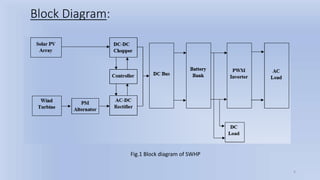
Fig.1 Block diagram of SWHP
5
Introduction:
• Many Countries count on coal, oil and natural gas to supply most of their energy needs due to tremendous
increase in population growth rate. But reliance on fossil fuels presents a big problem. Fossil fuels are a finite
resource.
• Eventually, the world will run out of fossil fuels, or it will become too expensive to retrieve those that remain.
Fossil fuels also cause air, water and soil pollution, and produce greenhouse gases that contribute to global
warming.
• Renewable energy resources, such as wind, solar and hydropower, offer clean alternatives to fossil fuels. They
produce little or no pollution and they will never run out. SWHP has a bright application to face electric
demand in the near future. It can raise power supply reliability and reduce the system cost according to local
environment condition and load characteristics of residents [1].
• For stand-alone SWHP, lead-acid batteries play a vital role as an energy storage unit. Even though batteries are
the weaker section in the overall system, they are in need of certain initial investment of equipment. As the
management of charging/discharging in storage battery directly affects the quality of power supply in SWHP
since electric energy from wind turbine generator and solar cells has obvious fluctuation.
• It makes the system great demand to electric power management. Therefore, it is significant to study power
management of batteries in detail [2].
• Conventional control theories do not have good performance for them. In this paper, the combination of fuzzy
control and traditional PID control is presented along with Neural Network to solve the problem of battery
management in Solar and Wind Hybrid Power system. And simulation result of the fuzzy and NN control
system is compared at the end [3].
Introduction:
6
• The SWHP is made up of solar photovoltaic array, wind turbine generator, controller with the combination of
PID/fuzzy/Neural Network, storage batteries, Rectifier, chopper, inverter, etc. as shown in Fig. 1. Rectifier used
in wind Turbine line is to convert AC into DC. Chopper used in Solar PV line is to convert variable DC into
constant DC. Then it is connected to batteries through charge controller. Here battery will ensure reliability of
the power system for all climatic conditions.
• Batteries will charge when the power generation from wind and solar PV system is in excess and it will
discharge when the power generation from wind and solar PV is not enough to meet the load demand.
Further battery makes the voltage of power supply steady. Fuzzy intelligence and NN controller are used to
switch and regulate working state of batteries, so as to operate alternately in the state of charging or
discharging. Thus the stability and continuity of power supply is improved. For the AC loads, PWM inverter is
used to convert DC from battery into AC.
System Description:
7
Literature review:
 Hybrid solar PV-wind systems:
• Hybrid solar PV and wind generation system become very attractive solution in particular for stand-alone
applications. Combining the two sources of solar and wind can provide better reliability and their hybrid system
becomes more economical to run since the weakness of one system can be complemented by the strength of the
other one.
• The integration of hybrid solar and wind power systems into the grid can further help in improving the overall
economy and reliability of renewable power generation to supply its load. Similarly, the integration of hybrid solar
and wind power in a stand-alone system can reduce the size of energy storage needed to supply continuous power.
• There are two types of systems available: 1. Grid Connected System 2. Stand-Alone System
 The Grid Connected System is an integration of combined solar and wind power systems into the grid can help in
reducing the overall cost and improving reliability of renewable power generation to supply its load. The grid takes
excess renewable power from renewable energy site and supplies power to the site’ loads when required.
 The Stand-alone or Autonomous power system is an excellent solution for remote areas where utilities facilities, in
particular transmission lines, are not economical to run or difficult to install due to their high cost and/or difficulties
of terrain, etc. The stand-alone systems can be sub-classified into common DC bus or common AC bus. Variable
nature of solar and wind resources can be partially overcome by integration of the two resources into an optimum
combination and hence the system becomes more reliable.
8
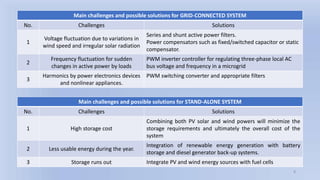
Main challenges and possible solutions for GRID-CONNECTED SYSTEM
No. Challenges Solutions
1
Voltage fluctuation due to variations in
wind speed and irregular solar radiation
Series and shunt active power filters.
Power compensators such as fixed/switched capacitor or static
compensator.
2
Frequency fluctuation for sudden
changes in active power by loads
PWM inverter controller for regulating three-phase local AC
bus voltage and frequency in a microgrid
3
Harmonics by power electronics devices
and nonlinear appliances.
PWM switching converter and appropriate filters
Main challenges and possible solutions for STAND-ALONE SYSTEM
No. Challenges Solutions
1 High storage cost
Combining both PV solar and wind powers will minimize the
storage requirements and ultimately the overall cost of the
system
2 Less usable energy during the year.
Integration of renewable energy generation with battery
storage and diesel generator back-up systems.
3 Storage runs out Integrate PV and wind energy sources with fuel cells
9
Literature review:
 Common AI-related approaches
• With the rapid development of AI techniques, integrating AI technologies with large-scale RES utilizations has become
an increasingly promising and imperative tendency. In general, AI techniques indicate the ability of one computer or
machine to mimic human cognitive functions, e.g., learning and trouble-shooting abilities.
• They can be used for performance or property prediction, operational control, programming and optimization, etc.
This section introduces some prevailing AI techniques, which are well-inspired by the human brains (e.g., artificial
neural networks (ANN) and fuzzy logic) or animal behaviors (e. g., particle swarm optimization (PSO) and ant colony
optimization (ACO)).
 Advantages and functional roles of intelligent techniques
• AI techniques have demonstrated promising performances in most previous studies, such as improved computational
effectiveness, resolved complicated optimization processes with ambiguities or uncertainties, and contributed to fully
exploiting potentials of renewable energy sources. In recent years, AI techniques have played an essential role in
information retrieval, decision-making, automatization, intelligent identification and management.
 The advantages of AI techniques as below:
• Better accuracy.
• Smaller non-detection zone (NDZ), i.e., the period of detection failure after islanding takes place.
• Easy to be applied for multiple DG unites.
• Unnecessary to select thresholds.
10
Literature review:
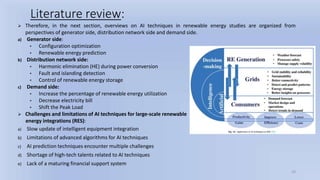
 Therefore, in the next section, overviews on AI techniques in renewable energy studies are organized from
perspectives of generator side, distribution network side and demand side.
a) Generator side:
• Configuration optimization
• Renewable energy prediction
b) Distribution network side:
• Harmonic elimination (HE) during power conversion
• Fault and islanding detection
• Control of renewable energy storage
c) Demand side:
• Increase the percentage of renewable energy utilization
• Decrease electricity bill
• Shift the Peak Load
 Challenges and limitations of AI techniques for large-scale renewable
energy integrations (RES):
a) Slow update of intelligent equipment integration
b) Limitations of advanced algorithms for AI techniques
c) AI prediction techniques encounter multiple challenges
d) Shortage of high-tech talents related to AI techniques
e) Lack of a maturing financial support system
11
Objectives:
 To study the performance & optimization characteristics of a Solar PV - Wind Hybrid Power System.
 To understand the battery power management system.
 To integrate traditional power systems with modern trends to improve operational efficiency.
 To study and understand the features of hybrid power systems.
 To evaluate the possible alternatives available for traditional power grids.
Methodology:
 Studied about hybrid power systems/stations.
 Studied about Solar PV Power Plants.
 Studied about Wind Power Plants.
 Studied about Artificial Intelligence techniques used to integrate power systems.
 Studied about various applications of AI controlling techniques.
12
References:
• P. Raju , Dr S. Vijayan “Artificial Intelligence based Battery Power Management for Solar PV And Wind Hybrid Power System”—2013 IJERGS
India
• Sunanda Sinha, S.S. Chandel “Review of recent trends in optimization techniques for solar photovoltaic–wind based hybrid energy systems” –
2015 Elsevier - India
• Rashid Al Badwawi, Mohammad Abusara & Tapas Mallick “A Review of Hybrid Solar PV and Wind Energy System” – 2015 ResearchGate –
United Kingdom
• Vincent Anayochukwu Ani “Development of an Intelligent Power Management System for Solar PV-Wind-Battery-Fuel-Cell Integrated System”
– 2021 – Frontiers in Energy Research
• Zhengxuan Liu, Ying Sun, Chaojie Xing, Jia Liu, Yingdong He, Yuekuan Zhou, Guoqiang Zhang “Artificial intelligence powered large-scale
renewable integrations in multi-energy systems for carbon neutrality transition: Challenges and future perspectives”– 2022 - Science Direct –
China
• Sinha S, Chandel SS. Review of software tools for hybrid renewable energy systems. Renewable Sustainable Energy Rev 2014;32:192–205.
• Zhou W, Lou C, Li Z, Lu L, Yang H. Current status of research on optimum sizing of stand-alone hybrid solar–wind power generation systems.
Appl Energy 2010;87:380–9.
• Fadaee M, MAM. Radzi. Multi-objective optimization of a stand-alone hybrid renewable energy system by using evolutionary algorithms: a
review. Renewable Sustainable Energy Rev 2012;16:3364–9.
• Luna-Rubio R, Trejo-Peres M, Vargas-Vazquez D, Rı´os-Moreno GJ. Optimal sizing of renewable hybrids energy systems: a review of
methodologies. Sol Energy 2012;86:1077–88.
• Khatib T, Mohamed A, Sopian K. A review of photovoltaic systems size optimization techniques. Renewable Sustainable Energy Rev
2013;22:454–65.
• Upadhyay S, Sharma MP. A review on configurations, control and sizing methodologies of hybrid energy systems. Renewable Sustainable
Energy Rev 2014;38:47–63.
• Chauhan A, Saini RP. A review on integrated renewable energy system based power generation for stand-alone applications: configurations,
storage options, sizing methodologies and control. Renewable Sustainable Energy Rev 2014;38:99–120.
• Nagabhushana AC, Jyoti R, Raju AB. Economic analysis and comparison of proposed hres for stand-alone applications at various places in
Karnataka state. IEEE PES Innovative Smart Grid Technol—India 2011:380–5.
13
Base Paper:
 P. Raju, Dr S. Vijayan “Artificial Intelligence based Battery Power Management for Solar PV And Wind Hybrid
Power System” 2013 IJERGS- India
 DOI: http://ijergs.org/files/documents/Artificial-Intelligence-5.pdf
THANK YOU

AI Battery Power Management

  • 1.
    ARTIFICIAL INTELLIGENCE BASEDBATTERY POWER MANAGEMENT FOR SOLAR PV AND WIND HYBRID POWER SYSTEM BHARAT INSTITUTE OF ENGINEERING & TECHNOLOGY Affiliated to JNTUH, Approved by AICTE, NAAC Accredited, NBA Accredited DEPARTMENT OF ELECTRICAL & ELECTRONICS ENGINEERING Project Guide: Dr. T.Sukanth Associate Professor Department of EEE - 20E15A0225 - 20E15A0227 - 20E15A0220 - 20E15A0208 - 19E11A0208 Presented by: K.Vishnuvardhan P.Prasad D.Sai Charan K.Nagesh G.Venkatesh
  • 2.
    Contents: ▪ Abstract ▪ BlockDiagram ▪ Introduction ▪ Literature Survey ▪ Objectives ▪ Methodology ▪ References 2
  • 3.
    3 Abstract: • This paperproposes an approach for the hybrid solar photovoltaic and wind power system in Battery management for stand-alone applications with Artificial Intelligence. In general, Solar and wind energy are utilized as leading sources of energy and battery unit is considered as storage element to meet out the load demand. • Loads are considered based on the priority. Ratings of hybrid energy system components such as solar PV, wind generator, battery unit, power electronic converter, etc., are optimally selected based on the rating of load. Fuzzy logic and Neural network are the tools being used here to obtain the maximum utilization of battery. • A simulation model with MATLAB/Simulink for the hybrid power system has been developed. Considering power supply variation in Solar and Wind Hybrid Power system (SWHP) caused due to disturbed power supply from wind turbine generator and solar cells, fuzzy-PID-NN control is brought into it. • The main components model of SWHP is established and simulation of fuzzy-PID-NN control is being presented, analyzed and compared. The final result of simulation indicates an effective utilization of battery.
  • 4.
  • 5.
    5 Introduction: • Many Countriescount on coal, oil and natural gas to supply most of their energy needs due to tremendous increase in population growth rate. But reliance on fossil fuels presents a big problem. Fossil fuels are a finite resource. • Eventually, the world will run out of fossil fuels, or it will become too expensive to retrieve those that remain. Fossil fuels also cause air, water and soil pollution, and produce greenhouse gases that contribute to global warming. • Renewable energy resources, such as wind, solar and hydropower, offer clean alternatives to fossil fuels. They produce little or no pollution and they will never run out. SWHP has a bright application to face electric demand in the near future. It can raise power supply reliability and reduce the system cost according to local environment condition and load characteristics of residents [1]. • For stand-alone SWHP, lead-acid batteries play a vital role as an energy storage unit. Even though batteries are the weaker section in the overall system, they are in need of certain initial investment of equipment. As the management of charging/discharging in storage battery directly affects the quality of power supply in SWHP since electric energy from wind turbine generator and solar cells has obvious fluctuation. • It makes the system great demand to electric power management. Therefore, it is significant to study power management of batteries in detail [2].
  • 6.
    • Conventional controltheories do not have good performance for them. In this paper, the combination of fuzzy control and traditional PID control is presented along with Neural Network to solve the problem of battery management in Solar and Wind Hybrid Power system. And simulation result of the fuzzy and NN control system is compared at the end [3]. Introduction: 6 • The SWHP is made up of solar photovoltaic array, wind turbine generator, controller with the combination of PID/fuzzy/Neural Network, storage batteries, Rectifier, chopper, inverter, etc. as shown in Fig. 1. Rectifier used in wind Turbine line is to convert AC into DC. Chopper used in Solar PV line is to convert variable DC into constant DC. Then it is connected to batteries through charge controller. Here battery will ensure reliability of the power system for all climatic conditions. • Batteries will charge when the power generation from wind and solar PV system is in excess and it will discharge when the power generation from wind and solar PV is not enough to meet the load demand. Further battery makes the voltage of power supply steady. Fuzzy intelligence and NN controller are used to switch and regulate working state of batteries, so as to operate alternately in the state of charging or discharging. Thus the stability and continuity of power supply is improved. For the AC loads, PWM inverter is used to convert DC from battery into AC. System Description:
  • 7.
    7 Literature review:  Hybridsolar PV-wind systems: • Hybrid solar PV and wind generation system become very attractive solution in particular for stand-alone applications. Combining the two sources of solar and wind can provide better reliability and their hybrid system becomes more economical to run since the weakness of one system can be complemented by the strength of the other one. • The integration of hybrid solar and wind power systems into the grid can further help in improving the overall economy and reliability of renewable power generation to supply its load. Similarly, the integration of hybrid solar and wind power in a stand-alone system can reduce the size of energy storage needed to supply continuous power. • There are two types of systems available: 1. Grid Connected System 2. Stand-Alone System  The Grid Connected System is an integration of combined solar and wind power systems into the grid can help in reducing the overall cost and improving reliability of renewable power generation to supply its load. The grid takes excess renewable power from renewable energy site and supplies power to the site’ loads when required.  The Stand-alone or Autonomous power system is an excellent solution for remote areas where utilities facilities, in particular transmission lines, are not economical to run or difficult to install due to their high cost and/or difficulties of terrain, etc. The stand-alone systems can be sub-classified into common DC bus or common AC bus. Variable nature of solar and wind resources can be partially overcome by integration of the two resources into an optimum combination and hence the system becomes more reliable.
  • 8.
    8 Main challenges andpossible solutions for GRID-CONNECTED SYSTEM No. Challenges Solutions 1 Voltage fluctuation due to variations in wind speed and irregular solar radiation Series and shunt active power filters. Power compensators such as fixed/switched capacitor or static compensator. 2 Frequency fluctuation for sudden changes in active power by loads PWM inverter controller for regulating three-phase local AC bus voltage and frequency in a microgrid 3 Harmonics by power electronics devices and nonlinear appliances. PWM switching converter and appropriate filters Main challenges and possible solutions for STAND-ALONE SYSTEM No. Challenges Solutions 1 High storage cost Combining both PV solar and wind powers will minimize the storage requirements and ultimately the overall cost of the system 2 Less usable energy during the year. Integration of renewable energy generation with battery storage and diesel generator back-up systems. 3 Storage runs out Integrate PV and wind energy sources with fuel cells
  • 9.
    9 Literature review:  CommonAI-related approaches • With the rapid development of AI techniques, integrating AI technologies with large-scale RES utilizations has become an increasingly promising and imperative tendency. In general, AI techniques indicate the ability of one computer or machine to mimic human cognitive functions, e.g., learning and trouble-shooting abilities. • They can be used for performance or property prediction, operational control, programming and optimization, etc. This section introduces some prevailing AI techniques, which are well-inspired by the human brains (e.g., artificial neural networks (ANN) and fuzzy logic) or animal behaviors (e. g., particle swarm optimization (PSO) and ant colony optimization (ACO)).  Advantages and functional roles of intelligent techniques • AI techniques have demonstrated promising performances in most previous studies, such as improved computational effectiveness, resolved complicated optimization processes with ambiguities or uncertainties, and contributed to fully exploiting potentials of renewable energy sources. In recent years, AI techniques have played an essential role in information retrieval, decision-making, automatization, intelligent identification and management.  The advantages of AI techniques as below: • Better accuracy. • Smaller non-detection zone (NDZ), i.e., the period of detection failure after islanding takes place. • Easy to be applied for multiple DG unites. • Unnecessary to select thresholds.
  • 10.
    10 Literature review:  Therefore,in the next section, overviews on AI techniques in renewable energy studies are organized from perspectives of generator side, distribution network side and demand side. a) Generator side: • Configuration optimization • Renewable energy prediction b) Distribution network side: • Harmonic elimination (HE) during power conversion • Fault and islanding detection • Control of renewable energy storage c) Demand side: • Increase the percentage of renewable energy utilization • Decrease electricity bill • Shift the Peak Load  Challenges and limitations of AI techniques for large-scale renewable energy integrations (RES): a) Slow update of intelligent equipment integration b) Limitations of advanced algorithms for AI techniques c) AI prediction techniques encounter multiple challenges d) Shortage of high-tech talents related to AI techniques e) Lack of a maturing financial support system
  • 11.
    11 Objectives:  To studythe performance & optimization characteristics of a Solar PV - Wind Hybrid Power System.  To understand the battery power management system.  To integrate traditional power systems with modern trends to improve operational efficiency.  To study and understand the features of hybrid power systems.  To evaluate the possible alternatives available for traditional power grids. Methodology:  Studied about hybrid power systems/stations.  Studied about Solar PV Power Plants.  Studied about Wind Power Plants.  Studied about Artificial Intelligence techniques used to integrate power systems.  Studied about various applications of AI controlling techniques.
  • 12.
    12 References: • P. Raju, Dr S. Vijayan “Artificial Intelligence based Battery Power Management for Solar PV And Wind Hybrid Power System”—2013 IJERGS India • Sunanda Sinha, S.S. Chandel “Review of recent trends in optimization techniques for solar photovoltaic–wind based hybrid energy systems” – 2015 Elsevier - India • Rashid Al Badwawi, Mohammad Abusara & Tapas Mallick “A Review of Hybrid Solar PV and Wind Energy System” – 2015 ResearchGate – United Kingdom • Vincent Anayochukwu Ani “Development of an Intelligent Power Management System for Solar PV-Wind-Battery-Fuel-Cell Integrated System” – 2021 – Frontiers in Energy Research • Zhengxuan Liu, Ying Sun, Chaojie Xing, Jia Liu, Yingdong He, Yuekuan Zhou, Guoqiang Zhang “Artificial intelligence powered large-scale renewable integrations in multi-energy systems for carbon neutrality transition: Challenges and future perspectives”– 2022 - Science Direct – China • Sinha S, Chandel SS. Review of software tools for hybrid renewable energy systems. Renewable Sustainable Energy Rev 2014;32:192–205. • Zhou W, Lou C, Li Z, Lu L, Yang H. Current status of research on optimum sizing of stand-alone hybrid solar–wind power generation systems. Appl Energy 2010;87:380–9. • Fadaee M, MAM. Radzi. Multi-objective optimization of a stand-alone hybrid renewable energy system by using evolutionary algorithms: a review. Renewable Sustainable Energy Rev 2012;16:3364–9. • Luna-Rubio R, Trejo-Peres M, Vargas-Vazquez D, Rı´os-Moreno GJ. Optimal sizing of renewable hybrids energy systems: a review of methodologies. Sol Energy 2012;86:1077–88. • Khatib T, Mohamed A, Sopian K. A review of photovoltaic systems size optimization techniques. Renewable Sustainable Energy Rev 2013;22:454–65. • Upadhyay S, Sharma MP. A review on configurations, control and sizing methodologies of hybrid energy systems. Renewable Sustainable Energy Rev 2014;38:47–63. • Chauhan A, Saini RP. A review on integrated renewable energy system based power generation for stand-alone applications: configurations, storage options, sizing methodologies and control. Renewable Sustainable Energy Rev 2014;38:99–120. • Nagabhushana AC, Jyoti R, Raju AB. Economic analysis and comparison of proposed hres for stand-alone applications at various places in Karnataka state. IEEE PES Innovative Smart Grid Technol—India 2011:380–5.
  • 13.
    13 Base Paper:  P.Raju, Dr S. Vijayan “Artificial Intelligence based Battery Power Management for Solar PV And Wind Hybrid Power System” 2013 IJERGS- India  DOI: http://ijergs.org/files/documents/Artificial-Intelligence-5.pdf THANK YOU