ENERGY MANAGEMENT FORON GRID AND OFF GRID
SYSTEMS USING HYBRID ENERGY SOURCES
PRESENTED BY, PROJECT GUIDE
S.PRADEEP , Dr.M.SENTHIL KUMAR, M.E.,Ph.D.,
ME-POWER SYSTEM ENGG, Professor,
Sona college of Technology, Department of EEE,
Salem-636 005. Sona college of Technology,
Salem-636 005.
2.
ABSTRACT OVERVIEW
• Decreasingthe energy dependency.
• Alleviating the intermittent Renewable energy.
• Maintaining the load voltage via on grid and off grid operations.
• stabilizing with Efficient control unit.
• Energy management via optimal power flow.
• Optimal operational strategy .
4.
REVIEW OF LITERATURE
•Pragya Nema et al.,(2009,ELSEVIER) has reported that hybrid energy
system supply continuous power to the load with optimal design of hybrid
controller.
• Kivanc basaran et al.,(2017,IET) has reported that within the context of
developed control unit application, provides the operation of hybrid
systems as islanded and grid connected.
• Petr Musilek et al.,(2017,IEEE) has reported that achieving optimal
operational strategy through evolved fuzzy base rule.
• Aseem sayal et al.,(2012,IEEE) has analyzed 8 MPPT techniques under
randomly varying atmospheric conditions.
5.
REVIEW OF LITERATURE(contd…)
• Rahul Sharma et al.,(2017,TURKISH) has proposed novel optimal tracking
algorithm to provide demanded power without using extra components and
control.
• N.Shaheen et al.,(2015,IEEE) has analyzed binary swarm optimization and
genetic algorithms to generate a hybrid algorithm.
• Felipe Valencia et al.,(2015,IEEE) has reported that robust energy
management system is used to improve the robustness in the operation of
micro grids.
• Sarin CR et al.,(2016,IEEE) has analyzed multi-dimensional algorithm,
composed of adaptive hopfield network and genetic algorithm.
6.
REVIEW OF LITERATURE(contd…)
• Ye yang et al.,(2017,IEEE) has analyzed the energy management design of
battery storage to enhance grid integration.
• Wenlong Jing et al.,(2017,IET) has analyzed the developments of battery-super
capacitor in micro grid systems.
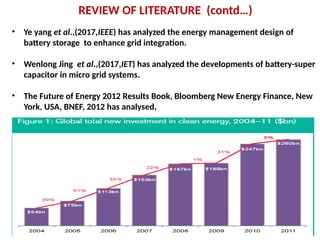
• The Future of Energy 2012 Results Book, Bloomberg New Energy Finance, New
York, USA, BNEF, 2012 has analysed,
7.
OBJECTIVES
To achieveand maintain optimum energy procurement and utilization.
Switching to the Current and future state of art development.
To maintain Optimal power flow irrespective of atmospheric conditions.
Enhancing On grid and off grid energy management.
To obtain Best feasible solution.
To compare and analyze optimization techniques.
To develop a optimal operational strategy for continuous power supply.
8.
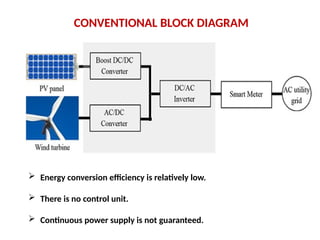
CONVENTIONAL BLOCK DIAGRAM
Energy conversion efficiency is relatively low.
There is no control unit.
Continuous power supply is not guaranteed.
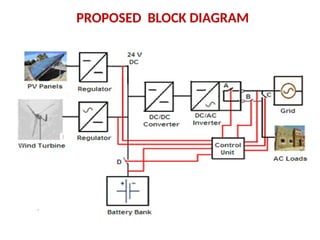
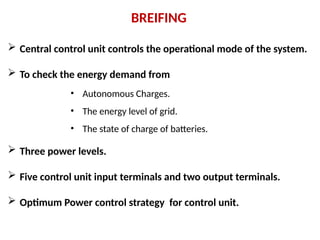
BREIFING
Central controlunit controls the operational mode of the system.
To check the energy demand from
Three power levels.
Five control unit input terminals and two output terminals.
Optimum Power control strategy for control unit.
• Autonomous Charges.
• The energy level of grid.
• The state of charge of batteries.
11.
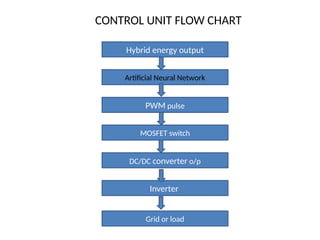
Hybrid energy output
PWMpulse
MOSFET switch
DC/DC converter o/p
Inverter
Grid or load
Artificial Neural Network
CONTROL UNIT FLOW CHART
12.
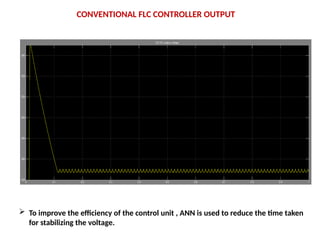
To improvethe efficiency of the control unit , ANN is used to reduce the time taken
for stabilizing the voltage.
CONVENTIONAL FLC CONTROLLER OUTPUT
13.
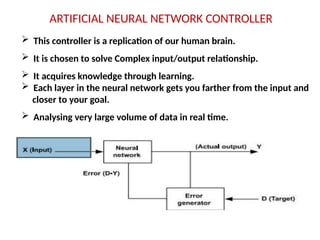
ARTIFICIAL NEURAL NETWORKCONTROLLER
This controller is a replication of our human brain.
It is chosen to solve Complex input/output relationship.
It acquires knowledge through learning.
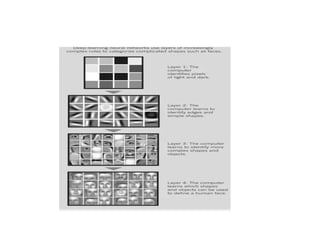
Each layer in the neural network gets you farther from the input and
closer to your goal.
Analysing very large volume of data in real time.
SIMULATION RESULTS ANDDISCUSSION
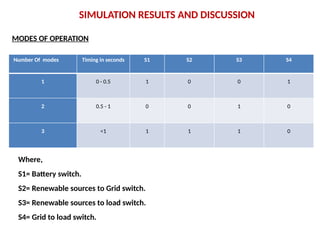
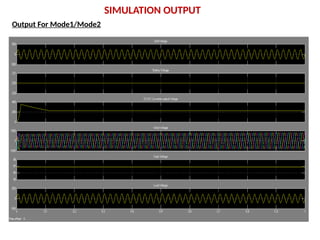
MODES OF OPERATION
Number Of modes Timing in seconds S1 S2 S3 S4
1 0 - 0.5 1 0 0 1
2 0.5 - 1 0 0 1 0
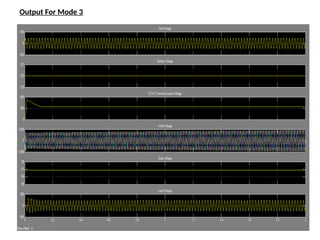
3 <1 1 1 1 0
Where,
S1= Battery switch.
S2= Renewable sources to Grid switch.
S3= Renewable sources to load switch.
S4= Grid to load switch.
17.
MODES OF OPERATION
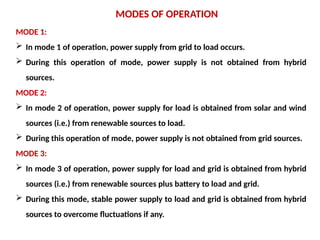
MODE1:
In mode 1 of operation, power supply from grid to load occurs.
During this operation of mode, power supply is not obtained from hybrid
sources.
MODE 2:
In mode 2 of operation, power supply for load is obtained from solar and wind
sources (i.e.) from renewable sources to load.
During this operation of mode, power supply is not obtained from grid sources.
MODE 3:
In mode 3 of operation, power supply for load and grid is obtained from hybrid
sources (i.e.) from renewable sources plus battery to load and grid.
During this mode, stable power supply to load and grid is obtained from hybrid
sources to overcome fluctuations if any.
CONCLUSION
Energy isone of the most essential things in the world to live.
By adopting this method the power oscillations are reduced in load
side.
Steady state is reached at much faster rate.
Continuity of power supply to load is assured.
Results show excellent performance with Fuzzy logic controller.
In this phase, control unit is employed with artificial neural network
to provide optimum operational strategy.
21.
REFERENCES
1. Aseem sayal.:‘MPPT Techniques for Photovoltaic System under Uniform Insolation and
Partial Shading Conditions’. Students Conf. on Engineering and Systems, Allahabad, Uttar
Pradesh, India, 16-18 March 2012, pp. 1 - 6
2. Felipe Valencia, Jorge Collado, Doris Sáez., et al.: ‘Robust Energy Management System for
a Microgrid Based on a Fuzzy Prediction Interval Model’. IEEE Trans. smart grid., 2015, pp.
1949-3053
3. Kivanc Basaran, Numan Sabit Cetin, Selim Borekci.: ‘Optimization of hybrid sources for on
grid and off grid systems’. IET Renew. Power Gener., 2017, Vol. 11 Iss. 5, pp. 642-649
4. Pragya Nema, R.K., Nema, Saroj Rangnekar.: ‘A current and future state of art
development of hybrid energy system using wind and PV-solar: A review’. Elsevier
Renewable and Sustainable Energy Reviews, 2009, 13, pp. 2096–2103
5. Petr Musilek, Pavel Kromert , Rodrigo Martins., et al.: ‘Optimal Energy Management of
Residential PV IHESS Using Evolutionary Fuzzy Control’. IEEE Congress on Evolutionary
Computation (CEC), Donostia, San Sebastián, Spain, 5-8 June 2017, pp. 2094 - 2101
6. Rahul Sharma, Sathans Suhag.: ‘Novel control strategy for hybrid renewable energy-based
standalone system’. Turk J Elec Eng & Comp Sci.,2017, 25, pp. 2261-2277
22.
7. Sarin, CR.,Syam Nair., et al.: ‘Load – source analysis and scheduling in hybrid smart grid
using multilayer adaptive GNN algorithm’ . Int. Conf. on Signal Processing,
Communication, Power and Embedded System (SCOPES), Paralakhemundi, India ,3-5
Oct. 2016, pp. 1900 - 1907
8. Shaheen, N., Javaid, N., Iqbal, Z., et al.: ‘A hybrid algorithm for energy management in
smart grid’. 18th int. conf. on network-based information systems, Taipei, Taiwan, 2-4
Sept. 2015, pp. 58 – 63
9. Wenlong Jing, Chean Hung Lai., et al.: ‘Battery-Super capacitor Hybrid Energy Storage
System in Standalone DC Micro grids: A Review’. IET Renewable Power Generation,2016
10. Ye Yang, Qing Ye, Leonard J. Tung, ., et al.: ‘Integrated Size and Energy Management
Design of Battery Storage to Enhance Grid Integration of Large-scale PV Power Plants’.
IEEE Trans. Industrial Electronics , 2017, pp. 1 -1
REFERENCES (contd…)
11. The Future of Energy 2012 Results Book, Bloomberg New Energy Finance, New york,
USA, BNEF, 2012.
https://india.gov.in/website-bureau-energy-efficiency.
BOOK
ONLINE URL