How To Breed Dogs
A Dog Breeding Presentation.
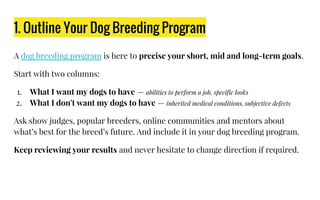
1. Outline Your Dog Breeding Program
A dog breeding program is here to precise your short, mid and long-term goals.
Start with two columns:
1. What I want my dogs to have — abilities to perform a job, specific looks
2. What I don't want my dogs to have — inherited medical conditions, subjective defects
Ask show judges, popular breeders, online communities and mentors about
what’s best for the breed’s future. And include it in your dog breeding program.
Keep reviewing your results and never hesitate to change direction if required.
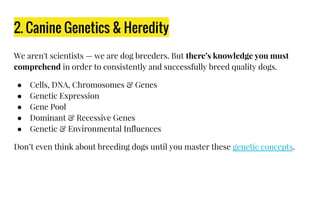
2. Canine Genetics & Heredity
We aren't scientists — we are dog breeders. But there’s knowledge you must
comprehend in order to consistently and successfully breed quality dogs.
● Cells, DNA, Chromosomes & Genes
● Genetic Expression
● Gene Pool
● Dominant & Recessive Genes
● Genetic & Environmental Influences
Don’t even think about breeding dogs until you master these genetic concepts.
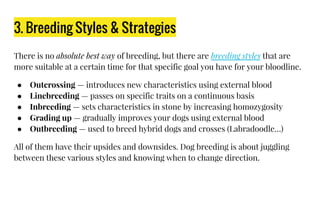
3. Breeding Styles & Strategies
There is no absolute best way of breeding, but there are breeding styles that are
more suitable at a certain time for that specific goal you have for your bloodline.
● Outcrossing — introduces new characteristics using external blood
● Linebreeding — passes on specific traits on a continuous basis
● Inbreeding — sets characteristics in stone by increasing homozygosity
● Grading up — gradually improves your dogs using external blood
● Outbreeding — used to breed hybrid dogs and crosses (Labradoodle…)
All of them have their upsides and downsides. Dog breeding is about juggling
between these various styles and knowing when to change direction.
4. Partner Selection & Pedigree Analysis
A reputable dog breeder never breeds two dogs because of intuition. Instead, it is
a long period filled with studies of dozens of bloodlines.
Pedigree analysis means the thorough research of the ancestors of a given dog in
order to establish their weaknesses and strengths; to establish whether or not we
spot a pattern or repetition of desirable characteristics.
By seeing wanted traits appearing over and over again in the previous
generations of a dog, you increase the chances of this dog passing on these
traits to your next litter of puppies.
5. Dog Heat Cycle & Mating
You must understand these perfectly (and it's not rocket science!) There are four
phases forming a cycle that repeats itself throughout a female dog's life:
1. The Proestrus Stage (9 to 11 days) — start of the heat/season
2. The Oestrus Stage (9 to 11 days) — eggs are released from ovaries (mating!)
3. The Diestrus Stage (58 to 63 days) — pregnancy, if the mating is successful
4. The Anestrus Stage (4 to 5 months) — the quiescence and recovery period
The mating itself, called tie or coitus, is a little odd to watch. Once the stud has
penetrated the female, he will often turn his back around. It looks painful and
scary, but please let Mother Nature handle the situation.
6. Pregnancy, Labour & Delivery
Dog pregnancy lasts 9 weeks or 63 days on average from the day of ovulation.
Signs of labour can vary from bitch to bitch but she will usually be restless,
isolated and get off her food the the last hours. The drop in her rectal
temperature will confirm that the labour is on its way.
A normal labour has three stages:
1. The Bitch’s Body Prepares For Delivery
2. The Delivery Of The Puppies
3. The Passage Of The Placenta
7. Rearing of the Newborn Puppies
For the first three weeks the mother and the pups are one unit. The mother ends
up doing everything for her litter; keeping them warm, feeding them,
stimulating them so they can defecate and even cleaning their excrements.
Focus points include the mother’s nutrition (she needs more!), the whelping box
(warm and away from cold air streams) and logging each pup’s weight.
From the third week, puppies should start to accept solid foods that are moist
and fine-textured. From the fifth week, they should be completely weaned.
Dog breeding
is an Art.
Are you an Artist?
LEARN MORE ON
THE #1 DOG BREEDING
ONLINE MAGAZINE

How To Breed Dogs Responsibly?

  • 1.
    How To BreedDogs A Dog Breeding Presentation.
  • 2.
    1. Outline YourDog Breeding Program A dog breeding program is here to precise your short, mid and long-term goals. Start with two columns: 1. What I want my dogs to have — abilities to perform a job, specific looks 2. What I don't want my dogs to have — inherited medical conditions, subjective defects Ask show judges, popular breeders, online communities and mentors about what’s best for the breed’s future. And include it in your dog breeding program. Keep reviewing your results and never hesitate to change direction if required.
  • 3.
    2. Canine Genetics& Heredity We aren't scientists — we are dog breeders. But there’s knowledge you must comprehend in order to consistently and successfully breed quality dogs. ● Cells, DNA, Chromosomes & Genes ● Genetic Expression ● Gene Pool ● Dominant & Recessive Genes ● Genetic & Environmental Influences Don’t even think about breeding dogs until you master these genetic concepts.
  • 4.
    3. Breeding Styles& Strategies There is no absolute best way of breeding, but there are breeding styles that are more suitable at a certain time for that specific goal you have for your bloodline. ● Outcrossing — introduces new characteristics using external blood ● Linebreeding — passes on specific traits on a continuous basis ● Inbreeding — sets characteristics in stone by increasing homozygosity ● Grading up — gradually improves your dogs using external blood ● Outbreeding — used to breed hybrid dogs and crosses (Labradoodle…) All of them have their upsides and downsides. Dog breeding is about juggling between these various styles and knowing when to change direction.
  • 5.
    4. Partner Selection& Pedigree Analysis A reputable dog breeder never breeds two dogs because of intuition. Instead, it is a long period filled with studies of dozens of bloodlines. Pedigree analysis means the thorough research of the ancestors of a given dog in order to establish their weaknesses and strengths; to establish whether or not we spot a pattern or repetition of desirable characteristics. By seeing wanted traits appearing over and over again in the previous generations of a dog, you increase the chances of this dog passing on these traits to your next litter of puppies.
  • 6.
    5. Dog HeatCycle & Mating You must understand these perfectly (and it's not rocket science!) There are four phases forming a cycle that repeats itself throughout a female dog's life: 1. The Proestrus Stage (9 to 11 days) — start of the heat/season 2. The Oestrus Stage (9 to 11 days) — eggs are released from ovaries (mating!) 3. The Diestrus Stage (58 to 63 days) — pregnancy, if the mating is successful 4. The Anestrus Stage (4 to 5 months) — the quiescence and recovery period The mating itself, called tie or coitus, is a little odd to watch. Once the stud has penetrated the female, he will often turn his back around. It looks painful and scary, but please let Mother Nature handle the situation.
  • 7.
    6. Pregnancy, Labour& Delivery Dog pregnancy lasts 9 weeks or 63 days on average from the day of ovulation. Signs of labour can vary from bitch to bitch but she will usually be restless, isolated and get off her food the the last hours. The drop in her rectal temperature will confirm that the labour is on its way. A normal labour has three stages: 1. The Bitch’s Body Prepares For Delivery 2. The Delivery Of The Puppies 3. The Passage Of The Placenta
  • 8.
    7. Rearing ofthe Newborn Puppies For the first three weeks the mother and the pups are one unit. The mother ends up doing everything for her litter; keeping them warm, feeding them, stimulating them so they can defecate and even cleaning their excrements. Focus points include the mother’s nutrition (she needs more!), the whelping box (warm and away from cold air streams) and logging each pup’s weight. From the third week, puppies should start to accept solid foods that are moist and fine-textured. From the fifth week, they should be completely weaned.
  • 9.
    Dog breeding is anArt. Are you an Artist?
  • 10.
    LEARN MORE ON THE#1 DOG BREEDING ONLINE MAGAZINE