Sample Agile Measurement Graphs
By Peter Baxter
This document provides a “quick” visual catalog of graphs used for managing agile projects. It is
intended to help managers and measurement professionals identify and select graphing and other
visualization techniques which are effective for them.
The graphs in this document include the following:
• SAMPLE AGILE MEASUREMENT GRAPHS
• PROJECT BURNDOWN CHART AND ITERATION BURN DOWN CHART
• BURN DOWN CHART WITH DESCRIPTIONS
• BURN UP CHART – FEATURE PERCENT COMPLETE
• PARKING LOT DIAGRAM
• BACKLOG LIST
• COMPLETION VELOCITY VARIATION
• CUMULATIVE ITERATION PROGRESS
• ISSUE LOG STATUS PER ITERATION
• PROCESS QUALITY INDEX (PQI) CHART
• PROJECT STATUS BY THEME
Project Burndown Chart and Iteration Burn Down Chart
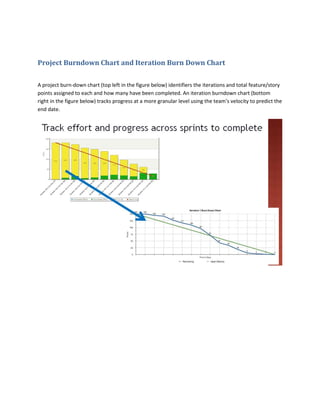
A project burn-down chart (top left in the figure below) identifiers the iterations and total feature/story
points assigned to each and how many have been completed. An iteration burndown chart (bottom
right in the figure below) tracks progress at a more granular level using the team’s velocity to predict the
end date.
Burn Down Chart With Descriptions
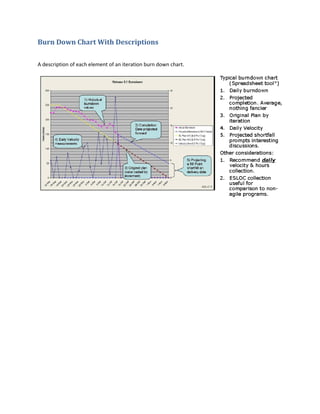
A description of each element of an iteration burn down chart.
Burn Up Chart – Feature Percent Complete
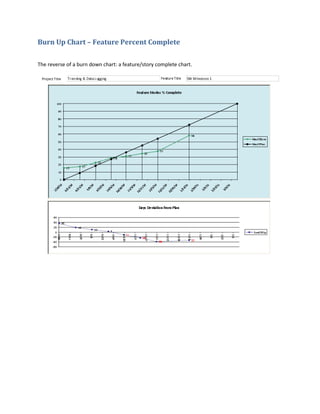
The reverse of a burn down chart: a feature/story complete chart.
Parking Lot Diagram
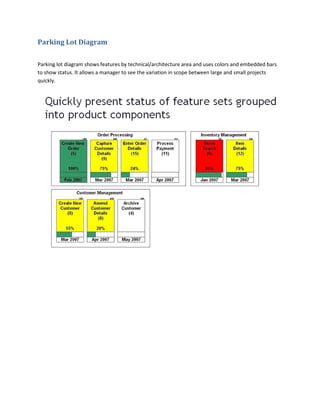
Parking lot diagram shows features by technical/architecture area and uses colors and embedded bars
to show status. It allows a manager to see the variation in scope between large and small projects
quickly.
BackLog List
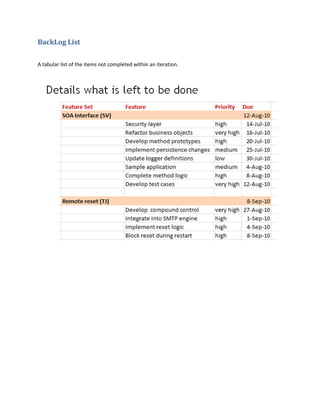
A tabular list of the items not completed within an iteration.
Completion Velocity Variation
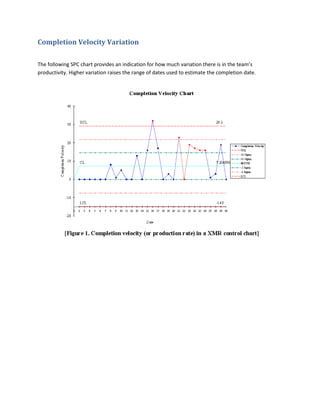
The following SPC chart provides an indication for how much variation there is in the team’s
productivity. Higher variation raises the range of dates used to estimate the completion date.
Cumulative Iteration Progress
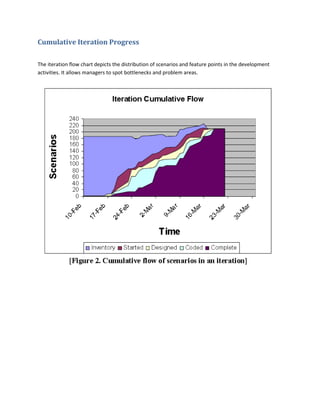
The iteration flow chart depicts the distribution of scenarios and feature points in the development
activities. It allows managers to spot bottlenecks and problem areas.
Issue Log Status Per Iteration
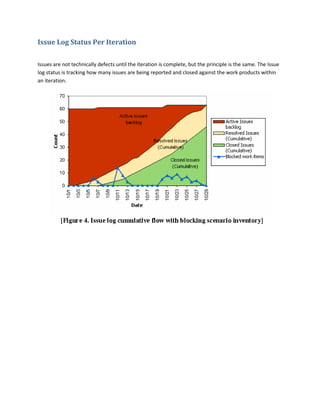
Issues are not technically defects until the iteration is complete, but the principle is the same. The Issue
log status is tracking how many issues are being reported and closed against the work products within
an iteration.
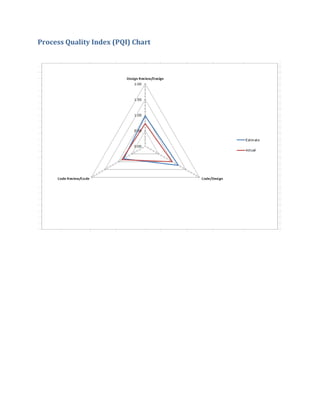
Process Quality Index (PQI) Chart
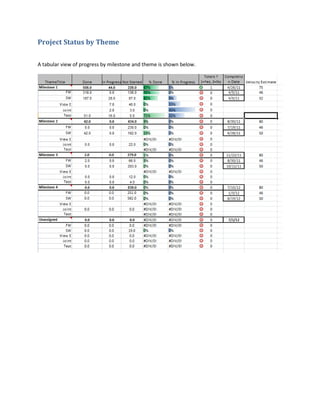
Project Status by Theme
A tabular view of progress by milestone and theme is shown below.

AgileGraphingCookbook

  • 1.
    Sample Agile MeasurementGraphs By Peter Baxter This document provides a “quick” visual catalog of graphs used for managing agile projects. It is intended to help managers and measurement professionals identify and select graphing and other visualization techniques which are effective for them. The graphs in this document include the following: • SAMPLE AGILE MEASUREMENT GRAPHS • PROJECT BURNDOWN CHART AND ITERATION BURN DOWN CHART • BURN DOWN CHART WITH DESCRIPTIONS • BURN UP CHART – FEATURE PERCENT COMPLETE • PARKING LOT DIAGRAM • BACKLOG LIST • COMPLETION VELOCITY VARIATION • CUMULATIVE ITERATION PROGRESS • ISSUE LOG STATUS PER ITERATION • PROCESS QUALITY INDEX (PQI) CHART • PROJECT STATUS BY THEME
  • 2.
    Project Burndown Chartand Iteration Burn Down Chart A project burn-down chart (top left in the figure below) identifiers the iterations and total feature/story points assigned to each and how many have been completed. An iteration burndown chart (bottom right in the figure below) tracks progress at a more granular level using the team’s velocity to predict the end date.
  • 3.
    Burn Down ChartWith Descriptions A description of each element of an iteration burn down chart.
  • 4.
    Burn Up Chart– Feature Percent Complete The reverse of a burn down chart: a feature/story complete chart.
  • 5.
    Parking Lot Diagram Parkinglot diagram shows features by technical/architecture area and uses colors and embedded bars to show status. It allows a manager to see the variation in scope between large and small projects quickly.
  • 6.
    BackLog List A tabularlist of the items not completed within an iteration.
  • 7.
    Completion Velocity Variation Thefollowing SPC chart provides an indication for how much variation there is in the team’s productivity. Higher variation raises the range of dates used to estimate the completion date.
  • 8.
    Cumulative Iteration Progress Theiteration flow chart depicts the distribution of scenarios and feature points in the development activities. It allows managers to spot bottlenecks and problem areas.
  • 9.
    Issue Log StatusPer Iteration Issues are not technically defects until the iteration is complete, but the principle is the same. The Issue log status is tracking how many issues are being reported and closed against the work products within an iteration.
  • 10.
  • 11.
    Project Status byTheme A tabular view of progress by milestone and theme is shown below.