AgileUX
Learning to Lead
-or-
EverybodyWantstoRuletheWorld
Chris Farnum
MSU XA Club, 2/12/2018
Yep, I know I’m
time stamping
myself…
I’ve been doing
this for a while.
It can be challenging to be the voice of UX when
you are on a scrum team. Sometimes it can be
easy to feel lost within Agile.
Agile /Scrum Basics
Let’s start with some quick background on Agile in case not
everyone is familiar
Agile
manifesto
viaUXCollective
https://uxdesign.cc/product-
design-playbook-103d3a5cf2e3
AgileAlliance defines Agile as “the ability
to create and respond to change in order
to succeed in an uncertain and turbulent
environment.”
A Manifesto with 12 principles was written
in February of 2001 by 17 software
practitioners.
http://agilemanifesto.org/
Agile
Principles-
Highlights
http://agilemanifesto.org/
Emphasis on collaboration in small teams
over documentation
Willingness to be flexible, accept changes
in direction
Deliver working code sooner, iterate
Teams self-organize to plan their own
work
Process includes time for reflection and
continuous improvement
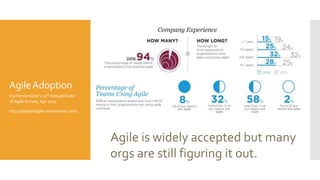
AgileAdoption
ViaVersionOne’s 11th AnnualState
of Agile Survey, Apr 2017
http://stateofagile.versionone.com/
Agile is widely accepted but many
orgs are still figuring it out.
Agile teams
may include
some or all of
these roles
 Project Manager / Scrum Master
 User Experience Designer
 UX Researcher
 Tech lead- backend
 Front end dev
 Visual design
 Content editor
 BusinessAnalyst
 QA
 Product Owner / Product Manager
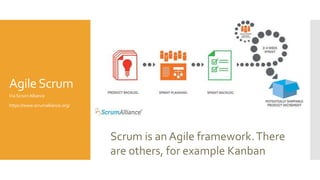
AgileScrum
Via Scrum Alliance
https://www.scrumalliance.org/
Scrum is an Agile framework.There
are others, for example Kanban
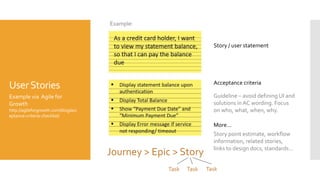
UserStories
Example via Agile for
Growth
http://agileforgrowth.com/blog/acc
eptance-criteria-checklist/
Story / user statement
Example:
Acceptance criteria
Guideline – avoid defining UI and
solutions in AC wording. Focus
on who, what, when, why.
Journey > Epic > Story
Task Task Task
More…
Story point estimate, workflow
information, related stories,
links to design docs, standards…
Agile sounds good
right, but where
doesUX fit?
User experience and information architecture got started when
most dev was “waterfall.” Define -> Design (create a spec) -> Build
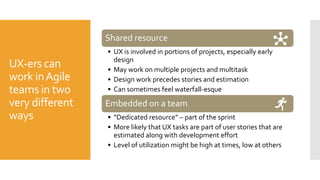
UX-ers can
work inAgile
teams in two
very different
ways
Shared resource
• UX is involved in portions of projects, especially early
design
• May work on multiple projects and multitask
• Design work precedes stories and estimation
• Can sometimes feel waterfall-esque
Embedded on a team
• “Dedicated resource” – part of the sprint
• More likely that UX tasks are part of user stories that are
estimated along with development effort
• Level of utilization might be high at times, low at others
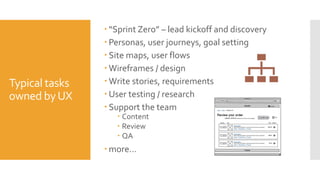
Typical tasks
owned byUX
 “Sprint Zero” – lead kickoff and discovery
 Personas, user journeys, goal setting
 Site maps, user flows
 Wireframes / design
 Write stories, requirements
 User testing / research
 Support the team
 Content
 Review
 QA
 more…
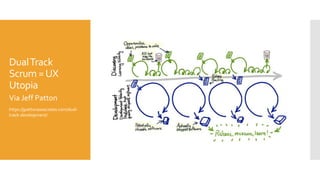
DualTrack
Scrum =UX
Utopia
Via Jeff Patton
https://jpattonassociates.com/dual-
track-development/
Common Pitfalls
andChallenges
Here are some common problems that you might encounter while
working with Agile teams, especially when you are a junior.And also
some approaches and philosophy for coping.
TheTeam –
ManyCooks…
Problem:
Overlapping roles – especially when UX is new to the organization,
especially:
 Business analysists
 Content writers/strategists
 Designers
 Engineers…
Approach:
Everybody on the team should care about UX and design thinking. But
one person,YOU, owns the role.
 Be a good facilitator and collaborator
 Seek input and feedback frequently
 Listen and give credit to others for good ideas
 Win respect and trust over time
Deliverables,
especially
wireframes…
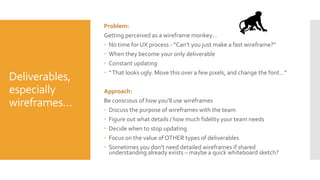
Problem:
Getting perceived as a wireframe monkey…
 No time for UX process - “Can’t you just make a fast wireframe?”
 When they become your only deliverable
 Constant updating
 “That looks ugly. Move this over a few pixels, and change the font…”
Approach:
Be conscious of how you’ll use wireframes
 Discuss the purpose of wireframes with the team
 Figure out what details / how much fidelity your team needs
 Decide when to stop updating
 Focus on the value of OTHER types of deliverables
 Sometimes you don’t need detailed wireframes if shared
understanding already exists – maybe a quick whiteboard sketch?
Making the
case for user
research and
testing
Problem:
Teams in a hurry often claim there is no time for user research and
testing
 “We are experts and already know the users.”
 Design by HIPPO - highest paid person’s opinion
 “We already have personas” From four years ago.
Approach:
Find ways to fit user research and testing into the Agile cycle
 Data/observations carry more weight than opinions
 Create hypotheses and test them
 Leverage existing knowledge, past tests, analytics, surveys… look for
the gaps where more info is needed
 Share your results, make them visible and digestible
Tactics and
strategies
Build a playbook or toolbox of techniques for showing your value
and making the Agile process work for UX
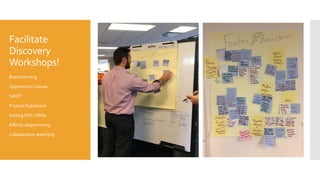
Facilitate
Discovery
Workshops!
Brainstorming
OpportunityCanvas
SWOT
Product hypothesis
Setting KPIs / OKRs
Affinity diagramming
Collaborative sketching
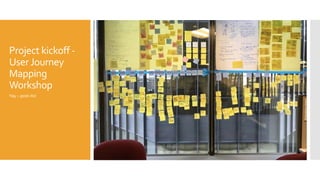
Project kickoff -
UserJourney
Mapping
Workshop
Yay – post-its!
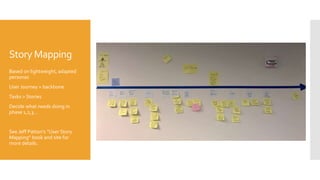
Story Mapping
Based on lightweight, adapted
personas
User Journey = backbone
Tasks > Stories
Decide what needs doing in
phase 1,2,3…
See Jeff Patton’s “User Story
Mapping” book and site for
more details.
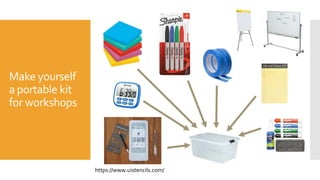
Make yourself
a portable kit
for workshops
https://www.uistencils.com/
Speak up,
stand up!
One of my mentors told me that it’s important to put on the
consultant “hat.”
 Volunteer to own part of the agenda, especially for stakeholder
meetings
 Write a good agenda
 Practice in advance of a presentation if it makes you more confident
 If you have an idea, articulate it for the group and explain why it’s
based on user research, project goals
 Put a meeting on the calendar if you have a topic you want to
discuss or work to share
 Take time to review other people work and give feedback, ask
questions, write comments
 It’s a cliché, but FAKE ITTILLYOU MAKE IT!
Ninja moves
for theAgile
process
Own “Sprint Zero” – it’s a great time to set the tone for
UX at the beginning of the project.
Build tight relationships with the project manager and
business analysts.
Offer to help with content, QA, etc. Especially when it’s
crunch time.
Get to know how Agile tools work – whether they are
paper index cards or software tools like JIRA.
Ninja moves
for theAgile
process -
continued
Review progress on current stories, even after your tasks are
complete. Provide comments.
Work differently - try sitting side-by-side with designers, developers
and work collaboratively instead of polishing wireframes. (aka
extreme programming)
Ask to have signoff approval before a story is marked “DONE.” Talk
with the team about the “definition of done” and how it should
include UX criteria.
Sprint retrospective meetings – a good time to advocate for more
UX processes
More about my
journey
A quick overview of how I got here…
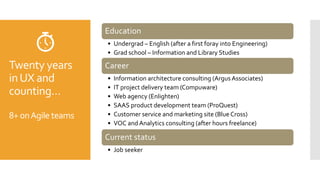
Twenty years
inUX and
counting…
8+ onAgile teams
Education
• Undergrad – English (after a first foray into Engineering)
• Grad school – Information and Library Studies
Career
• Information architecture consulting (Argus Associates)
• IT project delivery team (Compuware)
• Web agency (Enlighten)
• SAAS product development team (ProQuest)
• Customer service and marketing site (Blue Cross)
• VOC and Analytics consulting (after hours freelance)
Current status
• Job seeker
Conclusion &
questions
Chris Farnum
crfarnum@gmail.com
@crfarnum

Agile UX - Learning to Lead

  • 1.
  • 2.
    Yep, I knowI’m time stamping myself… I’ve been doing this for a while.
  • 3.
    It can bechallenging to be the voice of UX when you are on a scrum team. Sometimes it can be easy to feel lost within Agile.
  • 4.
    Agile /Scrum Basics Let’sstart with some quick background on Agile in case not everyone is familiar
  • 5.
    Agile manifesto viaUXCollective https://uxdesign.cc/product- design-playbook-103d3a5cf2e3 AgileAlliance defines Agileas “the ability to create and respond to change in order to succeed in an uncertain and turbulent environment.” A Manifesto with 12 principles was written in February of 2001 by 17 software practitioners. http://agilemanifesto.org/
  • 6.
    Agile Principles- Highlights http://agilemanifesto.org/ Emphasis on collaborationin small teams over documentation Willingness to be flexible, accept changes in direction Deliver working code sooner, iterate Teams self-organize to plan their own work Process includes time for reflection and continuous improvement
  • 7.
    AgileAdoption ViaVersionOne’s 11th AnnualState ofAgile Survey, Apr 2017 http://stateofagile.versionone.com/ Agile is widely accepted but many orgs are still figuring it out.
  • 8.
    Agile teams may include someor all of these roles  Project Manager / Scrum Master  User Experience Designer  UX Researcher  Tech lead- backend  Front end dev  Visual design  Content editor  BusinessAnalyst  QA  Product Owner / Product Manager
  • 9.
    AgileScrum Via Scrum Alliance https://www.scrumalliance.org/ Scrumis an Agile framework.There are others, for example Kanban
  • 10.
    UserStories Example via Agilefor Growth http://agileforgrowth.com/blog/acc eptance-criteria-checklist/ Story / user statement Example: Acceptance criteria Guideline – avoid defining UI and solutions in AC wording. Focus on who, what, when, why. Journey > Epic > Story Task Task Task More… Story point estimate, workflow information, related stories, links to design docs, standards…
  • 11.
    Agile sounds good right,but where doesUX fit? User experience and information architecture got started when most dev was “waterfall.” Define -> Design (create a spec) -> Build
  • 12.
    UX-ers can work inAgile teamsin two very different ways Shared resource • UX is involved in portions of projects, especially early design • May work on multiple projects and multitask • Design work precedes stories and estimation • Can sometimes feel waterfall-esque Embedded on a team • “Dedicated resource” – part of the sprint • More likely that UX tasks are part of user stories that are estimated along with development effort • Level of utilization might be high at times, low at others
  • 13.
    Typical tasks owned byUX “Sprint Zero” – lead kickoff and discovery  Personas, user journeys, goal setting  Site maps, user flows  Wireframes / design  Write stories, requirements  User testing / research  Support the team  Content  Review  QA  more…
  • 14.
    DualTrack Scrum =UX Utopia Via JeffPatton https://jpattonassociates.com/dual- track-development/
  • 15.
    Common Pitfalls andChallenges Here aresome common problems that you might encounter while working with Agile teams, especially when you are a junior.And also some approaches and philosophy for coping.
  • 16.
    TheTeam – ManyCooks… Problem: Overlapping roles– especially when UX is new to the organization, especially:  Business analysists  Content writers/strategists  Designers  Engineers… Approach: Everybody on the team should care about UX and design thinking. But one person,YOU, owns the role.  Be a good facilitator and collaborator  Seek input and feedback frequently  Listen and give credit to others for good ideas  Win respect and trust over time
  • 17.
    Deliverables, especially wireframes… Problem: Getting perceived asa wireframe monkey…  No time for UX process - “Can’t you just make a fast wireframe?”  When they become your only deliverable  Constant updating  “That looks ugly. Move this over a few pixels, and change the font…” Approach: Be conscious of how you’ll use wireframes  Discuss the purpose of wireframes with the team  Figure out what details / how much fidelity your team needs  Decide when to stop updating  Focus on the value of OTHER types of deliverables  Sometimes you don’t need detailed wireframes if shared understanding already exists – maybe a quick whiteboard sketch?
  • 18.
    Making the case foruser research and testing Problem: Teams in a hurry often claim there is no time for user research and testing  “We are experts and already know the users.”  Design by HIPPO - highest paid person’s opinion  “We already have personas” From four years ago. Approach: Find ways to fit user research and testing into the Agile cycle  Data/observations carry more weight than opinions  Create hypotheses and test them  Leverage existing knowledge, past tests, analytics, surveys… look for the gaps where more info is needed  Share your results, make them visible and digestible
  • 19.
    Tactics and strategies Build aplaybook or toolbox of techniques for showing your value and making the Agile process work for UX
  • 20.
  • 21.
  • 22.
    Story Mapping Based onlightweight, adapted personas User Journey = backbone Tasks > Stories Decide what needs doing in phase 1,2,3… See Jeff Patton’s “User Story Mapping” book and site for more details.
  • 23.
    Make yourself a portablekit for workshops https://www.uistencils.com/
  • 24.
    Speak up, stand up! Oneof my mentors told me that it’s important to put on the consultant “hat.”  Volunteer to own part of the agenda, especially for stakeholder meetings  Write a good agenda  Practice in advance of a presentation if it makes you more confident  If you have an idea, articulate it for the group and explain why it’s based on user research, project goals  Put a meeting on the calendar if you have a topic you want to discuss or work to share  Take time to review other people work and give feedback, ask questions, write comments  It’s a cliché, but FAKE ITTILLYOU MAKE IT!
  • 25.
    Ninja moves for theAgile process Own“Sprint Zero” – it’s a great time to set the tone for UX at the beginning of the project. Build tight relationships with the project manager and business analysts. Offer to help with content, QA, etc. Especially when it’s crunch time. Get to know how Agile tools work – whether they are paper index cards or software tools like JIRA.
  • 26.
    Ninja moves for theAgile process- continued Review progress on current stories, even after your tasks are complete. Provide comments. Work differently - try sitting side-by-side with designers, developers and work collaboratively instead of polishing wireframes. (aka extreme programming) Ask to have signoff approval before a story is marked “DONE.” Talk with the team about the “definition of done” and how it should include UX criteria. Sprint retrospective meetings – a good time to advocate for more UX processes
  • 27.
    More about my journey Aquick overview of how I got here…
  • 28.
    Twenty years inUX and counting… 8+onAgile teams Education • Undergrad – English (after a first foray into Engineering) • Grad school – Information and Library Studies Career • Information architecture consulting (Argus Associates) • IT project delivery team (Compuware) • Web agency (Enlighten) • SAAS product development team (ProQuest) • Customer service and marketing site (Blue Cross) • VOC and Analytics consulting (after hours freelance) Current status • Job seeker
  • 29.